Fractures &
Skeletal Conditions
Fractures A break in a bone
 Can be classified by cause & nature of break:
CAUSE
 Traumatic break due to injury
 Pathological break due to disease
NATURE
 Compound broken bone exposed to the
outside by an opening in skin
 Simple broken bone not exposed & protected
by unbroken skin
Types of Fractures
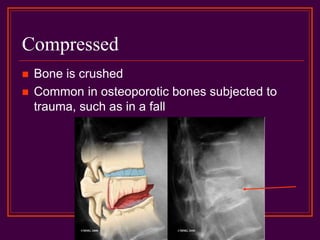
Compressed
 Bone is crushed
 Common in osteoporotic bones subjected to
trauma, such as in a fall
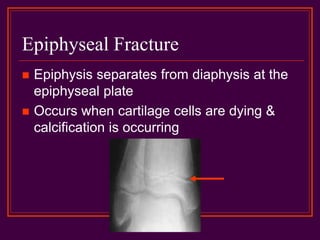
Epiphyseal Fracture
 Epiphysis separates from diaphysis at the
epiphyseal plate
 Occurs when cartilage cells are dying &
calcification is occurring
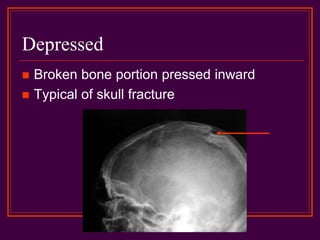
Depressed
 Broken bone portion pressed inward
 Typical of skull fracture
Greenstick Fracture
 Incomplete break
 Only breaks on 1 side
 Like a twig on a tree
 More common in kids
whose bones are more
flexible
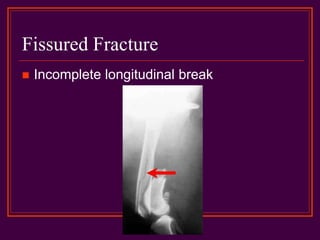
Fissured Fracture
 Incomplete longitudinal break
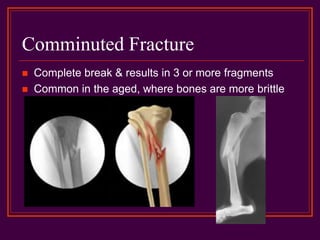
Comminuted Fracture
 Complete break & results in 3 or more fragments
 Common in the aged, where bones are more brittle
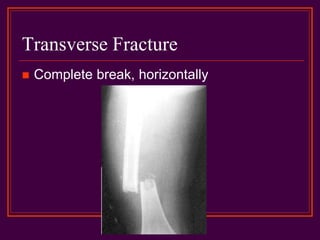
Transverse Fracture
 Complete break, horizontally
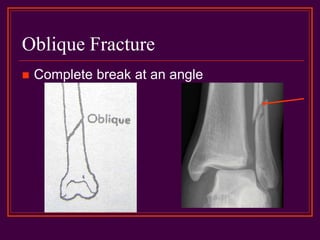
Oblique Fracture
 Complete break at an angle
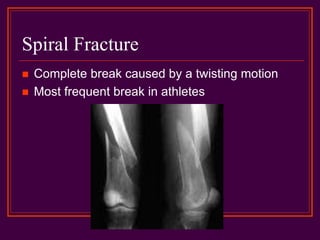
Spiral Fracture
 Complete break caused by a twisting motion
 Most frequent break in athletes
Fracture Video Clip
http://video.about.com/orthopedics/Fractures-
1.htm
Other Skeletal
Conditions
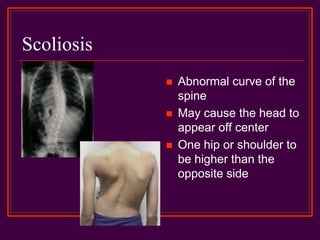
Scoliosis
 Abnormal curve of the
spine
 May cause the head to
appear off center
 One hip or shoulder to
be higher than the
opposite side
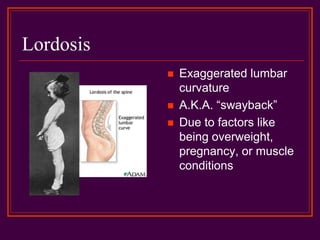
Lordosis
 Exaggerated lumbar
curvature
 A.K.A. “swayback”
 Due to factors like
being overweight,
pregnancy, or muscle
conditions
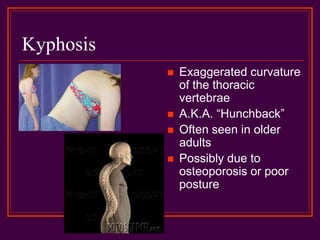
Kyphosis
 Exaggerated curvature
of the thoracic
vertebrae
 A.K.A. “Hunchback”
 Often seen in older
adults
 Possibly due to
osteoporosis or poor
posture
Stages in the Healing of a Bone
Fracture
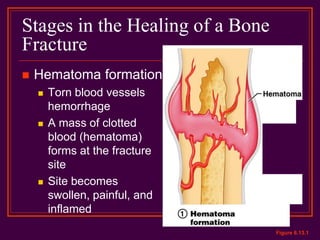
 Hematoma formation
 Torn blood vessels
hemorrhage
 A mass of clotted
blood (hematoma)
forms at the fracture
site
 Site becomes
swollen, painful, and
inflamed
Figure 6.13.1
Stages in the Healing of a Bone
Fracture
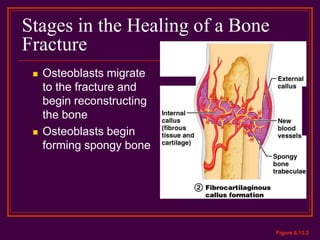
 Osteoblasts migrate
to the fracture and
begin reconstructing
the bone
 Osteoblasts begin
forming spongy bone
Figure 6.13.2
Stages in the Healing of a Bone
Fracture
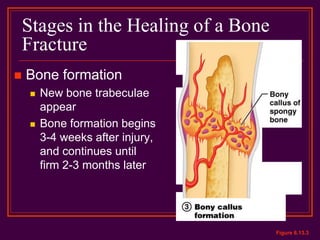
 Bone formation
 New bone trabeculae
appear
 Bone formation begins
3-4 weeks after injury,
and continues until
firm 2-3 months later
Figure 6.13.3
Stages in the Healing of a Bone
Fracture
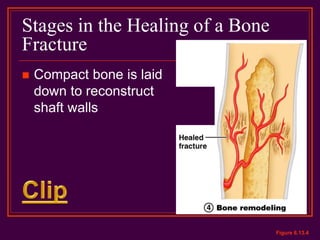
 Compact bone is laid
down to reconstruct
shaft walls
Figure 6.13.4

Fractures & Skeletal Conditions