Chapter 8: Bandaging and Taping
Bandaging
• Will contribute to recovery of injuries
• When applied incorrectly may cause
  discomfort, wound contamination, hamper
  healing
• Must be firmly applied while still allowing
  circulation
Materials
• Gauze- sterile pads for wounds, hold dressings in
  place (roller bandage) or padding for prevention of
  blisters
• Cotton cloth- ankle wraps, triangular and cravat
  bandages
• Elastic bandages- extensible and very useful with
  sports; active bandages allowing for movement;
  can provide support and compression for wound
  healing
• Cohesive elastic bandage- exerts constant even
  pressure; 2 layer bandage that is self adhering;
Elastic Bandages
• Gauze, cotton cloth, elastic wrapping
• Length and width vary and are used
  according to body part and size
• Sizes ranges 2, 3, 4, 6 inch width and 6 or
  10 yard lengths
• Should be stored rolled
• Bandage selected should be free from
  wrinkles, seams and imperfections that
  could cause irritation
Elastic Bandage Application

• Hold bandage in preferred hand with loose
  end extending from bottom of roll
• Back surface of loose end should lay on
  skin surface
• Pressure and tension should be standardized
• Anchor are created by overlapping wrap
  – Start anchor at smallest circumference of limb
• Body part should be wrapped in position of
  maximum contraction
• More turns with moderate tension vs. fewer
  turns with maximum tension
• Each turn should overlap by half to prevent
  separation
• Circulation should be monitored when
  limbs are wrapped
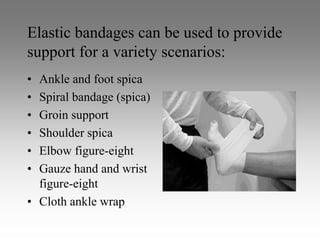
Elastic bandages can be used to provide
support for a variety scenarios:
• Ankle and foot spica
• Spiral bandage (spica)
• Groin support
• Shoulder spica
• Elbow figure-eight
• Gauze hand and wrist
  figure-eight
• Cloth ankle wrap
Triangle and Cravat Bandages
• Cotton cloth that can be substituted if roller
  bandages not available
• First aid device, due to ease and speed of
  application
• Primarily used for arm slings
  – Cervical arm sling
  – Shoulder arm sling
  – Sling and swathe
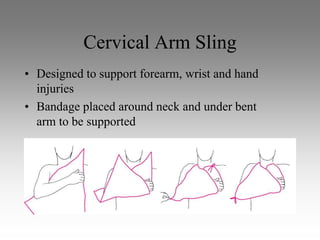
Cervical Arm Sling
• Designed to support forearm, wrist and hand
  injuries
• Bandage placed around neck and under bent
  arm to be supported
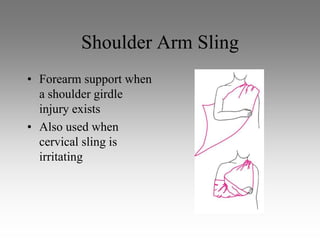
Shoulder Arm Sling
• Forearm support when
  a shoulder girdle
  injury exists
• Also used when
  cervical sling is
  irritating
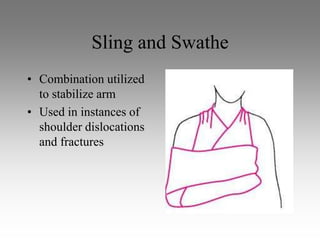
Sling and Swathe
• Combination utilized
  to stabilize arm
• Used in instances of
  shoulder dislocations
  and fractures
Taping
• Historically an important part of athletic
  training
• Becoming decreasingly important due to
  questions surfacing concerning
  effectiveness
• Utilized in areas of injury care and
  protection
Tape- Injury Care
• Retention of wound dressing
• Stabilization of compression bandages
  controlling internal and external bleeding
• Support of recent injuries in an effort to
  prevent additional trauma
• Provide stabilization while athlete
  undergoes rehabilitation
Tape- Injury Protection
• Used to protect against acute injuries
• Limits motion or secures special device
Non-elastic White Tape
• Great adaptability due to:
  –   Uniform adhesive mass
  –   Adhering qualities
  –   Lightness
  –   Relative strength
• Help to hold dressings and provide support
  and protection to injured areas
• Come in varied sizes (1”, 1 1/2” , 2”)
• When purchasing the following should be
  considered:
• Tape Grade
  – Graded according to longitudinal and vertical
    fibers per inch
  – More costly (heavier) contains 85 horizontal
    and 65 vertical fibers
• Adhesive Mass
  – Should adhere regularly and maintain adhesion
    with perspiration
  – Contain few skin irritants
  – Be easily removable without leaving adhesive
    residue and removing superficial skin
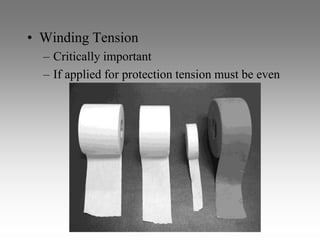
• Winding Tension
  – Critically important
  – If applied for protection tension must be even
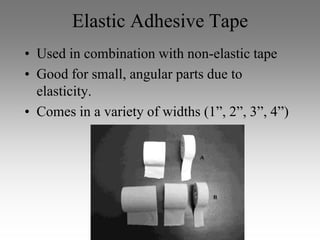
Elastic Adhesive Tape
• Used in combination with non-elastic tape
• Good for small, angular parts due to
  elasticity.
• Comes in a variety of widths (1”, 2”, 3”, 4”)
Preparation for Taping
• Skin surface should be clean of oil,
  perspiration and dirt
• Hair should be removed to prevent skin
  irritation with tape removal
• Tape adherent is optional
• Foam and skin lubricant should be used to
  minimize blisters
• Tape directly to skin
• Prewrap (roll of thin foam) can be used to
  protect skin in cases where tape is used
  daily
• Prewrap should only be applied one layer
  thick when taping and should be anchored
  proximally and distally
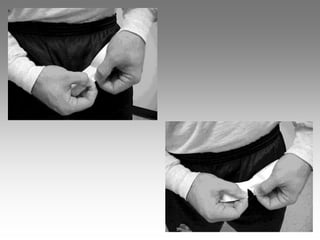
• Proper taping technique
  – Tape width used dependent on area
  – Acute angles = narrower tape
• Tearing tape
  – Various techniques can be used but should
    always allow athlete to hold on to roll of tape
  – Do not bend, twist or wrinkle tape
  – Tearing should result in straight edge with no
    loose strands
  – Some tapes may require cutting agents
Rules for Tape Application
• Tape in the position in which joint must be
  stabilized
• Overlap the tape by half
• Avoid continuous taping
• Keep tape roll in hand whenever possible
• Smooth and mold tape as it is laid down on
  skin
• Allow tape to follow contours of the skin
Rules for Tape Application (cont.)
• Start taping with an anchor piece and finish
  by applying a locking strip
• Where maximum support is desired, tape
  directly to the skin
• Do not apply tape if skin is hot or cold from
  treatments
Additional Taping Information
• Removing adhesive tape
  – Removable by hand
     • Always pull tape in direct line with body (one hand
       pulls tape while other hand presses skin in opposite
       direction
  – Aid of tape scissors and cutters may be required
     • Be sure not to aggravate injured area with cutting
       device
  – Also removable with chemical solvents
Taping Supplies
•   Razor (hair removal)     • Elastic adhesive tape
•   Soap (skin cleaning)     • Felt and foam padding
•   Alcohol (oil removal)      material
•   Adhesive spray           • Tape scissors
•   Prewrap material         • Tape cutters
•   Heel and lace pads       • Elastic bandages
•   White non-elastic tape
Common Foot Taping
   Procedures
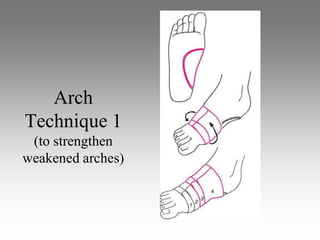
Arch
Technique 1
 (to strengthen
weakened arches)
Arch Technique
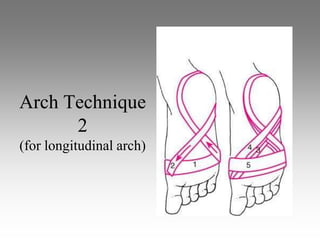
      2
(for longitudinal arch)
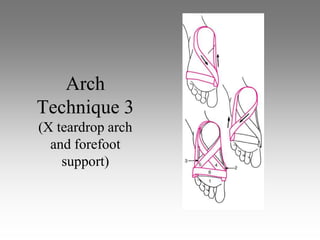
Arch
Technique 3
(X teardrop arch
  and forefoot
    support)
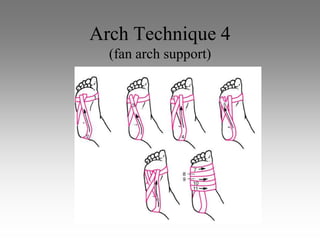
Arch Technique 4
  (fan arch support)
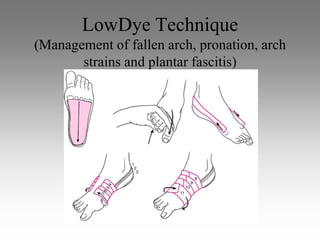
LowDye Technique
(Management of fallen arch, pronation, arch
       strains and plantar fascitis)
                     (
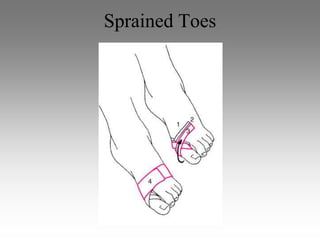
Sprained Toes
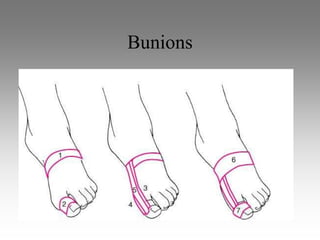
Bunions
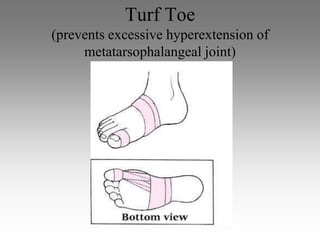
Turf Toe
(prevents excessive hyperextension of
     metatarsophalangeal joint)
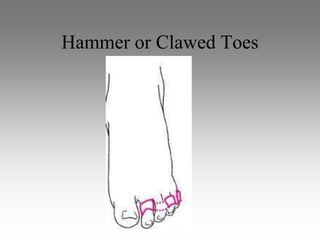
Hammer or Clawed Toes
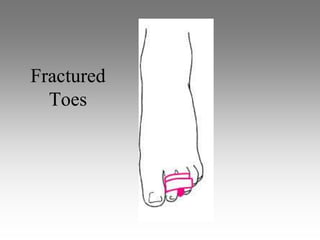
Fractured
  Toes
Common Ankle Taping
    Procedures
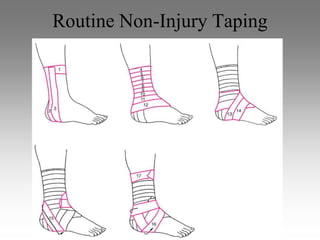
Routine Non-Injury Taping
• Routine Non-injury taping
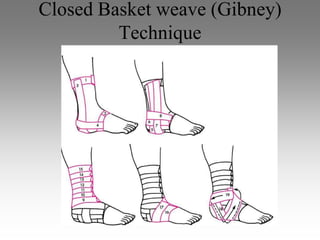
• Closed Basket Weave
  – Used for newly sprained or chronically weak
    ankles
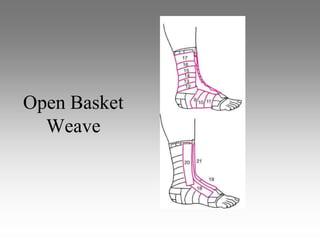
• Open Basket Weave
  – Allows more dorsiflexion and plantar flexion,
    provides medial and lateral stability and room
    for swelling
  – Used in acute sprain situations in conjunction
    with elastic bandage and cold application
Closed Basket weave (Gibney)
         Technique
Open Basket
  Weave
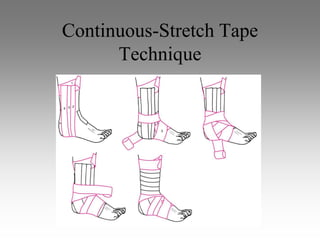
Continuous-Stretch Tape
      Technique
Common Leg & Knee Taping
      Procedures
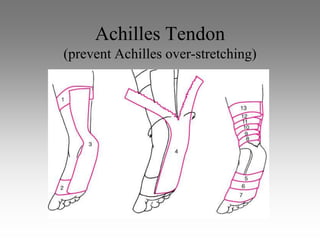
Achilles Tendon
(prevent Achilles over-stretching)
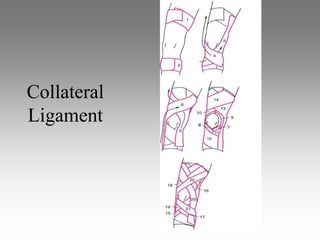
Collateral
Ligament
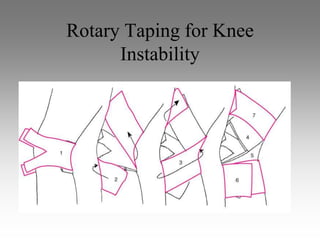
Rotary Taping for Knee
      Instability
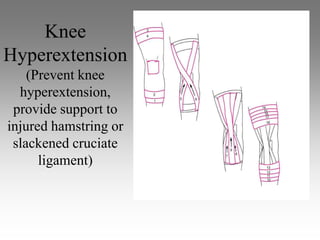
Knee
Hyperextension
    (Prevent knee
  hyperextension,
 provide support to
injured hamstring or
 slackened cruciate
      ligament)
Patellofemoral Taping
       (McConnell technique)
• Helps to manage glide, tilt, rotation and
  anteroposterior orientation of patella
• Accomplished by passively taping patella
  into biomechanically correct position
• Also provides prolonged stretch to soft-
  tissue structures associated with dysfunction
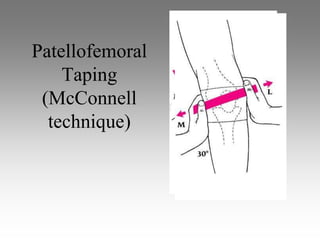
Patellofemoral
    Taping
 (McConnell
  technique)
Common Upper Extremity
   Taping Procedures
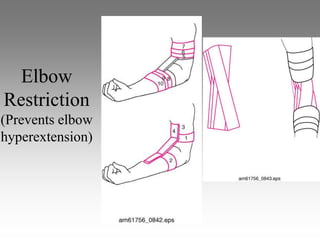
Elbow
Restriction
(Prevents elbow
hyperextension)
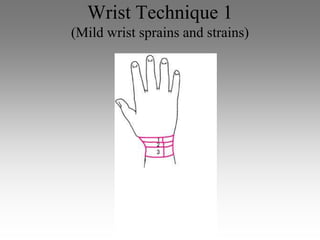
Wrist Technique 1
(Mild wrist sprains and strains)
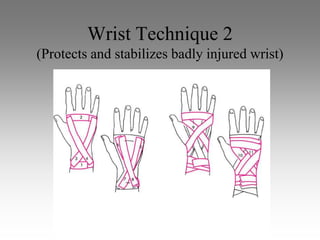
Wrist Technique 2
(Protects and stabilizes badly injured wrist)
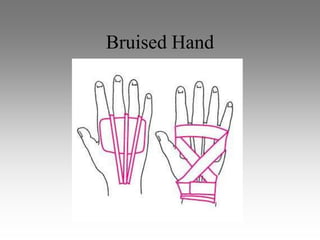
Bruised Hand
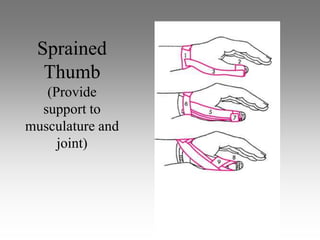
Sprained
  Thumb
   (Provide
  support to
musculature and
     joint)
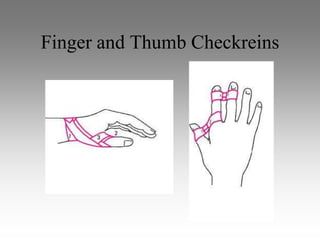
Finger and Thumb Checkreins

Chapter 8

  • 1.
  • 2.
    Bandaging • Will contributeto recovery of injuries • When applied incorrectly may cause discomfort, wound contamination, hamper healing • Must be firmly applied while still allowing circulation
  • 3.
    Materials • Gauze- sterilepads for wounds, hold dressings in place (roller bandage) or padding for prevention of blisters • Cotton cloth- ankle wraps, triangular and cravat bandages • Elastic bandages- extensible and very useful with sports; active bandages allowing for movement; can provide support and compression for wound healing • Cohesive elastic bandage- exerts constant even pressure; 2 layer bandage that is self adhering;
  • 4.
    Elastic Bandages • Gauze,cotton cloth, elastic wrapping • Length and width vary and are used according to body part and size • Sizes ranges 2, 3, 4, 6 inch width and 6 or 10 yard lengths • Should be stored rolled • Bandage selected should be free from wrinkles, seams and imperfections that could cause irritation
  • 5.
    Elastic Bandage Application •Hold bandage in preferred hand with loose end extending from bottom of roll • Back surface of loose end should lay on skin surface • Pressure and tension should be standardized • Anchor are created by overlapping wrap – Start anchor at smallest circumference of limb
  • 6.
    • Body partshould be wrapped in position of maximum contraction • More turns with moderate tension vs. fewer turns with maximum tension • Each turn should overlap by half to prevent separation • Circulation should be monitored when limbs are wrapped
  • 7.
    Elastic bandages canbe used to provide support for a variety scenarios: • Ankle and foot spica • Spiral bandage (spica) • Groin support • Shoulder spica • Elbow figure-eight • Gauze hand and wrist figure-eight • Cloth ankle wrap
  • 8.
    Triangle and CravatBandages • Cotton cloth that can be substituted if roller bandages not available • First aid device, due to ease and speed of application • Primarily used for arm slings – Cervical arm sling – Shoulder arm sling – Sling and swathe
  • 9.
    Cervical Arm Sling •Designed to support forearm, wrist and hand injuries • Bandage placed around neck and under bent arm to be supported
  • 10.
    Shoulder Arm Sling •Forearm support when a shoulder girdle injury exists • Also used when cervical sling is irritating
  • 11.
    Sling and Swathe •Combination utilized to stabilize arm • Used in instances of shoulder dislocations and fractures
  • 12.
    Taping • Historically animportant part of athletic training • Becoming decreasingly important due to questions surfacing concerning effectiveness • Utilized in areas of injury care and protection
  • 13.
    Tape- Injury Care •Retention of wound dressing • Stabilization of compression bandages controlling internal and external bleeding • Support of recent injuries in an effort to prevent additional trauma • Provide stabilization while athlete undergoes rehabilitation Tape- Injury Protection • Used to protect against acute injuries • Limits motion or secures special device
  • 14.
    Non-elastic White Tape •Great adaptability due to: – Uniform adhesive mass – Adhering qualities – Lightness – Relative strength • Help to hold dressings and provide support and protection to injured areas • Come in varied sizes (1”, 1 1/2” , 2”) • When purchasing the following should be considered:
  • 15.
    • Tape Grade – Graded according to longitudinal and vertical fibers per inch – More costly (heavier) contains 85 horizontal and 65 vertical fibers • Adhesive Mass – Should adhere regularly and maintain adhesion with perspiration – Contain few skin irritants – Be easily removable without leaving adhesive residue and removing superficial skin
  • 16.
    • Winding Tension – Critically important – If applied for protection tension must be even
  • 17.
    Elastic Adhesive Tape •Used in combination with non-elastic tape • Good for small, angular parts due to elasticity. • Comes in a variety of widths (1”, 2”, 3”, 4”)
  • 18.
    Preparation for Taping •Skin surface should be clean of oil, perspiration and dirt • Hair should be removed to prevent skin irritation with tape removal • Tape adherent is optional • Foam and skin lubricant should be used to minimize blisters
  • 19.
    • Tape directlyto skin • Prewrap (roll of thin foam) can be used to protect skin in cases where tape is used daily • Prewrap should only be applied one layer thick when taping and should be anchored proximally and distally
  • 20.
    • Proper tapingtechnique – Tape width used dependent on area – Acute angles = narrower tape • Tearing tape – Various techniques can be used but should always allow athlete to hold on to roll of tape – Do not bend, twist or wrinkle tape – Tearing should result in straight edge with no loose strands – Some tapes may require cutting agents
  • 22.
    Rules for TapeApplication • Tape in the position in which joint must be stabilized • Overlap the tape by half • Avoid continuous taping • Keep tape roll in hand whenever possible • Smooth and mold tape as it is laid down on skin • Allow tape to follow contours of the skin
  • 23.
    Rules for TapeApplication (cont.) • Start taping with an anchor piece and finish by applying a locking strip • Where maximum support is desired, tape directly to the skin • Do not apply tape if skin is hot or cold from treatments
  • 24.
    Additional Taping Information •Removing adhesive tape – Removable by hand • Always pull tape in direct line with body (one hand pulls tape while other hand presses skin in opposite direction – Aid of tape scissors and cutters may be required • Be sure not to aggravate injured area with cutting device – Also removable with chemical solvents
  • 25.
    Taping Supplies • Razor (hair removal) • Elastic adhesive tape • Soap (skin cleaning) • Felt and foam padding • Alcohol (oil removal) material • Adhesive spray • Tape scissors • Prewrap material • Tape cutters • Heel and lace pads • Elastic bandages • White non-elastic tape
  • 26.
  • 27.
    Arch Technique 1 (tostrengthen weakened arches)
  • 28.
    Arch Technique 2 (for longitudinal arch)
  • 29.
    Arch Technique 3 (X teardroparch and forefoot support)
  • 30.
    Arch Technique 4 (fan arch support)
  • 31.
    LowDye Technique (Management offallen arch, pronation, arch strains and plantar fascitis) (
  • 32.
  • 33.
  • 34.
    Turf Toe (prevents excessivehyperextension of metatarsophalangeal joint)
  • 35.
  • 36.
  • 37.
  • 38.
  • 39.
    • Routine Non-injurytaping • Closed Basket Weave – Used for newly sprained or chronically weak ankles • Open Basket Weave – Allows more dorsiflexion and plantar flexion, provides medial and lateral stability and room for swelling – Used in acute sprain situations in conjunction with elastic bandage and cold application
  • 40.
    Closed Basket weave(Gibney) Technique
  • 41.
  • 42.
  • 43.
    Common Leg &Knee Taping Procedures
  • 44.
  • 45.
  • 46.
    Rotary Taping forKnee Instability
  • 47.
    Knee Hyperextension (Prevent knee hyperextension, provide support to injured hamstring or slackened cruciate ligament)
  • 48.
    Patellofemoral Taping (McConnell technique) • Helps to manage glide, tilt, rotation and anteroposterior orientation of patella • Accomplished by passively taping patella into biomechanically correct position • Also provides prolonged stretch to soft- tissue structures associated with dysfunction
  • 49.
    Patellofemoral Taping (McConnell technique)
  • 50.
    Common Upper Extremity Taping Procedures
  • 51.
  • 52.
    Wrist Technique 1 (Mildwrist sprains and strains)
  • 53.
    Wrist Technique 2 (Protectsand stabilizes badly injured wrist)
  • 54.
  • 55.
    Sprained Thumb (Provide support to musculature and joint)
  • 56.
    Finger and ThumbCheckreins