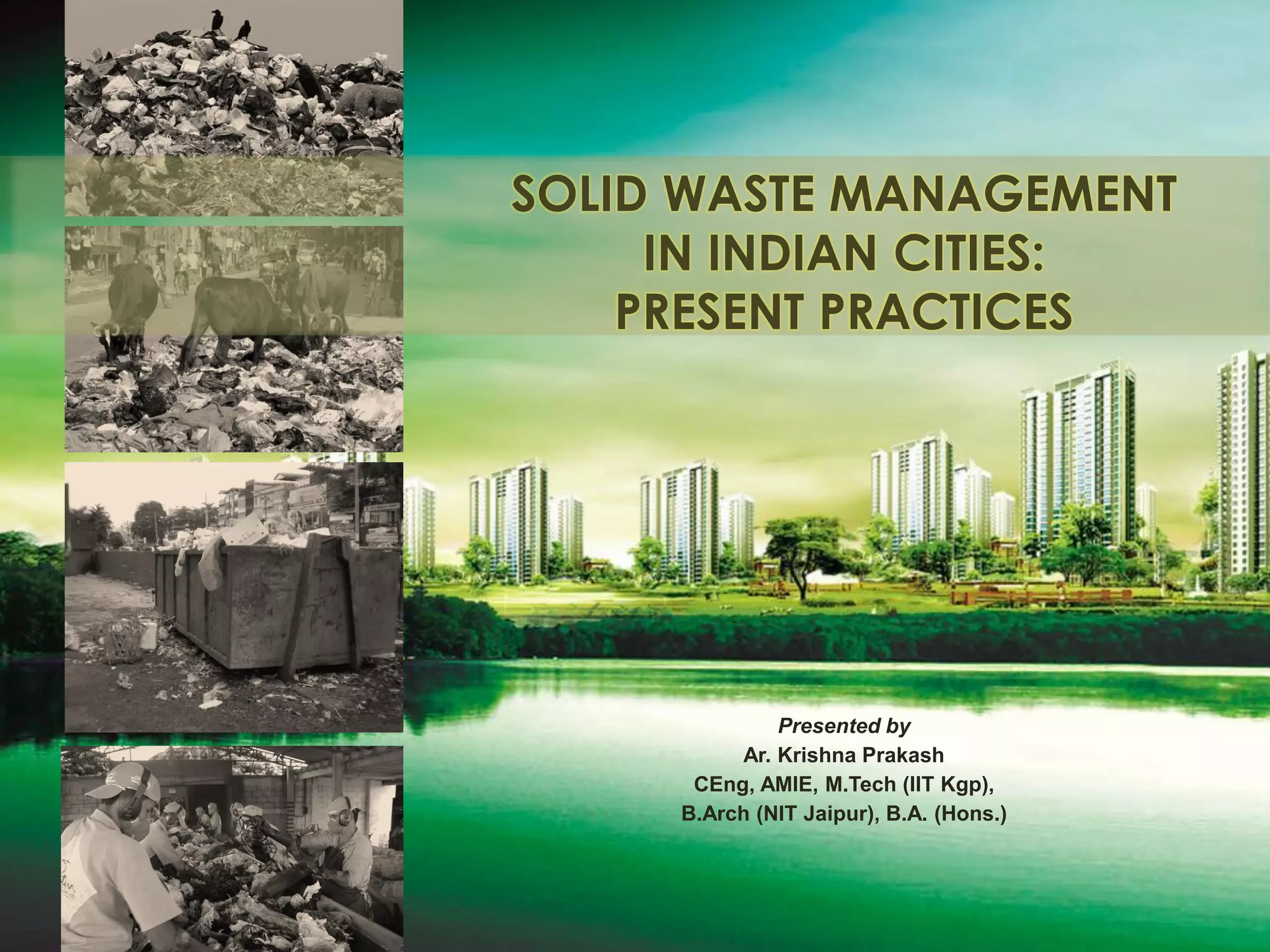
SOLID WASTE MANAGEMENT
IN INDIAN CITIES:
PRESENT PRACTICES
Presented by
Ar. Krishna Prakash
CEng, AMIE, M.Tech (IIT Kgp),
B.Arch (NIT Jaipur), B.A. (Hons.)
• Solid waste (SW) is the useless or unwanted solid (or semi solid)
materials that has no further value to its owner and discarded.
• SW is generally generated from residential, commercial and
industrial activities in
a given region.
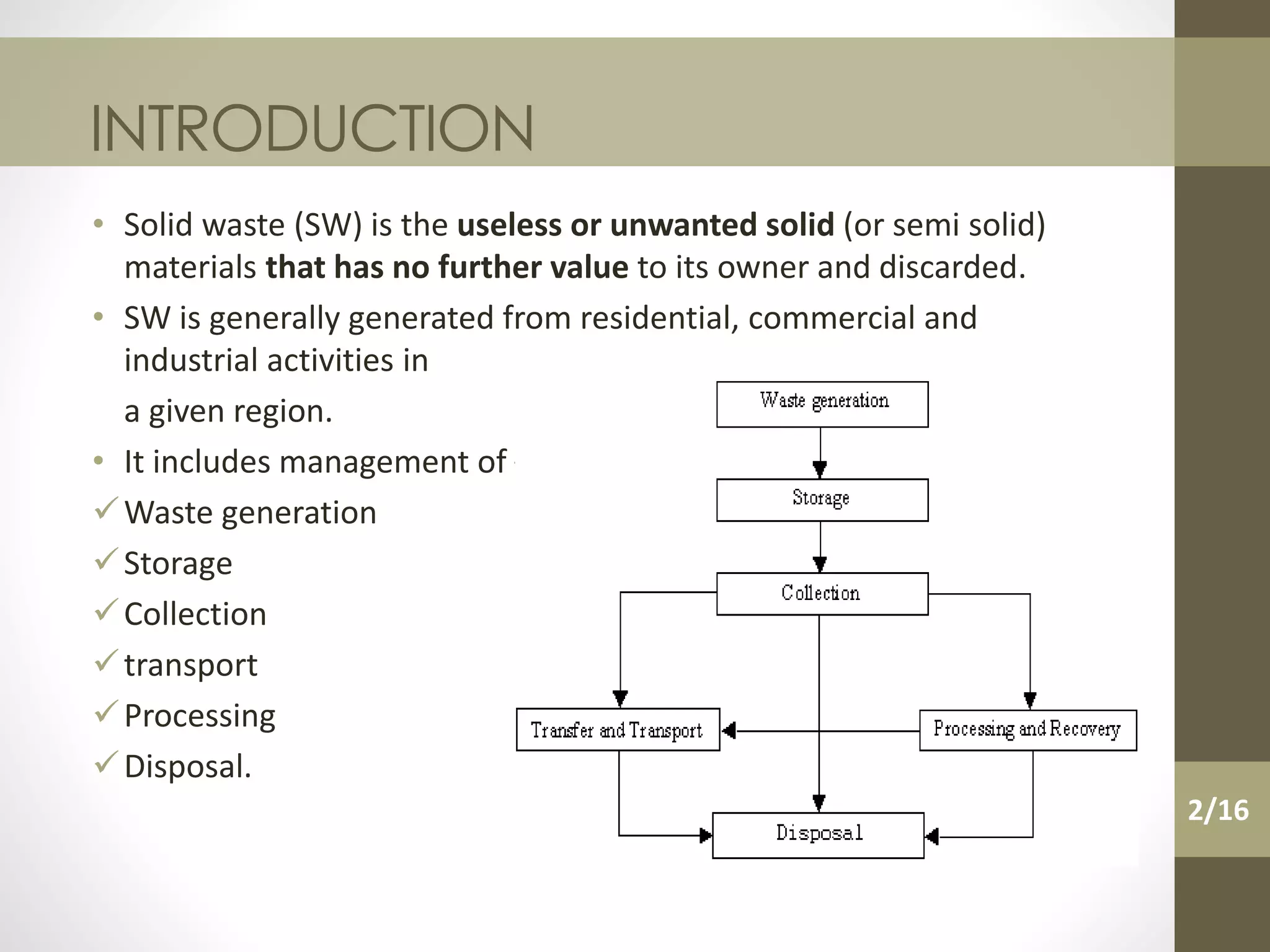
• It includes management of –
✓Waste generation
✓Storage
✓Collection
✓transport
✓Processing
✓Disposal.
INTRODUCTION
2/16
Fig 1a : Schematic representation of Solid Waste Management in cities
3/16
According to its origin –
• Domestic, Industrial, Commercial, Construction and Industrial
Classification of Solid Wastes
4/16
Municipal Solid Waste
AgricultureWaste
Mining Waste
Industrial Waste
Constructionand Demolition
debris
According to its contents -
Organic material, glass, metal, plastic paper, etc.,
According to hazard potential -
toxic, non-toxin, flammable, radioactive, infectious, etc.
5/16
Schematic Solid Waste Management Process
Source : Modified from the Toolkit for Solid Waste Management Jawaharlal Nehru National Urban Renewal Mission, MoUD.
6/16
• The annual quantity of solid waste generated in Indian cities -
Waste quantity (tons) Year
6 million 1947
48 million 1997
90 million 2009
300 million 2047
• Per capita generation rate of MSW
in India ranges from 0.2 to 0.7 kg/ day average of 0.5 kg / day.
• Per capita generation rate is high in some cities - Port Blair, Kochi, Chennai,
Vishakhapatnam, Pondicherry, Kolkata, Jammu, Delhi and Hyderabad.
• Per capita generation rate is observed to be low in other cities (Kohima,
Nasik, Imphal, Rajkot and Guwahati).
• MSW generation rates in small towns are lower than those of metro cities.
• In urban areas, the major fraction of municipal solid waste is compostable
materials (40%–60%) and inerts (30%–50%).
Present Status of Waste generation in India
7/16
• The relative percentage of organic waste in municipal solid waste is
generally increasing with the decreasing socio-economic status.
• Most of cities supply more than 75% of their waste to dumpsites
(Ahmedabad, Asansol, Chandigarh, Delhi, Faridabad, Greater Mumbai,
Jaipur, amshedpur, Kanpur, Lucknow, Ludhiana, Mangalore, Pune and
Vadodara).
• As per the Annual Report, 2010-11, waste processing plants
(compost/vermi compost) have been set up in Andhra Pradesh (32
Nos.), Chhatishgarh (15), Delhi (3), Gujarat (86), Himachal Pradesh (13),
Kerala (29), Maharashtra (125) .
• Also, improvement in SWM were reported in the state of Andhra
Pradesh, Chandigarh, Delhi, Goa, Gujarat, Himachal Pradesh, Karnataka,
Meghalaya, Madhya Pradesh, Maharashtra, Orissa and West Bengal.
(CPCB, 2011)
Source : Status Report on Municipal Solid Waste Management - 2011, Central Pollution
Control Board (Ministry of Environment & Forests), Delhi
Waste generation and characteristics
8/16
S.No. City Waste Quantity (TPD) Waste generation rate
(Kg/cap/day)
1 Port Blair 76 0.76
2 Kochi 400 0.67
3 Chennai 3036 0.62
4 Pondicherry 130 0.59
5 Vishakhapatnam 584 0.59
6 Kolkata 2653 0.58
7 Coimbatore 530 0.57
8 Delhi 5922 0.57
9 Panjim 32 0.54
10 Srinagar 428 0.48
11 Meerut 490 0.46
12 Amritsar 438 0.45
13 Gangtok 13 0.44
14 Vijaywada 374 0.44
15 Kanpur 1100 0.43
16 Daman 15 0.42
17 Surat 1000 0.41
Source : CPCB, 2005
Table 1 - Municipal solid waste generation rates in different cities of India
9/16
A global comparison of garbage
10/16
Source : CPCB, 2005 Source: https://www.cambridge.org/
Main issues regarding SWM in India Cities
• It has been observed that house-to-house collection is most critical
issue in the entire management of MSW.
• Generally solid waste is disposed off in low-lying areas, outskirts of
cities, alongside roads or any vacant place.
• Handling of waste by solid waste workers is done without taking any
precautions or protective measures which lead to many
communicable and non-communicable diseases to them.
• Bins neither they are properly designed as per requirements and
quantity nor they are placed at proper places so that they are within
reach of everybody.
• Vehicles transporting this waste are also not designed properly.
Neither they are covered nor equipped with instruments to collect
the whole waste.
11/16
Main issues regarding SWM in India Cities
• Landfill sites are also not scientifically designed so create air, water
and soil pollution. Waste workers work on these sites work without
any protective measures are prone to various diseases.
• Also incineration method is usually followed in maximum places to
reduce the waste which itself releases many toxic elements and
gases to the environment making the people ill.
• Lack of coordination among various departments of civic bodies also
lead to poor management of solid waste management.
• Public apathy and low social status assigned to this task has made
the situation worse.
Source : Status Report on Municipal Solid Waste Management - 2011, Central Pollution
Control Board (Ministry of Environment & Forests), Delhi
12/16
13/16
14/16
15/16
16/16
Time it takes for garbageto decomposein the environment:
• Glass Bottle.................... 1 million years
• Monofilament Fishing Line… 600 years
• Plastic Beverage Bottles…… 450 years
• Disposable Diapers………… 450 years
• Aluminum Can..................... 80-200 years
• Foamed Plastic Buoy……… 80 years
• Foamed Plastic Cups……… 50 years
• Rubber-Boot Sole............... 50-80 years
• Tin Cans……………………. 50 years
• Leather................................ 50 years
• Nylon Fabric........................ 30-40 years
• Plastic Film Container........ 20-30 years
• Plastic Bag.......................... 10-20 years
• Cigarette Butt...................... 1-5 years
• Wool Sock............................ 1-5 years
• Plywood……………………. . 1-3 years
• Waxed Milk Carton………… 3 months
• Apple Core………………… . 2 months
• Newspaper………………….. 6 weeks
• Orange or Banana Peel...... 2-5 weeks
• Paper Towel……………….. 2-4 weeks
Source: U.S. National Park Service; Mote Marine Lab, Sarasota, FL.
[1] Gupta, N., Yadav, K. K., & Kumar, V. (2015). A review on current status of municipal
solid waste management in India. Journal of Environmental Sciences.
[2] Hazra, T., & Goel, S. (2009). Solid waste management in Kolkata, India: Practices
and challenges. Waste management, 2(1), 470-478.
[3] Kumar, K. N., & Goel, S. (2009). Characterization of municipal solid waste (MSW)
and a proposed management plan for Kharagpur, West Bengal, India.Resources,
Conservation and Recycling, 53(3), 166-174.
[4] Gu, B., Wang, H., Chen, Z., Jiang, S., Zhu, W., Liu, M., ... & Bi, J. (2015).
Characterization, quantification and management of household solid waste: A case
study in China. Resources, Conservation and Recycling, 98, 67-75.
[5] Pirani, S. I., & Arafat, H. A. (2014). Solid waste management in the hospitality
industry: A review. Journal of environmental management, 146, 320-336.
[6] Rajesh R. Pai, Lewlyn L. R. Rodrigues, Asish Oommen Mathew, Sunith Hebbar
“Impact of Urbanization on Municipal Solid Waste Management: A System Dynamics
Approach”, ISSN 2348-0157, Vol. 02, No. 01, January 2014.
[7] C Chandramouli (23 August 2011). "Census of India 2011 – A Story of Innovations".
Press Information Bureau, Government of India.
[8] Brady D, Beckfield J and Seeleib-Kaiser M (2005) Economic globalization and the
welfare state in affluent democracies – 1975–2001. American Sociological Review
70(6): 921–948.
[9] Corbridge S and Harriss J (2001) Reinventing India: Liberalization, Hindu
Nationalism and Popular Democracy. New Delhi: Oxford University Press.
REFERENCES
Thank You !Krishna Prakash
Email : krishna2007prakash@gmail.com
Mobile : +91-9265516718, +91-9012015951

Solid waste management

  • 1.
    SOLID WASTE MANAGEMENT ININDIAN CITIES: PRESENT PRACTICES Presented by Ar. Krishna Prakash CEng, AMIE, M.Tech (IIT Kgp), B.Arch (NIT Jaipur), B.A. (Hons.)
  • 2.
    • Solid waste(SW) is the useless or unwanted solid (or semi solid) materials that has no further value to its owner and discarded. • SW is generally generated from residential, commercial and industrial activities in a given region. • It includes management of – ✓Waste generation ✓Storage ✓Collection ✓transport ✓Processing ✓Disposal. INTRODUCTION 2/16
  • 3.
    Fig 1a :Schematic representation of Solid Waste Management in cities 3/16
  • 4.
    According to itsorigin – • Domestic, Industrial, Commercial, Construction and Industrial Classification of Solid Wastes 4/16 Municipal Solid Waste AgricultureWaste Mining Waste Industrial Waste Constructionand Demolition debris
  • 5.
    According to itscontents - Organic material, glass, metal, plastic paper, etc., According to hazard potential - toxic, non-toxin, flammable, radioactive, infectious, etc. 5/16
  • 6.
    Schematic Solid WasteManagement Process Source : Modified from the Toolkit for Solid Waste Management Jawaharlal Nehru National Urban Renewal Mission, MoUD. 6/16
  • 7.
    • The annualquantity of solid waste generated in Indian cities - Waste quantity (tons) Year 6 million 1947 48 million 1997 90 million 2009 300 million 2047 • Per capita generation rate of MSW in India ranges from 0.2 to 0.7 kg/ day average of 0.5 kg / day. • Per capita generation rate is high in some cities - Port Blair, Kochi, Chennai, Vishakhapatnam, Pondicherry, Kolkata, Jammu, Delhi and Hyderabad. • Per capita generation rate is observed to be low in other cities (Kohima, Nasik, Imphal, Rajkot and Guwahati). • MSW generation rates in small towns are lower than those of metro cities. • In urban areas, the major fraction of municipal solid waste is compostable materials (40%–60%) and inerts (30%–50%). Present Status of Waste generation in India 7/16
  • 8.
    • The relativepercentage of organic waste in municipal solid waste is generally increasing with the decreasing socio-economic status. • Most of cities supply more than 75% of their waste to dumpsites (Ahmedabad, Asansol, Chandigarh, Delhi, Faridabad, Greater Mumbai, Jaipur, amshedpur, Kanpur, Lucknow, Ludhiana, Mangalore, Pune and Vadodara). • As per the Annual Report, 2010-11, waste processing plants (compost/vermi compost) have been set up in Andhra Pradesh (32 Nos.), Chhatishgarh (15), Delhi (3), Gujarat (86), Himachal Pradesh (13), Kerala (29), Maharashtra (125) . • Also, improvement in SWM were reported in the state of Andhra Pradesh, Chandigarh, Delhi, Goa, Gujarat, Himachal Pradesh, Karnataka, Meghalaya, Madhya Pradesh, Maharashtra, Orissa and West Bengal. (CPCB, 2011) Source : Status Report on Municipal Solid Waste Management - 2011, Central Pollution Control Board (Ministry of Environment & Forests), Delhi Waste generation and characteristics 8/16
  • 9.
    S.No. City WasteQuantity (TPD) Waste generation rate (Kg/cap/day) 1 Port Blair 76 0.76 2 Kochi 400 0.67 3 Chennai 3036 0.62 4 Pondicherry 130 0.59 5 Vishakhapatnam 584 0.59 6 Kolkata 2653 0.58 7 Coimbatore 530 0.57 8 Delhi 5922 0.57 9 Panjim 32 0.54 10 Srinagar 428 0.48 11 Meerut 490 0.46 12 Amritsar 438 0.45 13 Gangtok 13 0.44 14 Vijaywada 374 0.44 15 Kanpur 1100 0.43 16 Daman 15 0.42 17 Surat 1000 0.41 Source : CPCB, 2005 Table 1 - Municipal solid waste generation rates in different cities of India 9/16
  • 10.
    A global comparisonof garbage 10/16 Source : CPCB, 2005 Source: https://www.cambridge.org/
  • 11.
    Main issues regardingSWM in India Cities • It has been observed that house-to-house collection is most critical issue in the entire management of MSW. • Generally solid waste is disposed off in low-lying areas, outskirts of cities, alongside roads or any vacant place. • Handling of waste by solid waste workers is done without taking any precautions or protective measures which lead to many communicable and non-communicable diseases to them. • Bins neither they are properly designed as per requirements and quantity nor they are placed at proper places so that they are within reach of everybody. • Vehicles transporting this waste are also not designed properly. Neither they are covered nor equipped with instruments to collect the whole waste. 11/16
  • 12.
    Main issues regardingSWM in India Cities • Landfill sites are also not scientifically designed so create air, water and soil pollution. Waste workers work on these sites work without any protective measures are prone to various diseases. • Also incineration method is usually followed in maximum places to reduce the waste which itself releases many toxic elements and gases to the environment making the people ill. • Lack of coordination among various departments of civic bodies also lead to poor management of solid waste management. • Public apathy and low social status assigned to this task has made the situation worse. Source : Status Report on Municipal Solid Waste Management - 2011, Central Pollution Control Board (Ministry of Environment & Forests), Delhi 12/16
  • 13.
  • 14.
  • 15.
  • 16.
    16/16 Time it takesfor garbageto decomposein the environment: • Glass Bottle.................... 1 million years • Monofilament Fishing Line… 600 years • Plastic Beverage Bottles…… 450 years • Disposable Diapers………… 450 years • Aluminum Can..................... 80-200 years • Foamed Plastic Buoy……… 80 years • Foamed Plastic Cups……… 50 years • Rubber-Boot Sole............... 50-80 years • Tin Cans……………………. 50 years • Leather................................ 50 years • Nylon Fabric........................ 30-40 years • Plastic Film Container........ 20-30 years • Plastic Bag.......................... 10-20 years • Cigarette Butt...................... 1-5 years • Wool Sock............................ 1-5 years • Plywood……………………. . 1-3 years • Waxed Milk Carton………… 3 months • Apple Core………………… . 2 months • Newspaper………………….. 6 weeks • Orange or Banana Peel...... 2-5 weeks • Paper Towel……………….. 2-4 weeks Source: U.S. National Park Service; Mote Marine Lab, Sarasota, FL.
  • 17.
    [1] Gupta, N.,Yadav, K. K., & Kumar, V. (2015). A review on current status of municipal solid waste management in India. Journal of Environmental Sciences. [2] Hazra, T., & Goel, S. (2009). Solid waste management in Kolkata, India: Practices and challenges. Waste management, 2(1), 470-478. [3] Kumar, K. N., & Goel, S. (2009). Characterization of municipal solid waste (MSW) and a proposed management plan for Kharagpur, West Bengal, India.Resources, Conservation and Recycling, 53(3), 166-174. [4] Gu, B., Wang, H., Chen, Z., Jiang, S., Zhu, W., Liu, M., ... & Bi, J. (2015). Characterization, quantification and management of household solid waste: A case study in China. Resources, Conservation and Recycling, 98, 67-75. [5] Pirani, S. I., & Arafat, H. A. (2014). Solid waste management in the hospitality industry: A review. Journal of environmental management, 146, 320-336. [6] Rajesh R. Pai, Lewlyn L. R. Rodrigues, Asish Oommen Mathew, Sunith Hebbar “Impact of Urbanization on Municipal Solid Waste Management: A System Dynamics Approach”, ISSN 2348-0157, Vol. 02, No. 01, January 2014. [7] C Chandramouli (23 August 2011). "Census of India 2011 – A Story of Innovations". Press Information Bureau, Government of India. [8] Brady D, Beckfield J and Seeleib-Kaiser M (2005) Economic globalization and the welfare state in affluent democracies – 1975–2001. American Sociological Review 70(6): 921–948. [9] Corbridge S and Harriss J (2001) Reinventing India: Liberalization, Hindu Nationalism and Popular Democracy. New Delhi: Oxford University Press. REFERENCES
  • 18.
    Thank You !KrishnaPrakash Email : krishna2007prakash@gmail.com Mobile : +91-9265516718, +91-9012015951