Multiplying Polynomials
Prepared by:
Ms. Mary Ann R. Villanueva
What are Polynomials?
POLYNOMIALS
 It's an expression of variables and constants combined
using addition, subtraction, multiplication, and division.
What if we want to
multiply two polynomials
together?
There are three techniques you can
use for multiplying polynomials.
1. Distributive Property
2. FOIL
3. Box Method
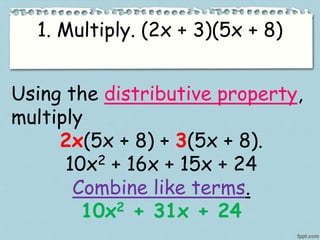
1. Multiply. (2x + 3)(5x + 8)
Using the distributive property,
multiply
2x(5x + 8) + 3(5x + 8).
10x2 + 16x + 15x + 24
Combine like terms.
10x2 + 31x + 24
A shortcut of the distributive
property is called the FOIL
method.
The FOIL method is ONLY
used when you multiply 2
binomials. It is an acronym and
tells you which terms to
multiply.
2. Use the FOIL method to multiply
the following binomials:
(y + 3)(y + 7).
(y + 3)(y + 7).
F tells you to multiply the
FIRST terms of each binomial
y2
(y + 3)(y + 7)
y2 + 7y
O tells you to multiply the
OUTER terms of each binomial.
(y + 3)(y + 7).
y2 + 7y + 3y
I tells you to multiply the
INNER terms of each binomial
(y + 3)(y + 7).
L tells you to multiply the
LAST terms of each binomial.
y2 + 7y + 3y + 21
Combine like terms.
y2 + 10y + 21
Remember, FOIL reminds you
to multiply the:
First terms
Outer terms
Inner terms
Last terms
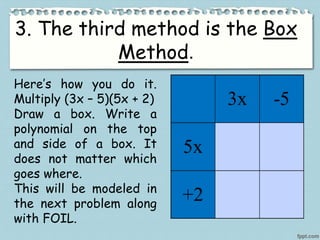
3. The third method is the Box
Method.
Here’s how you do it.
Multiply (3x – 5)(5x + 2)
Draw a box. Write a
polynomial on the top
and side of a box. It
does not matter which
goes where.
This will be modeled in
the next problem along
with FOIL.
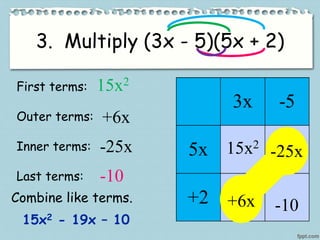
3. Multiply (3x - 5)(5x + 2)
First terms:
Outer terms:
Inner terms:
Last terms:
15x2
+6x
-25x
-10
15x2
-10
-25x
+6xCombine like terms.
15x2 - 19x – 10
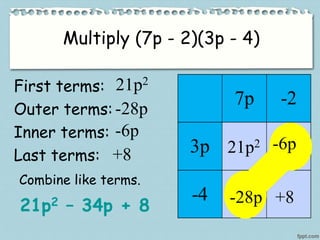
Multiply (7p - 2)(3p - 4)
First terms:
Outer terms:
Inner terms:
Last terms:
21p2
-28p
-6p
+8 21p2
+8-28p
-6p
Combine like terms.
21p2 – 34p + 8
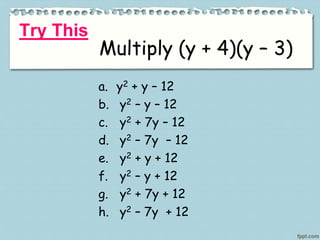
Try This
Multiply (y + 4)(y – 3)
a. y2 + y – 12
b. y2 – y – 12
c. y2 + 7y – 12
d. y2 – 7y – 12
e. y2 + y + 12
f. y2 – y + 12
g. y2 + 7y + 12
h. y2 – 7y + 12
Try This
Multiply (y + 4)(y – 3)
a. y2 + y – 12
b. y2 – y – 12
c. y2 + 7y – 12
d. y2 – 7y – 12
e. y2 + y + 12
f. y2 – y + 12
g. y2 + 7y + 12
h. y2 – 7y + 12
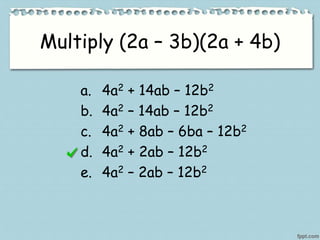
Multiply (2a – 3b)(2a + 4b)
a. 4a2 + 14ab – 12b2
b. 4a2 – 14ab – 12b2
c. 4a2 + 8ab – 6ba – 12b2
d. 4a2 + 2ab – 12b2
e. 4a2 – 2ab – 12b2
Multiply (2a – 3b)(2a + 4b)
a. 4a2 + 14ab – 12b2
b. 4a2 – 14ab – 12b2
c. 4a2 + 8ab – 6ba – 12b2
d. 4a2 + 2ab – 12b2
e. 4a2 – 2ab – 12b2
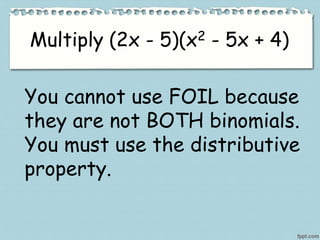
Multiply (2x - 5)(x2 - 5x + 4)
You cannot use FOIL because
they are not BOTH binomials.
You must use the distributive
property.
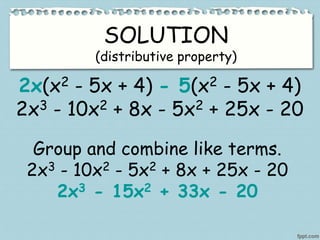
SOLUTION
(distributive property)
2x(x2 - 5x + 4) - 5(x2 - 5x + 4)
2x3 - 10x2 + 8x - 5x2 + 25x - 20
Group and combine like terms.
2x3 - 10x2 - 5x2 + 8x + 25x - 20
2x3 - 15x2 + 33x - 20
SOLUTION
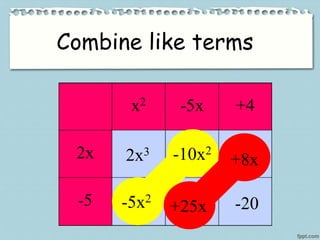
(Box Method)
2x3 -10x2
+8x
-5x2 +25x - 20
Combine like terms
2x3
-20
-10x2
-5x2
+25x
+8x
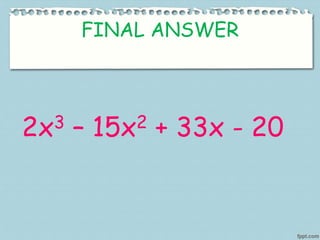
FINAL ANSWER
2x3 – 15x2 + 33x - 20
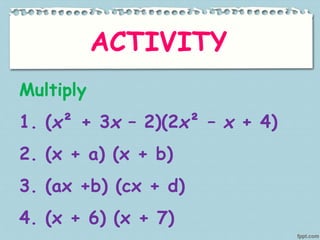
ACTIVITY
Multiply
1. (x² + 3x – 2)(2x² – x + 4)
2. (x + a) (x + b)
3. (ax +b) (cx + d)
4. (x + 6) (x + 7)
THANK
YOU!!


Multiplying Polynomials

  • 1.
  • 2.
    What are Polynomials? POLYNOMIALS It's an expression of variables and constants combined using addition, subtraction, multiplication, and division.
  • 3.
    What if wewant to multiply two polynomials together?
  • 4.
    There are threetechniques you can use for multiplying polynomials. 1. Distributive Property 2. FOIL 3. Box Method
  • 5.
    1. Multiply. (2x+ 3)(5x + 8) Using the distributive property, multiply 2x(5x + 8) + 3(5x + 8). 10x2 + 16x + 15x + 24 Combine like terms. 10x2 + 31x + 24
  • 6.
    A shortcut ofthe distributive property is called the FOIL method.
  • 7.
    The FOIL methodis ONLY used when you multiply 2 binomials. It is an acronym and tells you which terms to multiply.
  • 8.
    2. Use theFOIL method to multiply the following binomials: (y + 3)(y + 7). (y + 3)(y + 7). F tells you to multiply the FIRST terms of each binomial y2
  • 9.
    (y + 3)(y+ 7) y2 + 7y O tells you to multiply the OUTER terms of each binomial.
  • 10.
    (y + 3)(y+ 7). y2 + 7y + 3y I tells you to multiply the INNER terms of each binomial
  • 11.
    (y + 3)(y+ 7). L tells you to multiply the LAST terms of each binomial. y2 + 7y + 3y + 21 Combine like terms. y2 + 10y + 21
  • 12.
    Remember, FOIL remindsyou to multiply the: First terms Outer terms Inner terms Last terms
  • 13.
    3. The thirdmethod is the Box Method. Here’s how you do it. Multiply (3x – 5)(5x + 2) Draw a box. Write a polynomial on the top and side of a box. It does not matter which goes where. This will be modeled in the next problem along with FOIL.
  • 14.
    3. Multiply (3x- 5)(5x + 2) First terms: Outer terms: Inner terms: Last terms: 15x2 +6x -25x -10 15x2 -10 -25x +6xCombine like terms. 15x2 - 19x – 10
  • 15.
    Multiply (7p -2)(3p - 4) First terms: Outer terms: Inner terms: Last terms: 21p2 -28p -6p +8 21p2 +8-28p -6p Combine like terms. 21p2 – 34p + 8
  • 16.
    Try This Multiply (y+ 4)(y – 3) a. y2 + y – 12 b. y2 – y – 12 c. y2 + 7y – 12 d. y2 – 7y – 12 e. y2 + y + 12 f. y2 – y + 12 g. y2 + 7y + 12 h. y2 – 7y + 12
  • 17.
    Try This Multiply (y+ 4)(y – 3) a. y2 + y – 12 b. y2 – y – 12 c. y2 + 7y – 12 d. y2 – 7y – 12 e. y2 + y + 12 f. y2 – y + 12 g. y2 + 7y + 12 h. y2 – 7y + 12
  • 18.
    Multiply (2a –3b)(2a + 4b) a. 4a2 + 14ab – 12b2 b. 4a2 – 14ab – 12b2 c. 4a2 + 8ab – 6ba – 12b2 d. 4a2 + 2ab – 12b2 e. 4a2 – 2ab – 12b2
  • 19.
    Multiply (2a –3b)(2a + 4b) a. 4a2 + 14ab – 12b2 b. 4a2 – 14ab – 12b2 c. 4a2 + 8ab – 6ba – 12b2 d. 4a2 + 2ab – 12b2 e. 4a2 – 2ab – 12b2
  • 20.
    Multiply (2x -5)(x2 - 5x + 4) You cannot use FOIL because they are not BOTH binomials. You must use the distributive property.
  • 21.
    SOLUTION (distributive property) 2x(x2 -5x + 4) - 5(x2 - 5x + 4) 2x3 - 10x2 + 8x - 5x2 + 25x - 20 Group and combine like terms. 2x3 - 10x2 - 5x2 + 8x + 25x - 20 2x3 - 15x2 + 33x - 20
  • 22.
  • 23.
  • 24.
    FINAL ANSWER 2x3 –15x2 + 33x - 20
  • 25.
    ACTIVITY Multiply 1. (x² +3x – 2)(2x² – x + 4) 2. (x + a) (x + b) 3. (ax +b) (cx + d) 4. (x + 6) (x + 7)
  • 26.