2
Learning Objectives
Key Goalsfor This Chapter
Algebraic Expressions
Understand the different types of
algebraic expressions such as
monomials, binomials, and
polynomials, recognizing their
structure and components.
Multiplication Techniques
Learn how to multiply
monomials, binomials, and
polynomials effectively, applying
the right methods for various
algebraic expressions.
Distributive Property
Apply the distributive property
in multiplication to simplify and
solve algebraic expressions,
enhancing problem-solving skills
in mathematics.
3.
Understandin
g Algebraic
Expressions
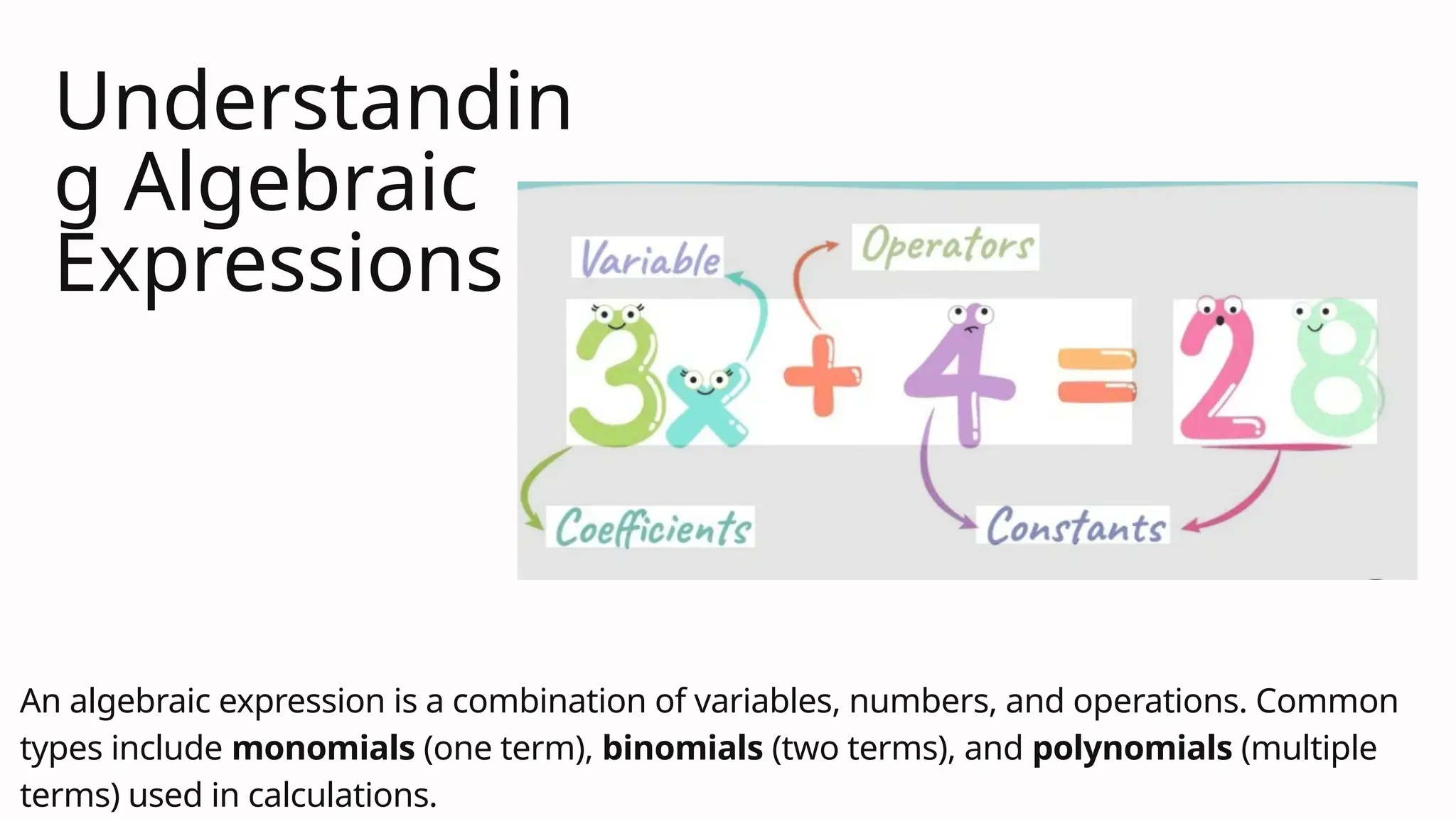
An algebraicexpression is a combination of variables, numbers, and operations. Common
types include monomials (one term), binomials (two terms), and polynomials (multiple
terms) used in calculations.
4.
Understandin
g Sign Rules
in
Multiplication
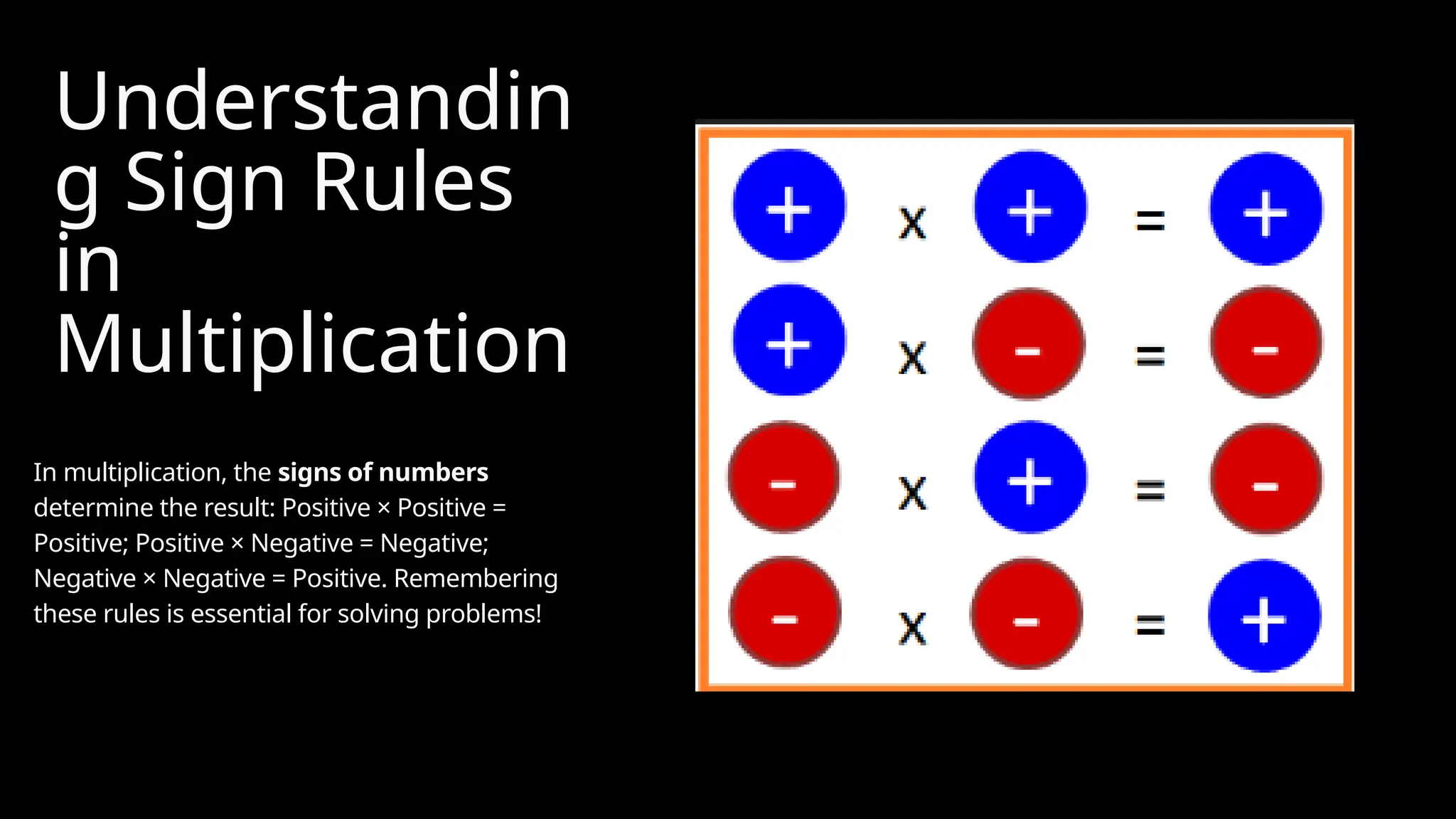
Inmultiplication, the signs of numbers
determine the result: Positive × Positive =
Positive; Positive × Negative = Negative;
Negative × Negative = Positive. Remembering
these rules is essential for solving problems!
5.
Multiplication
of monomials
• Wehave the 'x' sign for multiplication. It need not be
written between the product of a numeral and a
literal number.(a x y = ay)
• To multiply monomials, multiply the coefficients
and add the exponents of like bases. For example,
(3x^2 times 2x^3 = 6x^{2+3} = 6x^5), showcasing
the process clearly.
6.
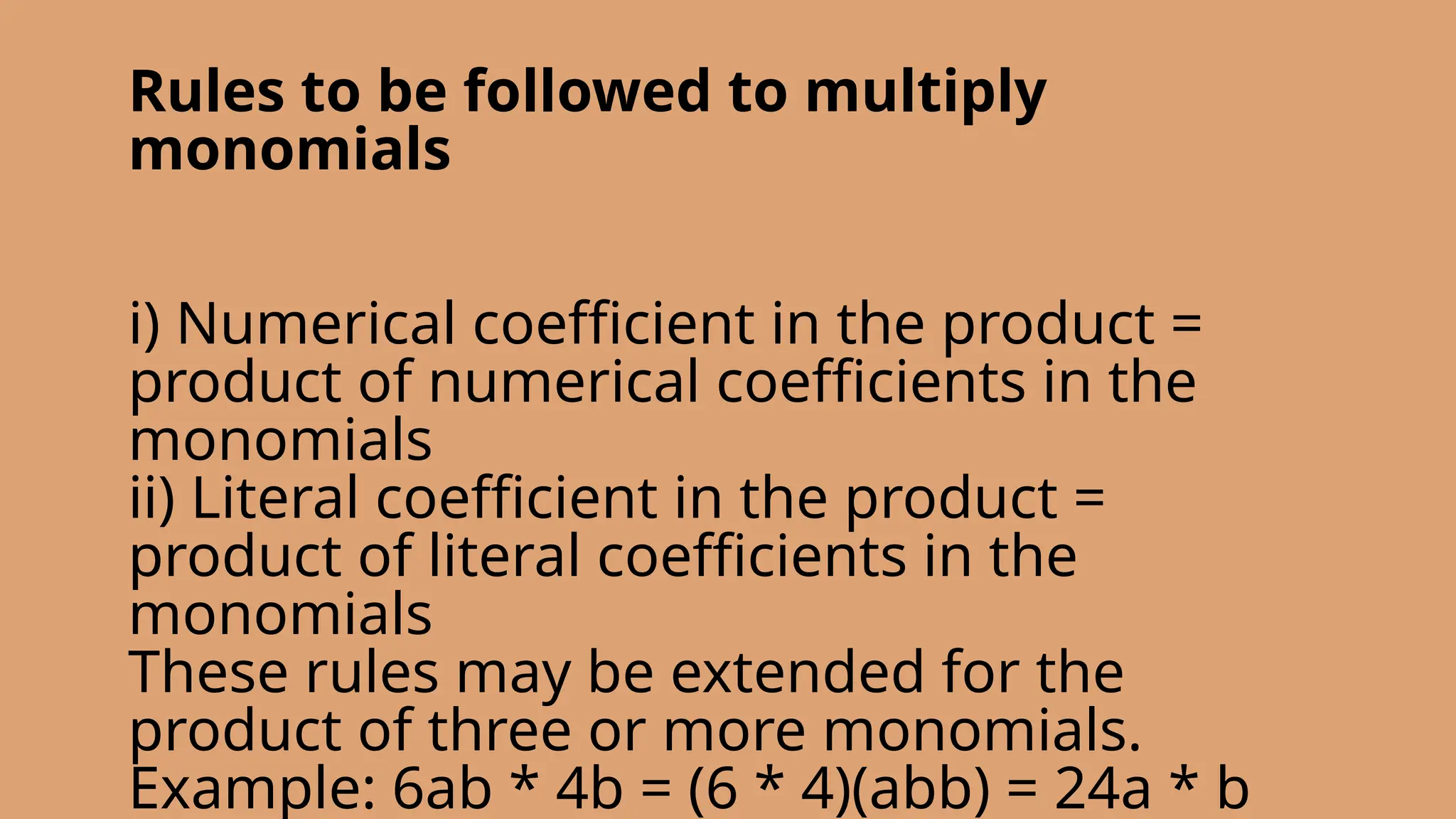
Rules to befollowed to multiply
monomials
i) Numerical coefficient in the product =
product of numerical coefficients in the
monomials
ii) Literal coefficient in the product =
product of literal coefficients in the
monomials
These rules may be extended for the
product of three or more monomials.
Example: 6ab * 4b = (6 * 4)(abb) = 24a * b
7.
Multiplying a Monomialby a
Binomial
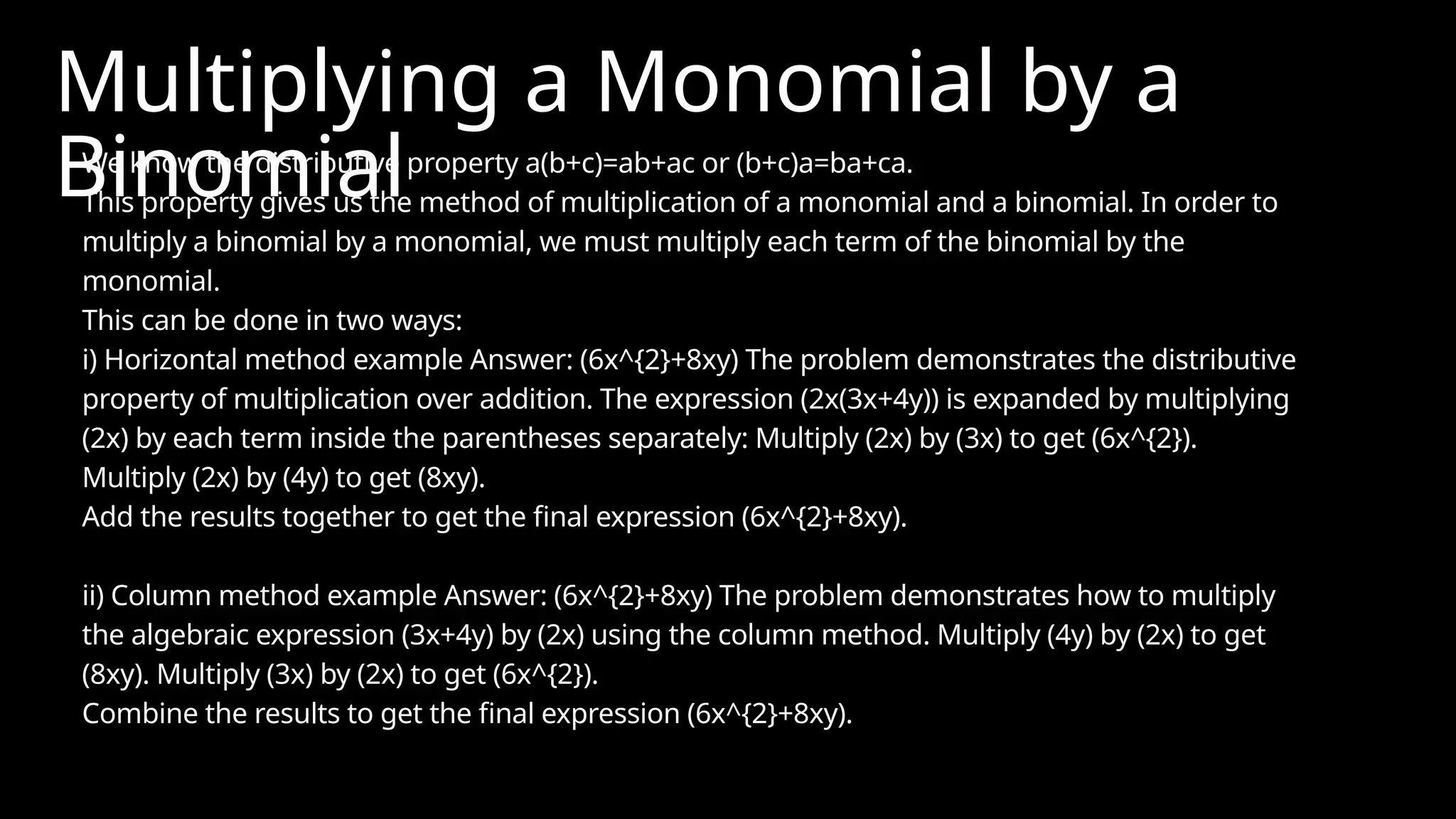
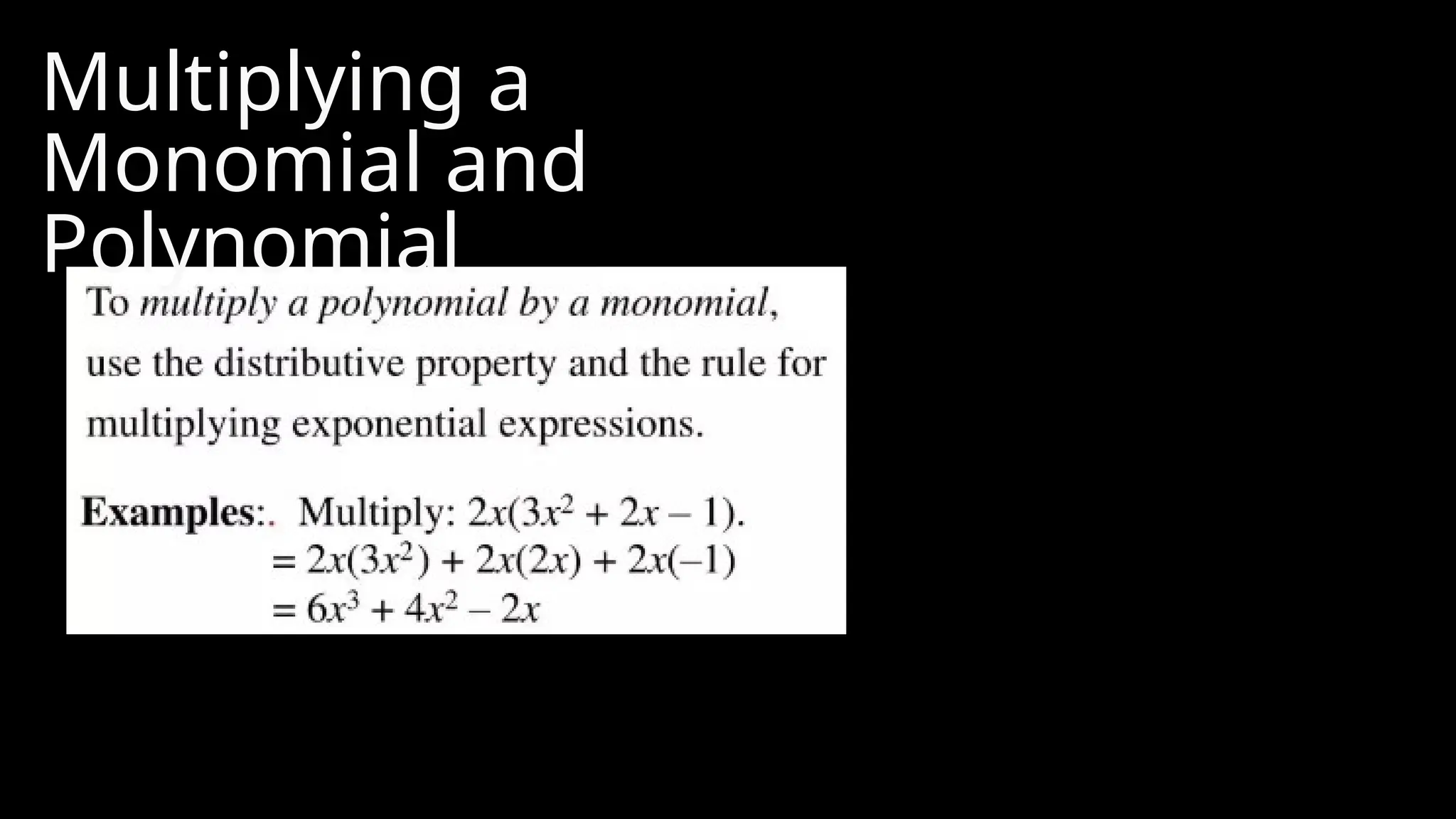
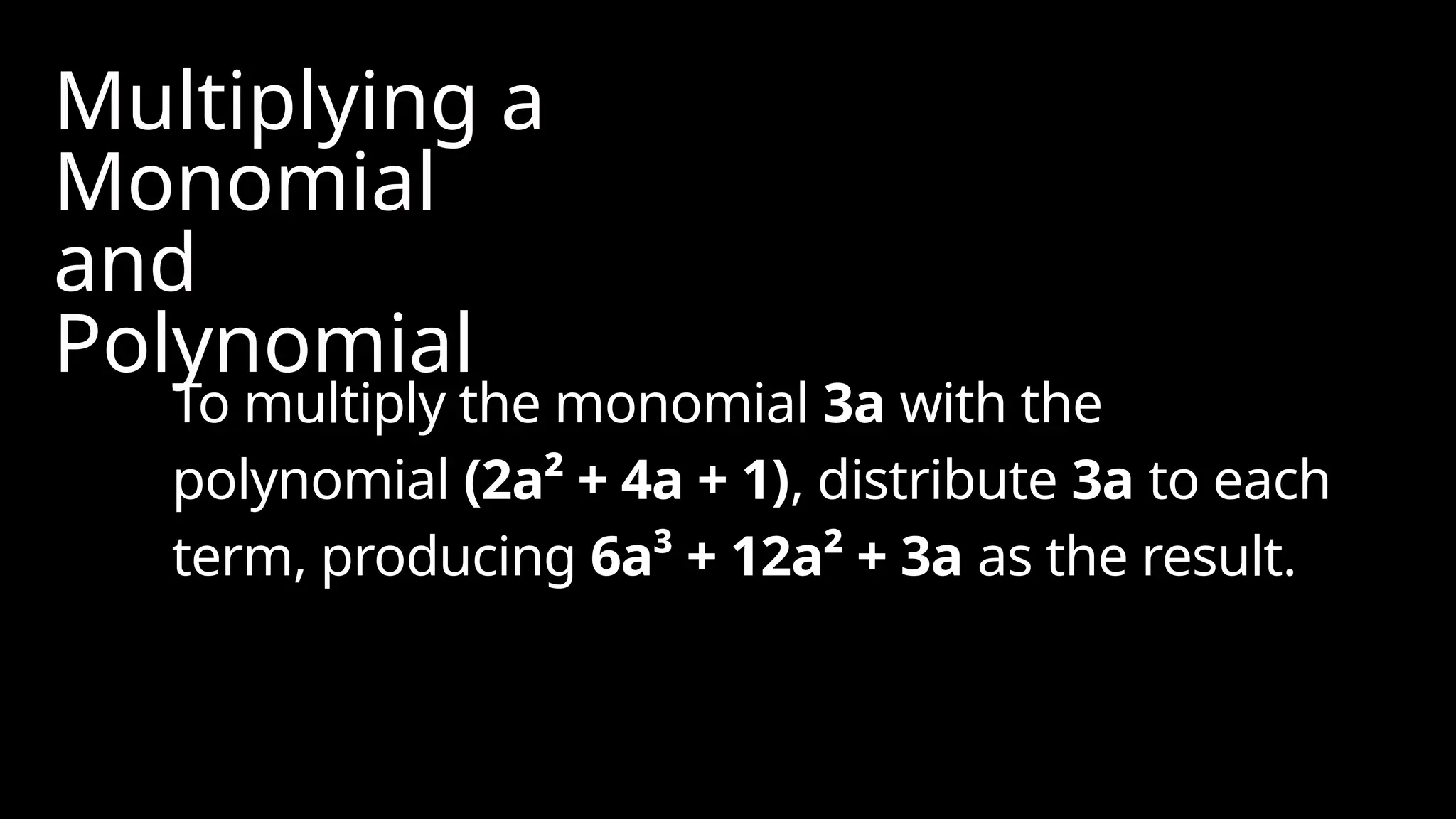
We know the distributive property a(b+c)=ab+ac or (b+c)a=ba+ca.
This property gives us the method of multiplication of a monomial and a binomial. In order to
multiply a binomial by a monomial, we must multiply each term of the binomial by the
monomial.
This can be done in two ways:
i) Horizontal method example Answer: (6x^{2}+8xy) The problem demonstrates the distributive
property of multiplication over addition. The expression (2x(3x+4y)) is expanded by multiplying
(2x) by each term inside the parentheses separately: Multiply (2x) by (3x) to get (6x^{2}).
Multiply (2x) by (4y) to get (8xy).
Add the results together to get the final expression (6x^{2}+8xy).
ii) Column method example Answer: (6x^{2}+8xy) The problem demonstrates how to multiply
the algebraic expression (3x+4y) by (2x) using the column method. Multiply (4y) by (2x) to get
(8xy). Multiply (3x) by (2x) to get (6x^{2}).
Combine the results to get the final expression (6x^{2}+8xy).
8.
Horizontal
Method of
Multiplication
The horizontalmethod simplifies
multiplication by aligning expressions side-by-
side. This technique enhances understanding,
allowing students to see each step clearly as
they derive the answer visually.
9.
Using the
Column
Method
The ColumnMethod simplifies polynomial
multiplication by aligning numbers vertically.
Each term is multiplied step-by-step, ensuring
clarity and organization, making it easier for
students to follow the process visually.
Multiplying
Monomials
Example
Let's explore themultiplication of monomials
with the example 4x × 3x². The product is
found by multiplying the coefficients and
adding the exponents, resulting in 12x³.
Multiplying
Monomial by
Binomial
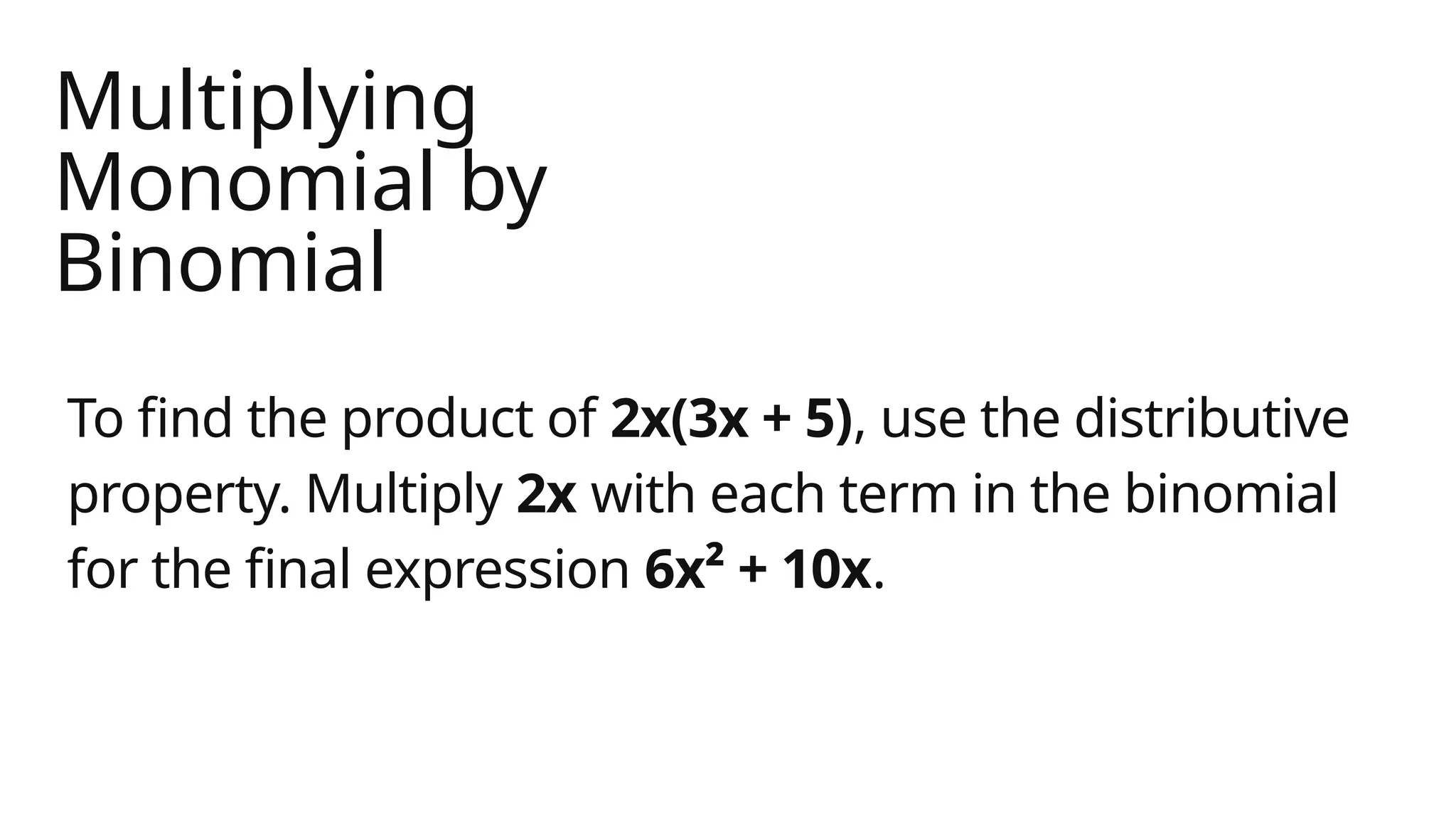
To findthe product of 2x(3x + 5), use the distributive
property. Multiply 2x with each term in the binomial
for the final expression 6x² + 10x.
What is theproduct of (x+1) and 3x?
6x^2
5x
3x^2+3x
8x^2
22.
What is theproduct of (x+2) and (x-1)?
x^2-x+2
x^2+x-1
x^2-x+2
x^2+x-2
23.
What is theproduct of (x-1) and (x+1)?
x^2-1
x^2+1
x+1
x-1
24.
What is theproduct of (2x-2) and 3x?
6x^2+1
6x^2-6x
6x
6x^2-2
25.
What is theproduct of 2 and 3x+1?
6x^2-1
5x+1
6x+2
8x^2
26.
What is theproduct of -11y^2 and (3y+7)?
-33y^3+11y^2
-33y^3-77y^2
-33y^3+77y^2
33y^3-77y^2
27.
Summary of
Key Concepts
Inthis chapter, we explored key multiplication
rules and the importance of the distributive
property. Continued practice will enhance your
understanding and mastery of algebraic
expressions.