
PHYSIOTHERAPY IN
MULTIPLE
SCLEROSIS
Dr. Manasi Kulkarni
MPT-Neurophysiotherapy
Content
■ Introduction of MS
■ Clinical features
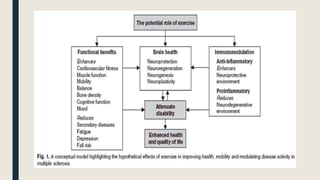
■ Role of Physiotherapy
■ PT management
■ Recent Advances
■ References
Introduction
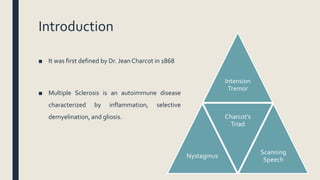
■ It was first defined by Dr. Jean Charcot in 1868
■ Multiple Sclerosis is an autoimmune disease
characterized by inflammation, selective
demyelination, and gliosis.
Intension
Tremor
Nystagmus
Charcot’s
Triad
Scanning
Speech
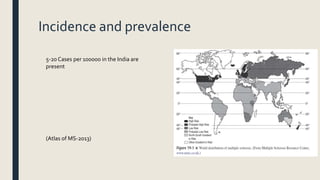
Incidence and prevalence
5-20 Cases per 100000 in the India are
present
(Atlas of MS-2013)
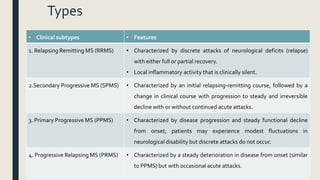
Types
• Clinical subtypes • Features
1. Relapsing Remitting MS (RRMS) • Characterized by discrete attacks of neurological deficits (relapse)
with either full or partial recovery.
• Local inflammatory activity that is clinically silent.
2.Secondary Progressive MS (SPMS) • Characterized by an initial relapsing-remitting course, followed by a
change in clinical course with progression to steady and irreversible
decline with or without continued acute attacks.
3. Primary Progressive MS (PPMS) • Characterized by disease progression and steady functional decline
from onset; patients may experience modest fluctuations in
neurological disability but discrete attacks do not occur.
4. Progressive Relapsing MS (PRMS) • Characterized by a steady deterioration in disease from onset (similar
to PPMS) but with occasional acute attacks.
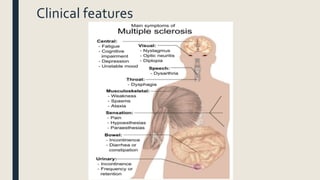
Clinical features
Aim of Physiotherapy
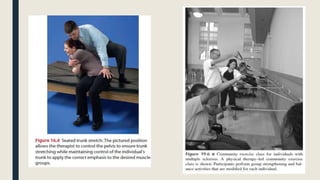
■ To reeducate and maintain all available voluntary control
■ Re-educate and maintain postural mechanisms
■ Inhibit abnormal tone
■ Prevent abnormal movement
■ To stimulate all sensory and perceptual experience
■ Incorporate treatment techniques into ways of life by relating to ADLs.
Physiotherapy Management
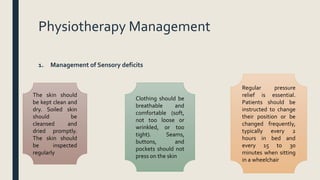
1. Management of Sensory deficits
The skin should
be kept clean and
dry. Soiled skin
should be
cleansed and
dried promptly.
The skin should
be inspected
regularly
Clothing should be
breathable and
comfortable (soft,
not too loose or
wrinkled, or too
tight). Seams,
buttons, and
pockets should not
press on the skin
Regular pressure
relief is essential.
Patients should be
instructed to change
their position or be
changed frequently,
typically every 2
hours in bed and
every 15 to 30
minutes when sitting
in a wheelchair
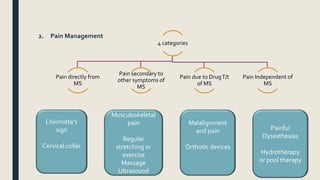
2. Pain Management
4 categories
Pain directly from
MS
Pain secondary to
other symptoms of
MS
Pain due to DrugT/t
of MS
Pain Independent of
MS
Lhermitte’s
sign
Cervical collar
Musculoskeletal
pain
Regular
stretching or
exercise
Massage
Ultrasound
Painful
Dysesthesias
Hydrotherapy
or pool therapy
Malalignment
and pain
Orthotic devices
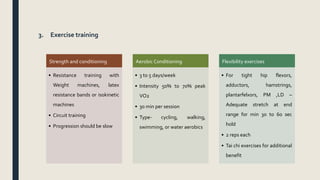
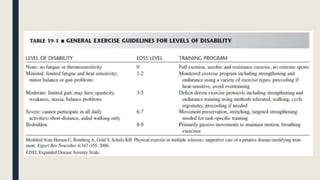
3. Exercise training
Strength and conditioning
• Resistance training with
Weight machines, latex
resistance bands or isokinetic
machines
• Circuit training
• Progression should be slow
Aerobic Conditioning
• 3 to 5 days/week
• Intensity 50% to 70% peak
VO2
• 30 min per session
• Type- cycling, walking,
swimming, or water aerobics
Flexibility exercises
• For tight hip flexors,
adductors, hamstrings,
plantarfelxors, PM ,LD –
Adequate stretch at end
range for min 30 to 60 sec
hold
• 2 reps each
• Tai chi exercises for additional
benefit
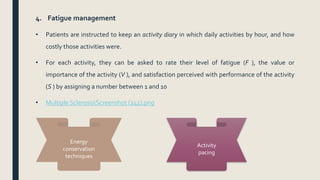
4. Fatigue management
• Patients are instructed to keep an activity diary in which daily activities by hour, and how
costly those activities were.
• For each activity, they can be asked to rate their level of fatigue (F ), the value or
importance of the activity (V ), and satisfaction perceived with performance of the activity
(S ) by assigning a number between 1 and 10
• Multiple SclerosisScreenshot (241).png
Energy
conservation
techniques
Activity
pacing
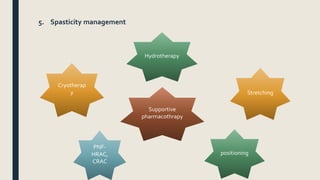
5. Spasticity management
Cryotherap
y
PNF-
HRAC,
CRAC
positioning
Stretching
Hydrotherapy
Supportive
pharmacothrapy
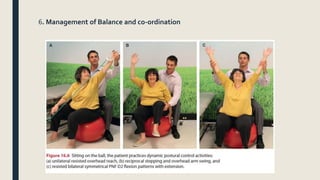
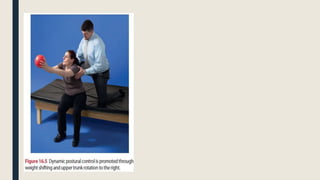
6. Management of Balance and co-ordination
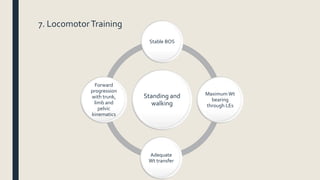
7. LocomotorTraining
Standing and
walking
Stable BOS
Maximum Wt
bearing
through LEs
Adequate
Wt transfer
Forward
progression
with trunk,
limb and
pelvic
kinematics
Forward
walking
Side
stepping
Backward
walking
Cross
stepping
Side
way
walking
Stair
climbing
Negotiat
ing curbs
and
ramps
Obstacle
walking
8. Management of speech and swallowing
• Application of transcutaneous neuromuscular electric stimulation (NMES) to the
submental muscles (suprahyoid triangle) to facilitate muscle reeducation.
• Thermal-tactile stimulation (TTS) is a sensory technique whereby stimulation is
provided to the anterior faucial pillars to improve swallowing reflexes and the
pharyngeal phase of swallowing.
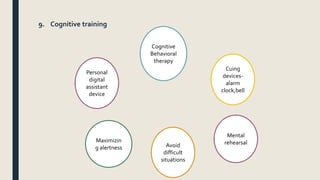
9. Cognitive training
Personal
digital
assistant
device
Cognitive
Behavioral
therapy
Cuing
devices-
alarm
clock,bell
Mental
rehearsal
Maximizin
g alertness Avoid
difficult
situations
■ Stage waise management of MS.png
Stagewise
management
Early/Mild stage
Middle/
Moderate stage
Late/ Advanced
stage
RecentAdvances
■ Mohhamand Etoom et al Conducted a review (2018)
Effectiveness of physiotherapy interventions on spasticity in people with multiple sclerosis:
A systematic review
• 29 studies were included
• PT interventions- Electrical stimulation, exercise therapy, radical shockwave therapy,
vibration and standing
• Results were positive regarding acute effects, follow up measurements and safety
• Physiotherapy management can e a safe and beneficial option for spasticity
management in people with MS.
■ Demanuef T. et al conducted a review on effectiveness of exercise intervention on Pain in
people with MS.
• 10 randomized controlled trials were included for meta-analysis and systematic review.
• This review concluded that Current pain management strategies are costly and have
significant adverse effects, but exercise therapy has many benefits to health and is generally
low-cost and accessible.
References
■ O’Sullivan S, SchimtzT,Fulk G. Physical Rehabilitation 6th edition
■ Umphred D, Lazaro R, Roller M, Burton G. Umphred’s Neurological Rehabilitationm.
6th edition
■ Bhatia R., Bali P, Choudhari R. Epidemiology and genetic aspects of multiple sclerosis
in india.Annal of Indian academy of neurology 2015; 18(1): s6.
■ Etoom M, KhraiweshY, Lena F et al. Effectiveness of Physiotherapy intervention on
Spasticity in people with Multiple sclerosis: a systematic review and meta analysis.Am
J Phys Med Rehabil 2018; 97(11):793-807.
■ DemanuefT. et al Effectiveness of exercise intervenions for pain reduction in people
with multiple sclerosis:A systematic review and meta analysis of Rendomized
controlled trials.Arch of Phys Med & Rehabil 2018
THANKYOU

Multiple sclerosis

  • 1.
    PHYSIOTHERAPY IN MULTIPLE SCLEROSIS Dr. ManasiKulkarni MPT-Neurophysiotherapy
  • 2.
    Content ■ Introduction ofMS ■ Clinical features ■ Role of Physiotherapy ■ PT management ■ Recent Advances ■ References
  • 3.
    Introduction ■ It wasfirst defined by Dr. Jean Charcot in 1868 ■ Multiple Sclerosis is an autoimmune disease characterized by inflammation, selective demyelination, and gliosis. Intension Tremor Nystagmus Charcot’s Triad Scanning Speech
  • 4.
    Incidence and prevalence 5-20Cases per 100000 in the India are present (Atlas of MS-2013)
  • 5.
    Types • Clinical subtypes• Features 1. Relapsing Remitting MS (RRMS) • Characterized by discrete attacks of neurological deficits (relapse) with either full or partial recovery. • Local inflammatory activity that is clinically silent. 2.Secondary Progressive MS (SPMS) • Characterized by an initial relapsing-remitting course, followed by a change in clinical course with progression to steady and irreversible decline with or without continued acute attacks. 3. Primary Progressive MS (PPMS) • Characterized by disease progression and steady functional decline from onset; patients may experience modest fluctuations in neurological disability but discrete attacks do not occur. 4. Progressive Relapsing MS (PRMS) • Characterized by a steady deterioration in disease from onset (similar to PPMS) but with occasional acute attacks.
  • 6.
  • 7.
    Aim of Physiotherapy ■To reeducate and maintain all available voluntary control ■ Re-educate and maintain postural mechanisms ■ Inhibit abnormal tone ■ Prevent abnormal movement ■ To stimulate all sensory and perceptual experience ■ Incorporate treatment techniques into ways of life by relating to ADLs.
  • 10.
    Physiotherapy Management 1. Managementof Sensory deficits The skin should be kept clean and dry. Soiled skin should be cleansed and dried promptly. The skin should be inspected regularly Clothing should be breathable and comfortable (soft, not too loose or wrinkled, or too tight). Seams, buttons, and pockets should not press on the skin Regular pressure relief is essential. Patients should be instructed to change their position or be changed frequently, typically every 2 hours in bed and every 15 to 30 minutes when sitting in a wheelchair
  • 11.
    2. Pain Management 4categories Pain directly from MS Pain secondary to other symptoms of MS Pain due to DrugT/t of MS Pain Independent of MS Lhermitte’s sign Cervical collar Musculoskeletal pain Regular stretching or exercise Massage Ultrasound Painful Dysesthesias Hydrotherapy or pool therapy Malalignment and pain Orthotic devices
  • 12.
    3. Exercise training Strengthand conditioning • Resistance training with Weight machines, latex resistance bands or isokinetic machines • Circuit training • Progression should be slow Aerobic Conditioning • 3 to 5 days/week • Intensity 50% to 70% peak VO2 • 30 min per session • Type- cycling, walking, swimming, or water aerobics Flexibility exercises • For tight hip flexors, adductors, hamstrings, plantarfelxors, PM ,LD – Adequate stretch at end range for min 30 to 60 sec hold • 2 reps each • Tai chi exercises for additional benefit
  • 14.
    4. Fatigue management •Patients are instructed to keep an activity diary in which daily activities by hour, and how costly those activities were. • For each activity, they can be asked to rate their level of fatigue (F ), the value or importance of the activity (V ), and satisfaction perceived with performance of the activity (S ) by assigning a number between 1 and 10 • Multiple SclerosisScreenshot (241).png Energy conservation techniques Activity pacing
  • 16.
  • 17.
    6. Management ofBalance and co-ordination
  • 19.
    7. LocomotorTraining Standing and walking StableBOS Maximum Wt bearing through LEs Adequate Wt transfer Forward progression with trunk, limb and pelvic kinematics
  • 20.
  • 21.
    8. Management ofspeech and swallowing • Application of transcutaneous neuromuscular electric stimulation (NMES) to the submental muscles (suprahyoid triangle) to facilitate muscle reeducation. • Thermal-tactile stimulation (TTS) is a sensory technique whereby stimulation is provided to the anterior faucial pillars to improve swallowing reflexes and the pharyngeal phase of swallowing.
  • 22.
  • 23.
    ■ Stage waisemanagement of MS.png Stagewise management Early/Mild stage Middle/ Moderate stage Late/ Advanced stage
  • 24.
    RecentAdvances ■ Mohhamand Etoomet al Conducted a review (2018) Effectiveness of physiotherapy interventions on spasticity in people with multiple sclerosis: A systematic review • 29 studies were included • PT interventions- Electrical stimulation, exercise therapy, radical shockwave therapy, vibration and standing • Results were positive regarding acute effects, follow up measurements and safety • Physiotherapy management can e a safe and beneficial option for spasticity management in people with MS.
  • 25.
    ■ Demanuef T.et al conducted a review on effectiveness of exercise intervention on Pain in people with MS. • 10 randomized controlled trials were included for meta-analysis and systematic review. • This review concluded that Current pain management strategies are costly and have significant adverse effects, but exercise therapy has many benefits to health and is generally low-cost and accessible.
  • 26.
    References ■ O’Sullivan S,SchimtzT,Fulk G. Physical Rehabilitation 6th edition ■ Umphred D, Lazaro R, Roller M, Burton G. Umphred’s Neurological Rehabilitationm. 6th edition ■ Bhatia R., Bali P, Choudhari R. Epidemiology and genetic aspects of multiple sclerosis in india.Annal of Indian academy of neurology 2015; 18(1): s6. ■ Etoom M, KhraiweshY, Lena F et al. Effectiveness of Physiotherapy intervention on Spasticity in people with Multiple sclerosis: a systematic review and meta analysis.Am J Phys Med Rehabil 2018; 97(11):793-807. ■ DemanuefT. et al Effectiveness of exercise intervenions for pain reduction in people with multiple sclerosis:A systematic review and meta analysis of Rendomized controlled trials.Arch of Phys Med & Rehabil 2018
  • 27.