MULTIPLE SCLEROSIS
BALQEES MAJALI
INTRODUCTION
…Multiple sclerosis (MS) is a chronic inflammatory
autoimmune demyelinating disease of the central nervous
system.
It expresses itself in four clinical forms:
• relapsing remitting MS (RRMS)
• secondary progressive MS (SPMS)
• primary progressive MS (PPMS)
• progressive relapsing MS (PRMS)
Epidemiology
..The disease is more common in females than males
(approximately 3:1). It may develop at any age, though its
first onset is rare in children and the elderly. The usual age
of presentation is between 20 and 40 years. In the UK, its
prevalence is approximately 1 in 1000.
• It is more common in areas of temperate than tropical
climate
• Ethnic differences
• geographical variation, This is particularly indicated by the
suggested occurrence of MS ‘epidemics’
ETIOLOGY
• The etiology of multiple sclerosis (MS) remains elusive.
However, clues to its pathogenesis have traditionally been
derived from the basic pathologic characterization of
central nervous system (CNS) tissues of MS patients. it is
well established that the immune system directly
participates in the destruction of myelin and nervous cells.
It is believed that MS, like other autoimmune diseases, is
caused by a combination of environmental and genetic
factors that result in a loss of tolerance to self proteins (in this
case myelin antigen) .
• The HLA locus on chromosome 6p21
which contains the DR antigens has
been linked to MS susceptibility
Genetic factors
• exposure to infectious agents as
well as sunlight exposure/vitamin D
are felt to account for changing risk
of MS when a person migrates from
one risk area to another before age
15 years old
Environmental
factors
… Immune cells mediated in pathogenesis of MS :
CD4+Tcells
• TH17 ,TH1
• Critical component of the injury to myelin they
release cytokines and mediate inflammation process
CD8+Tcells
• kill glial cells, leaving axons exposed
• transect axons, promote vascular permeability and
activate oligodendrocyte death
B cells
• Production of autoantobodies
• The target of these antibodies is not yet known
PATHOLOGY
…The pathologic hallmark of multiple sclerosis (MS) is
multiple focal areas of myelin loss within the CNS called
plaques or lesions, Demyelination is accompanied by
variable gliosis and inflammation and by relative axonal
preservation.
-Lesions are disseminated throughout the CNS but have a
predilection for :
• optic nerves
• subpial spinal cord
• brainstem
• cerebellum
• juxtacortical and periventricular white matter regions
• At an early stage there is local breakdown of the
blood–brain barrier, then evidence of inflammation
with oedema, loss of myelin and eventually the CNS
equivalent of scar tissue, gliosis. The final result, a
shrunken area of sclerosis, may be associated with
little clinical deficit compared with that present when
the plaque was pathologically most active.
• Further inflammatory lesions, close to sites of
preexisting damage, may contribute to the eventual
accumulation of neurological deficit, but axonal loss,
with consequent brain, cord and optic atrophy, is now
recognized as a major pathological substrate for the
progressive phase of the illness
• Neuropathology of white matter lesions :
…MS lesions evolve differently during early versus
chronic disease phases, and within each phase,
different plaque types and plaques in different stages
of demyelinating activity are evident.
Histologically, several basic processes drive the
formation of plaques: inflammation, myelin
breakdown, astrogliosis, oligodendrocyte injury,
neurodegeneration and axonal loss, and
remyelination.
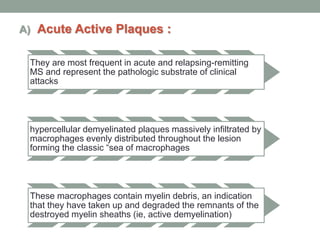
A) Acute Active Plaques :
They are most frequent in acute and relapsing-remitting
MS and represent the pathologic substrate of clinical
attacks
hypercellular demyelinated plaques massively infiltrated by
macrophages evenly distributed throughout the lesion
forming the classic “sea of macrophages
These macrophages contain myelin debris, an indication
that they have taken up and degraded the remnants of the
destroyed myelin sheaths (ie, active demyelination)
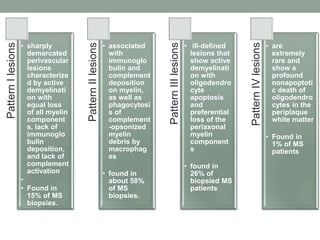
PatternIlesions
• sharply
demarcated
perivascular
lesions
characterize
d by active
demyelinati
on with
equal loss
of all myelin
component
s, lack of
immunoglo
bulin
deposition,
and lack of
complement
activation
•
• Found in
15% of MS
biopsies.
PatternIIlesions
• associated
with
immunoglo
bulin and
complement
deposition
on myelin,
as well as
phagocytosi
s of
complement
-opsonized
myelin
debris by
macrophag
es
• found in
about 58%
of MS
biopsies.
PatternIIIlesions
• ill-defined
lesions that
show active
demyelinati
on with
oligodendro
cyte
apoptosis
and
preferential
loss of the
periaxonal
myelin
component
s
• found in
26% of
biopsied MS
patients
PatternIVlesions
• are
extremely
rare and
show a
profound
nonapoptoti
c death of
oligodendro
cytes in the
periplaque
white matter
• Found in
1% of MS
patients
B) Chronic plaques :
Chronic inactive plaques are completely demyelinated, sharply
circumscribed hypocellular lesions characterized by substantial loss
of axons and oligodendrocytes, astrogliosis, and minor infiltration by
macrophages/microglia and lymphocytes
more frequently seen than active plaques in patients with progressive MS
myelin-laden macrophages are concentrated at the centrifugally expanding edges of
the plaque and diminish toward its hypocellular inactive center
characterized by a slowly expanding rim of activated microglia (few of which
contain myelin degradation products) surrounding their inactive center
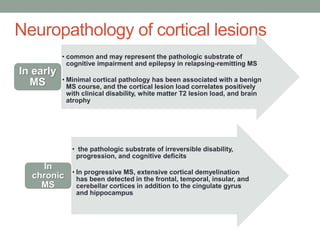
Neuropathology of cortical lesions
• common and may represent the pathologic substrate of
cognitive impairment and epilepsy in relapsing-remitting MS
• Minimal cortical pathology has been associated with a benign
MS course, and the cortical lesion load correlates positively
with clinical disability, white matter T2 lesion load, and brain
atrophy
In early
MS
• the pathologic substrate of irreversible disability,
progression, and cognitive deficits
• In progressive MS, extensive cortical demyelination
has been detected in the frontal, temporal, insular, and
cerebellar cortices in addition to the cingulate gyrus
and hippocampus
In
chronic
MS
CASE STUDY:
*extra slides ;)
• A 33-year-old white woman presented with sudden-onset
headache associated with right periorbital pain. Her
medical history was notable only for a history of migraine,
a vaginal delivery 4 months ago, and an upper respiratory
tract infection 1 week ago. The neurologic examination
was normal. Brain MRI revealed a high signal intensity
lesion on T2-weighted imaging involving the left occipital
cortex (visual association cortex) that enhanced with
gadolinium
An open brain biopsy performed :
1 month after symptom onset to exclude neoplasm revealed a subpial
cortical demyelinated lesion (FigureA)
heavily infiltrated by phagocytic macrophages involved in active
demyelination (Figure B).
Parenchymal and perivascular cortical inflammatory infiltrates were
present and composed of macrophages, microglia, CD3-positive and
CD8-positive T cells, B lymphocytes, and plasma cells(FigureC, D).
Acute axonal injury was evidenced by axonal swellings (FigureE),
and neuronal injury was evidenced by the presence of scattered
pyknotic neurons (FigureF).
Macrophages, microglia, and T lymphocytes were found in close
apposition to neurons as well as concentrated subpially in the cortical
molecular layer and in the subarachnoid space (FigureG).
Mild meningeal inflammation consisting of CD3-positive T lymphocytes,
CD8-positive T and B lymphocytes, and plasma cells was present
(FigureH, I).
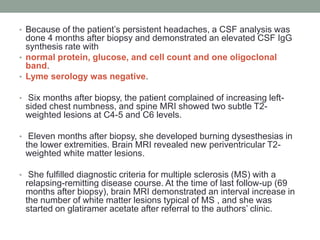
• Because of the patient’s persistent headaches, a CSF analysis was
done 4 months after biopsy and demonstrated an elevated CSF IgG
synthesis rate with
• normal protein, glucose, and cell count and one oligoclonal
band.
• Lyme serology was negative.
• Six months after biopsy, the patient complained of increasing left-
sided chest numbness, and spine MRI showed two subtle T2-
weighted lesions at C4-5 and C6 levels.
• Eleven months after biopsy, she developed burning dysesthesias in
the lower extremities. Brain MRI revealed new periventricular T2-
weighted white matter lesions.
• She fulfilled diagnostic criteria for multiple sclerosis (MS) with a
relapsing-remitting disease course. At the time of last follow-up (69
months after biopsy), brain MRI demonstrated an interval increase in
the number of white matter lesions typical of MS , and she was
started on glatiramer acetate after referral to the authors’ clinic.
• Comment
…. The first lesion detected in this case was a cortical
lesion with pathologic features typical for acute
inflammatory demyelinating lesions of MS. Subpial
demyelinated lesions, as demonstrated in this case, may
occur early in MS. Gadolinium enhancement of the newly
forming cortical lesion is an uncommon observation;
however, it was observed in this case, which highlights that
acute cortical lesion formation is characterized by similar,
albeit more transient MRI features compared to white
matter lesions in MS. Possible reasons for the paucity of
this phenomenon include the lack of symptoms associated
with lesion formation in small focal subpial cortical areas
(therefore no MRI is acquired during this stage), limited
blood-brain barrier breakdown, and more rapid resolution of
inflammation in the cortex compared to the white matter.
THANK YOU!

epidemiology and pathophysiology of multiple sclerosis

  • 1.
  • 2.
    INTRODUCTION …Multiple sclerosis (MS)is a chronic inflammatory autoimmune demyelinating disease of the central nervous system. It expresses itself in four clinical forms: • relapsing remitting MS (RRMS) • secondary progressive MS (SPMS) • primary progressive MS (PPMS) • progressive relapsing MS (PRMS)
  • 3.
    Epidemiology ..The disease ismore common in females than males (approximately 3:1). It may develop at any age, though its first onset is rare in children and the elderly. The usual age of presentation is between 20 and 40 years. In the UK, its prevalence is approximately 1 in 1000. • It is more common in areas of temperate than tropical climate • Ethnic differences • geographical variation, This is particularly indicated by the suggested occurrence of MS ‘epidemics’
  • 4.
    ETIOLOGY • The etiologyof multiple sclerosis (MS) remains elusive. However, clues to its pathogenesis have traditionally been derived from the basic pathologic characterization of central nervous system (CNS) tissues of MS patients. it is well established that the immune system directly participates in the destruction of myelin and nervous cells.
  • 5.
    It is believedthat MS, like other autoimmune diseases, is caused by a combination of environmental and genetic factors that result in a loss of tolerance to self proteins (in this case myelin antigen) . • The HLA locus on chromosome 6p21 which contains the DR antigens has been linked to MS susceptibility Genetic factors • exposure to infectious agents as well as sunlight exposure/vitamin D are felt to account for changing risk of MS when a person migrates from one risk area to another before age 15 years old Environmental factors
  • 6.
    … Immune cellsmediated in pathogenesis of MS : CD4+Tcells • TH17 ,TH1 • Critical component of the injury to myelin they release cytokines and mediate inflammation process CD8+Tcells • kill glial cells, leaving axons exposed • transect axons, promote vascular permeability and activate oligodendrocyte death B cells • Production of autoantobodies • The target of these antibodies is not yet known
  • 7.
    PATHOLOGY …The pathologic hallmarkof multiple sclerosis (MS) is multiple focal areas of myelin loss within the CNS called plaques or lesions, Demyelination is accompanied by variable gliosis and inflammation and by relative axonal preservation. -Lesions are disseminated throughout the CNS but have a predilection for : • optic nerves • subpial spinal cord • brainstem • cerebellum • juxtacortical and periventricular white matter regions
  • 8.
    • At anearly stage there is local breakdown of the blood–brain barrier, then evidence of inflammation with oedema, loss of myelin and eventually the CNS equivalent of scar tissue, gliosis. The final result, a shrunken area of sclerosis, may be associated with little clinical deficit compared with that present when the plaque was pathologically most active. • Further inflammatory lesions, close to sites of preexisting damage, may contribute to the eventual accumulation of neurological deficit, but axonal loss, with consequent brain, cord and optic atrophy, is now recognized as a major pathological substrate for the progressive phase of the illness
  • 9.
    • Neuropathology ofwhite matter lesions : …MS lesions evolve differently during early versus chronic disease phases, and within each phase, different plaque types and plaques in different stages of demyelinating activity are evident. Histologically, several basic processes drive the formation of plaques: inflammation, myelin breakdown, astrogliosis, oligodendrocyte injury, neurodegeneration and axonal loss, and remyelination.
  • 10.
    A) Acute ActivePlaques : They are most frequent in acute and relapsing-remitting MS and represent the pathologic substrate of clinical attacks hypercellular demyelinated plaques massively infiltrated by macrophages evenly distributed throughout the lesion forming the classic “sea of macrophages These macrophages contain myelin debris, an indication that they have taken up and degraded the remnants of the destroyed myelin sheaths (ie, active demyelination)
  • 11.
    PatternIlesions • sharply demarcated perivascular lesions characterize d byactive demyelinati on with equal loss of all myelin component s, lack of immunoglo bulin deposition, and lack of complement activation • • Found in 15% of MS biopsies. PatternIIlesions • associated with immunoglo bulin and complement deposition on myelin, as well as phagocytosi s of complement -opsonized myelin debris by macrophag es • found in about 58% of MS biopsies. PatternIIIlesions • ill-defined lesions that show active demyelinati on with oligodendro cyte apoptosis and preferential loss of the periaxonal myelin component s • found in 26% of biopsied MS patients PatternIVlesions • are extremely rare and show a profound nonapoptoti c death of oligodendro cytes in the periplaque white matter • Found in 1% of MS patients
  • 14.
    B) Chronic plaques: Chronic inactive plaques are completely demyelinated, sharply circumscribed hypocellular lesions characterized by substantial loss of axons and oligodendrocytes, astrogliosis, and minor infiltration by macrophages/microglia and lymphocytes more frequently seen than active plaques in patients with progressive MS myelin-laden macrophages are concentrated at the centrifugally expanding edges of the plaque and diminish toward its hypocellular inactive center characterized by a slowly expanding rim of activated microglia (few of which contain myelin degradation products) surrounding their inactive center
  • 15.
    Neuropathology of corticallesions • common and may represent the pathologic substrate of cognitive impairment and epilepsy in relapsing-remitting MS • Minimal cortical pathology has been associated with a benign MS course, and the cortical lesion load correlates positively with clinical disability, white matter T2 lesion load, and brain atrophy In early MS • the pathologic substrate of irreversible disability, progression, and cognitive deficits • In progressive MS, extensive cortical demyelination has been detected in the frontal, temporal, insular, and cerebellar cortices in addition to the cingulate gyrus and hippocampus In chronic MS
  • 16.
  • 17.
    • A 33-year-oldwhite woman presented with sudden-onset headache associated with right periorbital pain. Her medical history was notable only for a history of migraine, a vaginal delivery 4 months ago, and an upper respiratory tract infection 1 week ago. The neurologic examination was normal. Brain MRI revealed a high signal intensity lesion on T2-weighted imaging involving the left occipital cortex (visual association cortex) that enhanced with gadolinium
  • 18.
    An open brainbiopsy performed : 1 month after symptom onset to exclude neoplasm revealed a subpial cortical demyelinated lesion (FigureA) heavily infiltrated by phagocytic macrophages involved in active demyelination (Figure B). Parenchymal and perivascular cortical inflammatory infiltrates were present and composed of macrophages, microglia, CD3-positive and CD8-positive T cells, B lymphocytes, and plasma cells(FigureC, D). Acute axonal injury was evidenced by axonal swellings (FigureE), and neuronal injury was evidenced by the presence of scattered pyknotic neurons (FigureF). Macrophages, microglia, and T lymphocytes were found in close apposition to neurons as well as concentrated subpially in the cortical molecular layer and in the subarachnoid space (FigureG). Mild meningeal inflammation consisting of CD3-positive T lymphocytes, CD8-positive T and B lymphocytes, and plasma cells was present (FigureH, I).
  • 20.
    • Because ofthe patient’s persistent headaches, a CSF analysis was done 4 months after biopsy and demonstrated an elevated CSF IgG synthesis rate with • normal protein, glucose, and cell count and one oligoclonal band. • Lyme serology was negative. • Six months after biopsy, the patient complained of increasing left- sided chest numbness, and spine MRI showed two subtle T2- weighted lesions at C4-5 and C6 levels. • Eleven months after biopsy, she developed burning dysesthesias in the lower extremities. Brain MRI revealed new periventricular T2- weighted white matter lesions. • She fulfilled diagnostic criteria for multiple sclerosis (MS) with a relapsing-remitting disease course. At the time of last follow-up (69 months after biopsy), brain MRI demonstrated an interval increase in the number of white matter lesions typical of MS , and she was started on glatiramer acetate after referral to the authors’ clinic.
  • 21.
    • Comment …. Thefirst lesion detected in this case was a cortical lesion with pathologic features typical for acute inflammatory demyelinating lesions of MS. Subpial demyelinated lesions, as demonstrated in this case, may occur early in MS. Gadolinium enhancement of the newly forming cortical lesion is an uncommon observation; however, it was observed in this case, which highlights that acute cortical lesion formation is characterized by similar, albeit more transient MRI features compared to white matter lesions in MS. Possible reasons for the paucity of this phenomenon include the lack of symptoms associated with lesion formation in small focal subpial cortical areas (therefore no MRI is acquired during this stage), limited blood-brain barrier breakdown, and more rapid resolution of inflammation in the cortex compared to the white matter.
  • 22.

Editor's Notes

  • #4 Ethnic defferences : genetic geographical variation may also suggest a role for environmental factors, e.g. viruses.
  • #5 Understanding the mechanisms of immune-mediated destruction of CNS components in MS promises to not only promote effective design of MS therapeutics, but also provides a broader understanding of immune-mediated diseases affecting the CNS.
  • #6 Studies of families and twin have shown a 40-fold increased susceptibility among first degree relatives of MS patients, suggesting a genetic basis. HLA-DRB1*1501-DQB1*0602 haplotype (DR2) has been repeatedly demonstrated in high-risk populations of Northern European descent. Additional susceptibility loci include chromosomes 10p15, 5p13, and 1p36 Among the pathogens possibly involved are human herpes virus type 6, Epstein Barr virus, and mycoplasma pneumoniae It is speculated that one way for pathogens to produce MS would be by molecular mimicry The pathogens may have peptides with direct sequence homologies with myelin components. Also, it is clear that common viral infections such as upper respiratory tract infections and bacterial urinary tract infections may trigger MS relapses
  • #7 In view of prominence of chronic inflammatory cells within and around MS plaques as well as genetic evidence , immune mediated myeline destruction is thought to have a central role in MS The presence of these polyclonal antibodies in the cerebrospinal fluid of MS patients is known as oligoclonal bands
  • #8 Although MS has historically been considered a disease primarily affecting the CNS white matter, recent pathologic and imaging studies have established that demyelinated lesions are also commonly found in the cortical gray matter of MS patients.
  • #9 This is partly because of remyelination, for which the CNS has some potential, and also signifies a return of function with resolution of the inflammation and oedema. This pathological sequence corresponds to the clinical pattern of MS relapses, with symptoms being present for a period then resolving partially or completely
  • #10 And these lesions can be classified as : acute , chronic and remyelinated plaques
  • #13 Immunopattern II multiple sclerosis lesion. A, Demyelination demonstrated as loss of immunohistochemical (IHC) staining. The myelin protein proteolipid protein (PLP) (arrow indicates a perivascular inflammatory infiltrate) (scale bar = 250 μm). B, The myelin protein myelin oligodendrocyte glycoprotein (scale bar = 250 μm). C, The myelin protein myelin-associated glycoprotein (scale bar = 250 μm). D, Active demyelination evidenced by the presence of myelin-laden macrophages (arrows) (PLP IHC, scale bar = 50 μm); E, Sea of macrophages (IHC for KiM1P, a panmacrophage marker, scale bar = 100 μm). F, T-cell perivascular inflammatory infiltrate (arrow) (IHC for cluster of differentiation 3, a marker common to all lymphocytes, scale bar = 50 μm). G, Complement activation on axons (black arrows) and phagocytosis of complement-opsonized myelin debris by macrophages (white arrow) (IHC for neoepitope on the complement component C9 of the terminal lytic complex, scale bar = 50 μm). H, Reactive astrocyte (arrows) and Creutzfeldt-Peters cells (reactive astrocytes with abundant cytoplasm and fragmented nuclear inclusions arranged in a circular pattern) (inset) (hematoxylin and eosin stain, scale bar = 100 μm, inset scale bar = 50 μm). I, Relative axonal preservation within the multiple sclerosis lesion (arrows indicate the lesion’s edge) (Bielschowsky stain, scale bar = 100 μm)
  • #14 Immunopattern III multiple sclerosis/Baló concentric sclerosis. Demyelination is characterized by A, a preferential loss of the myelin protein myelin-associated glycoprotein (MAG) seen on MAG immunohistochemical (IHC) staining (scale bar = 1.5 mm), while other myelin proteins such as B, proteolipid protein (PLP) (PLP IHC, scale bar = 1.5 mm), and C, myelin oligodendrocyte glycoprotein (MOG) (MOG IHC, scale bar = 1.5 mm), are partially preserved.
  • #16 Pathologic studies have established that meningeal inflammation is prominent in early MS (Figure 1-3G–I).34 Both focal perivascular meningeal inflammation and diffuse meningeal inflammation are topographically and strongly associated with cortical lesions in early MS.34 The presence of diffuse meningeal inflammation increases the odds of cortical demyelination 45-fold, whereas perivascular meningeal inflammation increases the odds of cortical demyelination 15-fold Profound meningeal inflammatory infiltrates have been described and extensively characterized in late-stage progressive MS. They are composed of T cells, B cells, and macrophages; are topographically associated with subpial lesions; and are found in patients with both primary and secondary progressive MS.41–43 The extent of meningeal inflammation correlates with microglia activation and the extent of demyelination and neurodegeneration in the underlying cortex. Patients with extensive meningeal inflammation show a more severe clinical course, shorter disease duration, and younger age at death.