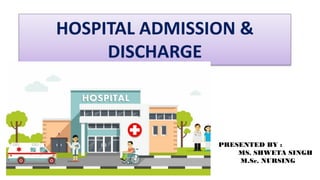
Hospital admission and discharge involve a crucial process. Patients are admitted to the hospital for medical treatment and care, where they receive necessary interventions and monitoring.
Specific objectives
•Explain theimportance of preparing the hospital unit prior to admission.
•Describe the purpose and procedure of preparing an admission bed.
•Outline the steps of admission procedure, including reception,
registration, assessment, and orientation of the patient.
•Identify the medico-legal issues related to admission (e.g., poisoning,
accidents, assault).
•Enumerate the roles and responsibilities of the nurse during hospital
admission, including physical, psychological, and social care.
4.
•Define discharge andexplain its importance in continuity of patient care.
•Differentiate between the types of discharge – planned, LAMA (Leave
Against Medical Advice), absconding, referral, and transfer.
•Explain the components of discharge planning, including patient and
family education.
•Describe the discharge procedure, including preparation of records,
patient instructions, and arrangements for follow-up.
•Identify the medico-legal issues associated with discharge, especially in
cases of LAMA, absconding, and death.
•Discuss the roles and responsibilities of the nurse during discharge,
such as preparing summaries, counseling, and ensuring continuity of care.
•Explain the procedure for care of the unit after discharge, including bed
making, cleaning, disinfection, and preparation for the next patient.
5.
INTRODUCTION
Hospital admission anddischarge are
essential components of patient care.
Admission refers to the process of
receiving a patient into the hospital for
diagnosis, treatment, or observation,
whereas discharge is the process of
officially releasing the patient after
treatment with advice for home care or
follow-up. Both require careful planning,
coordination, and documentation.
6.
DEFINITION
• "Admission ofa patient means allowing
and facilitating a patient to stay in the
hospital unit or ward for observation,
investigation, and treatment of the
disease he or she is suffering from.”
"Admission is defined as allowing a
patient to stay in hospital for observation,
investigation, treatment and care."
"Hospital admission may be defined as
‘receiving a patient to stay in the hospital
for observation, investigation, diagnosis,
treatment and care.’"
7.
PURPOSES OF
ADMISSION
Hospital admissionis not merely
receiving a patient into the ward; it
has several important purposes:
1. Diagnostic Purpose
•To conduct observation,
investigations, and diagnostic tests
(e.g., X-rays, blood tests, CT scans)
for identifying the illness.
8.
CONTI…. 2. TherapeuticPurpose
•To provide treatment, surgery,
medical procedures, and nursing care
that cannot be done at home.
•To administer medications, IV fluids,
and specialized interventions.
3. Rest and Recovery
•To provide rest, comfort, and
supportive care in an environment
conducive to healing.
9.
CONTI….
4. Emergency andIntensive Care
•To manage patients in critical conditions
such as trauma, poisoning, burns, or cardiac
arrest.
5. Preventive and Promotive Purpose
•To prevent complications through early
detection and timely management.
•To promote health through health
education, counseling, and lifestyle
modifications.
11.
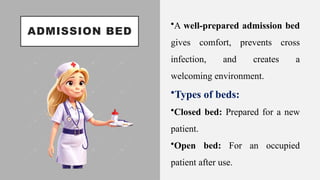
ADMISSION BED
•A well-preparedadmission bed
gives comfort, prevents cross
infection, and creates a
welcoming environment.
•Types of beds:
•Closed bed: Prepared for a new
patient.
•Open bed: For an occupied
patient after use.
12.
CONTI….
Procedure for admissionbed:
•Use clean linen, properly tucked
and wrinkle-free.
•Keep essential items ready: pillow,
blanket, draw sheet, mackintosh.
•Provide hand hygiene facilities.
•Place identification bands and
charts at bedside.
14.
Admission procedure refersto the
systematic process of receiving a patient
into a hospital or healthcare unit for
observation, diagnosis, treatment, and care.
It involves preparation of the unit,
receiving the patient, orientation,
documentation, and ensuring comfort and
safety.
15.
STEPS OF ADMISSION
PROCEDURE
1.Preparation of Unit
•Prepare admission bed with clean linen,
draw sheet, and mackintosh.
•Ensure cleanliness, proper ventilation,
and availability of equipment
(thermometer, BP apparatus, oxygen,
suction).
•Keep admission record files, consent
forms, and patient ID bands ready.
2. Reception of the Patient
Receive patient courteously, introduce
yourself, and call by name.
Provide wheelchair or stretcher if
required.
Offer reassurance to relieve anxiety.
16.
CONTI….
3. Identification andRegistration
•Record demographic details: name, age,
sex, address, occupation, religion,
marital status.
•Assign hospital registration number and
ward/bed number.
•Obtain signatures for admission and
consent forms.
4. Assessment and History Taking
• Record medical, surgical, family, and
social history.
• Perform physical assessment: vital
signs, anthropometry, and general
condition.
• Note allergies, risk factors, and
special needs.
17.
CONTI….
5. Orientation tothe Unit
•Show the patient bed, bathroom, nurse call
bell, and ward facilities.
•Explain ward rules, visiting hours, and meal
timings.
•Introduce to roommate and ward staff.
6. Documentation
Complete admission record, nursing
assessment forms, and consent forms.
Enter medico-legal cases (MLC) in medico-
legal register when applicable.
18.
CONTI….
7. Comfort andSafety Measures
•Assist in changing into hospital
gown.
•Keep personal belongings safe and
documented.
•Provide psychological support to
reduce anxiety.
19.
NURSE’S ROLE IN
ADMISSION
•Preparethe unit and admission bed.
•Receive the patient with respect and
empathy.
•Perform nursing assessment and
baseline observations.
•Provide orientation and
psychological support.
•Complete all admission
documentation accurately.
•Ensure patient’s safety, comfort, and
continuity of care.
•Preparation: Ensure unit,admission bed, and necessary equipment are ready.
•Reception: Receive patient with courtesy and empathy.
•Assessment: Perform initial nursing assessment, record baseline vital signs.
•Documentation: Complete admission formalities, ensure signatures on consent
forms.
•Orientation: Explain ward environment, rules, and routines.
•Psychological support: Provide reassurance to reduce anxiety.
•Coordination: Collaborate with doctors, lab, pharmacy, and other departments.
27.
1. Nissanka R.Comprehensive Textbook of Foundation of Nursing. 1st ed.
New Delhi: Jaypee Brothers Medical Publishers (P) Ltd; 2016
2. Sharma SK. Nursing Foundations: A Textbook for B.Sc Nursing Students.
2nd ed. Elsevier; 2021.
3. Basavanthappa BT. Nursing Foundations. Jaypee Brothers Medical
Publishers; 2015.
4. Potter PA, Perry AG. Fundamentals of Nursing. 9th ed. Elsevier; 2017.
5. Kozier B, Erb G, et al. Fundamentals of Nursing: Concepts, Process and
Practice. 10th ed. Pearson; 2016.