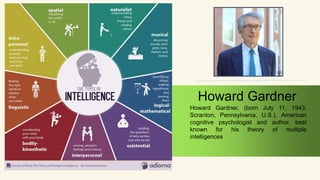
Howard Gardner, (born July 11, 1943,
Scranton, Pennsylvania, U.S.), American
cognitive psychologist and author, best
known for his theory of multiple
intelligences
Howard Gardner
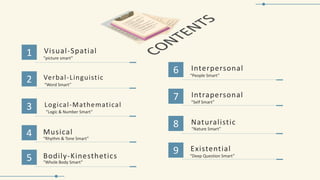
6 Interpersonal
“People Smart”
7 Intrapersonal
“Self Smart”
8 Naturalistic
“Nature Smart”
9 Existential
“Deep Question Smart”
“picture smart”
1 Visual-Spatial
2 Verbal-Linguistic
“Word Smart”
3 Logical-Mathematical
“Logic & Number Smart”
4 Musical
“Rhythm & Tone Smart”
5 Bodily-Kinesthetics
“Whole Body Smart”
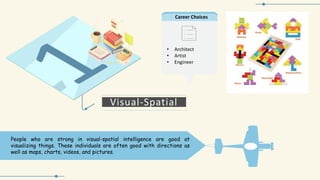
People who are strong in visual-spatial intelligence are good at
visualizing things. These individuals are often good with directions as
well as maps, charts, videos, and pictures.
• Architect
• Artist
• Engineer
Career Choices
Visual-Spatial
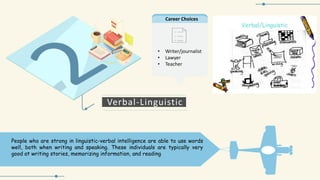
People who are strong in linguistic-verbal intelligence are able to use words
well, both when writing and speaking. These individuals are typically very
good at writing stories, memorizing information, and reading
• Writer/journalist
• Lawyer
• Teacher
Career Choices
Verbal-Linguistic
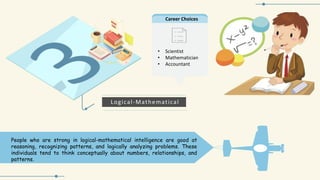
People who are strong in logical-mathematical intelligence are good at
reasoning, recognizing patterns, and logically analyzing problems. These
individuals tend to think conceptually about numbers, relationships, and
patterns.
• Scientist
• Mathematician
• Accountant
Career Choices
Logical-Mathematical
Bodily-Kinesthetic
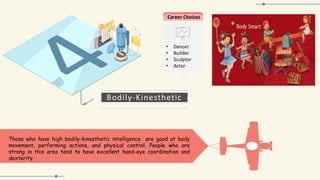
Those who have high bodily-kinesthetic intelligence are good at body
movement, performing actions, and physical control. People who are
strong in this area tend to have excellent hand-eye coordination and
dexterity.
Career Choices
• Dancer
• Builder
• Sculptor
• Actor
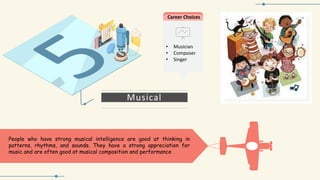
Musical
People who have strong musical intelligence are good at thinking in
patterns, rhythms, and sounds. They have a strong appreciation for
music and are often good at musical composition and performance
Career Choices
• Musician
• Composer
• Singer
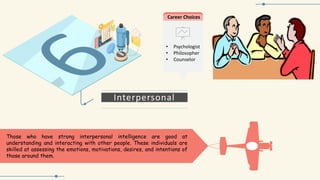
Interpersonal
Those who have strong interpersonal intelligence are good at
understanding and interacting with other people. These individuals are
skilled at assessing the emotions, motivations, desires, and intentions of
those around them.
Career Choices
• Psychologist
• Philosopher
• Counselor
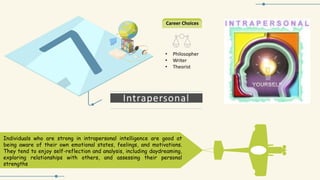
Intrapersonal
• Philosopher
• Writer
• Theorist
Career Choices
Individuals who are strong in intrapersonal intelligence are good at
being aware of their own emotional states, feelings, and motivations.
They tend to enjoy self-reflection and analysis, including daydreaming,
exploring relationships with others, and assessing their personal
strengths
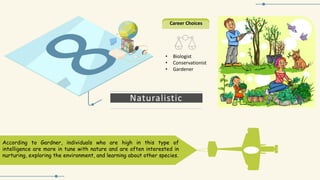
Naturalistic
• Biologist
• Conservationist
• Gardener
Career Choices
According to Gardner, individuals who are high in this type of
intelligence are more in tune with nature and are often interested in
nurturing, exploring the environment, and learning about other species.
Existential
• Scientist
• Philosopher
• Theologian
Career Choices
Existential intelligence is the ability to be sensitive to, or have the
capacity for, conceptualizing or tackling deeper or larger questions about
human existence, such as the meaning of life, why are we born, why do
we die, what is consciousness, or how did we get here.
NAME - Darshil malviya
class - viii
roll no. - 4

Types of intelligence

  • 2.
    Howard Gardner, (bornJuly 11, 1943, Scranton, Pennsylvania, U.S.), American cognitive psychologist and author, best known for his theory of multiple intelligences Howard Gardner
  • 3.
    6 Interpersonal “People Smart” 7Intrapersonal “Self Smart” 8 Naturalistic “Nature Smart” 9 Existential “Deep Question Smart” “picture smart” 1 Visual-Spatial 2 Verbal-Linguistic “Word Smart” 3 Logical-Mathematical “Logic & Number Smart” 4 Musical “Rhythm & Tone Smart” 5 Bodily-Kinesthetics “Whole Body Smart”
  • 4.
    People who arestrong in visual-spatial intelligence are good at visualizing things. These individuals are often good with directions as well as maps, charts, videos, and pictures. • Architect • Artist • Engineer Career Choices Visual-Spatial
  • 5.
    People who arestrong in linguistic-verbal intelligence are able to use words well, both when writing and speaking. These individuals are typically very good at writing stories, memorizing information, and reading • Writer/journalist • Lawyer • Teacher Career Choices Verbal-Linguistic
  • 6.
    People who arestrong in logical-mathematical intelligence are good at reasoning, recognizing patterns, and logically analyzing problems. These individuals tend to think conceptually about numbers, relationships, and patterns. • Scientist • Mathematician • Accountant Career Choices Logical-Mathematical
  • 7.
    Bodily-Kinesthetic Those who havehigh bodily-kinesthetic intelligence are good at body movement, performing actions, and physical control. People who are strong in this area tend to have excellent hand-eye coordination and dexterity. Career Choices • Dancer • Builder • Sculptor • Actor
  • 8.
    Musical People who havestrong musical intelligence are good at thinking in patterns, rhythms, and sounds. They have a strong appreciation for music and are often good at musical composition and performance Career Choices • Musician • Composer • Singer
  • 9.
    Interpersonal Those who havestrong interpersonal intelligence are good at understanding and interacting with other people. These individuals are skilled at assessing the emotions, motivations, desires, and intentions of those around them. Career Choices • Psychologist • Philosopher • Counselor
  • 10.
    Intrapersonal • Philosopher • Writer •Theorist Career Choices Individuals who are strong in intrapersonal intelligence are good at being aware of their own emotional states, feelings, and motivations. They tend to enjoy self-reflection and analysis, including daydreaming, exploring relationships with others, and assessing their personal strengths
  • 11.
    Naturalistic • Biologist • Conservationist •Gardener Career Choices According to Gardner, individuals who are high in this type of intelligence are more in tune with nature and are often interested in nurturing, exploring the environment, and learning about other species.
  • 12.
    Existential • Scientist • Philosopher •Theologian Career Choices Existential intelligence is the ability to be sensitive to, or have the capacity for, conceptualizing or tackling deeper or larger questions about human existence, such as the meaning of life, why are we born, why do we die, what is consciousness, or how did we get here.
  • 13.
    NAME - Darshilmalviya class - viii roll no. - 4