The world's leading graph DB
Georgios Eleftheriadis
Software/Database Engineer
What is NOSQL?
 It’s not “No to SQL”
 It’s not “Never SQL”
 It’s “Not Only SQL” as they may support SQL-like query languages
NOSQL describes ongoing trend where developers increasingly opt for non-relational databases to
help solve their problems, in an effort to use the right tool for the right job.
 NOSQL example databases
 Document Oriented (CouchDB, MongoDB)
 Key-Value (Memcached, Redis)
 Graph Database (Neo4J, InfiniteGraph)
 Multi-model (ArangoDB, OrientDB)
2
Graphs are everywhere
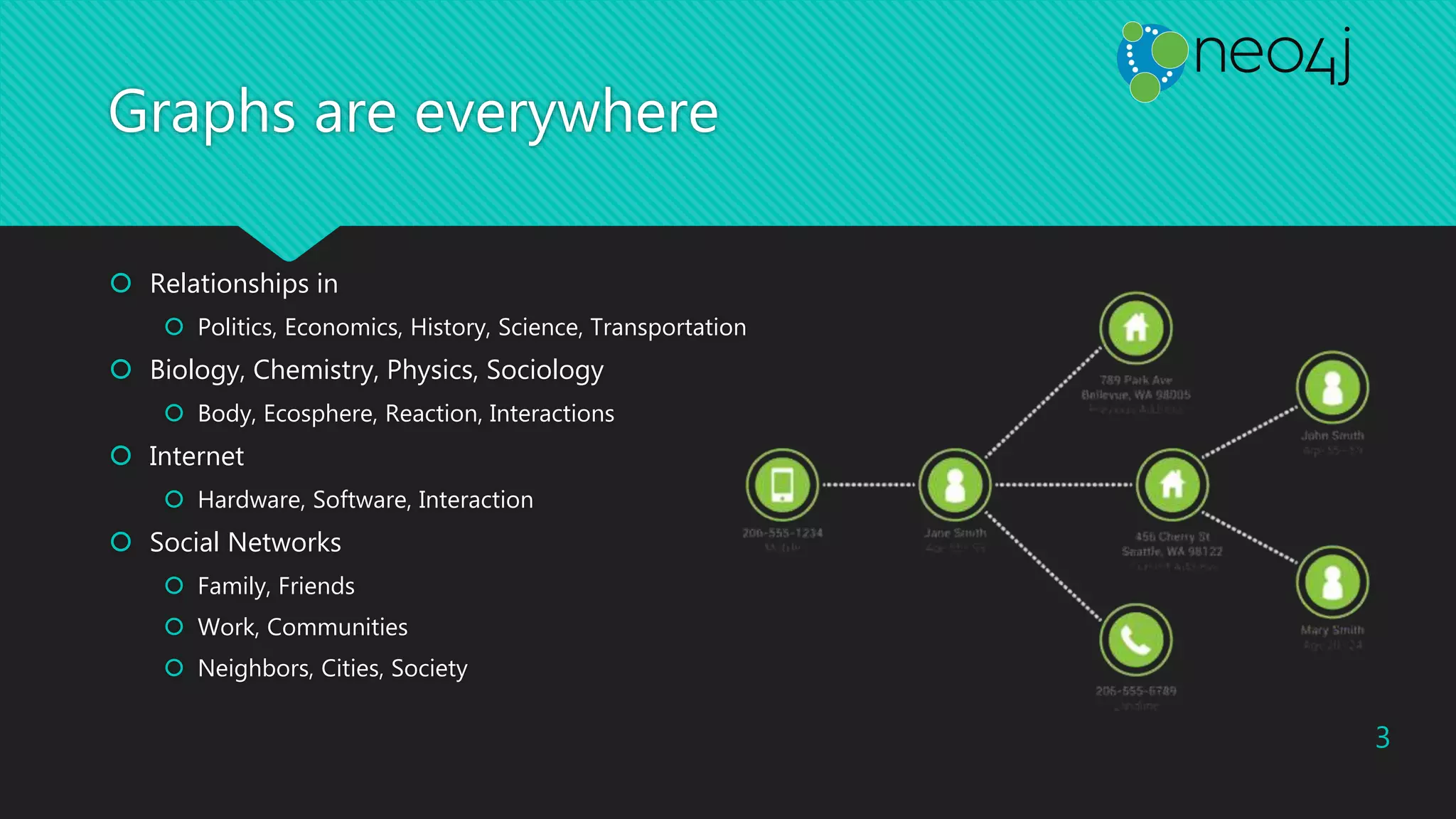
 Relationships in
 Politics, Economics, History, Science, Transportation
 Biology, Chemistry, Physics, Sociology
 Body, Ecosphere, Reaction, Interactions
 Internet
 Hardware, Software, Interaction
 Social Networks
 Family, Friends
 Work, Communities
 Neighbors, Cities, Society
3
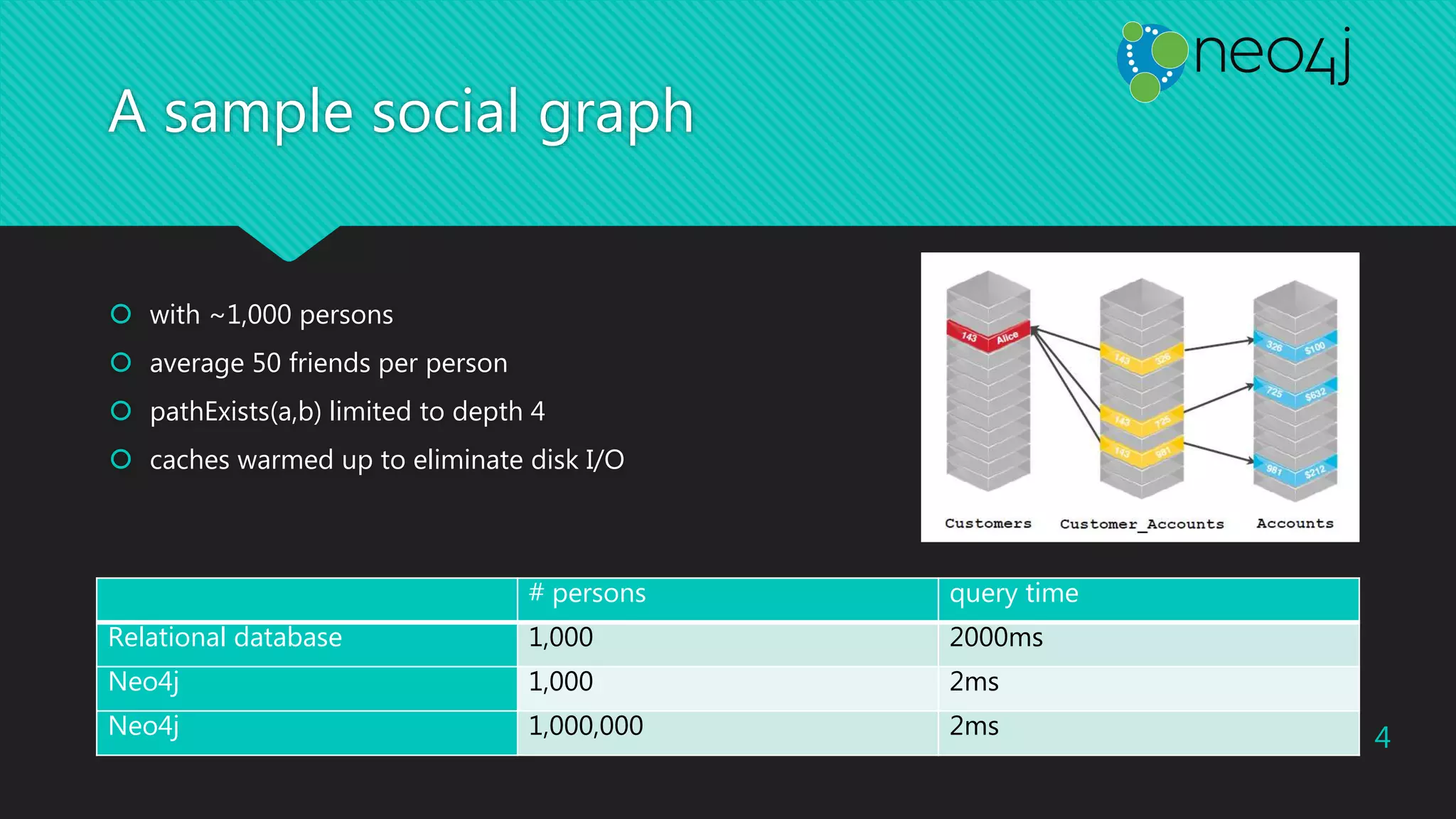
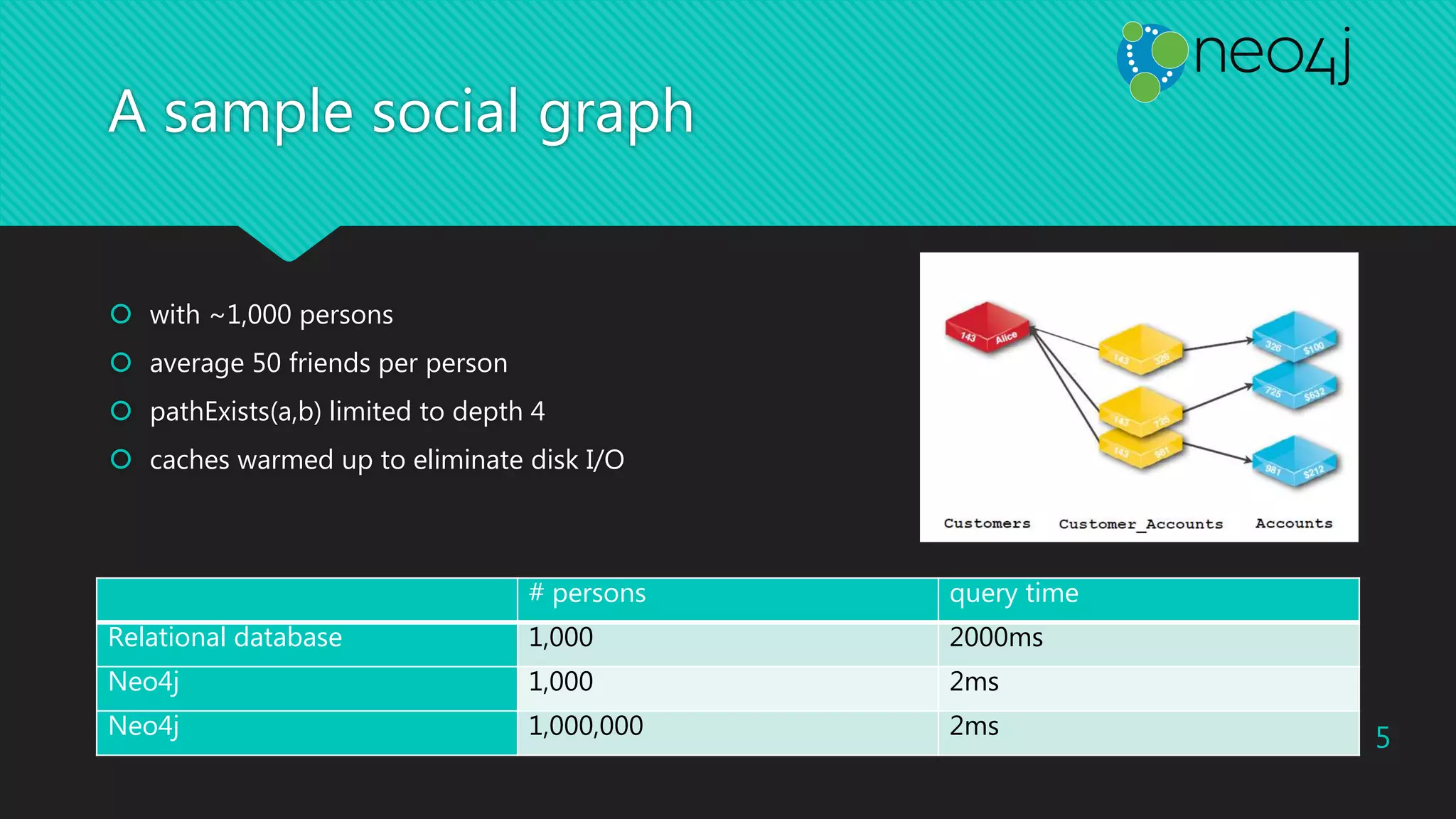
A sample social graph
# persons query time
Relational database 1,000 2000ms
Neo4j 1,000 2ms
Neo4j 1,000,000 2ms
 with ~1,000 persons
 average 50 friends per person
 pathExists(a,b) limited to depth 4
 caches warmed up to eliminate disk I/O
4
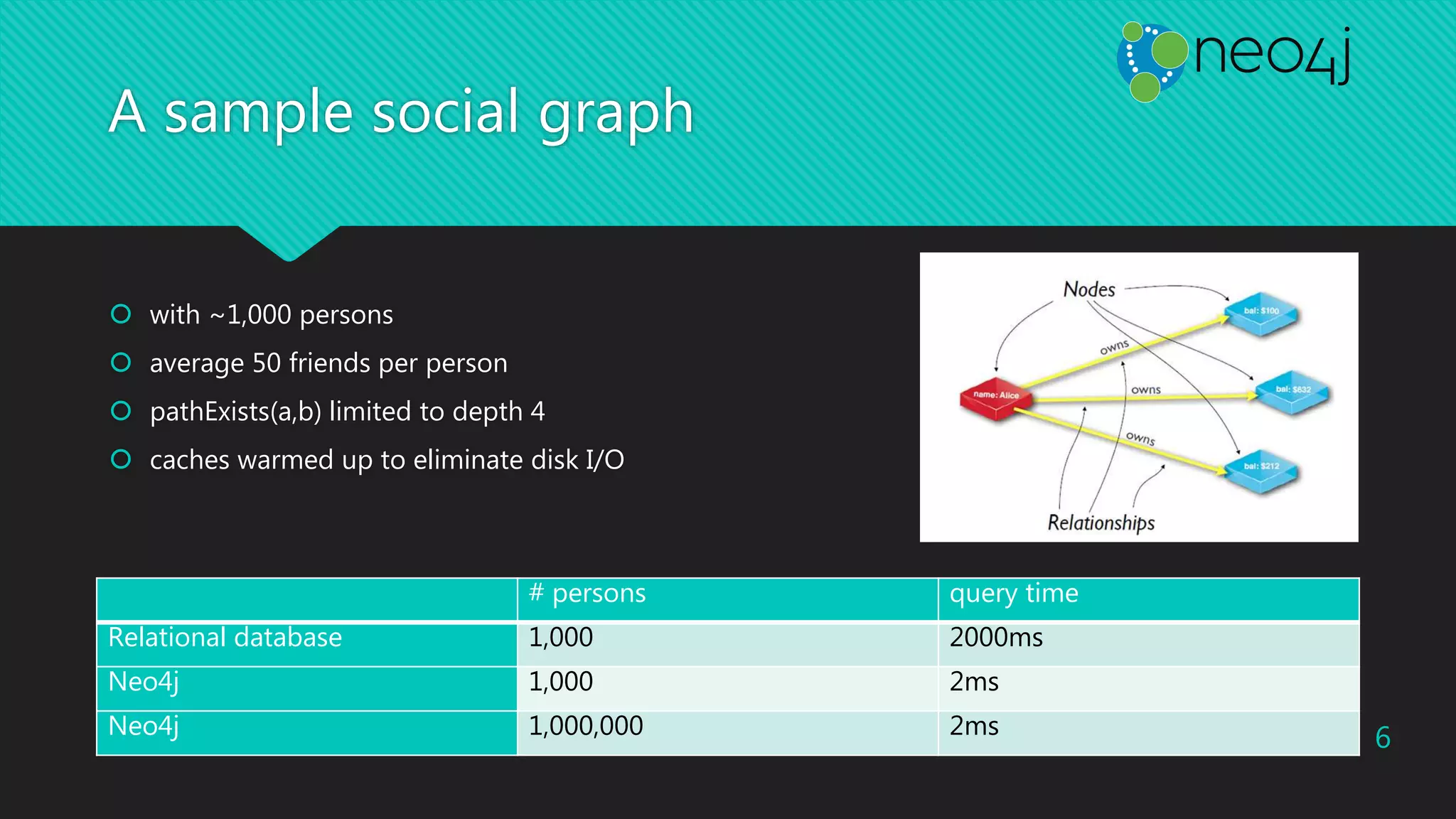
A sample social graph
# persons query time
Relational database 1,000 2000ms
Neo4j 1,000 2ms
Neo4j 1,000,000 2ms
 with ~1,000 persons
 average 50 friends per person
 pathExists(a,b) limited to depth 4
 caches warmed up to eliminate disk I/O
5
A sample social graph
# persons query time
Relational database 1,000 2000ms
Neo4j 1,000 2ms
Neo4j 1,000,000 2ms
 with ~1,000 persons
 average 50 friends per person
 pathExists(a,b) limited to depth 4
 caches warmed up to eliminate disk I/O
6
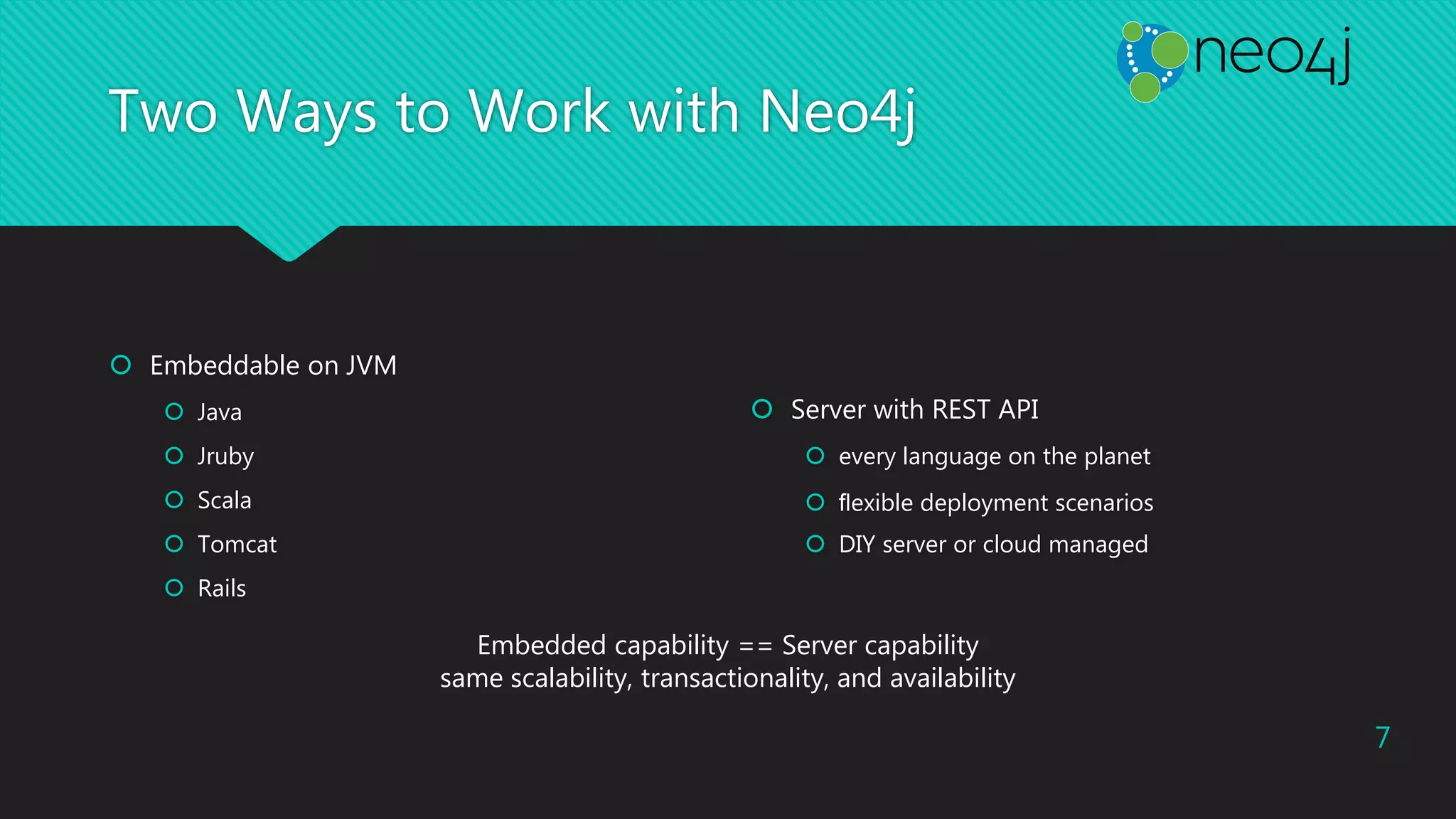
Two Ways to Work with Neo4j
 Embeddable on JVM
 Java
 Jruby
 Scala
 Tomcat
 Rails
 Server with REST API
 every language on the planet
 flexible deployment scenarios
 DIY server or cloud managed
Embedded capability == Server capability
same scalability, transactionality, and availability
7
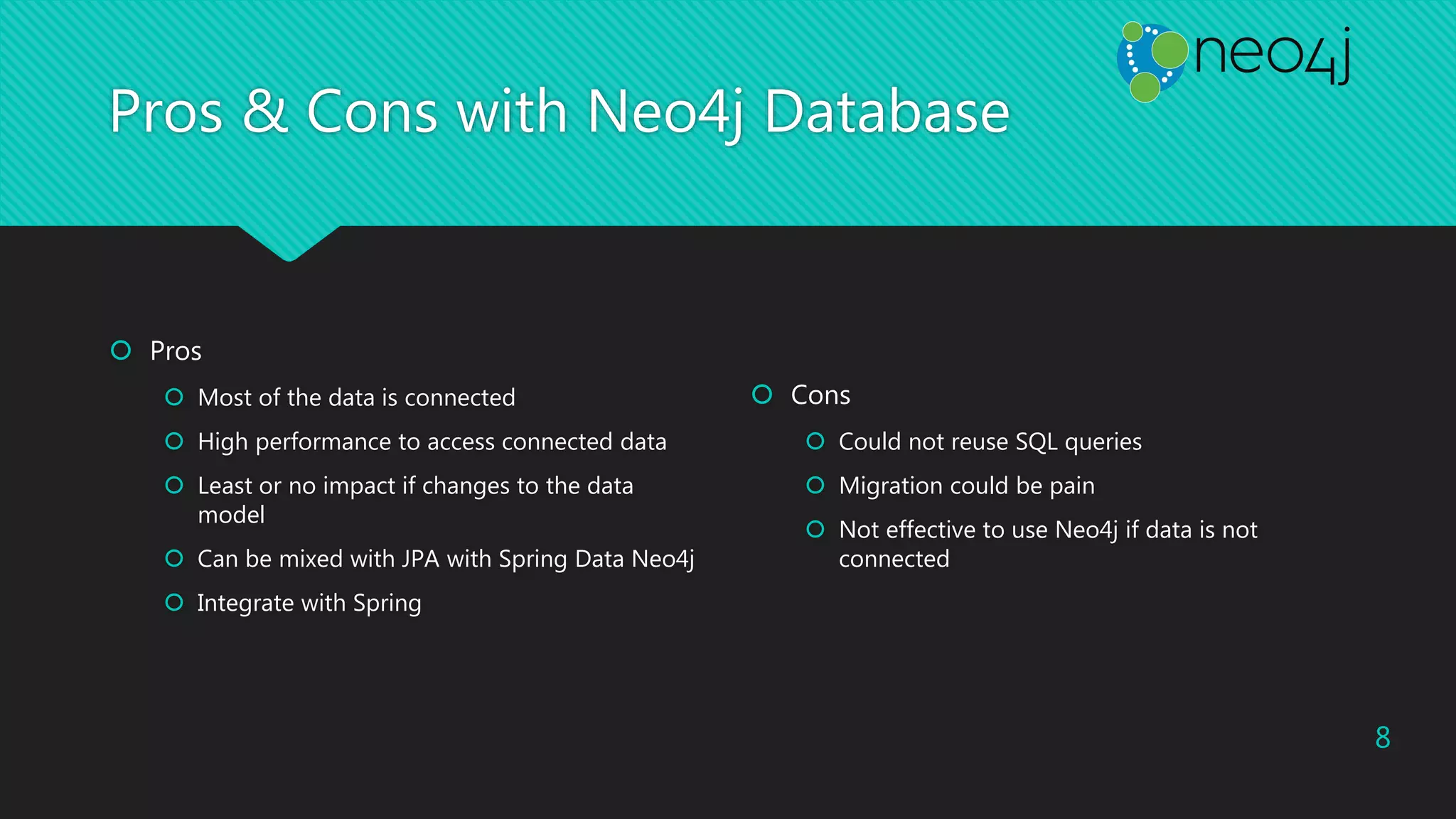
Pros & Cons with Neo4j Database
 Pros
 Most of the data is connected
 High performance to access connected data
 Least or no impact if changes to the data
model
 Can be mixed with JPA with Spring Data Neo4j
 Integrate with Spring
 Cons
 Could not reuse SQL queries
 Migration could be pain
 Not effective to use Neo4j if data is not
connected
8
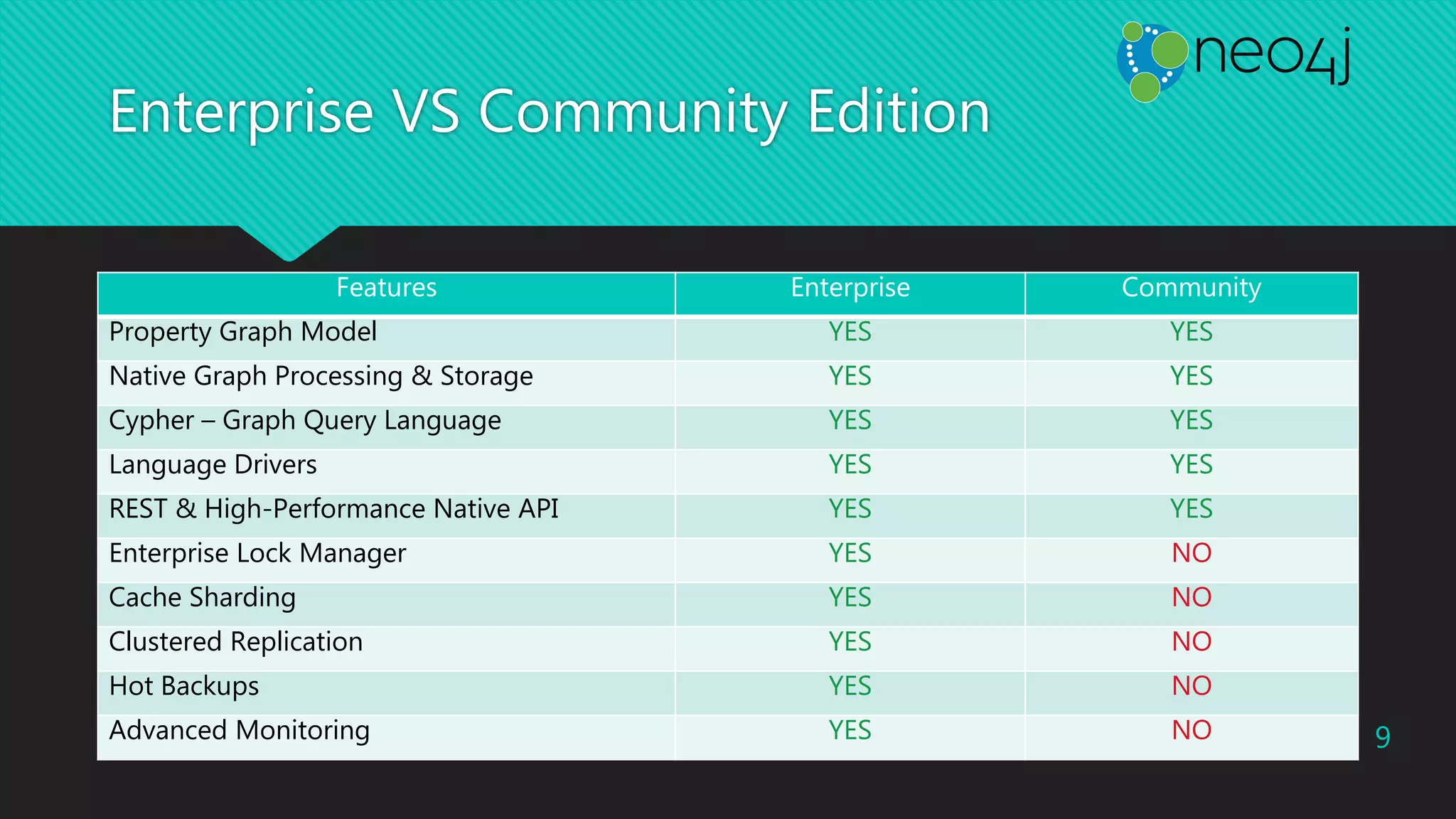
Enterprise VS Community Edition
Features Enterprise Community
Property Graph Model YES YES
Native Graph Processing & Storage YES YES
Cypher – Graph Query Language YES YES
Language Drivers YES YES
REST & High-Performance Native API YES YES
Enterprise Lock Manager YES NO
Cache Sharding YES NO
Clustered Replication YES NO
Hot Backups YES NO
Advanced Monitoring YES NO 9
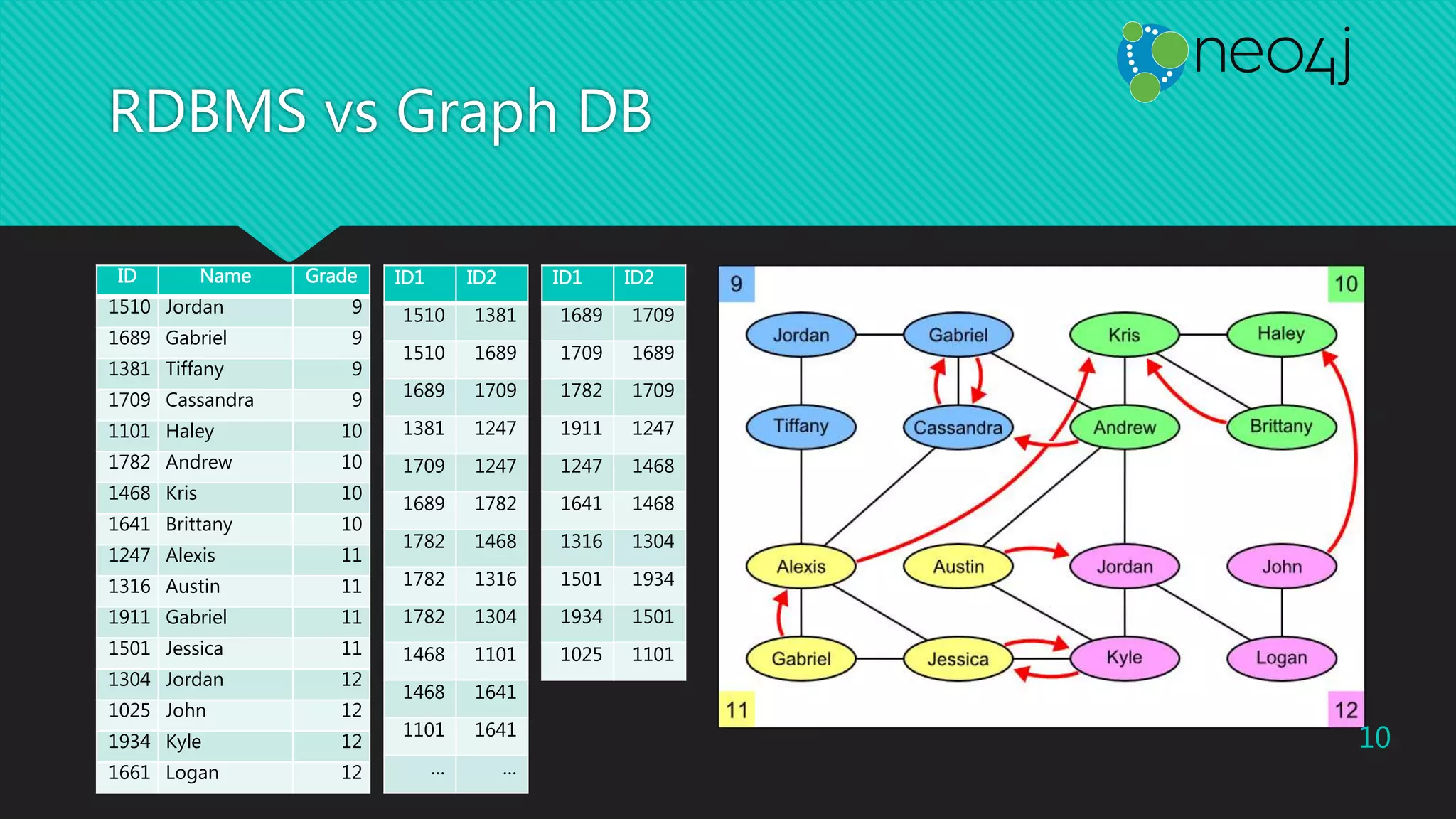
RDBMS vs Graph DB
10
ID Name Grade
1510 Jordan 9
1689 Gabriel 9
1381 Tiffany 9
1709 Cassandra 9
1101 Haley 10
1782 Andrew 10
1468 Kris 10
1641 Brittany 10
1247 Alexis 11
1316 Austin 11
1911 Gabriel 11
1501 Jessica 11
1304 Jordan 12
1025 John 12
1934 Kyle 12
1661 Logan 12
ID1 ID2
1510 1381
1510 1689
1689 1709
1381 1247
1709 1247
1689 1782
1782 1468
1782 1316
1782 1304
1468 1101
1468 1641
1101 1641
… …
ID1 ID2
1689 1709
1709 1689
1782 1709
1911 1247
1247 1468
1641 1468
1316 1304
1501 1934
1934 1501
1025 1101
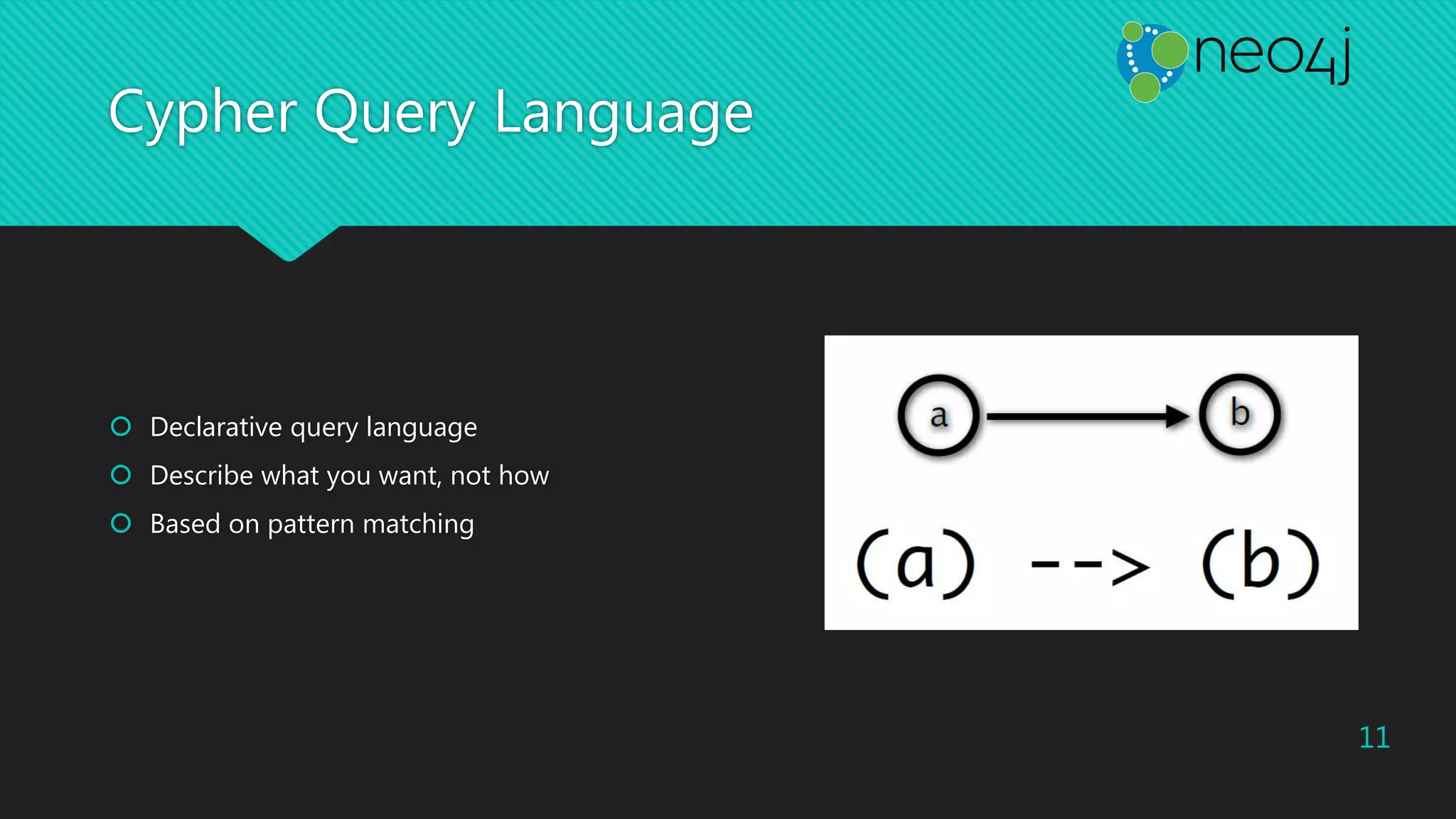
Cypher Query Language
 Declarative query language
 Describe what you want, not how
 Based on pattern matching
11
CQL MATCH
 MATCH (a)-->(b)
RETURN a, b;
 MATCH (a)-->()
RETURN a.name;
 MATCH (n)-[r]->(m)
RETURN n, r, m;
 MATCH (a)-[r]->()
RETURN id(a), labels(a), keys(a), type(r);
 MATCH (a)-[r:ACTED_IN]->(m)
RETURN a.name, r.roles, m.title;
12
CQL MATCH
 MATCH (a)-[:ACTED_IN]->(m)<-[:DIRECTED]-(d)
RETURN a.name, m.title, d.name;
 MATCH (a)-[:ACTED_IN]->(m)<-[:DIRECTED]-(d)
RETURN a.name AS actor, m.title AS movie, d.name AS director;
 MATCH (a)-[:ACTED_IN]->(m)
OPTIONAL MATCH (d)-[:DIRECTED]->(m)
RETURN a.name, m.title, d.name;
 MATCH (a)-[:ACTED_IN]->(m), (d)-[:DIRECTED]->(m)
RETURN a.name, m.title, d.name;
 MATCH p=(a)-[:ACTED_IN]->(m)<-[:DIRECTED]-(d)
RETURN nodes(p);
13
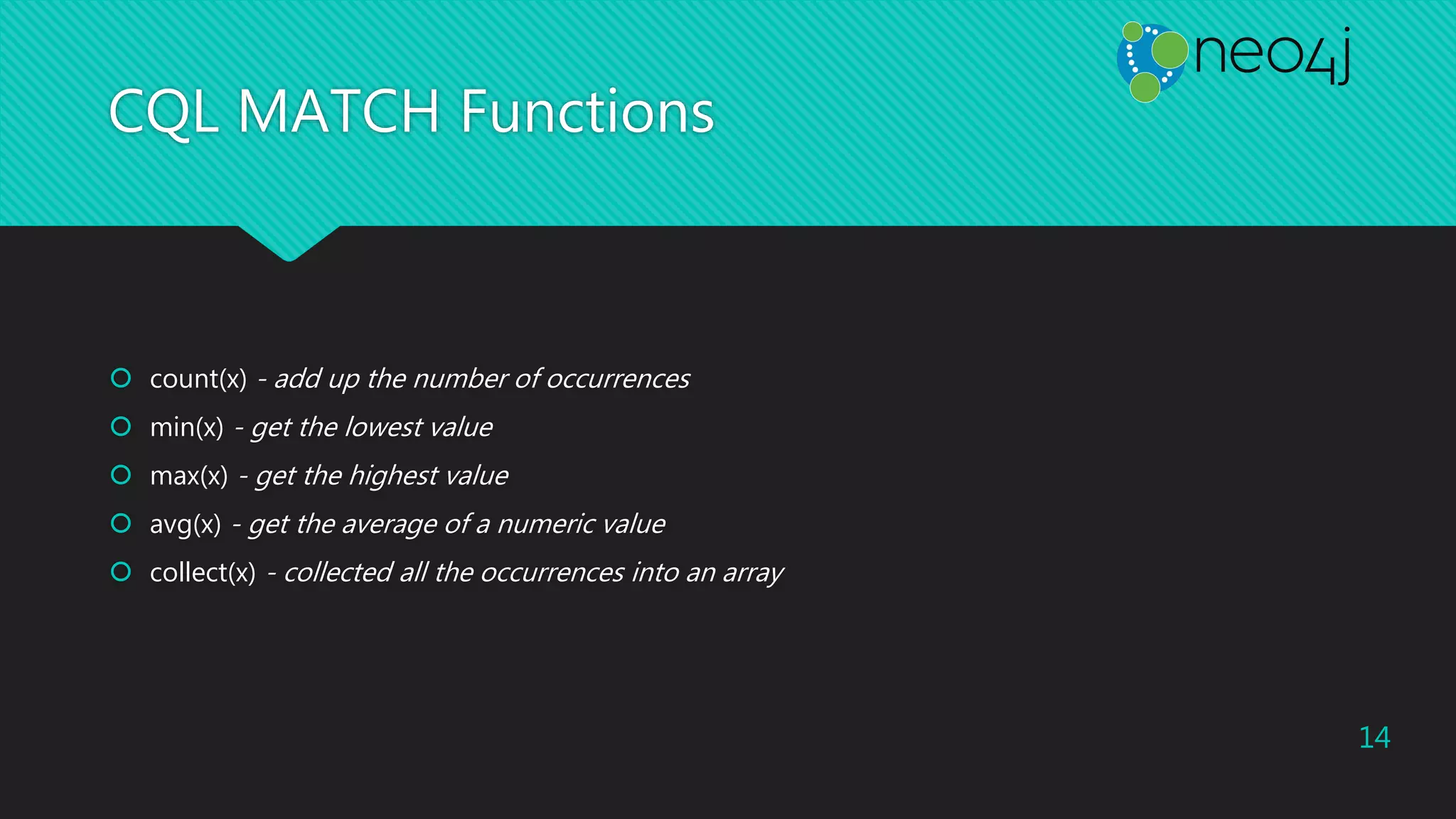
CQL MATCH Functions
 count(x) - add up the number of occurrences
 min(x) - get the lowest value
 max(x) - get the highest value
 avg(x) - get the average of a numeric value
 collect(x) - collected all the occurrences into an array
14
CQL WHERE
 MATCH (tom{name:"Tom Hanks"})-[:ACTED_IN]->(movie)
WHERE movie.released < 1992
RETURN DISTINCT movie.title;
 MATCH (actor{name:"Keanu Reeves"})-[r:ACTED_IN]->(movie)
WHERE "Neo" IN r.roles
RETURN DISTINCT movie.title;
 MATCH (tom{name:"Tom Hanks"})-[:ACTED_IN]->(movie)<-[:ACTED_IN]-(a)
WHERE a.born < tom.born
RETURN DISTINCT a.name, (tom.born - a.born) AS diff;
 MATCH (kevin {name:"Kevin Bacon"})-[:ACTED_IN]->(movie)
RETURN DISTINCT movie.title;
 MATCH (kevin)-[:ACTED_IN]->(movie)
WHERE kevin.name =~ '.*Kevin.*‘ // Regular expressions
RETURN DISTINCT movie.title;
15
CQL WHERE
 MATCH (gene {name:"Gene Hackman"})-[:ACTED_IN]->(movie)<-[:ACTED_IN]-(n)
WHERE (n)-[:DIRECTED]->()
RETURN DISTINCT n.name;
 MATCH (a)-[:ACTED_IN]->()
RETURN a.name, count(*) AS count
ORDER BY count DESC LIMIT 5;
 MATCH (keanu {name:"Keanu Reeves"})-[:ACTED_IN]->()<-[:ACTED_IN]-(c),
(c)-[:ACTED_IN]->()<-[:ACTED_IN]-(coc)
WHERE NOT((keanu)-[:ACTED_IN]->()<-[:ACTED_IN]-(coc)) AND coc <> keanu
RETURN coc.name, count(coc)
ORDER BY count(coc) DESC LIMIT 3;
// Recommend 5 actors that Keanu Reeves should work with (but hasn't)
16
CQL CREATE
 CREATE ({title:"Mystic River", released:1993});
 MATCH (movie {title:"Mystic River"})
SET movie.tagline = "We bury our sins here, Dave. We wash them clean."
RETURN movie;
 MATCH (kevin {name:"Kevin Bacon"}),(movie {title:"Mystic River"})
CREATE UNIQUE (kevin)-[:ACTED_IN {roles:["Sean"]}]->(movie);
 MATCH (kevin {name:"Kevin Bacon"})-[r:ACTED_IN]->(movie {title:"Mystic River"})
SET r.roles = ["Sean Devine"]
RETURN r.roles;
 MATCH (clint {name:"Clint Eastwood"})-[r:ACTED_IN]->(movie {title:"Mystic River"})
CREATE UNIQUE (clint)-[:DIRECTED]->(movie);
17
CQL DELETE
 MATCH (matrix {title:"The Matrix"})<-[r:ACTED_IN]-(a)
WHERE "Emil" IN r.roles
RETURN a;
// Emil Eifrem is CEO of Neo Technology and co-founder of the Neo4j project
 MATCH (emil{name:"Emil Eifrem"})
DELETE emil;
 MATCH (emil{name:"Emil Eifrem"}) -[r]-()
DELETE r;
 MATCH (emil{name:"Emil Eifrem"}) -[r]-()
DELETE r, emil;
 MATCH (node) where ID(node)=1
OPTIONAL MATCH (node)-[r]-()
DELETE r, node;
18
SQL VS Cypher
MATCH (keanu:Person { name: 'Keanu Reeves' })-[:ACTED_IN]->(movie:Movie),
(director:Person)-[:DIRECTED]->(movie)
RETURN director.name, count(*)
ORDER BY count(*) DESC
19
SELECT director.name, count(*) FROM person Keanu
JOIN acted_in ON keanu.id = acted_in.person_id
JOIN directed ON acted_in.movie_id = directed.movie_id
JOIN person AS director ON directed.person_id = director.id
WHERE keanu.name = 'Keanu Reeves‘
GROUP BY director.name ORDER BY count(*) DESC
Now let’s find out a bit about the directors in movies that Keanu Reeves acted in. We want to know
how many of those movies each of them directed.
CQL INDEXES
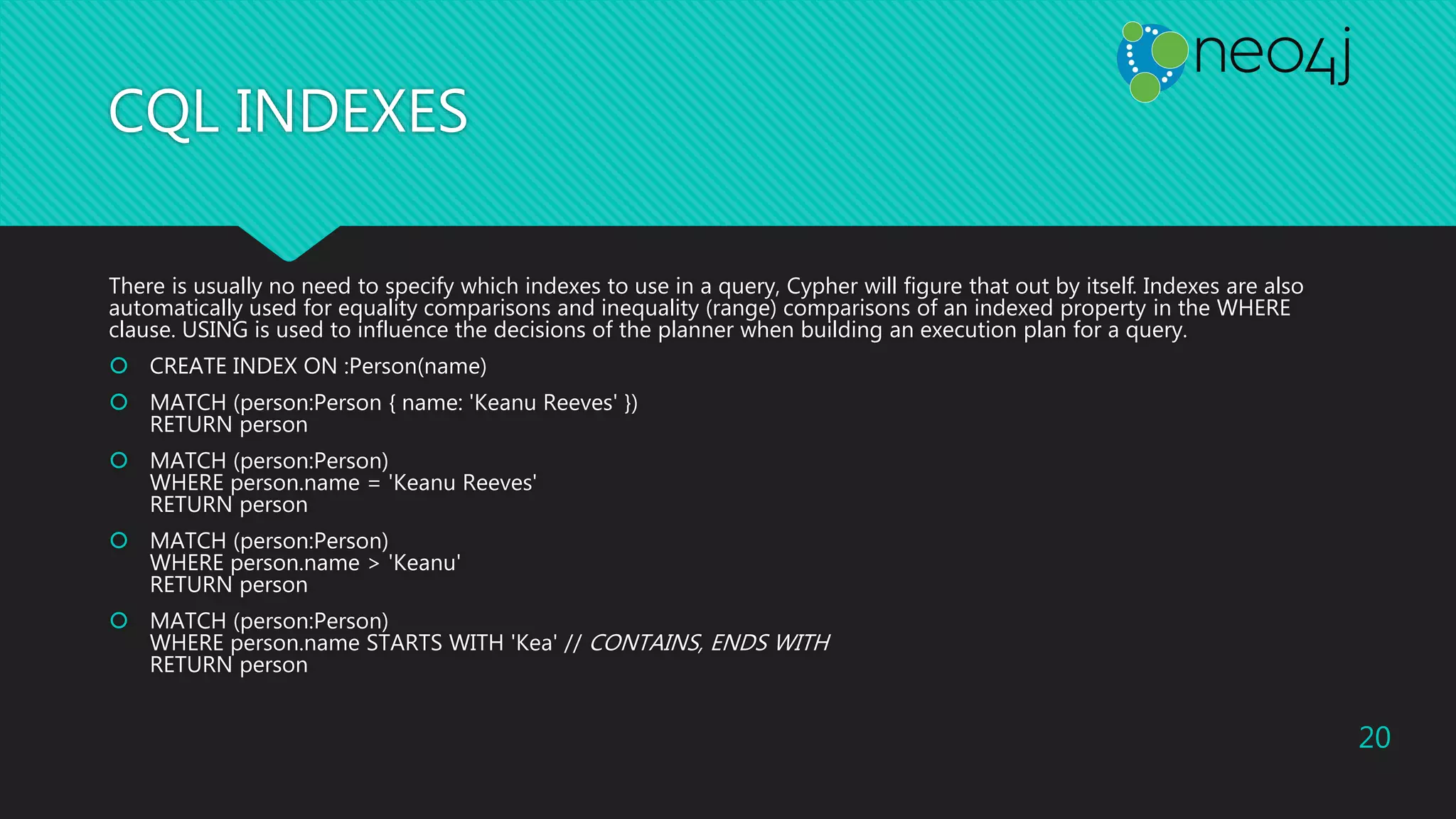
There is usually no need to specify which indexes to use in a query, Cypher will figure that out by itself. Indexes are also
automatically used for equality comparisons and inequality (range) comparisons of an indexed property in the WHERE
clause. USING is used to influence the decisions of the planner when building an execution plan for a query.
 CREATE INDEX ON :Person(name)
 MATCH (person:Person { name: 'Keanu Reeves' })
RETURN person
 MATCH (person:Person)
WHERE person.name = 'Keanu Reeves'
RETURN person
 MATCH (person:Person)
WHERE person.name > 'Keanu'
RETURN person
 MATCH (person:Person)
WHERE person.name STARTS WITH 'Kea' // CONTAINS, ENDS WITH
RETURN person
20
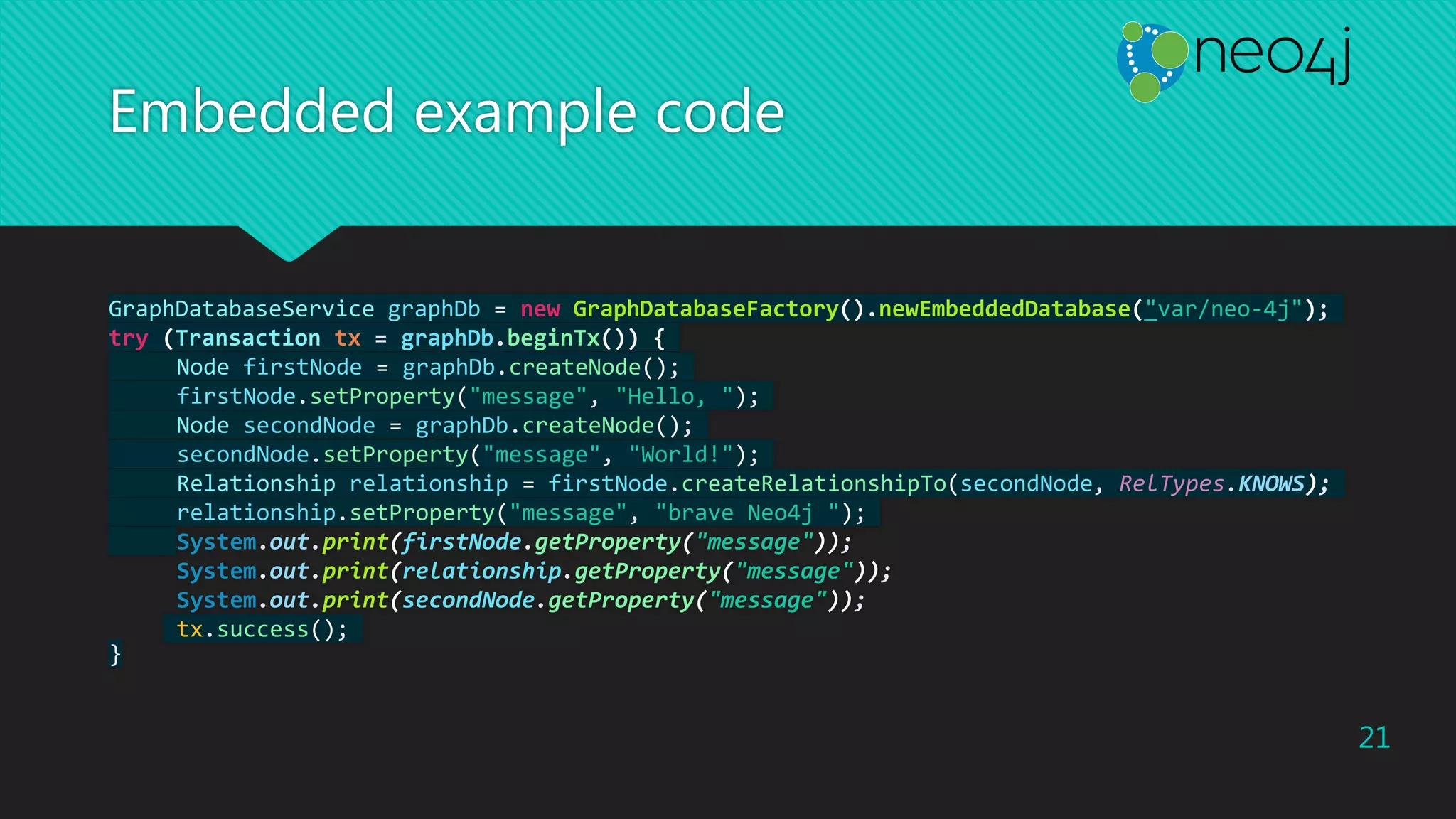
Embedded example code
GraphDatabaseService graphDb = new GraphDatabaseFactory().newEmbeddedDatabase("var/neo-4j");
try (Transaction tx = graphDb.beginTx()) {
Node firstNode = graphDb.createNode();
firstNode.setProperty("message", "Hello, ");
Node secondNode = graphDb.createNode();
secondNode.setProperty("message", "World!");
Relationship relationship = firstNode.createRelationshipTo(secondNode, RelTypes.KNOWS);
relationship.setProperty("message", "brave Neo4j ");
System.out.print(firstNode.getProperty("message"));
System.out.print(relationship.getProperty("message"));
System.out.print(secondNode.getProperty("message"));
tx.success();
}
21
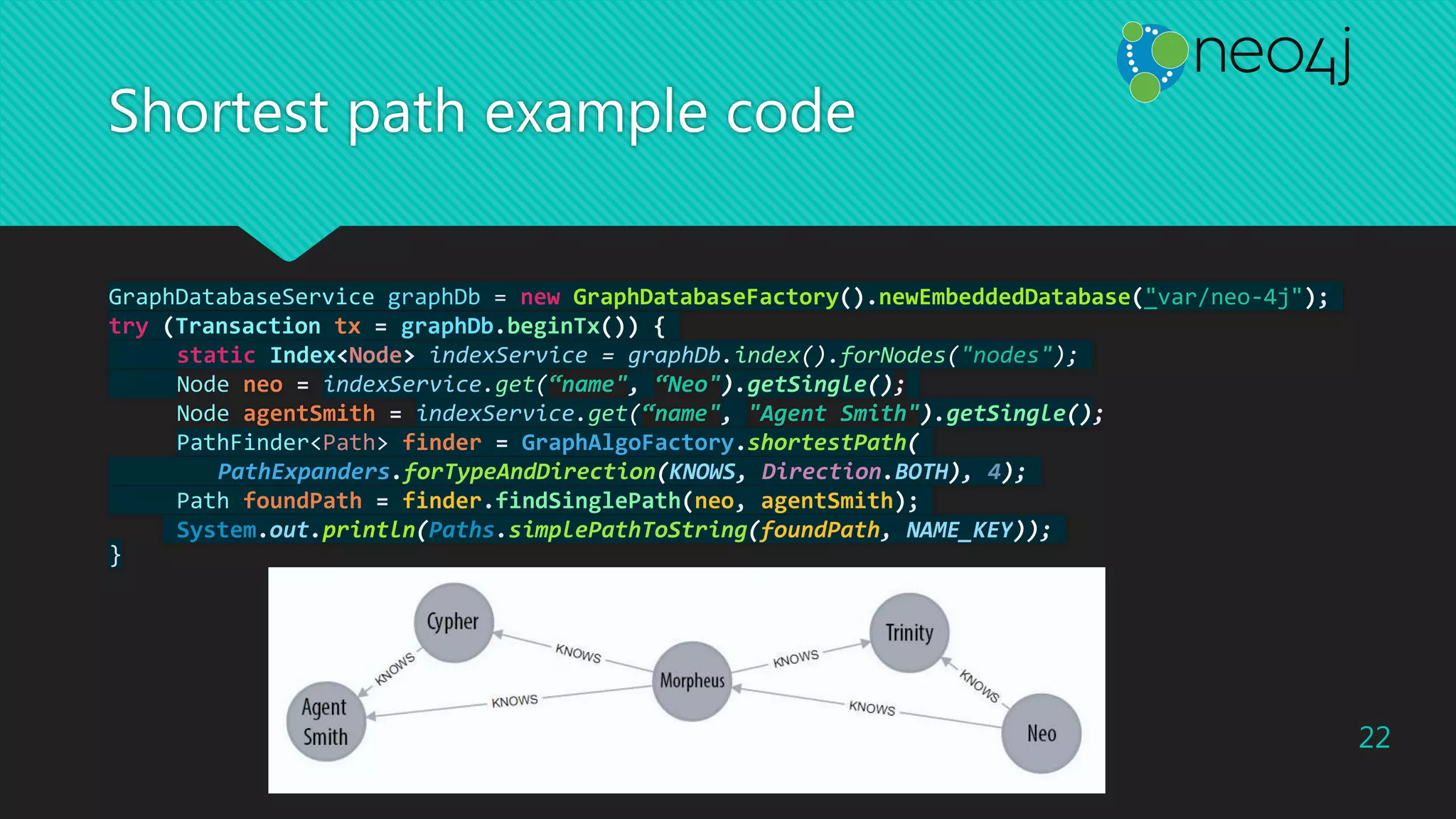
Shortest path example code
GraphDatabaseService graphDb = new GraphDatabaseFactory().newEmbeddedDatabase("var/neo-4j");
try (Transaction tx = graphDb.beginTx()) {
static Index<Node> indexService = graphDb.index().forNodes("nodes");
Node neo = indexService.get(“name", “Neo").getSingle();
Node agentSmith = indexService.get(“name", "Agent Smith").getSingle();
PathFinder<Path> finder = GraphAlgoFactory.shortestPath(
PathExpanders.forTypeAndDirection(KNOWS, Direction.BOTH), 4);
Path foundPath = finder.findSinglePath(neo, agentSmith);
System.out.println(Paths.simplePathToString(foundPath, NAME_KEY));
}
22
CQL Do-It-Yourself
 Add KNOWS relationships between all actors who were in the same movie
23
 MATCH (a)-[:ACTED_IN]->()<-[:ACTED_IN]-(b)
CREATE UNIQUE (a)-[:KNOWS]->(b);
 MATCH (a)-[:ACTED_IN|DIRECTED]->()<-[:ACTED_IN|DIRECTED]-(b)
CREATE UNIQUE (a)-[:KNOWS]->(b);
CQL Useful Tricks
 Find friends of friends
 MATCH (keanu{name:"Keanu Reeves"})-[:KNOWS*2]->(fof)
WHERE NOT((keanu)-[:KNOWS]-(fof))
RETURN DISTINCT fof.name;
 Find shortest path
 MATCH p=shortestPath(
(charlize{name:"Charlize Theron"})-[:KNOWS*]->(bacon{name:"Kevin Bacon"}))
RETURN length(rels(p));
 Return the names of the people joining Charlize to Kevin.
 MATCH p=shortestPath(
(charlize{name:"Charlize Theron"})-[:KNOWS*]->(bacon{name:"Kevin Bacon"}))
RETURN extract(n IN nodes(p)| n.name) AS names
24
CQL Useful Tricks
 Find movies and actors up to 4 "hops" away from Kevin Bacon
 MATCH (bacon:Person {name:"Kevin Bacon"})-[*1..4]-(hollywood)
RETURN DISTINCT Hollywood
 Find someone to introduce Tom Hanks to Tom Cruise
 MATCH (tom:Person {name:"Tom Hanks"})-[:ACTED_IN]->(m)<-[:ACTED_IN]-(coActors),
(coActors)-[:ACTED_IN]->(m2)<-[:ACTED_IN]-(cruise:Person {name:"Tom Cruise"})
RETURN tom, m, coActors, m2, cruise
25
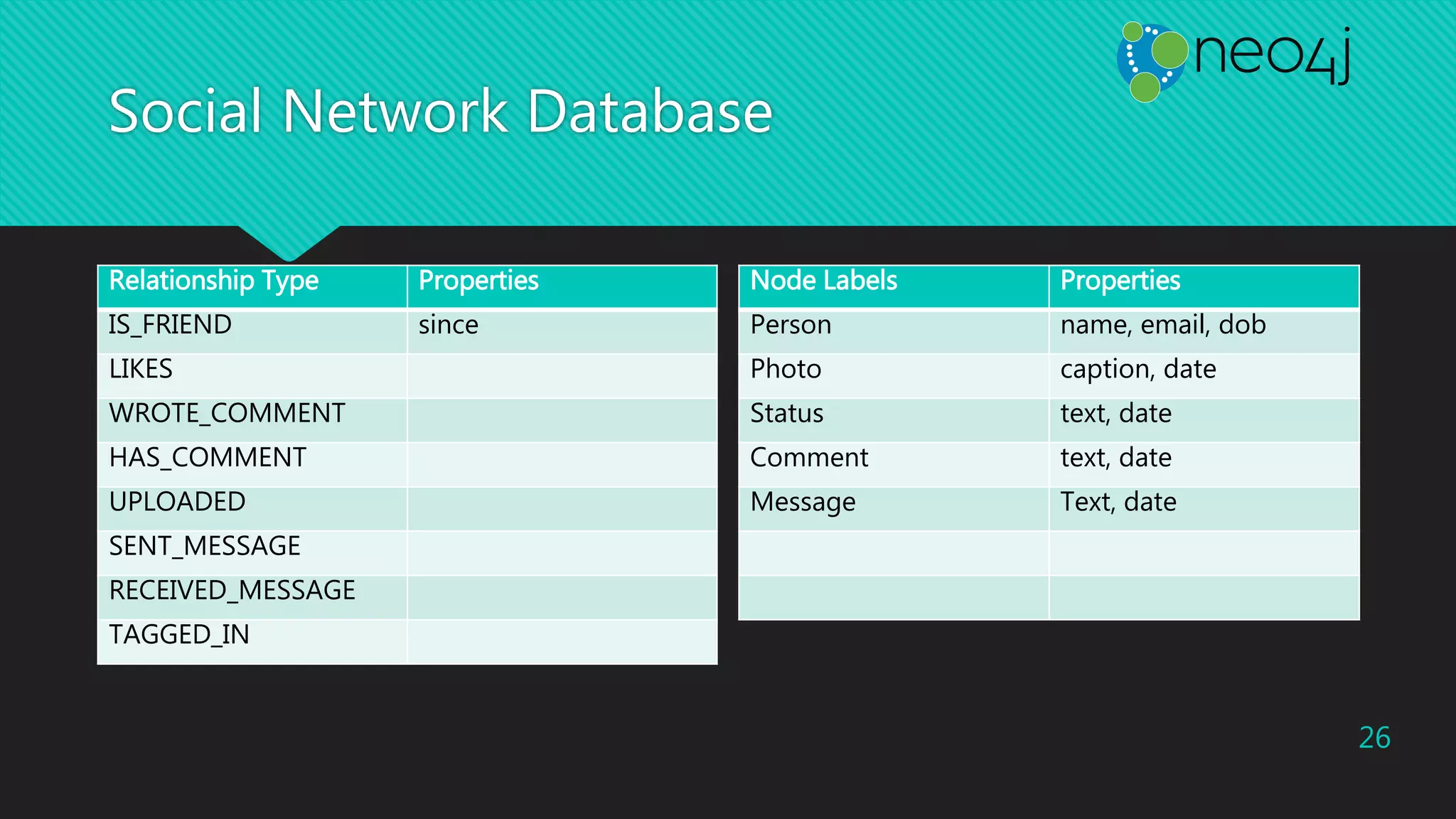
Social Network Database
Relationship Type Properties
IS_FRIEND since
LIKES
WROTE_COMMENT
HAS_COMMENT
UPLOADED
SENT_MESSAGE
RECEIVED_MESSAGE
TAGGED_IN
Node Labels Properties
Person name, email, dob
Photo caption, date
Status text, date
Comment text, date
Message Text, date
26
Social Network Database (2)
 CREATE (ann:Person { name: 'Ann', email:'ann@neo.4j', dob:487119060000 })
RETURN ann;
 CREATE (john:Person { name: 'John', email:'john@neo.4j', dob:435679060000 })
RETURN john;
 MATCH (ann:Person { name: 'Ann' }), (john:Person { name: 'John' })
CREATE UNIQUE (ann)-[:IS_FRIEND{since:'2009'}]-(john);
 MATCH (ann:Person { name: 'Ann' })
CREATE (ann)-[:UPLOADED]->(status:Status{text:'Happy Birthday', date:1451610010000});
 MATCH (john:Person { name: 'John' }), (status:Status{text:'Happy Birthday'})
CREATE (john)-[:LIKES]->(status);
27
Social Network Database (3)
 MATCH (john:Person { name: 'John' })
CREATE (john)-[:UPLOADED]->(photo:Photo{text:'Birthday Party', date:1452410019386});
 MATCH (ann:Person { name: 'Ann' }), (photo:Photo{text:'Birthday Party'})
CREATE (ann)-[:LIKES]->(photo);
 MATCH (ann:Person { name: 'Ann' }), (photo:Photo{text:'Birthday Party'})
CREATE (ann)-[:WROTE_COMMENT]->(comment:Comment{text:'Happy Birthday. The party was
great!', date:1452410478569})<-[:HAS_COMMENT]-(photo);
 MATCH (ann:Person { name: 'Ann' }), (photo:Photo{text:'Birthday Party'})
CREATE (ann)-[:TAGGED_IN]->(photo);
28
Social Network Database (4)
 MATCH (john:Person { name: 'John' })
RETURN (john)-[:UPLOADED]->(:Photo);
 MATCH (ann:Person { name: 'Ann' }) -[:LIKES]->(photo:Photo)
RETURN ann, photo;
 MATCH (ann:Person { name: 'Ann' })-[:IS_FRIEND]-(:Person)-[:UPLOADED]-(photo:Photo)
RETURN ann, photo
 MATCH (ann:Person { name: 'Ann' })-[:IS_FRIEND]-(friend:Person),
(friend:Person)-[:UPLOADED]-(photo:Photo)
RETURN ann, photo, friend
29
How to get started?
 Documentation
 http://neo4j.com/docs/ - tutorials & reference
 Neo4j in Action
 Graph Databases by O'Reilly
 Get Neo4j
 http://neo4j.org/download
 http://elements.heroku.com/addons/graphenedb
 Participate
 http://groups.google.com/group/neo4j
 http://neo4j.meetup.com
 http://stackoverflow.com/questions/tagged/neo4j
30

Neo4j

  • 1.
    The world's leadinggraph DB Georgios Eleftheriadis Software/Database Engineer
  • 2.
    What is NOSQL? It’s not “No to SQL”  It’s not “Never SQL”  It’s “Not Only SQL” as they may support SQL-like query languages NOSQL describes ongoing trend where developers increasingly opt for non-relational databases to help solve their problems, in an effort to use the right tool for the right job.  NOSQL example databases  Document Oriented (CouchDB, MongoDB)  Key-Value (Memcached, Redis)  Graph Database (Neo4J, InfiniteGraph)  Multi-model (ArangoDB, OrientDB) 2
  • 3.
    Graphs are everywhere Relationships in  Politics, Economics, History, Science, Transportation  Biology, Chemistry, Physics, Sociology  Body, Ecosphere, Reaction, Interactions  Internet  Hardware, Software, Interaction  Social Networks  Family, Friends  Work, Communities  Neighbors, Cities, Society 3
  • 4.
    A sample socialgraph # persons query time Relational database 1,000 2000ms Neo4j 1,000 2ms Neo4j 1,000,000 2ms  with ~1,000 persons  average 50 friends per person  pathExists(a,b) limited to depth 4  caches warmed up to eliminate disk I/O 4
  • 5.
    A sample socialgraph # persons query time Relational database 1,000 2000ms Neo4j 1,000 2ms Neo4j 1,000,000 2ms  with ~1,000 persons  average 50 friends per person  pathExists(a,b) limited to depth 4  caches warmed up to eliminate disk I/O 5
  • 6.
    A sample socialgraph # persons query time Relational database 1,000 2000ms Neo4j 1,000 2ms Neo4j 1,000,000 2ms  with ~1,000 persons  average 50 friends per person  pathExists(a,b) limited to depth 4  caches warmed up to eliminate disk I/O 6
  • 7.
    Two Ways toWork with Neo4j  Embeddable on JVM  Java  Jruby  Scala  Tomcat  Rails  Server with REST API  every language on the planet  flexible deployment scenarios  DIY server or cloud managed Embedded capability == Server capability same scalability, transactionality, and availability 7
  • 8.
    Pros & Conswith Neo4j Database  Pros  Most of the data is connected  High performance to access connected data  Least or no impact if changes to the data model  Can be mixed with JPA with Spring Data Neo4j  Integrate with Spring  Cons  Could not reuse SQL queries  Migration could be pain  Not effective to use Neo4j if data is not connected 8
  • 9.
    Enterprise VS CommunityEdition Features Enterprise Community Property Graph Model YES YES Native Graph Processing & Storage YES YES Cypher – Graph Query Language YES YES Language Drivers YES YES REST & High-Performance Native API YES YES Enterprise Lock Manager YES NO Cache Sharding YES NO Clustered Replication YES NO Hot Backups YES NO Advanced Monitoring YES NO 9
  • 10.
    RDBMS vs GraphDB 10 ID Name Grade 1510 Jordan 9 1689 Gabriel 9 1381 Tiffany 9 1709 Cassandra 9 1101 Haley 10 1782 Andrew 10 1468 Kris 10 1641 Brittany 10 1247 Alexis 11 1316 Austin 11 1911 Gabriel 11 1501 Jessica 11 1304 Jordan 12 1025 John 12 1934 Kyle 12 1661 Logan 12 ID1 ID2 1510 1381 1510 1689 1689 1709 1381 1247 1709 1247 1689 1782 1782 1468 1782 1316 1782 1304 1468 1101 1468 1641 1101 1641 … … ID1 ID2 1689 1709 1709 1689 1782 1709 1911 1247 1247 1468 1641 1468 1316 1304 1501 1934 1934 1501 1025 1101
  • 11.
    Cypher Query Language Declarative query language  Describe what you want, not how  Based on pattern matching 11
  • 12.
    CQL MATCH  MATCH(a)-->(b) RETURN a, b;  MATCH (a)-->() RETURN a.name;  MATCH (n)-[r]->(m) RETURN n, r, m;  MATCH (a)-[r]->() RETURN id(a), labels(a), keys(a), type(r);  MATCH (a)-[r:ACTED_IN]->(m) RETURN a.name, r.roles, m.title; 12
  • 13.
    CQL MATCH  MATCH(a)-[:ACTED_IN]->(m)<-[:DIRECTED]-(d) RETURN a.name, m.title, d.name;  MATCH (a)-[:ACTED_IN]->(m)<-[:DIRECTED]-(d) RETURN a.name AS actor, m.title AS movie, d.name AS director;  MATCH (a)-[:ACTED_IN]->(m) OPTIONAL MATCH (d)-[:DIRECTED]->(m) RETURN a.name, m.title, d.name;  MATCH (a)-[:ACTED_IN]->(m), (d)-[:DIRECTED]->(m) RETURN a.name, m.title, d.name;  MATCH p=(a)-[:ACTED_IN]->(m)<-[:DIRECTED]-(d) RETURN nodes(p); 13
  • 14.
    CQL MATCH Functions count(x) - add up the number of occurrences  min(x) - get the lowest value  max(x) - get the highest value  avg(x) - get the average of a numeric value  collect(x) - collected all the occurrences into an array 14
  • 15.
    CQL WHERE  MATCH(tom{name:"Tom Hanks"})-[:ACTED_IN]->(movie) WHERE movie.released < 1992 RETURN DISTINCT movie.title;  MATCH (actor{name:"Keanu Reeves"})-[r:ACTED_IN]->(movie) WHERE "Neo" IN r.roles RETURN DISTINCT movie.title;  MATCH (tom{name:"Tom Hanks"})-[:ACTED_IN]->(movie)<-[:ACTED_IN]-(a) WHERE a.born < tom.born RETURN DISTINCT a.name, (tom.born - a.born) AS diff;  MATCH (kevin {name:"Kevin Bacon"})-[:ACTED_IN]->(movie) RETURN DISTINCT movie.title;  MATCH (kevin)-[:ACTED_IN]->(movie) WHERE kevin.name =~ '.*Kevin.*‘ // Regular expressions RETURN DISTINCT movie.title; 15
  • 16.
    CQL WHERE  MATCH(gene {name:"Gene Hackman"})-[:ACTED_IN]->(movie)<-[:ACTED_IN]-(n) WHERE (n)-[:DIRECTED]->() RETURN DISTINCT n.name;  MATCH (a)-[:ACTED_IN]->() RETURN a.name, count(*) AS count ORDER BY count DESC LIMIT 5;  MATCH (keanu {name:"Keanu Reeves"})-[:ACTED_IN]->()<-[:ACTED_IN]-(c), (c)-[:ACTED_IN]->()<-[:ACTED_IN]-(coc) WHERE NOT((keanu)-[:ACTED_IN]->()<-[:ACTED_IN]-(coc)) AND coc <> keanu RETURN coc.name, count(coc) ORDER BY count(coc) DESC LIMIT 3; // Recommend 5 actors that Keanu Reeves should work with (but hasn't) 16
  • 17.
    CQL CREATE  CREATE({title:"Mystic River", released:1993});  MATCH (movie {title:"Mystic River"}) SET movie.tagline = "We bury our sins here, Dave. We wash them clean." RETURN movie;  MATCH (kevin {name:"Kevin Bacon"}),(movie {title:"Mystic River"}) CREATE UNIQUE (kevin)-[:ACTED_IN {roles:["Sean"]}]->(movie);  MATCH (kevin {name:"Kevin Bacon"})-[r:ACTED_IN]->(movie {title:"Mystic River"}) SET r.roles = ["Sean Devine"] RETURN r.roles;  MATCH (clint {name:"Clint Eastwood"})-[r:ACTED_IN]->(movie {title:"Mystic River"}) CREATE UNIQUE (clint)-[:DIRECTED]->(movie); 17
  • 18.
    CQL DELETE  MATCH(matrix {title:"The Matrix"})<-[r:ACTED_IN]-(a) WHERE "Emil" IN r.roles RETURN a; // Emil Eifrem is CEO of Neo Technology and co-founder of the Neo4j project  MATCH (emil{name:"Emil Eifrem"}) DELETE emil;  MATCH (emil{name:"Emil Eifrem"}) -[r]-() DELETE r;  MATCH (emil{name:"Emil Eifrem"}) -[r]-() DELETE r, emil;  MATCH (node) where ID(node)=1 OPTIONAL MATCH (node)-[r]-() DELETE r, node; 18
  • 19.
    SQL VS Cypher MATCH(keanu:Person { name: 'Keanu Reeves' })-[:ACTED_IN]->(movie:Movie), (director:Person)-[:DIRECTED]->(movie) RETURN director.name, count(*) ORDER BY count(*) DESC 19 SELECT director.name, count(*) FROM person Keanu JOIN acted_in ON keanu.id = acted_in.person_id JOIN directed ON acted_in.movie_id = directed.movie_id JOIN person AS director ON directed.person_id = director.id WHERE keanu.name = 'Keanu Reeves‘ GROUP BY director.name ORDER BY count(*) DESC Now let’s find out a bit about the directors in movies that Keanu Reeves acted in. We want to know how many of those movies each of them directed.
  • 20.
    CQL INDEXES There isusually no need to specify which indexes to use in a query, Cypher will figure that out by itself. Indexes are also automatically used for equality comparisons and inequality (range) comparisons of an indexed property in the WHERE clause. USING is used to influence the decisions of the planner when building an execution plan for a query.  CREATE INDEX ON :Person(name)  MATCH (person:Person { name: 'Keanu Reeves' }) RETURN person  MATCH (person:Person) WHERE person.name = 'Keanu Reeves' RETURN person  MATCH (person:Person) WHERE person.name > 'Keanu' RETURN person  MATCH (person:Person) WHERE person.name STARTS WITH 'Kea' // CONTAINS, ENDS WITH RETURN person 20
  • 21.
    Embedded example code GraphDatabaseServicegraphDb = new GraphDatabaseFactory().newEmbeddedDatabase("var/neo-4j"); try (Transaction tx = graphDb.beginTx()) { Node firstNode = graphDb.createNode(); firstNode.setProperty("message", "Hello, "); Node secondNode = graphDb.createNode(); secondNode.setProperty("message", "World!"); Relationship relationship = firstNode.createRelationshipTo(secondNode, RelTypes.KNOWS); relationship.setProperty("message", "brave Neo4j "); System.out.print(firstNode.getProperty("message")); System.out.print(relationship.getProperty("message")); System.out.print(secondNode.getProperty("message")); tx.success(); } 21
  • 22.
    Shortest path examplecode GraphDatabaseService graphDb = new GraphDatabaseFactory().newEmbeddedDatabase("var/neo-4j"); try (Transaction tx = graphDb.beginTx()) { static Index<Node> indexService = graphDb.index().forNodes("nodes"); Node neo = indexService.get(“name", “Neo").getSingle(); Node agentSmith = indexService.get(“name", "Agent Smith").getSingle(); PathFinder<Path> finder = GraphAlgoFactory.shortestPath( PathExpanders.forTypeAndDirection(KNOWS, Direction.BOTH), 4); Path foundPath = finder.findSinglePath(neo, agentSmith); System.out.println(Paths.simplePathToString(foundPath, NAME_KEY)); } 22
  • 23.
    CQL Do-It-Yourself  AddKNOWS relationships between all actors who were in the same movie 23  MATCH (a)-[:ACTED_IN]->()<-[:ACTED_IN]-(b) CREATE UNIQUE (a)-[:KNOWS]->(b);  MATCH (a)-[:ACTED_IN|DIRECTED]->()<-[:ACTED_IN|DIRECTED]-(b) CREATE UNIQUE (a)-[:KNOWS]->(b);
  • 24.
    CQL Useful Tricks Find friends of friends  MATCH (keanu{name:"Keanu Reeves"})-[:KNOWS*2]->(fof) WHERE NOT((keanu)-[:KNOWS]-(fof)) RETURN DISTINCT fof.name;  Find shortest path  MATCH p=shortestPath( (charlize{name:"Charlize Theron"})-[:KNOWS*]->(bacon{name:"Kevin Bacon"})) RETURN length(rels(p));  Return the names of the people joining Charlize to Kevin.  MATCH p=shortestPath( (charlize{name:"Charlize Theron"})-[:KNOWS*]->(bacon{name:"Kevin Bacon"})) RETURN extract(n IN nodes(p)| n.name) AS names 24
  • 25.
    CQL Useful Tricks Find movies and actors up to 4 "hops" away from Kevin Bacon  MATCH (bacon:Person {name:"Kevin Bacon"})-[*1..4]-(hollywood) RETURN DISTINCT Hollywood  Find someone to introduce Tom Hanks to Tom Cruise  MATCH (tom:Person {name:"Tom Hanks"})-[:ACTED_IN]->(m)<-[:ACTED_IN]-(coActors), (coActors)-[:ACTED_IN]->(m2)<-[:ACTED_IN]-(cruise:Person {name:"Tom Cruise"}) RETURN tom, m, coActors, m2, cruise 25
  • 26.
    Social Network Database RelationshipType Properties IS_FRIEND since LIKES WROTE_COMMENT HAS_COMMENT UPLOADED SENT_MESSAGE RECEIVED_MESSAGE TAGGED_IN Node Labels Properties Person name, email, dob Photo caption, date Status text, date Comment text, date Message Text, date 26
  • 27.
    Social Network Database(2)  CREATE (ann:Person { name: 'Ann', email:'ann@neo.4j', dob:487119060000 }) RETURN ann;  CREATE (john:Person { name: 'John', email:'john@neo.4j', dob:435679060000 }) RETURN john;  MATCH (ann:Person { name: 'Ann' }), (john:Person { name: 'John' }) CREATE UNIQUE (ann)-[:IS_FRIEND{since:'2009'}]-(john);  MATCH (ann:Person { name: 'Ann' }) CREATE (ann)-[:UPLOADED]->(status:Status{text:'Happy Birthday', date:1451610010000});  MATCH (john:Person { name: 'John' }), (status:Status{text:'Happy Birthday'}) CREATE (john)-[:LIKES]->(status); 27
  • 28.
    Social Network Database(3)  MATCH (john:Person { name: 'John' }) CREATE (john)-[:UPLOADED]->(photo:Photo{text:'Birthday Party', date:1452410019386});  MATCH (ann:Person { name: 'Ann' }), (photo:Photo{text:'Birthday Party'}) CREATE (ann)-[:LIKES]->(photo);  MATCH (ann:Person { name: 'Ann' }), (photo:Photo{text:'Birthday Party'}) CREATE (ann)-[:WROTE_COMMENT]->(comment:Comment{text:'Happy Birthday. The party was great!', date:1452410478569})<-[:HAS_COMMENT]-(photo);  MATCH (ann:Person { name: 'Ann' }), (photo:Photo{text:'Birthday Party'}) CREATE (ann)-[:TAGGED_IN]->(photo); 28
  • 29.
    Social Network Database(4)  MATCH (john:Person { name: 'John' }) RETURN (john)-[:UPLOADED]->(:Photo);  MATCH (ann:Person { name: 'Ann' }) -[:LIKES]->(photo:Photo) RETURN ann, photo;  MATCH (ann:Person { name: 'Ann' })-[:IS_FRIEND]-(:Person)-[:UPLOADED]-(photo:Photo) RETURN ann, photo  MATCH (ann:Person { name: 'Ann' })-[:IS_FRIEND]-(friend:Person), (friend:Person)-[:UPLOADED]-(photo:Photo) RETURN ann, photo, friend 29
  • 30.
    How to getstarted?  Documentation  http://neo4j.com/docs/ - tutorials & reference  Neo4j in Action  Graph Databases by O'Reilly  Get Neo4j  http://neo4j.org/download  http://elements.heroku.com/addons/graphenedb  Participate  http://groups.google.com/group/neo4j  http://neo4j.meetup.com  http://stackoverflow.com/questions/tagged/neo4j 30