KLE SOCIETY’S OF EDUCATION
VIDYANAGAR, HUBBALLI
SUBMITTED BY: RANJITHA.K
SEMESTER : 1st
TOPIC : MULTIMEDIA
SUBMITTED TO: PRADEEP.A.LAXETTI
CONTENTS.
• Introduction.
• History of Multimedia.
• Basic elements of Multimedia.
• Advantages,Dis advantages of Multimedia.
• Applications of Multimedia.
• Future scope of Multimedia.
• Coclusion.
INTRODUCTION.
• Multimedia is the medium through which the information can be transmitted
easily from one person to another person or from system to another system.
• Multimedia is the field concerned with the computer controlled integration of
Text, Graphics, Drawings and still Moving images (Animations) and etc….
• The world Multimedia is divided into two parts i.e,Multi+Media.
Multi(Many)+Media(Mode of communication)=MULTIMEDIA.
HISTORY OF MULTIMEDIA.
• The multimedia concept was first originated by a germanist called PAUL NIPKOW.
He invented the Nipkow disk, which laid the foundation of television, since his
disk was a fundamental component in the first televisions.
• During 1900’s Multimedia took into a current meaning by BOB GOLDSTEIN to
promote opening of his light work.
• Later,TAY VAUGHAN declared the Multimedia as combination of Text ,Graphic
,art , sounds, animation and video that is delivered by computer.
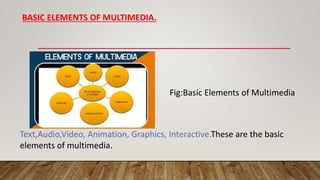
BASIC ELEMENTS OF MULTIMEDIA.
Fig:Basic Elements of Multimedia
Text,Audio,Video, Animation, Graphics, Interactive.These are the basic
elements of multimedia.
TEXT.
• Text is the most widely used and flexible means of presenting information on
screen and conveying ideas.Text is the foundation and fundamental word in
processing programs.
GRAPHICS.
• Humans are visually oriented with graphic.it consists of slide shows,Galleries
that a website or social media visitor can conveyed.Graphics may be in simple
matrix of tiny dots called pixel or drawing elements caled vector images.
Fig:Pixel graphic v/s Vector graphic.
ANIMATION.
• Animation is the process of dispalying still images so quickly so that they give the
continuous movement
Fig:An animated image.
AUDIO AND VIDEO.
• Audio and video commonly refers to the time-based media storage format for
sound /music and moving pictures information.
Audio. Video.
Intelligent Multimedia refers “as any compute conveyed electronic frame
work that enablesthre client to control join and manage diverse, kinds of
media.”
ADVANTAGES AND DISADVANTAGES.
ADVANTAGES.
• It can be used for educational and entertainment purposes
• It is quicker and it is easier.
• It is flexible.
DISADVANTAGES.
• It takes time to compile.
• Cost effective
• Information overload.Whenever file storage is too large it requires large computer
to store.
APPLICATION OF MULTIMEDIA.
Multimedia in Education.
• Multimedia content helps to vary and enhance the learning process, and leads to
better knowledge retention.
• Educational video can provide more opportunities for students to engage with the
content. Students around the world can learn from course content made available
through video.
Fig: Multimedia in
Education.
Multimedia in entertainment.
• Computer graphics are the most common used graphics for entertainment to make
video games and movies.
Multimedia in business.
• Video conferencing and Marketing surveying advertisement are the some
application used.Through video conference people can connect to explore there
business issues.Advertisement is done for the products through television and
internet through online.
Fig: Multimedia in Business.
• Multimedia in Medicine:Virtual surgery, Diagnosis.
• Multimedia in Engineering: Virtual reality,3D 4D Technology.
• Multimedia in Industries:Fine arts,Web design.
• Multimedia in Research: Satellite communications.
FUTURE SCOPE OF MULTIMEDIA.
• In future multimedia systems, seamless access to application services on different devices
available to users in their vicinity, will be commonplace.
• The future of digital media will evolve as new tools emerge, consumers make new
demands, and the quality and accessibility of the technologies improve. The rise of mobile
video, virtual reality (VR), augmented reality (AR), and the more refined use of data
analytics will all influence the future of digital media.
• A good multimedia program helps it in the future to reduce the limitation costs,less
reliability,less regulatory burden and etc…
CONCLUSION.
This chapter discussed that the evolution of knowledge and Communication
Technology (ICT) is an important milestone.Computer become an important
part of today’s lifestyle and completes are being employed in nearly each
field and everyday new areas of activities are being discovered . Application
of software education implications. The advantages of applications of
software word application.
Thank you.

Presentation (3)

  • 2.
    KLE SOCIETY’S OFEDUCATION VIDYANAGAR, HUBBALLI SUBMITTED BY: RANJITHA.K SEMESTER : 1st TOPIC : MULTIMEDIA SUBMITTED TO: PRADEEP.A.LAXETTI
  • 3.
    CONTENTS. • Introduction. • Historyof Multimedia. • Basic elements of Multimedia. • Advantages,Dis advantages of Multimedia. • Applications of Multimedia. • Future scope of Multimedia. • Coclusion.
  • 4.
    INTRODUCTION. • Multimedia isthe medium through which the information can be transmitted easily from one person to another person or from system to another system. • Multimedia is the field concerned with the computer controlled integration of Text, Graphics, Drawings and still Moving images (Animations) and etc…. • The world Multimedia is divided into two parts i.e,Multi+Media. Multi(Many)+Media(Mode of communication)=MULTIMEDIA.
  • 5.
    HISTORY OF MULTIMEDIA. •The multimedia concept was first originated by a germanist called PAUL NIPKOW. He invented the Nipkow disk, which laid the foundation of television, since his disk was a fundamental component in the first televisions. • During 1900’s Multimedia took into a current meaning by BOB GOLDSTEIN to promote opening of his light work. • Later,TAY VAUGHAN declared the Multimedia as combination of Text ,Graphic ,art , sounds, animation and video that is delivered by computer.
  • 6.
    BASIC ELEMENTS OFMULTIMEDIA. Fig:Basic Elements of Multimedia Text,Audio,Video, Animation, Graphics, Interactive.These are the basic elements of multimedia.
  • 7.
    TEXT. • Text isthe most widely used and flexible means of presenting information on screen and conveying ideas.Text is the foundation and fundamental word in processing programs. GRAPHICS. • Humans are visually oriented with graphic.it consists of slide shows,Galleries that a website or social media visitor can conveyed.Graphics may be in simple matrix of tiny dots called pixel or drawing elements caled vector images.
  • 8.
    Fig:Pixel graphic v/sVector graphic. ANIMATION. • Animation is the process of dispalying still images so quickly so that they give the continuous movement Fig:An animated image.
  • 9.
    AUDIO AND VIDEO. •Audio and video commonly refers to the time-based media storage format for sound /music and moving pictures information. Audio. Video. Intelligent Multimedia refers “as any compute conveyed electronic frame work that enablesthre client to control join and manage diverse, kinds of media.”
  • 10.
    ADVANTAGES AND DISADVANTAGES. ADVANTAGES. •It can be used for educational and entertainment purposes • It is quicker and it is easier. • It is flexible. DISADVANTAGES. • It takes time to compile. • Cost effective • Information overload.Whenever file storage is too large it requires large computer to store.
  • 11.
    APPLICATION OF MULTIMEDIA. Multimediain Education. • Multimedia content helps to vary and enhance the learning process, and leads to better knowledge retention. • Educational video can provide more opportunities for students to engage with the content. Students around the world can learn from course content made available through video. Fig: Multimedia in Education.
  • 12.
    Multimedia in entertainment. •Computer graphics are the most common used graphics for entertainment to make video games and movies. Multimedia in business. • Video conferencing and Marketing surveying advertisement are the some application used.Through video conference people can connect to explore there business issues.Advertisement is done for the products through television and internet through online.
  • 13.
    Fig: Multimedia inBusiness. • Multimedia in Medicine:Virtual surgery, Diagnosis. • Multimedia in Engineering: Virtual reality,3D 4D Technology. • Multimedia in Industries:Fine arts,Web design. • Multimedia in Research: Satellite communications.
  • 14.
    FUTURE SCOPE OFMULTIMEDIA. • In future multimedia systems, seamless access to application services on different devices available to users in their vicinity, will be commonplace. • The future of digital media will evolve as new tools emerge, consumers make new demands, and the quality and accessibility of the technologies improve. The rise of mobile video, virtual reality (VR), augmented reality (AR), and the more refined use of data analytics will all influence the future of digital media. • A good multimedia program helps it in the future to reduce the limitation costs,less reliability,less regulatory burden and etc…
  • 15.
    CONCLUSION. This chapter discussedthat the evolution of knowledge and Communication Technology (ICT) is an important milestone.Computer become an important part of today’s lifestyle and completes are being employed in nearly each field and everyday new areas of activities are being discovered . Application of software education implications. The advantages of applications of software word application.
  • 16.