Process Concept
Program, Process, Processor
• A progam is a set of instructions. A process is a program in execution.
It is a unit of work within the system. Program is a passive entity,
process is an active entity.
• Processor is the device which executes programs.
• Process needs resources to accomplish its task
– CPU, memory, I/O, files
– Initialization data
• Process termination requires reclaim of any reusable resources
Threads
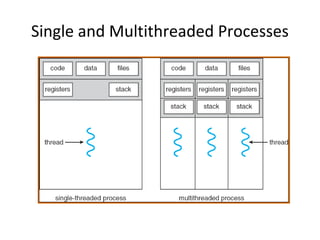
• A thread is predefined instance of a process. A thread performs a specific
function. A process may consist a set of threads
• Single-threaded process has one program counter specifying location of
next instruction to execute
– Process executes instructions sequentially, one at a time, until completion
• Multi-threaded process has one program counter per thread
• Typically system has many processes, some user, some operating system
running concurrently on one or more CPUs
– Concurrency by multiplexing the CPUs among the processes / threads
Single and Multithreaded Processes
Process Management Activities
• The operating system is responsible for the
following activities in connection with process
management:
– Creating and deleting both user and system
processes
– Suspending and resuming processes
– Providing mechanisms for process synchronization
– Providing mechanisms for process communication
– Providing mechanisms for deadlock handling
Process Creation
• System Initialization – Boots up
• User related events – click, double click, drag
• Execution of a function call- process creates a
child process
Process Termination
• System shut down
• Process termination – completes execution
• Error condition(Voluntary)
• Fatal error(Involuntary
• Killed by another process
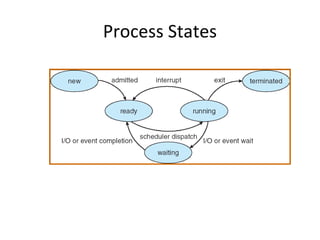
Process States
• New – just created, arrived in memory
• Ready – prepared for execution once the CPU
becomes available
• Running – Being executed.
• Blocked – has suspended running, requires an
I/O device.
• Terminated – Has finished executed, prepared
to exit memory.
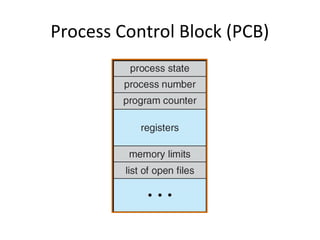
Process Control Block (PCB)
Stores Information associated with each
process
• Process state
• Program counter
• CPU registers
• CPU scheduling information
• Memory-management information
• Accounting information
• I/O status information
Process Control Block (PCB)
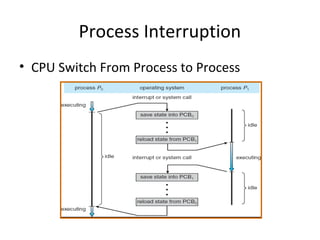
Process Interruption
• CPU Switch From Process to Process
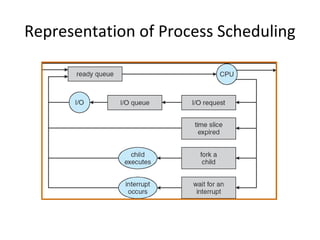
Process Scheduling Queues
• Ready queue – set of all processes residing in
main memory, ready and waiting to execute
• Device queues – set of processes waiting for
an I/O device
• Processes migrate among the various queues
Representation of Process Scheduling
Context Switch
• When CPU switches to another process, the
system must save the state of the old process and
load the saved state for the new process
• Context-switch time is overhead; the system does
no useful work while switching
• Time dependent on hardware support
Process Creation
• Parent process create children processes, which,
in turn create other processes, forming a tree of
processes
• Resource sharing may be
– Parent and children share all resources
– Children share subset of parent’s resources
– Parent and child share no resources
• Execution mode may be
– Parent and children execute concurrently
– Parent waits until children terminate
Process Termination
• Process executes last statement and asks the operating
system to delete it (exit)
– Output data from child to parent (via wait)
– Process’ resources are deallocated by operating system
• Parent may terminate execution of children processes
(abort) if
– Child has exceeded allocated resources
– Task assigned to child is no longer required
– If parent is exiting
• Some operating system do not allow child to continue if its parent
terminates
– All children terminated - cascading termination

Processes

  • 1.
  • 2.
    Program, Process, Processor •A progam is a set of instructions. A process is a program in execution. It is a unit of work within the system. Program is a passive entity, process is an active entity. • Processor is the device which executes programs. • Process needs resources to accomplish its task – CPU, memory, I/O, files – Initialization data • Process termination requires reclaim of any reusable resources
  • 3.
    Threads • A threadis predefined instance of a process. A thread performs a specific function. A process may consist a set of threads • Single-threaded process has one program counter specifying location of next instruction to execute – Process executes instructions sequentially, one at a time, until completion • Multi-threaded process has one program counter per thread • Typically system has many processes, some user, some operating system running concurrently on one or more CPUs – Concurrency by multiplexing the CPUs among the processes / threads
  • 4.
  • 5.
    Process Management Activities •The operating system is responsible for the following activities in connection with process management: – Creating and deleting both user and system processes – Suspending and resuming processes – Providing mechanisms for process synchronization – Providing mechanisms for process communication – Providing mechanisms for deadlock handling
  • 6.
    Process Creation • SystemInitialization – Boots up • User related events – click, double click, drag • Execution of a function call- process creates a child process
  • 7.
    Process Termination • Systemshut down • Process termination – completes execution • Error condition(Voluntary) • Fatal error(Involuntary • Killed by another process
  • 8.
  • 9.
    • New –just created, arrived in memory • Ready – prepared for execution once the CPU becomes available • Running – Being executed. • Blocked – has suspended running, requires an I/O device. • Terminated – Has finished executed, prepared to exit memory.
  • 10.
    Process Control Block(PCB) Stores Information associated with each process • Process state • Program counter • CPU registers • CPU scheduling information • Memory-management information • Accounting information • I/O status information
  • 11.
  • 12.
    Process Interruption • CPUSwitch From Process to Process
  • 13.
    Process Scheduling Queues •Ready queue – set of all processes residing in main memory, ready and waiting to execute • Device queues – set of processes waiting for an I/O device • Processes migrate among the various queues
  • 14.
  • 15.
    Context Switch • WhenCPU switches to another process, the system must save the state of the old process and load the saved state for the new process • Context-switch time is overhead; the system does no useful work while switching • Time dependent on hardware support
  • 16.
    Process Creation • Parentprocess create children processes, which, in turn create other processes, forming a tree of processes • Resource sharing may be – Parent and children share all resources – Children share subset of parent’s resources – Parent and child share no resources • Execution mode may be – Parent and children execute concurrently – Parent waits until children terminate
  • 17.
    Process Termination • Processexecutes last statement and asks the operating system to delete it (exit) – Output data from child to parent (via wait) – Process’ resources are deallocated by operating system • Parent may terminate execution of children processes (abort) if – Child has exceeded allocated resources – Task assigned to child is no longer required – If parent is exiting • Some operating system do not allow child to continue if its parent terminates – All children terminated - cascading termination