1

6th EUROPEAN CONGRESS ON COMPUTATIONAL METHODS IN APPLIED SCIENCES AND
ENGINEERING, the University of Vienna, Austria, September 10-14, 2012.


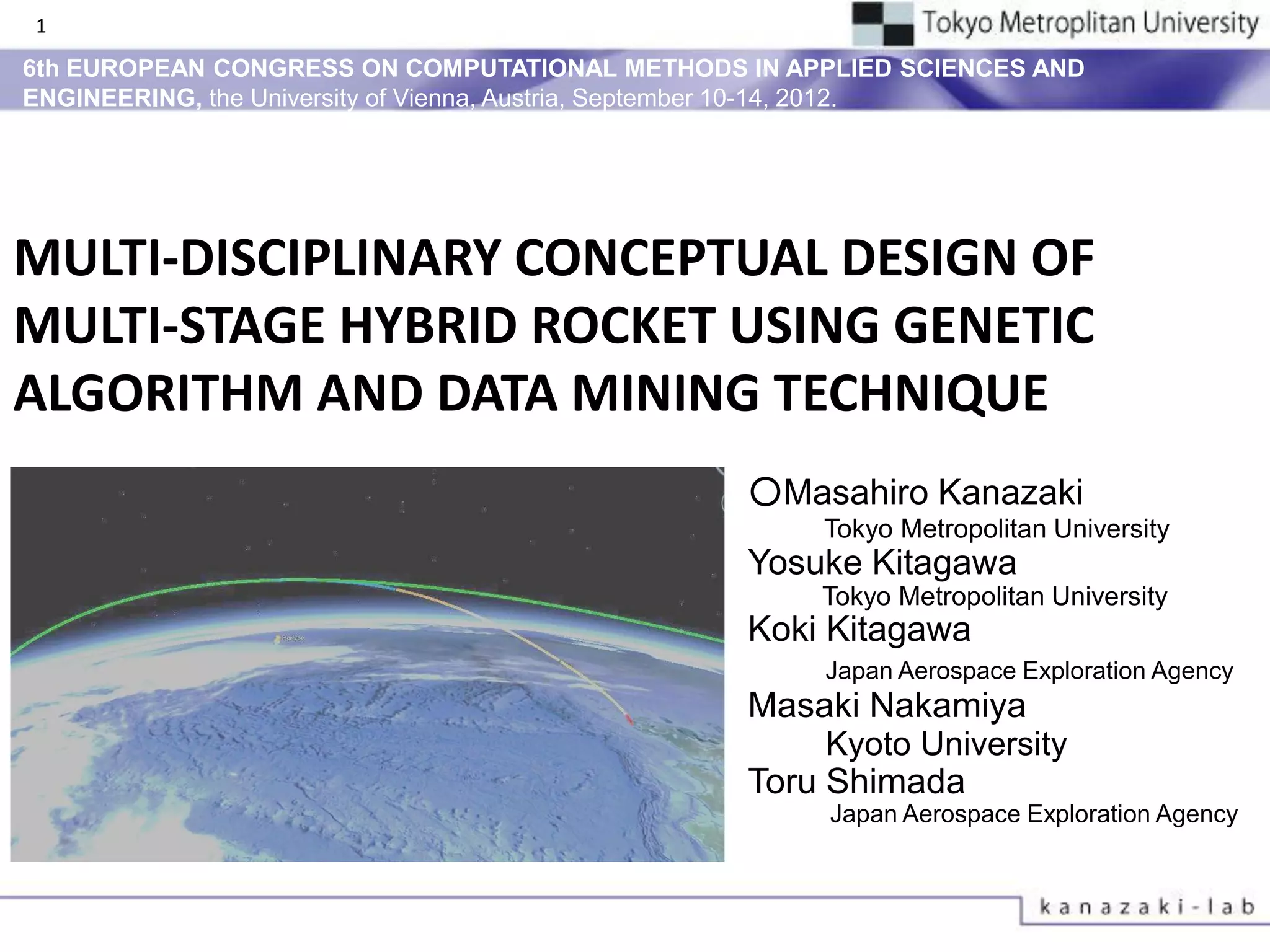
MULTI-DISCIPLINARY CONCEPTUAL DESIGN OF
MULTI-STAGE HYBRID ROCKET USING GENETIC
ALGORITHM AND DATA MINING TECHNIQUE
                                               ○Masahiro Kanazaki
                                                    Tokyo Metropolitan University
                                               Yosuke Kitagawa
                                                    Tokyo Metropolitan University
                                               Koki Kitagawa
                                                    Japan Aerospace Exploration Agency
                                               Masaki Nakamiya
                                                    Kyoto University
                                               Toru Shimada
                                                     Japan Aerospace Exploration Agency
2


Contents
• Background
• Objectives
• Design methods
   – Evaluation procedure of hybrid rocket engine (HRE)
   – Multi-objective Genetic Algorithm (MOGA)
   – Analysis of Variance (ANOVA)
   – Self-organizing Map (SOM)
• Formulation (Design problem for LV with HRE)
   – Design variables
   – Objective functions
• Results
   – Design and visualization results
   – Design knowledge
• Conclusions
3


Background
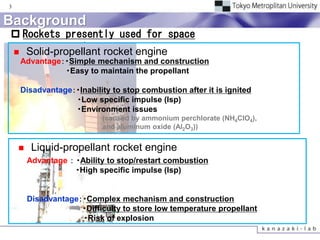
 Rockets presently used for space
  transportation
 Solid-propellant rocket engine
    Advantage:・Simple mechanism and construction
              ・Easy to maintain the propellant

    Disadvantage:・Inability to stop combustion after it is ignited
                 ・Low specific impulse (Isp)
                 ・Environment issues
                           (caused by ammonium perchlorate (NH4ClO4),
                           and aluminum oxide (Al2O3))


        Liquid-propellant rocket engine
        Advantage : ・Ability to stop/restart combustion
                    ・High specific impulse (Isp)


        Disadvantage:・Complex mechanism and construction
                     ・Difficulty to store low temperature propellant
                     ・Risk of explosion
4


Background
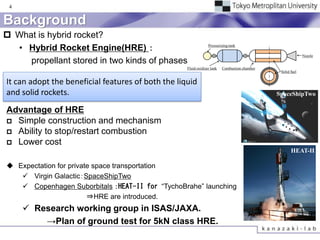
 What is hybrid rocket?
  • Hybrid Rocket Engine(HRE) :
     propellant stored in two kinds of phases

It can adopt the beneficial features of both the liquid
and solid rockets.                                                SpaceShipTwo

Advantage of HRE
 Simple construction and mechanism
 Ability to stop/restart combustion
 Lower cost
                                                                      HEAT-II

 Expectation for private space transportation
    Virgin Galactic:SpaceShipTwo
    Copenhagen Suborbitals :HEAT-II for “TychoBrahe” launching
                        ⇒HRE are introduced.
      Research working group in ISAS/JAXA.
         →Plan of ground test for 5kN class HRE.
5


Background
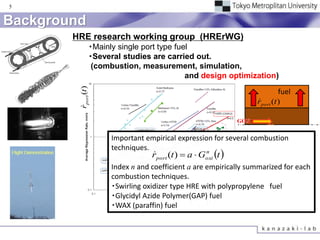
        HRE research working group (HRErWG)
                                ・Mainly single port type fuel


        rport (t )  a  Goxi t 
                                ・Several studies are carried out.

                          n
                                 (combustion, measurement, simulation,
                                                            and design optimization)
                                                                                           fuel
                                                                                  rport (t )  a  Goxi t 
                                                                                                   n
        


                                      Important empirical expression for several combustion
                                      techniques.
                                                  rport (t )  a  Goxi t 
                                                                  n


                                      Index n and coefficient a are empirically summarized for each
                                      combustion techniques.
                                      ・Swirling oxidizer type HRE with polypropylene fuel
                                      ・Glycidyl Azide Polymer(GAP) fuel
                                                rport (tfuel a  Goxi t 
                                                 
                                      ・WAX (paraffin)    )       n
6


Background
 Difficulty of hybrid rocket design
  Solid rocket:Preliminary mixed solid propellant

  Liquid rocket:Control of mass flow of fluid propellant

            → Easy to maintain a constant oxidizer massand fuel
            mass ratio (O/F) and to get a stable thrust
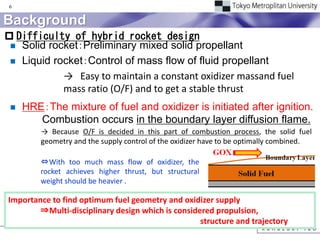
    HRE:The mixture of fuel and oxidizer is initiated after ignition.
        Combustion occurs in the boundary layer diffusion flame.
         → Because O/F is decided in this part of combustion process, the solid fuel
         geometry and the supply control of the oxidizer have to be optimally combined.

         ⇔With too much mass flow of oxidizer, the
         rocket achieves higher thrust, but structural
         weight should be heavier .

Importance to find optimum fuel geometry and oxidizer supply
       ⇒Multi-disciplinary design which is considered propulsion,
                                                  structure and trajectory
7


Objectives
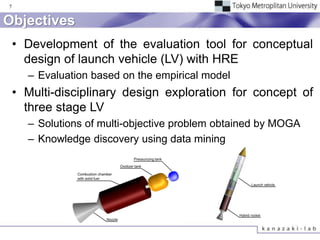
    • Development of the evaluation tool for conceptual
      design of launch vehicle (LV) with HRE
      – Evaluation based on the empirical model
    • Multi-disciplinary design exploration for concept of
      three stage LV
      – Solutions of multi-objective problem obtained by MOGA
      – Knowledge discovery using data mining
8


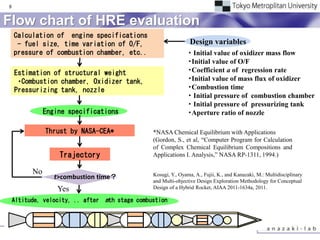
Flow chart of HRE evaluation
    Calculation of engine specifications
     - fuel size, time variation of O/F,                        Design variables
    pressure of combustion chamber, etc..                       ・ Initial value of oxidizer mass flow
                                                                ・Initial value of O/F
    Estimation of structural weight                             ・Coefficient a of regression rate
     ・Combustion chamber, Oxidizer tank,                        ・Initial value of mass flux of oxidizer
    Pressurizing tank, nozzle                                   ・Combustion time
                                                                ・ Initial pressure of combustion chamber
                                                                ・ Initial pressure of pressurizing tank
               Engine specifications                            ・Aperture ratio of nozzle

               Thrust by NASA-CEA*              *NASA Chemical Equilibrium with Applications
                                                (Gordon, S., et al, “Computer Program for Calculation
                                                of Complex Chemical Equilibrium Compositions and
                   Trajectory                   Applications I. Analysis,” NASA RP-1311, 1994.)

          No                                    Kosugi, Y., Oyama, A., Fujii, K., and Kanazaki, M.: Multidisciplinary
                  t>combustion time?
                                                and Multi-objective Design Exploration Methodology for Conceptual
                   Yes                          Design of a Hybrid Rocket, AIAA 2011-1634a, 2011.

    Altitude, velocity, .. after mth stage combustion
9


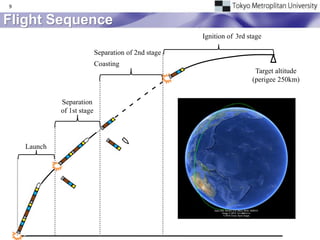
Flight Sequence
                                                      Ignition of 3rd stage

                            Separation of 2nd stage
                            Coasting
                                                                        Target altitude
                                                                       (perigee 250km)


             Separation
             of 1st stage


    Launch
10


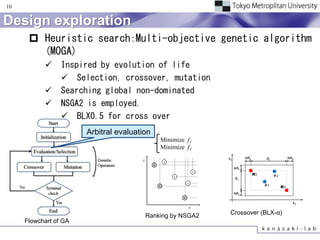
Design exploration
       Heuristic search:Multi-objective genetic algorithm
        (MOGA)
                Inspired by evolution of life
                  Selection, crossover, mutation
                Searching global non-dominated
                NSGA2 is employed.
                  BLX0.5 for cross over
                       Arbitral evaluation
                                             Minimize f1
                                             Minimize f2


                                        Ranking by NSGA2   Crossover (BLX-α)
     Flowchart of GA
11


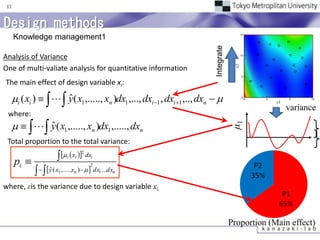
Design methods
      Knowledge management1


                                                                         Integrate
Analysis of Variance
One of multi-valiate analysis for quantitative information
The main effect of design variable xi:

  i ( xi )     y( x1 ,....., xn )dx1 ,..., dxi 1 , dxi 1 ,.., dxn  
                    ˆ
                                                                                                    variance
 where:
           y( x1 ,....., xn )dx1 ,....., dxn
                ˆ


                                                                                     μ1
 Total proportion to the total variance:
                               i  xi  dxi
                                          2

      pi 
                         y ( x1 ,....,xn )   dx1 ...dxn
                                               2
                       ˆ

where, εis the variance due to design variable xi.


                                                                                     Proportion (Main effect)
12


Design methods
     Knowledge management2
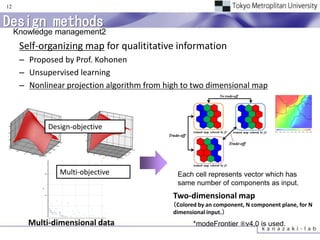
      Self-organizing map for qualititative information
      – Proposed by Prof. Kohonen
      – Unsupervised learning
      – Nonlinear projection algorithm from high to two dimensional map


             Design-objective


                Multi-objective                Each cell represents vector which has
                                               same number of components as input.
                                              Two-dimensional map
                                              (Colored by an component, N component plane, for N
                                              dimensional input.)
        Multi-dimensional data                       *modeFrontier ®v4.0 is used.
13


Design space


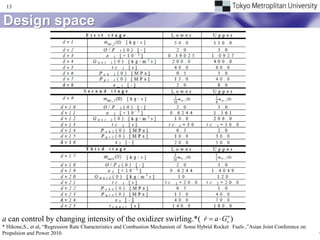
a can control by changing intensity of the oxidizer swirling.*( r  a  Gon )
                                                                
* Hikone,S., et al, “Regression Rate Characteristics and Combustion Mechanism of Some Hybrid Rocket Fuels ,”Asian Joint Conference on
Propulsion and Power 2010.
14


Design Problem
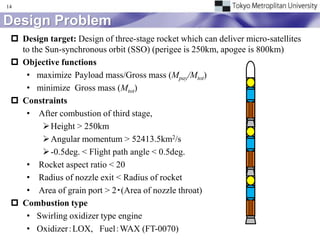
  Design target: Design of three-stage rocket which can deliver micro-satellites
   to the Sun-synchronous orbit (SSO) (perigee is 250km, apogee is 800km)
  Objective functions
    • maximize Payload mass/Gross mass (Mpay/Mtot)
    • minimize Gross mass (Mtot)
  Constraints
    • After combustion of third stage,
          Height > 250km
          Angular momentum > 52413.5km2/s
          -0.5deg. < Flight path angle < 0.5deg.
    • Rocket aspect ratio < 20
    • Radius of nozzle exit < Radius of rocket
    • Area of grain port > 2・(Area of nozzle throat)
  Combustion type
    • Swirling oxidizer type engine
    • Oxidizer:LOX, Fuel:WAX (FT-0070)
15


Result
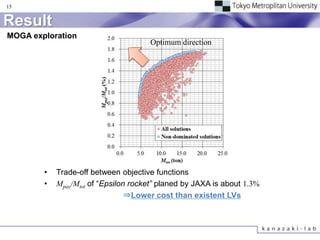
MOGA exploration
                                      Optimum direction


        •   Trade-off between objective functions
        •   Mpay/Mtot of “Epsilon rocket” planed by JAXA is about 1.3%
                                 ⇒Lower cost than existent LVs
16


Selected Design from Non-dominated Solutions
      Selected rocket size
              Length of rocket                 [m]                     20.8
              Diameter of rocket               [m]                     1.46
              Aspect ratio of rocket           [-]                     14.3


                                                     1st stage   2nd stage              3rd stage
              Length                   [m]             8.22        6.57                   6.06
              Diameter                 [m]             1.45        1.46                   1.07
              Gross mass               [ton]           8.07        4.09                   0.70
              Structural mass          [ton]           1.78        0.49                   0.10
              Structural mass ratio [%]                22.1        11.9                   14.5
                                                       20.8
                       8.22                            6.57                      6.06
              1.35                                   1.36                 0.97
                                                                                                    1.46

                            What kind of design can be high performance?
     1.21   2.18         3.21     1.61   2.29 1.06  2.11  1.11 2.06 0.35 0.99 0.64 2.02
                              ⇒Design knowledge discovery by means of data mining
17


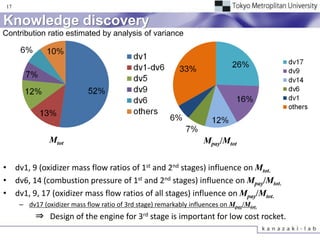
Knowledge discovery
Contribution ratio estimated by analysis of variance


                Mtot                                                 Mpay/Mtot


• dv1, 9 (oxidizer mass flow ratios of 1st and 2nd stages) influence on Mtot.
• dv6, 14 (combustion pressure of 1st and 2nd stages) influence on Mpay/Mtot.
• dv1, 9, 17 (oxidizer mass flow ratios of all stages) influence on Mpay/Mtot.
      – dv17 (oxidizer mass flow ratio of 3rd stage) remarkably influences on Mpay/Mtot.
           ⇒ Design of the engine for 3rd stage is important for low cost rocket.
18


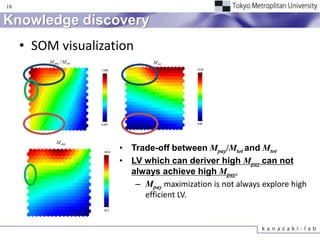
Knowledge discovery
     • SOM visualization


                     • Trade-off between Mpay/Mtot and Mtot
                     • LV which can deriver high Mpay can not
                       always achieve high Mpay.
                        – Mpay maximization is not always explore high
                          efficient LV.
19


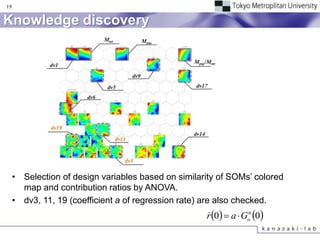
Knowledge discovery


     • Selection of design variables based on similarity of SOMs’ colored
       map and contribution ratios by ANOVA.
     • dv3, 11, 19 (coefficient a of regression rate) are also checked.
                                                     r 0  a  Go 0
                                                                 n
20


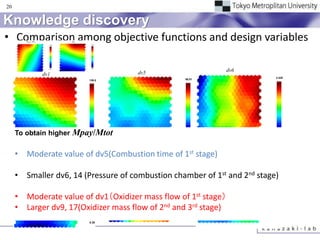
Knowledge discovery
• Comparison among objective functions and design variables

                                      dv5                        dv6
            dv1
                                                                           2.420
                            139.5                  56.01


     To obtain higher   Mpay/Mtot
                           60.4                   46.01                    1.900


     • Moderate value of dv5(Combustion time of 1st stage)
          dv9
                                   dv14
                                                  1.600
                                                                 dv17
                                                                           3.677
                             18.30


     • Smaller dv6, 14 (Pressure of combustion chamber of 1st and 2nd stage)

     • Moderate value of dv1(Oxidizer mass flow of 1st stage)
     • Larger dv9, 17(Oxidizer mass flow of 2nd and 3rd stage)
                                                  1.215                   1.710
                            9.36
21


Knowledge discovery
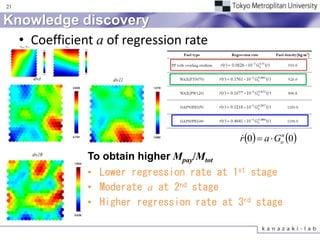
  • Coefficient a of regression rate


                                           r 0  a  Go 0
                                                       n


              To obtain higher Mpay/Mtot
              • Lower regression rate at 1st stage
              • Moderate a at 2nd stage
              • Higher regression rate at 3rd stage
22


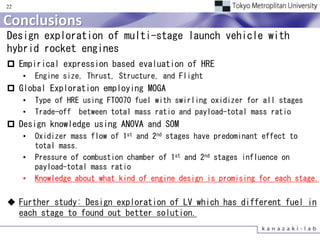
Conclusions
Design exploration of multi-stage launch vehicle with
hybrid rocket engines
 Empirical expression based evaluation of HRE
     •   Engine size, Thrust, Structure, and Flight
 Global Exploration employing MOGA
     •   Type of HRE using FT0070 fuel with swirling oxidizer for all stages
     •   Trade-off between total mass ratio and payload-total mass ratio
 Design knowledge using ANOVA and SOM
     •   Oxidizer mass flow of 1st and 2nd stages have predominant effect to
         total mass.
     •   Pressure of combustion chamber of 1st and 2nd stages influence on
         payload-total mass ratio
     •   Knowledge about what kind of engine design is promising for each stage.


 Further study: Design exploration of LV which has different fuel in
  each stage to found out better solution.
23


Acknowledgement

     • We thank members of the hybrid rocket engine
       research working group in ISAS/JAXA for giving
       their experimental data and their valuable
       advices. This paper and presentation was
       supported by ISAS/JAXA.


      Thank you very much for your kind attention.

Multi-Disciplinary Conceptual Design of Multi-Stage Hybrid Rocket using Genetic Algorithm and Data Mining Technique

  • 1.
    1 6th EUROPEAN CONGRESSON COMPUTATIONAL METHODS IN APPLIED SCIENCES AND ENGINEERING, the University of Vienna, Austria, September 10-14, 2012. MULTI-DISCIPLINARY CONCEPTUAL DESIGN OF MULTI-STAGE HYBRID ROCKET USING GENETIC ALGORITHM AND DATA MINING TECHNIQUE ○Masahiro Kanazaki Tokyo Metropolitan University Yosuke Kitagawa Tokyo Metropolitan University Koki Kitagawa Japan Aerospace Exploration Agency Masaki Nakamiya Kyoto University Toru Shimada Japan Aerospace Exploration Agency
  • 2.
    2 Contents • Background • Objectives •Design methods – Evaluation procedure of hybrid rocket engine (HRE) – Multi-objective Genetic Algorithm (MOGA) – Analysis of Variance (ANOVA) – Self-organizing Map (SOM) • Formulation (Design problem for LV with HRE) – Design variables – Objective functions • Results – Design and visualization results – Design knowledge • Conclusions
  • 3.
    3 Background  Rockets presentlyused for space transportation  Solid-propellant rocket engine Advantage:・Simple mechanism and construction ・Easy to maintain the propellant Disadvantage:・Inability to stop combustion after it is ignited ・Low specific impulse (Isp) ・Environment issues (caused by ammonium perchlorate (NH4ClO4), and aluminum oxide (Al2O3))  Liquid-propellant rocket engine Advantage : ・Ability to stop/restart combustion ・High specific impulse (Isp) Disadvantage:・Complex mechanism and construction ・Difficulty to store low temperature propellant ・Risk of explosion
  • 4.
    4 Background  What ishybrid rocket? • Hybrid Rocket Engine(HRE) : propellant stored in two kinds of phases It can adopt the beneficial features of both the liquid and solid rockets. SpaceShipTwo Advantage of HRE  Simple construction and mechanism  Ability to stop/restart combustion  Lower cost HEAT-II  Expectation for private space transportation  Virgin Galactic:SpaceShipTwo  Copenhagen Suborbitals :HEAT-II for “TychoBrahe” launching ⇒HRE are introduced.  Research working group in ISAS/JAXA. →Plan of ground test for 5kN class HRE.
  • 5.
    5 Background HRE research working group (HRErWG) ・Mainly single port type fuel rport (t )  a  Goxi t  ・Several studies are carried out. n (combustion, measurement, simulation, and design optimization) fuel rport (t )  a  Goxi t   n  Important empirical expression for several combustion techniques. rport (t )  a  Goxi t   n Index n and coefficient a are empirically summarized for each combustion techniques. ・Swirling oxidizer type HRE with polypropylene fuel ・Glycidyl Azide Polymer(GAP) fuel rport (tfuel a  Goxi t   ・WAX (paraffin) ) n
  • 6.
    6 Background  Difficulty ofhybrid rocket design  Solid rocket:Preliminary mixed solid propellant  Liquid rocket:Control of mass flow of fluid propellant → Easy to maintain a constant oxidizer massand fuel mass ratio (O/F) and to get a stable thrust  HRE:The mixture of fuel and oxidizer is initiated after ignition. Combustion occurs in the boundary layer diffusion flame. → Because O/F is decided in this part of combustion process, the solid fuel geometry and the supply control of the oxidizer have to be optimally combined. ⇔With too much mass flow of oxidizer, the rocket achieves higher thrust, but structural weight should be heavier . Importance to find optimum fuel geometry and oxidizer supply ⇒Multi-disciplinary design which is considered propulsion, structure and trajectory
  • 7.
    7 Objectives • Development of the evaluation tool for conceptual design of launch vehicle (LV) with HRE – Evaluation based on the empirical model • Multi-disciplinary design exploration for concept of three stage LV – Solutions of multi-objective problem obtained by MOGA – Knowledge discovery using data mining
  • 8.
    8 Flow chart ofHRE evaluation Calculation of engine specifications - fuel size, time variation of O/F, Design variables pressure of combustion chamber, etc.. ・ Initial value of oxidizer mass flow ・Initial value of O/F Estimation of structural weight ・Coefficient a of regression rate ・Combustion chamber, Oxidizer tank, ・Initial value of mass flux of oxidizer Pressurizing tank, nozzle ・Combustion time ・ Initial pressure of combustion chamber ・ Initial pressure of pressurizing tank Engine specifications ・Aperture ratio of nozzle Thrust by NASA-CEA* *NASA Chemical Equilibrium with Applications (Gordon, S., et al, “Computer Program for Calculation of Complex Chemical Equilibrium Compositions and Trajectory Applications I. Analysis,” NASA RP-1311, 1994.) No Kosugi, Y., Oyama, A., Fujii, K., and Kanazaki, M.: Multidisciplinary t>combustion time? and Multi-objective Design Exploration Methodology for Conceptual Yes Design of a Hybrid Rocket, AIAA 2011-1634a, 2011. Altitude, velocity, .. after mth stage combustion
  • 9.
    9 Flight Sequence Ignition of 3rd stage Separation of 2nd stage Coasting Target altitude (perigee 250km) Separation of 1st stage Launch
  • 10.
    10 Design exploration  Heuristic search:Multi-objective genetic algorithm (MOGA)  Inspired by evolution of life  Selection, crossover, mutation  Searching global non-dominated  NSGA2 is employed.  BLX0.5 for cross over Arbitral evaluation Minimize f1 Minimize f2 Ranking by NSGA2 Crossover (BLX-α) Flowchart of GA
  • 11.
    11 Design methods Knowledge management1 Integrate Analysis of Variance One of multi-valiate analysis for quantitative information The main effect of design variable xi: i ( xi )     y( x1 ,....., xn )dx1 ,..., dxi 1 , dxi 1 ,.., dxn   ˆ variance where:      y( x1 ,....., xn )dx1 ,....., dxn ˆ μ1 Total proportion to the total variance:  i  xi  dxi 2 pi    y ( x1 ,....,xn )   dx1 ...dxn 2   ˆ where, εis the variance due to design variable xi. Proportion (Main effect)
  • 12.
    12 Design methods Knowledge management2 Self-organizing map for qualititative information – Proposed by Prof. Kohonen – Unsupervised learning – Nonlinear projection algorithm from high to two dimensional map Design-objective Multi-objective Each cell represents vector which has same number of components as input. Two-dimensional map (Colored by an component, N component plane, for N dimensional input.) Multi-dimensional data *modeFrontier ®v4.0 is used.
  • 13.
    13 Design space a cancontrol by changing intensity of the oxidizer swirling.*( r  a  Gon )  * Hikone,S., et al, “Regression Rate Characteristics and Combustion Mechanism of Some Hybrid Rocket Fuels ,”Asian Joint Conference on Propulsion and Power 2010.
  • 14.
    14 Design Problem Design target: Design of three-stage rocket which can deliver micro-satellites to the Sun-synchronous orbit (SSO) (perigee is 250km, apogee is 800km)  Objective functions • maximize Payload mass/Gross mass (Mpay/Mtot) • minimize Gross mass (Mtot)  Constraints • After combustion of third stage,  Height > 250km  Angular momentum > 52413.5km2/s  -0.5deg. < Flight path angle < 0.5deg. • Rocket aspect ratio < 20 • Radius of nozzle exit < Radius of rocket • Area of grain port > 2・(Area of nozzle throat)  Combustion type • Swirling oxidizer type engine • Oxidizer:LOX, Fuel:WAX (FT-0070)
  • 15.
    15 Result MOGA exploration Optimum direction • Trade-off between objective functions • Mpay/Mtot of “Epsilon rocket” planed by JAXA is about 1.3% ⇒Lower cost than existent LVs
  • 16.
    16 Selected Design fromNon-dominated Solutions  Selected rocket size Length of rocket [m] 20.8 Diameter of rocket [m] 1.46 Aspect ratio of rocket [-] 14.3 1st stage 2nd stage 3rd stage Length [m] 8.22 6.57 6.06 Diameter [m] 1.45 1.46 1.07 Gross mass [ton] 8.07 4.09 0.70 Structural mass [ton] 1.78 0.49 0.10 Structural mass ratio [%] 22.1 11.9 14.5 20.8 8.22 6.57 6.06 1.35 1.36 0.97 1.46 What kind of design can be high performance? 1.21 2.18 3.21 1.61 2.29 1.06 2.11 1.11 2.06 0.35 0.99 0.64 2.02 ⇒Design knowledge discovery by means of data mining
  • 17.
    17 Knowledge discovery Contribution ratioestimated by analysis of variance Mtot Mpay/Mtot • dv1, 9 (oxidizer mass flow ratios of 1st and 2nd stages) influence on Mtot. • dv6, 14 (combustion pressure of 1st and 2nd stages) influence on Mpay/Mtot. • dv1, 9, 17 (oxidizer mass flow ratios of all stages) influence on Mpay/Mtot. – dv17 (oxidizer mass flow ratio of 3rd stage) remarkably influences on Mpay/Mtot. ⇒ Design of the engine for 3rd stage is important for low cost rocket.
  • 18.
    18 Knowledge discovery • SOM visualization • Trade-off between Mpay/Mtot and Mtot • LV which can deriver high Mpay can not always achieve high Mpay. – Mpay maximization is not always explore high efficient LV.
  • 19.
    19 Knowledge discovery • Selection of design variables based on similarity of SOMs’ colored map and contribution ratios by ANOVA. • dv3, 11, 19 (coefficient a of regression rate) are also checked. r 0  a  Go 0  n
  • 20.
    20 Knowledge discovery • Comparisonamong objective functions and design variables dv5 dv6 dv1 2.420 139.5 56.01 To obtain higher Mpay/Mtot 60.4 46.01 1.900 • Moderate value of dv5(Combustion time of 1st stage) dv9 dv14 1.600 dv17 3.677 18.30 • Smaller dv6, 14 (Pressure of combustion chamber of 1st and 2nd stage) • Moderate value of dv1(Oxidizer mass flow of 1st stage) • Larger dv9, 17(Oxidizer mass flow of 2nd and 3rd stage) 1.215 1.710 9.36
  • 21.
    21 Knowledge discovery • Coefficient a of regression rate r 0  a  Go 0  n To obtain higher Mpay/Mtot • Lower regression rate at 1st stage • Moderate a at 2nd stage • Higher regression rate at 3rd stage
  • 22.
    22 Conclusions Design exploration ofmulti-stage launch vehicle with hybrid rocket engines  Empirical expression based evaluation of HRE • Engine size, Thrust, Structure, and Flight  Global Exploration employing MOGA • Type of HRE using FT0070 fuel with swirling oxidizer for all stages • Trade-off between total mass ratio and payload-total mass ratio  Design knowledge using ANOVA and SOM • Oxidizer mass flow of 1st and 2nd stages have predominant effect to total mass. • Pressure of combustion chamber of 1st and 2nd stages influence on payload-total mass ratio • Knowledge about what kind of engine design is promising for each stage.  Further study: Design exploration of LV which has different fuel in each stage to found out better solution.
  • 23.
    23 Acknowledgement • We thank members of the hybrid rocket engine research working group in ISAS/JAXA for giving their experimental data and their valuable advices. This paper and presentation was supported by ISAS/JAXA. Thank you very much for your kind attention.