1
2015 Americas Altair Technology Conference
K.K. Choi, Nicholas Gaul, Hyeongjin Song
and Hyunkyoo Cho
RAMDO Solutions, LLC
Iowa City, IA 52240
2
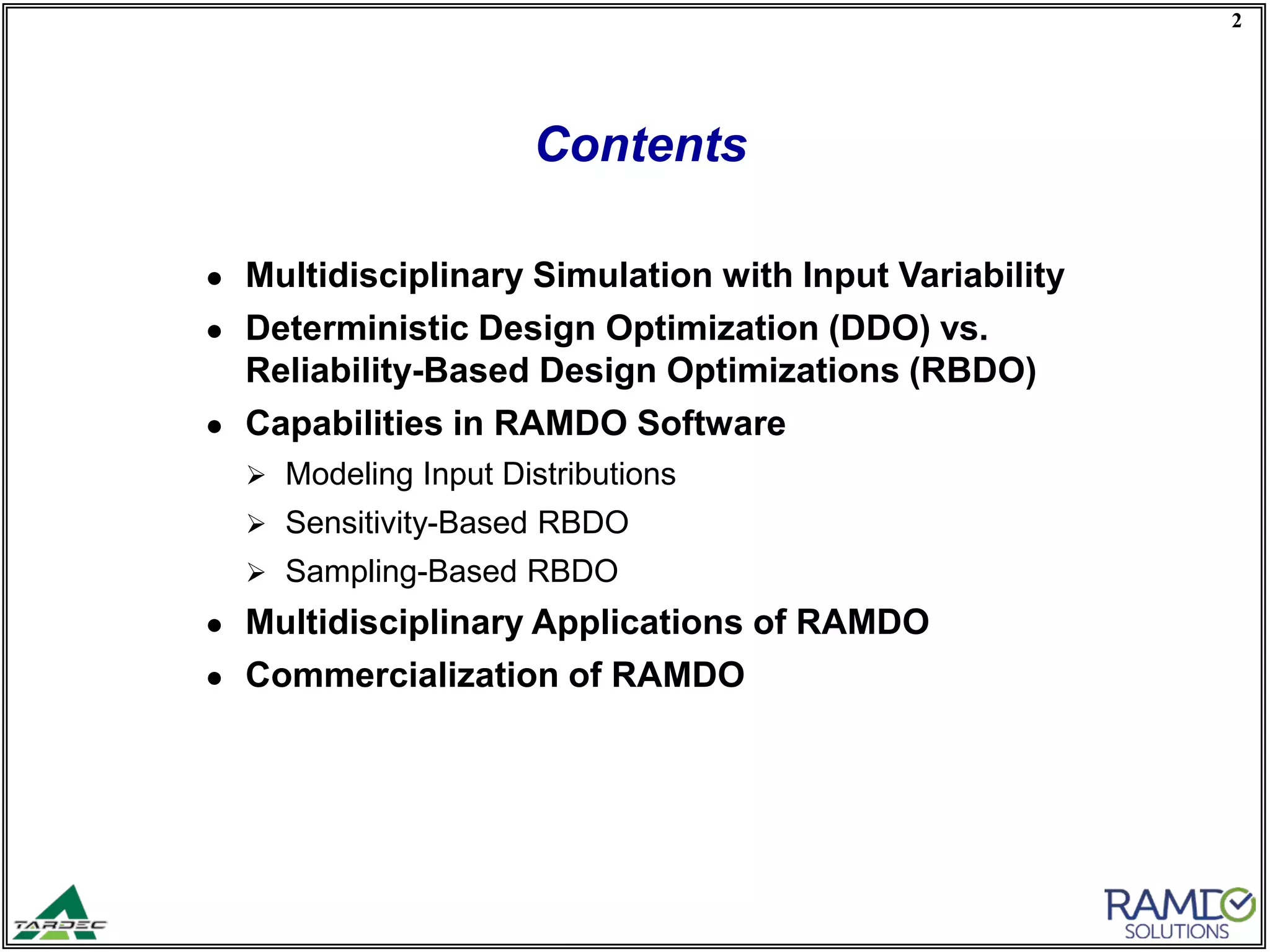
Contents
● Multidisciplinary Simulation with Input Variability
● Deterministic Design Optimization (DDO) vs.
Reliability-Based Design Optimizations (RBDO)
● Capabilities in RAMDO Software
 Modeling Input Distributions
 Sensitivity-Based RBDO
 Sampling-Based RBDO
● Multidisciplinary Applications of RAMDO
● Commercialization of RAMDO
3
Input Variables
X=[X1, X2,…, Xn]
Output
Performances
G(X)=[G1,.., Gnc]
Multidisciplinary Simulation with Input Variability
Output
Performances G(X)
Output Variability of
Performance G1(X)
Output Variability of
Performance Gnc(X)
Input Variables X
Load
Variability
Manufacturing
Variability
Surrogate
Modeling
Variability
Material
Property
Variability
Other Input
Variable
Variabilities
Casting
Process
Variability
RAMDO will stimulate collaboration
among Design, Manufacturing &
Testing Engineers.
FEA
Multibody
Dynamics
CFD
Casting
Electromagnetics
Reliability
4
 Safety factor approach can be considered.
 Right safety factor? Over design or under design?
 How about multidisciplinary design optimization problem?
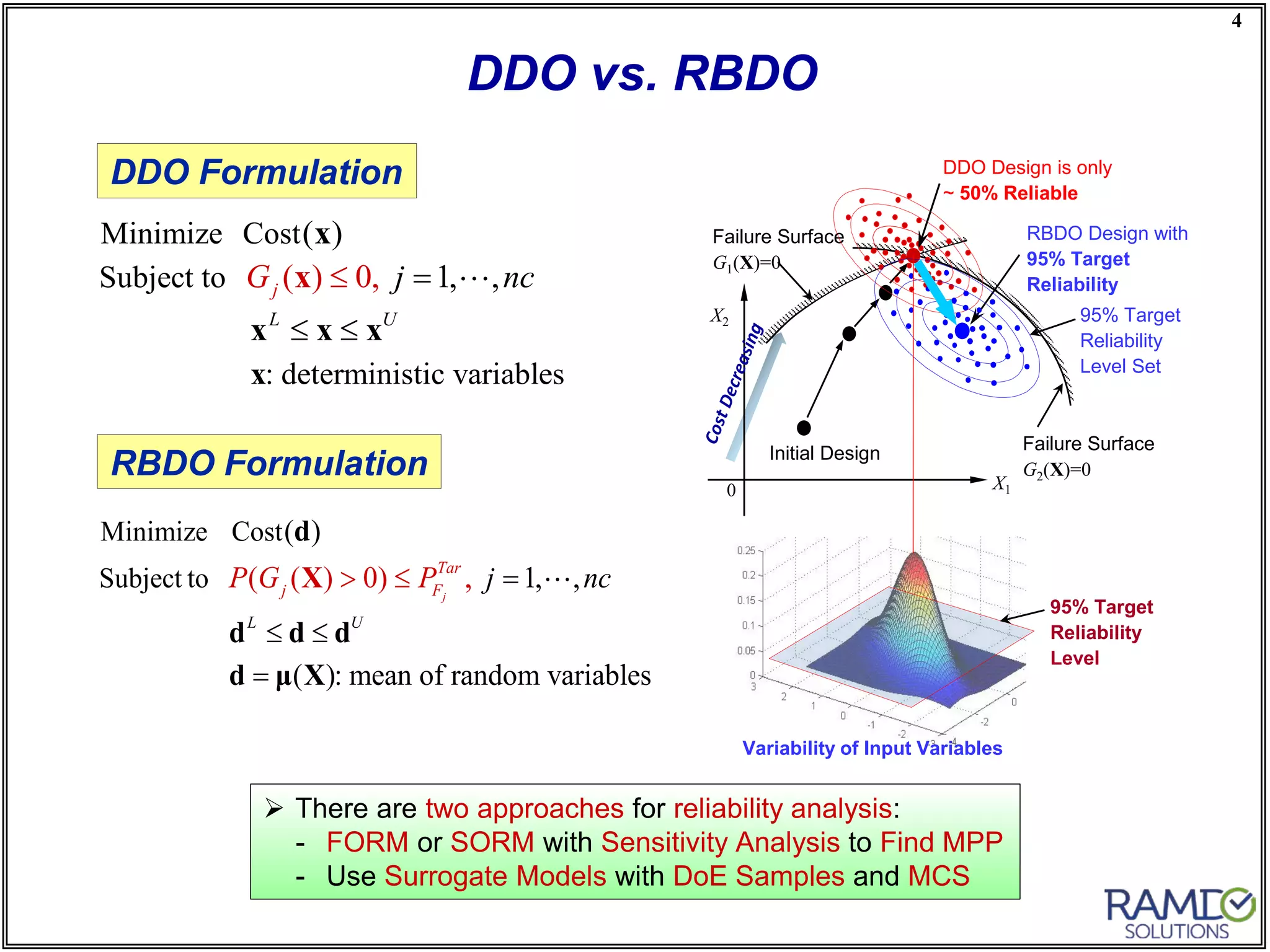
 There are two approaches for reliability analysis:
- FORM or SORM with Sensitivity Analysis to Find MPP
- Use Surrogate Models with DoE Samples and MCS
DDO vs. RBDO
Minimize Cost
Subject to
: deterministic variables
( )
1,) , ,( 0
L U
j j ncG =
≤ ≤
≤
x
x
x
x x x

DDO Formulation
X2
Failure Surface
G1(X)=0
Failure Surface
G2(X)=0
Initial Design
X10
DDO Design is only
~ 50% Reliable
Minimize Cost
Subject to
( )
1, ,
( ): mean of random
( ( ) 0)
variables
,j
L U
Tar
j F j nP G P c=
≤
≤
≤
>
=
d
d d d
μ X
X
d

RBDO Formulation
RBDO Design with
95% Target
Reliability
95% Target
Reliability
Level Set
Variability of Input Variables
95% Target
Reliability
Level
5
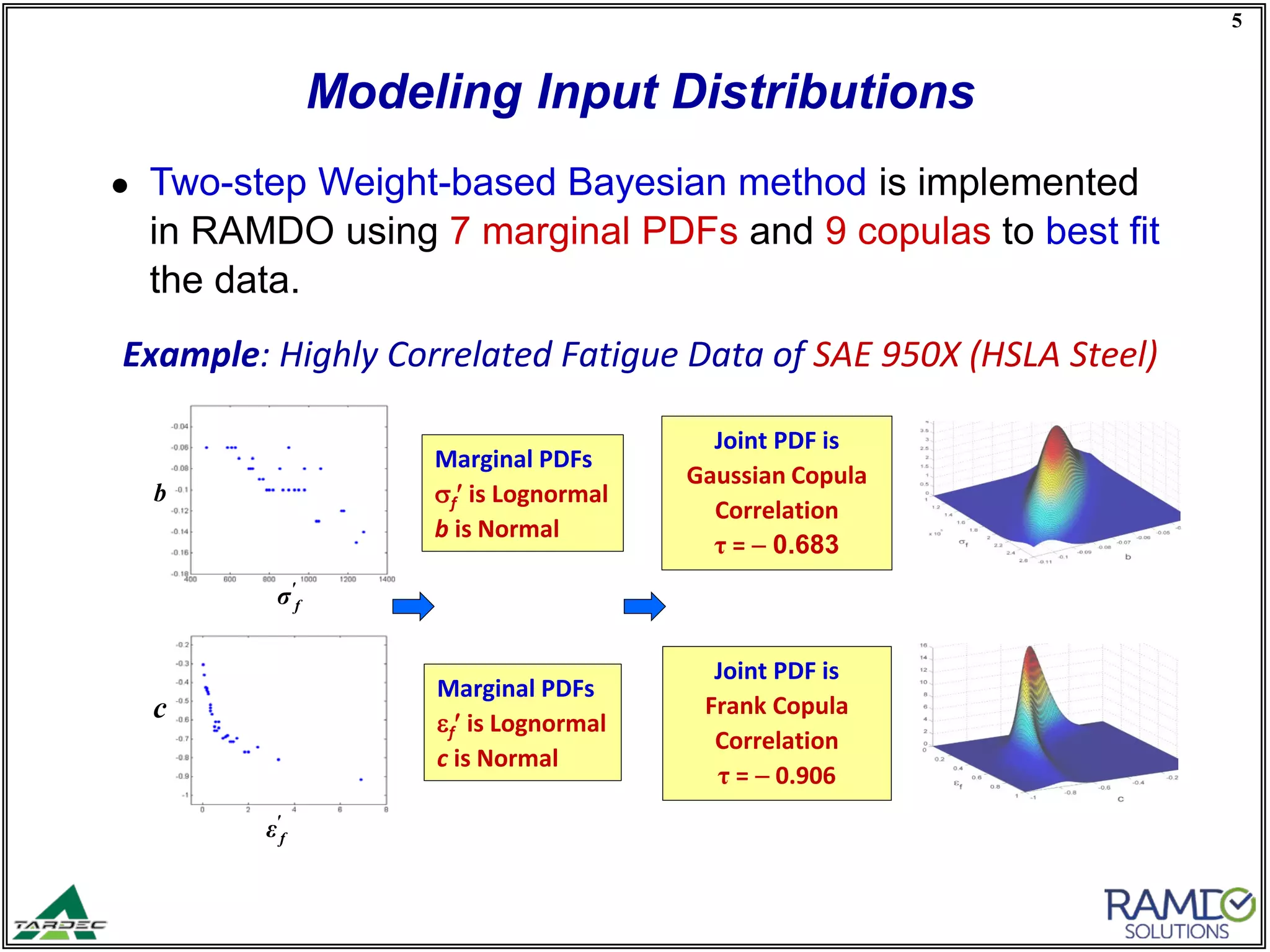
Modeling Input Distributions
● Two-step Weight-based Bayesian method is implemented
in RAMDO using 7 marginal PDFs and 9 copulas to best fit
the data.
Example: Highly Correlated Fatigue Data of SAE 950X (HSLA Steel)
b
'
fσ
c
'
fε
Joint PDF is
Frank Copula
Correlation
τ = − 0.906
Joint PDF is
Gaussian Copula
Correlation
τ = − 0.683
Marginal PDFs
σf′ is Lognormal
b is Normal
Marginal PDFs
εf′ is Lognormal
c is Normal
6
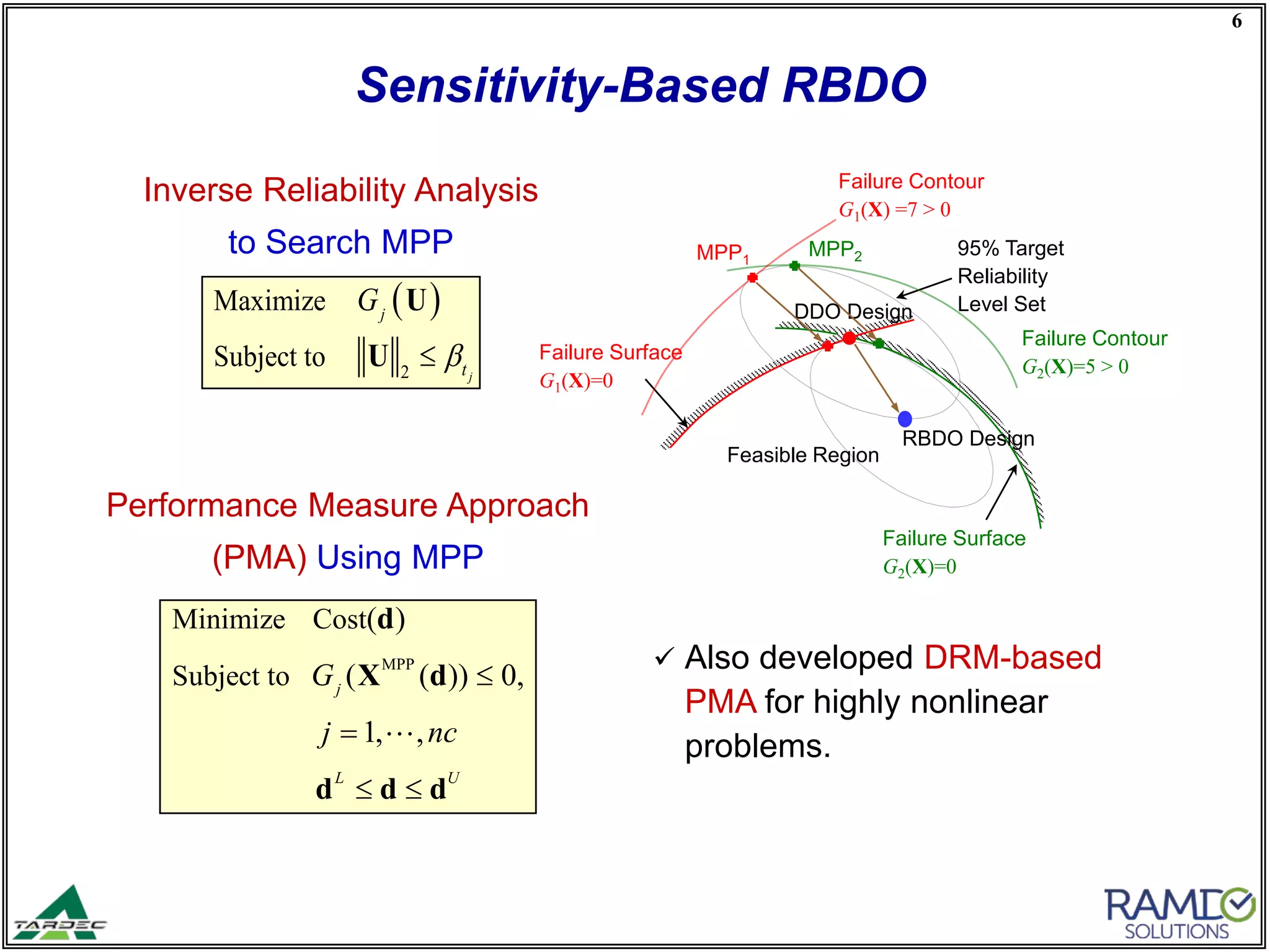
Sensitivity-Based RBDO
Failure Surface
G1(X)=0
Failure Surface
G2(X)=0
95% Target
Reliability
Level Set( )
2
Maximize
Subject to j
j
t
G
β≤
U
U
Inverse Reliability Analysis
to Search MPP
Failure Contour
G2(X)=5 > 0
Failure Contour
G1(X) =7 > 0
MPP2MPP1
MPP
Minimize Cost
Subject to
( )
( ( )) 0,
1, ,
j
L U
G
j nc
≤
=
≤ ≤
d
X d
d d d

Performance Measure Approach
(PMA) Using MPP
 Also developed DRM-based
PMA for highly nonlinear
problems.
DDO Design
Feasible Region
RBDO Design
7
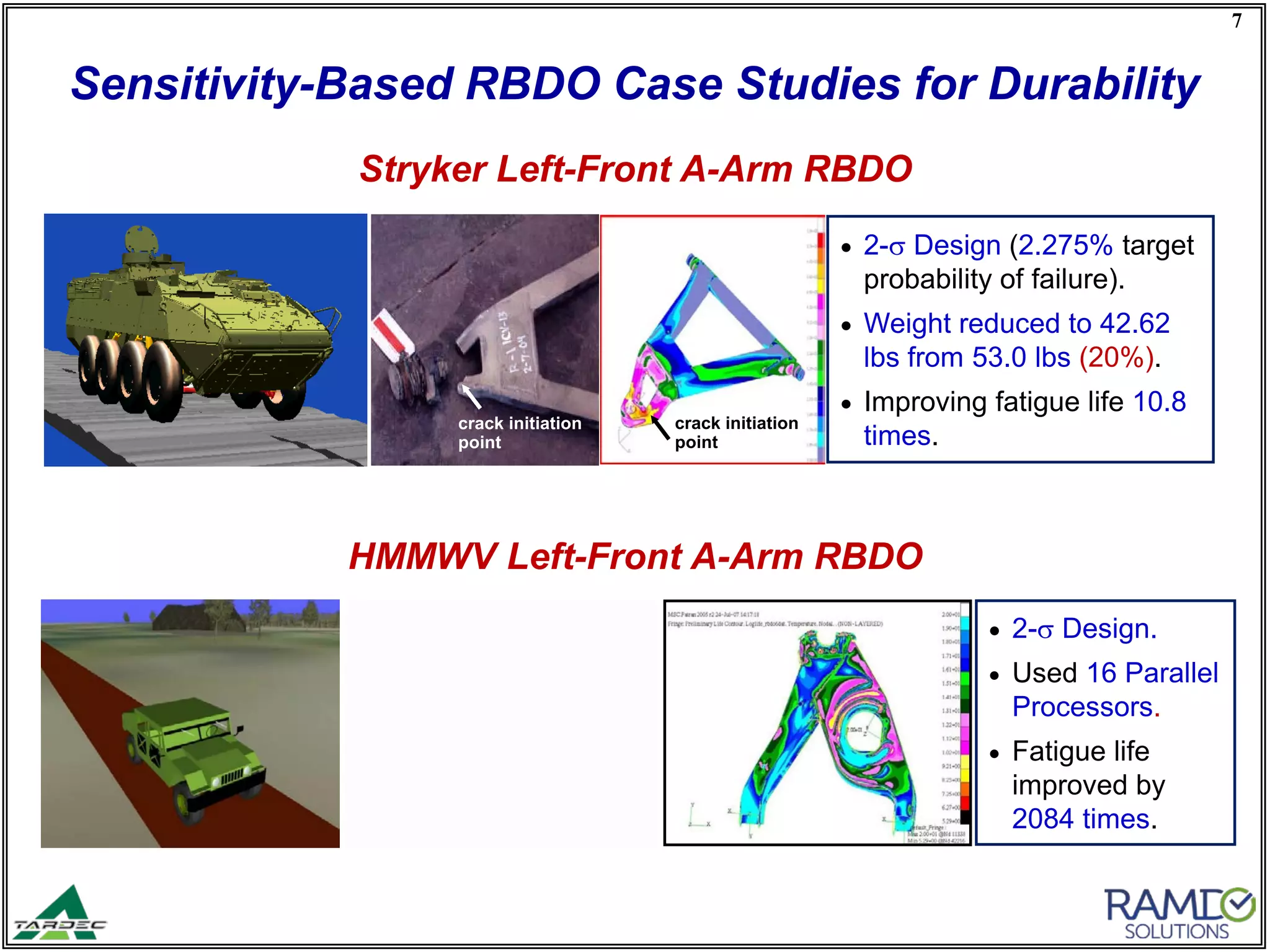
Sensitivity-Based RBDO Case Studies for Durability
crack initiation
point
crack initiation
point
• 2-σ Design (2.275% target
probability of failure).
• Weight reduced to 42.62
lbs from 53.0 lbs (20%).
• Improving fatigue life 10.8
times.
• 2-σ Design.
• Used 16 Parallel
Processors.
• Fatigue life
improved by
2084 times.
Stryker Left-Front A-Arm RBDO
HMMWV Left-Front A-Arm RBDO
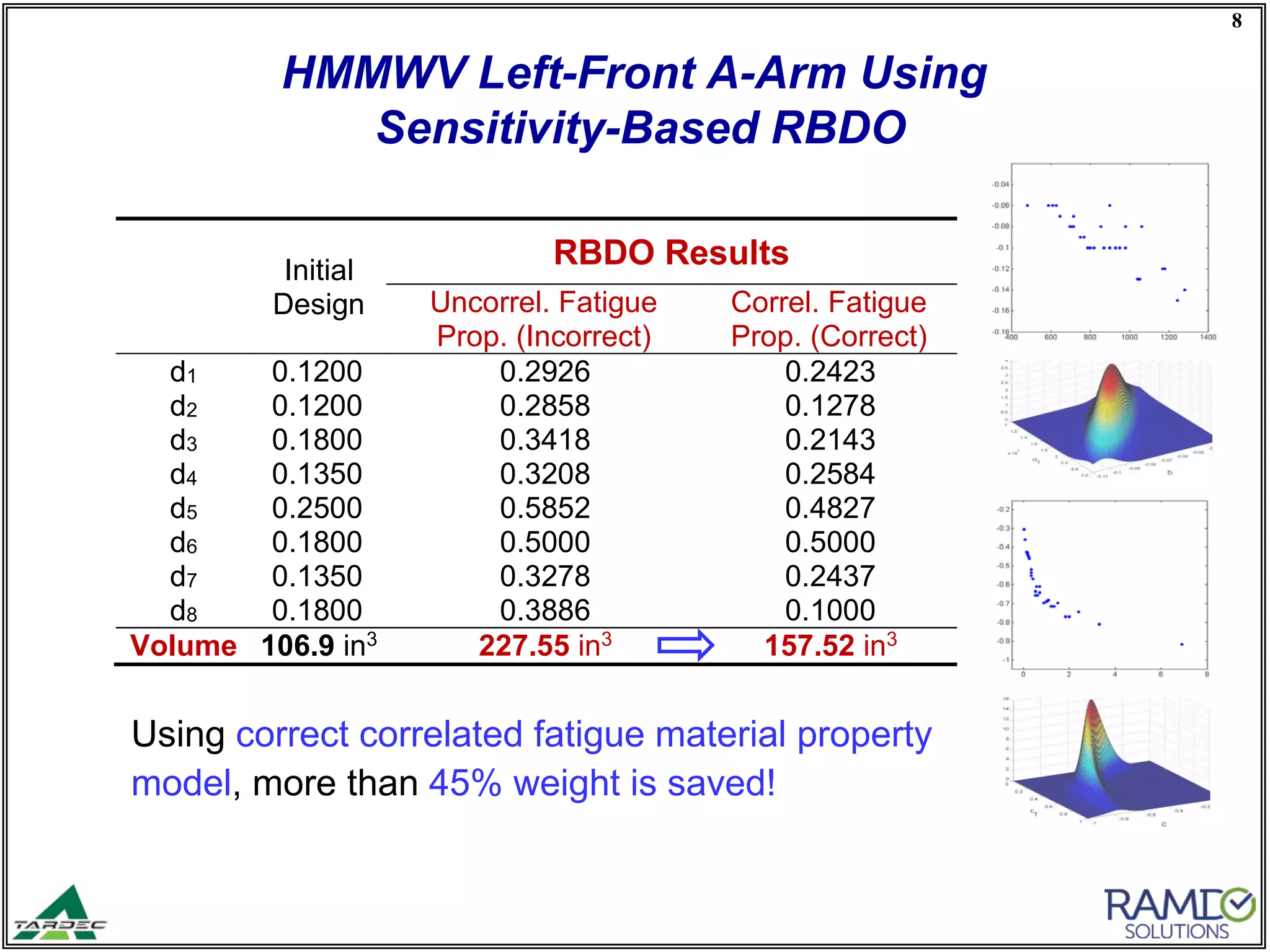
8
HMMWV Left-Front A-Arm Using
Sensitivity-Based RBDO
Initial
Design
RBDO Results
Uncorrel. Fatigue
Prop. (Incorrect)
Correl. Fatigue
Prop. (Correct)
d1 0.1200 0.2926 0.2423
d2 0.1200 0.2858 0.1278
d3 0.1800 0.3418 0.2143
d4 0.1350 0.3208 0.2584
d5 0.2500 0.5852 0.4827
d6 0.1800 0.5000 0.5000
d7 0.1350 0.3278 0.2437
d8 0.1800 0.3886 0.1000
Volume 106.9 in3 227.55 in3 157.52 in3
Using correct correlated fatigue material property
model, more than 45% weight is saved!
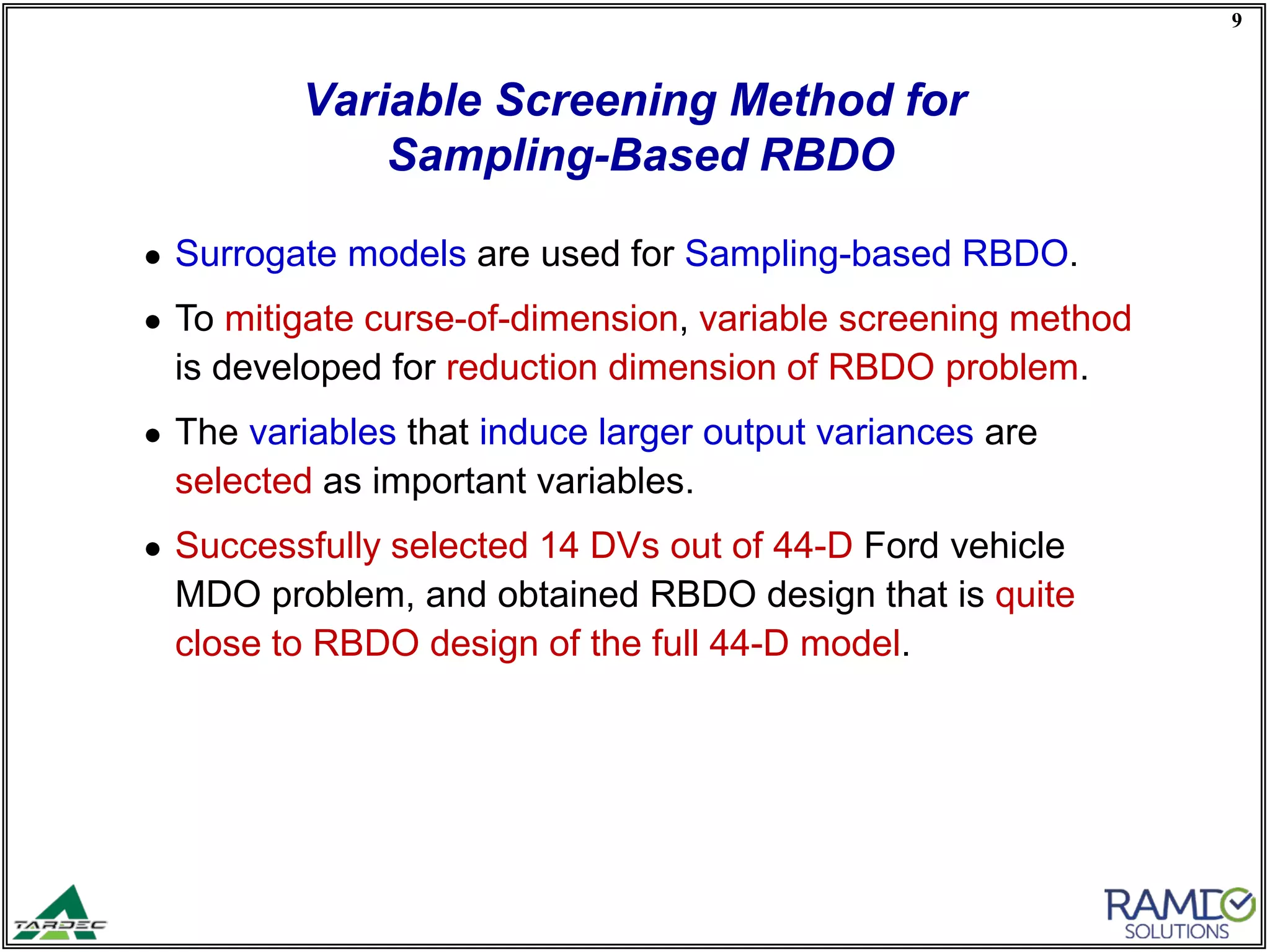
9
● Surrogate models are used for Sampling-based RBDO.
● To mitigate curse-of-dimension, variable screening method
is developed for reduction dimension of RBDO problem.
● The variables that induce larger output variances are
selected as important variables.
● Successfully selected 14 DVs out of 44-D Ford vehicle
MDO problem, and obtained RBDO design that is quite
close to RBDO design of the full 44-D model.
Variable Screening Method for
Sampling-Based RBDO
10
Dynamic Kriging (DKG) Surrogate Models
● In standard Kriging model, the responses are represented by
where is the regression coefficient, is polynomial basis
function and is a model of Gaussian random process with
zero mean and covariance .
● Select best mean structure from 0th, 1st, and 2nd order
polynomials using cross validation (CV) error.
● Select best correlation model from 7 candidates using
maximum likelihood estimation.
● Provides 7×3 = 21 options for surrogate models on each local
window.
( , , )i jR θ x x
( )k
f x
, =[ ( ), 1,..., , 1,..., ]n Kik
f k K i n ×= =y =Fβ+Z F x
2
( , ) ( , , )i j i jC Rσ=x x θ x x
1K×β
1n×Z
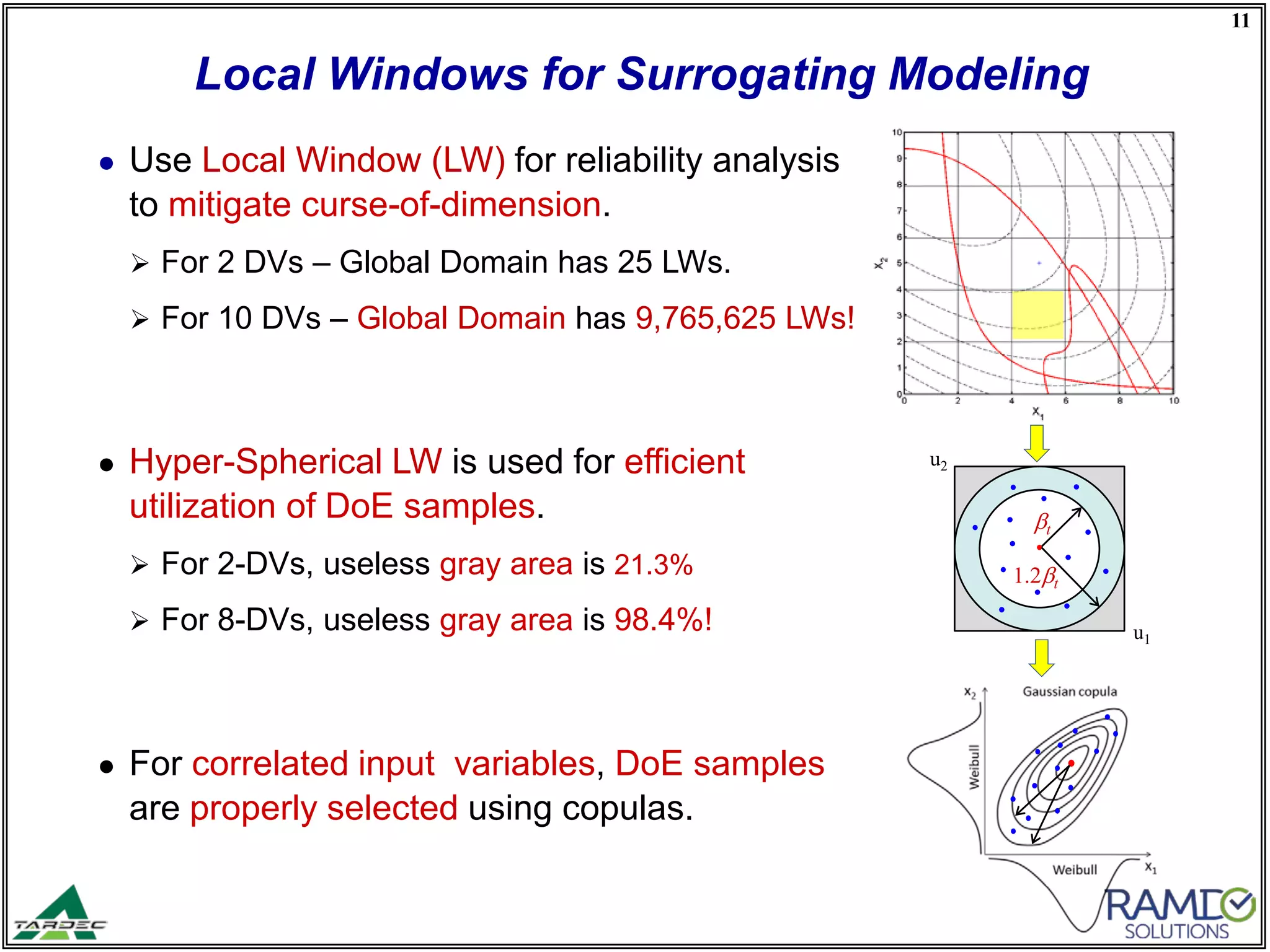
11
● For correlated input variables, DoE samples
are properly selected using copulas.
Local Windows for Surrogating Modeling
● Use Local Window (LW) for reliability analysis
to mitigate curse-of-dimension.
 For 2 DVs – Global Domain has 25 LWs.
 For 10 DVs – Global Domain has 9,765,625 LWs!
βt
u1
u2
1.2βt
● Hyper-Spherical LW is used for efficient
utilization of DoE samples.
 For 2-DVs, useless gray area is 21.3%
 For 8-DVs, useless gray area is 98.4%!
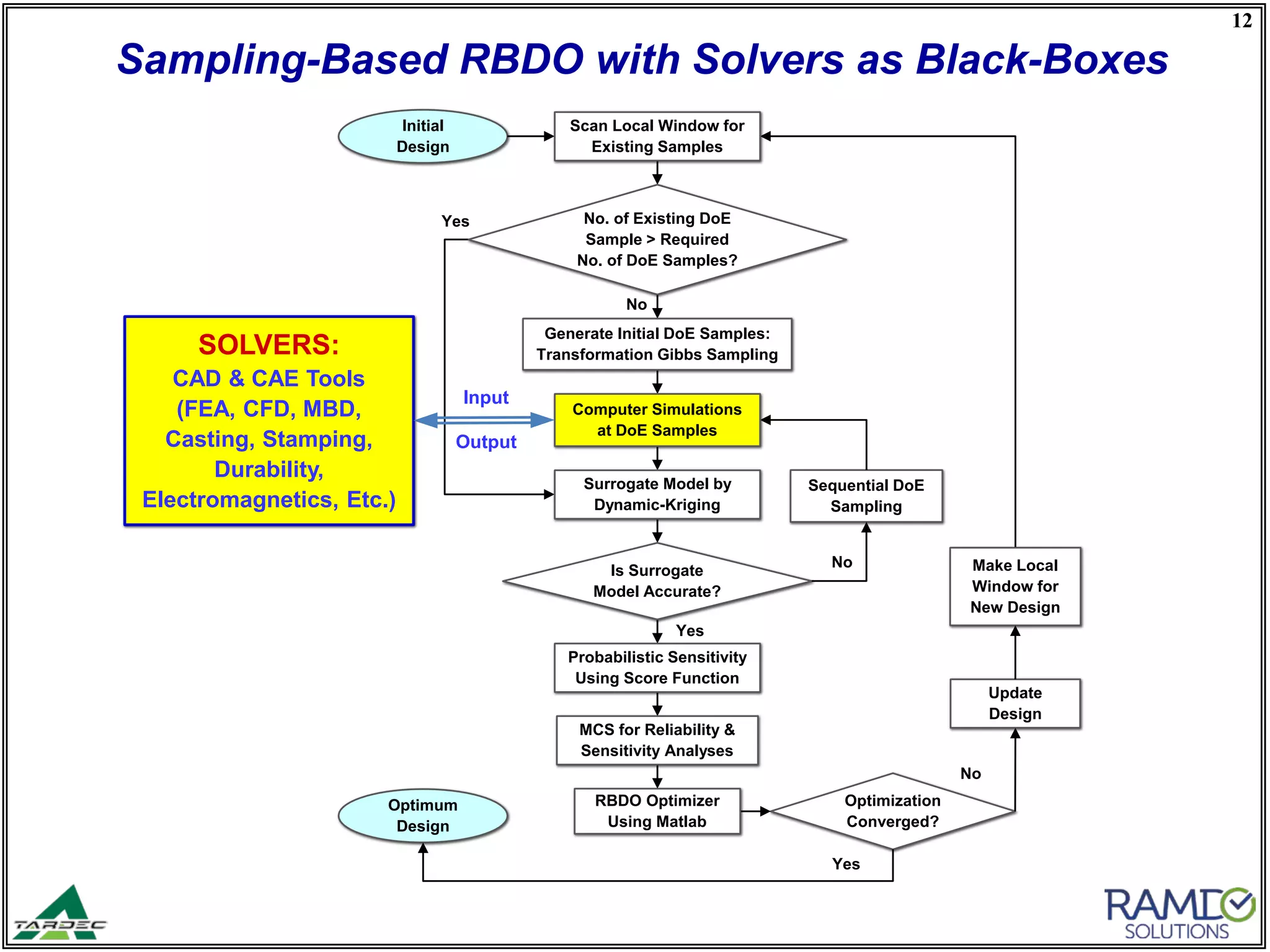
12
Sampling-Based RBDO with Solvers as Black-Boxes
Initial
Design
No
Yes
Optimization
Converged?
Update
Design
No
Optimum
Design
Yes
Yes
Sequential DoE
Sampling
No
Scan Local Window for
Existing Samples
No. of Existing DoE
Sample > Required
No. of DoE Samples?
Generate Initial DoE Samples:
Transformation Gibbs Sampling
Computer Simulations
at DoE Samples
Surrogate Model by
Dynamic-Kriging
Is Surrogate
Model Accurate?
Probabilistic Sensitivity
Using Score Function
MCS for Reliability &
Sensitivity Analyses
RBDO Optimizer
Using Matlab
Make Local
Window for
New Design
SOLVERS:
CAD & CAE Tools
(FEA, CFD, MBD,
Casting, Stamping,
Durability,
Electromagnetics, Etc.)
Input
Output
Safety Optimization And RobustnessResearch & Advanced Engineering
13
Safety Optimization And RobustnessResearch & Advanced Engineering
13
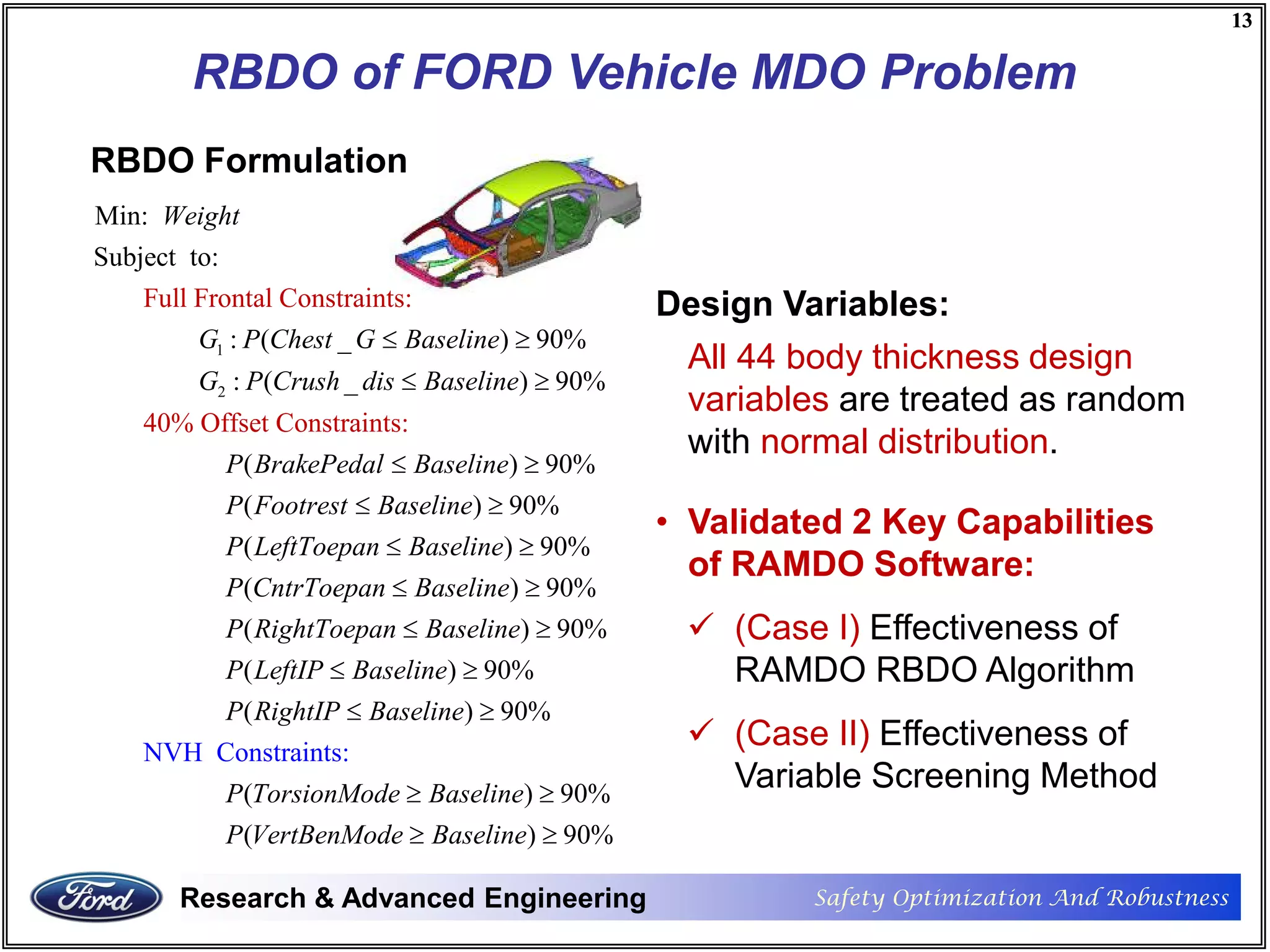
RBDO of FORD Vehicle MDO Problem
RBDO Formulation
1
2
Min:
Subject to:
: ( _ ) 90%
: ( _ ) 90%
Full Frontal Constraints:
40% Offset Constraint :
(
s
Weight
G P Chest G Baseline
G P Crush dis Baseline
P BrakePeda
≤ ≥
≤ ≥
) 90%
( ) 90%
( ) 90%
( ) 90%
( ) 90%
l Baseline
P Footrest Baseline
P LeftToepan Baseline
P CntrToepan Baseline
P RightToepan Baseline
≤ ≥
≤ ≥
≤ ≥
≤ ≥
≤ ≥
NVH Constrai
( ) 90%
( ) 90%
( ) 90%
( ) 90
nts
%
:
P LeftIP Baseline
P RightIP Baseline
P TorsionMode Baseline
P VertBenMode Baseline
≤ ≥
≤ ≥
≥ ≥
≥ ≥
Design Variables:
All 44 body thickness design
variables are treated as random
with normal distribution.
• Validated 2 Key Capabilities
of RAMDO Software:
 (Case I) Effectiveness of
RAMDO RBDO Algorithm
 (Case II) Effectiveness of
Variable Screening Method
Safety Optimization And RobustnessResearch & Advanced Engineering
14
Safety Optimization And RobustnessResearch & Advanced Engineering
14
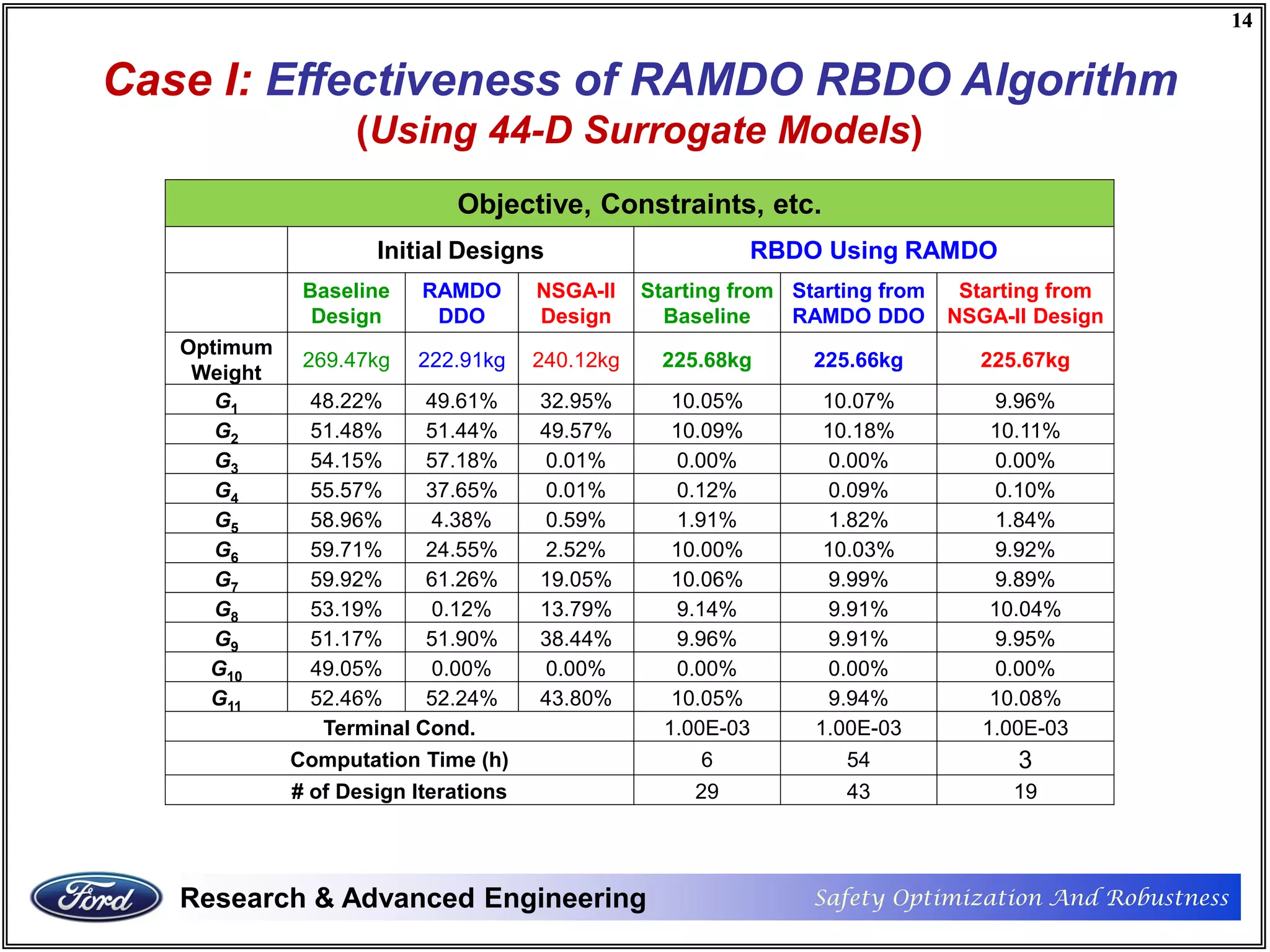
Case I: Effectiveness of RAMDO RBDO Algorithm
(Using 44-D Surrogate Models)
Objective, Constraints, etc.
Initial Designs RBDO Using RAMDO
Baseline
Design
RAMDO
DDO
NSGA-II
Design
Starting from
Baseline
Starting from
RAMDO DDO
Starting from
NSGA-II Design
Optimum
Weight
269.47kg 222.91kg 240.12kg 225.68kg 225.66kg 225.67kg
G1 48.22% 49.61% 32.95% 10.05% 10.07% 9.96%
G2 51.48% 51.44% 49.57% 10.09% 10.18% 10.11%
G3 54.15% 57.18% 0.01% 0.00% 0.00% 0.00%
G4 55.57% 37.65% 0.01% 0.12% 0.09% 0.10%
G5 58.96% 4.38% 0.59% 1.91% 1.82% 1.84%
G6 59.71% 24.55% 2.52% 10.00% 10.03% 9.92%
G7 59.92% 61.26% 19.05% 10.06% 9.99% 9.89%
G8 53.19% 0.12% 13.79% 9.14% 9.91% 10.04%
G9 51.17% 51.90% 38.44% 9.96% 9.91% 9.95%
G10 49.05% 0.00% 0.00% 0.00% 0.00% 0.00%
G11 52.46% 52.24% 43.80% 10.05% 9.94% 10.08%
Terminal Cond. 1.00E-03 1.00E-03 1.00E-03
Computation Time (h) 6 54 3
# of Design Iterations 29 43 19
Safety Optimization And RobustnessResearch & Advanced Engineering
15
Safety Optimization And RobustnessResearch & Advanced Engineering
15
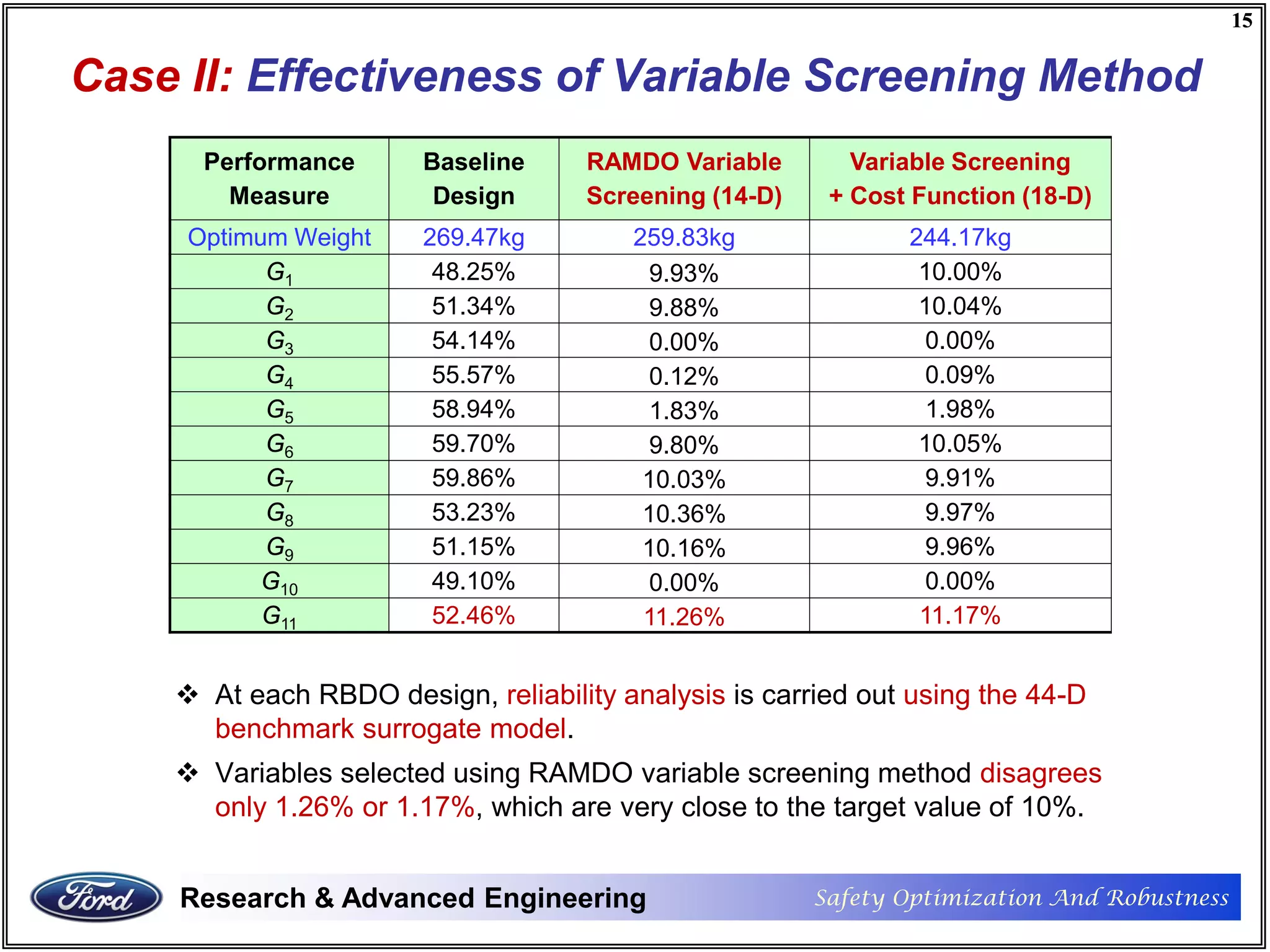
Case II: Effectiveness of Variable Screening Method
 At each RBDO design, reliability analysis is carried out using the 44-D
benchmark surrogate model.
 Variables selected using RAMDO variable screening method disagrees
only 1.26% or 1.17%, which are very close to the target value of 10%.
Performance
Measure
Baseline
Design
RAMDO Variable
Screening (14-D)
Variable Screening
+ Cost Function (18-D)
Optimum Weight 269.47kg 259.83kg 244.17kg
G1 48.25% 9.93% 10.00%
G2 51.34% 9.88% 10.04%
G3 54.14% 0.00% 0.00%
G4 55.57% 0.12% 0.09%
G5 58.94% 1.83% 1.98%
G6 59.70% 9.80% 10.05%
G7 59.86% 10.03% 9.91%
G8 53.23% 10.36% 9.97%
G9 51.15% 10.16% 9.96%
G10 49.10% 0.00% 0.00%
G11 52.46% 11.26% 11.17%
16
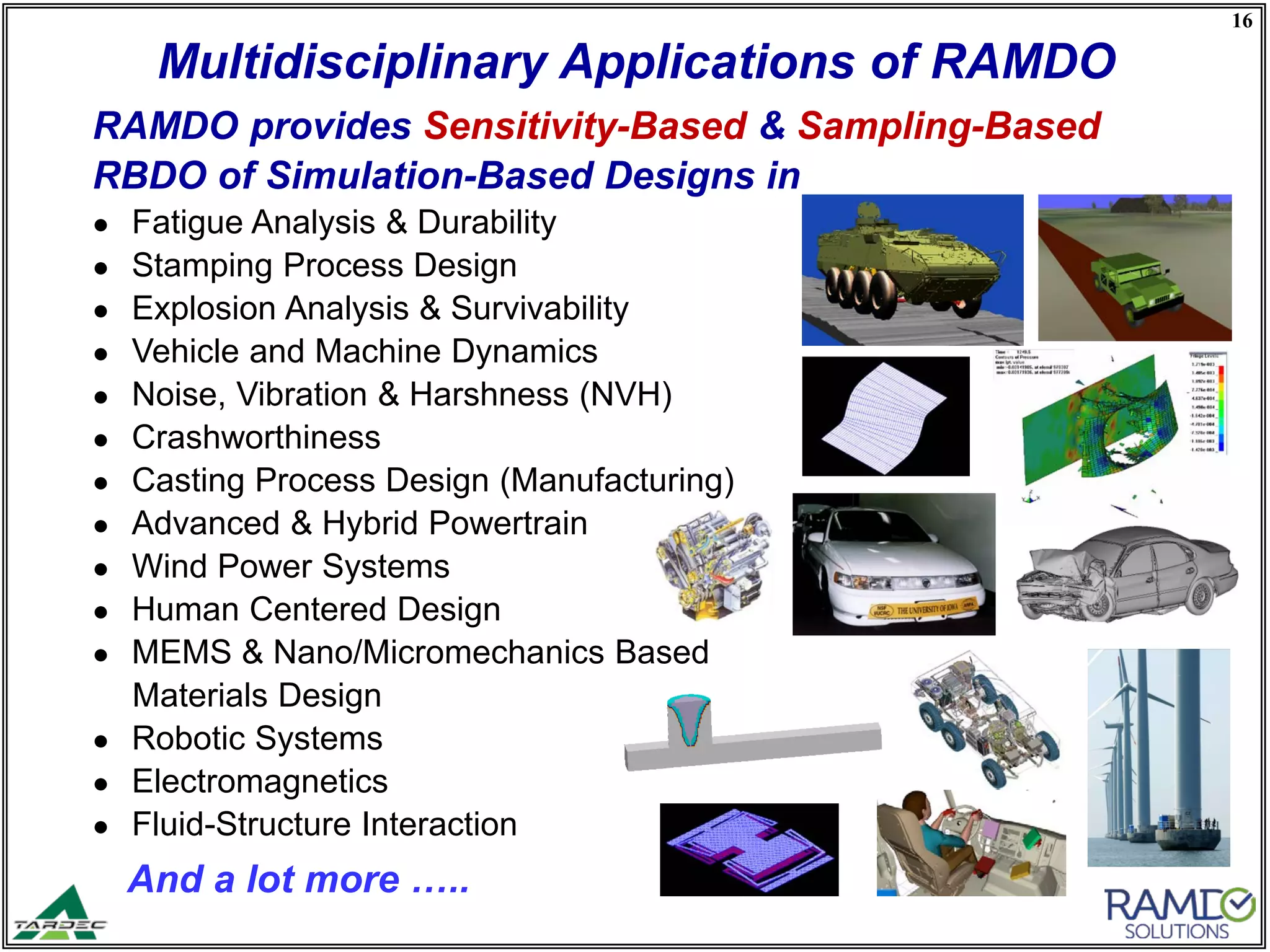
RAMDO provides Sensitivity-Based & Sampling-Based
RBDO of Simulation-Based Designs in
● Fatigue Analysis & Durability
● Stamping Process Design
● Explosion Analysis & Survivability
● Vehicle and Machine Dynamics
● Noise, Vibration & Harshness (NVH)
● Crashworthiness
● Casting Process Design (Manufacturing)
● Advanced & Hybrid Powertrain
● Wind Power Systems
● Human Centered Design
● MEMS & Nano/Micromechanics Based
Materials Design
● Robotic Systems
● Electromagnetics
● Fluid-Structure Interaction
Multidisciplinary Applications of RAMDO
And a lot more …..
17
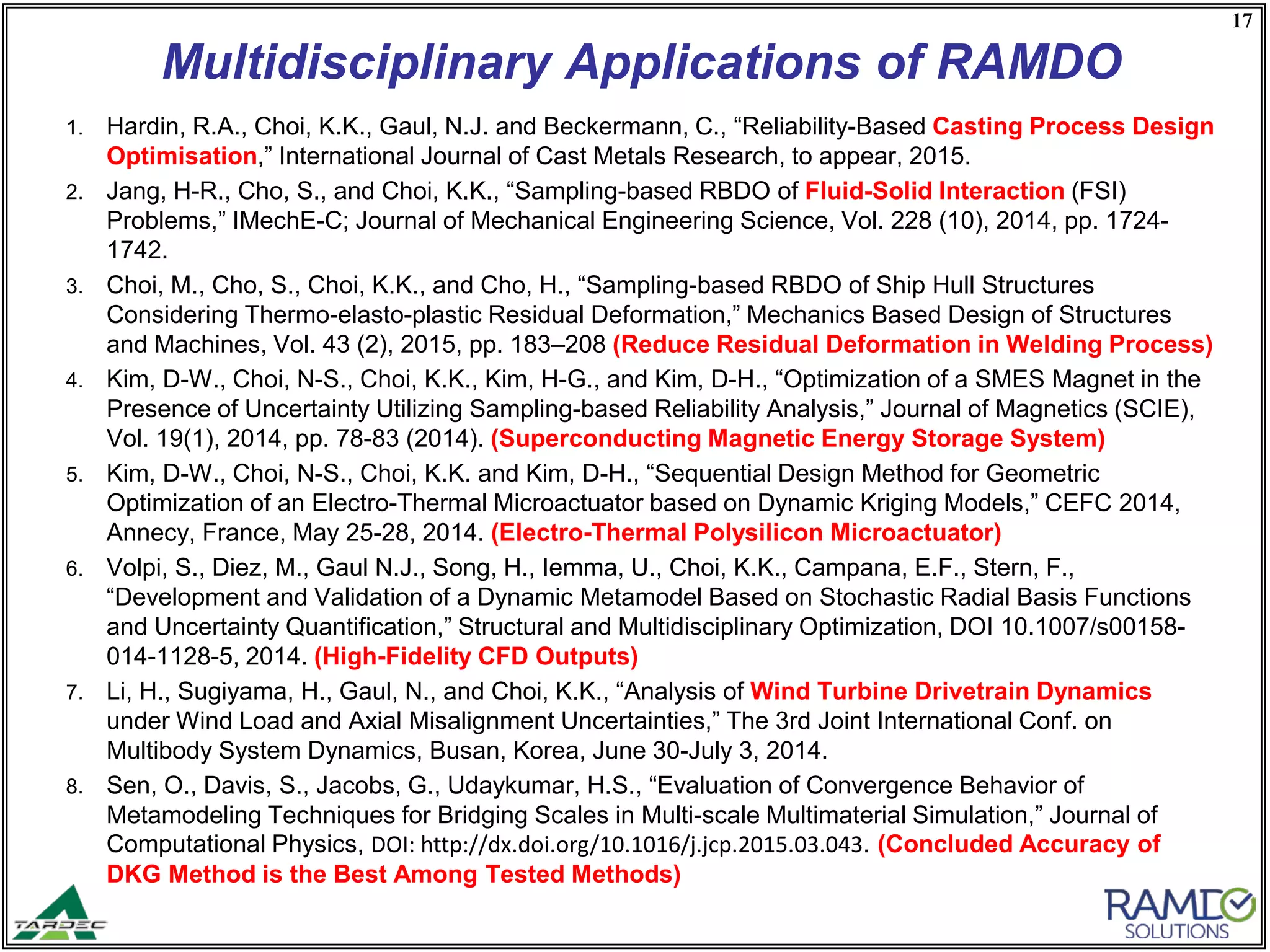
Multidisciplinary Applications of RAMDO
1. Hardin, R.A., Choi, K.K., Gaul, N.J. and Beckermann, C., “Reliability-Based Casting Process Design
Optimisation,” International Journal of Cast Metals Research, to appear, 2015.
2. Jang, H-R., Cho, S., and Choi, K.K., “Sampling-based RBDO of Fluid-Solid Interaction (FSI)
Problems,” IMechE-C; Journal of Mechanical Engineering Science, Vol. 228 (10), 2014, pp. 1724-
1742.
3. Choi, M., Cho, S., Choi, K.K., and Cho, H., “Sampling-based RBDO of Ship Hull Structures
Considering Thermo-elasto-plastic Residual Deformation,” Mechanics Based Design of Structures
and Machines, Vol. 43 (2), 2015, pp. 183–208 (Reduce Residual Deformation in Welding Process)
4. Kim, D-W., Choi, N-S., Choi, K.K., Kim, H-G., and Kim, D-H., “Optimization of a SMES Magnet in the
Presence of Uncertainty Utilizing Sampling-based Reliability Analysis,” Journal of Magnetics (SCIE),
Vol. 19(1), 2014, pp. 78-83 (2014). (Superconducting Magnetic Energy Storage System)
5. Kim, D-W., Choi, N-S., Choi, K.K. and Kim, D-H., “Sequential Design Method for Geometric
Optimization of an Electro-Thermal Microactuator based on Dynamic Kriging Models,” CEFC 2014,
Annecy, France, May 25-28, 2014. (Electro-Thermal Polysilicon Microactuator)
6. Volpi, S., Diez, M., Gaul N.J., Song, H., Iemma, U., Choi, K.K., Campana, E.F., Stern, F.,
“Development and Validation of a Dynamic Metamodel Based on Stochastic Radial Basis Functions
and Uncertainty Quantification,” Structural and Multidisciplinary Optimization, DOI 10.1007/s00158-
014-1128-5, 2014. (High-Fidelity CFD Outputs)
7. Li, H., Sugiyama, H., Gaul, N., and Choi, K.K., “Analysis of Wind Turbine Drivetrain Dynamics
under Wind Load and Axial Misalignment Uncertainties,” The 3rd Joint International Conf. on
Multibody System Dynamics, Busan, Korea, June 30-July 3, 2014.
8. Sen, O., Davis, S., Jacobs, G., Udaykumar, H.S., “Evaluation of Convergence Behavior of
Metamodeling Techniques for Bridging Scales in Multi-scale Multimaterial Simulation,” Journal of
Computational Physics, DOI: http://dx.doi.org/10.1016/j.jcp.2015.03.043. (Concluded Accuracy of
DKG Method is the Best Among Tested Methods)
18
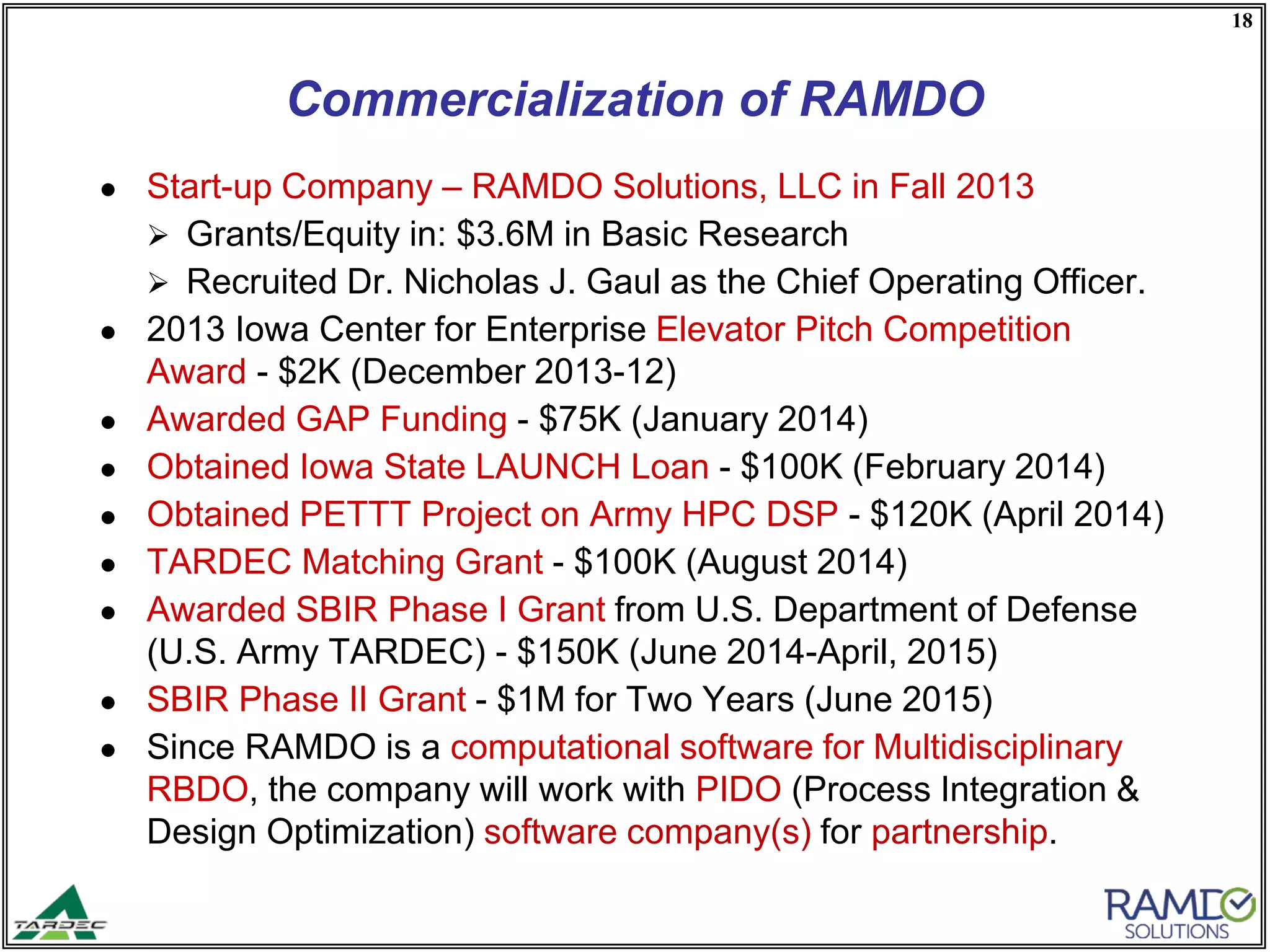
Commercialization of RAMDO
● Start-up Company – RAMDO Solutions, LLC in Fall 2013
 Grants/Equity in: $3.6M in Basic Research
 Recruited Dr. Nicholas J. Gaul as the Chief Operating Officer.
● 2013 Iowa Center for Enterprise Elevator Pitch Competition
Award - $2K (December 2013-12)
● Awarded GAP Funding - $75K (January 2014)
● Obtained Iowa State LAUNCH Loan - $100K (February 2014)
● Obtained PETTT Project on Army HPC DSP - $120K (April 2014)
● TARDEC Matching Grant - $100K (August 2014)
● Awarded SBIR Phase I Grant from U.S. Department of Defense
(U.S. Army TARDEC) - $150K (June 2014-April, 2015)
● SBIR Phase II Grant - $1M for Two Years (June 2015)
● Since RAMDO is a computational software for Multidisciplinary
RBDO, the company will work with PIDO (Process Integration &
Design Optimization) software company(s) for partnership.
19
http://www.ramdosolutions.com/

Development of Reliability Analysis and Multidisciplinary Design Optimization (RAMDO) Software

  • 1.
    1 2015 Americas AltairTechnology Conference K.K. Choi, Nicholas Gaul, Hyeongjin Song and Hyunkyoo Cho RAMDO Solutions, LLC Iowa City, IA 52240
  • 2.
    2 Contents ● Multidisciplinary Simulationwith Input Variability ● Deterministic Design Optimization (DDO) vs. Reliability-Based Design Optimizations (RBDO) ● Capabilities in RAMDO Software  Modeling Input Distributions  Sensitivity-Based RBDO  Sampling-Based RBDO ● Multidisciplinary Applications of RAMDO ● Commercialization of RAMDO
  • 3.
    3 Input Variables X=[X1, X2,…,Xn] Output Performances G(X)=[G1,.., Gnc] Multidisciplinary Simulation with Input Variability Output Performances G(X) Output Variability of Performance G1(X) Output Variability of Performance Gnc(X) Input Variables X Load Variability Manufacturing Variability Surrogate Modeling Variability Material Property Variability Other Input Variable Variabilities Casting Process Variability RAMDO will stimulate collaboration among Design, Manufacturing & Testing Engineers. FEA Multibody Dynamics CFD Casting Electromagnetics Reliability
  • 4.
    4  Safety factorapproach can be considered.  Right safety factor? Over design or under design?  How about multidisciplinary design optimization problem?  There are two approaches for reliability analysis: - FORM or SORM with Sensitivity Analysis to Find MPP - Use Surrogate Models with DoE Samples and MCS DDO vs. RBDO Minimize Cost Subject to : deterministic variables ( ) 1,) , ,( 0 L U j j ncG = ≤ ≤ ≤ x x x x x x  DDO Formulation X2 Failure Surface G1(X)=0 Failure Surface G2(X)=0 Initial Design X10 DDO Design is only ~ 50% Reliable Minimize Cost Subject to ( ) 1, , ( ): mean of random ( ( ) 0) variables ,j L U Tar j F j nP G P c= ≤ ≤ ≤ > = d d d d μ X X d  RBDO Formulation RBDO Design with 95% Target Reliability 95% Target Reliability Level Set Variability of Input Variables 95% Target Reliability Level
  • 5.
    5 Modeling Input Distributions ●Two-step Weight-based Bayesian method is implemented in RAMDO using 7 marginal PDFs and 9 copulas to best fit the data. Example: Highly Correlated Fatigue Data of SAE 950X (HSLA Steel) b ' fσ c ' fε Joint PDF is Frank Copula Correlation τ = − 0.906 Joint PDF is Gaussian Copula Correlation τ = − 0.683 Marginal PDFs σf′ is Lognormal b is Normal Marginal PDFs εf′ is Lognormal c is Normal
  • 6.
    6 Sensitivity-Based RBDO Failure Surface G1(X)=0 FailureSurface G2(X)=0 95% Target Reliability Level Set( ) 2 Maximize Subject to j j t G β≤ U U Inverse Reliability Analysis to Search MPP Failure Contour G2(X)=5 > 0 Failure Contour G1(X) =7 > 0 MPP2MPP1 MPP Minimize Cost Subject to ( ) ( ( )) 0, 1, , j L U G j nc ≤ = ≤ ≤ d X d d d d  Performance Measure Approach (PMA) Using MPP  Also developed DRM-based PMA for highly nonlinear problems. DDO Design Feasible Region RBDO Design
  • 7.
    7 Sensitivity-Based RBDO CaseStudies for Durability crack initiation point crack initiation point • 2-σ Design (2.275% target probability of failure). • Weight reduced to 42.62 lbs from 53.0 lbs (20%). • Improving fatigue life 10.8 times. • 2-σ Design. • Used 16 Parallel Processors. • Fatigue life improved by 2084 times. Stryker Left-Front A-Arm RBDO HMMWV Left-Front A-Arm RBDO
  • 8.
    8 HMMWV Left-Front A-ArmUsing Sensitivity-Based RBDO Initial Design RBDO Results Uncorrel. Fatigue Prop. (Incorrect) Correl. Fatigue Prop. (Correct) d1 0.1200 0.2926 0.2423 d2 0.1200 0.2858 0.1278 d3 0.1800 0.3418 0.2143 d4 0.1350 0.3208 0.2584 d5 0.2500 0.5852 0.4827 d6 0.1800 0.5000 0.5000 d7 0.1350 0.3278 0.2437 d8 0.1800 0.3886 0.1000 Volume 106.9 in3 227.55 in3 157.52 in3 Using correct correlated fatigue material property model, more than 45% weight is saved!
  • 9.
    9 ● Surrogate modelsare used for Sampling-based RBDO. ● To mitigate curse-of-dimension, variable screening method is developed for reduction dimension of RBDO problem. ● The variables that induce larger output variances are selected as important variables. ● Successfully selected 14 DVs out of 44-D Ford vehicle MDO problem, and obtained RBDO design that is quite close to RBDO design of the full 44-D model. Variable Screening Method for Sampling-Based RBDO
  • 10.
    10 Dynamic Kriging (DKG)Surrogate Models ● In standard Kriging model, the responses are represented by where is the regression coefficient, is polynomial basis function and is a model of Gaussian random process with zero mean and covariance . ● Select best mean structure from 0th, 1st, and 2nd order polynomials using cross validation (CV) error. ● Select best correlation model from 7 candidates using maximum likelihood estimation. ● Provides 7×3 = 21 options for surrogate models on each local window. ( , , )i jR θ x x ( )k f x , =[ ( ), 1,..., , 1,..., ]n Kik f k K i n ×= =y =Fβ+Z F x 2 ( , ) ( , , )i j i jC Rσ=x x θ x x 1K×β 1n×Z
  • 11.
    11 ● For correlatedinput variables, DoE samples are properly selected using copulas. Local Windows for Surrogating Modeling ● Use Local Window (LW) for reliability analysis to mitigate curse-of-dimension.  For 2 DVs – Global Domain has 25 LWs.  For 10 DVs – Global Domain has 9,765,625 LWs! βt u1 u2 1.2βt ● Hyper-Spherical LW is used for efficient utilization of DoE samples.  For 2-DVs, useless gray area is 21.3%  For 8-DVs, useless gray area is 98.4%!
  • 12.
    12 Sampling-Based RBDO withSolvers as Black-Boxes Initial Design No Yes Optimization Converged? Update Design No Optimum Design Yes Yes Sequential DoE Sampling No Scan Local Window for Existing Samples No. of Existing DoE Sample > Required No. of DoE Samples? Generate Initial DoE Samples: Transformation Gibbs Sampling Computer Simulations at DoE Samples Surrogate Model by Dynamic-Kriging Is Surrogate Model Accurate? Probabilistic Sensitivity Using Score Function MCS for Reliability & Sensitivity Analyses RBDO Optimizer Using Matlab Make Local Window for New Design SOLVERS: CAD & CAE Tools (FEA, CFD, MBD, Casting, Stamping, Durability, Electromagnetics, Etc.) Input Output
  • 13.
    Safety Optimization AndRobustnessResearch & Advanced Engineering 13 Safety Optimization And RobustnessResearch & Advanced Engineering 13 RBDO of FORD Vehicle MDO Problem RBDO Formulation 1 2 Min: Subject to: : ( _ ) 90% : ( _ ) 90% Full Frontal Constraints: 40% Offset Constraint : ( s Weight G P Chest G Baseline G P Crush dis Baseline P BrakePeda ≤ ≥ ≤ ≥ ) 90% ( ) 90% ( ) 90% ( ) 90% ( ) 90% l Baseline P Footrest Baseline P LeftToepan Baseline P CntrToepan Baseline P RightToepan Baseline ≤ ≥ ≤ ≥ ≤ ≥ ≤ ≥ ≤ ≥ NVH Constrai ( ) 90% ( ) 90% ( ) 90% ( ) 90 nts % : P LeftIP Baseline P RightIP Baseline P TorsionMode Baseline P VertBenMode Baseline ≤ ≥ ≤ ≥ ≥ ≥ ≥ ≥ Design Variables: All 44 body thickness design variables are treated as random with normal distribution. • Validated 2 Key Capabilities of RAMDO Software:  (Case I) Effectiveness of RAMDO RBDO Algorithm  (Case II) Effectiveness of Variable Screening Method
  • 14.
    Safety Optimization AndRobustnessResearch & Advanced Engineering 14 Safety Optimization And RobustnessResearch & Advanced Engineering 14 Case I: Effectiveness of RAMDO RBDO Algorithm (Using 44-D Surrogate Models) Objective, Constraints, etc. Initial Designs RBDO Using RAMDO Baseline Design RAMDO DDO NSGA-II Design Starting from Baseline Starting from RAMDO DDO Starting from NSGA-II Design Optimum Weight 269.47kg 222.91kg 240.12kg 225.68kg 225.66kg 225.67kg G1 48.22% 49.61% 32.95% 10.05% 10.07% 9.96% G2 51.48% 51.44% 49.57% 10.09% 10.18% 10.11% G3 54.15% 57.18% 0.01% 0.00% 0.00% 0.00% G4 55.57% 37.65% 0.01% 0.12% 0.09% 0.10% G5 58.96% 4.38% 0.59% 1.91% 1.82% 1.84% G6 59.71% 24.55% 2.52% 10.00% 10.03% 9.92% G7 59.92% 61.26% 19.05% 10.06% 9.99% 9.89% G8 53.19% 0.12% 13.79% 9.14% 9.91% 10.04% G9 51.17% 51.90% 38.44% 9.96% 9.91% 9.95% G10 49.05% 0.00% 0.00% 0.00% 0.00% 0.00% G11 52.46% 52.24% 43.80% 10.05% 9.94% 10.08% Terminal Cond. 1.00E-03 1.00E-03 1.00E-03 Computation Time (h) 6 54 3 # of Design Iterations 29 43 19
  • 15.
    Safety Optimization AndRobustnessResearch & Advanced Engineering 15 Safety Optimization And RobustnessResearch & Advanced Engineering 15 Case II: Effectiveness of Variable Screening Method  At each RBDO design, reliability analysis is carried out using the 44-D benchmark surrogate model.  Variables selected using RAMDO variable screening method disagrees only 1.26% or 1.17%, which are very close to the target value of 10%. Performance Measure Baseline Design RAMDO Variable Screening (14-D) Variable Screening + Cost Function (18-D) Optimum Weight 269.47kg 259.83kg 244.17kg G1 48.25% 9.93% 10.00% G2 51.34% 9.88% 10.04% G3 54.14% 0.00% 0.00% G4 55.57% 0.12% 0.09% G5 58.94% 1.83% 1.98% G6 59.70% 9.80% 10.05% G7 59.86% 10.03% 9.91% G8 53.23% 10.36% 9.97% G9 51.15% 10.16% 9.96% G10 49.10% 0.00% 0.00% G11 52.46% 11.26% 11.17%
  • 16.
    16 RAMDO provides Sensitivity-Based& Sampling-Based RBDO of Simulation-Based Designs in ● Fatigue Analysis & Durability ● Stamping Process Design ● Explosion Analysis & Survivability ● Vehicle and Machine Dynamics ● Noise, Vibration & Harshness (NVH) ● Crashworthiness ● Casting Process Design (Manufacturing) ● Advanced & Hybrid Powertrain ● Wind Power Systems ● Human Centered Design ● MEMS & Nano/Micromechanics Based Materials Design ● Robotic Systems ● Electromagnetics ● Fluid-Structure Interaction Multidisciplinary Applications of RAMDO And a lot more …..
  • 17.
    17 Multidisciplinary Applications ofRAMDO 1. Hardin, R.A., Choi, K.K., Gaul, N.J. and Beckermann, C., “Reliability-Based Casting Process Design Optimisation,” International Journal of Cast Metals Research, to appear, 2015. 2. Jang, H-R., Cho, S., and Choi, K.K., “Sampling-based RBDO of Fluid-Solid Interaction (FSI) Problems,” IMechE-C; Journal of Mechanical Engineering Science, Vol. 228 (10), 2014, pp. 1724- 1742. 3. Choi, M., Cho, S., Choi, K.K., and Cho, H., “Sampling-based RBDO of Ship Hull Structures Considering Thermo-elasto-plastic Residual Deformation,” Mechanics Based Design of Structures and Machines, Vol. 43 (2), 2015, pp. 183–208 (Reduce Residual Deformation in Welding Process) 4. Kim, D-W., Choi, N-S., Choi, K.K., Kim, H-G., and Kim, D-H., “Optimization of a SMES Magnet in the Presence of Uncertainty Utilizing Sampling-based Reliability Analysis,” Journal of Magnetics (SCIE), Vol. 19(1), 2014, pp. 78-83 (2014). (Superconducting Magnetic Energy Storage System) 5. Kim, D-W., Choi, N-S., Choi, K.K. and Kim, D-H., “Sequential Design Method for Geometric Optimization of an Electro-Thermal Microactuator based on Dynamic Kriging Models,” CEFC 2014, Annecy, France, May 25-28, 2014. (Electro-Thermal Polysilicon Microactuator) 6. Volpi, S., Diez, M., Gaul N.J., Song, H., Iemma, U., Choi, K.K., Campana, E.F., Stern, F., “Development and Validation of a Dynamic Metamodel Based on Stochastic Radial Basis Functions and Uncertainty Quantification,” Structural and Multidisciplinary Optimization, DOI 10.1007/s00158- 014-1128-5, 2014. (High-Fidelity CFD Outputs) 7. Li, H., Sugiyama, H., Gaul, N., and Choi, K.K., “Analysis of Wind Turbine Drivetrain Dynamics under Wind Load and Axial Misalignment Uncertainties,” The 3rd Joint International Conf. on Multibody System Dynamics, Busan, Korea, June 30-July 3, 2014. 8. Sen, O., Davis, S., Jacobs, G., Udaykumar, H.S., “Evaluation of Convergence Behavior of Metamodeling Techniques for Bridging Scales in Multi-scale Multimaterial Simulation,” Journal of Computational Physics, DOI: http://dx.doi.org/10.1016/j.jcp.2015.03.043. (Concluded Accuracy of DKG Method is the Best Among Tested Methods)
  • 18.
    18 Commercialization of RAMDO ●Start-up Company – RAMDO Solutions, LLC in Fall 2013  Grants/Equity in: $3.6M in Basic Research  Recruited Dr. Nicholas J. Gaul as the Chief Operating Officer. ● 2013 Iowa Center for Enterprise Elevator Pitch Competition Award - $2K (December 2013-12) ● Awarded GAP Funding - $75K (January 2014) ● Obtained Iowa State LAUNCH Loan - $100K (February 2014) ● Obtained PETTT Project on Army HPC DSP - $120K (April 2014) ● TARDEC Matching Grant - $100K (August 2014) ● Awarded SBIR Phase I Grant from U.S. Department of Defense (U.S. Army TARDEC) - $150K (June 2014-April, 2015) ● SBIR Phase II Grant - $1M for Two Years (June 2015) ● Since RAMDO is a computational software for Multidisciplinary RBDO, the company will work with PIDO (Process Integration & Design Optimization) software company(s) for partnership.
  • 19.