Eurogen 2013

October 7–9, 2013, Las Palmas de Gran Canaria, Spain

Efficient Design Exploration for Civil Aircraft
Using a Kriging-Based Genetic Algorithm
Mashiro Kanazaki
Tokyo Metropolitan University
Contents
Introduction
Aerodynamic Design of Civil Transport
Optimization method
Efficient Global Optimization
Data mining
Flow solver
Case1: Optimization of wing integrated engine
nacelle
Case2: Multi-disciplinary design of wing tip
Conclusions

2
Introductino1

3

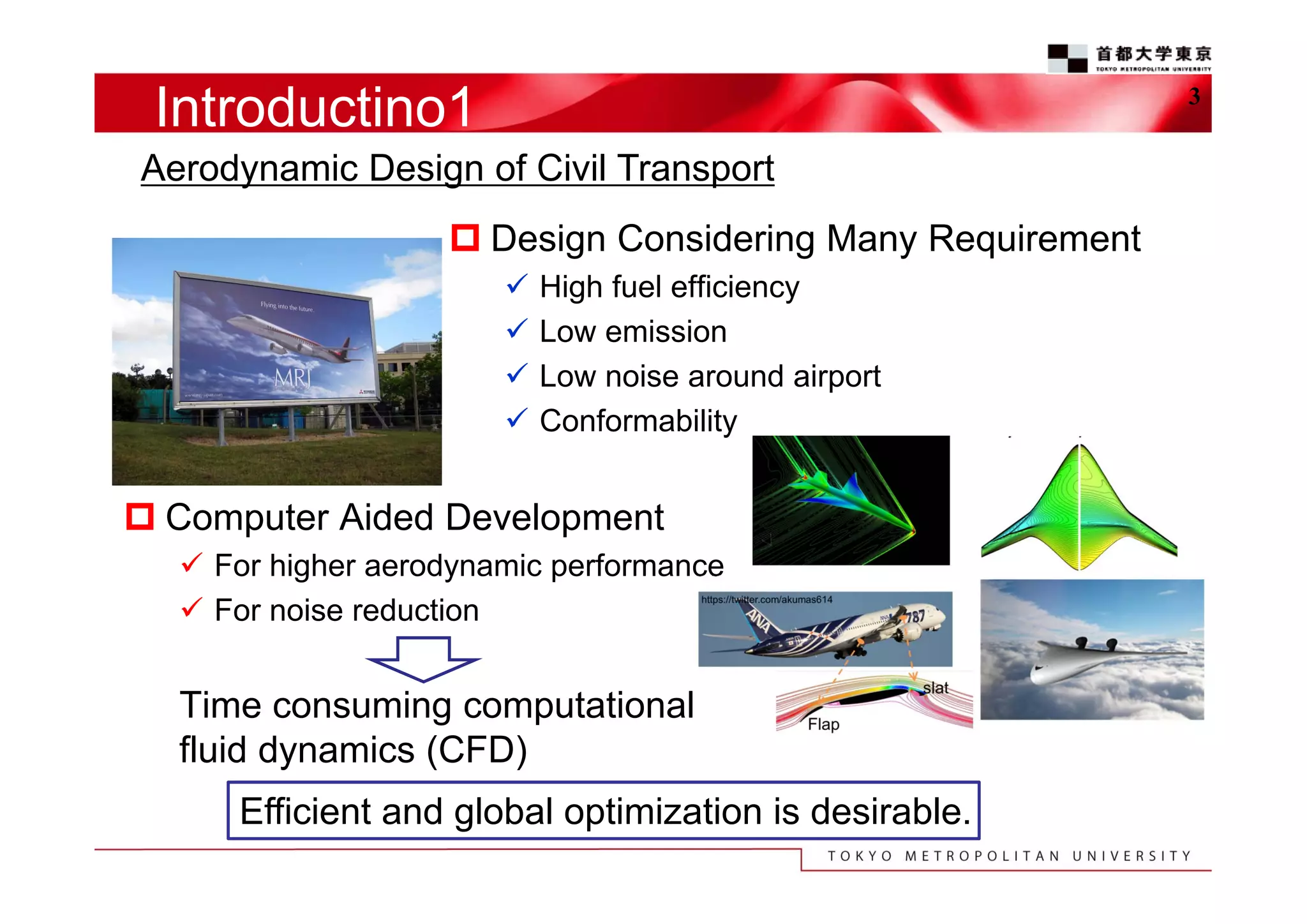
Aerodynamic Design of Civil Transport
 Design Considering Many Requirement





High fuel efficiency
Low emission
Low noise around airport
Conformability

 Computer Aided Development
 For higher aerodynamic performance
 For noise reduction

Time consuming computational
fluid dynamics (CFD)
Efficient and global optimization is desirable.
Introduction2

4

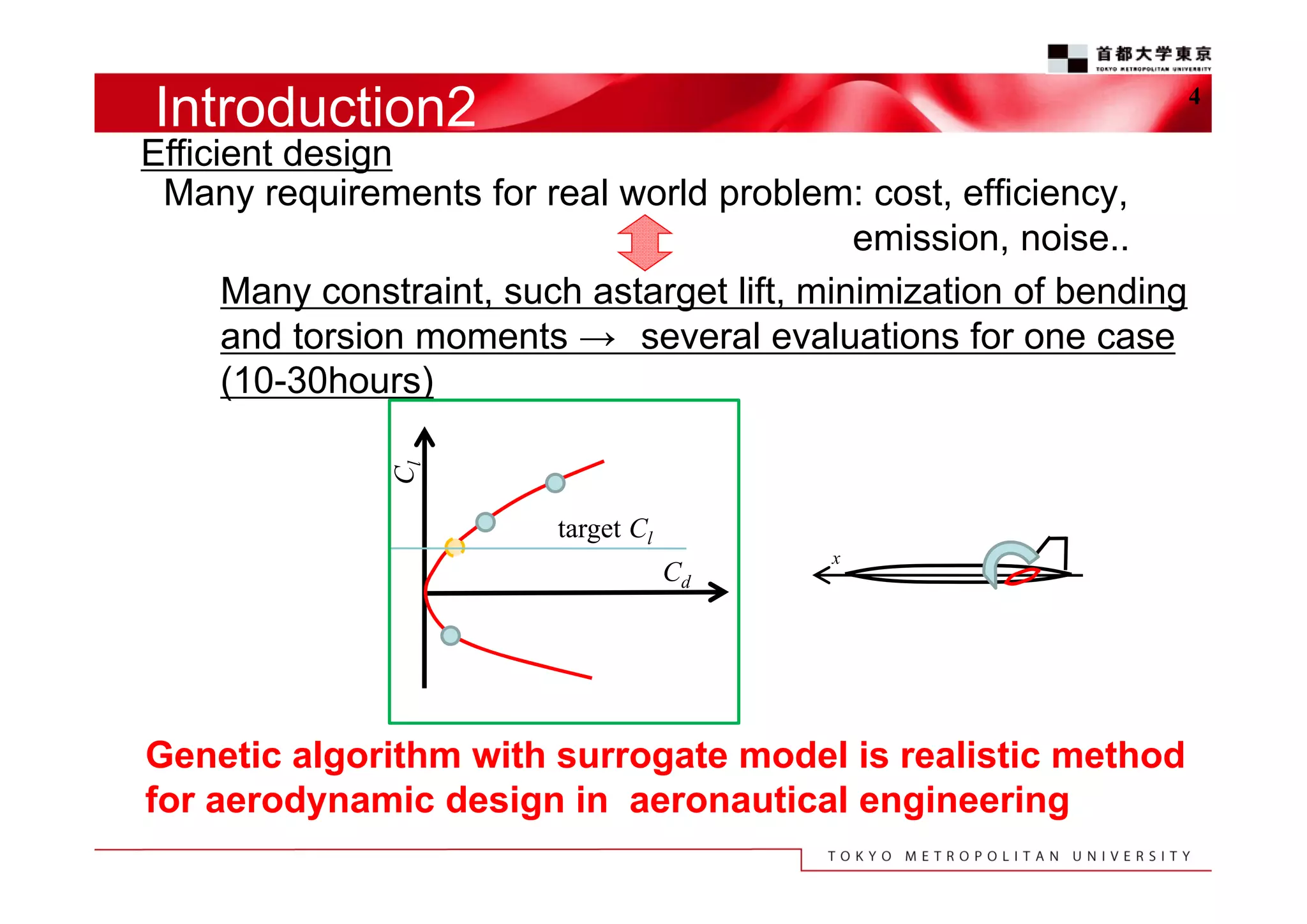
Cl

Efficient design
Many requirements for real world problem: cost, efficiency,
emission, noise..
Many constraint, such astarget lift, minimization of bending
and torsion moments → several evaluations for one case
(10-30hours)

target Cl
Cd

x

Genetic algorithm with surrogate model is realistic method
for aerodynamic design in aeronautical engineering
Introduction3
Several efficient and global optimization
Combination of heuristic optimization and
surrogate model
Efficient Global Optimization(Jones, D. R., 1998)

Analysis design problem using data mining
Multi-Objective Design Exploration (Obayashi, S. and
Jeong, S., 2005)

5
Objectives
Introduction of efficient global optimization with high
fidelity flow solver (such as Navier-Stokes solver)
Kriging model
Genetic Algorithm
Knowledge discovery using ANOVA and SOM
Application of realistic design problem
Wing design for an engine nacelle installed under
the wing (Case1)
Multi-disciplinary design of wing let (Case2)

6
Optimization Method(1/5)

7

 Surrogate model:Kriging model
 Interpolation based on sampling data
 Standard error estimation (uncertainty)

y (xi )     (xi )
global model

localized deviation
from the global model

 EI(Expected Improvement)
 The balance between optimality and uncertainty
 EI maximum point has possibility to improve the model.
Improvement at a point x is
I=max(fmin-Y,0)
Expected improvement E[I(x))]=E[max(fmin-Y,0)]
To calculate EI,

Jones, D. R., “Efficient Global
Optimization of Expensive BlackBox Functions,” J. Glob. Opt., Vol.
13, pp.455-492 1998.
Optimization Method(2/5)

8

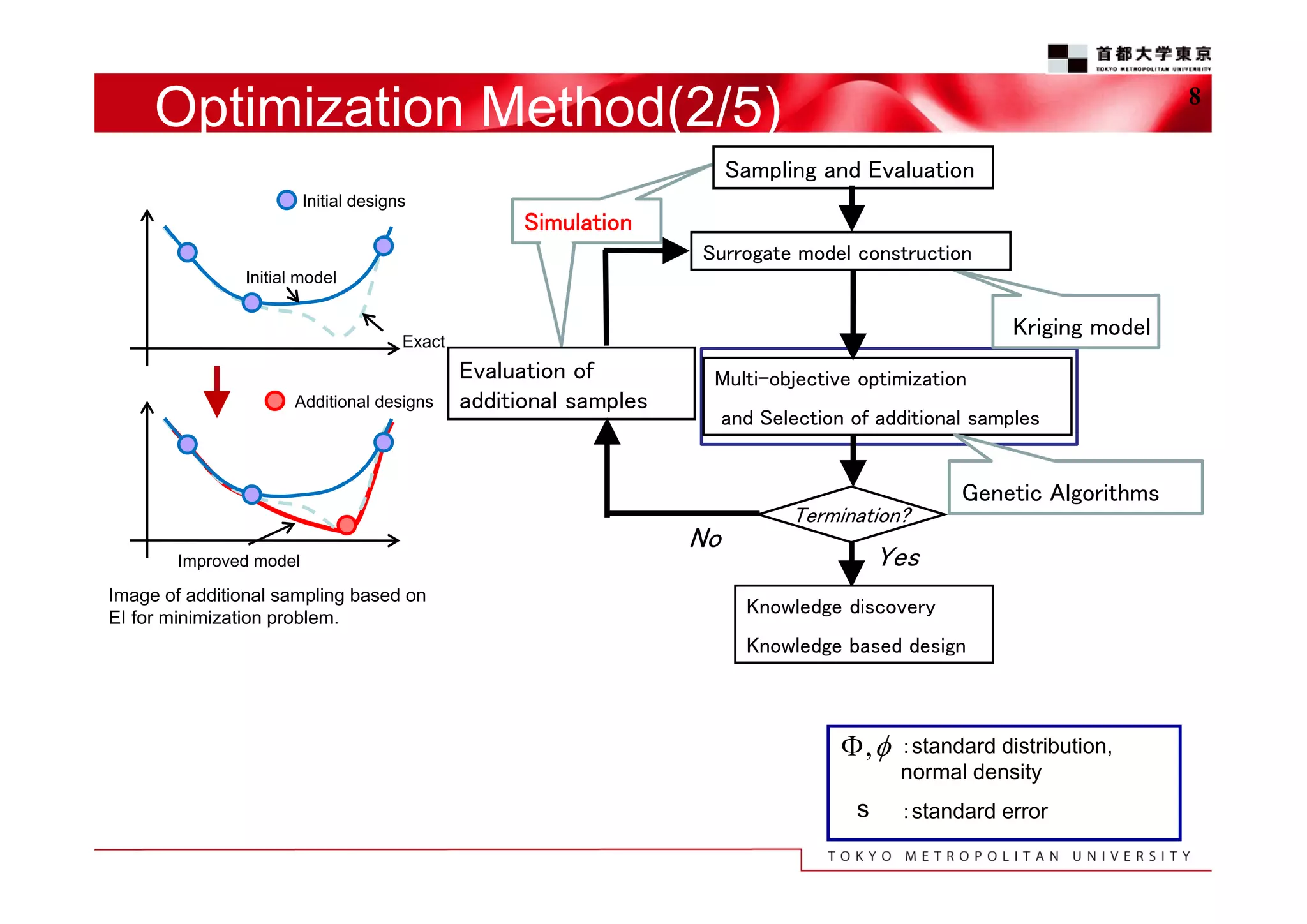
Sampling and Evaluation
Initial designs

Simulation
Surrogate model construction

Initial model

Kriging model

Exact
Additional designs

Improved model

Image of additional sampling based on
EI for minimization problem.

Evaluation of
additional samples

Multi-objective optimization
and Selection of additional samples

No

Termination?

Genetic Algorithms

Yes
Knowledge discovery
Knowledge based design

,
s

:standard distribution,
normal density
:standard error
Optimization Method(3/5)
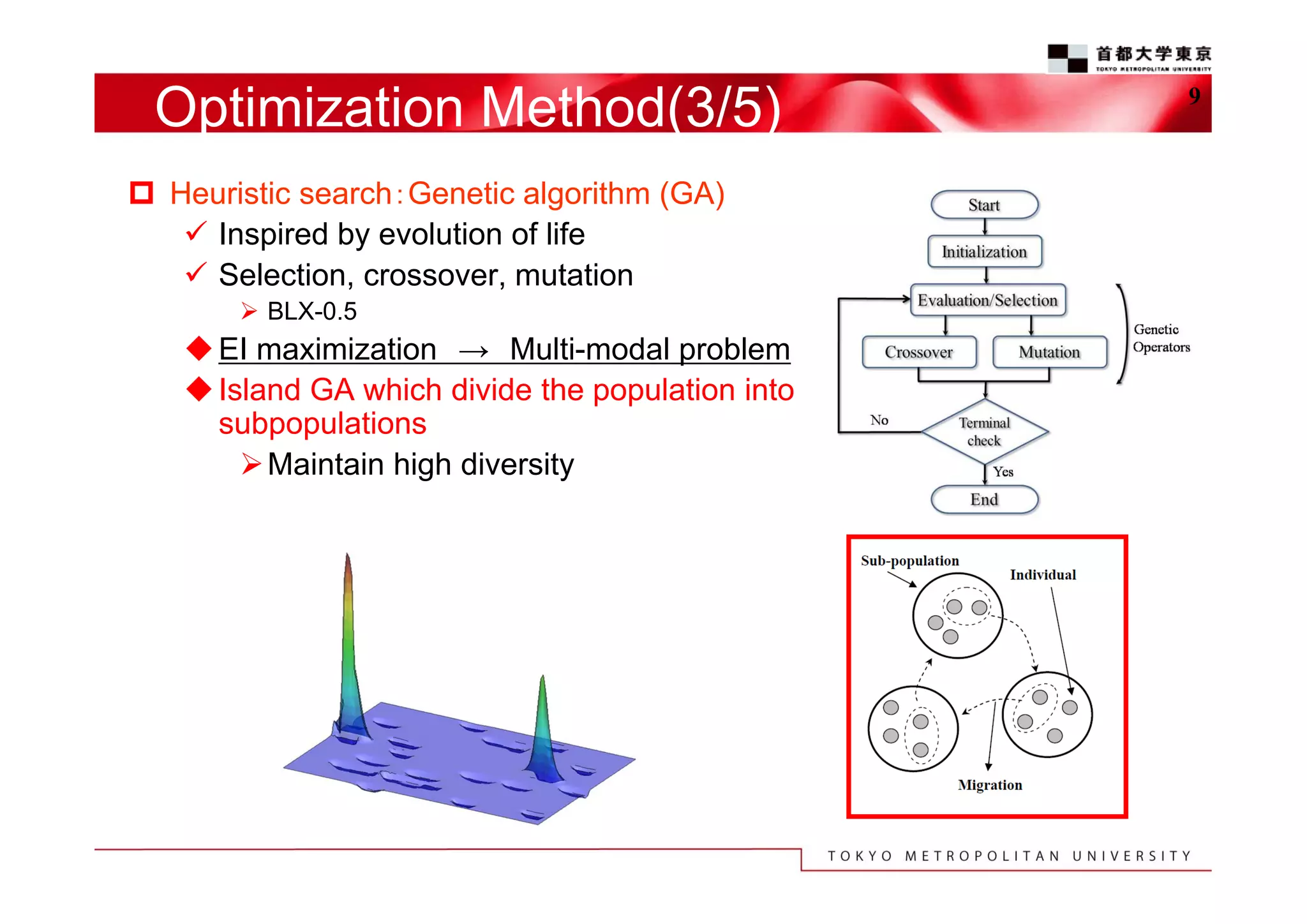
 Heuristic search:Genetic algorithm (GA)
 Inspired by evolution of life
 Selection, crossover, mutation
 BLX-0.5

 EI maximization → Multi-modal problem
 Island GA which divide the population into
subpopulations
 Maintain high diversity

9
Design Methods (4/5)
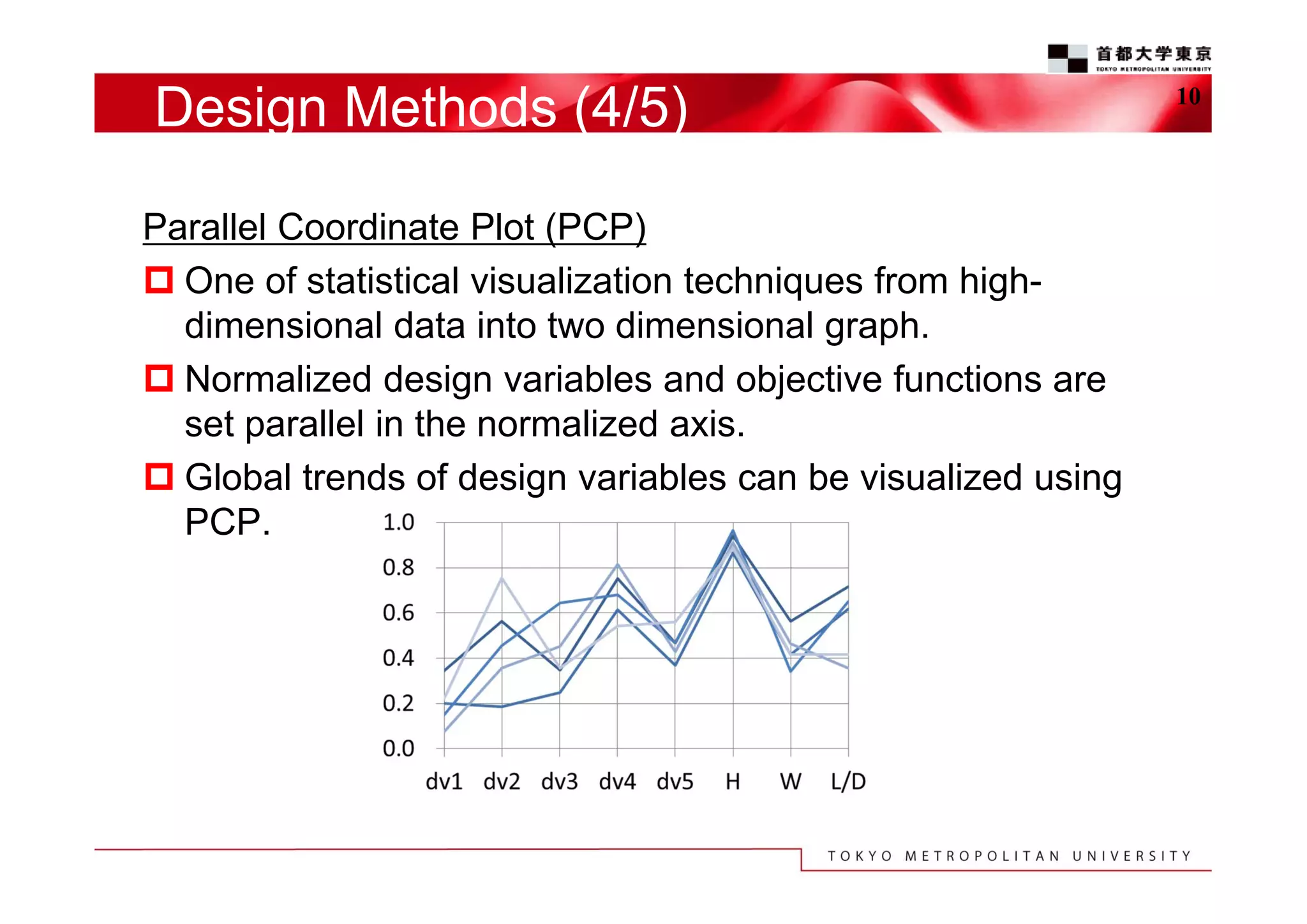
Parallel Coordinate Plot (PCP)
 One of statistical visualization techniques from highdimensional data into two dimensional graph.
 Normalized design variables and objective functions are
set parallel in the normalized axis.
 Global trends of design variables can be visualized using
PCP.

10
Optimization Method(5/5)

11

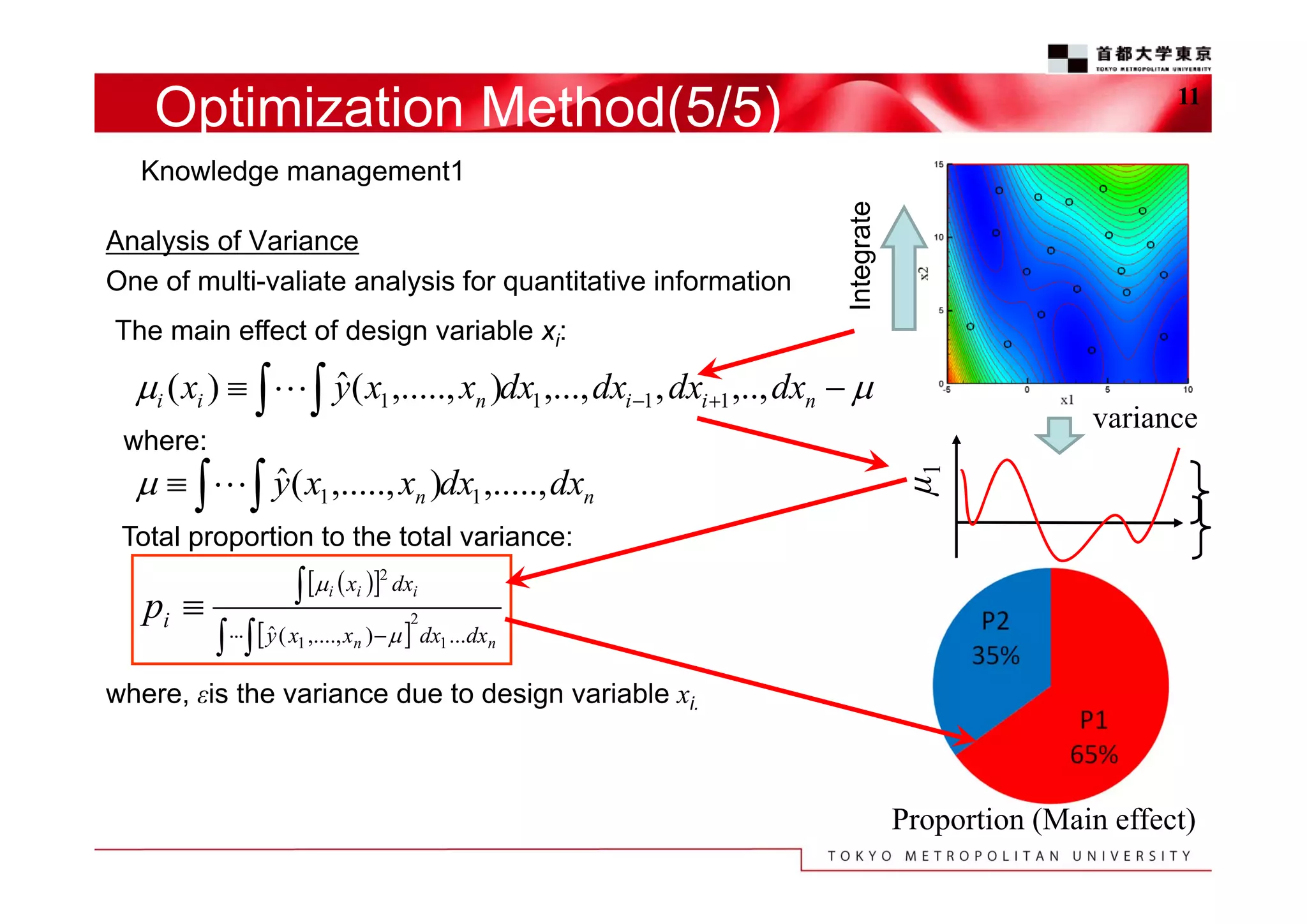
Analysis of Variance
One of multi-valiate analysis for quantitative information

Integrate

Knowledge management1

The main effect of design variable xi:

ˆ
i ( xi )     y( x1 ,....., xn )dx1 ,..., dxi 1 , dxi 1 ,.., dxn  

variance

ˆ
     y( x1 ,....., xn )dx1 ,....., dxn

μ1

where:

Total proportion to the total variance:

pi 

 i  xi  dxi
2





ˆ
  y ( x1 ,...., xn )    dx1 ...dxn
2

where, εis the variance due to design variable xi.

Proportion (Main effect)
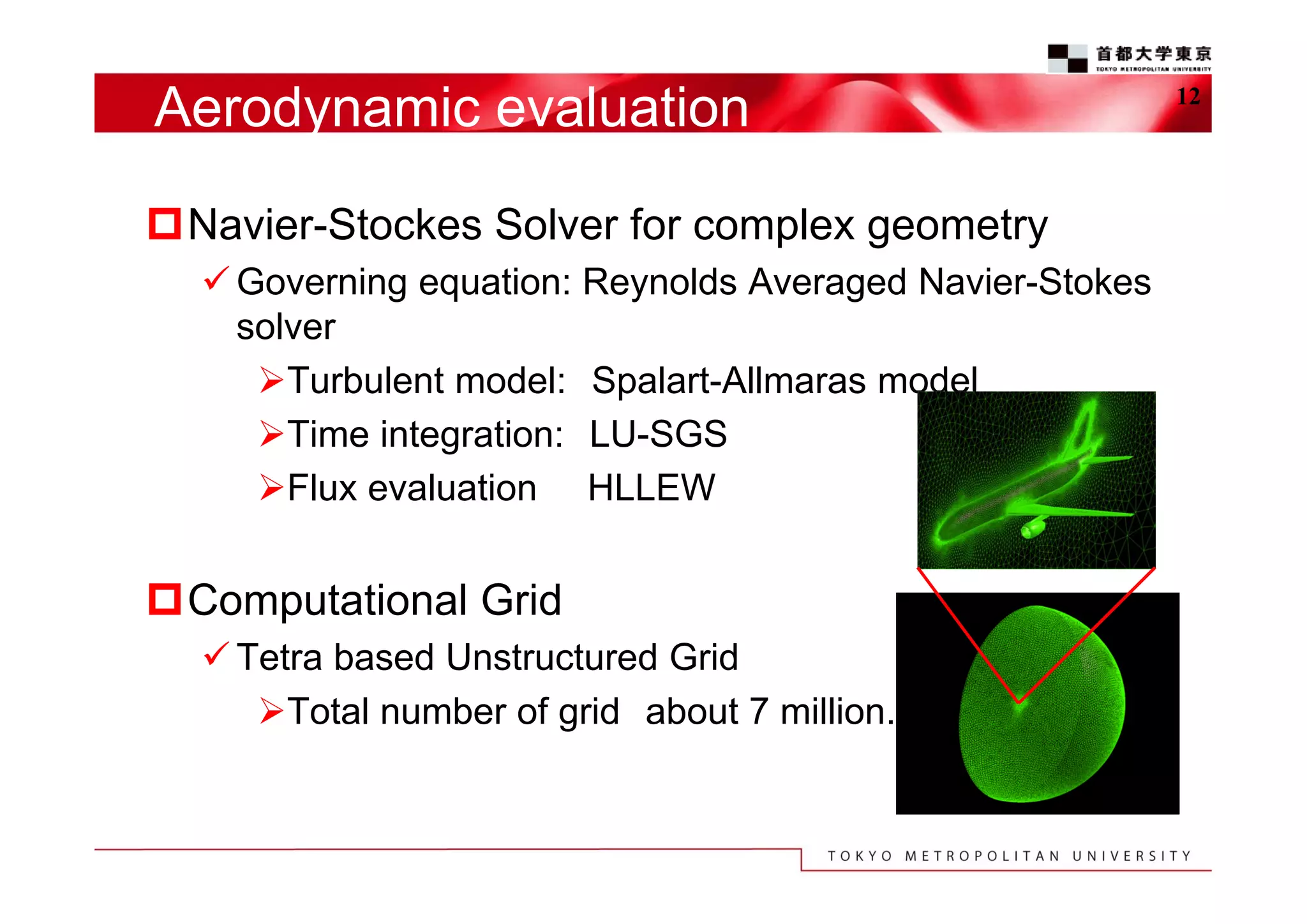
Aerodynamic evaluation
Navier-Stockes Solver for complex geometry
 Governing equation: Reynolds Averaged Navier-Stokes
solver
Turbulent model: Spalart-Allmaras model
Time integration: LU-SGS
Flux evaluation HLLEW

Computational Grid
 Tetra based Unstructured Grid
Total number of grid about 7 million.

12
13

Case1
Wing design for an engine nacelle
installed under the wing
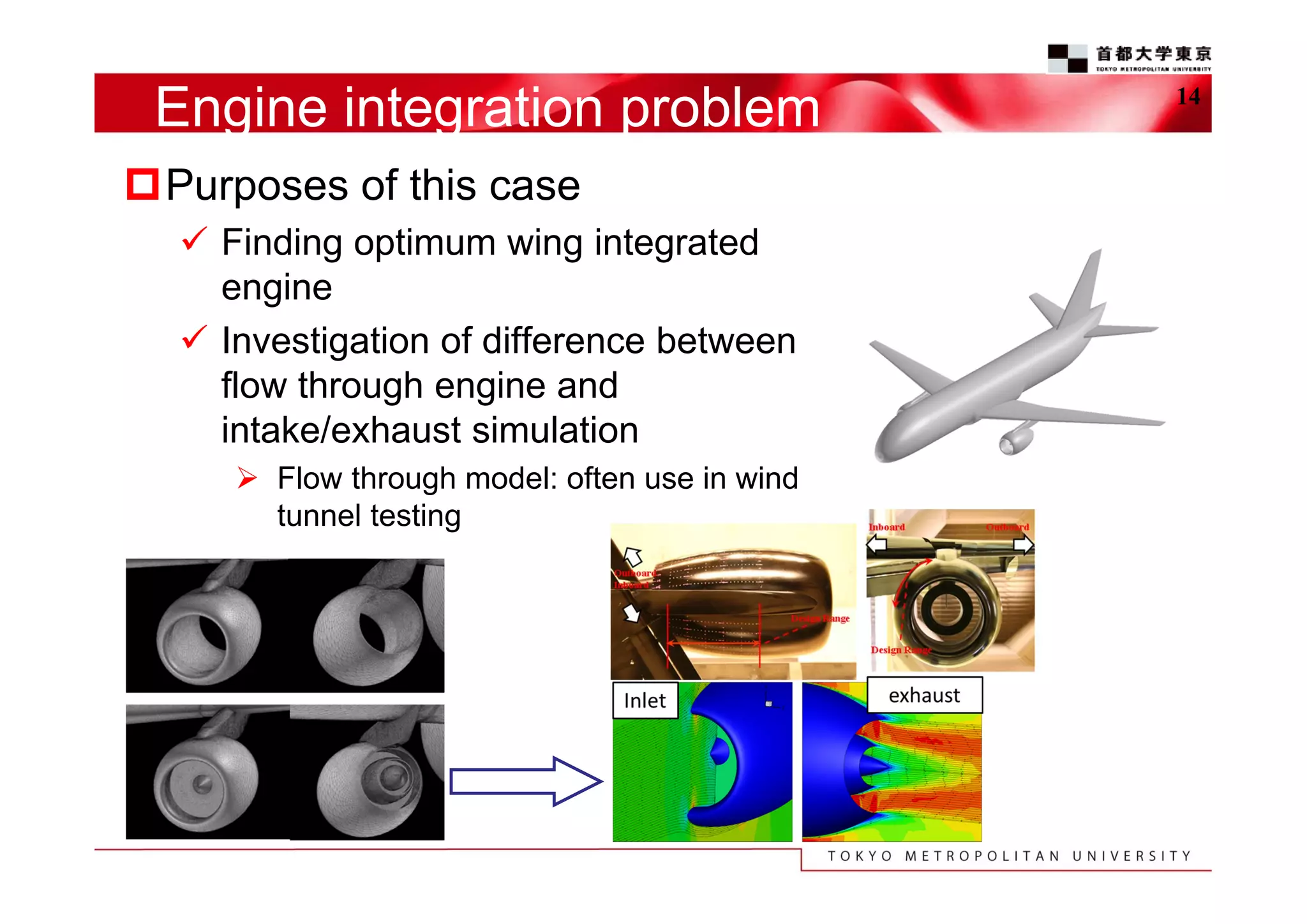
Engine integration problem
Purposes of this case
 Finding optimum wing integrated
engine
 Investigation of difference between
flow through engine and
intake/exhaust simulation
 Flow through model: often use in wind
tunnel testing

14
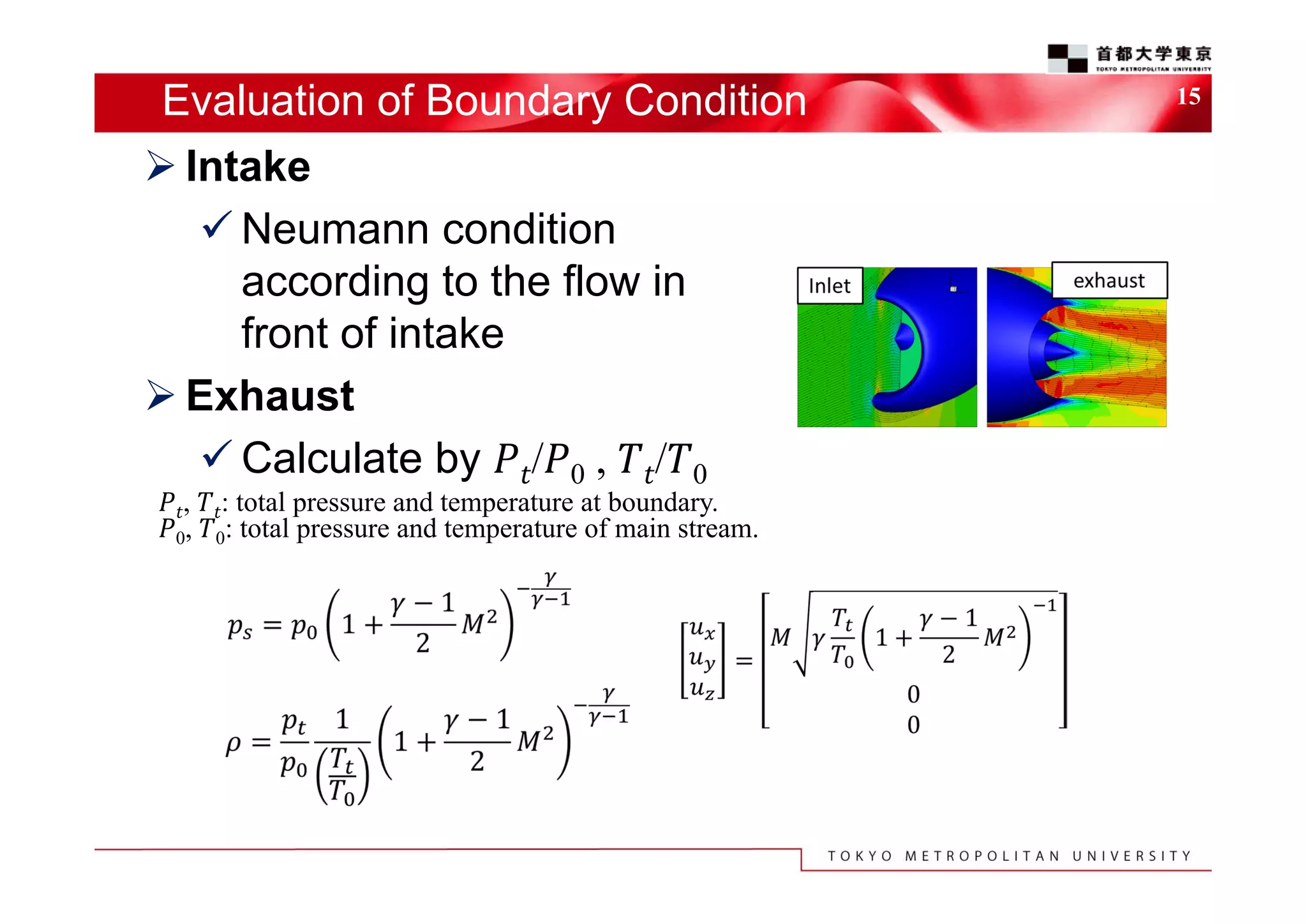
Evaluation of Boundary Condition
 Intake
 Neumann condition
according to the flow in
front of intake
 Exhaust
 Calculate by / 0 , / 0
,
0,

: total pressure and temperature at boundary.
0: total pressure and temperature of main stream.

15
Formulations

16

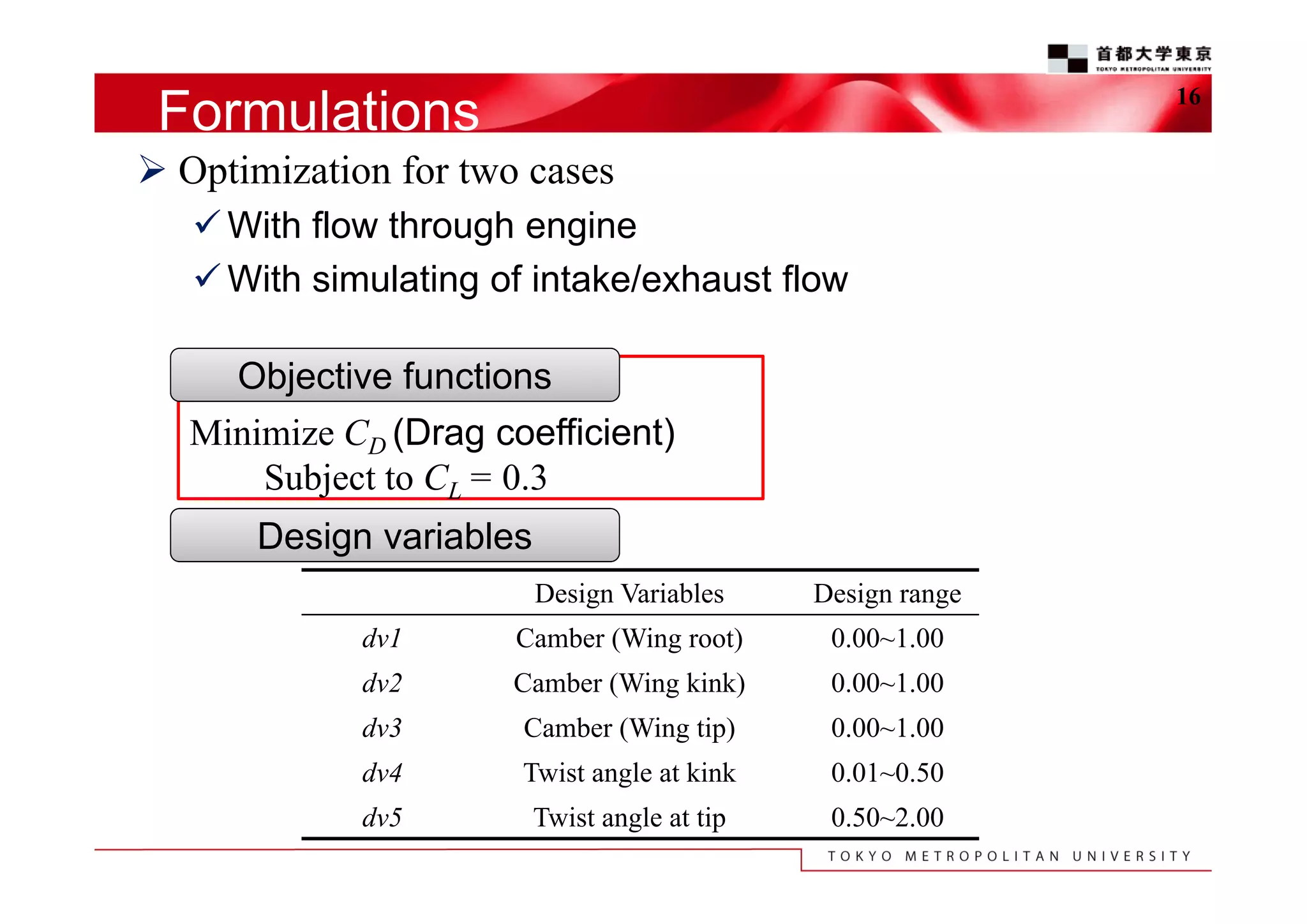
 Optimization for two cases
 With flow through engine
 With simulating of intake/exhaust flow
Objective functions
Minimize CD (Drag coefficient)
Subject to CL = 0.3
Design variables
Design Variables

Design range

dv1

Camber (Wing root)

0.00~1.00

dv2

Camber (Wing kink)

0.00~1.00

dv3

Camber (Wing tip)

0.00~1.00

dv4

Twist angle at kink

0.01~0.50

dv5

Twist angle at tip

0.50~2.00
Design Exploration Result
Flow through

With intake /exhaust flow

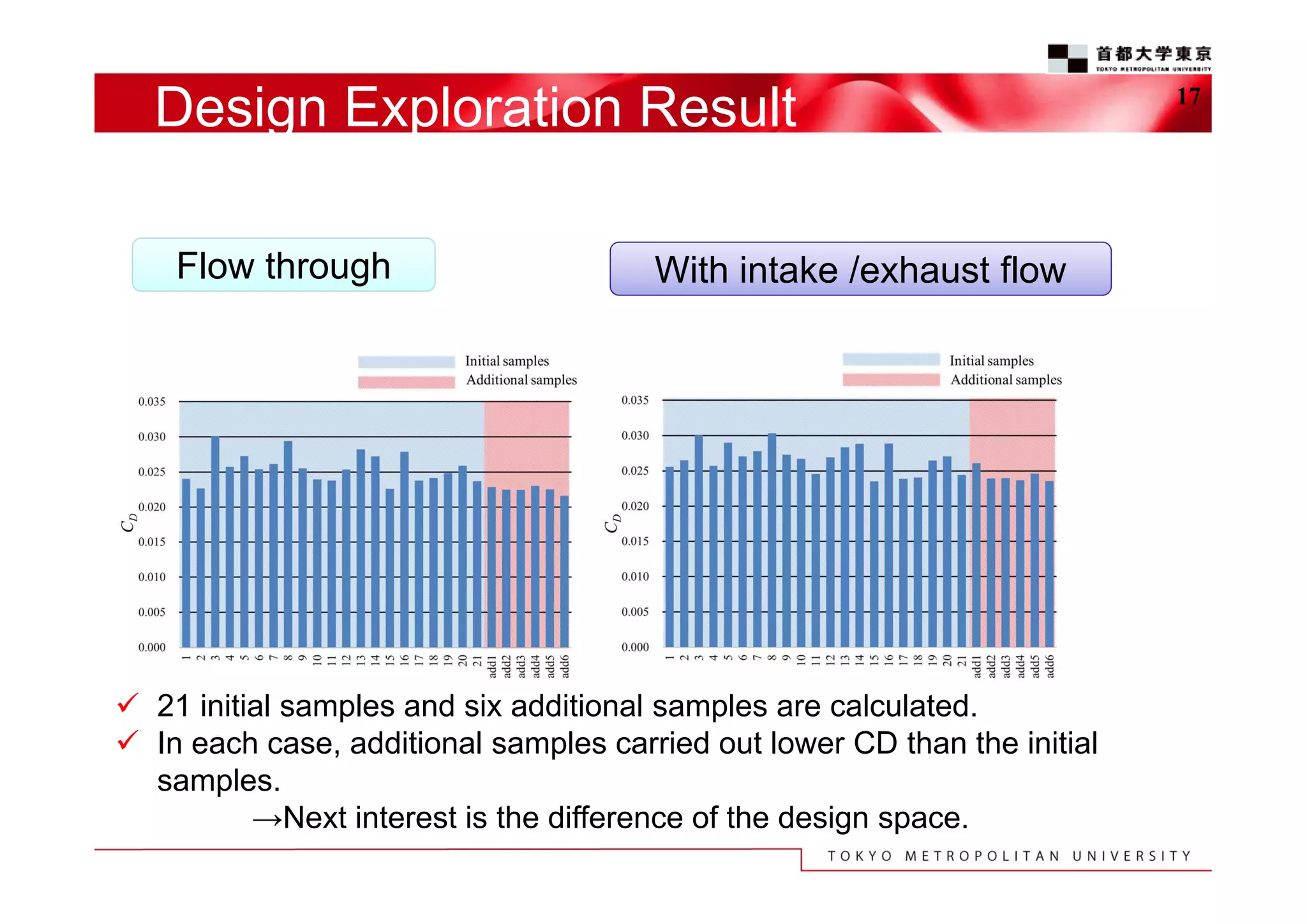
 21 initial samples and six additional samples are calculated.
 In each case, additional samples carried out lower CD than the initial
samples.
→Next interest is the difference of the design space.

17
Visualization by PCP
Flow through

18

With intake /exhaust flow

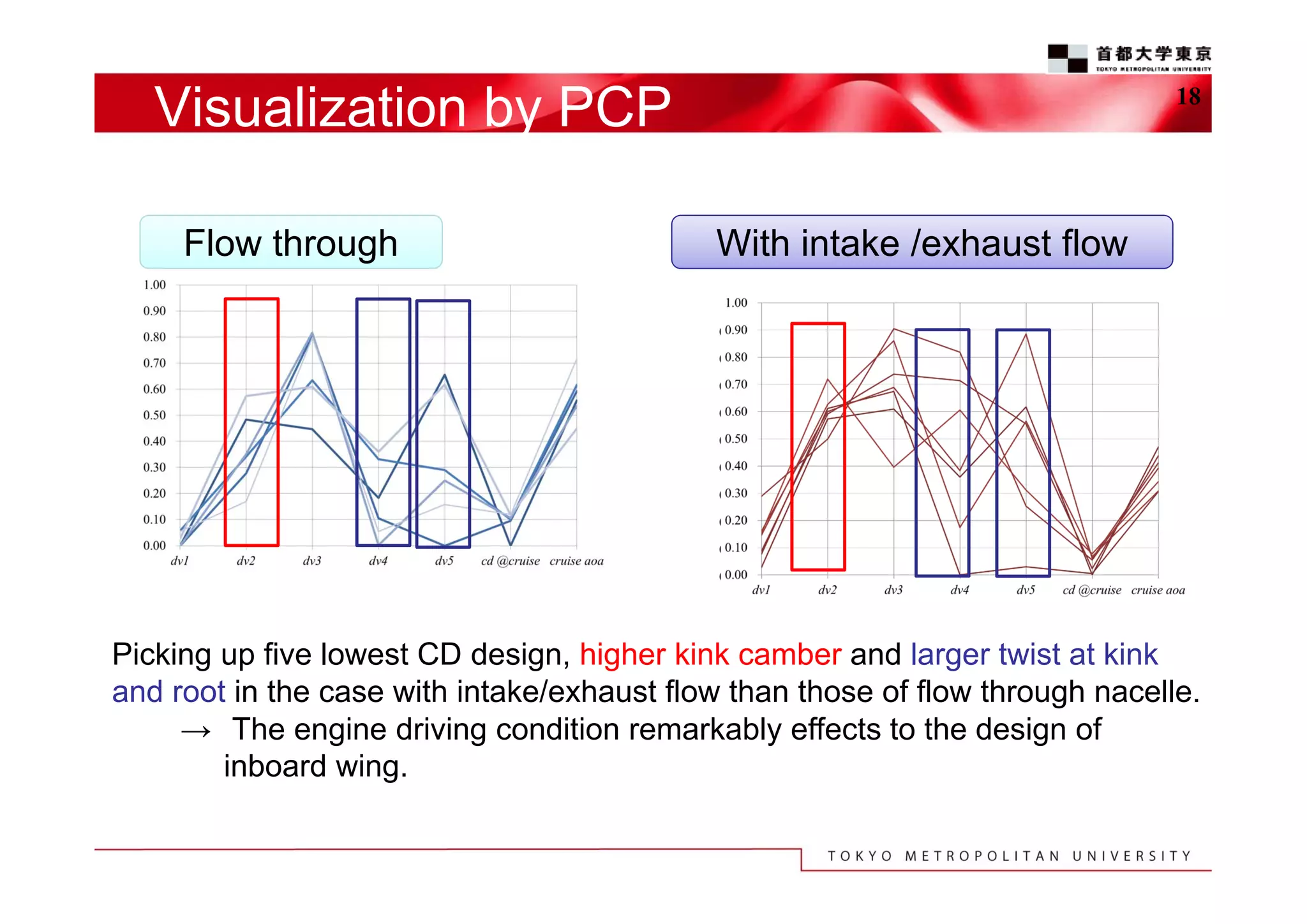
Picking up five lowest CD design, higher kink camber and larger twist at kink
and root in the case with intake/exhaust flow than those of flow through nacelle.
→ The engine driving condition remarkably effects to the design of
inboard wing.
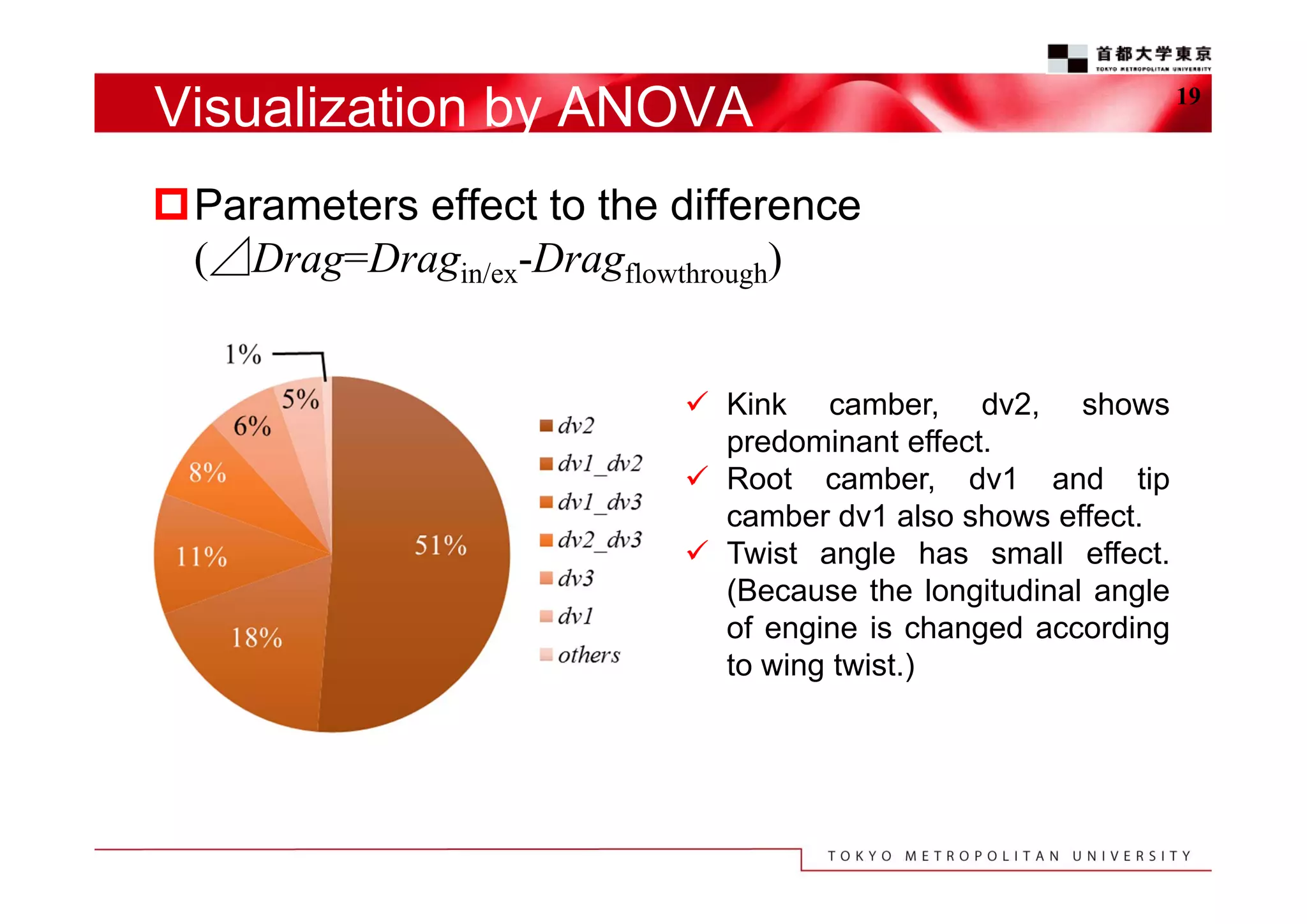
Visualization by ANOVA
Parameters effect to the difference
(⊿Drag=Dragin/ex-Dragflowthrough)
 Kink camber, dv2, shows
predominant effect.
 Root camber, dv1 and tip
camber dv1 also shows effect.
 Twist angle has small effect.
(Because the longitudinal angle
of engine is changed according
to wing twist.)

19
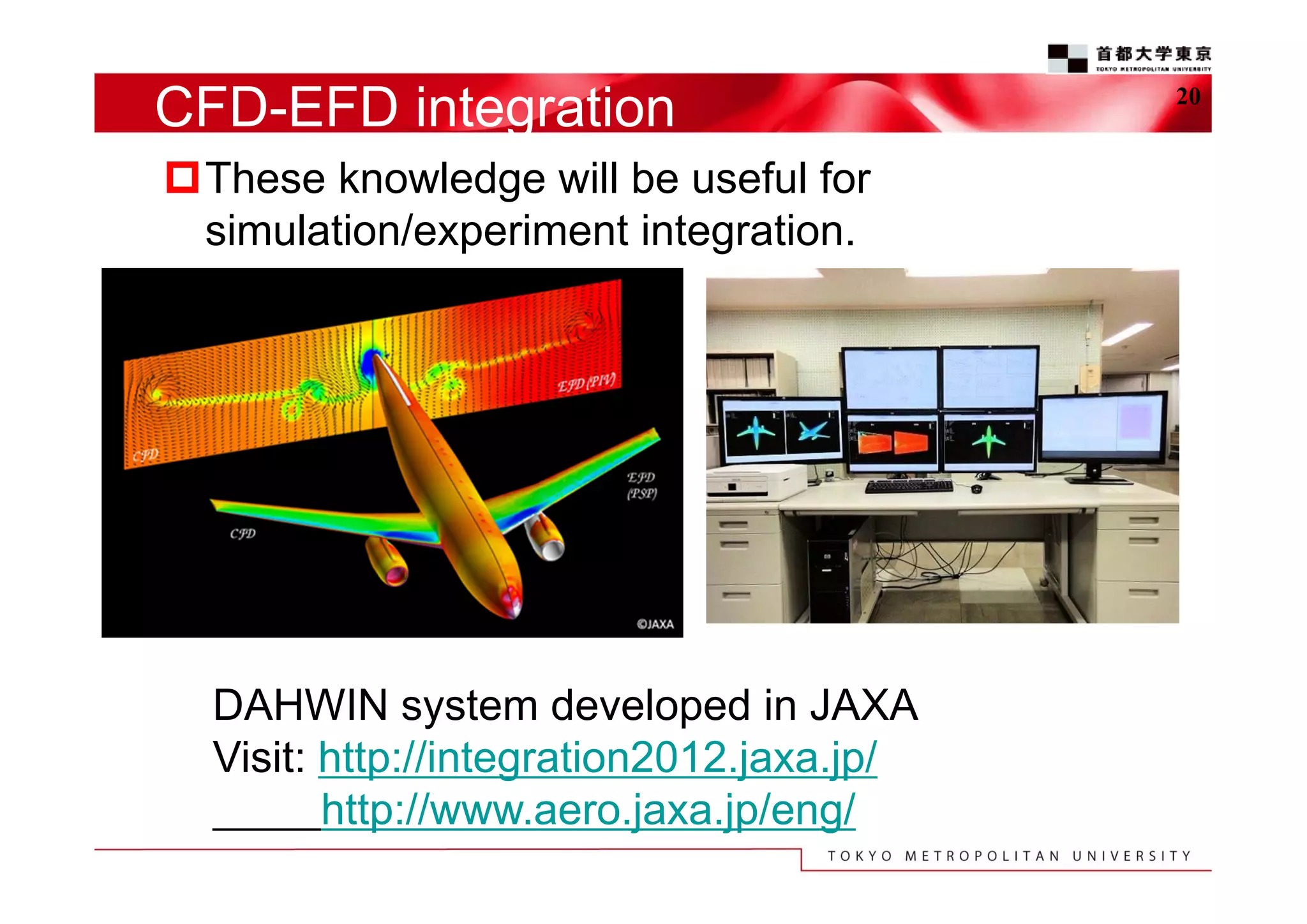
CFD-EFD integration
These knowledge will be useful for
simulation/experiment integration.

DAHWIN system developed in JAXA
Visit: http://integration2012.jaxa.jp/
http://www.aero.jaxa.jp/eng/

20
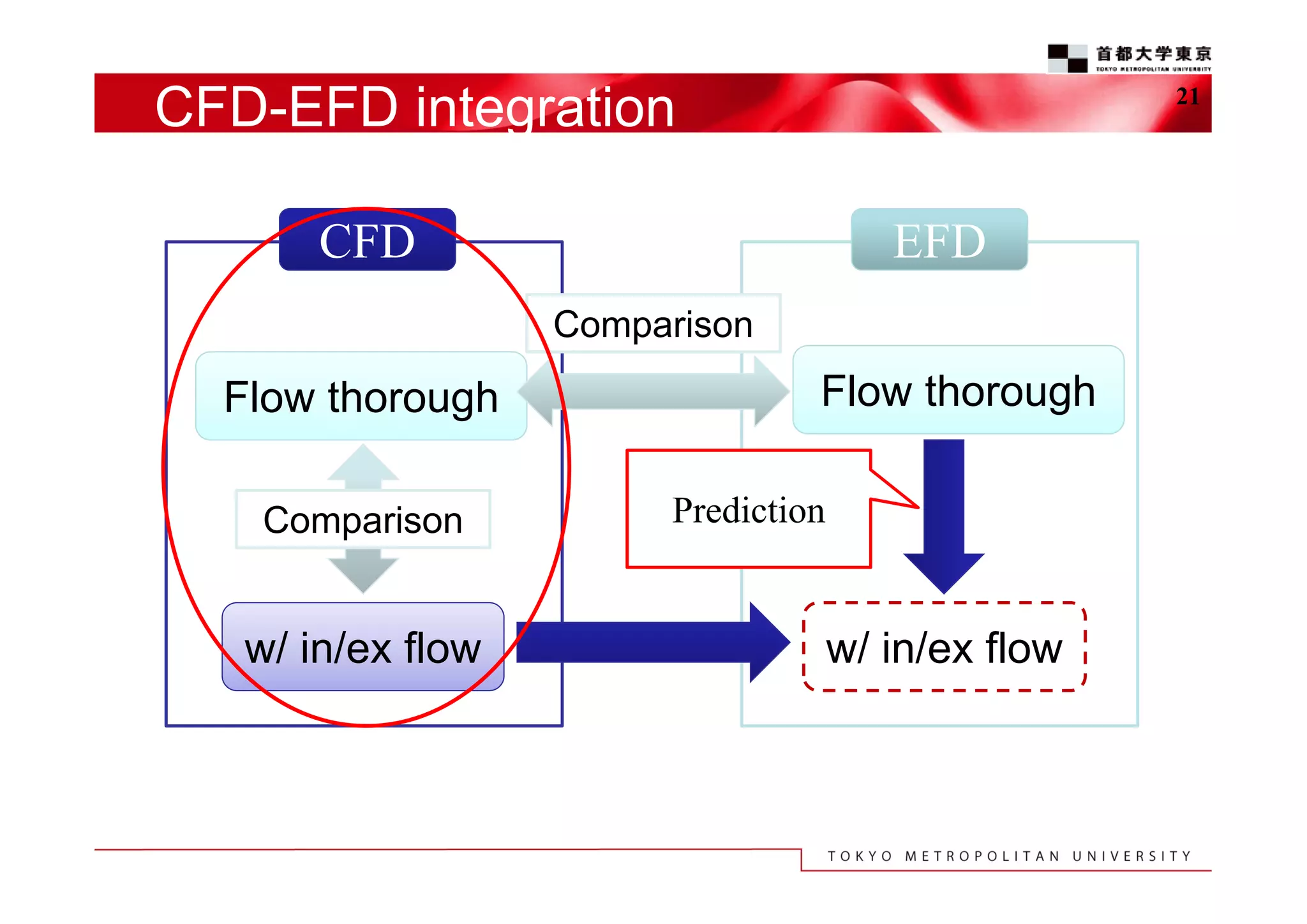
CFD-EFD integration

21

CFD

EFD
Comparison

Flow thorough
Comparison

w/ in/ex flow

Flow thorough
Prediction

w/ in/ex flow
22

Case2
Wing tip design considering the
bending moment
Wing Tip Design

23

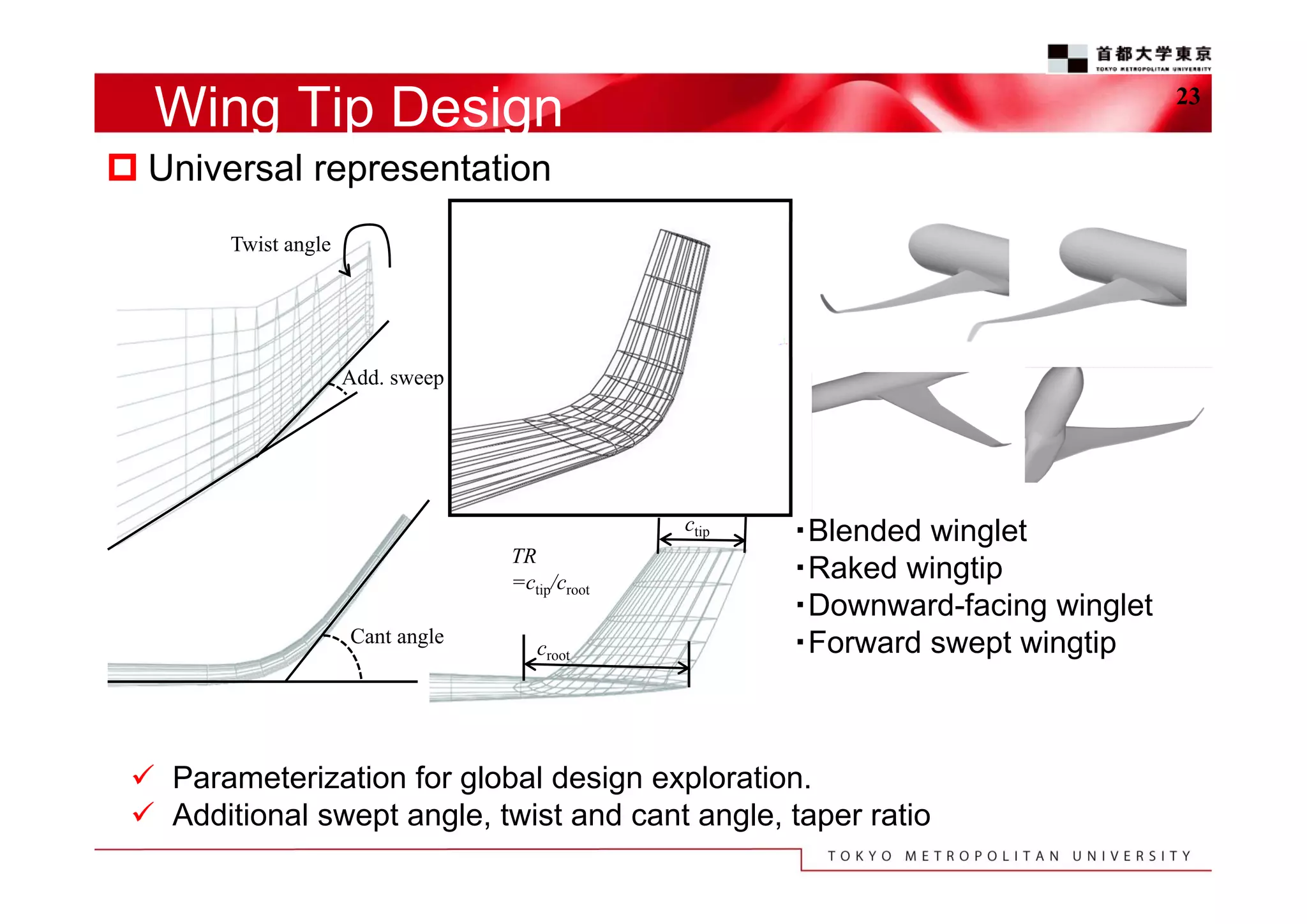
 Universal representation
Twist angle

Add. sweep

ctip
TR
=ctip/croot
Cant angle

croot

・Blended winglet
・Raked wingtip
・Downward-facing winglet
・Forward swept wingtip

 Parameterization for global design exploration.
 Additional swept angle, twist and cant angle, taper ratio
Formulations
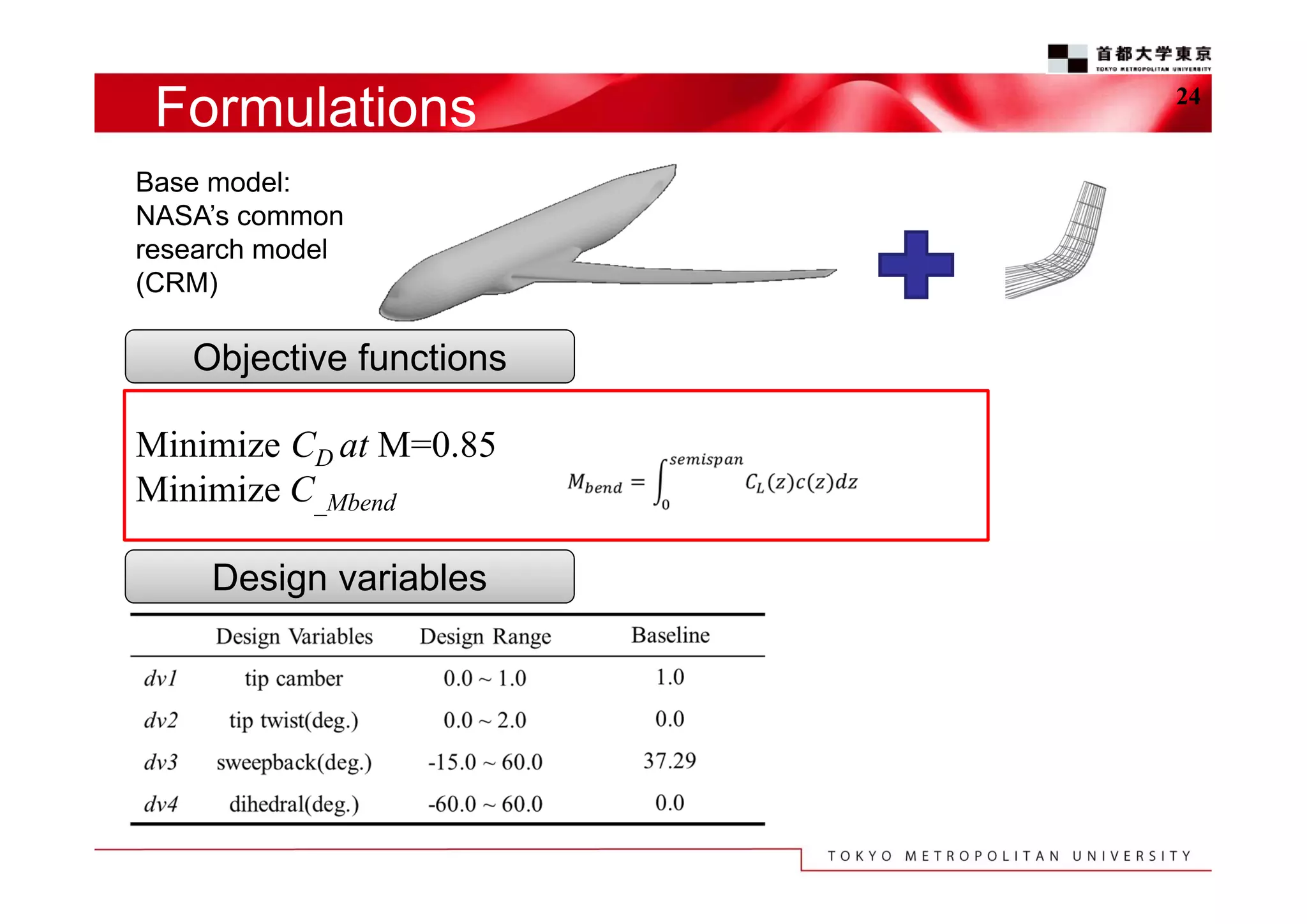
Base model:
NASA’s common
research model
(CRM)

Objective functions
Minimize CD at M=0.85
Minimize C_Mbend
Design variables

24
MO Design exploration result

25

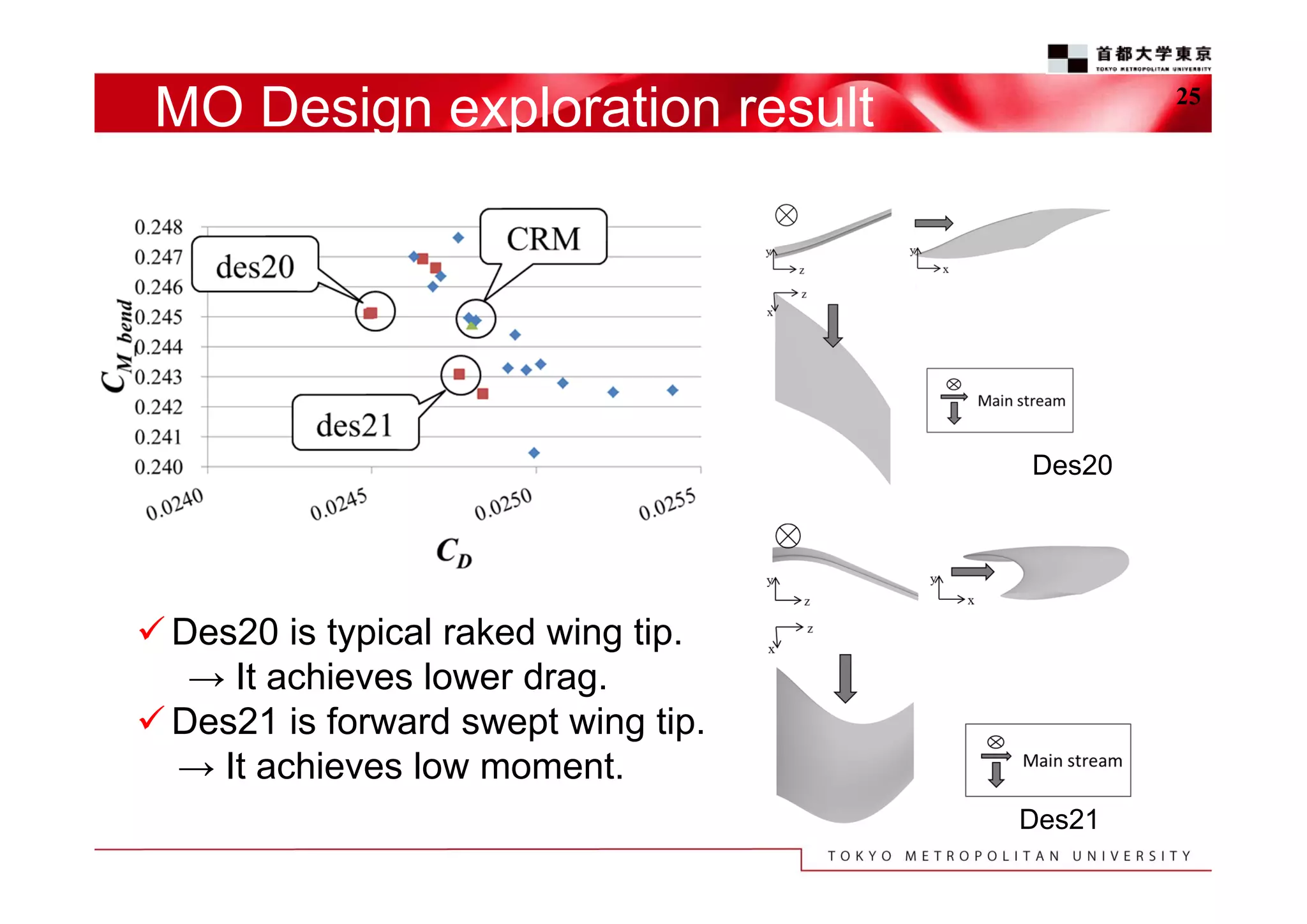
Des20

 Des20 is typical raked wing tip.
→ It achieves lower drag.
 Des21 is forward swept wing tip.
→ It achieves low moment.
Des21
Flow visualizations M=0.85

26

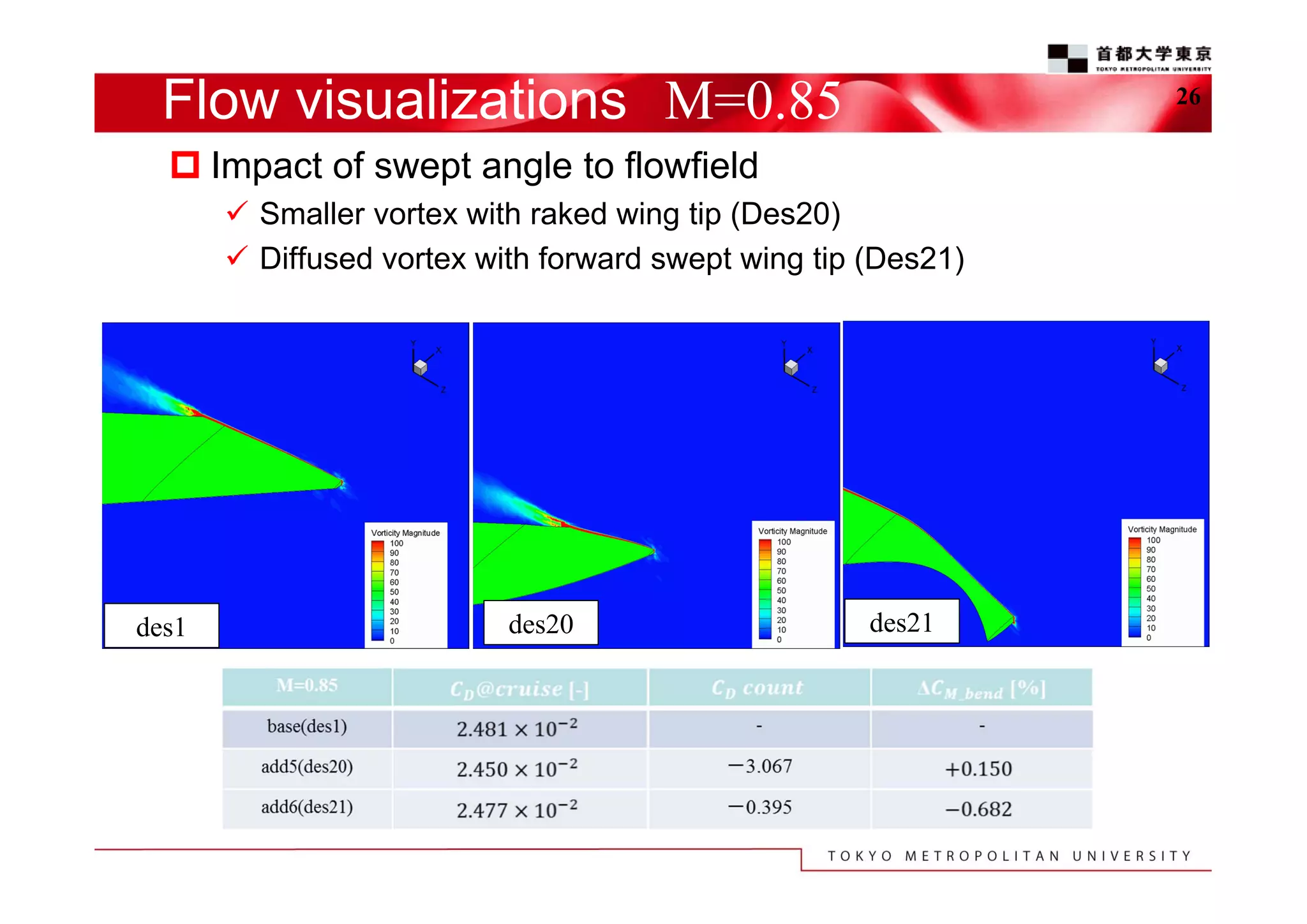
 Impact of swept angle to flowfield
 Smaller vortex with raked wing tip (Des20)
 Diffused vortex with forward swept wing tip (Des21)

des1

des20

des21
Conclusions
 High-efficient design procedure for aerodynamic design.
 Employment of EGO’s efficient global search
 Genetic algorithm, and Kriging surrogate model

 Knowledge discovery techniques, such as ANOVA and PCP
 Design knowledge management
 Two cases could successfully solved.
 Effect of the difference to the wing design due engine
driving condition
 Multi-disciprinaly design of wing tip.

27

Efficient Design Exploration for Civil Aircraft Using a Kriging-Based Genetic Algorithm

  • 1.
    Eurogen 2013 October 7–9,2013, Las Palmas de Gran Canaria, Spain Efficient Design Exploration for Civil Aircraft Using a Kriging-Based Genetic Algorithm Mashiro Kanazaki Tokyo Metropolitan University
  • 2.
    Contents Introduction Aerodynamic Design ofCivil Transport Optimization method Efficient Global Optimization Data mining Flow solver Case1: Optimization of wing integrated engine nacelle Case2: Multi-disciplinary design of wing tip Conclusions 2
  • 3.
    Introductino1 3 Aerodynamic Design ofCivil Transport  Design Considering Many Requirement     High fuel efficiency Low emission Low noise around airport Conformability  Computer Aided Development  For higher aerodynamic performance  For noise reduction Time consuming computational fluid dynamics (CFD) Efficient and global optimization is desirable.
  • 4.
    Introduction2 4 Cl Efficient design Many requirementsfor real world problem: cost, efficiency, emission, noise.. Many constraint, such astarget lift, minimization of bending and torsion moments → several evaluations for one case (10-30hours) target Cl Cd x Genetic algorithm with surrogate model is realistic method for aerodynamic design in aeronautical engineering
  • 5.
    Introduction3 Several efficient andglobal optimization Combination of heuristic optimization and surrogate model Efficient Global Optimization(Jones, D. R., 1998) Analysis design problem using data mining Multi-Objective Design Exploration (Obayashi, S. and Jeong, S., 2005) 5
  • 6.
    Objectives Introduction of efficientglobal optimization with high fidelity flow solver (such as Navier-Stokes solver) Kriging model Genetic Algorithm Knowledge discovery using ANOVA and SOM Application of realistic design problem Wing design for an engine nacelle installed under the wing (Case1) Multi-disciplinary design of wing let (Case2) 6
  • 7.
    Optimization Method(1/5) 7  Surrogatemodel:Kriging model  Interpolation based on sampling data  Standard error estimation (uncertainty) y (xi )     (xi ) global model localized deviation from the global model  EI(Expected Improvement)  The balance between optimality and uncertainty  EI maximum point has possibility to improve the model. Improvement at a point x is I=max(fmin-Y,0) Expected improvement E[I(x))]=E[max(fmin-Y,0)] To calculate EI, Jones, D. R., “Efficient Global Optimization of Expensive BlackBox Functions,” J. Glob. Opt., Vol. 13, pp.455-492 1998.
  • 8.
    Optimization Method(2/5) 8 Sampling andEvaluation Initial designs Simulation Surrogate model construction Initial model Kriging model Exact Additional designs Improved model Image of additional sampling based on EI for minimization problem. Evaluation of additional samples Multi-objective optimization and Selection of additional samples No Termination? Genetic Algorithms Yes Knowledge discovery Knowledge based design , s :standard distribution, normal density :standard error
  • 9.
    Optimization Method(3/5)  Heuristicsearch:Genetic algorithm (GA)  Inspired by evolution of life  Selection, crossover, mutation  BLX-0.5  EI maximization → Multi-modal problem  Island GA which divide the population into subpopulations  Maintain high diversity 9
  • 10.
    Design Methods (4/5) ParallelCoordinate Plot (PCP)  One of statistical visualization techniques from highdimensional data into two dimensional graph.  Normalized design variables and objective functions are set parallel in the normalized axis.  Global trends of design variables can be visualized using PCP. 10
  • 11.
    Optimization Method(5/5) 11 Analysis ofVariance One of multi-valiate analysis for quantitative information Integrate Knowledge management1 The main effect of design variable xi: ˆ i ( xi )     y( x1 ,....., xn )dx1 ,..., dxi 1 , dxi 1 ,.., dxn   variance ˆ      y( x1 ,....., xn )dx1 ,....., dxn μ1 where: Total proportion to the total variance: pi   i  xi  dxi 2   ˆ   y ( x1 ,...., xn )    dx1 ...dxn 2 where, εis the variance due to design variable xi. Proportion (Main effect)
  • 12.
    Aerodynamic evaluation Navier-Stockes Solverfor complex geometry  Governing equation: Reynolds Averaged Navier-Stokes solver Turbulent model: Spalart-Allmaras model Time integration: LU-SGS Flux evaluation HLLEW Computational Grid  Tetra based Unstructured Grid Total number of grid about 7 million. 12
  • 13.
    13 Case1 Wing design foran engine nacelle installed under the wing
  • 14.
    Engine integration problem Purposesof this case  Finding optimum wing integrated engine  Investigation of difference between flow through engine and intake/exhaust simulation  Flow through model: often use in wind tunnel testing 14
  • 15.
    Evaluation of BoundaryCondition  Intake  Neumann condition according to the flow in front of intake  Exhaust  Calculate by / 0 , / 0 , 0, : total pressure and temperature at boundary. 0: total pressure and temperature of main stream. 15
  • 16.
    Formulations 16  Optimization fortwo cases  With flow through engine  With simulating of intake/exhaust flow Objective functions Minimize CD (Drag coefficient) Subject to CL = 0.3 Design variables Design Variables Design range dv1 Camber (Wing root) 0.00~1.00 dv2 Camber (Wing kink) 0.00~1.00 dv3 Camber (Wing tip) 0.00~1.00 dv4 Twist angle at kink 0.01~0.50 dv5 Twist angle at tip 0.50~2.00
  • 17.
    Design Exploration Result Flowthrough With intake /exhaust flow  21 initial samples and six additional samples are calculated.  In each case, additional samples carried out lower CD than the initial samples. →Next interest is the difference of the design space. 17
  • 18.
    Visualization by PCP Flowthrough 18 With intake /exhaust flow Picking up five lowest CD design, higher kink camber and larger twist at kink and root in the case with intake/exhaust flow than those of flow through nacelle. → The engine driving condition remarkably effects to the design of inboard wing.
  • 19.
    Visualization by ANOVA Parameterseffect to the difference (⊿Drag=Dragin/ex-Dragflowthrough)  Kink camber, dv2, shows predominant effect.  Root camber, dv1 and tip camber dv1 also shows effect.  Twist angle has small effect. (Because the longitudinal angle of engine is changed according to wing twist.) 19
  • 20.
    CFD-EFD integration These knowledgewill be useful for simulation/experiment integration. DAHWIN system developed in JAXA Visit: http://integration2012.jaxa.jp/ http://www.aero.jaxa.jp/eng/ 20
  • 21.
    CFD-EFD integration 21 CFD EFD Comparison Flow thorough Comparison w/in/ex flow Flow thorough Prediction w/ in/ex flow
  • 22.
    22 Case2 Wing tip designconsidering the bending moment
  • 23.
    Wing Tip Design 23 Universal representation Twist angle Add. sweep ctip TR =ctip/croot Cant angle croot ・Blended winglet ・Raked wingtip ・Downward-facing winglet ・Forward swept wingtip  Parameterization for global design exploration.  Additional swept angle, twist and cant angle, taper ratio
  • 24.
    Formulations Base model: NASA’s common researchmodel (CRM) Objective functions Minimize CD at M=0.85 Minimize C_Mbend Design variables 24
  • 25.
    MO Design explorationresult 25 Des20  Des20 is typical raked wing tip. → It achieves lower drag.  Des21 is forward swept wing tip. → It achieves low moment. Des21
  • 26.
    Flow visualizations M=0.85 26 Impact of swept angle to flowfield  Smaller vortex with raked wing tip (Des20)  Diffused vortex with forward swept wing tip (Des21) des1 des20 des21
  • 27.
    Conclusions  High-efficient designprocedure for aerodynamic design.  Employment of EGO’s efficient global search  Genetic algorithm, and Kriging surrogate model  Knowledge discovery techniques, such as ANOVA and PCP  Design knowledge management  Two cases could successfully solved.  Effect of the difference to the wing design due engine driving condition  Multi-disciprinaly design of wing tip. 27