Design Optimization of Launch
Vehicle Concept Using
Cluster Hybrid Rocket Engine for
Future Space Transportation
Shoma Ito (Tokyo Metropolitan University)
Fumio Kanamori (Tokyo Metropolitan University)
Masaki Nakamiya (Kyoto University)
Koki Kitagawa (ISAS/JAXA)
Masahiro Kanazaki (Tokyo Metropolitan University)
Toru Shimada (ISAS/JAXA)
1OS8:Flow Dynamics and Combustion in Hybrid Rockets
OS 8-9 2014 Eleventh International Conference on Flow Dynamics
October 8-10. Sendai, Japan
Contents
• Background
• Objectives
• Rocket Configuration and Structure
• Design and Evaluation Methods
• Problem Definition
• Results
• Conclusions
2
Background
Advantage of hybrid
rocket engine(HRE)
 Higher safety
 Lower cost
 Lower environmental
impact
Hybrid rocket has possibility
to be next generation
efficient launch vehicle.
Space ship two※1
※1,VirginGalactic http://www.virgingalactic.com/
※2, [1] Y. Kitagawa, K. Kitagawa, M. Nakamiya, M. Kanazaki, T.
Shimada, T JSASS, 55(2012), R4
3
Our previous research※2
 Development of multi-
disciplinary design methodology
 Optimization for single stage and
three stage launch vehicle
Background
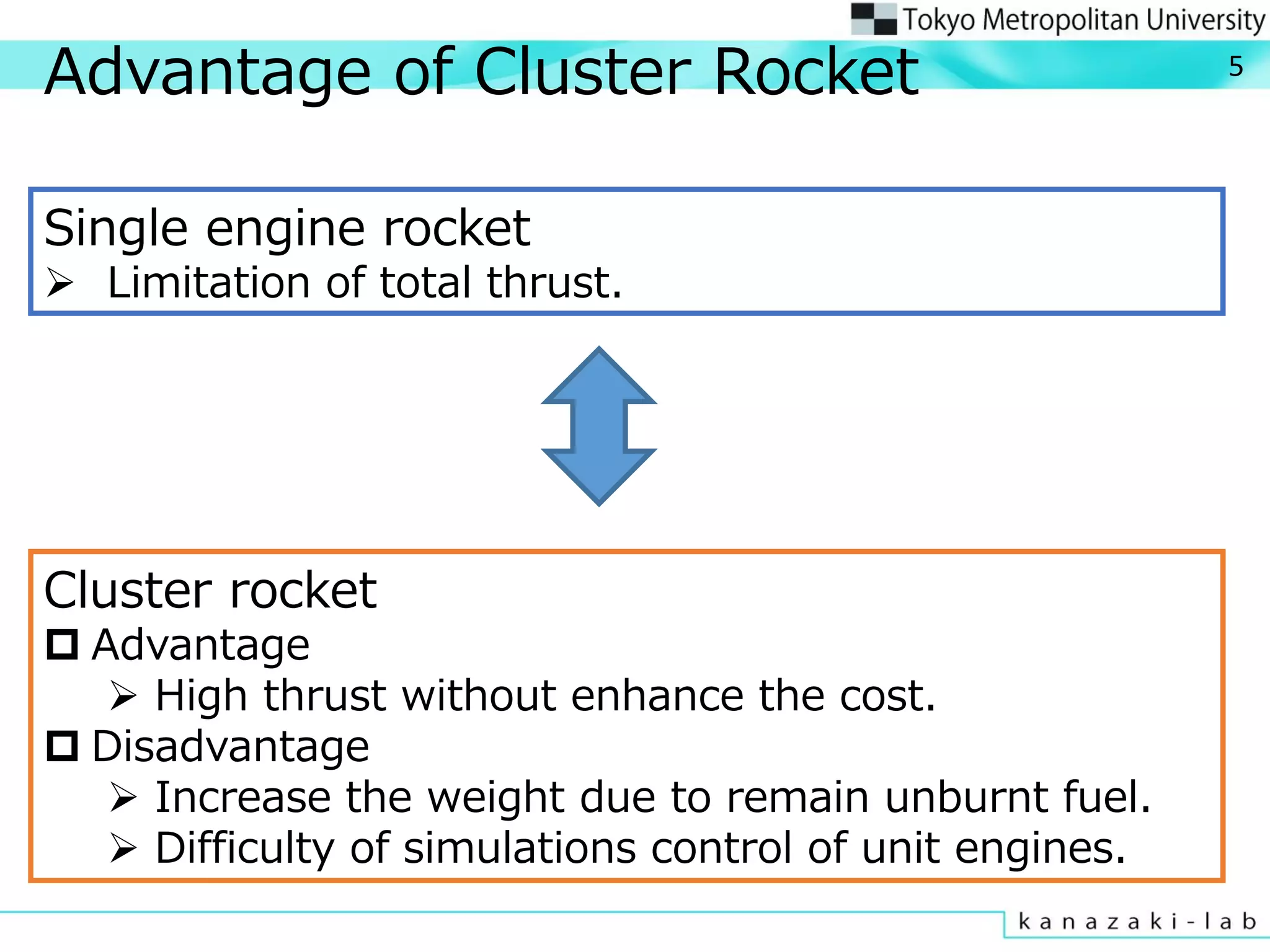
Cluster rocket
 Installed several unit engines in a stage for
sufficient thrust.
4
Hybrid Launcher※3
Soyuz※2 (using liquid engine)
※2 Wikipedia
http://ja.wikipedia.org/wiki/%E3%82%BD%E3%83%A6%E3%83%BC%E3%82%BA#mediaviewer/File:Soyu
z_tma-3_transported_to_launch_pad.jpg
※3 ANTARES Hybridtaken e.V. http://www.hybridraketen.de/Homepage/antares.html
Advantage of Cluster Rocket
Cluster rocket
 Advantage
 High thrust without enhance the cost.
 Disadvantage
 Increase the weight due to remain unburnt fuel.
 Difficulty of simulations control of unit engines.
Single engine rocket
 Limitation of total thrust.
5
Objectives
Design Optimization of Launch
Vehicle (LV) Concept Using Three
Stage Clustered Hybrid Rocket (HRE)
6
 Development design methodology for LV with
clustered HRE
 Investigation of the combination of the unit
engine
Rocket Configuration and Structure
7
Fuel Design
Regression rate rport is calculated by
n
tport Gatr ][)( )(0
8
.
.
Radius of fuel is calculated by rport and tb
(tb is design variables) .
G0(t) Oxidizer mass flux
a Fixed number decided by kind of fuel
n
β Simulating fuel circling
.
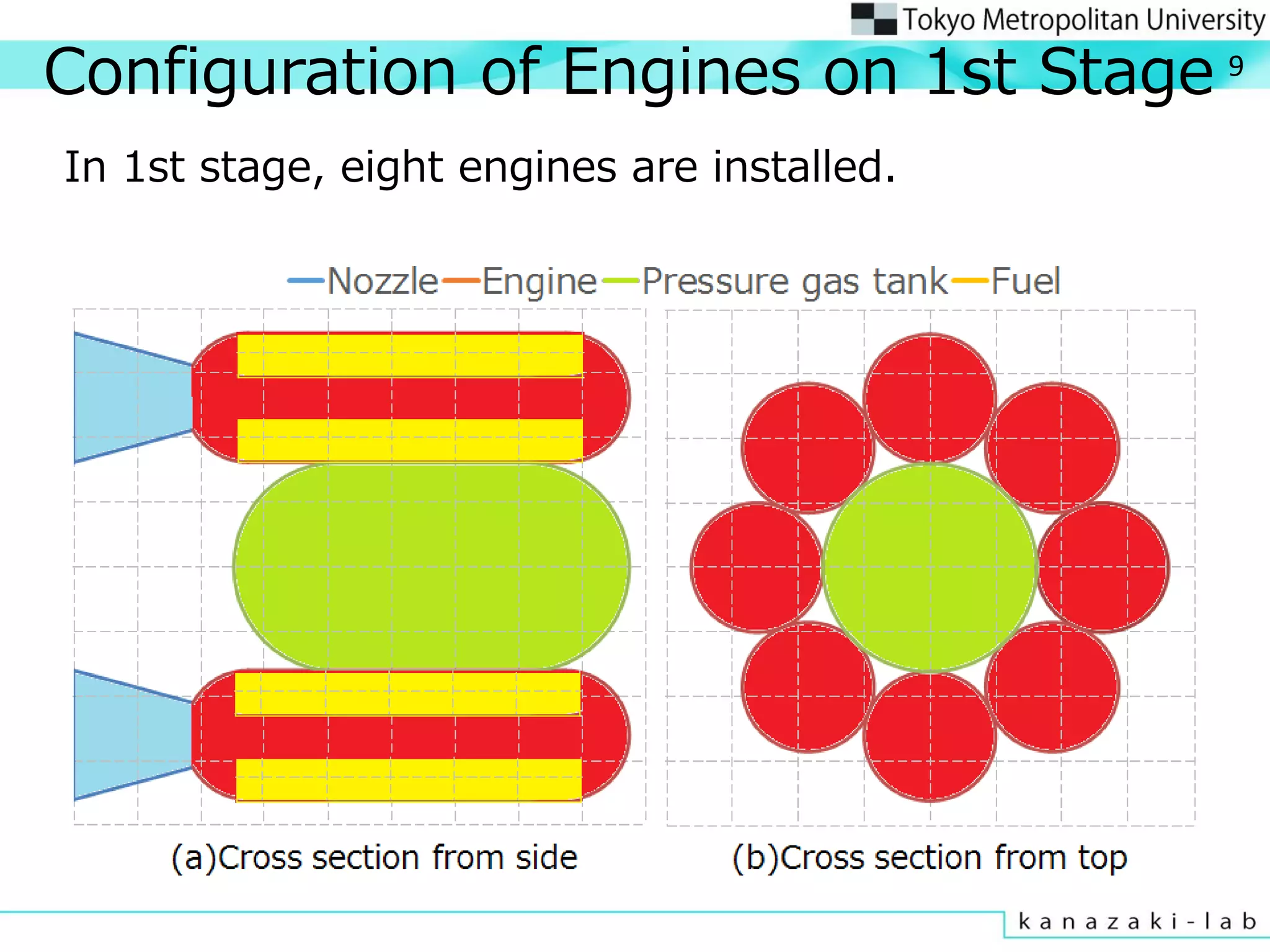
Configuration of Engines on 1st Stage
In 1st stage, eight engines are installed.
9
Configuration of Engines on 2nd Stage
In 2nd stage, two engines are installed.
10
Cluster Rocket Design Method
Evaluation of rocket radius
Radius of 2nd and 3rd stage exterior wall is equal to
radius of 2nd stage.
Radius of 1st stage is calculated independently.
11
Kind of fuel and oxidizer: Fuel…FT0070 Oxidizer…O2
FT0070
spec
Chemical formula Density[kg/m3] Index n Coefficient a
C35H72 910.0 0.3905 0.1561
n
tport Gatr ][)( )(0
Overview of Evaluation and
Optimization Method
12
Optimization Method
• Multi-objective Genetic Algorithm(MOGA)
Search non-dominated solutions based on
global explorations .
GA Flow
13
Data Mining Method
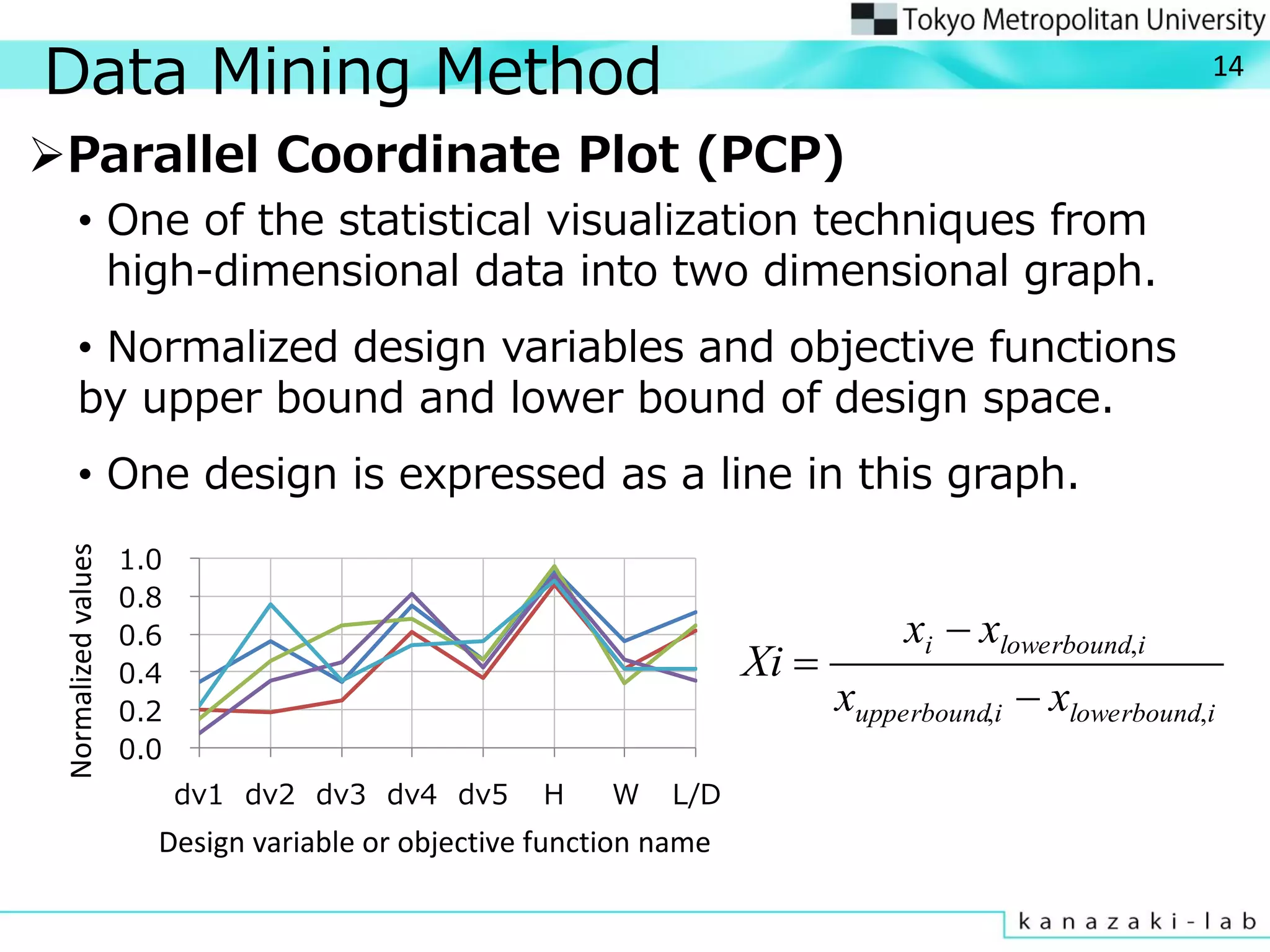
Parallel Coordinate Plot (PCP)
• One of the statistical visualization techniques from
high-dimensional data into two dimensional graph.
• Normalized design variables and objective functions
by upper bound and lower bound of design space.
• One design is expressed as a line in this graph.
0.0
0.2
0.4
0.6
0.8
1.0
dv1 dv2 dv3 dv4 dv5 H W L/D
Design variable or objective function name
Normalizedvalues
ilowerboundiupperbound
ilowerboundi
xx
xx
Xi
,,
,



14
Rocket Design Method 15
Problem Definition
16
Problem Definition
Objective functions
Maximize payload to gross weight ratio(Mpay/Mtot)
Minimize gross weight(Mtot)
 Constraints
After 3rd stage combustion
• Height ≧ 250km
• Angular momentum ≧ 52413.5km2/s
• 0.5deg ≧ Flight path angle ≧-0.5deg
On 1st and 2nd stage
• (Atmospheric pressure)×4 ≦ Pressure of nozzle exit
when start burning
• Radius of nozzle exit ≦ Radius of engine
Rocket aspect ratio ≦ 20
(Area of nozzle throat)×2 ≦ Area of grain port
Radius of 3rd stage nozzle exit ≦ Radius of 2nd stage
exterior wall
17
On the assumption that launch
the super micro satellite
Design Cases
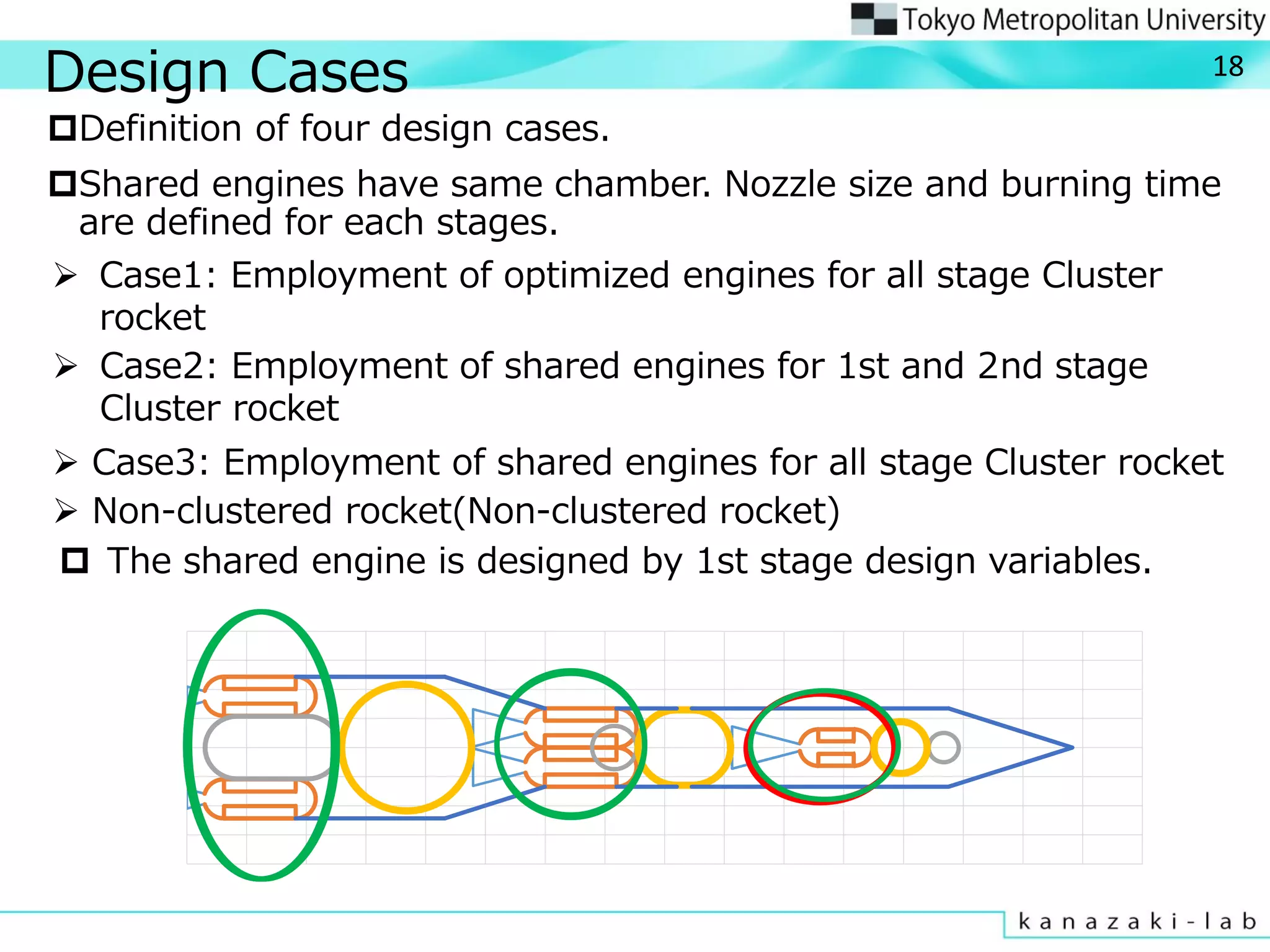
Definition of four design cases.
Shared engines have same chamber. Nozzle size and burning time
are defined for each stages.
 Case1: Employment of optimized engines for all stage Cluster
rocket
 Case2: Employment of shared engines for 1st and 2nd stage
Cluster rocket
 Case3: Employment of shared engines for all stage Cluster rocket
 Non-clustered rocket(Non-clustered rocket)
18
 The shared engine is designed by 1st stage design variables.
Result
19
Result of Design Optimization
0.0
0.2
0.4
0.6
0.8
1.0
1.2
1.4
0.0 2.0 4.0 6.0 8.0 10.0 12.0 14.0 16.0 18.0 20.0 22.0 24.0 26.0 28.0 30.0
Mtot/Mpay[%]
Mtot[ton]
Case1 Case2 Case3 Non-clustered rocket
 Trade off can be shown between two objective functions in each case.
 Case1 show similar result as non-clustered case.
 Case3 which employs same shared engine for each stage achieves
less than half performance compared with Case1.
 Unburnt fuel is appeared when one engine design is shared in
two or three stages.
Optimum
Direction
20
Des1 Des0
Des2
Des3
Mpay=100[kg]
Comparison from Pareto Solutions
 Des1 has slender engines.
 Des1 and Des2 use small engine in 3rd stage.
↔ Des3 uses largest engine in 3rd stage.
21
Length Radius
18.46[m] 0.60[m]
Length Radius
21.62[m] 0.59[m]
Length Radius(1st) Radius(2nd)
16.64[m] 1.42[m] 0.79[m]
Length Radius(1st) Radius(2nd)
14.83[m] 1.22[m] 0.68[m]
Des0
Des1
Des3
Des2
Comparison of Payload 100kg Rocket(PCP)
0.0
0.1
0.2
0.3
0.4
0.5
0.6
0.7
0.8
0.9
1.0
mo1
O/F1
a1
Go1
tb1
Pc1
Ppt1
ε1
Des1 Des2 Des3
0.0
0.1
0.2
0.3
0.4
0.5
0.6
0.7
0.8
0.9
1.0
mo2
O/F2
a2
Go2
tb2
Pc2
Ppt2
ε2
0.0
0.1
0.2
0.3
0.4
0.5
0.6
0.7
0.8
0.9
1.0
mo3
O/F3
a3
Go3
tb3
Pc3
Ppt3
ε3
 For 1st stage, mo1 is small
in each case.
 For 2nd stage, O/F2 of Des3
is the highest. Sufficient
thrust is small, so fuel
become less.
 For 3rd stage, tb3 of Des3 is
small while mo3 is the
highest.1st Stage
2nd Stage 3rd Stage
22
Comparison of time history of engine thrust per an engine
23Comparison of payload 100kg Rocket(Thrust)
Unit engine thrust
= Total thrust by each stage/Number of engines in a stage
 1st stage thrust is
influenced by total mass
and drag. Des3 has big
total mass and drag, so it
has the highest thrust.
 Des0, Des1 and Des2 show
similar result in 3rd stage,
because these cases
optimized engine only for
3rd stage.
Comparison of payload 100kg Rocket(Isp) 24
220
230
240
250
260
270
280
290
300
310
320
0 50 100 150 200 250 300 350 400 450
Isp[s]
Time[s]
 While Des3 achieves the highest thrust in all stage, Isp of
3rd stage is the lowest.
 Engines of Des3 are not only optimized for 3rd stage.
 2nd stage of Des1 achieves the lowest Isp.
 The efficiency is limited because the radius of 1st stage is
small.
Comparison of Payload 100kg Rocket(Altitude)25
 Des3 achieves high
acceleration at low altitude.
 Des3 achieves high
thrust in 1st and 2nd
stage.
 Des3 has the shortest flying
time.
 Des3 become heavy by
using shared engines.
Optimized to rise quickly.
 Des0 and Des1 have long
coasting time.
Comparison of Payload 100kg Rocket(Numerical Value)
Mtot
[ton]
Mpay/Mtot
[%]
Des1 9.31 1.10
Des2 13.3 0.75
Des3 15.5 0.64
 Payload ratio of Des3 is 0.5% less than Des1.
 Because of unburnt fuel, total mass of Des3 become heavy.
Fuel Filling Ratio
1st stage 2nd stage 3rd stage
Des1 63[%] 80[%] 93[%]
Des2 86[%] 86[%] 88[%]
Des3 84[%] 84[%] 84[%]
 Fuel filling ratio of Des1 is the smallest in 1st stage.
 Des1 has slender engines to reduce aerodynamic drag.
 Fuel filling ratio of Des2 and Des3 are high.
 Because of the appearance of the unburnt fuel, payload
ratio of Des2 and 3 becomes lower than Des1.
 It is also required to reduce unburnt fuel.
→(Future work)Addition of objective function objective function:
Minimize unburnt fuel
26
Fuel Filling Ratio=Area of fuel/Area of chamber
Conclusions
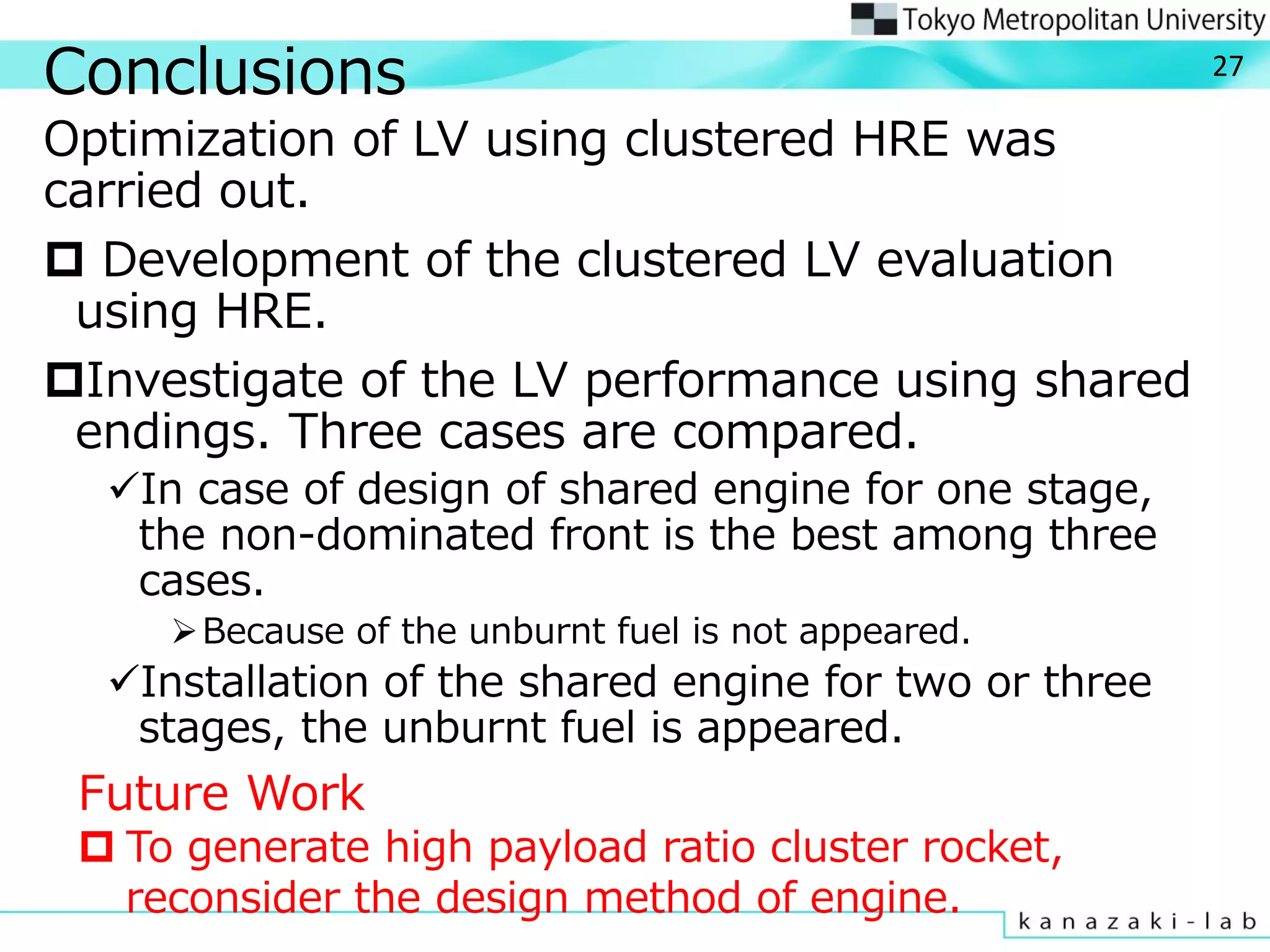
Optimization of LV using clustered HRE was
carried out.
 Development of the clustered LV evaluation
using HRE.
Investigate of the LV performance using shared
endings. Three cases are compared.
In case of design of shared engine for one stage,
the non-dominated front is the best among three
cases.
Because of the unburnt fuel is not appeared.
Installation of the shared engine for two or three
stages, the unburnt fuel is appeared.
27
Future Work
 To generate high payload ratio cluster rocket,
reconsider the design method of engine.
Thank you for listening
28

ハイブリッドロケットエンジンを用いたクラスタ型多段ロケットの設計@ICFD2014

  • 1.
    Design Optimization ofLaunch Vehicle Concept Using Cluster Hybrid Rocket Engine for Future Space Transportation Shoma Ito (Tokyo Metropolitan University) Fumio Kanamori (Tokyo Metropolitan University) Masaki Nakamiya (Kyoto University) Koki Kitagawa (ISAS/JAXA) Masahiro Kanazaki (Tokyo Metropolitan University) Toru Shimada (ISAS/JAXA) 1OS8:Flow Dynamics and Combustion in Hybrid Rockets OS 8-9 2014 Eleventh International Conference on Flow Dynamics October 8-10. Sendai, Japan
  • 2.
    Contents • Background • Objectives •Rocket Configuration and Structure • Design and Evaluation Methods • Problem Definition • Results • Conclusions 2
  • 3.
    Background Advantage of hybrid rocketengine(HRE)  Higher safety  Lower cost  Lower environmental impact Hybrid rocket has possibility to be next generation efficient launch vehicle. Space ship two※1 ※1,VirginGalactic http://www.virgingalactic.com/ ※2, [1] Y. Kitagawa, K. Kitagawa, M. Nakamiya, M. Kanazaki, T. Shimada, T JSASS, 55(2012), R4 3 Our previous research※2  Development of multi- disciplinary design methodology  Optimization for single stage and three stage launch vehicle
  • 4.
    Background Cluster rocket  Installedseveral unit engines in a stage for sufficient thrust. 4 Hybrid Launcher※3 Soyuz※2 (using liquid engine) ※2 Wikipedia http://ja.wikipedia.org/wiki/%E3%82%BD%E3%83%A6%E3%83%BC%E3%82%BA#mediaviewer/File:Soyu z_tma-3_transported_to_launch_pad.jpg ※3 ANTARES Hybridtaken e.V. http://www.hybridraketen.de/Homepage/antares.html
  • 5.
    Advantage of ClusterRocket Cluster rocket  Advantage  High thrust without enhance the cost.  Disadvantage  Increase the weight due to remain unburnt fuel.  Difficulty of simulations control of unit engines. Single engine rocket  Limitation of total thrust. 5
  • 6.
    Objectives Design Optimization ofLaunch Vehicle (LV) Concept Using Three Stage Clustered Hybrid Rocket (HRE) 6  Development design methodology for LV with clustered HRE  Investigation of the combination of the unit engine
  • 7.
  • 8.
    Fuel Design Regression raterport is calculated by n tport Gatr ][)( )(0 8 . . Radius of fuel is calculated by rport and tb (tb is design variables) . G0(t) Oxidizer mass flux a Fixed number decided by kind of fuel n β Simulating fuel circling .
  • 9.
    Configuration of Engineson 1st Stage In 1st stage, eight engines are installed. 9
  • 10.
    Configuration of Engineson 2nd Stage In 2nd stage, two engines are installed. 10
  • 11.
    Cluster Rocket DesignMethod Evaluation of rocket radius Radius of 2nd and 3rd stage exterior wall is equal to radius of 2nd stage. Radius of 1st stage is calculated independently. 11 Kind of fuel and oxidizer: Fuel…FT0070 Oxidizer…O2 FT0070 spec Chemical formula Density[kg/m3] Index n Coefficient a C35H72 910.0 0.3905 0.1561 n tport Gatr ][)( )(0
  • 12.
    Overview of Evaluationand Optimization Method 12
  • 13.
    Optimization Method • Multi-objectiveGenetic Algorithm(MOGA) Search non-dominated solutions based on global explorations . GA Flow 13
  • 14.
    Data Mining Method ParallelCoordinate Plot (PCP) • One of the statistical visualization techniques from high-dimensional data into two dimensional graph. • Normalized design variables and objective functions by upper bound and lower bound of design space. • One design is expressed as a line in this graph. 0.0 0.2 0.4 0.6 0.8 1.0 dv1 dv2 dv3 dv4 dv5 H W L/D Design variable or objective function name Normalizedvalues ilowerboundiupperbound ilowerboundi xx xx Xi ,, ,    14
  • 15.
  • 16.
  • 17.
    Problem Definition Objective functions Maximizepayload to gross weight ratio(Mpay/Mtot) Minimize gross weight(Mtot)  Constraints After 3rd stage combustion • Height ≧ 250km • Angular momentum ≧ 52413.5km2/s • 0.5deg ≧ Flight path angle ≧-0.5deg On 1st and 2nd stage • (Atmospheric pressure)×4 ≦ Pressure of nozzle exit when start burning • Radius of nozzle exit ≦ Radius of engine Rocket aspect ratio ≦ 20 (Area of nozzle throat)×2 ≦ Area of grain port Radius of 3rd stage nozzle exit ≦ Radius of 2nd stage exterior wall 17 On the assumption that launch the super micro satellite
  • 18.
    Design Cases Definition offour design cases. Shared engines have same chamber. Nozzle size and burning time are defined for each stages.  Case1: Employment of optimized engines for all stage Cluster rocket  Case2: Employment of shared engines for 1st and 2nd stage Cluster rocket  Case3: Employment of shared engines for all stage Cluster rocket  Non-clustered rocket(Non-clustered rocket) 18  The shared engine is designed by 1st stage design variables.
  • 19.
  • 20.
    Result of DesignOptimization 0.0 0.2 0.4 0.6 0.8 1.0 1.2 1.4 0.0 2.0 4.0 6.0 8.0 10.0 12.0 14.0 16.0 18.0 20.0 22.0 24.0 26.0 28.0 30.0 Mtot/Mpay[%] Mtot[ton] Case1 Case2 Case3 Non-clustered rocket  Trade off can be shown between two objective functions in each case.  Case1 show similar result as non-clustered case.  Case3 which employs same shared engine for each stage achieves less than half performance compared with Case1.  Unburnt fuel is appeared when one engine design is shared in two or three stages. Optimum Direction 20 Des1 Des0 Des2 Des3 Mpay=100[kg]
  • 21.
    Comparison from ParetoSolutions  Des1 has slender engines.  Des1 and Des2 use small engine in 3rd stage. ↔ Des3 uses largest engine in 3rd stage. 21 Length Radius 18.46[m] 0.60[m] Length Radius 21.62[m] 0.59[m] Length Radius(1st) Radius(2nd) 16.64[m] 1.42[m] 0.79[m] Length Radius(1st) Radius(2nd) 14.83[m] 1.22[m] 0.68[m] Des0 Des1 Des3 Des2
  • 22.
    Comparison of Payload100kg Rocket(PCP) 0.0 0.1 0.2 0.3 0.4 0.5 0.6 0.7 0.8 0.9 1.0 mo1 O/F1 a1 Go1 tb1 Pc1 Ppt1 ε1 Des1 Des2 Des3 0.0 0.1 0.2 0.3 0.4 0.5 0.6 0.7 0.8 0.9 1.0 mo2 O/F2 a2 Go2 tb2 Pc2 Ppt2 ε2 0.0 0.1 0.2 0.3 0.4 0.5 0.6 0.7 0.8 0.9 1.0 mo3 O/F3 a3 Go3 tb3 Pc3 Ppt3 ε3  For 1st stage, mo1 is small in each case.  For 2nd stage, O/F2 of Des3 is the highest. Sufficient thrust is small, so fuel become less.  For 3rd stage, tb3 of Des3 is small while mo3 is the highest.1st Stage 2nd Stage 3rd Stage 22
  • 23.
    Comparison of timehistory of engine thrust per an engine 23Comparison of payload 100kg Rocket(Thrust) Unit engine thrust = Total thrust by each stage/Number of engines in a stage  1st stage thrust is influenced by total mass and drag. Des3 has big total mass and drag, so it has the highest thrust.  Des0, Des1 and Des2 show similar result in 3rd stage, because these cases optimized engine only for 3rd stage.
  • 24.
    Comparison of payload100kg Rocket(Isp) 24 220 230 240 250 260 270 280 290 300 310 320 0 50 100 150 200 250 300 350 400 450 Isp[s] Time[s]  While Des3 achieves the highest thrust in all stage, Isp of 3rd stage is the lowest.  Engines of Des3 are not only optimized for 3rd stage.  2nd stage of Des1 achieves the lowest Isp.  The efficiency is limited because the radius of 1st stage is small.
  • 25.
    Comparison of Payload100kg Rocket(Altitude)25  Des3 achieves high acceleration at low altitude.  Des3 achieves high thrust in 1st and 2nd stage.  Des3 has the shortest flying time.  Des3 become heavy by using shared engines. Optimized to rise quickly.  Des0 and Des1 have long coasting time.
  • 26.
    Comparison of Payload100kg Rocket(Numerical Value) Mtot [ton] Mpay/Mtot [%] Des1 9.31 1.10 Des2 13.3 0.75 Des3 15.5 0.64  Payload ratio of Des3 is 0.5% less than Des1.  Because of unburnt fuel, total mass of Des3 become heavy. Fuel Filling Ratio 1st stage 2nd stage 3rd stage Des1 63[%] 80[%] 93[%] Des2 86[%] 86[%] 88[%] Des3 84[%] 84[%] 84[%]  Fuel filling ratio of Des1 is the smallest in 1st stage.  Des1 has slender engines to reduce aerodynamic drag.  Fuel filling ratio of Des2 and Des3 are high.  Because of the appearance of the unburnt fuel, payload ratio of Des2 and 3 becomes lower than Des1.  It is also required to reduce unburnt fuel. →(Future work)Addition of objective function objective function: Minimize unburnt fuel 26 Fuel Filling Ratio=Area of fuel/Area of chamber
  • 27.
    Conclusions Optimization of LVusing clustered HRE was carried out.  Development of the clustered LV evaluation using HRE. Investigate of the LV performance using shared endings. Three cases are compared. In case of design of shared engine for one stage, the non-dominated front is the best among three cases. Because of the unburnt fuel is not appeared. Installation of the shared engine for two or three stages, the unburnt fuel is appeared. 27 Future Work  To generate high payload ratio cluster rocket, reconsider the design method of engine.
  • 28.
    Thank you forlistening 28