Efficient Global Optimization Applied to Wind Tunnel
Evaluation Based Optimization for
Improvement of Flow Control by Plasma Actuator
○Masahiro Kanazaki(Tokyo Metropolitan University)
Takashi Matsuno (Tottori University)
Kengo Maeda (Tottori University)
Hiromitsu Kawazoe (Tottori University)
Japan-Finland Joint Seminar 2013
Contents
Introduction
 Overview of Active Flow Control by Means of Plasma
Actuator
Objectives
Optimization Method
Efficient Global Optimization (EGO)
Experimental Setup
Formulation
Results
Conclusions
2
Introduction(1/3)
Requirements of flow control around aircraft
Take-off and landing
Pitching, rolling and yawing motion
➔ Large aerodynamic force under
the large scale flow
3
 Complex geometry
 Noise
Improvement of
aerodynamics at
landing and take-off
Introduction(2/3)
Plasma Actuator: PA
Electric device for active flow control
Induced flow (Jet) is appeared by ionization of
the air between exposed electrode and
insulated electrode
Alternating current (AC) is supplied.
Small and light weight device
4
Introduction(3/3)
Pulse Width Modulation(PWM) PA
 Efficient AC supplement for PA
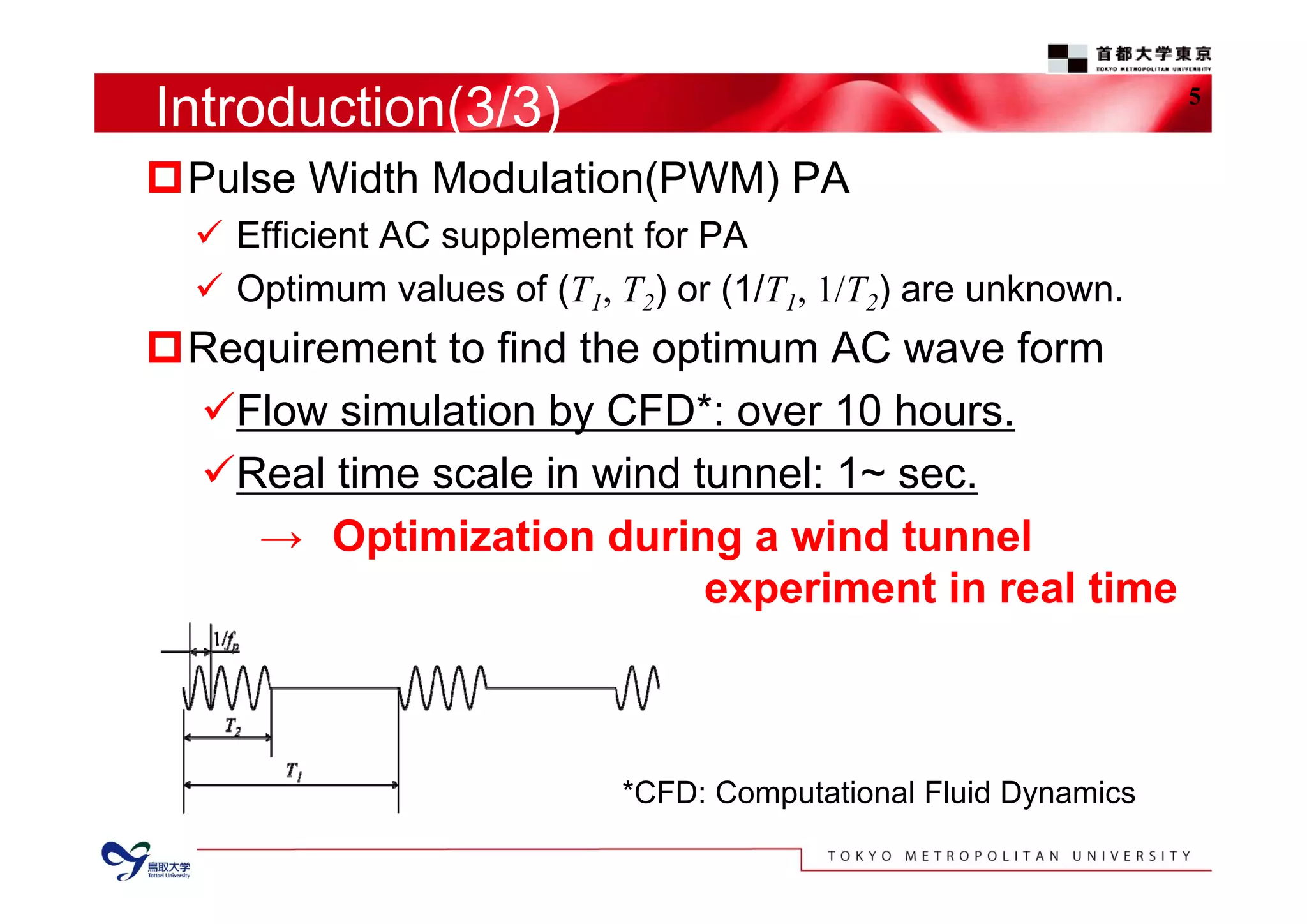
 Optimum values of (T1, T2) or (1/T1, 1/T2) are unknown.
Requirement to find the optimum AC wave form
Flow simulation by CFD*: over 10 hours.
Real time scale in wind tunnel: 1~ sec.
→ Optimization during a wind tunnel
experiment in real time
5
*CFD: Computational Fluid Dynamics
Objectives
Wind tunnel evaluation based optimization
Optimization during a wind tunnel experiment in
real time
Efficient Global Optimization ~ Kriging model based
Genetic Algorithm
Improvement of flow control by PA
Designing AC wave form
6
7
Optimization Method(1/5)
 Surrogate model:Kriging model
 Interpolation based on sampling data
 Standard error estimation (uncertainty)
)()( ii
y xx  
global model localized deviation
from the global model
 EI(Expected Improvement)
 The balance between optimality and uncertainty
 EI maximum point has possibility to improve the model.
Improvement at a point x is I=max(fmin-Y,0)
Expected improvement E[I(x))]=E[max(fmin-Y,0)]
To calculate EI,
Jones, D. R., “Efficient Global
Optimization of Expensive Black-Box
Functions,” J. Glob. Opt., Vol. 13,
pp.455-492 1998.
8
Optimization Method(2/5)
, :standard distribution,
normal density
:standard errors
Surrogate model construction
Multi-objective optimization
and Selection of additional samples
Sampling and Evaluation
Evaluation of
additional samples
Termination?
Yes
Knowledge discovery
Knowledge based design
No
Kriging model
Genetic Algorithms
Wind tunnel
Exact
Initial model
Initial designs
Additional designs
Improved model
Image of additional sampling based on
EI for minimization problem.
9
Optimization Method(3/5)
 Heuristic search:Genetic algorithm (GA)
 Inspired by evolution of life
 Selection, crossover, mutation
 BLX-0.5
EI maximization → Multi-modal problem
Island GA which divide the population into
subpopulations
Maintain high diversity
Optimization Method(4/5)
Fully automated optimization based on the wind
tunnel evaluation.
Wind tunnel testing is incorporated into EGO.
• NI LabVIEWTM is employed.
10
Design variable (Power supply)
Objective function(Aerodynamic force)
Optimization method(5/5)
Flowfield around semicircular cylinder with two PAs
Drag minimization by controlling two design
variables related to (T1, T2)
 Over 1,000 wind tunnel run will be required if full-
factorial design should be carried out.
11
PA off PA on
12
Formulation
 Modulation frequency:
 Duty ratio: [%]
m
p
x
f
T
f
1
20
1
1
mod 
1
2
100
T
T
Dcycle 
Power supply unit provide frequency fp 9kHz
and 20/fp as a one unit wave.
[Hz]
 Objective function
 Design variables
Minimize CD (Drag coefficient)
2 .0 ≤ xm ≤ 90.0
10.0 ≤ Dcycle ≤ 70.0
13
Result(1/5)
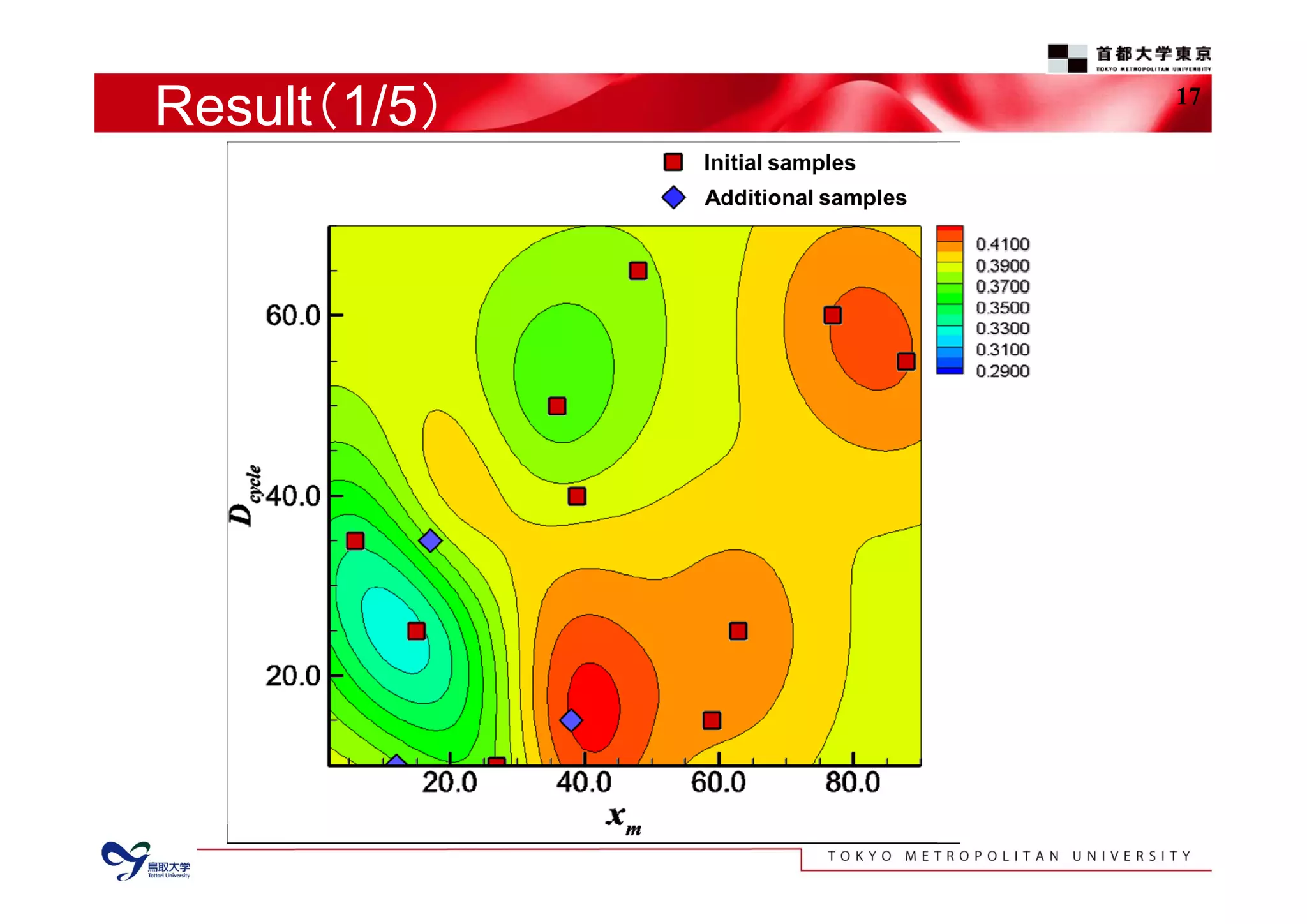
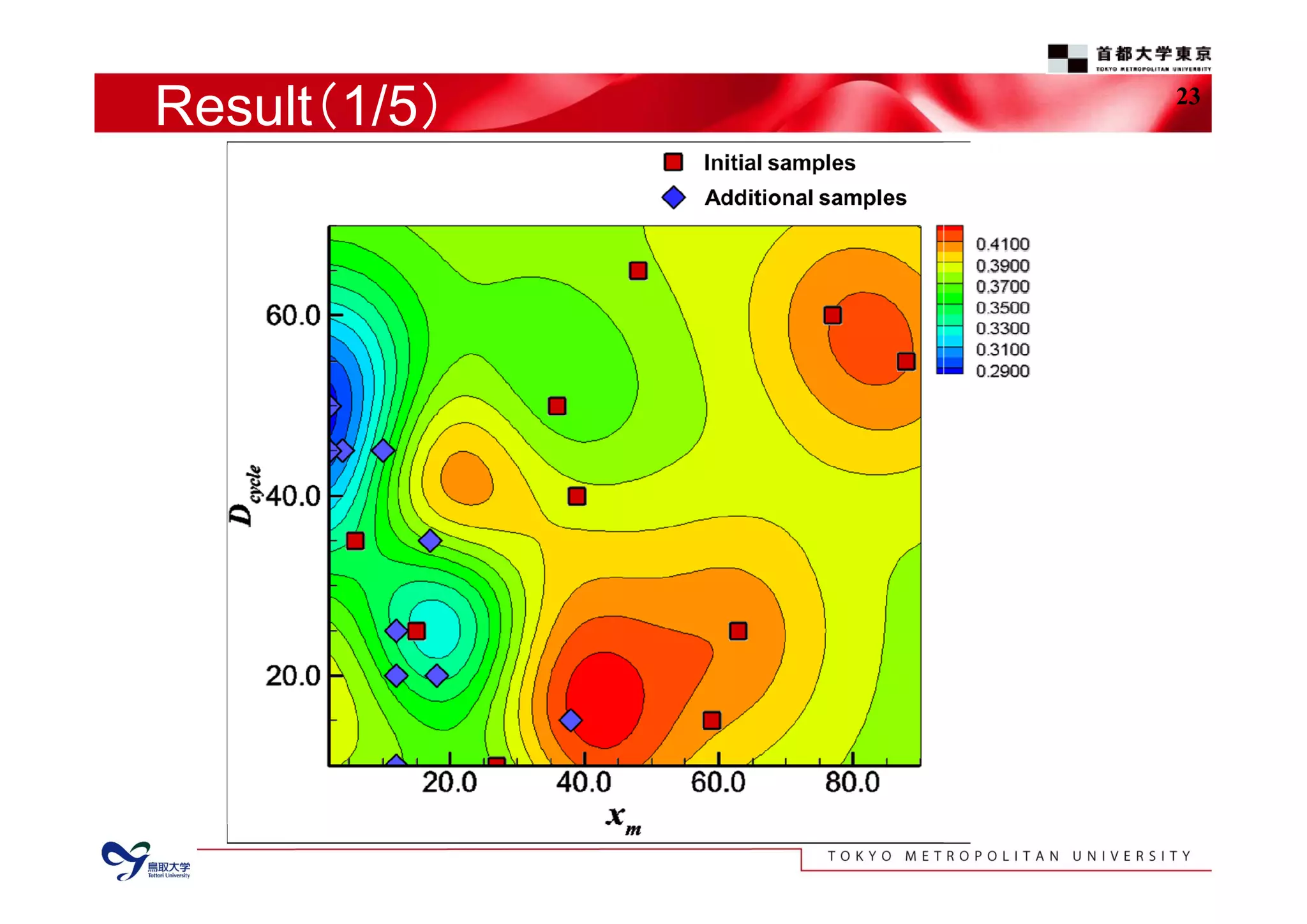
Lower xm = Higher jet energy
10 initial samples
14
Result(1/5)
15
Result(1/5)
16
Result(1/5)
17
Result(1/5)
18
Result(1/5)
19
Result(1/5)
20
Result(1/5)
21
Result(1/5)
22
Result(1/5)
23
Result(1/5)
24
Result(1/5)
25
Result(1/5)
Local minimum
Global minimum
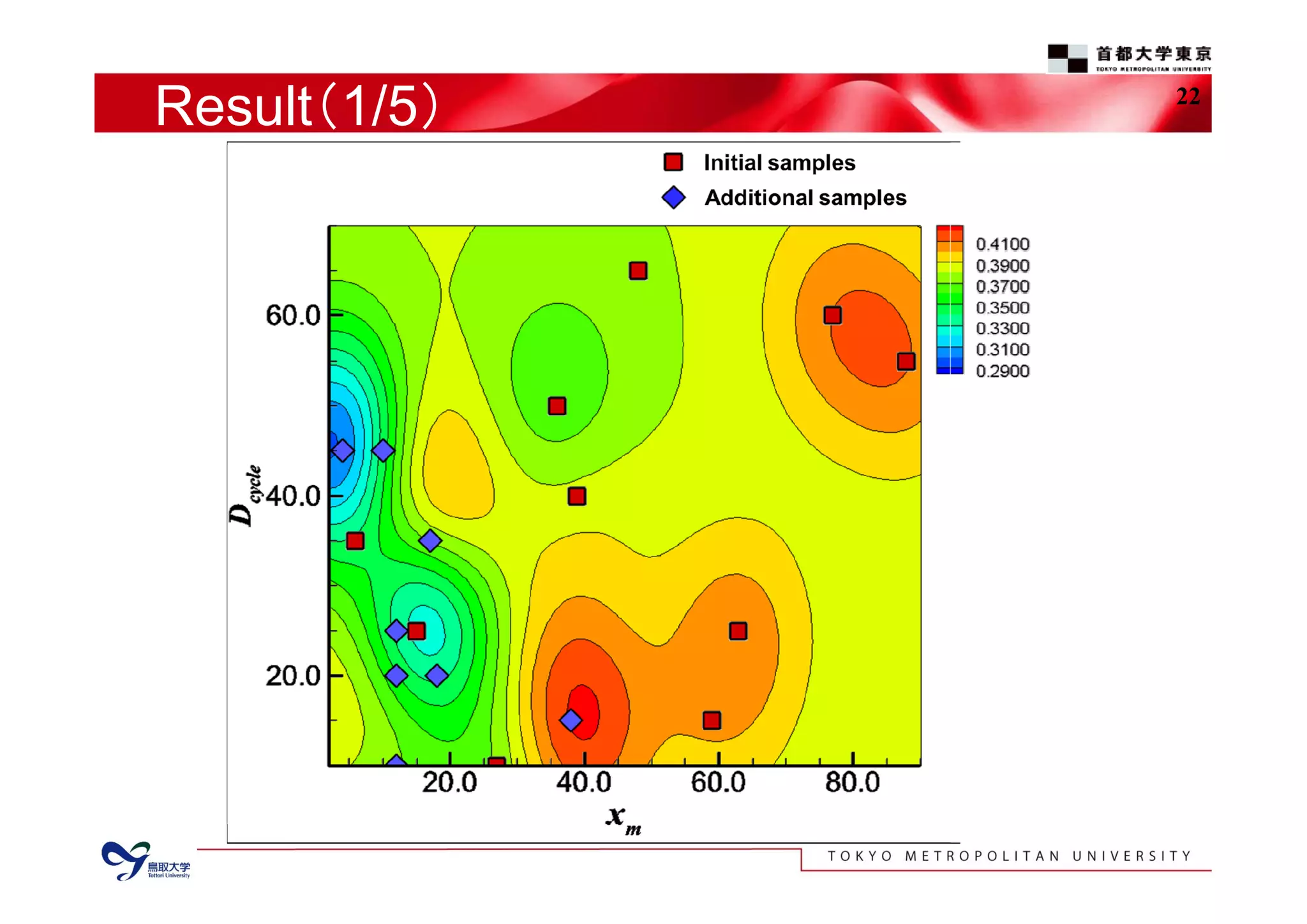
After 12 additional sampling
26
Result(2/5)
The minimum point could be obtained
about 20 wind tunnel runs.
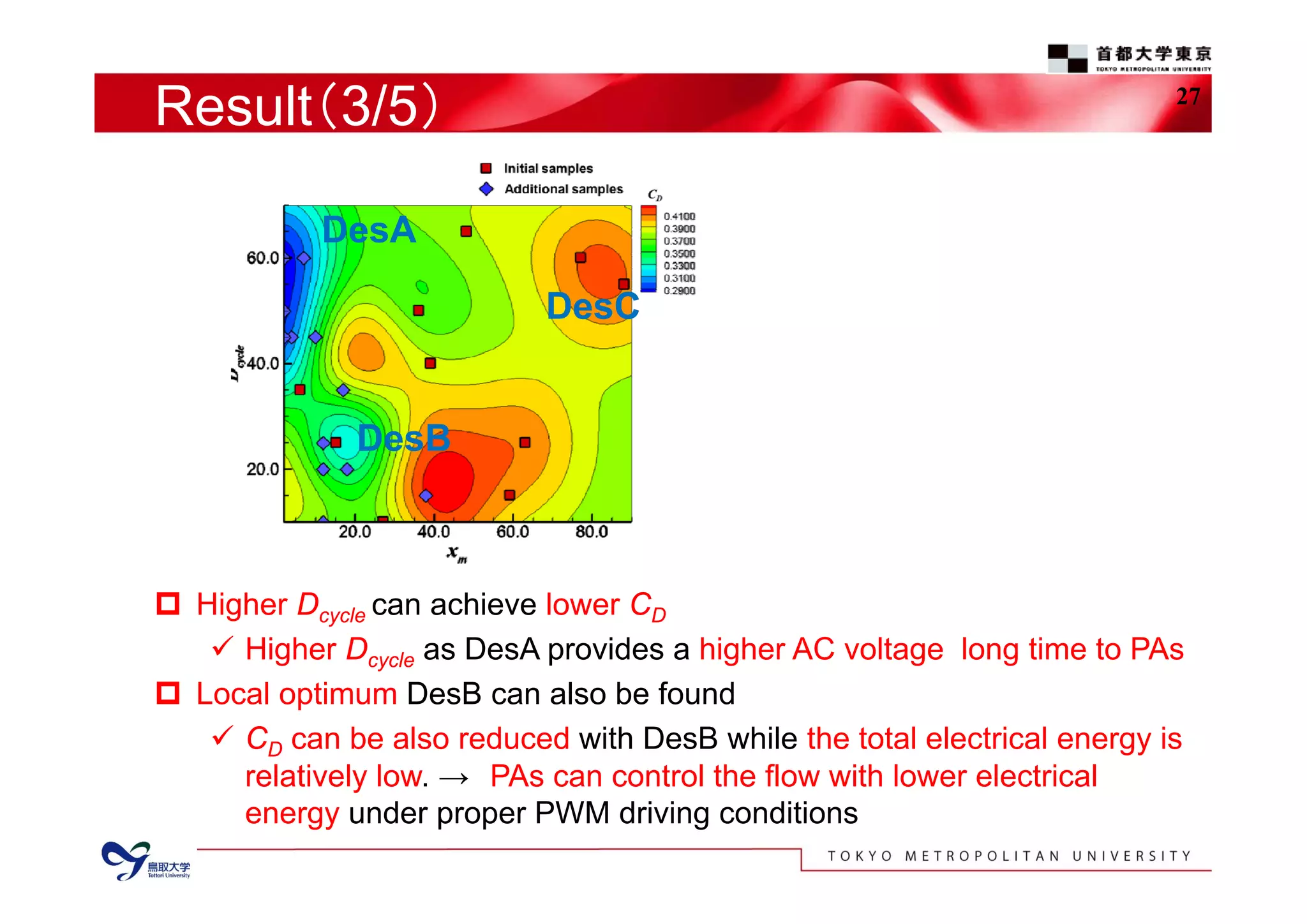
 Higher Dcycle can achieve lower CD
 Higher Dcycle as DesA provides a higher AC voltage long time to PAs
 Local optimum DesB can also be found
 CD can be also reduced with DesB while the total electrical energy is
relatively low. → PAs can control the flow with lower electrical
energy under proper PWM driving conditions
27
Result(3/5)
DesA
DesB
DesC
28
Result(4/5)
x m [-] D cycle [%] f mod [Hz] C D
DesA 2.0 60.0 400.0 0.2985
DesB 15.0 25.0 53.3 0.3272
DesC 88.0 55.0 9.1 0.4105
DesA
DesB
DesC
29
Result(5/5)
x m [-] D cycle [%] f mod [Hz] C D
DesA 2.0 60.0 400.0 0.2985
DesB 15.0 25.0 53.3 0.3272
DesC 88.0 55.0 9.1 0.4105
DesA
DesB
DesC
 DesA: Separated region was reduced, and the streamline was less deformed
from the uniform flow
 DesB: Separated region was reduced, the streak of smoke far downstream from
the model was blurred
Conclusions
Wind Tunnel Evaluation–Based Optimization
The optimization technique successfully
integrated in the operating system of the wind
tunnel experiment
Automation of the data-acquisition/optimization
process
Improvement of Flow Control by Plasma
Actuator
The cost of optimization based on wind tunnel
evaluation can be drastically reduced
Not only global optimum but also local optimum were
found out.
30
31
Kiitos paljon!
Thank you!

finland_japan_joint_seminor

  • 1.
    Efficient Global OptimizationApplied to Wind Tunnel Evaluation Based Optimization for Improvement of Flow Control by Plasma Actuator ○Masahiro Kanazaki(Tokyo Metropolitan University) Takashi Matsuno (Tottori University) Kengo Maeda (Tottori University) Hiromitsu Kawazoe (Tottori University) Japan-Finland Joint Seminar 2013
  • 2.
    Contents Introduction  Overview ofActive Flow Control by Means of Plasma Actuator Objectives Optimization Method Efficient Global Optimization (EGO) Experimental Setup Formulation Results Conclusions 2
  • 3.
    Introduction(1/3) Requirements of flowcontrol around aircraft Take-off and landing Pitching, rolling and yawing motion ➔ Large aerodynamic force under the large scale flow 3  Complex geometry  Noise Improvement of aerodynamics at landing and take-off
  • 4.
    Introduction(2/3) Plasma Actuator: PA Electricdevice for active flow control Induced flow (Jet) is appeared by ionization of the air between exposed electrode and insulated electrode Alternating current (AC) is supplied. Small and light weight device 4
  • 5.
    Introduction(3/3) Pulse Width Modulation(PWM)PA  Efficient AC supplement for PA  Optimum values of (T1, T2) or (1/T1, 1/T2) are unknown. Requirement to find the optimum AC wave form Flow simulation by CFD*: over 10 hours. Real time scale in wind tunnel: 1~ sec. → Optimization during a wind tunnel experiment in real time 5 *CFD: Computational Fluid Dynamics
  • 6.
    Objectives Wind tunnel evaluationbased optimization Optimization during a wind tunnel experiment in real time Efficient Global Optimization ~ Kriging model based Genetic Algorithm Improvement of flow control by PA Designing AC wave form 6
  • 7.
    7 Optimization Method(1/5)  Surrogatemodel:Kriging model  Interpolation based on sampling data  Standard error estimation (uncertainty) )()( ii y xx   global model localized deviation from the global model  EI(Expected Improvement)  The balance between optimality and uncertainty  EI maximum point has possibility to improve the model. Improvement at a point x is I=max(fmin-Y,0) Expected improvement E[I(x))]=E[max(fmin-Y,0)] To calculate EI, Jones, D. R., “Efficient Global Optimization of Expensive Black-Box Functions,” J. Glob. Opt., Vol. 13, pp.455-492 1998.
  • 8.
    8 Optimization Method(2/5) , :standarddistribution, normal density :standard errors Surrogate model construction Multi-objective optimization and Selection of additional samples Sampling and Evaluation Evaluation of additional samples Termination? Yes Knowledge discovery Knowledge based design No Kriging model Genetic Algorithms Wind tunnel Exact Initial model Initial designs Additional designs Improved model Image of additional sampling based on EI for minimization problem.
  • 9.
    9 Optimization Method(3/5)  Heuristicsearch:Genetic algorithm (GA)  Inspired by evolution of life  Selection, crossover, mutation  BLX-0.5 EI maximization → Multi-modal problem Island GA which divide the population into subpopulations Maintain high diversity
  • 10.
    Optimization Method(4/5) Fully automatedoptimization based on the wind tunnel evaluation. Wind tunnel testing is incorporated into EGO. • NI LabVIEWTM is employed. 10 Design variable (Power supply) Objective function(Aerodynamic force)
  • 11.
    Optimization method(5/5) Flowfield aroundsemicircular cylinder with two PAs Drag minimization by controlling two design variables related to (T1, T2)  Over 1,000 wind tunnel run will be required if full- factorial design should be carried out. 11 PA off PA on
  • 12.
    12 Formulation  Modulation frequency: Duty ratio: [%] m p x f T f 1 20 1 1 mod  1 2 100 T T Dcycle  Power supply unit provide frequency fp 9kHz and 20/fp as a one unit wave. [Hz]  Objective function  Design variables Minimize CD (Drag coefficient) 2 .0 ≤ xm ≤ 90.0 10.0 ≤ Dcycle ≤ 70.0
  • 13.
    13 Result(1/5) Lower xm =Higher jet energy 10 initial samples
  • 14.
  • 15.
  • 16.
  • 17.
  • 18.
  • 19.
  • 20.
  • 21.
  • 22.
  • 23.
  • 24.
  • 25.
  • 26.
    26 Result(2/5) The minimum pointcould be obtained about 20 wind tunnel runs.
  • 27.
     Higher Dcyclecan achieve lower CD  Higher Dcycle as DesA provides a higher AC voltage long time to PAs  Local optimum DesB can also be found  CD can be also reduced with DesB while the total electrical energy is relatively low. → PAs can control the flow with lower electrical energy under proper PWM driving conditions 27 Result(3/5) DesA DesB DesC
  • 28.
    28 Result(4/5) x m [-]D cycle [%] f mod [Hz] C D DesA 2.0 60.0 400.0 0.2985 DesB 15.0 25.0 53.3 0.3272 DesC 88.0 55.0 9.1 0.4105 DesA DesB DesC
  • 29.
    29 Result(5/5) x m [-]D cycle [%] f mod [Hz] C D DesA 2.0 60.0 400.0 0.2985 DesB 15.0 25.0 53.3 0.3272 DesC 88.0 55.0 9.1 0.4105 DesA DesB DesC  DesA: Separated region was reduced, and the streamline was less deformed from the uniform flow  DesB: Separated region was reduced, the streak of smoke far downstream from the model was blurred
  • 30.
    Conclusions Wind Tunnel Evaluation–BasedOptimization The optimization technique successfully integrated in the operating system of the wind tunnel experiment Automation of the data-acquisition/optimization process Improvement of Flow Control by Plasma Actuator The cost of optimization based on wind tunnel evaluation can be drastically reduced Not only global optimum but also local optimum were found out. 30
  • 31.