Airfoil Design for Mars Aircraft
Using Modified PARSEC Geometry Representation

                           Masahiro Kanazaki
                           Tokyo Metropolitan University
                           Tomoyoshi Yotsuya
                           Tokyo Metropolitan University
                           Kisa Matsushima
                           University of Toyama
Contents                                                             2


 Background
 Objectives
 Design methods
    Airfoil representation by modified PARSEC method
    Evaluation by computational fluid dynamics (CFD)
    Design optimization by genetic algorithm (GA)
    Knowledge discovery by scatter plot matrix (SPM)
 Formulation
 Results
    Maximization result of maximum lift to drag ratio (t/c=0.07c, 0.10c)
    Visualization result by Parallel Coordinate Plot (PCP)
 Conclusions
Background1                                                3


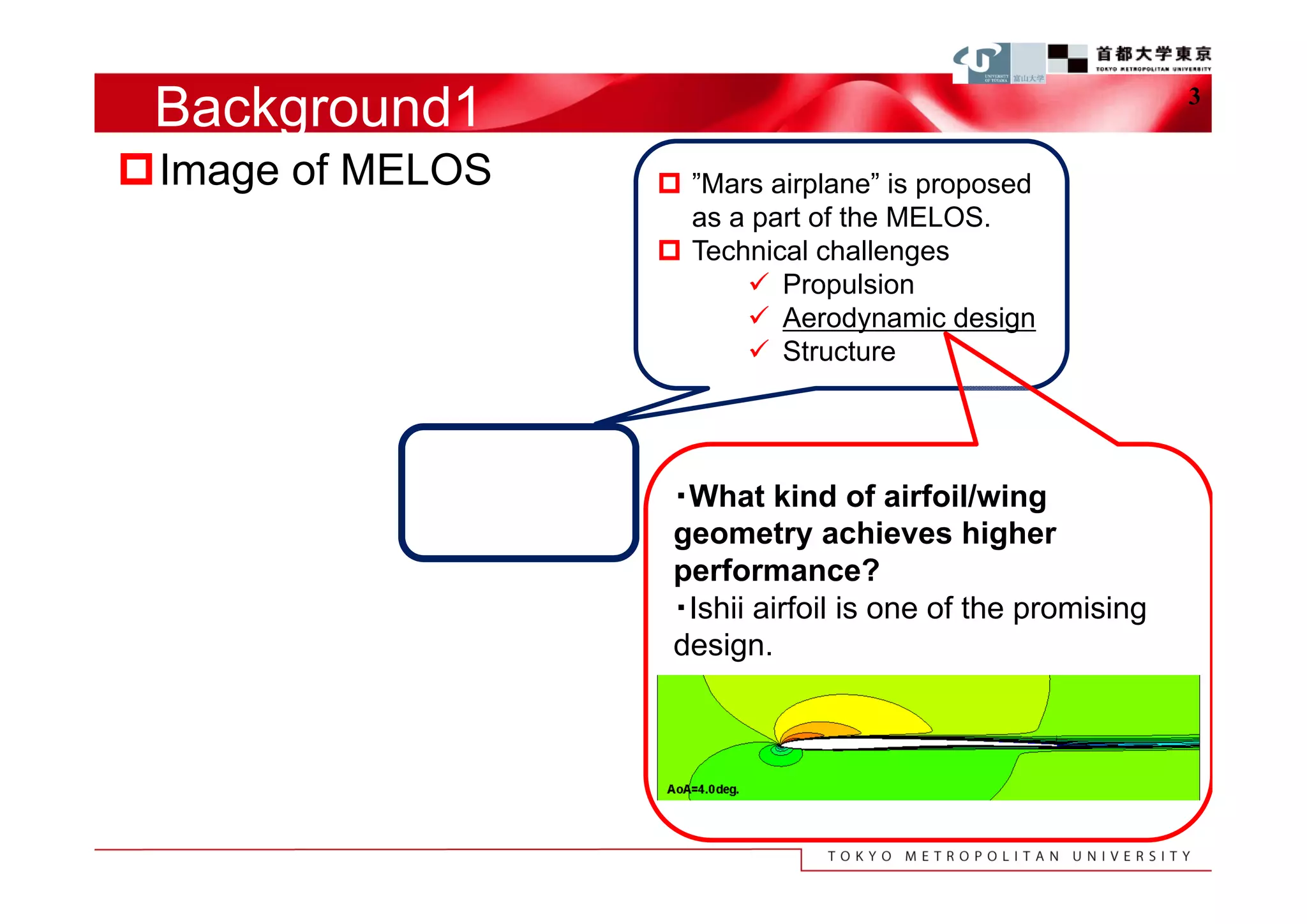
Image of MELOS    ”Mars airplane” is proposed
                    as a part of the MELOS.
                   Technical challenges
                         Propulsion
                         Aerodynamic design
                         Structure


                   ・What kind of airfoil/wing
                   geometry achieves higher
                   performance?
                   ・Ishii airfoil is one of the promising
                   design.
Background2                                                                   4

Difficulty of flight in the Martian atmosphere
             gravity     density       Viscosity   Sonic speed   atmospheric
             [m/s2]      [kg/m3]      [10-5Pa・s]     [m/s]       constituent
 The Earth    9.8         1.17          1.86          345         N2,O2
The Mars      3.2       0.0118          1.36         258           CO2
       1/3 gravity of the earth → Required lift is 1/3.
       1% density of the earth → Lift is required to be
                                        hundredfold increased.
                 ⇒ Lift of the Mars-airplane have to be about 33rd
                 times lift as much as that of the Earth-airplane.

      3/4 speed of sound → Compressibility should be
       considered even for relative slow flight.


 Knowledge has to be acquired for unknown design problem.
 Efficient design method is required for Mars-airplane design.
Background3                                                                                                5

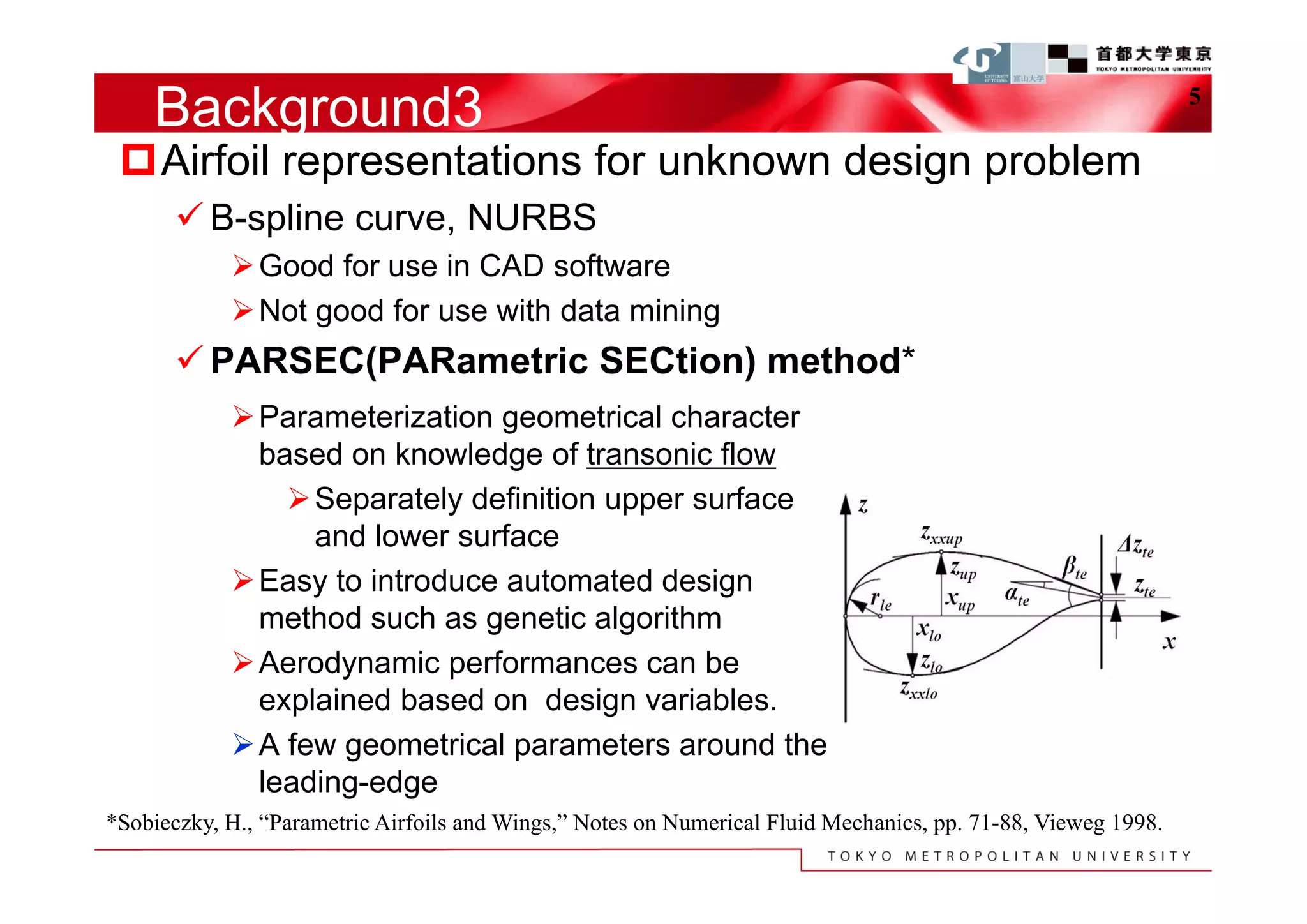
 Airfoil representations for unknown design problem
        B-spline curve, NURBS
             Good for use in CAD software
             Not good for use with data mining
        PARSEC(PARametric SECtion) method*
             Parameterization geometrical character
              based on knowledge of transonic flow
                 Separately definition upper surface
                  and lower surface
             Easy to introduce automated design
              method such as genetic algorithm
             Aerodynamic performances can be
              explained based on design variables.
             A few geometrical parameters around the
              leading-edge
*Sobieczky, H., “Parametric Airfoils and Wings,” Notes on Numerical Fluid Mechanics, pp. 71-88, Vieweg 1998.
Background4                                                                                            6


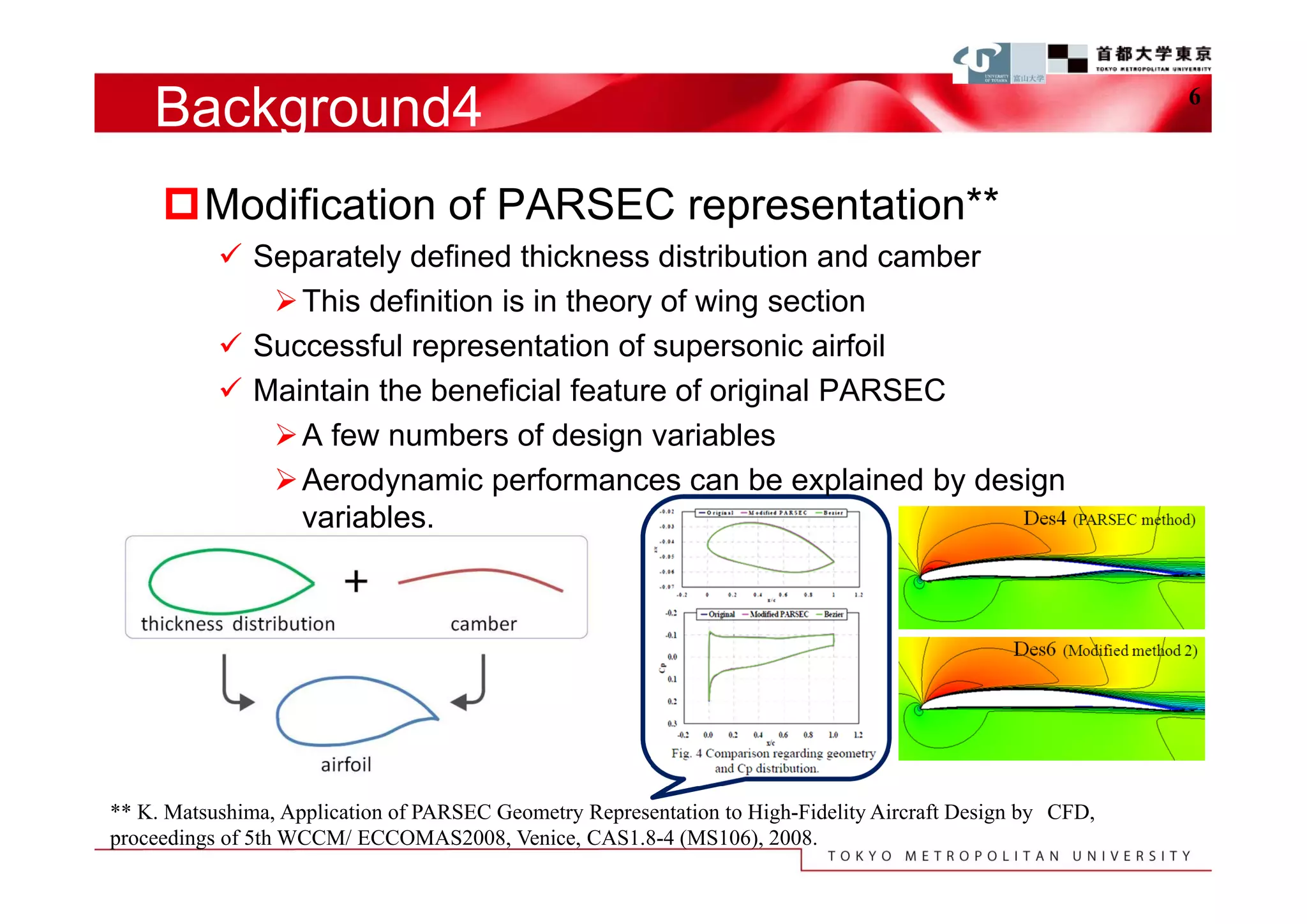
     Modification of PARSEC representation**
            Separately defined thickness distribution and camber
               This definition is in theory of wing section
            Successful representation of supersonic airfoil
            Maintain the beneficial feature of original PARSEC
               A few numbers of design variables
               Aerodynamic performances can be explained by design
                variables.


** K. Matsushima, Application of PARSEC Geometry Representation to High-Fidelity Aircraft Design by CFD,
proceedings of 5th WCCM/ ECCOMAS2008, Venice, CAS1.8-4 (MS106), 2008.
Objectives                                         7


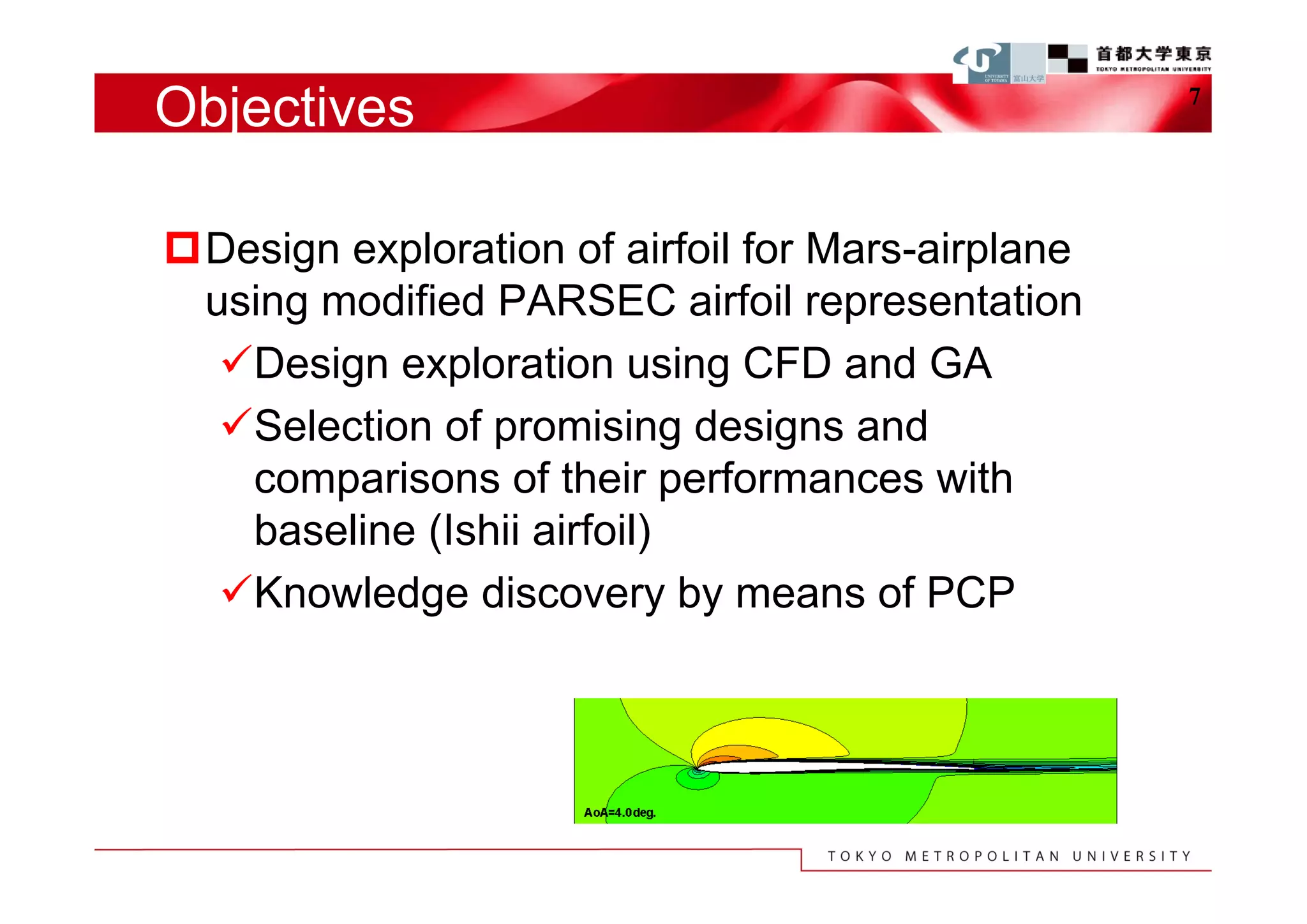
Design exploration of airfoil for Mars-airplane
 using modified PARSEC airfoil representation
  Design exploration using CFD and GA
  Selection of promising designs and
   comparisons of their performances with
   baseline (Ishii airfoil)
  Knowledge discovery by means of PCP
Design methods1                                                             8


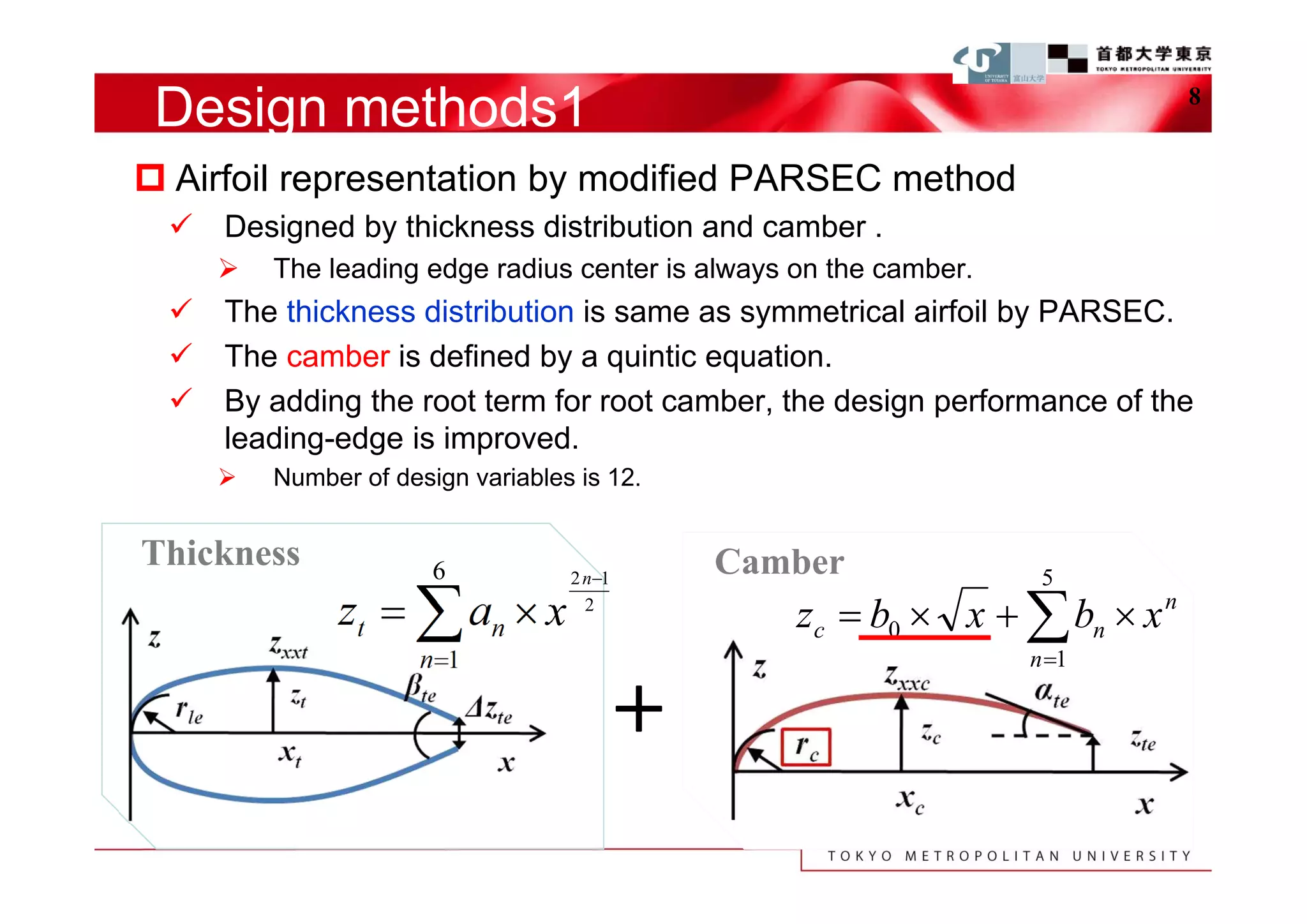
 Airfoil representation by modified PARSEC method
    Designed by thickness distribution and camber .
        The leading edge radius center is always on the camber.
    The thickness distribution is same as symmetrical airfoil by PARSEC.
    The camber is defined by a quintic equation.
    By adding the root term for root camber, the design performance of the
     leading-edge is improved.
        Number of design variables is 12.


Thickness              6                     Camber
                                   2 n1                            5
              z t   an  x         2
                                                  zc  b0  x   bn  x n
                      n 1                                         n 1

                                       +
Design method2                                                          9


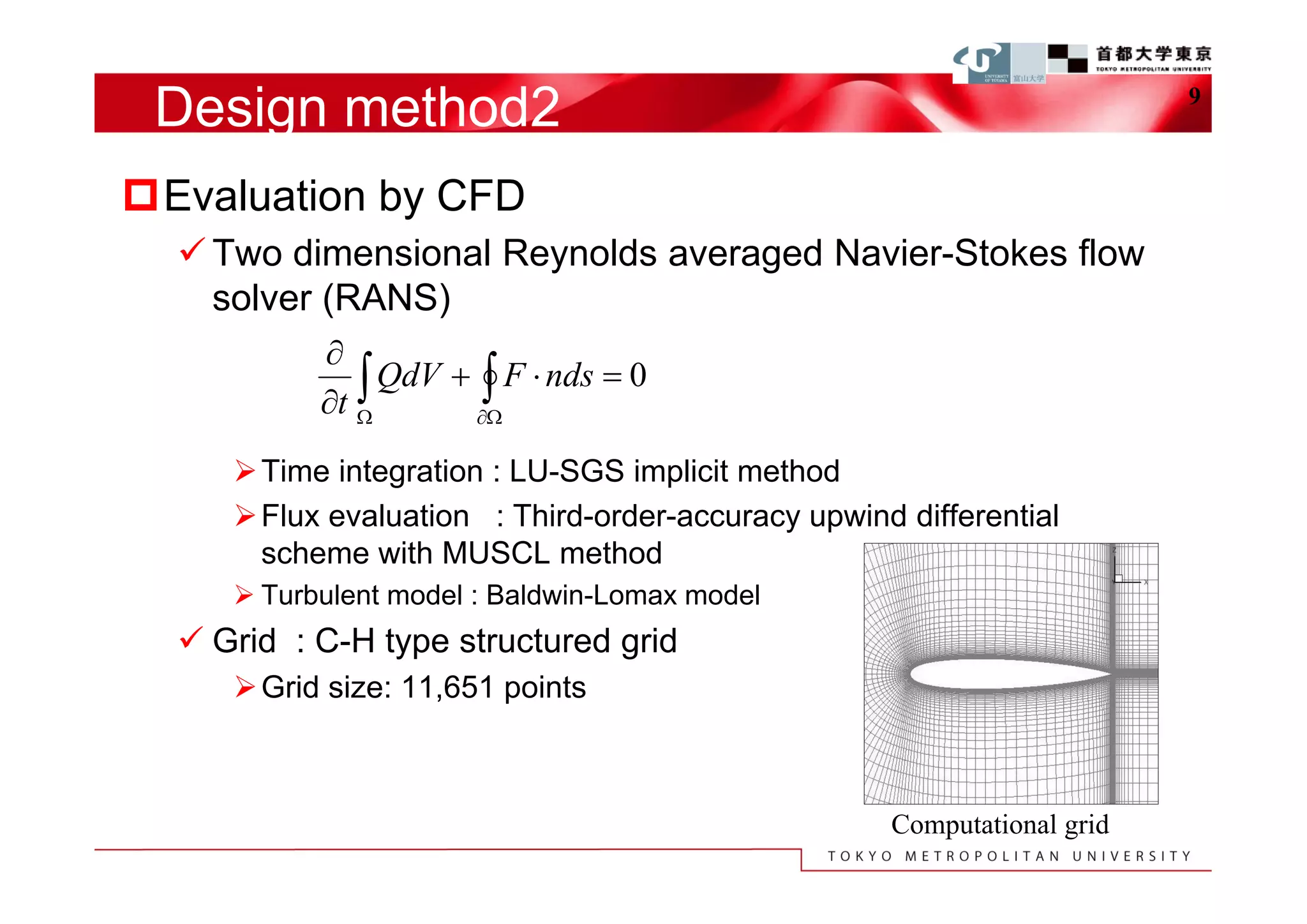
Evaluation by CFD
   Two dimensional Reynolds averaged Navier-Stokes flow
    solver (RANS)
           
               QdV  F  nds  0
           t 
      Time integration : LU-SGS implicit method
      Flux evaluation : Third-order-accuracy upwind differential
       scheme with MUSCL method
      Turbulent model : Baldwin-Lomax model
   Grid : C-H type structured grid
      Grid size: 11,651 points


                                                    Computational grid
Design method3                         10


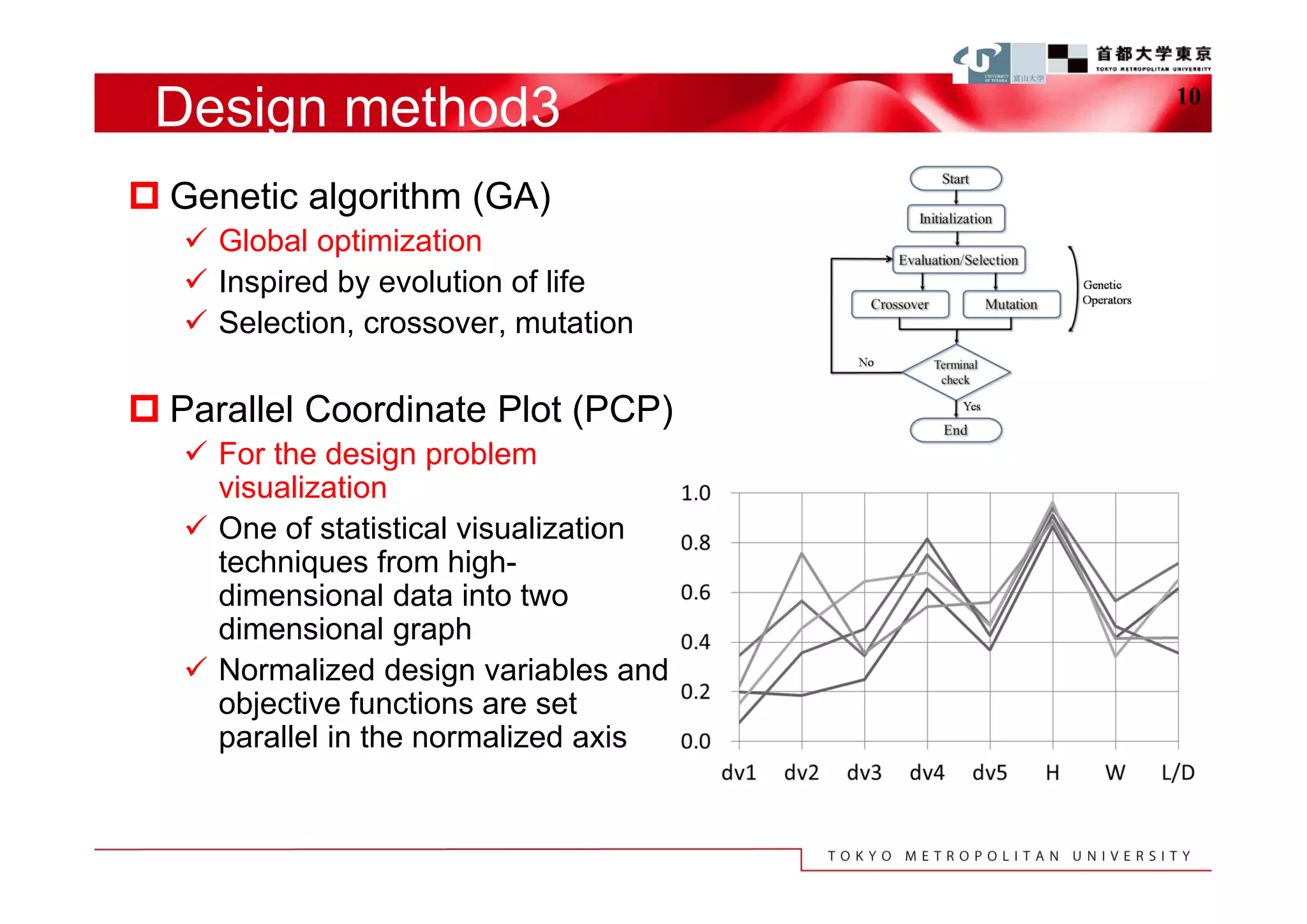
 Genetic algorithm (GA)
    Global optimization
    Inspired by evolution of life
    Selection, crossover, mutation

 Parallel Coordinate Plot (PCP)
    For the design problem
     visualization
    One of statistical visualization
     techniques from high-
     dimensional data into two
     dimensional graph
    Normalized design variables and
     objective functions are set
     parallel in the normalized axis
Formulation1
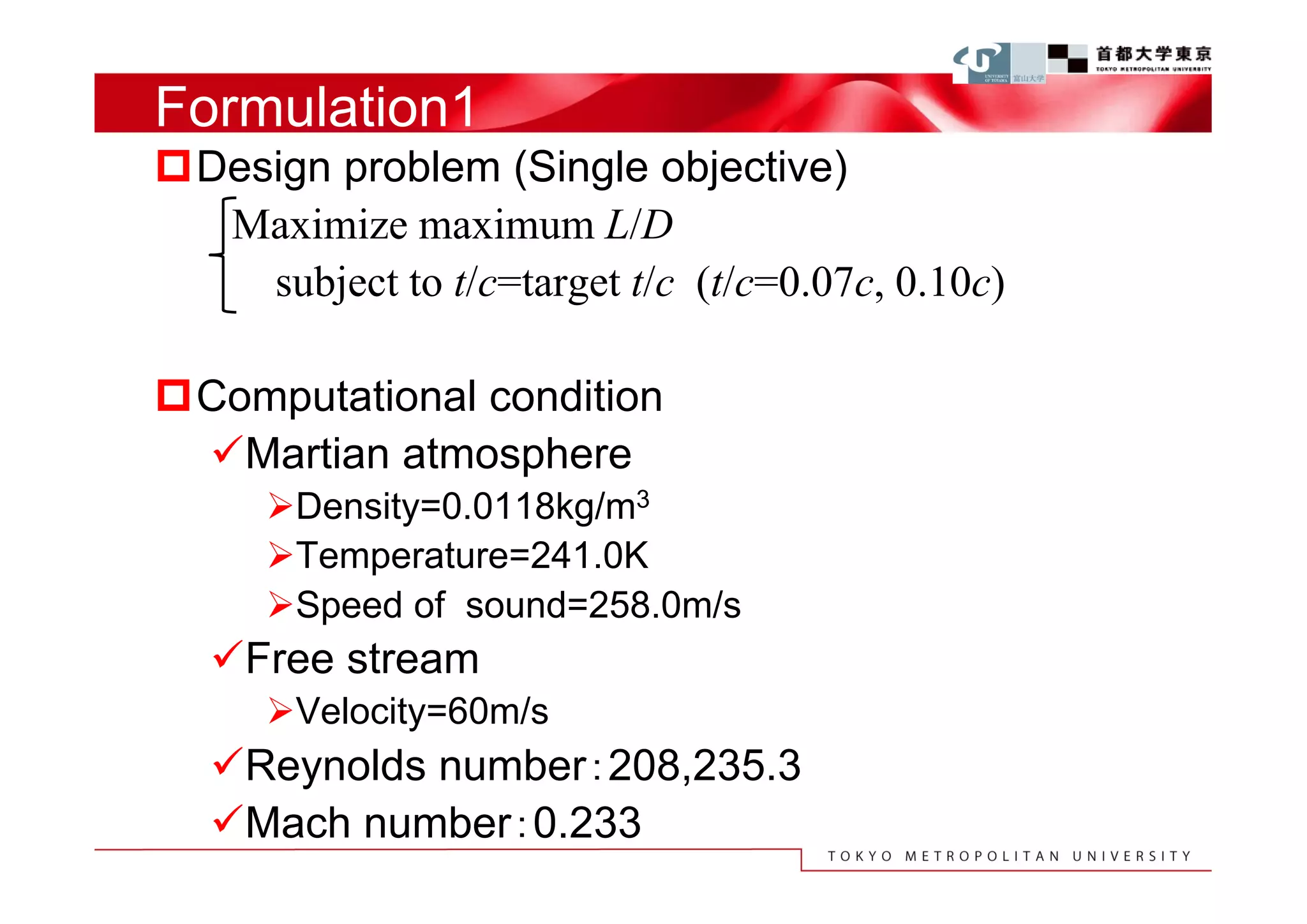
Design problem (Single objective)
  Maximize maximum L/D
    subject to t/c=target t/c (t/c=0.07c, 0.10c)

Computational condition
 Martian atmosphere
      Density=0.0118kg/m3
      Temperature=241.0K
      Speed of sound=258.0m/s
   Free stream
      Velocity=60m/s
   Reynolds number:208,235.3
   Mach number:0.233
Formulation2
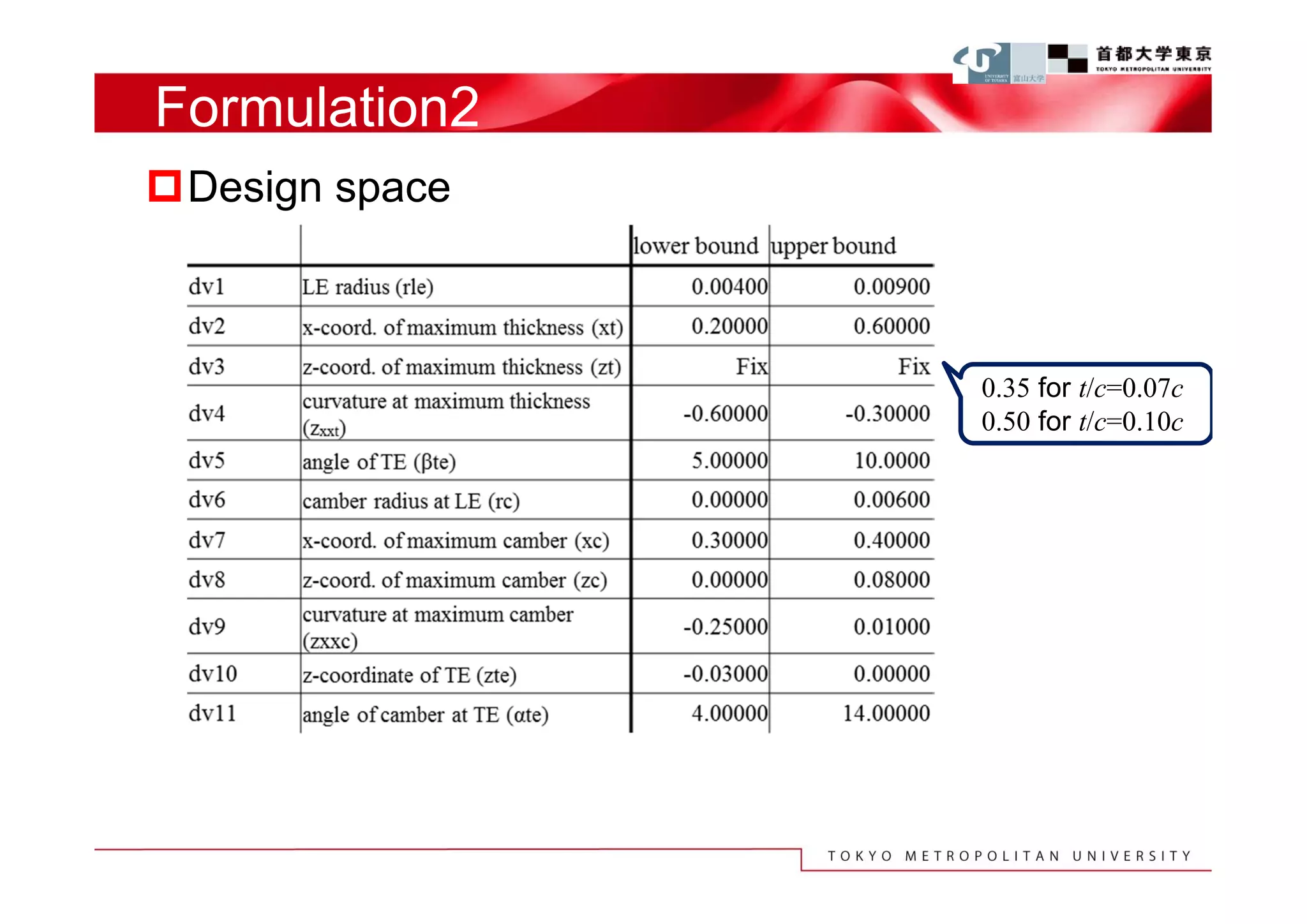
Design space


                0.35 for t/c=0.07c
                0.50 for t/c=0.10c
Result1                                                                      13


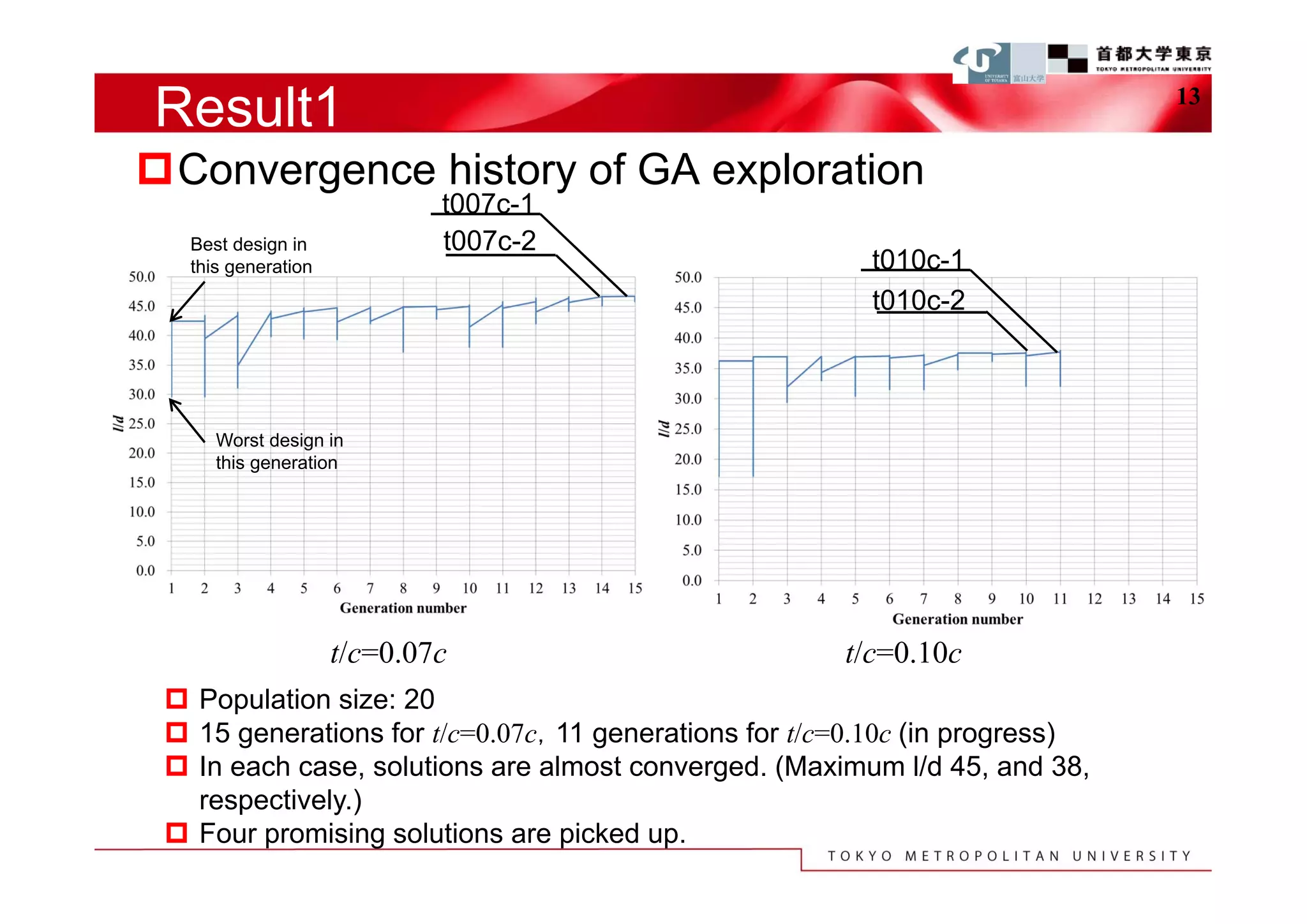
Convergence history of GA exploration
                             t007c-1
   Best design in            t007c-2
   this generation                                      t010c-1
                                                        t010c-2


      Worst design in
      this generation


                     t/c=0.07c                        t/c=0.10c
  Population size: 20
  15 generations for t/c=0.07c,11 generations for t/c=0.10c (in progress)
  In each case, solutions are almost converged. (Maximum l/d 45, and 38,
   respectively.)
  Four promising solutions are picked up.
Result2                                                           14


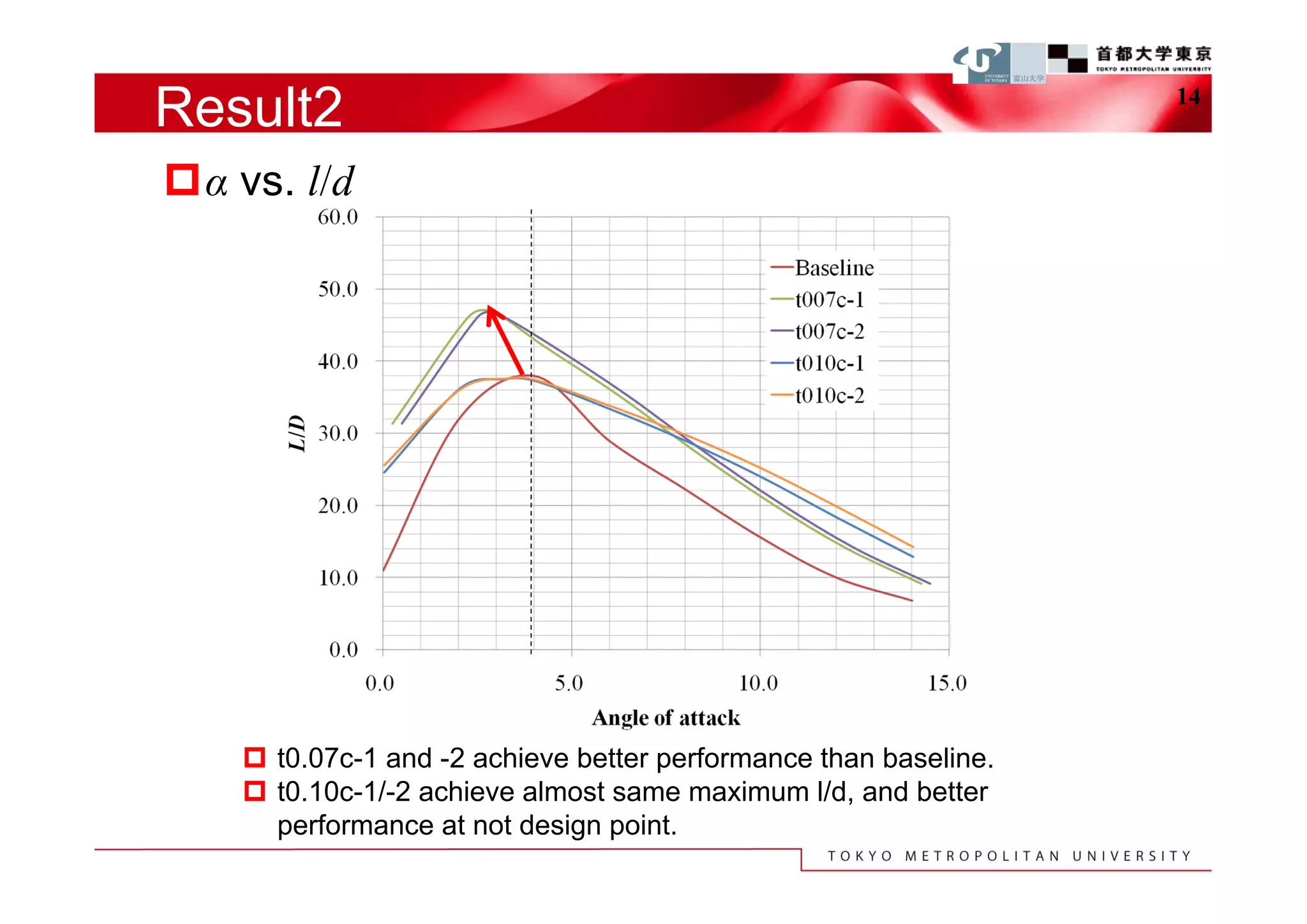
α vs. l/d


     t0.07c-1 and -2 achieve better performance than baseline.
     t0.10c-1/-2 achieve almost same maximum l/d, and better
      performance at not design point.
Result3                                                         15


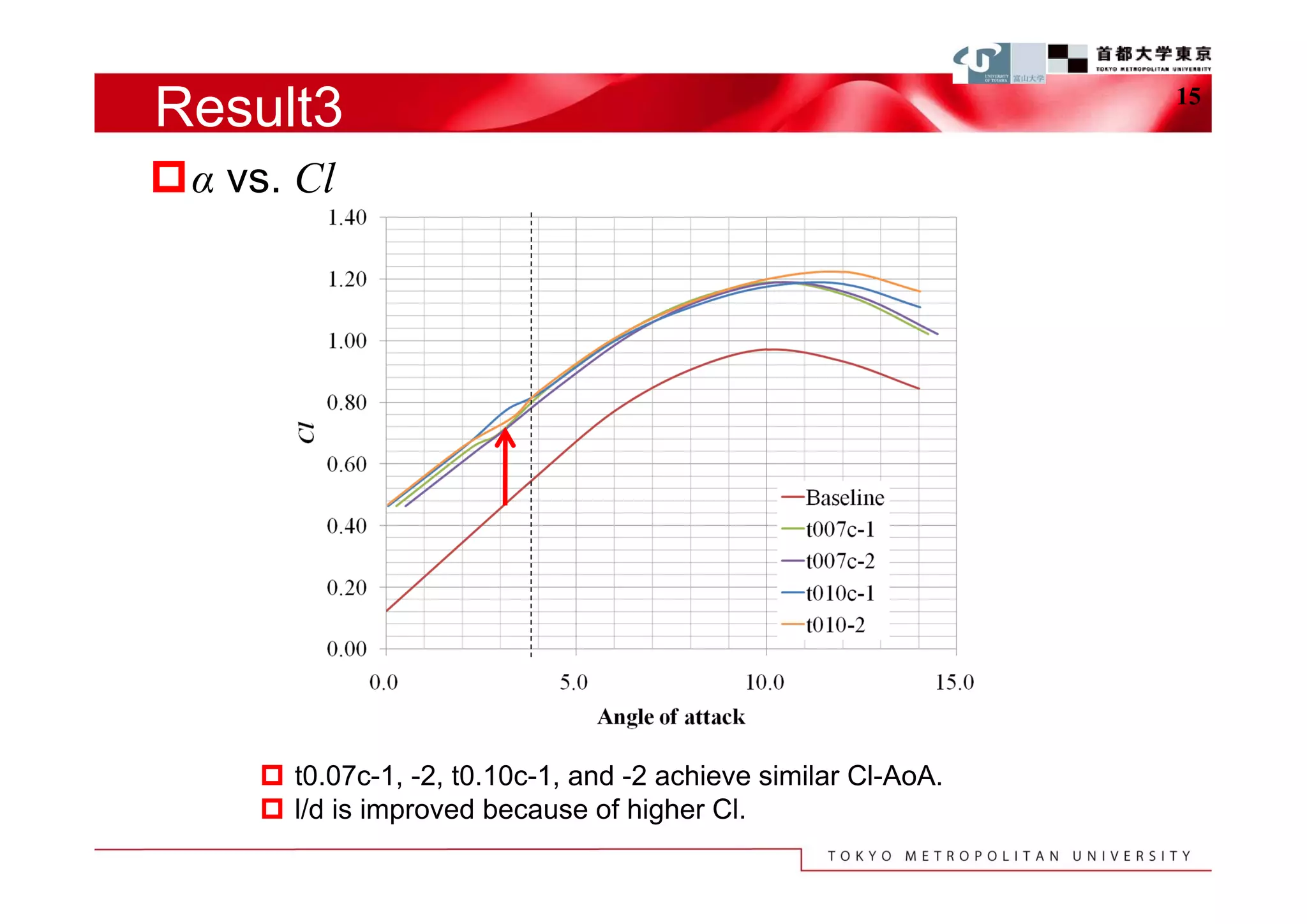
α vs. Cl


      t0.07c-1, -2, t0.10c-1, and -2 achieve similar Cl-AoA.
      l/d is improved because of higher Cl.
Result4                                                                  16


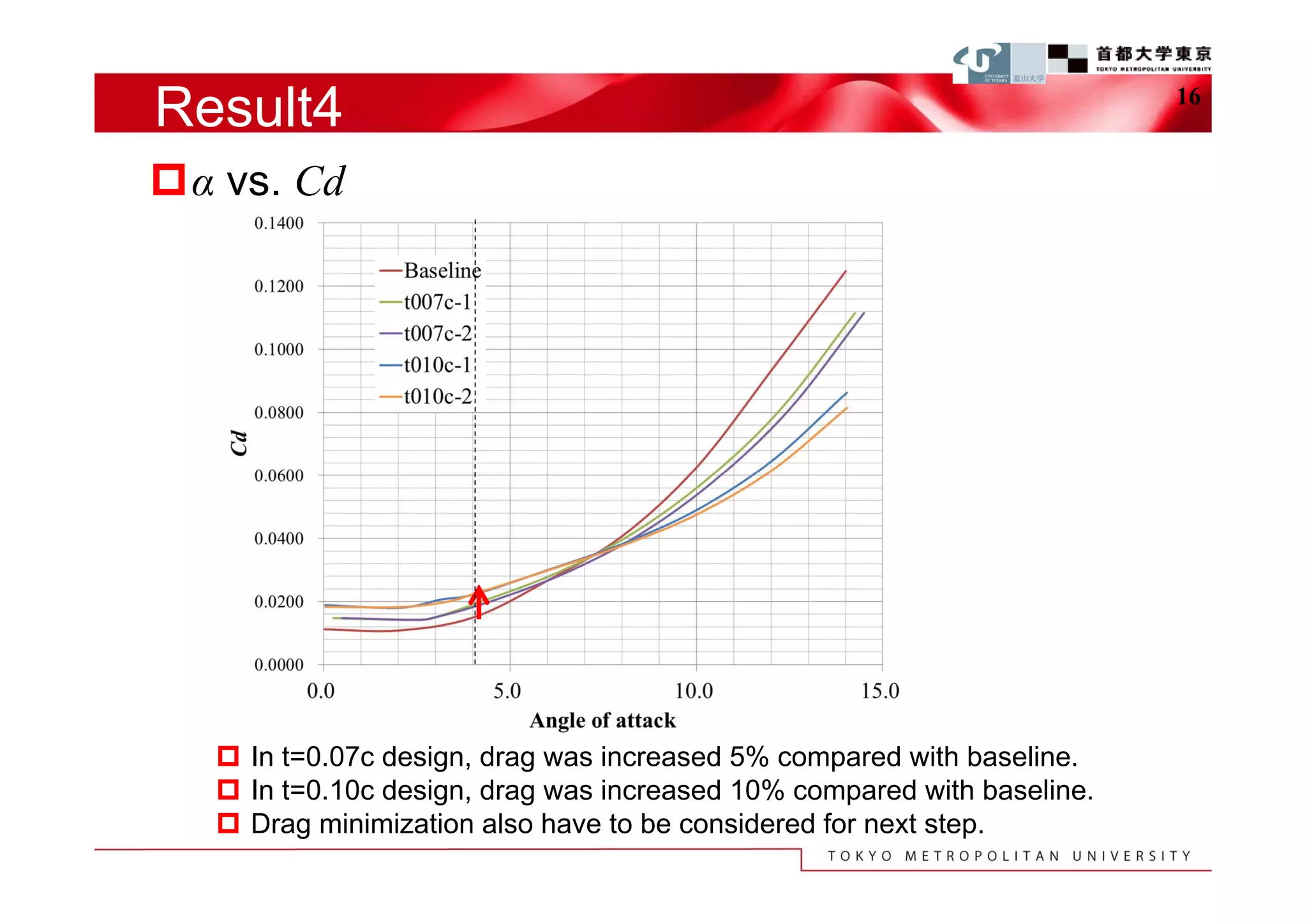
α vs. Cd


    In t=0.07c design, drag was increased 5% compared with baseline.
    In t=0.10c design, drag was increased 10% compared with baseline.
    Drag minimization also have to be considered for next step.
Result5                                                                   17


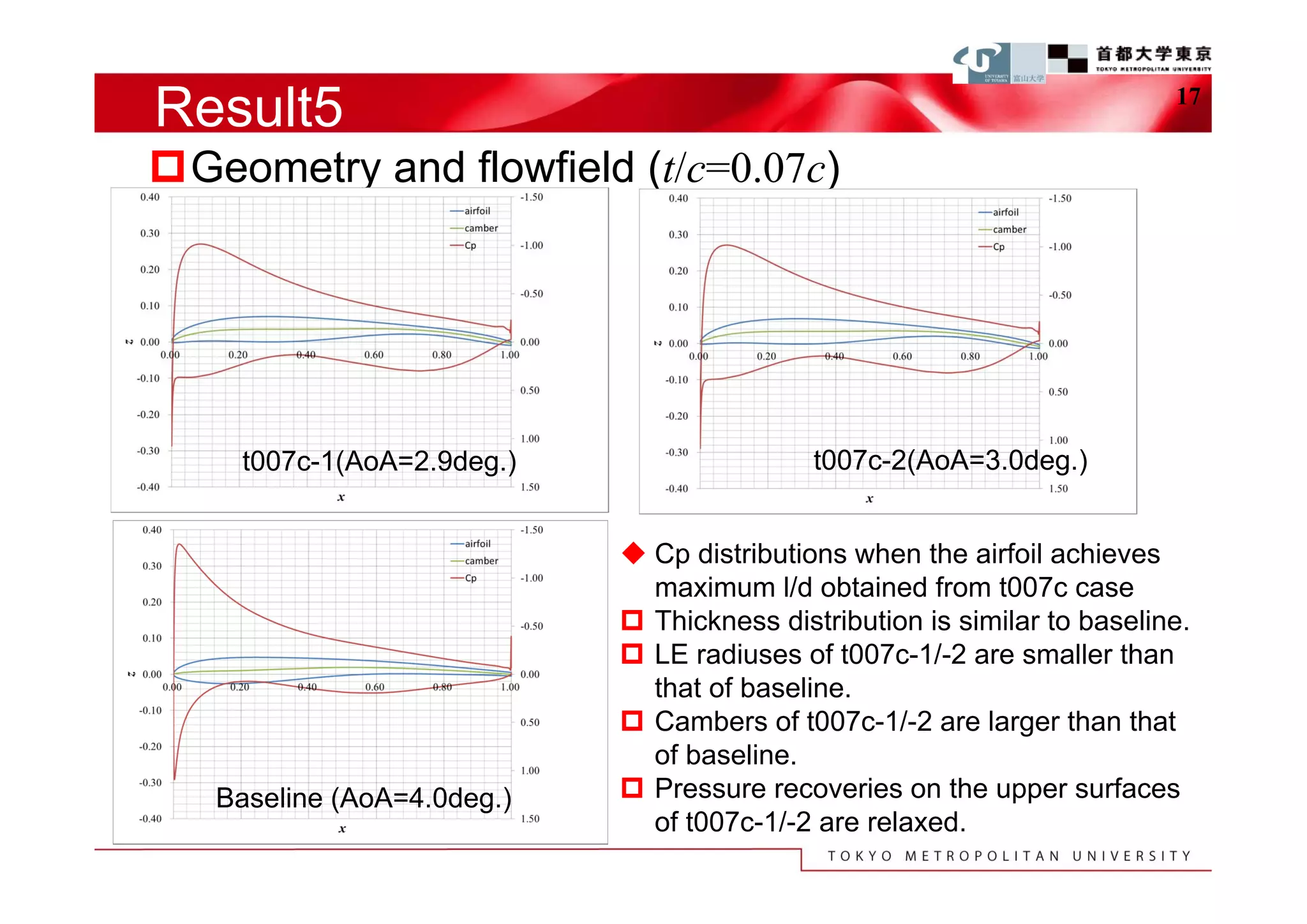
Geometry and flowfield (t/c=0.07c)


    t007c-1(AoA=2.9deg.)                    t007c-2(AoA=3.0deg.)


                             Cp distributions when the airfoil achieves
                              maximum l/d obtained from t007c case
                             Thickness distribution is similar to baseline.
                             LE radiuses of t007c-1/-2 are smaller than
                              that of baseline.
                             Cambers of t007c-1/-2 are larger than that
                              of baseline.
   Baseline (AoA=4.0deg.)    Pressure recoveries on the upper surfaces
                              of t007c-1/-2 are relaxed.
Result6                                                                18


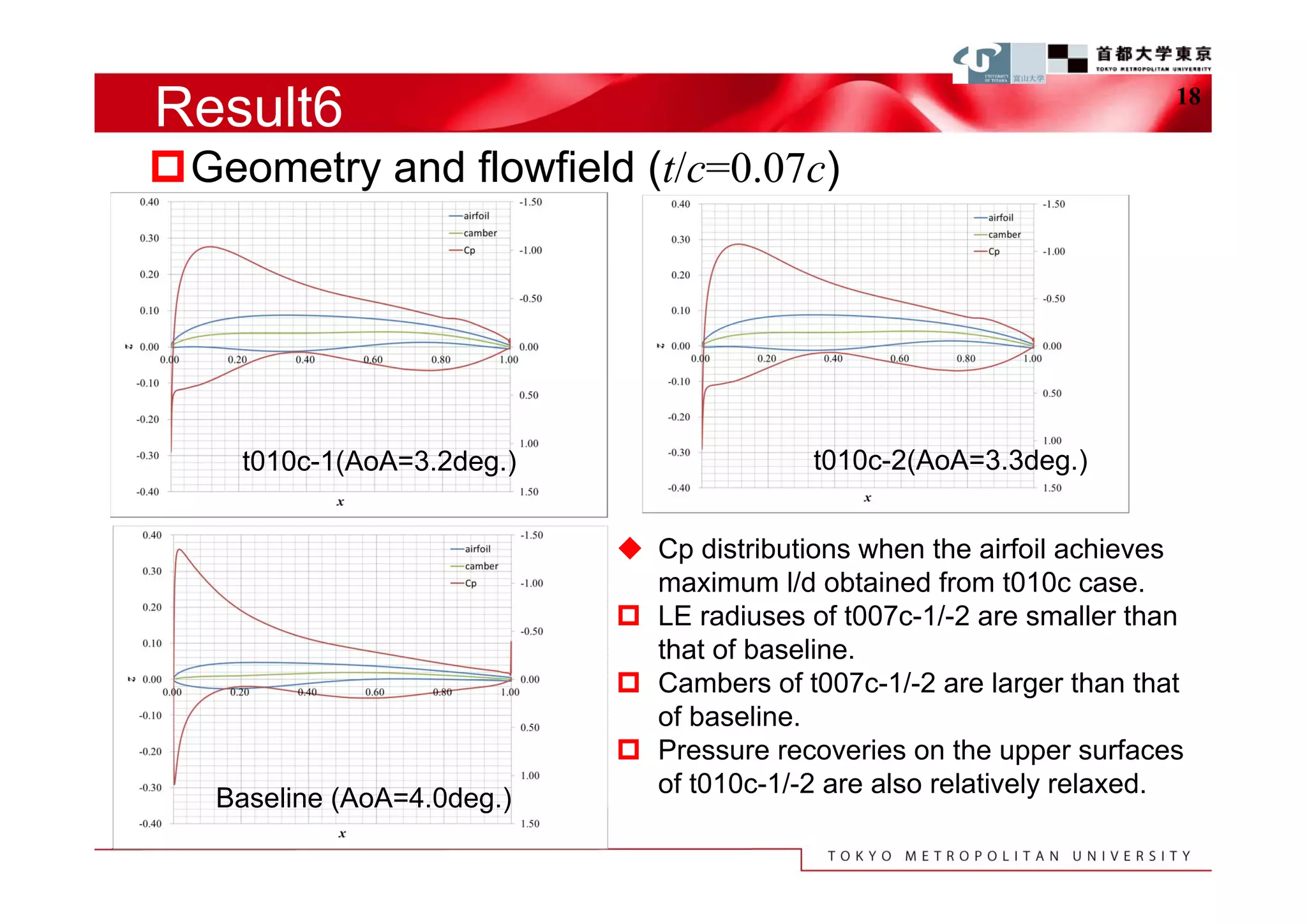
Geometry and flowfield (t/c=0.07c)


    t010c-1(AoA=3.2deg.)                   t010c-2(AoA=3.3deg.)


                             Cp distributions when the airfoil achieves
                              maximum l/d obtained from t010c case.
                             LE radiuses of t007c-1/-2 are smaller than
                              that of baseline.
                             Cambers of t007c-1/-2 are larger than that
                              of baseline.
                             Pressure recoveries on the upper surfaces
                              of t010c-1/-2 are also relatively relaxed.
   Baseline (AoA=4.0deg.)
Result7
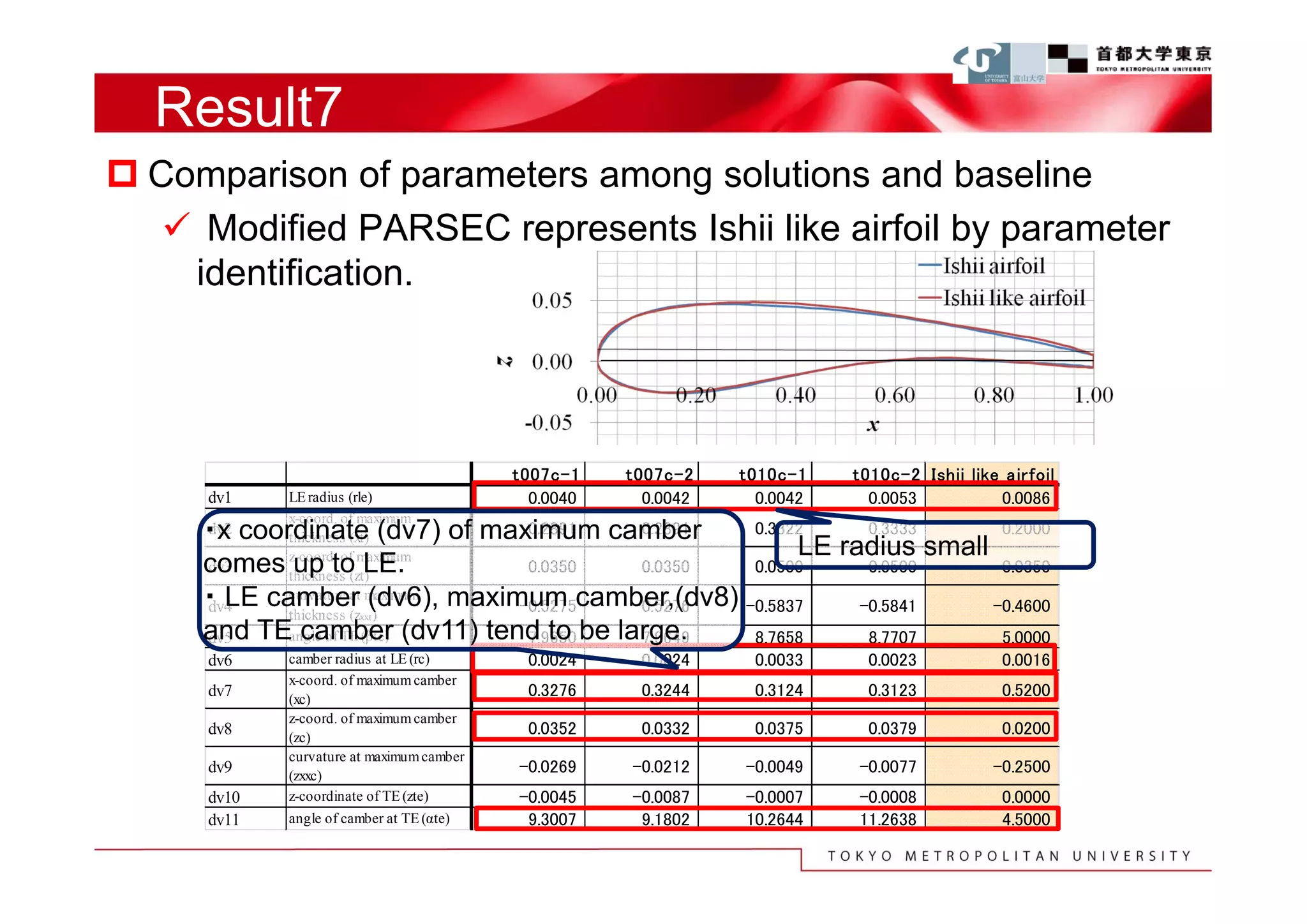
 Comparison of parameters among solutions and baseline
    Modified PARSEC represents Ishii like airfoil by parameter
    identification.


                                           t007c-1    t007c-2    t010c-1    t010c-2 Ishii like airfoil
      dv1    LE radius (rle)                 0.0040     0.0042     0.0042     0.0053          0.0086
             x-coord. of maximum
     ・x coordinate (dv7) of maximum camber
     dv2     thickness (xt)
                               0.2891   0.2891 0.3322     0.3333     0.2000
                                                    LE radius small
     comes up to LE.
     dv3
             z-coord. of maximum
             thickness (zt)
                               0.0350   0.0350 0.0500     0.0500     0.0350
     ・ LE camber (dv6), maximum camber,(dv8) -0.5837
     dv4
             curvature at maximum
             thickness (zxxt )
                              -0.5275  -0.5276           -0.5841    -0.4600
     and TE camber (dv11) tend to be large.
     dv5     angle of TE (βte) 7.9650   7.9649 8.7658     8.7707     5.0000
      dv6    camber radius at LE (rc)       0.0024     0.0024     0.0033      0.0023           0.0016
             x-coord. of maximum camber
      dv7    (xc)
                                            0.3276     0.3244     0.3124      0.3123           0.5200
             z-coord. of maximum camber
      dv8    (zc)
                                            0.0352     0.0332     0.0375      0.0379           0.0200
             curvature at maximum camber
      dv9    (zxxc)
                                           -0.0269    -0.0212    -0.0049    -0.0077           -0.2500
      dv10   z-coordinate of TE (zte)      -0.0045    -0.0087    -0.0007    -0.0008            0.0000
      dv11   angle of camber at TE (αte)    9.3007     9.1802    10.2644    11.2638            4.5000
Result8                                                         20


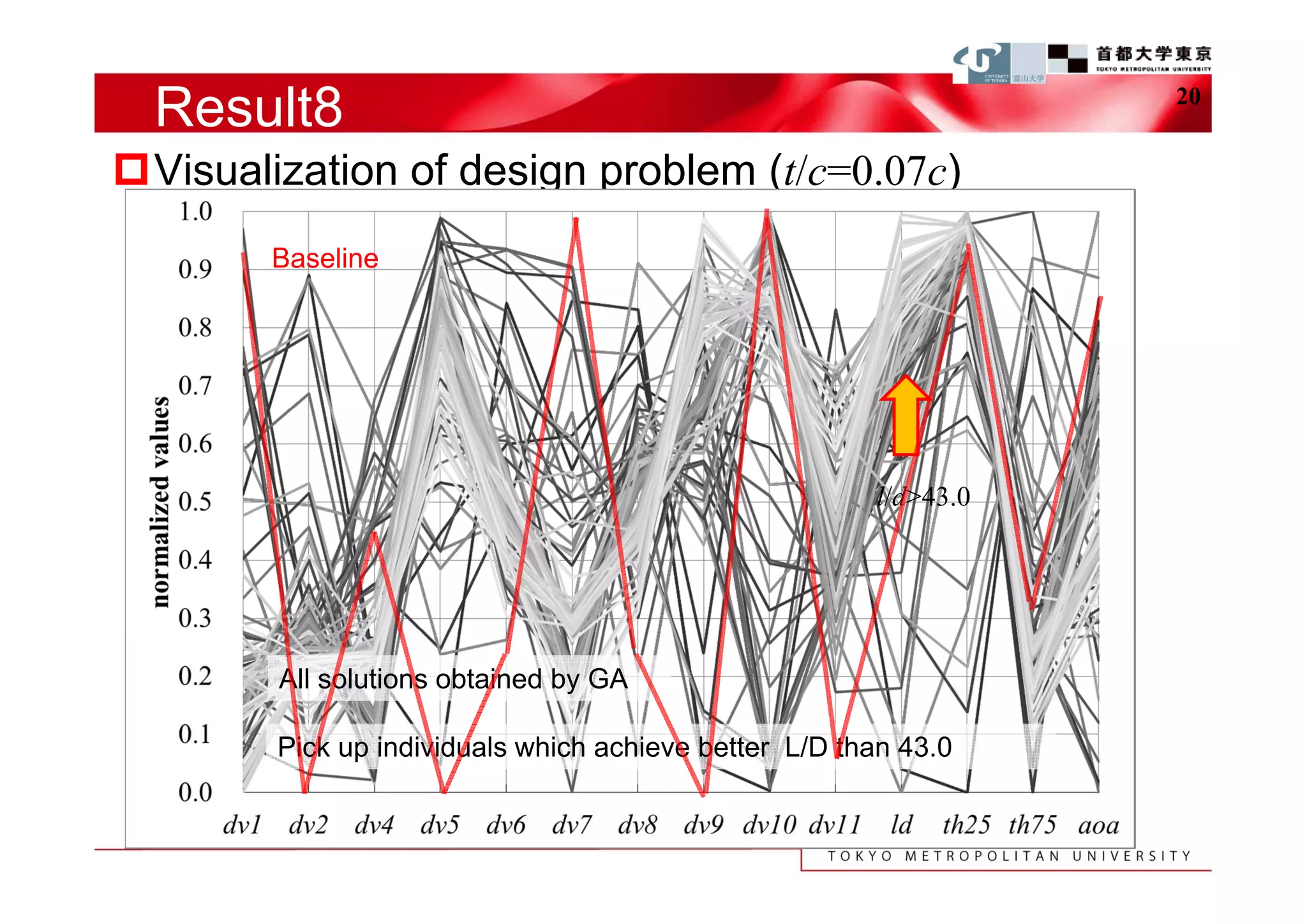
Visualization of design problem (t/c=0.07c)
        Baseline


                                                       l/d>43.0


        All solutions obtained by GA

        Pick up individuals which achieve better L/D than 43.0
Result8                                                  21


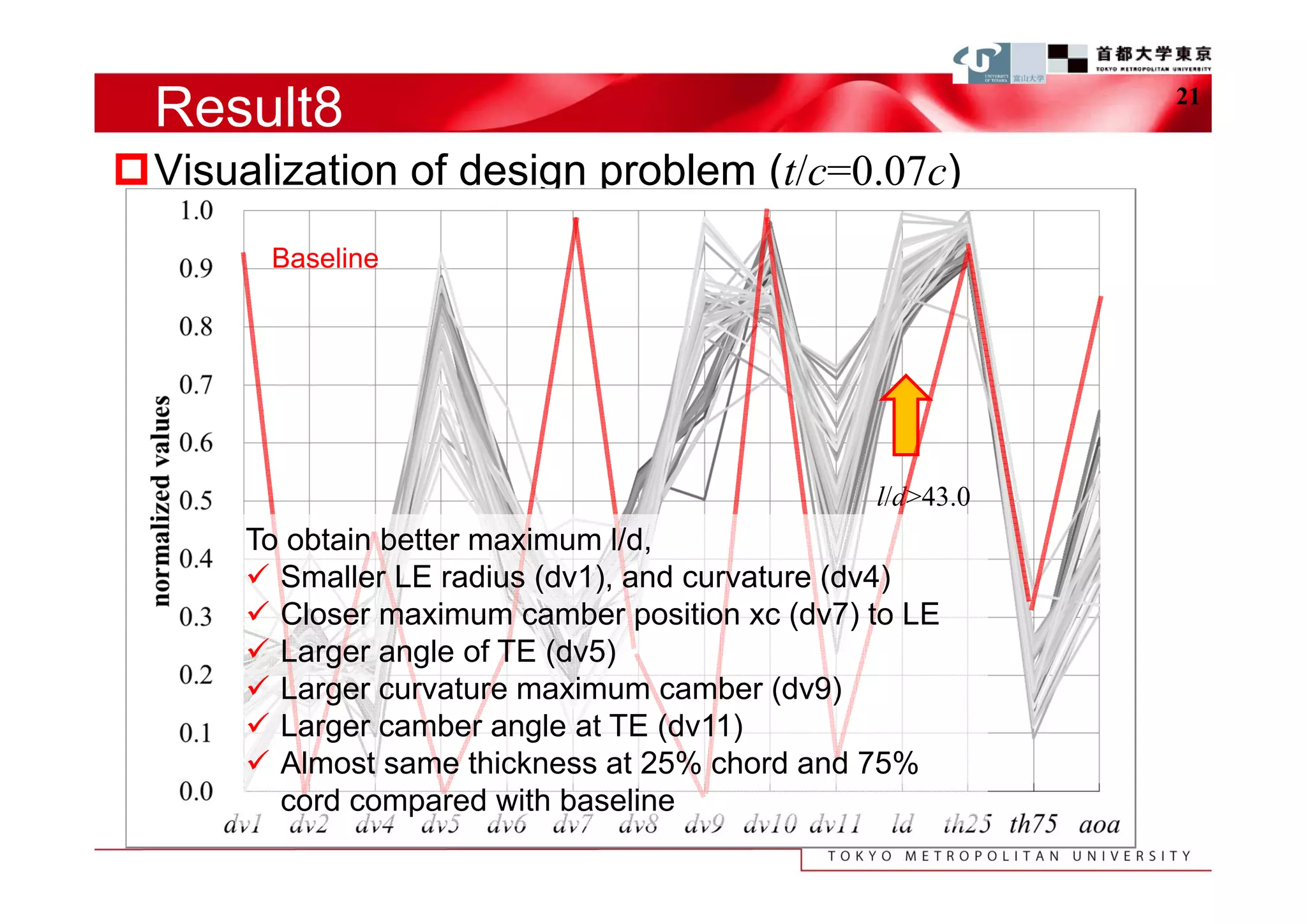
Visualization of design problem (t/c=0.07c)
        Baseline


                                                l/d>43.0
      To obtain better maximum l/d,
       Smaller LE radius (dv1), and curvature (dv4)
       Closer maximum camber position xc (dv7) to LE
       Larger angle of TE (dv5)
       Larger curvature maximum camber (dv9)
       Larger camber angle at TE (dv11)
       Almost same thickness at 25% chord and 75%
        cord compared with baseline
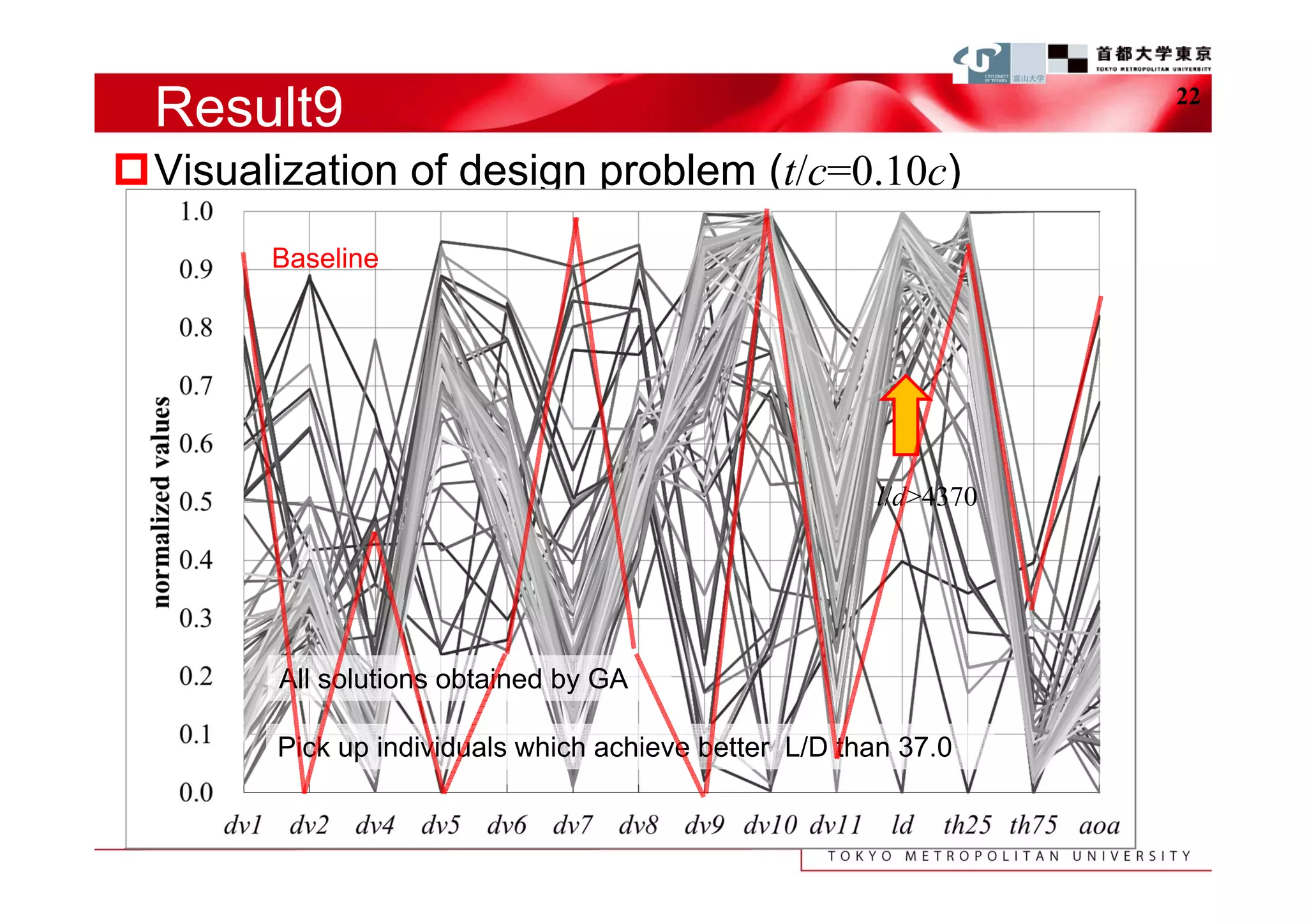
Result9                                                         22


Visualization of design problem (t/c=0.10c)
        Baseline


                                                       l/d>4370


        All solutions obtained by GA

        Pick up individuals which achieve better L/D than 37.0
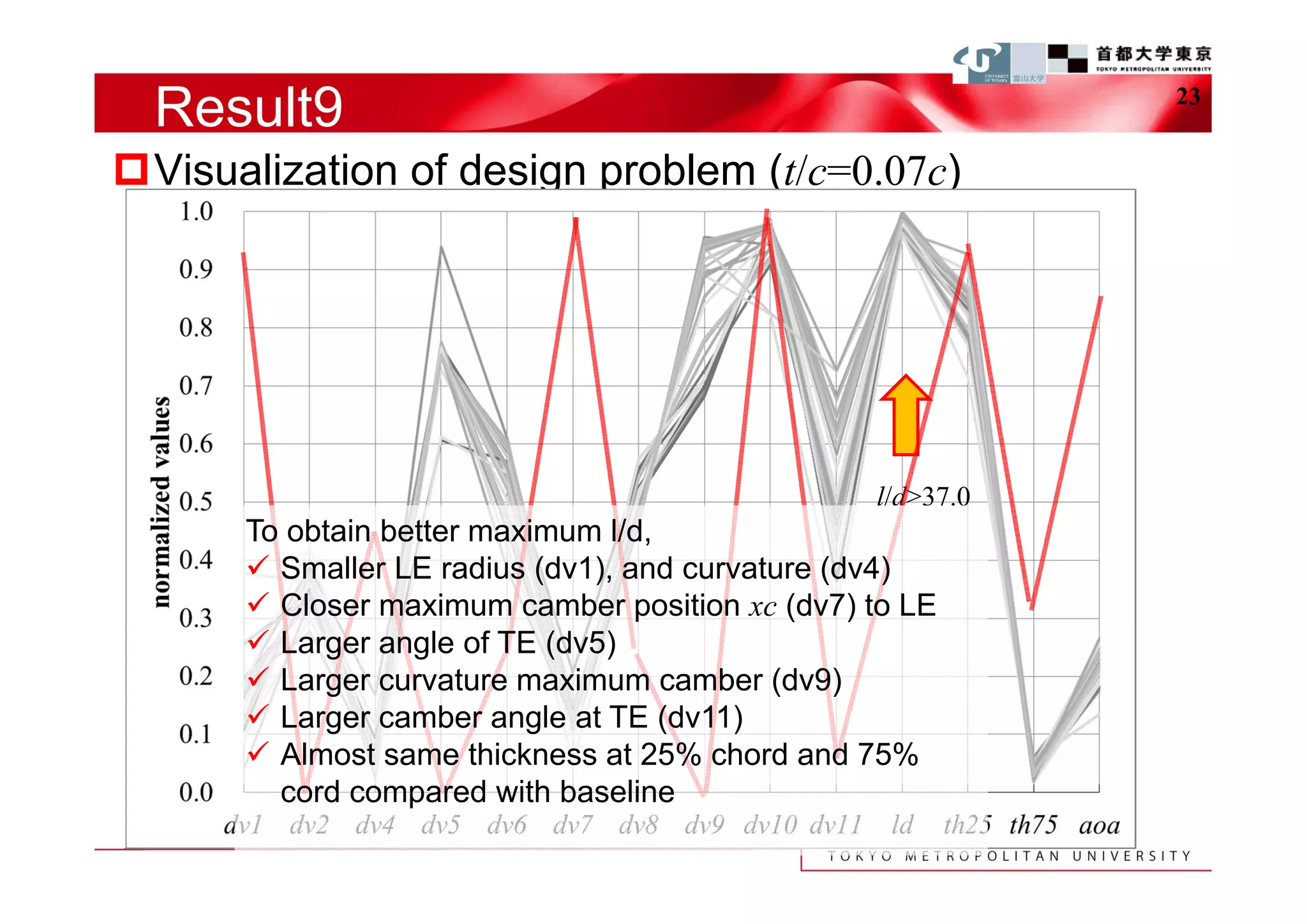
Result9                                                  23


Visualization of design problem (t/c=0.07c)


                                                l/d>37.0
      To obtain better maximum l/d,
       Smaller LE radius (dv1), and curvature (dv4)
       Closer maximum camber position xc (dv7) to LE
       Larger angle of TE (dv5)
       Larger curvature maximum camber (dv9)
       Larger camber angle at TE (dv11)
       Almost same thickness at 25% chord and 75%
        cord compared with baseline
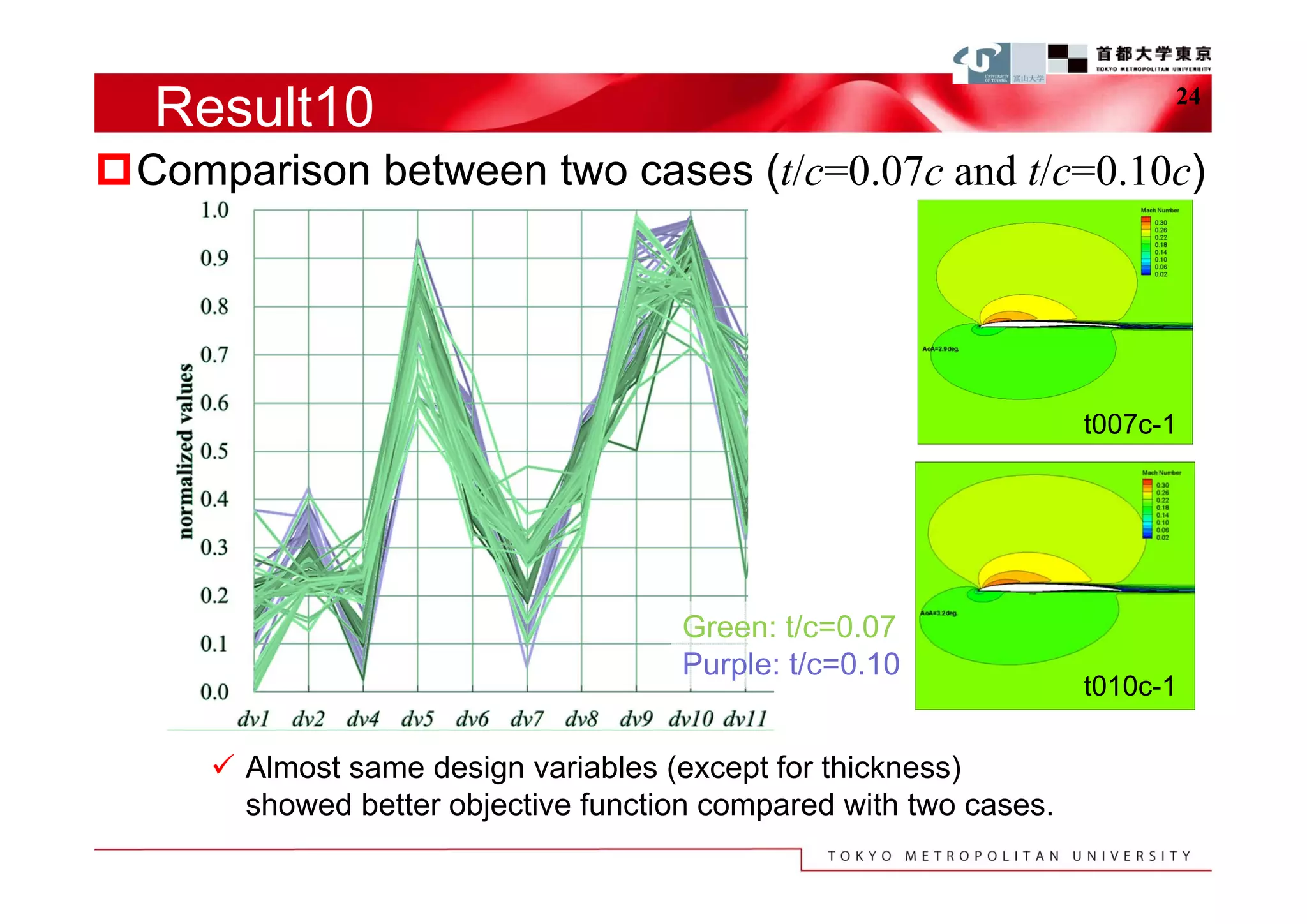
Result10                                                               24


Comparison between two cases (t/c=0.07c and t/c=0.10c)


                                                                   t007c-1


                                     Green: t/c=0.07
                                     Purple: t/c=0.10
                                                                   t010c-1

      Almost same design variables (except for thickness)
       showed better objective function compared with two cases.
Conclusions                                                                     25


 Design exploration of airfoil for Mars-airplane
    Design optimization using CFD and GA
    Selections of promising designs and investigations of their
     performances
        Improvement of maximum l/d in t/c=7% case
        Acquirements of airfoils which achieves relaxed pressure recovery on
         the upper surface
        Higher Cl, but higher Cd than baseline
    Knowledge discovery by means of ANOVA and SPM to obtain better
     maximum l/d
        Smaller LE radius, and uppersurface curvature
        Closer maximum camber position xc to LE
        Larger angle of TE
        Larger curvature maximum camber
        Larger camber angle at TE
   Further study: Consideration of Cd minimization
Acknowledgement                                     26


We thank members of the Mars-airplane working
 group in ISAS/JAXA for giving their experimental
 data and their valuable advices.


 Thank you very much for your kind attention.

Airfoil Design for Mars Aircraft Using Modified PARSEC Geometry Representation

  • 1.
    Airfoil Design forMars Aircraft Using Modified PARSEC Geometry Representation Masahiro Kanazaki Tokyo Metropolitan University Tomoyoshi Yotsuya Tokyo Metropolitan University Kisa Matsushima University of Toyama
  • 2.
    Contents 2  Background  Objectives  Design methods  Airfoil representation by modified PARSEC method  Evaluation by computational fluid dynamics (CFD)  Design optimization by genetic algorithm (GA)  Knowledge discovery by scatter plot matrix (SPM)  Formulation  Results  Maximization result of maximum lift to drag ratio (t/c=0.07c, 0.10c)  Visualization result by Parallel Coordinate Plot (PCP)  Conclusions
  • 3.
    Background1 3 Image of MELOS  ”Mars airplane” is proposed as a part of the MELOS.  Technical challenges  Propulsion  Aerodynamic design  Structure ・What kind of airfoil/wing geometry achieves higher performance? ・Ishii airfoil is one of the promising design.
  • 4.
    Background2 4 Difficulty of flight in the Martian atmosphere gravity density Viscosity Sonic speed atmospheric [m/s2] [kg/m3] [10-5Pa・s] [m/s] constituent The Earth 9.8 1.17 1.86 345 N2,O2 The Mars 3.2 0.0118 1.36 258 CO2  1/3 gravity of the earth → Required lift is 1/3.  1% density of the earth → Lift is required to be hundredfold increased. ⇒ Lift of the Mars-airplane have to be about 33rd times lift as much as that of the Earth-airplane. 3/4 speed of sound → Compressibility should be considered even for relative slow flight.  Knowledge has to be acquired for unknown design problem.  Efficient design method is required for Mars-airplane design.
  • 5.
    Background3 5 Airfoil representations for unknown design problem  B-spline curve, NURBS  Good for use in CAD software  Not good for use with data mining  PARSEC(PARametric SECtion) method*  Parameterization geometrical character based on knowledge of transonic flow  Separately definition upper surface and lower surface  Easy to introduce automated design method such as genetic algorithm  Aerodynamic performances can be explained based on design variables.  A few geometrical parameters around the leading-edge *Sobieczky, H., “Parametric Airfoils and Wings,” Notes on Numerical Fluid Mechanics, pp. 71-88, Vieweg 1998.
  • 6.
    Background4 6 Modification of PARSEC representation**  Separately defined thickness distribution and camber  This definition is in theory of wing section  Successful representation of supersonic airfoil  Maintain the beneficial feature of original PARSEC  A few numbers of design variables  Aerodynamic performances can be explained by design variables. ** K. Matsushima, Application of PARSEC Geometry Representation to High-Fidelity Aircraft Design by CFD, proceedings of 5th WCCM/ ECCOMAS2008, Venice, CAS1.8-4 (MS106), 2008.
  • 7.
    Objectives 7 Design exploration of airfoil for Mars-airplane using modified PARSEC airfoil representation Design exploration using CFD and GA Selection of promising designs and comparisons of their performances with baseline (Ishii airfoil) Knowledge discovery by means of PCP
  • 8.
    Design methods1 8  Airfoil representation by modified PARSEC method  Designed by thickness distribution and camber .  The leading edge radius center is always on the camber.  The thickness distribution is same as symmetrical airfoil by PARSEC.  The camber is defined by a quintic equation.  By adding the root term for root camber, the design performance of the leading-edge is improved.  Number of design variables is 12. Thickness 6 Camber 2 n1 5 z t   an  x 2 zc  b0  x   bn  x n n 1 n 1 +
  • 9.
    Design method2 9 Evaluation by CFD  Two dimensional Reynolds averaged Navier-Stokes flow solver (RANS)   QdV  F  nds  0 t   Time integration : LU-SGS implicit method  Flux evaluation : Third-order-accuracy upwind differential scheme with MUSCL method  Turbulent model : Baldwin-Lomax model  Grid : C-H type structured grid  Grid size: 11,651 points Computational grid
  • 10.
    Design method3 10  Genetic algorithm (GA)  Global optimization  Inspired by evolution of life  Selection, crossover, mutation  Parallel Coordinate Plot (PCP)  For the design problem visualization  One of statistical visualization techniques from high- dimensional data into two dimensional graph  Normalized design variables and objective functions are set parallel in the normalized axis
  • 11.
    Formulation1 Design problem (Singleobjective) Maximize maximum L/D subject to t/c=target t/c (t/c=0.07c, 0.10c) Computational condition Martian atmosphere Density=0.0118kg/m3 Temperature=241.0K Speed of sound=258.0m/s Free stream Velocity=60m/s Reynolds number:208,235.3 Mach number:0.233
  • 12.
    Formulation2 Design space 0.35 for t/c=0.07c 0.50 for t/c=0.10c
  • 13.
    Result1 13 Convergence history of GA exploration t007c-1 Best design in t007c-2 this generation t010c-1 t010c-2 Worst design in this generation t/c=0.07c t/c=0.10c  Population size: 20  15 generations for t/c=0.07c,11 generations for t/c=0.10c (in progress)  In each case, solutions are almost converged. (Maximum l/d 45, and 38, respectively.)  Four promising solutions are picked up.
  • 14.
    Result2 14 α vs. l/d  t0.07c-1 and -2 achieve better performance than baseline.  t0.10c-1/-2 achieve almost same maximum l/d, and better performance at not design point.
  • 15.
    Result3 15 α vs. Cl  t0.07c-1, -2, t0.10c-1, and -2 achieve similar Cl-AoA.  l/d is improved because of higher Cl.
  • 16.
    Result4 16 α vs. Cd  In t=0.07c design, drag was increased 5% compared with baseline.  In t=0.10c design, drag was increased 10% compared with baseline.  Drag minimization also have to be considered for next step.
  • 17.
    Result5 17 Geometry and flowfield (t/c=0.07c) t007c-1(AoA=2.9deg.) t007c-2(AoA=3.0deg.)  Cp distributions when the airfoil achieves maximum l/d obtained from t007c case  Thickness distribution is similar to baseline.  LE radiuses of t007c-1/-2 are smaller than that of baseline.  Cambers of t007c-1/-2 are larger than that of baseline. Baseline (AoA=4.0deg.)  Pressure recoveries on the upper surfaces of t007c-1/-2 are relaxed.
  • 18.
    Result6 18 Geometry and flowfield (t/c=0.07c) t010c-1(AoA=3.2deg.) t010c-2(AoA=3.3deg.)  Cp distributions when the airfoil achieves maximum l/d obtained from t010c case.  LE radiuses of t007c-1/-2 are smaller than that of baseline.  Cambers of t007c-1/-2 are larger than that of baseline.  Pressure recoveries on the upper surfaces of t010c-1/-2 are also relatively relaxed. Baseline (AoA=4.0deg.)
  • 19.
    Result7  Comparison ofparameters among solutions and baseline  Modified PARSEC represents Ishii like airfoil by parameter identification. t007c-1 t007c-2 t010c-1 t010c-2 Ishii like airfoil dv1 LE radius (rle) 0.0040 0.0042 0.0042 0.0053 0.0086 x-coord. of maximum ・x coordinate (dv7) of maximum camber dv2 thickness (xt) 0.2891 0.2891 0.3322 0.3333 0.2000 LE radius small comes up to LE. dv3 z-coord. of maximum thickness (zt) 0.0350 0.0350 0.0500 0.0500 0.0350 ・ LE camber (dv6), maximum camber,(dv8) -0.5837 dv4 curvature at maximum thickness (zxxt ) -0.5275 -0.5276 -0.5841 -0.4600 and TE camber (dv11) tend to be large. dv5 angle of TE (βte) 7.9650 7.9649 8.7658 8.7707 5.0000 dv6 camber radius at LE (rc) 0.0024 0.0024 0.0033 0.0023 0.0016 x-coord. of maximum camber dv7 (xc) 0.3276 0.3244 0.3124 0.3123 0.5200 z-coord. of maximum camber dv8 (zc) 0.0352 0.0332 0.0375 0.0379 0.0200 curvature at maximum camber dv9 (zxxc) -0.0269 -0.0212 -0.0049 -0.0077 -0.2500 dv10 z-coordinate of TE (zte) -0.0045 -0.0087 -0.0007 -0.0008 0.0000 dv11 angle of camber at TE (αte) 9.3007 9.1802 10.2644 11.2638 4.5000
  • 20.
    Result8 20 Visualization of design problem (t/c=0.07c) Baseline l/d>43.0 All solutions obtained by GA Pick up individuals which achieve better L/D than 43.0
  • 21.
    Result8 21 Visualization of design problem (t/c=0.07c) Baseline l/d>43.0 To obtain better maximum l/d,  Smaller LE radius (dv1), and curvature (dv4)  Closer maximum camber position xc (dv7) to LE  Larger angle of TE (dv5)  Larger curvature maximum camber (dv9)  Larger camber angle at TE (dv11)  Almost same thickness at 25% chord and 75% cord compared with baseline
  • 22.
    Result9 22 Visualization of design problem (t/c=0.10c) Baseline l/d>4370 All solutions obtained by GA Pick up individuals which achieve better L/D than 37.0
  • 23.
    Result9 23 Visualization of design problem (t/c=0.07c) l/d>37.0 To obtain better maximum l/d,  Smaller LE radius (dv1), and curvature (dv4)  Closer maximum camber position xc (dv7) to LE  Larger angle of TE (dv5)  Larger curvature maximum camber (dv9)  Larger camber angle at TE (dv11)  Almost same thickness at 25% chord and 75% cord compared with baseline
  • 24.
    Result10 24 Comparison between two cases (t/c=0.07c and t/c=0.10c) t007c-1 Green: t/c=0.07 Purple: t/c=0.10 t010c-1  Almost same design variables (except for thickness) showed better objective function compared with two cases.
  • 25.
    Conclusions 25  Design exploration of airfoil for Mars-airplane  Design optimization using CFD and GA  Selections of promising designs and investigations of their performances  Improvement of maximum l/d in t/c=7% case  Acquirements of airfoils which achieves relaxed pressure recovery on the upper surface  Higher Cl, but higher Cd than baseline  Knowledge discovery by means of ANOVA and SPM to obtain better maximum l/d  Smaller LE radius, and uppersurface curvature  Closer maximum camber position xc to LE  Larger angle of TE  Larger curvature maximum camber  Larger camber angle at TE Further study: Consideration of Cd minimization
  • 26.
    Acknowledgement 26 We thank members of the Mars-airplane working group in ISAS/JAXA for giving their experimental data and their valuable advices. Thank you very much for your kind attention.