Masahiro Kanazaki
Tokyo Metropolitan University
Atthaphon Ariyarit
Tokyo Metropolitan University
Kazuhisa Chiba
Hokkaido Institute of Technology
Koki Kitagawa
Japan Aerospace Exploration Agency
Toru Shimada
Japan Aerospace Exploration Agency
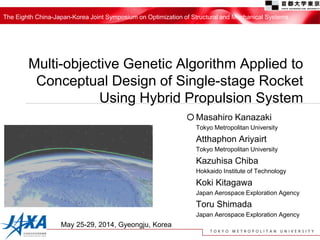
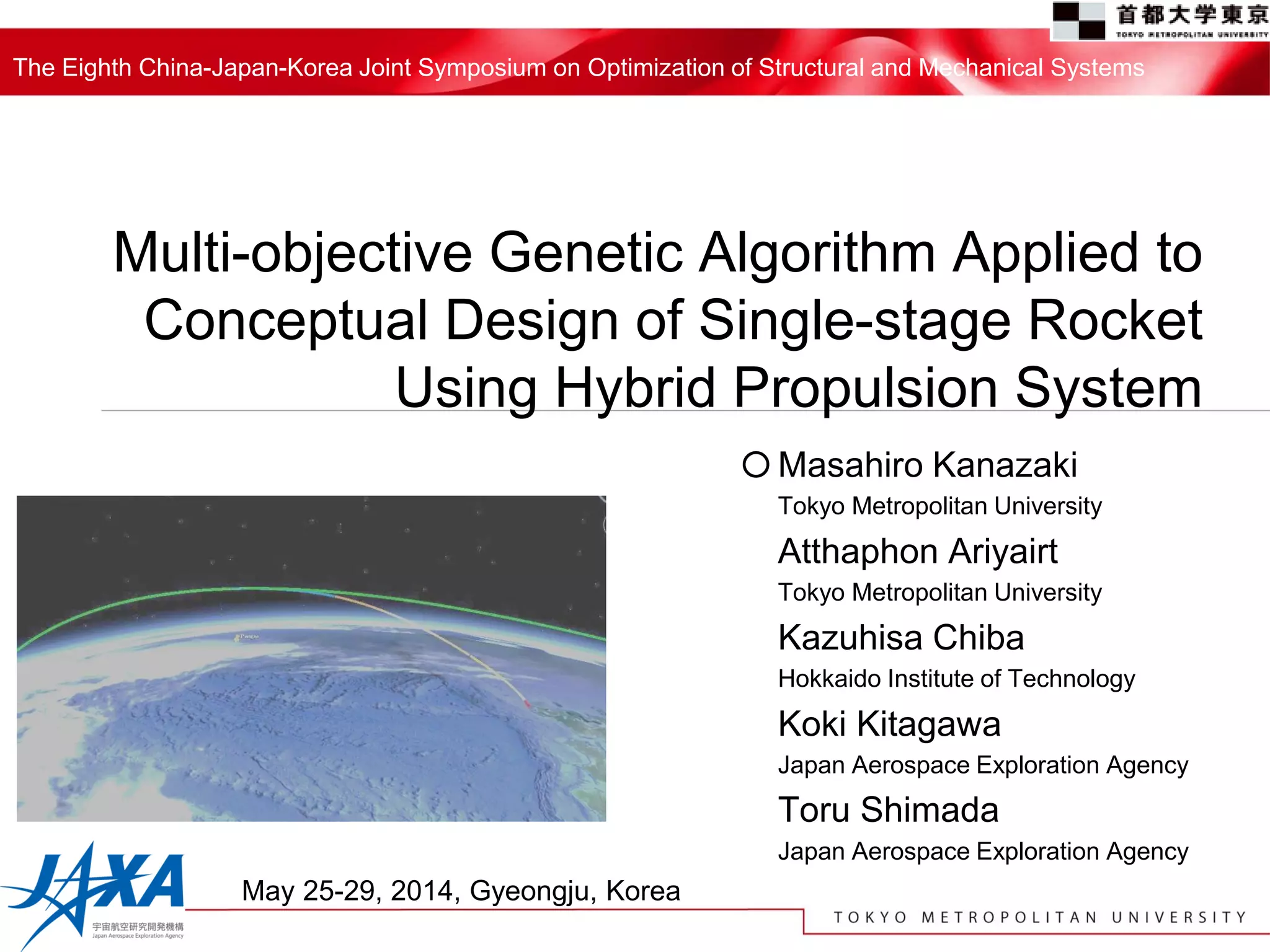
Multi-objective Genetic Algorithm Applied to
Conceptual Design of Single-stage Rocket
Using Hybrid Propulsion System
The Eighth China-Japan-Korea Joint Symposium on Optimization of Structural and Mechanical Systems
○
May 25-29, 2014, Gyeongju, Korea
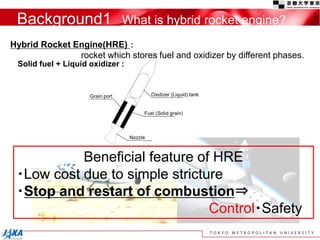
Background1 What is hybrid rocket engine?
2
Beneficial feature of HRE
・Low cost due to simple stricture
・Stop and restart of combustion⇒
Control・Safety
Hybrid Rocket Engine(HRE) :
rocket which stores fuel and oxidizer by different phases.
Solid fuel + Liquid oxidizer :
3
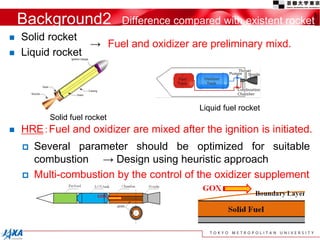
Background2 Difference compared with existent rocket
 Solid rocket
 Liquid rocket
 HRE:Fuel and oxidizer are mixed after the ignition is initiated.
→ Fuel and oxidizer are preliminary mixd.
 Several parameter should be optimized for suitable
combustion → Design using heuristic approach
 Multi-combustion by the control of the oxidizer supplement
Solid fuel rocket
Liquid fuel rocket
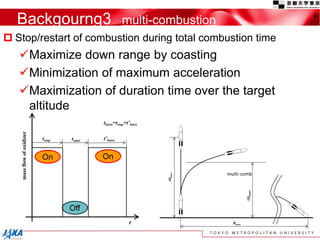
Backgourng3 multi-combustion
 Stop/restart of combustion during total combustion time
Maximize down range by coasting
Minimization of maximum acceleration
Maximization of duration time over the target
altitude
4
Off
On On
5
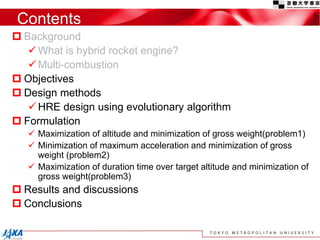
Contents
 Background
 What is hybrid rocket engine?
 Multi-combustion
 Objectives
 Design methods
 HRE design using evolutionary algorithm
 Formulation
 Maximization of altitude and minimization of gross weight(problem1)
 Minimization of maximum acceleration and minimization of gross
weight (problem2)
 Maximization of duration time over target altitude and minimization of
gross weight(problem3)
 Results and discussions
 Conclusions
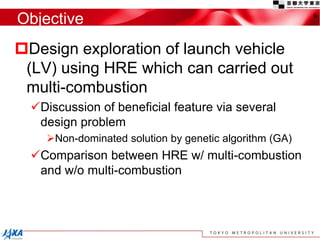
Objective
Design exploration of launch vehicle
(LV) using HRE which can carried out
multi-combustion
Discussion of beneficial feature via several
design problem
Non-dominated solution by genetic algorithm (GA)
Comparison between HRE w/ multi-combustion
and w/o multi-combustion
6
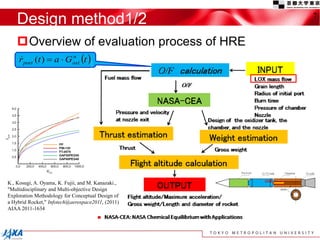
Design method1/2
Overview of evaluation process of HRE
7
 tGatr n
oxiport )(
K., Kosugi, A. Oyama, K. Fujii, and M. Kanazaki.,
"Multidisciplinary and Multi-objective Design
Exploration Methodology for Conceptual Design of
a Hybrid Rocket," Infotech@aerospace2011, (2011)
AIAA 2011-1634
Design method2/2
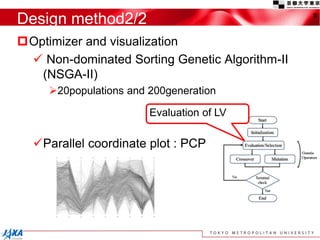
Optimizer and visualization
 Non-dominated Sorting Genetic Algorithm-II
(NSGA-II)
20populations and 200generation
Parallel coordinate plot : PCP
8
Evaluation of LV
Formulation1/3
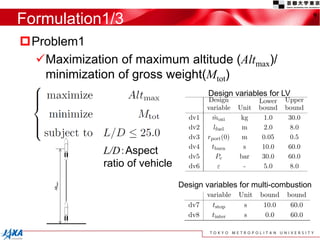
Problem1
Maximization of maximum altitude (Altmax)/
minimization of gross weight(Mtot)
9
Design variables for LV
Design variables for multi-combustion
L/D:Aspect
ratio of vehicle
Formulation2/3
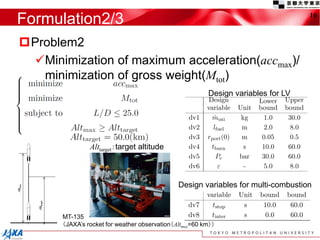
Problem2
Minimization of maximum acceleration(accmax)/
minimization of gross weight(Mtot)
10
MT-135
(JAXA’s rocket for weather observation(Altmax=60 km))
Alttarget:target altitude
Design variables for LV
Design variables for multi-combustion
Formulation3/3
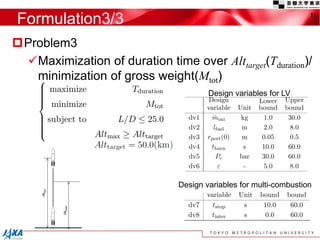
Problem3
Maximization of duration time over Alttarget(Tduration)/
minimization of gross weight(Mtot)
11
Design variables for LV
Design variables for multi-combustion
Result1/8 12
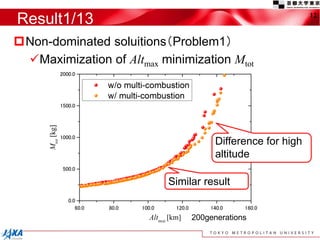
Non-dominated soluitions(Problem1)
Maximization of Altmax minimization Mtot
Similar result
Difference for high
altitude
50generations100generations150generations200generations
Result2/8
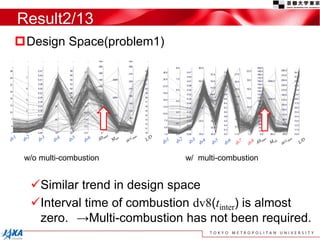
Design Space(problem1)
Similar trend in design space
Interval time of combustion dv8(tinter) is almost
zero. →Multi-combustion has not been required.
w/o multi-combustion w/ multi-combustion
Result3/8
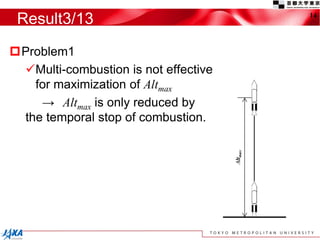
Problem1
Multi-combustion is not effective
for maximization of Altmax
→ Altmax is only reduced by
the temporal stop of combustion.
14
Result4/8
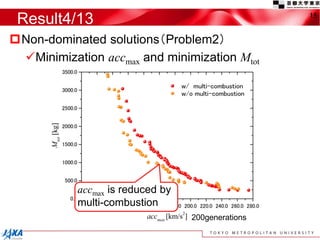
Non-dominated solutions(Problem2)
Minimization accmax and minimization Mtot
15
accmax is reduced by
multi-combustion
50generations100generations150generations200generations
Result5/8
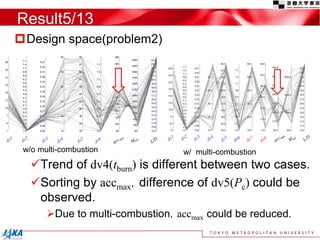
Design space(problem2)
Trend of dv4(tburn) is different between two cases.
Sorting by accmax,difference of dv5(Pc) could be
observed.
Due to multi-combustion,accmax could be reduced.
w/o multi-combustion w/ multi-combustion
Result6/8
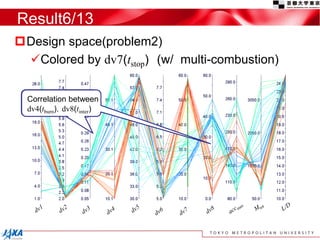
Design space(problem2)
Colored by dv7(tstop) (w/ multi-combustion)
)
Correlation between
dv4(tburn),dv8(tinter)
Result7/8
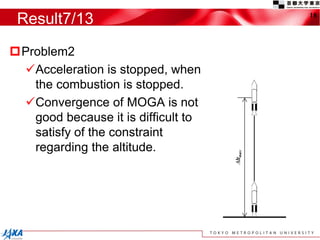
Problem2
Acceleration is stopped, when
the combustion is stopped.
Convergence of MOGA is not
good because it is difficult to
satisfy of the constraint
regarding the altitude.
18
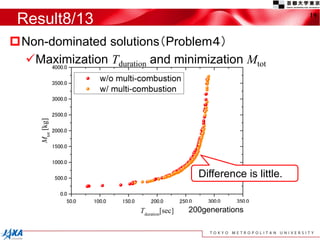
Result8/8
Non-dominated solutions(Problem4)
Maximization Tduration and minimization Mtot
19
Difference is little.
200generations
Conclusions
Design exploration for the LV using HRE
which can carried out multi-combustion
Evaluation for HRE which can carried out multi-
combustion has been developed
Design problem evaluation by solving several
deign problems
Multi-combustion is not effective to maximize
the altitude/ the duration time.
Better solution could be obtained by the multi-
combustion in the minimization of maximum
acceleration.
20

Multi-objective Genetic Algorithm Applied to Conceptual Design of Single-stage Rocket Using Hybrid Propulsion System

  • 1.
    Masahiro Kanazaki Tokyo MetropolitanUniversity Atthaphon Ariyarit Tokyo Metropolitan University Kazuhisa Chiba Hokkaido Institute of Technology Koki Kitagawa Japan Aerospace Exploration Agency Toru Shimada Japan Aerospace Exploration Agency Multi-objective Genetic Algorithm Applied to Conceptual Design of Single-stage Rocket Using Hybrid Propulsion System The Eighth China-Japan-Korea Joint Symposium on Optimization of Structural and Mechanical Systems ○ May 25-29, 2014, Gyeongju, Korea
  • 2.
    Background1 What ishybrid rocket engine? 2 Beneficial feature of HRE ・Low cost due to simple stricture ・Stop and restart of combustion⇒ Control・Safety Hybrid Rocket Engine(HRE) : rocket which stores fuel and oxidizer by different phases. Solid fuel + Liquid oxidizer :
  • 3.
    3 Background2 Difference comparedwith existent rocket  Solid rocket  Liquid rocket  HRE:Fuel and oxidizer are mixed after the ignition is initiated. → Fuel and oxidizer are preliminary mixd.  Several parameter should be optimized for suitable combustion → Design using heuristic approach  Multi-combustion by the control of the oxidizer supplement Solid fuel rocket Liquid fuel rocket
  • 4.
    Backgourng3 multi-combustion  Stop/restartof combustion during total combustion time Maximize down range by coasting Minimization of maximum acceleration Maximization of duration time over the target altitude 4 Off On On
  • 5.
    5 Contents  Background  Whatis hybrid rocket engine?  Multi-combustion  Objectives  Design methods  HRE design using evolutionary algorithm  Formulation  Maximization of altitude and minimization of gross weight(problem1)  Minimization of maximum acceleration and minimization of gross weight (problem2)  Maximization of duration time over target altitude and minimization of gross weight(problem3)  Results and discussions  Conclusions
  • 6.
    Objective Design exploration oflaunch vehicle (LV) using HRE which can carried out multi-combustion Discussion of beneficial feature via several design problem Non-dominated solution by genetic algorithm (GA) Comparison between HRE w/ multi-combustion and w/o multi-combustion 6
  • 7.
    Design method1/2 Overview ofevaluation process of HRE 7  tGatr n oxiport )( K., Kosugi, A. Oyama, K. Fujii, and M. Kanazaki., "Multidisciplinary and Multi-objective Design Exploration Methodology for Conceptual Design of a Hybrid Rocket," Infotech@aerospace2011, (2011) AIAA 2011-1634
  • 8.
    Design method2/2 Optimizer andvisualization  Non-dominated Sorting Genetic Algorithm-II (NSGA-II) 20populations and 200generation Parallel coordinate plot : PCP 8 Evaluation of LV
  • 9.
    Formulation1/3 Problem1 Maximization of maximumaltitude (Altmax)/ minimization of gross weight(Mtot) 9 Design variables for LV Design variables for multi-combustion L/D:Aspect ratio of vehicle
  • 10.
    Formulation2/3 Problem2 Minimization of maximumacceleration(accmax)/ minimization of gross weight(Mtot) 10 MT-135 (JAXA’s rocket for weather observation(Altmax=60 km)) Alttarget:target altitude Design variables for LV Design variables for multi-combustion
  • 11.
    Formulation3/3 Problem3 Maximization of durationtime over Alttarget(Tduration)/ minimization of gross weight(Mtot) 11 Design variables for LV Design variables for multi-combustion
  • 12.
    Result1/8 12 Non-dominated soluitions(Problem1) Maximizationof Altmax minimization Mtot Similar result Difference for high altitude 50generations100generations150generations200generations
  • 13.
    Result2/8 Design Space(problem1) Similar trendin design space Interval time of combustion dv8(tinter) is almost zero. →Multi-combustion has not been required. w/o multi-combustion w/ multi-combustion
  • 14.
    Result3/8 Problem1 Multi-combustion is noteffective for maximization of Altmax → Altmax is only reduced by the temporal stop of combustion. 14
  • 15.
    Result4/8 Non-dominated solutions(Problem2) Minimization accmaxand minimization Mtot 15 accmax is reduced by multi-combustion 50generations100generations150generations200generations
  • 16.
    Result5/8 Design space(problem2) Trend ofdv4(tburn) is different between two cases. Sorting by accmax,difference of dv5(Pc) could be observed. Due to multi-combustion,accmax could be reduced. w/o multi-combustion w/ multi-combustion
  • 17.
    Result6/8 Design space(problem2) Colored bydv7(tstop) (w/ multi-combustion) ) Correlation between dv4(tburn),dv8(tinter)
  • 18.
    Result7/8 Problem2 Acceleration is stopped,when the combustion is stopped. Convergence of MOGA is not good because it is difficult to satisfy of the constraint regarding the altitude. 18
  • 19.
    Result8/8 Non-dominated solutions(Problem4) Maximization Tdurationand minimization Mtot 19 Difference is little. 200generations
  • 20.
    Conclusions Design exploration forthe LV using HRE which can carried out multi-combustion Evaluation for HRE which can carried out multi- combustion has been developed Design problem evaluation by solving several deign problems Multi-combustion is not effective to maximize the altitude/ the duration time. Better solution could be obtained by the multi- combustion in the minimization of maximum acceleration. 20