Discussant: Dannilyn P. Manayan
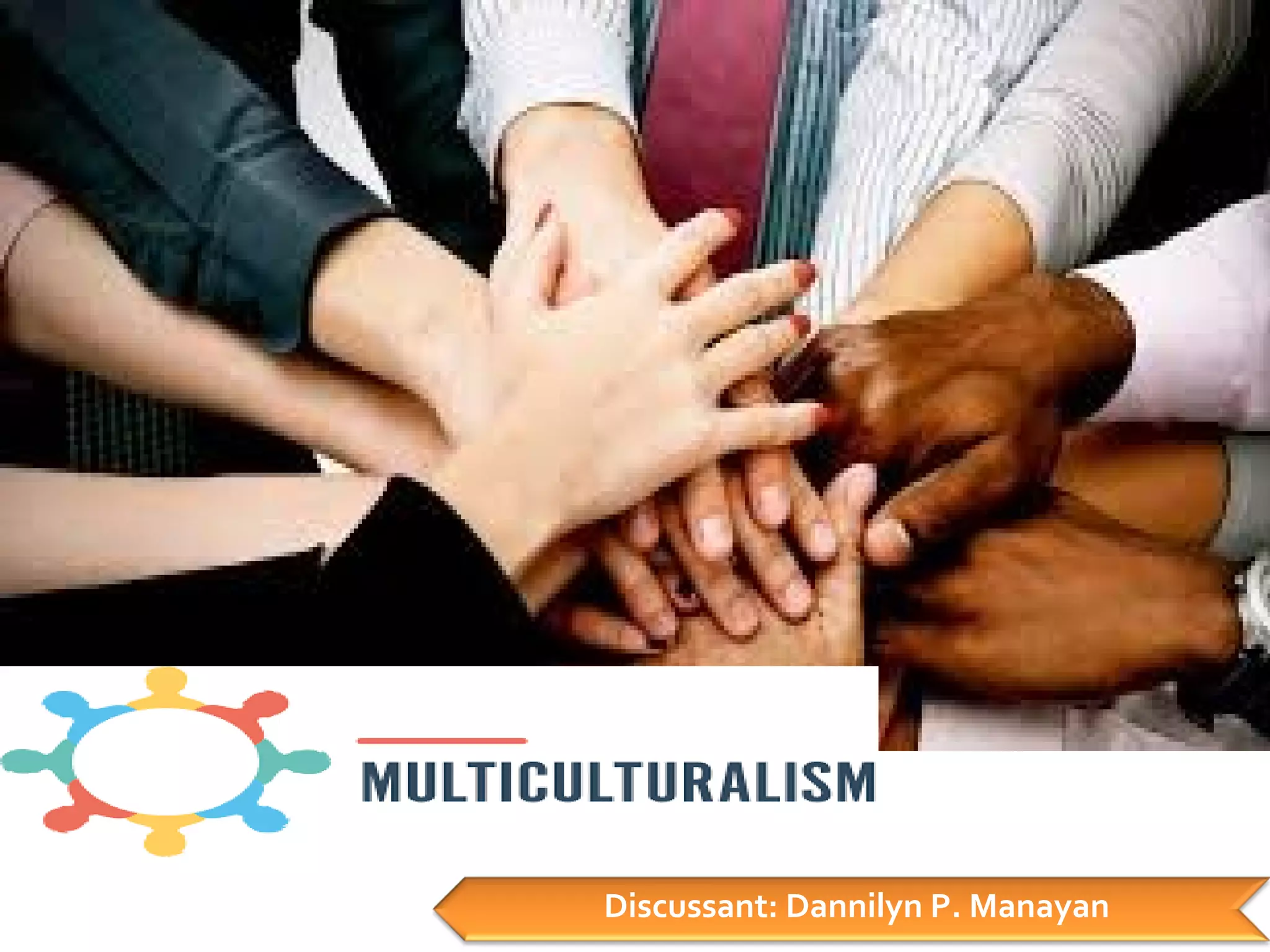
MULTICULTURALISM
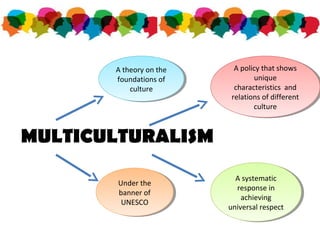
According to Harrison (1984), multiculturalism is a theory about the
foundations of a culture rather than a practice which only includes
cultural ideas.
Multiculturalism is a systematic and comprehensive response to
cultural and ethnic diversity, with educational, linguistic, economic
and social components and specific institutional mechanisms.
MULTICULTURALISM
Multiculturalism as a model of democratic policy response to culture
and ethnic diversity is of to UNESCO.
Multiculturalism is a policy that emphasizes the unique characteristics
of different cultures, especially as they relate to one another in
receiving in nation.
MULTICULTURALISM
A theory on the
foundations of
culture
A theory on the
foundations of
culture
A policy that shows
unique
characteristics and
relations of different
culture
A policy that shows
unique
characteristics and
relations of different
culture
Under the
banner of
UNESCO
Under the
banner of
UNESCO
A systematic
response in
achieving
universal respect
A systematic
response in
achieving
universal respect
ISSUES ON
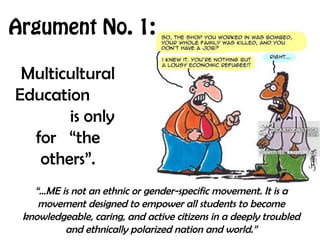
Argument No. 1:
Multicultural
Education
is only
for “the
others”.
“…ME is not an ethnic or gender-specific movement. It is a
movement designed to empower all students to become
knowledgeable, caring, and active citizens in a deeply troubled
and ethnically polarized nation and world.”
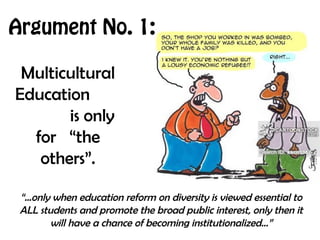
Multicultural
Education
is only
for “the
others”.
“…only when education reform on diversity is viewed essential to
ALL students and promote the broad public interest, only then it
will have a chance of becoming institutionalized…”
Argument No. 1:
Argument No. 2:
Multicultural
Education
will
divide the
nation.
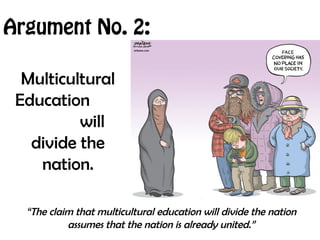
“The claim that multicultural education will divide the nation
assumes that the nation is already united.”
Argument No. 2:
Multicultural
Education
will
divide the
nation.
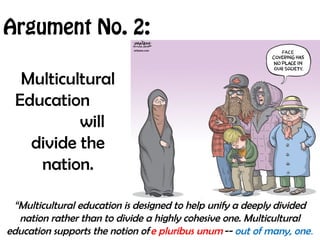
“Multicultural education is designed to help unify a deeply divided
nation rather than to divide a highly cohesive one. Multicultural
education supports the notion of e pluribus unum -- out of many, one.
“E pluribus unum”– out of many, one
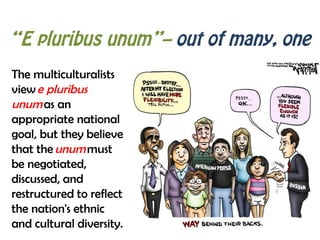
The multiculturalists
view e pluribus
unum as an
appropriate national
goal, but they believe
that the unum must
be negotiated,
discussed, and
restructured to reflect
the nation's ethnic
and cultural diversity.
M U L T I C U L T U R A L
EDUCATION
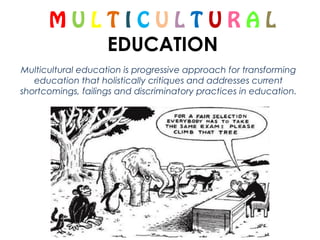
Multicultural education is progressive approach for transforming
education that holistically critiques and addresses current
shortcomings, failings and discriminatory practices in education.
M U L T I C U L T U R A L
EDUCATION
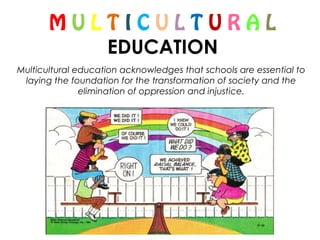
Multicultural education acknowledges that schools are essential to
laying the foundation for the transformation of society and the
elimination of oppression and injustice.
Despite a multitude of differing conceptualizations of
multicultural education, these ideals are all, at their roots,
about these transformations:
• Every student must have an equal
opportunity to achieve his or her full
potential.
• Every student must be prepared to
competently participate in an increasingly
intercultural society.
Remember DepEd’s Vision?
Mission?
Therefore…
 Teachers must be prepared to effectively
f_ c _ L ______ learning for every individual
student, no matter how culturally similar or
d _ f _ r ___ from themselves.
Therefore…
 Teachers must be prepared to effectively
f_ c _ L ______ learning for every individual
student, no matter how culturally similar or
d _ f _ r __ from themselves.
facilitate
different
Also…
 Schools must be a _ t ___ participants in ending
oppression of all types, first by ending oppression within
their own walls, then by producing socially and critically
active and a _ _ r _ students.
Also…
 Schools must be a _ t ___ participants in ending
oppression of all types, first by ending oppression within
their own walls, then by producing socially and critically
active and a _ _ r _ students.
active
aware
And…
 Educators, activists and other must take a more active
r _ l _ in reexamining all educational practices and how
they a _ f ___ the learning of all students :
testing methods, teaching approaches, evaluation
and assessment, school psychology and counseling.
And…
 Educators, activists and other must take a more active
r _ l _ in reexamining all educational practices and how
they a _ f ___ the learning of all students :
testing methods, teaching approaches, evaluation
and assessment, school psychology and counseling.
role
affect
D I M E N S I O N S
OF
MULTICULTURAL
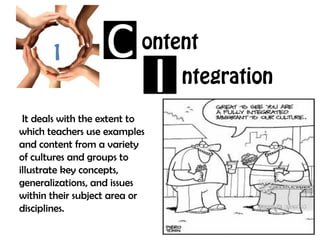
1
ontent
ntegration
 It deals with the extent to
which teachers use examples
and content from a variety
of cultures and groups to
illustrate key concepts,
generalizations, and issues
within their subject area or
disciplines.
2
nowledge
rocess
  It describes how teachers
help students to understand,
investigate, and determine how
the biases, frames of reference,
and perspectives within a
discipline influence the ways in
which knowledge is constructed
within it.
onstruction
2
nowledge
rocess
onstruction
•Personal/cultural knowledge consists of the
concepts, explanations, and interpretations that
students derive from personal experiences in their
homes, families, and community cultures. 
Ex. IP ignoring education
Ex.2: No feeding, no schooling
Ex.3: Children verbally abused
2
nowledge
rocess
onstruction
* Cultural conflict occurs in the classroom because much
of the personal/cultural knowledge that students from
diverse cultural groups bring to the classroom is
inconsistent with school and teacher knowledge.
2
nowledge
rocess
onstruction
•Popular knowledge is institutionalized by the mass
media and other forces that shape the popular
culture, has a strong influence on the values,
perceptions, and behavior of children and young
people.
Ex. Social media
Ex. Movies watched in the classroom
2
nowledge
rocess
onstruction
• Mainstream academic knowledge is established
within mainstream professional associations.
Ex. Research-based, factual evidences
3
rejudice
  It describes lessons
and activities used by
teachers to help students to
develop positive attitudes
toward different racial,
ethnic, and cultural groups.
eduction
Here’s a study!
Generally, at the age
of 4, children start to
be aware of racial
differences and social
preferences.
(1960s social scientists)
Here’s a study!
Generally, at the age
of 4, children start to
be aware of racial
differences and social
preferences.
(1960s social scientists)
4
quity
   It exists when
teachers modify their
teaching in ways that will
facilitate the academic
achievement of students
from diverse racial,
cultural, and social class
groups.
edagogy
What class
activities do we
usually use to
meet this?
Ex. Cooperative
Learning
4
5
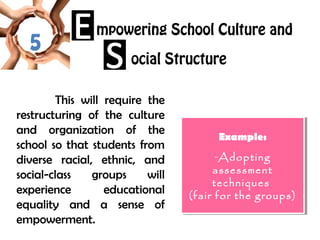
mpowering School Culture and
  This will require the
restructuring of the culture
and organization of the
school so that students from
diverse racial, ethnic, and
social-class groups will
experience educational
equality and a sense of
empowerment.
ocial Structure
Example:
-Adopting
assessment
techniques
(fair for the groups)
Example:
-Adopting
assessment
techniques
(fair for the groups)
References:
• http://webapp1.dlib.indiana.edu/virtual_disk_library/index.cgi/4273
355/FID840/eqtyres/erg/111511/1511.htm (Multicultural Education
Development, Dimensions, and Challenges By James A. Banks)
• https://education.uw.edu/cme/view (Multicultural Education: Goals
and Dimensions)
• https://www.slideshare.net/jho_anne/dimensions-of-multicultural-
education?from_action=save (Dimensions of Multicultural Education)
• http://best-sociology-articles.blogspot.com/2016/04/multicultural-
approach-in-classroom.html
• http://best-sociology-articles.blogspot.com/2016/04/multicultural-
approach-in-classroom.html
• https://ejournals.ph/article.php?id=4041
THAN
K
YOU!
• James Banks’ Goals of ME:
• to transform school so that male and female
students, exceptional students from diverse
cultural, social-class, racial and ethnic groups
experience an equal opportunity to learn.
• to help students to acquire knowledge,
attitudes and skills needed to function
effectively in pluralistic democratic society
• to help students to acquire knowledge and
commitments needed to make reflective

Cultural changes final

  • 1.
  • 2.
    MULTICULTURALISM According to Harrison(1984), multiculturalism is a theory about the foundations of a culture rather than a practice which only includes cultural ideas. Multiculturalism is a systematic and comprehensive response to cultural and ethnic diversity, with educational, linguistic, economic and social components and specific institutional mechanisms.
  • 3.
    MULTICULTURALISM Multiculturalism as amodel of democratic policy response to culture and ethnic diversity is of to UNESCO. Multiculturalism is a policy that emphasizes the unique characteristics of different cultures, especially as they relate to one another in receiving in nation.
  • 4.
    MULTICULTURALISM A theory onthe foundations of culture A theory on the foundations of culture A policy that shows unique characteristics and relations of different culture A policy that shows unique characteristics and relations of different culture Under the banner of UNESCO Under the banner of UNESCO A systematic response in achieving universal respect A systematic response in achieving universal respect
  • 5.
  • 6.
    Argument No. 1: Multicultural Education isonly for “the others”. “…ME is not an ethnic or gender-specific movement. It is a movement designed to empower all students to become knowledgeable, caring, and active citizens in a deeply troubled and ethnically polarized nation and world.”
  • 7.
    Multicultural Education is only for “the others”. “…onlywhen education reform on diversity is viewed essential to ALL students and promote the broad public interest, only then it will have a chance of becoming institutionalized…” Argument No. 1:
  • 8.
    Argument No. 2: Multicultural Education will dividethe nation. “The claim that multicultural education will divide the nation assumes that the nation is already united.”
  • 9.
    Argument No. 2: Multicultural Education will dividethe nation. “Multicultural education is designed to help unify a deeply divided nation rather than to divide a highly cohesive one. Multicultural education supports the notion of e pluribus unum -- out of many, one.
  • 10.
    “E pluribus unum”–out of many, one The multiculturalists view e pluribus unum as an appropriate national goal, but they believe that the unum must be negotiated, discussed, and restructured to reflect the nation's ethnic and cultural diversity.
  • 11.
    M U LT I C U L T U R A L EDUCATION Multicultural education is progressive approach for transforming education that holistically critiques and addresses current shortcomings, failings and discriminatory practices in education.
  • 12.
    M U LT I C U L T U R A L EDUCATION Multicultural education acknowledges that schools are essential to laying the foundation for the transformation of society and the elimination of oppression and injustice.
  • 13.
    Despite a multitudeof differing conceptualizations of multicultural education, these ideals are all, at their roots, about these transformations: • Every student must have an equal opportunity to achieve his or her full potential. • Every student must be prepared to competently participate in an increasingly intercultural society.
  • 14.
  • 15.
  • 16.
    Therefore…  Teachers mustbe prepared to effectively f_ c _ L ______ learning for every individual student, no matter how culturally similar or d _ f _ r ___ from themselves.
  • 17.
    Therefore…  Teachers mustbe prepared to effectively f_ c _ L ______ learning for every individual student, no matter how culturally similar or d _ f _ r __ from themselves. facilitate different
  • 18.
    Also…  Schools mustbe a _ t ___ participants in ending oppression of all types, first by ending oppression within their own walls, then by producing socially and critically active and a _ _ r _ students.
  • 19.
    Also…  Schools mustbe a _ t ___ participants in ending oppression of all types, first by ending oppression within their own walls, then by producing socially and critically active and a _ _ r _ students. active aware
  • 20.
    And…  Educators, activistsand other must take a more active r _ l _ in reexamining all educational practices and how they a _ f ___ the learning of all students : testing methods, teaching approaches, evaluation and assessment, school psychology and counseling.
  • 21.
    And…  Educators, activistsand other must take a more active r _ l _ in reexamining all educational practices and how they a _ f ___ the learning of all students : testing methods, teaching approaches, evaluation and assessment, school psychology and counseling. role affect
  • 22.
    D I ME N S I O N S OF MULTICULTURAL
  • 24.
    1 ontent ntegration  It deals withthe extent to which teachers use examples and content from a variety of cultures and groups to illustrate key concepts, generalizations, and issues within their subject area or disciplines.
  • 25.
    2 nowledge rocess   It describeshow teachers help students to understand, investigate, and determine how the biases, frames of reference, and perspectives within a discipline influence the ways in which knowledge is constructed within it. onstruction


  • 26.
    2 nowledge rocess onstruction •Personal/cultural knowledge consistsof the concepts, explanations, and interpretations that students derive from personal experiences in their homes, families, and community cultures.  Ex. IP ignoring education Ex.2: No feeding, no schooling Ex.3: Children verbally abused
  • 27.
    2 nowledge rocess onstruction * Cultural conflictoccurs in the classroom because much of the personal/cultural knowledge that students from diverse cultural groups bring to the classroom is inconsistent with school and teacher knowledge.
  • 28.
    2 nowledge rocess onstruction •Popular knowledge isinstitutionalized by the mass media and other forces that shape the popular culture, has a strong influence on the values, perceptions, and behavior of children and young people. Ex. Social media Ex. Movies watched in the classroom
  • 29.
    2 nowledge rocess onstruction • Mainstream academicknowledge is established within mainstream professional associations. Ex. Research-based, factual evidences
  • 30.
    3 rejudice   It describeslessons and activities used by teachers to help students to develop positive attitudes toward different racial, ethnic, and cultural groups. eduction Here’s a study! Generally, at the age of 4, children start to be aware of racial differences and social preferences. (1960s social scientists) Here’s a study! Generally, at the age of 4, children start to be aware of racial differences and social preferences. (1960s social scientists)
  • 31.
    4 quity    It existswhen teachers modify their teaching in ways that will facilitate the academic achievement of students from diverse racial, cultural, and social class groups. edagogy What class activities do we usually use to meet this? Ex. Cooperative Learning
  • 32.
  • 33.
    5 mpowering School Cultureand   This will require the restructuring of the culture and organization of the school so that students from diverse racial, ethnic, and social-class groups will experience educational equality and a sense of empowerment. ocial Structure Example: -Adopting assessment techniques (fair for the groups) Example: -Adopting assessment techniques (fair for the groups)
  • 35.
    References: • http://webapp1.dlib.indiana.edu/virtual_disk_library/index.cgi/4273 355/FID840/eqtyres/erg/111511/1511.htm (MulticulturalEducation Development, Dimensions, and Challenges By James A. Banks) • https://education.uw.edu/cme/view (Multicultural Education: Goals and Dimensions) • https://www.slideshare.net/jho_anne/dimensions-of-multicultural- education?from_action=save (Dimensions of Multicultural Education) • http://best-sociology-articles.blogspot.com/2016/04/multicultural- approach-in-classroom.html • http://best-sociology-articles.blogspot.com/2016/04/multicultural- approach-in-classroom.html • https://ejournals.ph/article.php?id=4041
  • 36.
  • 38.
    • James Banks’Goals of ME: • to transform school so that male and female students, exceptional students from diverse cultural, social-class, racial and ethnic groups experience an equal opportunity to learn. • to help students to acquire knowledge, attitudes and skills needed to function effectively in pluralistic democratic society • to help students to acquire knowledge and commitments needed to make reflective