Clinical Proof-of-Concept (POC)
Ashwin Gollerkeri, M.D.
OutlineOutline
 Exploratory Drug Development
 Defining POC Defining POC
 Improving Probability of Success with Greater
Emphasis on POCp
 Improving POC Through Better Patient Selection
 Practical Considerations of Patient Selection
Strategies
 Summary/conclusion
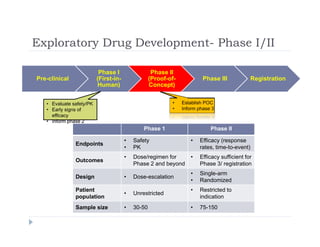
Exploratory Drug Development- Phase I/IIExploratory Drug Development Phase I/II
P li i l
Phase I
(Fi t i
Phase II
(P f f Ph III R i t tiPre-clinical (First-in-
Human)
(Proof-of-
Concept)
Phase III Registration
• Evaluate safety/PK
E l i f
• Establish POC
Inform phase 3
Phase 1 Phase II
S f t Effi (
• Inform phase 2
• Early signs of
efficacy
• Inform phase 2
• Inform phase 3
Endpoints
• Safety
• PK
• Efficacy (response
rates, time-to-event)
Outcomes
• Dose/regimen for
Phase 2 and beyond
• Efficacy sufficient for
Phase 3/ registration
Design • Dose-escalation
• Single-arm
• Randomized
Patient
population
• Unrestricted
• Restricted to
indication
Sample size • 30-50 • 75-150
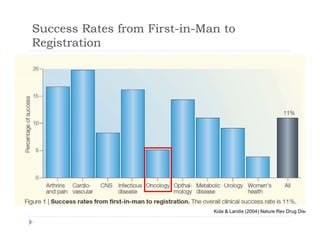
Success Rates from First-in-Man to
RegistrationRegistration
Kola & Landis (2004) Nature Rev Drug Disc
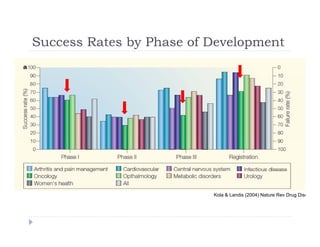
Success Rates by Phase of DevelopmentSuccess Rates by Phase of Development
Kola & Landis (2004) Nature Rev Drug Disc
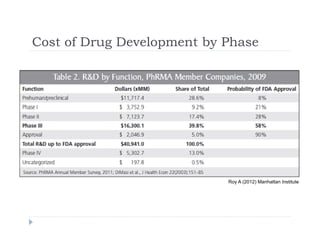
Cost of Drug Development by PhaseCost of Drug Development by Phase
Roy A (2012) Manhattan Institute
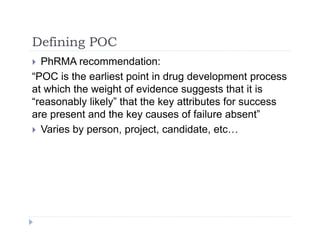
Defining POCDefining POC
 PhRMA recommendation:
“POC is the earliest point in drug development processPOC is the earliest point in drug development process
at which the weight of evidence suggests that it is
“reasonably likely” that the key attributes for success
are present and the key causes of failure absent”
 Varies by person, project, candidate, etc…
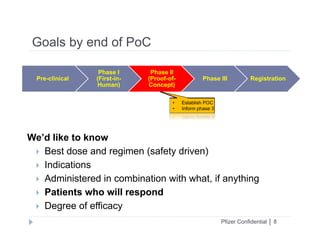
Goals by end of PoCGoals by end of PoC
P li i l
Phase I
(Fi t i
Phase II
(P f f Ph III R i t tiPre-clinical (First-in-
Human)
(Proof-of-
Concept)
Phase III Registration
• Establish POC
Inform phase 3
We’d like to know
• Inform phase 3
We d like to know
 Best dose and regimen (safety driven)
 Indications
 Administered in combination with what, if anything
 Patients who will respond
Pfizer Confidential │ 8
 Degree of efficacy
POC Essential ElementsPOC Essential Elements
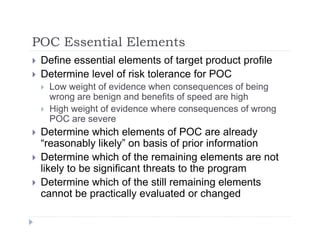
 Define essential elements of target product profile
 Determine level of risk tolerance for POC Determine level of risk tolerance for POC
 Low weight of evidence when consequences of being
wrong are benign and benefits of speed are high
 High weight of evidence where consequences of wrong High weight of evidence where consequences of wrong
POC are severe
 Determine which elements of POC are already
“reasonably likely” on basis of prior information
 Determine which of the remaining elements are not
likely to be significant threats to the programlikely to be significant threats to the program
 Determine which of the still remaining elements
cannot be practically evaluated or changed
Decision Criteria for POCDecision Criteria for POC
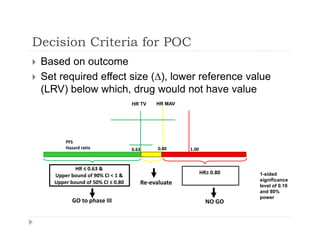
 Based on outcome
 Set required effect size (∆) lower reference value Set required effect size (∆), lower reference value
(LRV) below which, drug would not have value
HR TV HR MAV
HR ≤ 0.63 &
0.63 0.80 1.00
PFS
Hazard ratio
HR ≤ 0.63 &
Upper bound of 90% CI < 1 &
Upper bound of 50% CI ≤ 0.80
GO to phase III NO GO
HR≥ 0.80
Re‐evaluate
1-sided
significance
level of 0.10
and 80%
power
GO to phase III NO GO
Examples of Oncology POC TrialsExamples of Oncology POC Trials
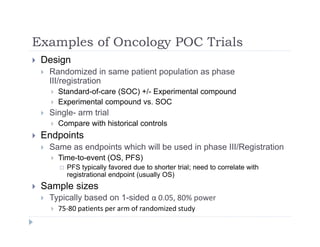
 Design
 Randomized in same patient population as phase
III/registration
 Standard-of-care (SOC) +/- Experimental compound
 Experimental compound vs. SOC
 Single- arm trial
 Compare with historical controls
 Endpointsp
 Same as endpoints which will be used in phase III/Registration
 Time-to-event (OS, PFS)
 PFS typically favored due to shorter trial; need to correlate withyp y ;
registrational endpoint (usually OS)
 Sample sizes
 Typically based on 1-sided α 0.05, 80% poweryp y , p
 75‐80 patients per arm of randomized study
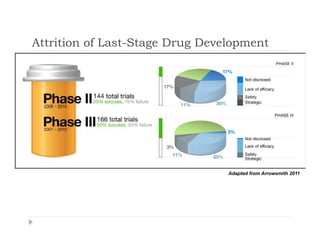
Attrition of Last-Stage Drug DevelopmentAttrition of Last Stage Drug Development
Adapted from Arrowsmith 2011
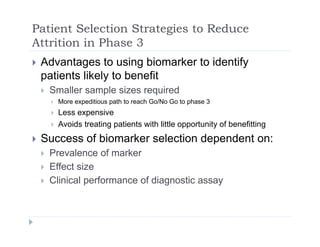
Patient Selection Strategies to Reduce
Attrition in Phase 3Attrition in Phase 3
 Advantages to using biomarker to identify
patients likely to benefitpatients likely to benefit
 Smaller sample sizes required
 More expeditious path to reach Go/No Go to phase 3
 Less expensive
 Avoids treating patients with little opportunity of benefitting
 Success of biomarker selection dependent on: Success of biomarker selection dependent on:
 Prevalence of marker
 Effect size
 Clinical performance of diagnostic assay
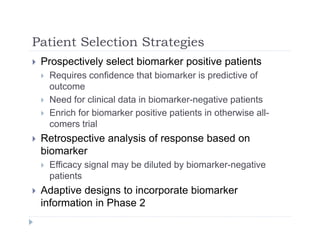
Patient Selection StrategiesPatient Selection Strategies
 Prospectively select biomarker positive patients
 Requires confidence that biomarker is predictive of Requires confidence that biomarker is predictive of
outcome
 Need for clinical data in biomarker-negative patients
 Enrich for biomarker positive patients in otherwise all-
comers trial
 Retrospective analysis of response based on Retrospective analysis of response based on
biomarker
 Efficacy signal may be diluted by biomarker-negative
patients
 Adaptive designs to incorporate biomarker
information in Phase 2information in Phase 2
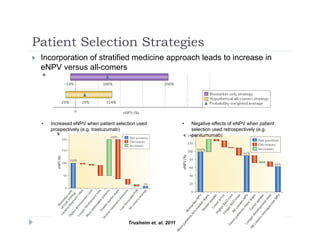
Patient Selection Strategies
 Incorporation of stratified medicine approach leads to increase in
eNPV versus all-comers
Patient Selection Strategies
• Increased eNPV when patient selection used
prospectively (e.g. trastuzumab)
• Negative effects of eNPV when patient
selection used retrospectively (e.g.
panitumumab)
Trusheim et. al. 2011
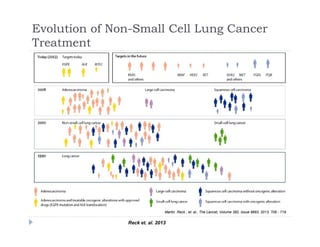
Evolution of Non-Small Cell Lung Cancer
TreatmentTreatment
Martin Reck , et. al., The Lancet, Volume 382, Issue 9893, 2013, 709 - 719
Reck et. al. 2013
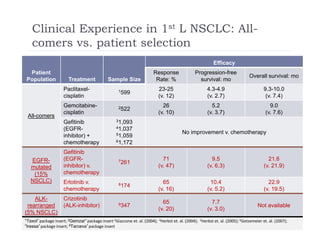
Clinical Experience in 1st L NSCLC: All-
comers vs. patient selectioncomers vs. patient selection
Patient
Efficacy
Response Progression-free
Overall survival: mo
Population Treatment Sample Size Rate: % survival: mo
Overall survival: mo
Paclitaxel-
cisplatin
1599
23-25
(v. 12)
4.3-4.9
(v. 2.7)
9.3-10.0
(v. 7.4)
Gemcitabine- 2522
26 5.2 9.0
All-comers
cisplatin
2522
(v. 10) (v. 3.7) (v. 7.6)
Gefitinib
(EGFR-
inhibitor) +
31,093
41,037
51,059
No improvement v. chemotherapy
chemotherapy 61,172
EGFR-
mutated
Gefitinib
(EGFR-
inhibitor) v.
7261
71
(v. 47)
9.5
(v. 6.3)
21.6
(v. 21.9)
(15%
NSCLC)
chemotherapy
Erlotinib v.
chemotherapy
8174
65
(v. 16)
10.4
(v. 5.2)
22.9
(v. 19.5)
ALK- Crizotinib
65 7 7
rearranged
(5% NSCLC)
(ALK-inhibitor) 9347
65
(v. 20)
7.7
(v. 3.0)
Not available
1Taxol® package insert; 2Gemzar® package insert 3Giaccone et. al. (2004);  4Herbst et. al. (2004);  5Herbst et. al. (2005); 6Getzemeier et. al. (2007); 
7Iressa® package insert; 8Tarceva® package insert
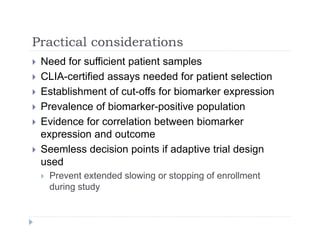
Practical considerationsPractical considerations
 Need for sufficient patient samples
 CLIA-certified assays needed for patient selection CLIA-certified assays needed for patient selection
 Establishment of cut-offs for biomarker expression
 Prevalence of biomarker-positive population Prevalence of biomarker positive population
 Evidence for correlation between biomarker
expression and outcomep
 Seemless decision points if adaptive trial design
used
 Prevent extended slowing or stopping of enrollment
during study
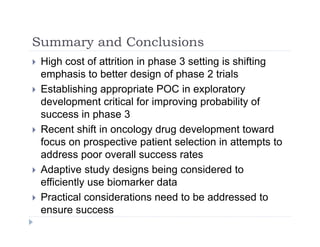
Summary and ConclusionsSummary and Conclusions
 High cost of attrition in phase 3 setting is shifting
emphasis to better design of phase 2 trialsemphasis to better design of phase 2 trials
 Establishing appropriate POC in exploratory
development critical for improving probability of
success in phase 3
 Recent shift in oncology drug development toward
f ti ti t l ti i tt t tfocus on prospective patient selection in attempts to
address poor overall success rates
 Adaptive study designs being considered to Adaptive study designs being considered to
efficiently use biomarker data
 Practical considerations need to be addressed to
ensure success
ReferencesReferences
 Arrowsmith J. Phase II failures: 2008-2010. Nat Rev Drug Disc (2011);10:1
 Cartwright ME, Cohen S, Fleishaker JC, et. al. Proof of concept: a PhRMA position paper with
recommendations for best practice. Nature (2010);87;278
DiM i JA H RW G b ki HG Th i f i ti ti t f d DiMasi JA, Hansen RW, Grabowski HG. The price of innovation: new estimates of drug
development costs. J Health Econ (2003);22:151
 Gatzemeier U, Pluzanska A, Szczesna A, et. al. Phase III study of erlotinib in combination with
cisplatin and gemcitabine in advanced non-small-cell lung cancer: the Tarceva lung cancer
investigation trial. J Clin Oncol (2007);25;1545
G G S C G f Giaccone G, Herbst RS, Manegold C, et. al. Gefitinib in combination with gemcitabine and
cisplatin in advanced non-small-cell lung cancer: a phase III trial-INTACT 1. J Clin Oncol
(2004);22:777
 Herbst RS, Giaccone G, Schiller JH, et. al. Gefitinib in combination with paclitaxel and carboplatin
in advanced non-small cell lung cancer: a phase III trial- INTACT 2. J Clin Oncol (2004);22:785
 Herbst RS, Prager D, Hermann R, et. al. TRIBUTE: a phase III trial of erlotinib hydrochloride (OSI-
774) combined with carboplatin and paclitaxel chemotherapy in advanced non-small-cell lung
cancer. J Clin Oncol (2005);23:5892
 Kola I and Landis J. Can the pharmaceutical industry reduce attrition rates? Nat Rev Drug Disc
(2004);3:711
 Reck M, Heigner DF, Mak T, et. al. Management of non-small-cell lung cancer: recent
developments. Lancet (2013);382:709
 Roy SA. Stifling new cures: The true cost of lengthy clinical drug trials. Project FDA (2012).
Manhattan Institute for Policy Research. http://www.manhattan-institute.org/html/fda_05.htm
 Trusheim MR Burgess B Hu SX et al Quantifying factors for the success of stratified medicine Trusheim MR, Burgess B, Hu SX, et.al. Quantifying factors for the success of stratified medicine.
Nat Rev Drug Disc (2011);10:817

Clinical Proof of Concept (PoC)

  • 1.
  • 2.
    OutlineOutline  Exploratory DrugDevelopment  Defining POC Defining POC  Improving Probability of Success with Greater Emphasis on POCp  Improving POC Through Better Patient Selection  Practical Considerations of Patient Selection Strategies  Summary/conclusion
  • 3.
    Exploratory Drug Development-Phase I/IIExploratory Drug Development Phase I/II P li i l Phase I (Fi t i Phase II (P f f Ph III R i t tiPre-clinical (First-in- Human) (Proof-of- Concept) Phase III Registration • Evaluate safety/PK E l i f • Establish POC Inform phase 3 Phase 1 Phase II S f t Effi ( • Inform phase 2 • Early signs of efficacy • Inform phase 2 • Inform phase 3 Endpoints • Safety • PK • Efficacy (response rates, time-to-event) Outcomes • Dose/regimen for Phase 2 and beyond • Efficacy sufficient for Phase 3/ registration Design • Dose-escalation • Single-arm • Randomized Patient population • Unrestricted • Restricted to indication Sample size • 30-50 • 75-150
  • 4.
    Success Rates fromFirst-in-Man to RegistrationRegistration Kola & Landis (2004) Nature Rev Drug Disc
  • 5.
    Success Rates byPhase of DevelopmentSuccess Rates by Phase of Development Kola & Landis (2004) Nature Rev Drug Disc
  • 6.
    Cost of DrugDevelopment by PhaseCost of Drug Development by Phase Roy A (2012) Manhattan Institute
  • 7.
    Defining POCDefining POC PhRMA recommendation: “POC is the earliest point in drug development processPOC is the earliest point in drug development process at which the weight of evidence suggests that it is “reasonably likely” that the key attributes for success are present and the key causes of failure absent”  Varies by person, project, candidate, etc…
  • 8.
    Goals by endof PoCGoals by end of PoC P li i l Phase I (Fi t i Phase II (P f f Ph III R i t tiPre-clinical (First-in- Human) (Proof-of- Concept) Phase III Registration • Establish POC Inform phase 3 We’d like to know • Inform phase 3 We d like to know  Best dose and regimen (safety driven)  Indications  Administered in combination with what, if anything  Patients who will respond Pfizer Confidential │ 8  Degree of efficacy
  • 9.
    POC Essential ElementsPOCEssential Elements  Define essential elements of target product profile  Determine level of risk tolerance for POC Determine level of risk tolerance for POC  Low weight of evidence when consequences of being wrong are benign and benefits of speed are high  High weight of evidence where consequences of wrong High weight of evidence where consequences of wrong POC are severe  Determine which elements of POC are already “reasonably likely” on basis of prior information  Determine which of the remaining elements are not likely to be significant threats to the programlikely to be significant threats to the program  Determine which of the still remaining elements cannot be practically evaluated or changed
  • 10.
    Decision Criteria forPOCDecision Criteria for POC  Based on outcome  Set required effect size (∆) lower reference value Set required effect size (∆), lower reference value (LRV) below which, drug would not have value HR TV HR MAV HR ≤ 0.63 & 0.63 0.80 1.00 PFS Hazard ratio HR ≤ 0.63 & Upper bound of 90% CI < 1 & Upper bound of 50% CI ≤ 0.80 GO to phase III NO GO HR≥ 0.80 Re‐evaluate 1-sided significance level of 0.10 and 80% power GO to phase III NO GO
  • 11.
    Examples of OncologyPOC TrialsExamples of Oncology POC Trials  Design  Randomized in same patient population as phase III/registration  Standard-of-care (SOC) +/- Experimental compound  Experimental compound vs. SOC  Single- arm trial  Compare with historical controls  Endpointsp  Same as endpoints which will be used in phase III/Registration  Time-to-event (OS, PFS)  PFS typically favored due to shorter trial; need to correlate withyp y ; registrational endpoint (usually OS)  Sample sizes  Typically based on 1-sided α 0.05, 80% poweryp y , p  75‐80 patients per arm of randomized study
  • 12.
    Attrition of Last-StageDrug DevelopmentAttrition of Last Stage Drug Development Adapted from Arrowsmith 2011
  • 13.
    Patient Selection Strategiesto Reduce Attrition in Phase 3Attrition in Phase 3  Advantages to using biomarker to identify patients likely to benefitpatients likely to benefit  Smaller sample sizes required  More expeditious path to reach Go/No Go to phase 3  Less expensive  Avoids treating patients with little opportunity of benefitting  Success of biomarker selection dependent on: Success of biomarker selection dependent on:  Prevalence of marker  Effect size  Clinical performance of diagnostic assay
  • 14.
    Patient Selection StrategiesPatientSelection Strategies  Prospectively select biomarker positive patients  Requires confidence that biomarker is predictive of Requires confidence that biomarker is predictive of outcome  Need for clinical data in biomarker-negative patients  Enrich for biomarker positive patients in otherwise all- comers trial  Retrospective analysis of response based on Retrospective analysis of response based on biomarker  Efficacy signal may be diluted by biomarker-negative patients  Adaptive designs to incorporate biomarker information in Phase 2information in Phase 2
  • 15.
    Patient Selection Strategies Incorporation of stratified medicine approach leads to increase in eNPV versus all-comers Patient Selection Strategies • Increased eNPV when patient selection used prospectively (e.g. trastuzumab) • Negative effects of eNPV when patient selection used retrospectively (e.g. panitumumab) Trusheim et. al. 2011
  • 16.
    Evolution of Non-SmallCell Lung Cancer TreatmentTreatment Martin Reck , et. al., The Lancet, Volume 382, Issue 9893, 2013, 709 - 719 Reck et. al. 2013
  • 17.
    Clinical Experience in1st L NSCLC: All- comers vs. patient selectioncomers vs. patient selection Patient Efficacy Response Progression-free Overall survival: mo Population Treatment Sample Size Rate: % survival: mo Overall survival: mo Paclitaxel- cisplatin 1599 23-25 (v. 12) 4.3-4.9 (v. 2.7) 9.3-10.0 (v. 7.4) Gemcitabine- 2522 26 5.2 9.0 All-comers cisplatin 2522 (v. 10) (v. 3.7) (v. 7.6) Gefitinib (EGFR- inhibitor) + 31,093 41,037 51,059 No improvement v. chemotherapy chemotherapy 61,172 EGFR- mutated Gefitinib (EGFR- inhibitor) v. 7261 71 (v. 47) 9.5 (v. 6.3) 21.6 (v. 21.9) (15% NSCLC) chemotherapy Erlotinib v. chemotherapy 8174 65 (v. 16) 10.4 (v. 5.2) 22.9 (v. 19.5) ALK- Crizotinib 65 7 7 rearranged (5% NSCLC) (ALK-inhibitor) 9347 65 (v. 20) 7.7 (v. 3.0) Not available 1Taxol® package insert; 2Gemzar® package insert 3Giaccone et. al. (2004);  4Herbst et. al. (2004);  5Herbst et. al. (2005); 6Getzemeier et. al. (2007);  7Iressa® package insert; 8Tarceva® package insert
  • 18.
    Practical considerationsPractical considerations Need for sufficient patient samples  CLIA-certified assays needed for patient selection CLIA-certified assays needed for patient selection  Establishment of cut-offs for biomarker expression  Prevalence of biomarker-positive population Prevalence of biomarker positive population  Evidence for correlation between biomarker expression and outcomep  Seemless decision points if adaptive trial design used  Prevent extended slowing or stopping of enrollment during study
  • 19.
    Summary and ConclusionsSummaryand Conclusions  High cost of attrition in phase 3 setting is shifting emphasis to better design of phase 2 trialsemphasis to better design of phase 2 trials  Establishing appropriate POC in exploratory development critical for improving probability of success in phase 3  Recent shift in oncology drug development toward f ti ti t l ti i tt t tfocus on prospective patient selection in attempts to address poor overall success rates  Adaptive study designs being considered to Adaptive study designs being considered to efficiently use biomarker data  Practical considerations need to be addressed to ensure success
  • 20.
    ReferencesReferences  Arrowsmith J.Phase II failures: 2008-2010. Nat Rev Drug Disc (2011);10:1  Cartwright ME, Cohen S, Fleishaker JC, et. al. Proof of concept: a PhRMA position paper with recommendations for best practice. Nature (2010);87;278 DiM i JA H RW G b ki HG Th i f i ti ti t f d DiMasi JA, Hansen RW, Grabowski HG. The price of innovation: new estimates of drug development costs. J Health Econ (2003);22:151  Gatzemeier U, Pluzanska A, Szczesna A, et. al. Phase III study of erlotinib in combination with cisplatin and gemcitabine in advanced non-small-cell lung cancer: the Tarceva lung cancer investigation trial. J Clin Oncol (2007);25;1545 G G S C G f Giaccone G, Herbst RS, Manegold C, et. al. Gefitinib in combination with gemcitabine and cisplatin in advanced non-small-cell lung cancer: a phase III trial-INTACT 1. J Clin Oncol (2004);22:777  Herbst RS, Giaccone G, Schiller JH, et. al. Gefitinib in combination with paclitaxel and carboplatin in advanced non-small cell lung cancer: a phase III trial- INTACT 2. J Clin Oncol (2004);22:785  Herbst RS, Prager D, Hermann R, et. al. TRIBUTE: a phase III trial of erlotinib hydrochloride (OSI- 774) combined with carboplatin and paclitaxel chemotherapy in advanced non-small-cell lung cancer. J Clin Oncol (2005);23:5892  Kola I and Landis J. Can the pharmaceutical industry reduce attrition rates? Nat Rev Drug Disc (2004);3:711  Reck M, Heigner DF, Mak T, et. al. Management of non-small-cell lung cancer: recent developments. Lancet (2013);382:709  Roy SA. Stifling new cures: The true cost of lengthy clinical drug trials. Project FDA (2012). Manhattan Institute for Policy Research. http://www.manhattan-institute.org/html/fda_05.htm  Trusheim MR Burgess B Hu SX et al Quantifying factors for the success of stratified medicine Trusheim MR, Burgess B, Hu SX, et.al. Quantifying factors for the success of stratified medicine. Nat Rev Drug Disc (2011);10:817