Clinical Trial Process: An
Overview
Overview
John O. Naim, Ph.D.
John O. Naim, Ph.D.
Director, Clinical Trials Research
Unit
Unit
West Virginia University
Mary Babb Randolph Cancer Center
What Is a Clinical Trial?
 Effectiveness of intervention to treat a
Effectiveness of intervention to treat a
disease
disease
 Safety of a new drug
Safety of a new drug
 Defining dose administration
Defining dose administration
 Testing drug formulation
Testing drug formulation
 Exploring combination therapies
Exploring combination therapies
 Evaluating effect of therapies on quality of
Evaluating effect of therapies on quality of
life
life
Types of Clinical Trials
 Treatment
Treatment
– Test new approaches to treat a disease
Test new approaches to treat a disease
 Prevention
Prevention
– What approaches can prevent disease
What approaches can prevent disease
 Early-detection/screening
Early-detection/screening
– What are new ways to find hidden disease
What are new ways to find hidden disease
 Diagnostic
Diagnostic
– How can new tests or procedures ID disease
How can new tests or procedures ID disease
Phases of Drug Development
Phase 1
Phase 1 Phase 2
Phase 2 Phase 3
Phase 3 Phase 4
Phase 4
No. of
No. of
Participants
Participants
15-30
15-30 <100
<100 100 to
100 to
thousands
thousands
Several
Several
hundreds to
hundreds to
several
several
thousands
thousands
Purpose
Purpose First in
First in
humans
humans
Find safe
Find safe
dose
dose
Determine
Determine
efficacy
efficacy
Compare
Compare
new agent
new agent
with
with
standard
standard
treatment
treatment
Post –market
Post –market
Long-term
Long-term
safety and
safety and
efficacy
efficacy
Who are the Players?
 Human Subject Volunteers
Human Subject Volunteers
 Physician Investigators
Physician Investigators
 Research Nurses
Research Nurses
 Pharmacists
Pharmacists
 Lab Techs
Lab Techs
 Social Workers
Social Workers
 Data Managers
Data Managers
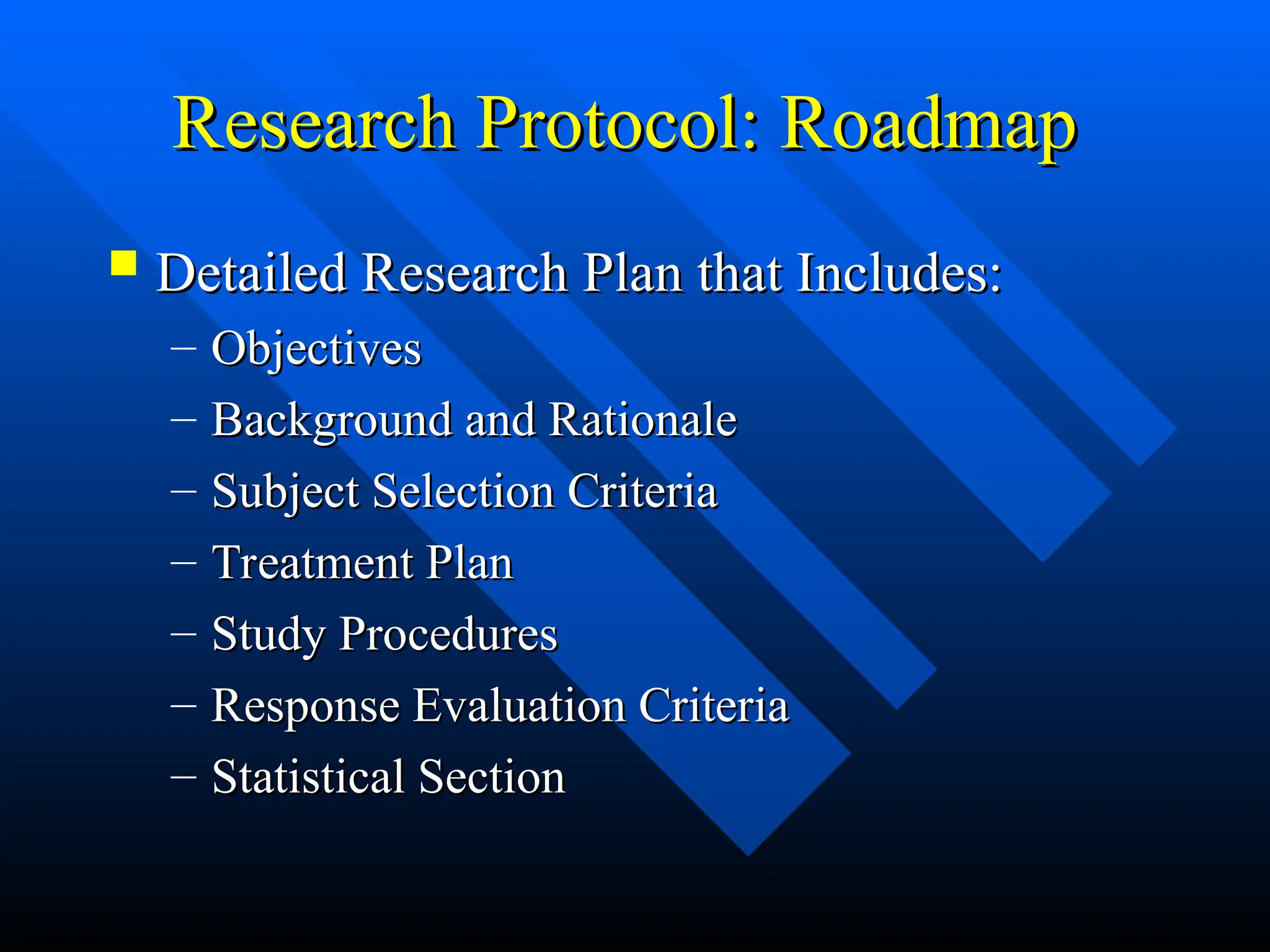
Research Protocol: Roadmap
 Detailed Research Plan that Includes:
Detailed Research Plan that Includes:
– Objectives
Objectives
– Background and Rationale
Background and Rationale
– Subject Selection Criteria
Subject Selection Criteria
– Treatment Plan
Treatment Plan
– Study Procedures
Study Procedures
– Response Evaluation Criteria
Response Evaluation Criteria
– Statistical Section
Statistical Section
Human Research is Highly
Regulated
Regulated
 Code of Federal Regulations (CFR)
Code of Federal Regulations (CFR)
– Title 21- Food and Drugs
Title 21- Food and Drugs
» Part 50 Informed Consent
Part 50 Informed Consent
» Part 56 IRB
Part 56 IRB
» Part 312 IND
Part 312 IND
» Part 314 NDA
Part 314 NDA
» Part 600, 6001 Biologics
Part 600, 6001 Biologics
» Part 812, 813, 814 Medical Devices
Part 812, 813, 814 Medical Devices
– Title 45- Public Welfare
Title 45- Public Welfare
» Part 46
Part 46 (subparts B, C, D)
(subparts B, C, D) DHHS, Protection of Human subjects
DHHS, Protection of Human subjects
What About International
Regulation?
Regulation?
 E6 Good Clinical Practice (GCP):
E6 Good Clinical Practice (GCP):
Consolidated Guidance
– International ethical and scientific quality
International ethical and scientific quality
standard for designing, conducting, recording
and reporting trial results.
Why is Human Research Highly
Regulated?
Regulated?
 Past transgressions lead to the need for laws
Past transgressions lead to the need for laws
that protect the rights and welfare of human
subjects.
subjects.
– Nuremberg Doctors Trial of 1946 (Nuremberg Code)
Nuremberg Doctors Trial of 1946 (Nuremberg Code)
– Thalidomide Tragedy (Kefauver-Harris Amendment)
Thalidomide Tragedy (Kefauver-Harris Amendment)
– Tuskegee Experiments (Belmont Report)
Tuskegee Experiments (Belmont Report)
– Human Radiation Experiments
Human Radiation Experiments
– Gene Transfer Experiment
Gene Transfer Experiment
Informed Consent
Informed Consent
 Learning the key facts about a trial
Learning the key facts about a trial before
before
deciding whether to participate.
– Research study purpose
Research study purpose
– Risks/Benefits
Risks/Benefits
– Alternative treatments
Alternative treatments
– Confidentiality of records
Confidentiality of records
– Medical treatment available if injury occurs
Medical treatment available if injury occurs
– Whom to contact for answers to questions
Whom to contact for answers to questions
– Statement that participation is
Statement that participation is voluntary
voluntary
Institutional Review Board
(IRB)
(IRB)
 All clinical trials must be approved and
All clinical trials must be approved and
monitored by an IRB.
 IRB is an independent committee of
IRB is an independent committee of
physicians, nurses, statisticians, community
advocates and others.
 The function of the IRB is to ensure that a
The function of the IRB is to ensure that a
clinical trial is ethical and the rights welfare
of study participants are protected.
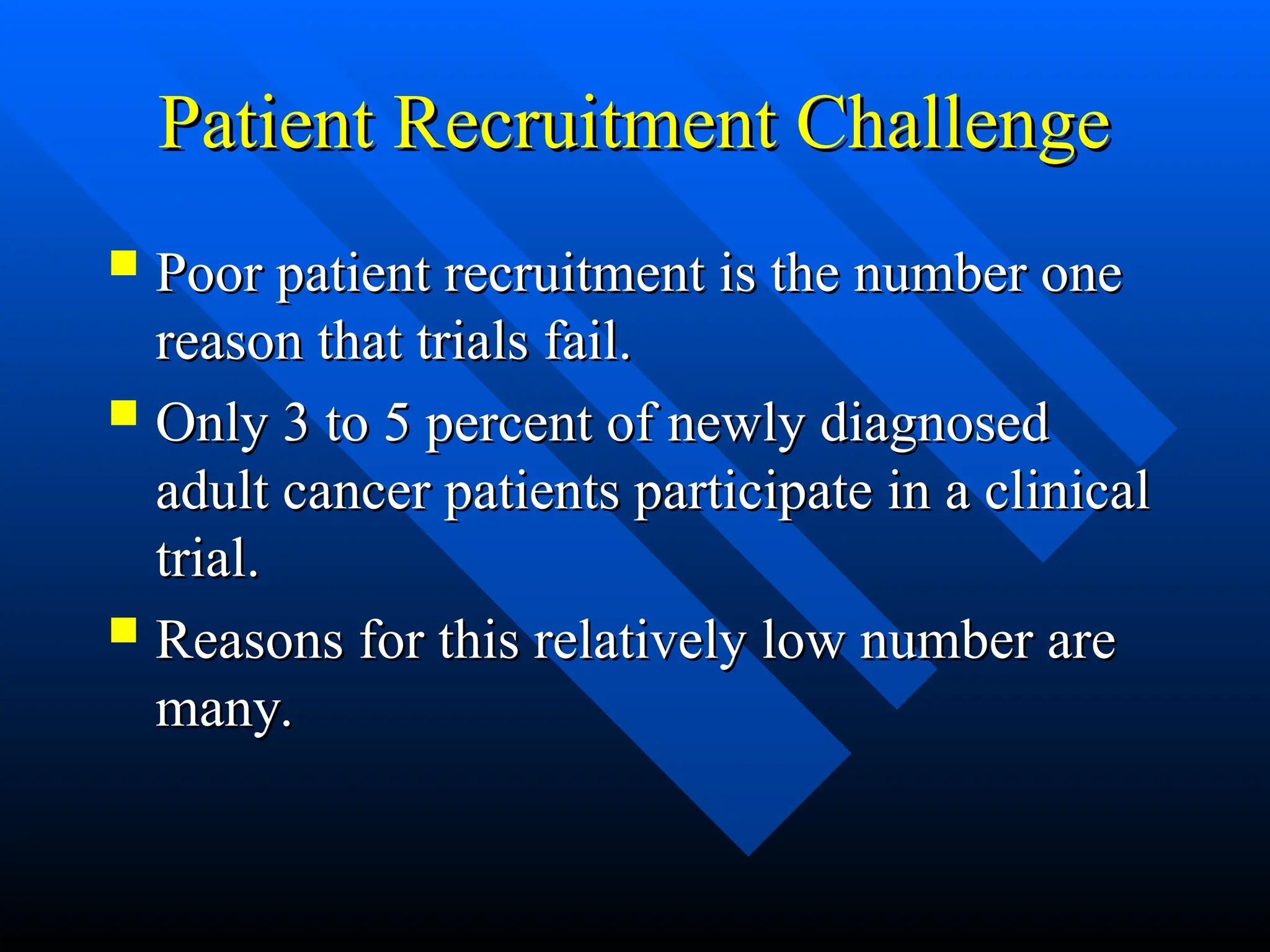
Patient Recruitment Challenge
 Poor patient recruitment is the number one
Poor patient recruitment is the number one
reason that trials fail.
 Only 3 to 5 percent of newly diagnosed
Only 3 to 5 percent of newly diagnosed
adult cancer patients participate in a clinical
trial.
trial.
 Reasons for this relatively low number are
Reasons for this relatively low number are
many.
many.
Recruitment Strategies
 Physician trust and contact
Physician trust and contact
 Study staff contact
Study staff contact
 Speaking to community groups
Speaking to community groups
 Newspaper and radio Ads
Newspaper and radio Ads
 Internet websites
Internet websites
 Physician referrals
Physician referrals
Subject Data Collection
 Data is collected on case report forms
Data is collected on case report forms
(CRF)
(CRF)
 Much of clinical data is taken from the
Much of clinical data is taken from the
subjects medical record (source documents)
 Pharmaceutical and device trials, data is
Pharmaceutical and device trials, data is
verified by multiple players
Serious Adverse Events
 Events that results in any of the following:
Events that results in any of the following:
– Death or life-threatening
Death or life-threatening
– Hospitalization or prolonged hospitalization
Hospitalization or prolonged hospitalization
– Persistent or significant disability/incapacity
Persistent or significant disability/incapacity
– Congenital anomaly/birth defect
Congenital anomaly/birth defect
 Events that are serious, unexpected, and
Events that are serious, unexpected, and
related or possibly related to participation in
the research must be reported to the
Sponsor, FDA and IRB in a timely manner.
Clinical Trial End Product
 Ideal: Unambiguous conclusion regarding
Ideal: Unambiguous conclusion regarding
the clinical outcome of the test
treatment/device.
treatment/device.
 Always strive for the ideal, but in most
Always strive for the ideal, but in most
cases have to settle for the best comprise.

Clinical Trial Process to see overall trial.ppt

  • 1.
    Clinical Trial Process:An Clinical Trial Process: An Overview Overview John O. Naim, Ph.D. John O. Naim, Ph.D. Director, Clinical Trials Research Director, Clinical Trials Research Unit Unit West Virginia University West Virginia University Mary Babb Randolph Cancer Center Mary Babb Randolph Cancer Center
  • 2.
    What Is aClinical Trial? What Is a Clinical Trial?  Effectiveness of intervention to treat a Effectiveness of intervention to treat a disease disease  Safety of a new drug Safety of a new drug  Defining dose administration Defining dose administration  Testing drug formulation Testing drug formulation  Exploring combination therapies Exploring combination therapies  Evaluating effect of therapies on quality of Evaluating effect of therapies on quality of life life
  • 3.
    Types of ClinicalTrials Types of Clinical Trials  Treatment Treatment – Test new approaches to treat a disease Test new approaches to treat a disease  Prevention Prevention – What approaches can prevent disease What approaches can prevent disease  Early-detection/screening Early-detection/screening – What are new ways to find hidden disease What are new ways to find hidden disease  Diagnostic Diagnostic – How can new tests or procedures ID disease How can new tests or procedures ID disease
  • 4.
    Phases of DrugDevelopment Phases of Drug Development Phase 1 Phase 1 Phase 2 Phase 2 Phase 3 Phase 3 Phase 4 Phase 4 No. of No. of Participants Participants 15-30 15-30 <100 <100 100 to 100 to thousands thousands Several Several hundreds to hundreds to several several thousands thousands Purpose Purpose First in First in humans humans Find safe Find safe dose dose Determine Determine efficacy efficacy Compare Compare new agent new agent with with standard standard treatment treatment Post –market Post –market Long-term Long-term safety and safety and efficacy efficacy
  • 5.
    Who are thePlayers? Who are the Players?  Human Subject Volunteers Human Subject Volunteers  Physician Investigators Physician Investigators  Research Nurses Research Nurses  Pharmacists Pharmacists  Lab Techs Lab Techs  Social Workers Social Workers  Data Managers Data Managers
  • 6.
    Research Protocol: Roadmap ResearchProtocol: Roadmap  Detailed Research Plan that Includes: Detailed Research Plan that Includes: – Objectives Objectives – Background and Rationale Background and Rationale – Subject Selection Criteria Subject Selection Criteria – Treatment Plan Treatment Plan – Study Procedures Study Procedures – Response Evaluation Criteria Response Evaluation Criteria – Statistical Section Statistical Section
  • 7.
    Human Research isHighly Human Research is Highly Regulated Regulated  Code of Federal Regulations (CFR) Code of Federal Regulations (CFR) – Title 21- Food and Drugs Title 21- Food and Drugs » Part 50 Informed Consent Part 50 Informed Consent » Part 56 IRB Part 56 IRB » Part 312 IND Part 312 IND » Part 314 NDA Part 314 NDA » Part 600, 6001 Biologics Part 600, 6001 Biologics » Part 812, 813, 814 Medical Devices Part 812, 813, 814 Medical Devices – Title 45- Public Welfare Title 45- Public Welfare » Part 46 Part 46 (subparts B, C, D) (subparts B, C, D) DHHS, Protection of Human subjects DHHS, Protection of Human subjects
  • 8.
    What About International WhatAbout International Regulation? Regulation?  E6 Good Clinical Practice (GCP): E6 Good Clinical Practice (GCP): Consolidated Guidance Consolidated Guidance – International ethical and scientific quality International ethical and scientific quality standard for designing, conducting, recording standard for designing, conducting, recording and reporting trial results. and reporting trial results.
  • 9.
    Why is HumanResearch Highly Why is Human Research Highly Regulated? Regulated?  Past transgressions lead to the need for laws Past transgressions lead to the need for laws that protect the rights and welfare of human that protect the rights and welfare of human subjects. subjects. – Nuremberg Doctors Trial of 1946 (Nuremberg Code) Nuremberg Doctors Trial of 1946 (Nuremberg Code) – Thalidomide Tragedy (Kefauver-Harris Amendment) Thalidomide Tragedy (Kefauver-Harris Amendment) – Tuskegee Experiments (Belmont Report) Tuskegee Experiments (Belmont Report) – Human Radiation Experiments Human Radiation Experiments – Gene Transfer Experiment Gene Transfer Experiment
  • 10.
    Informed Consent Informed Consent Learning the key facts about a trial Learning the key facts about a trial before before deciding whether to participate. deciding whether to participate. – Research study purpose Research study purpose – Risks/Benefits Risks/Benefits – Alternative treatments Alternative treatments – Confidentiality of records Confidentiality of records – Medical treatment available if injury occurs Medical treatment available if injury occurs – Whom to contact for answers to questions Whom to contact for answers to questions – Statement that participation is Statement that participation is voluntary voluntary
  • 11.
    Institutional Review Board InstitutionalReview Board (IRB) (IRB)  All clinical trials must be approved and All clinical trials must be approved and monitored by an IRB. monitored by an IRB.  IRB is an independent committee of IRB is an independent committee of physicians, nurses, statisticians, community physicians, nurses, statisticians, community advocates and others. advocates and others.  The function of the IRB is to ensure that a The function of the IRB is to ensure that a clinical trial is ethical and the rights welfare clinical trial is ethical and the rights welfare of study participants are protected. of study participants are protected.
  • 12.
    Patient Recruitment Challenge PatientRecruitment Challenge  Poor patient recruitment is the number one Poor patient recruitment is the number one reason that trials fail. reason that trials fail.  Only 3 to 5 percent of newly diagnosed Only 3 to 5 percent of newly diagnosed adult cancer patients participate in a clinical adult cancer patients participate in a clinical trial. trial.  Reasons for this relatively low number are Reasons for this relatively low number are many. many.
  • 13.
    Recruitment Strategies Recruitment Strategies Physician trust and contact Physician trust and contact  Study staff contact Study staff contact  Speaking to community groups Speaking to community groups  Newspaper and radio Ads Newspaper and radio Ads  Internet websites Internet websites  Physician referrals Physician referrals
  • 14.
    Subject Data Collection SubjectData Collection  Data is collected on case report forms Data is collected on case report forms (CRF) (CRF)  Much of clinical data is taken from the Much of clinical data is taken from the subjects medical record (source documents) subjects medical record (source documents)  Pharmaceutical and device trials, data is Pharmaceutical and device trials, data is verified by multiple players verified by multiple players
  • 15.
    Serious Adverse Events SeriousAdverse Events  Events that results in any of the following: Events that results in any of the following: – Death or life-threatening Death or life-threatening – Hospitalization or prolonged hospitalization Hospitalization or prolonged hospitalization – Persistent or significant disability/incapacity Persistent or significant disability/incapacity – Congenital anomaly/birth defect Congenital anomaly/birth defect  Events that are serious, unexpected, and Events that are serious, unexpected, and related or possibly related to participation in related or possibly related to participation in the research must be reported to the the research must be reported to the Sponsor, FDA and IRB in a timely manner. Sponsor, FDA and IRB in a timely manner.
  • 16.
    Clinical Trial EndProduct Clinical Trial End Product  Ideal: Unambiguous conclusion regarding Ideal: Unambiguous conclusion regarding the clinical outcome of the test the clinical outcome of the test treatment/device. treatment/device.  Always strive for the ideal, but in most Always strive for the ideal, but in most cases have to settle for the best comprise. cases have to settle for the best comprise.