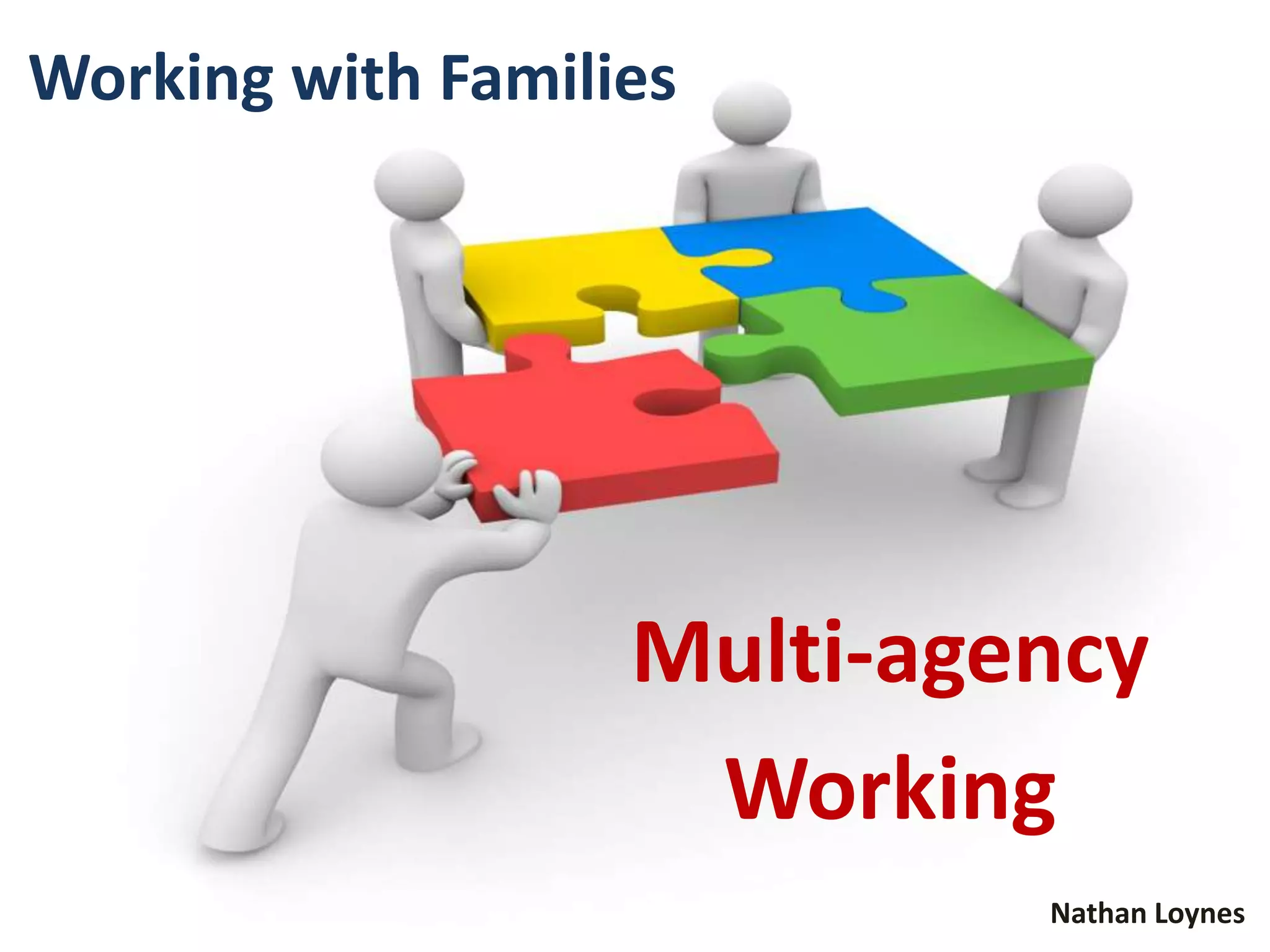
Working with Families

Multi-agency
Working
Nathan Loynes
“Multi-disciplinary
collaborations involve a number
of

differences that can

easily

clash”
Thompson, (2009:183)
Values

Norms

Priorities

Protocols

Perspectives

Experiences

Budgets
“Working in partnership is
important to avoid these

3

sets of

problems”
Thompson, (2009:184-5)
1. Falling between 2 stools
2. Wasteful overlap
3. Pulling in different directions
How might each of these appear?

Thompson, (2009:184-5)
“In some of these situations, clients
may receive contradictory advice, with
one person undermining the efforts of
another. In many situations this will
happen unwittingly [not deliberate],
but, unfortunately, there are cases on
record of this happening intentionally
– clearly very poor, unethical practice.”

Thompson, (2009:185)
Read Thomson, 2009:186-8
Principles of working together
How might each of the following principles be
affected in communications between a Health
professional (i.e. a Midwife) and a Social Care
professional (i.e. a Family Support Worker)?
Avoid stereotypes
Understand each
other’s roles
Be sensitive
Avoid
Hierarchies
Avoid preciousness Focus
on communication
Conclusion:
• Multi-disciplinary collaboration has always
been important. In recent years it has received
renewed emphasis:
• Development in Law
• Development in Policy
• Recognition of impact on clients
• Never-the-less, ‘Human Factors’ often impede
effective collaboration.
Development in Law
The Children Act 2004

•S.10 A new duty on agencies to co-operate
to improve the well-being of children and young
people.

•S.11

A duty to safeguard and

the welfare of children.

promote
Development in Policy
(Victoria Climbie : 25 February 2000)
Every Child Matters, 2004
What did ECM mean?

•More roles
•More interventions
•More skills
“Multi-agency working has shown
to be an effective way of
supporting children and young
people with additional needs,
securing real improvements in
their life outcomes”.
(www.everychildmatters.gov.uk,
cited in Rawlings, 2008:77)
More Skills? Earlier & Better
Assessments of need
Assessment is part of a bigger process
The Common Assessment Framework
Summary:
• Renewed emphasis following death of Victoria
Climbie (2000).
• Climbie case characterised by a failure for
professionals to collaborate and
communicate.
• Acknowledgement that improved professional
communication could improve out comes for
all children.
Summary (continued)
• ECM policy devised to unify the goals that all
children’s professionals should be working
towards.
• This to be achieved through improved
communication and collaboration.
• Communication and Collaboration given
increased statutory importance by The
Children Act 2004.
Summary (continued)
• This needed to be achieved by different
systems, role creation and training in skills.
• These systems, roles and skills can be
exemplified in the Common Assessment
Framework.
• The CAF is a graduated and systematic
approach focused upon early identification of
needs with the intention to provide services
before ‘things get too far/bad’.
Finally:
• Although, communication and collaboration
(Multi-agency working) ‘look good on paper’
and most professionals would sign-up to their
aims ‘in principle’; ideal effective multi-agency
partnerships remain difficult to achieve and
maintain in practice.
• (See Cheminais 2009 in today’s pack for more
detail on these barriers and benefits)

Multi agency working

  • 1.
  • 4.
    “Multi-disciplinary collaborations involve anumber of differences that can easily clash” Thompson, (2009:183)
  • 5.
  • 6.
    “Working in partnershipis important to avoid these 3 sets of problems” Thompson, (2009:184-5)
  • 7.
    1. Falling between2 stools 2. Wasteful overlap 3. Pulling in different directions How might each of these appear? Thompson, (2009:184-5)
  • 8.
    “In some ofthese situations, clients may receive contradictory advice, with one person undermining the efforts of another. In many situations this will happen unwittingly [not deliberate], but, unfortunately, there are cases on record of this happening intentionally – clearly very poor, unethical practice.” Thompson, (2009:185)
  • 9.
    Read Thomson, 2009:186-8 Principlesof working together How might each of the following principles be affected in communications between a Health professional (i.e. a Midwife) and a Social Care professional (i.e. a Family Support Worker)? Avoid stereotypes Understand each other’s roles Be sensitive Avoid Hierarchies Avoid preciousness Focus on communication
  • 10.
    Conclusion: • Multi-disciplinary collaborationhas always been important. In recent years it has received renewed emphasis: • Development in Law • Development in Policy • Recognition of impact on clients • Never-the-less, ‘Human Factors’ often impede effective collaboration.
  • 11.
    Development in Law TheChildren Act 2004 •S.10 A new duty on agencies to co-operate to improve the well-being of children and young people. •S.11 A duty to safeguard and the welfare of children. promote
  • 12.
    Development in Policy (VictoriaClimbie : 25 February 2000)
  • 13.
  • 14.
    What did ECMmean? •More roles •More interventions •More skills
  • 15.
    “Multi-agency working hasshown to be an effective way of supporting children and young people with additional needs, securing real improvements in their life outcomes”. (www.everychildmatters.gov.uk, cited in Rawlings, 2008:77)
  • 16.
    More Skills? Earlier& Better Assessments of need
  • 17.
    Assessment is partof a bigger process
  • 18.
  • 19.
    Summary: • Renewed emphasisfollowing death of Victoria Climbie (2000). • Climbie case characterised by a failure for professionals to collaborate and communicate. • Acknowledgement that improved professional communication could improve out comes for all children.
  • 20.
    Summary (continued) • ECMpolicy devised to unify the goals that all children’s professionals should be working towards. • This to be achieved through improved communication and collaboration. • Communication and Collaboration given increased statutory importance by The Children Act 2004.
  • 21.
    Summary (continued) • Thisneeded to be achieved by different systems, role creation and training in skills. • These systems, roles and skills can be exemplified in the Common Assessment Framework. • The CAF is a graduated and systematic approach focused upon early identification of needs with the intention to provide services before ‘things get too far/bad’.
  • 22.
    Finally: • Although, communicationand collaboration (Multi-agency working) ‘look good on paper’ and most professionals would sign-up to their aims ‘in principle’; ideal effective multi-agency partnerships remain difficult to achieve and maintain in practice. • (See Cheminais 2009 in today’s pack for more detail on these barriers and benefits)