HEALTHY FAMILY
RELATIONSHIPS!!!
Q OF THE DAY
Write about your favorite
family tradition.
 What makes this tradition so great?
 When does it occur?
 Who participates?
FAMILY RELATIONSHIPS
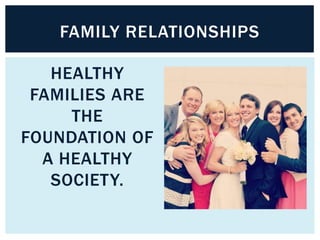
HEALTHY
FAMILIES ARE
THE
FOUNDATION OF
A HEALTHY
SOCIETY.
WHAT IS A FAMILY?
FAMILY: The basic unit of society
 What does family mean to you?

 Why is it be important to establish healthy families?
ď‚§ Promoting healthy families contributes to a healthy society!

 How can we promote healthy families?
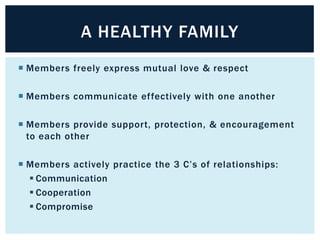
A HEALTHY FAMILY
 Members freely express mutual love & respect
 Members communicate effectively with one another
 Members provide support, protection, & encouragement
to each other
 Members actively practice the 3 C’s of relationships:
ď‚§ Communication
ď‚§ Cooperation
ď‚§ Compromise
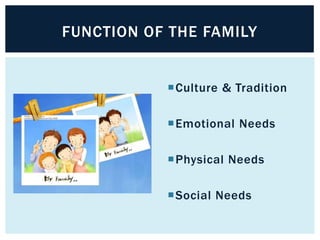
FUNCTION OF THE FAMILY

Culture & Tradition
Emotional Needs
Physical Needs

Social Needs
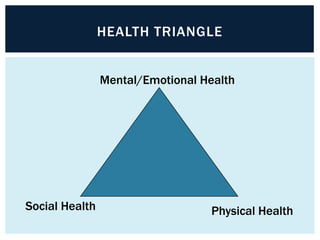
HEALTH TRIANGLE
Mental/Emotional Health

Social Health

Physical Health
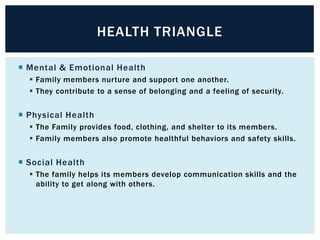
HEALTH TRIANGLE
 Mental & Emotional Health
ď‚§ Family members nurture and support one another.
ď‚§ They contribute to a sense of belonging and a feeling of security.

 Physical Health
ď‚§ The Family provides food, clothing, and shelter to its members.
ď‚§ Family members also promote healthful behaviors and safety skills.

 Social Health
ď‚§ The family helps its members develop communication skills and the
ability to get along with others.
TYPES OF FAMILIES
 Nuclear Family: two parents and one or more
children living in the same place .
 Single Parent Family: one parent caring for one or
more children.
 Blended Family: consists of a married couple and
their children from previous marriages (formed when
a single parent remarries).
TYPES OF FAMILIES
 Extended Family: a family that includes additional
relatives beyond parents and children.
 Adoptive Family: consist of a parent or parents and
one or more adopted children. Can have both
adopted and biological children.
 Foster Family: the temporary placement of children
in the homes of adults who are not related to them.
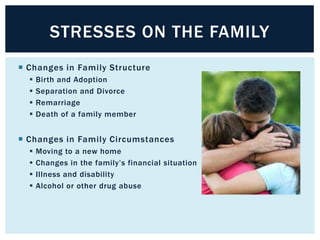
STRESSES ON THE FAMILY
 Changes in Family Structure
ď‚§
ď‚§
ď‚§
ď‚§

Birth and Adoption
Separation and Divorce
Remarriage
Death of a family member

 Changes in Family Circumstances
ď‚§
ď‚§
ď‚§
ď‚§

Moving to a new home
Changes in the family’s financial situation
Illness and disability
Alcohol or other drug abuse
CHANGES OCCURRING IN THE
FAMILY TODAY
 Dual Income
ď‚§ How does this affect the family?
 Blended Families
ď‚§ How can this cause stress in the family?
ď‚§ Why is this a new situation we are being face with?
 Single Parents
ď‚§ What difficulties can this cause?
ď‚§ Why is this a new circumstance today?
BIRTH ORDER
 Birth order: The order in which children are born into
a family influences the development of the children.
 Each group is to list the advantages and disadvantages of
their birth order on the butcher paper. Each group will
present their findings.
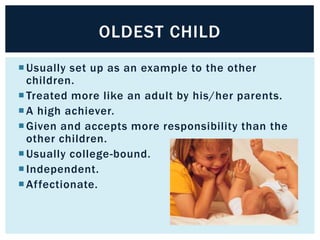
OLDEST CHILD
 Usually set up as an example to the other
children.
 Treated more like an adult by his/her parents.
 A high achiever.
 Given and accepts more responsibility than the
other children.
 Usually college-bound.
 Independent.
 Affectionate.
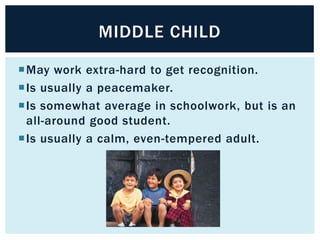
MIDDLE CHILD
May work extra-hard to get recognition.
Is usually a peacemaker.
Is somewhat average in schoolwork, but is an
all-around good student.
Is usually a calm, even-tempered adult.
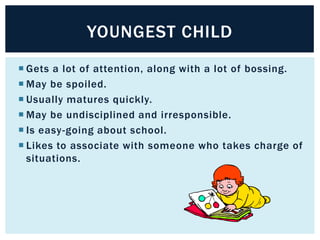
YOUNGEST CHILD
 Gets a lot of attention, along with a lot of bossing.
 May be spoiled.
 Usually matures quickly.
 May be undisciplined and irresponsible.
 Is easy-going about school.
 Likes to associate with someone who takes charge of
situations.
HOW TO STRENGTHEN FAMILY
RELATIONSHIPS…
MAKE DEPOSITES!!!!!
“You are 100% responsible for 50% of the
relationship!!”
 Demonstrate care & love
 Show support, especially during difficult times
 Demonstrate trust
 Express commitment
 Be responsible
 Spend time together
 Respect individuality
 Work together to solve problems
 Be sensitive to others’ needs

Family relationships final

  • 1.
  • 2.
    Q OF THEDAY Write about your favorite family tradition.  What makes this tradition so great?  When does it occur?  Who participates?
  • 3.
  • 4.
    WHAT IS AFAMILY? FAMILY: The basic unit of society  What does family mean to you?  Why is it be important to establish healthy families?  Promoting healthy families contributes to a healthy society!  How can we promote healthy families?
  • 5.
    A HEALTHY FAMILY Members freely express mutual love & respect  Members communicate effectively with one another  Members provide support, protection, & encouragement to each other  Members actively practice the 3 C’s of relationships:  Communication  Cooperation  Compromise
  • 6.
    FUNCTION OF THEFAMILY Culture & Tradition Emotional Needs Physical Needs Social Needs
  • 7.
  • 8.
    HEALTH TRIANGLE  Mental& Emotional Health  Family members nurture and support one another.  They contribute to a sense of belonging and a feeling of security.  Physical Health  The Family provides food, clothing, and shelter to its members.  Family members also promote healthful behaviors and safety skills.  Social Health  The family helps its members develop communication skills and the ability to get along with others.
  • 9.
    TYPES OF FAMILIES Nuclear Family: two parents and one or more children living in the same place .  Single Parent Family: one parent caring for one or more children.  Blended Family: consists of a married couple and their children from previous marriages (formed when a single parent remarries).
  • 10.
    TYPES OF FAMILIES Extended Family: a family that includes additional relatives beyond parents and children.  Adoptive Family: consist of a parent or parents and one or more adopted children. Can have both adopted and biological children.  Foster Family: the temporary placement of children in the homes of adults who are not related to them.
  • 11.
    STRESSES ON THEFAMILY  Changes in Family Structure     Birth and Adoption Separation and Divorce Remarriage Death of a family member  Changes in Family Circumstances     Moving to a new home Changes in the family’s financial situation Illness and disability Alcohol or other drug abuse
  • 12.
    CHANGES OCCURRING INTHE FAMILY TODAY  Dual Income  How does this affect the family?  Blended Families  How can this cause stress in the family?  Why is this a new situation we are being face with?  Single Parents  What difficulties can this cause?  Why is this a new circumstance today?
  • 13.
    BIRTH ORDER  Birthorder: The order in which children are born into a family influences the development of the children.  Each group is to list the advantages and disadvantages of their birth order on the butcher paper. Each group will present their findings.
  • 14.
    OLDEST CHILD  Usuallyset up as an example to the other children.  Treated more like an adult by his/her parents.  A high achiever.  Given and accepts more responsibility than the other children.  Usually college-bound.  Independent.  Affectionate.
  • 15.
    MIDDLE CHILD May workextra-hard to get recognition. Is usually a peacemaker. Is somewhat average in schoolwork, but is an all-around good student. Is usually a calm, even-tempered adult.
  • 16.
    YOUNGEST CHILD  Getsa lot of attention, along with a lot of bossing.  May be spoiled.  Usually matures quickly.  May be undisciplined and irresponsible.  Is easy-going about school.  Likes to associate with someone who takes charge of situations.
  • 17.
    HOW TO STRENGTHENFAMILY RELATIONSHIPS… MAKE DEPOSITES!!!!! “You are 100% responsible for 50% of the relationship!!”  Demonstrate care & love  Show support, especially during difficult times  Demonstrate trust  Express commitment  Be responsible  Spend time together  Respect individuality  Work together to solve problems  Be sensitive to others’ needs