© SpringPeople Software Private Limited, All Rights Reserved.
Introduction to Mule
ESB
Agenda
• What is Mule?
• How do you use Mule?
• What are the core Mule concepts?
• Learning mule with File endpoints
Enterprise Service Backbone
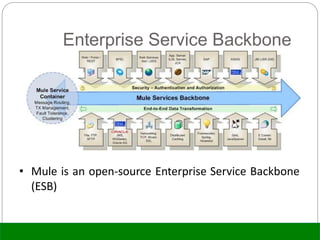
• Mule is an open-source Enterprise Service Backbone
(ESB)
Mule – Advanced Technologies
 •SEDA
 Staged Event-Driven Architecture
 •Java NIO
 Java New Input/Output
Mule’s “Moves Things Around”
• Folder to folder
• Queue to queue
• Shared memory to shared memory
• Using different types of transports
• In a flexible way
XML Pipeline
© SpringPeople Software Private Limited, All
Rights Reserved.
• An XML pipeline is a series of operation that
are performed on one or more XML files
• Examples include:
– validate
– transform
– prune (remove nodes)
– split (break a single XML file into many files)
– merge (join two or more files together)
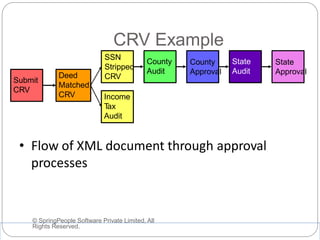
CRV Example
© SpringPeople Software Private Limited, All
Rights Reserved.
• Flow of XML document through approval
processes
Submit
CRV
Deed
Matched
CRV
SSN
Stripped
CRV
Income
Tax
Audit
County
Audit
County
Approval
State
Audit
State
Approval
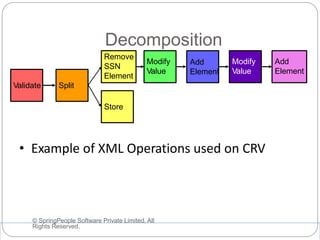
Decomposition
© SpringPeople Software Private Limited, All
Rights Reserved.
• Example of XML Operations used on CRV
Validate Split
Remove
SSN
Element
Store
Modify
Value
Add
Element
Modify
Value
Add
Element
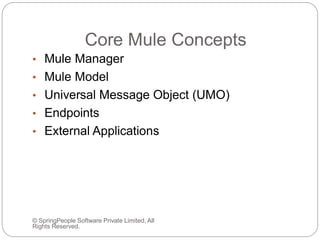
Core Mule Concepts
© SpringPeople Software Private Limited, All
Rights Reserved.
• Mule Manager
• Mule Model
• Universal Message Object (UMO)
• Endpoints
• External Applications
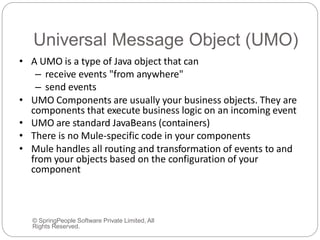
Universal Message Object (UMO)
© SpringPeople Software Private Limited, All
Rights Reserved.
• A UMO is a type of Java object that can
– receive events "from anywhere"
– send events
• UMO Components are usually your business objects. They are
components that execute business logic on an incoming event
• UMO are standard JavaBeans (containers)
• There is no Mule-specific code in your components
• Mule handles all routing and transformation of events to and
from your objects based on the configuration of your
component
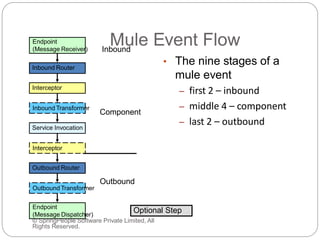
Mule Event Flow
© SpringPeople Software Private Limited, All
Rights Reserved.
• The nine stages of a
mule event
– first 2 – inbound
– middle 4 – component
– last 2 – outbound
Endpoint
(Message Receiver)
Endpoint
(Message Dispatcher)
Inbound Router
Outbound Router
Inbound Transformer
Outbound Transformer
Interceptor
Service Invocation
Interceptor
Inbound
Component
Outbound
Optional Step
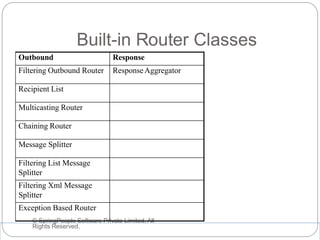
Built-in Router Classes
© SpringPeople Software Private Limited, All
Rights Reserved.
Outbound Response
Filtering Outbound Router ResponseAggregator
Recipient List
Multicasting Router
Chaining Router
Message Splitter
Filtering List Message
Splitter
Filtering Xml Message
Splitter
Exception Based Router
Exception Handling
© SpringPeople Software Private Limited, All
Rights Reserved.
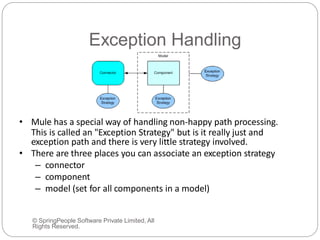
• Mule has a special way of handling non-happy path processing.
This is called an "Exception Strategy" but is it really just and
exception path and there is very little strategy involved.
• There are three places you can associate an exception strategy
– connector
– component
– model (set for all components in a model)
Exception Strategy
© SpringPeople Software Private Limited, All
Rights Reserved.
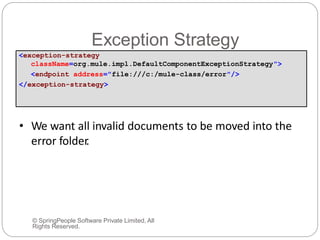
• We want all invalid documents to be moved into the
error folder.
<exception-strategy
className=org.mule.impl.DefaultComponentExceptionStrategy">
<endpoint address="file:///c:/mule-class/error"/>
</exception-strategy>
Who will benefit?
© SpringPeople Software Private Limited, All
Rights Reserved.
Developers, Enterprise Architects and Development Managers having
knowledge in JAVA
Thank you
© SpringPeople Software Private Limited, All
Rights Reserved.

Introduction to mule esb

  • 1.
    © SpringPeople SoftwarePrivate Limited, All Rights Reserved. Introduction to Mule ESB
  • 2.
    Agenda • What isMule? • How do you use Mule? • What are the core Mule concepts? • Learning mule with File endpoints
  • 3.
    Enterprise Service Backbone •Mule is an open-source Enterprise Service Backbone (ESB)
  • 4.
    Mule – AdvancedTechnologies  •SEDA  Staged Event-Driven Architecture  •Java NIO  Java New Input/Output
  • 5.
    Mule’s “Moves ThingsAround” • Folder to folder • Queue to queue • Shared memory to shared memory • Using different types of transports • In a flexible way
  • 6.
    XML Pipeline © SpringPeopleSoftware Private Limited, All Rights Reserved. • An XML pipeline is a series of operation that are performed on one or more XML files • Examples include: – validate – transform – prune (remove nodes) – split (break a single XML file into many files) – merge (join two or more files together)
  • 7.
    CRV Example © SpringPeopleSoftware Private Limited, All Rights Reserved. • Flow of XML document through approval processes Submit CRV Deed Matched CRV SSN Stripped CRV Income Tax Audit County Audit County Approval State Audit State Approval
  • 8.
    Decomposition © SpringPeople SoftwarePrivate Limited, All Rights Reserved. • Example of XML Operations used on CRV Validate Split Remove SSN Element Store Modify Value Add Element Modify Value Add Element
  • 9.
    Core Mule Concepts ©SpringPeople Software Private Limited, All Rights Reserved. • Mule Manager • Mule Model • Universal Message Object (UMO) • Endpoints • External Applications
  • 10.
    Universal Message Object(UMO) © SpringPeople Software Private Limited, All Rights Reserved. • A UMO is a type of Java object that can – receive events "from anywhere" – send events • UMO Components are usually your business objects. They are components that execute business logic on an incoming event • UMO are standard JavaBeans (containers) • There is no Mule-specific code in your components • Mule handles all routing and transformation of events to and from your objects based on the configuration of your component
  • 11.
    Mule Event Flow ©SpringPeople Software Private Limited, All Rights Reserved. • The nine stages of a mule event – first 2 – inbound – middle 4 – component – last 2 – outbound Endpoint (Message Receiver) Endpoint (Message Dispatcher) Inbound Router Outbound Router Inbound Transformer Outbound Transformer Interceptor Service Invocation Interceptor Inbound Component Outbound Optional Step
  • 12.
    Built-in Router Classes ©SpringPeople Software Private Limited, All Rights Reserved. Outbound Response Filtering Outbound Router ResponseAggregator Recipient List Multicasting Router Chaining Router Message Splitter Filtering List Message Splitter Filtering Xml Message Splitter Exception Based Router
  • 13.
    Exception Handling © SpringPeopleSoftware Private Limited, All Rights Reserved. • Mule has a special way of handling non-happy path processing. This is called an "Exception Strategy" but is it really just and exception path and there is very little strategy involved. • There are three places you can associate an exception strategy – connector – component – model (set for all components in a model)
  • 14.
    Exception Strategy © SpringPeopleSoftware Private Limited, All Rights Reserved. • We want all invalid documents to be moved into the error folder. <exception-strategy className=org.mule.impl.DefaultComponentExceptionStrategy"> <endpoint address="file:///c:/mule-class/error"/> </exception-strategy>
  • 15.
    Who will benefit? ©SpringPeople Software Private Limited, All Rights Reserved. Developers, Enterprise Architects and Development Managers having knowledge in JAVA
  • 16.
    Thank you © SpringPeopleSoftware Private Limited, All Rights Reserved.