Mule and Web Services
Agenda
 Mule Overview
 Mule & web services
 Building web services integration
 The future
Overview
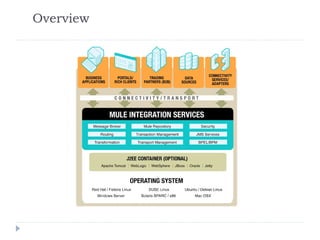
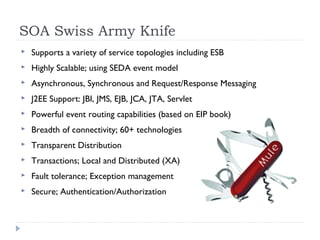
SOA Swiss Army Knife
 Supports a variety of service topologies including ESB
 Highly Scalable; using SEDA event model
 Asynchronous, Synchronous and Request/Response Messaging
 J2EE Support: JBI, JMS, EJB, JCA, JTA, Servlet
 Powerful event routing capabilities (based on EIP book)
 Breadth of connectivity; 60+ technologies
 Transparent Distribution
 Transactions; Local and Distributed (XA)
 Fault tolerance; Exception management
 Secure; Authentication/Authorization
Why do developers choose Mule?
No prescribed message format
 XML, CSV, Binary, Streams, Record, Java Objects
 Mix and match
Zero code intrusion
 Mule does not impose an API on service objects
 Objects are fully portable
Existing objects can be managed
 POJOs, IoC Objects, EJB Session Beans, Remote Objects
 REST / Web Services
Easy to test
 Mule can be run easily from a JUnit test case
 Framework provides a Test compatibility kit
 Scales down as well as up
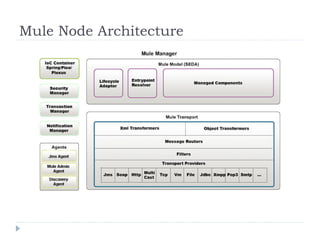
Mule Node Architecture
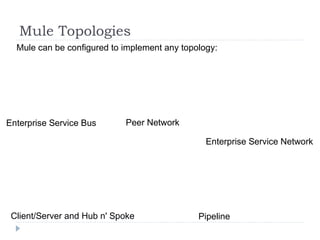
Mule Topologies
Mule can be configured to implement any topology:
Enterprise Service Bus
Client/Server and Hub n' Spoke
Peer Network
Pipeline
Enterprise Service Network
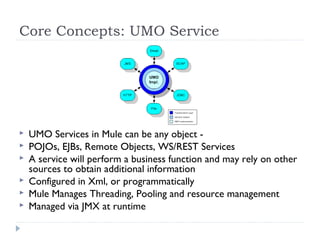
Core Concepts: UMO Service
 UMO Services in Mule can be any object -
 POJOs, EJBs, Remote Objects, WS/REST Services
 A service will perform a business function and may rely on other
sources to obtain additional information
 Configured in Xml, or programmatically
 Mule Manages Threading, Pooling and resource management
 Managed via JMX at runtime
Core Concepts: Endpoints
 Used to connect components and external
systems together
 Endpoints use a URI for Addressing
 Can have transformer, transaction, filter, security
and meta-information associated
 Two types of URI
 scheme://[username][:password]@[host]
[:port]?[params]
 smtp://ross:pass@localhost:25
 scheme://[address]?[params]
 jms://my.queue?persistent=true
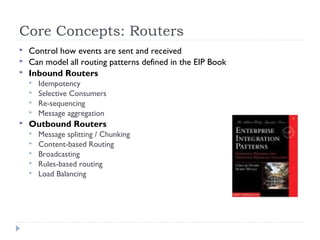
Core Concepts: Routers
 Control how events are sent and received
 Can model all routing patterns defined in the EIP Book
 Inbound Routers
 Idempotency
 Selective Consumers
 Re-sequencing
 Message aggregation
 Outbound Routers
 Message splitting / Chunking
 Content-based Routing
 Broadcasting
 Rules-based routing
 Load Balancing
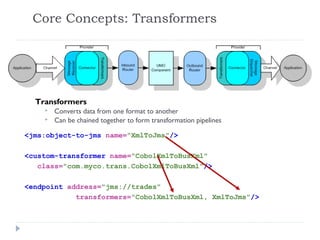
Core Concepts: Transformers
Transformers
 Converts data from one format to another
 Can be chained together to form transformation pipelines
<jms:object-to-jms name="XmlToJms"/>
<custom-transformer name="CobolXmlToBusXml"
class="com.myco.trans.CobolXmlToBusXml"/>
<endpoint address="jms://trades"
transformers="CobolXmlToBusXml, XmlToJms"/>
Mule and Web Services
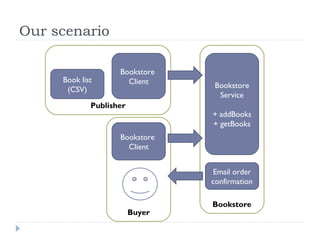
Bookstore
Publisher
Our scenario
Bookstore
Service
+ addBooks
+ getBooks
Bookstore
ClientBook list
(CSV)
Buyer
Bookstore
Client
Email order
confirmation
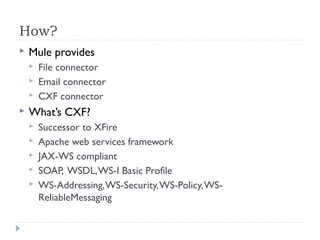
How?
 Mule provides
 File connector
 Email connector
 CXF connector
 What’s CXF?
 Successor to XFire
 Apache web services framework
 JAX-WS compliant
 SOAP, WSDL,WS-I Basic Profile
 WS-Addressing,WS-Security,WS-Policy,WS-
ReliableMessaging
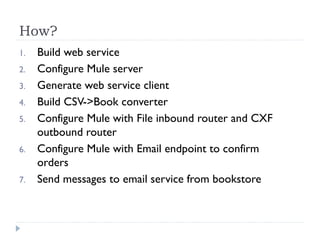
How?
1. Build web service
2. Configure Mule server
3. Generate web service client
4. Build CSV->Book converter
5. Configure Mule with File inbound router and CXF
outbound router
6. Configure Mule with Email endpoint to confirm
orders
7. Send messages to email service from bookstore
Quick Intro to JAX-WS
 The standard way to build SOAP web services
 Supports code first web service building through
annotations
 Supports WSDL first through ant/maven/command
line tools
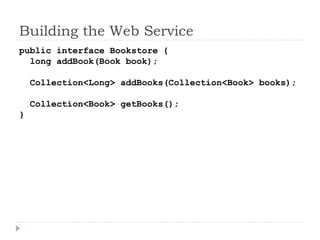
Building the Web Service
public interface Bookstore {
long addBook(Book book);
Collection<Long> addBooks(Collection<Book> books);
Collection<Book> getBooks();
}
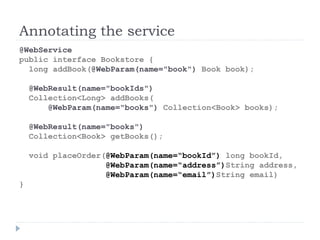
Annotating the service
@WebService
public interface Bookstore {
long addBook(@WebParam(name="book") Book book);
@WebResult(name="bookIds")
Collection<Long> addBooks(
@WebParam(name="books") Collection<Book> books);
@WebResult(name="books")
Collection<Book> getBooks();
void placeOrder(@WebParam(name=“bookId”) long bookId,
@WebParam(name=“address”)String address,
@WebParam(name=“email”)String email)
}
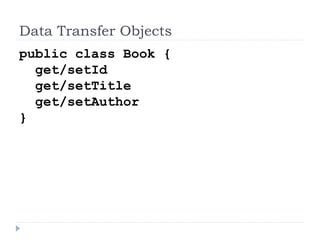
Data Transfer Objects
public class Book {
get/setId
get/setTitle
get/setAuthor
}
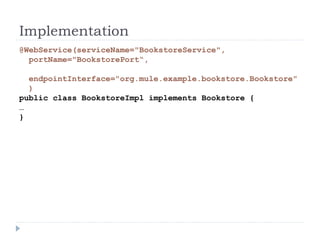
Implementation
@WebService(serviceName="BookstoreService",
portName="BookstorePort“,
endpointInterface="org.mule.example.bookstore.Bookstore"
)
public class BookstoreImpl implements Bookstore {
…
}
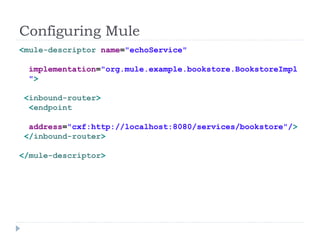
Configuring Mule
<mule-descriptor name="echoService"
implementation="org.mule.example.bookstore.BookstoreImpl
">
<inbound-router>
<endpoint
address="cxf:http://localhost:8080/services/bookstore"/>
</inbound-router>
</mule-descriptor>
Starting Mule
 Web applications
 Embedded
 Spring
 Anywhere!
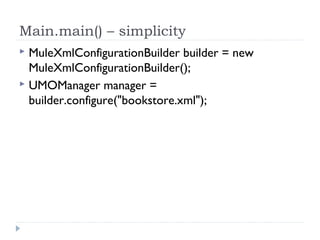
Main.main() – simplicity
 MuleXmlConfigurationBuilder builder = new
MuleXmlConfigurationBuilder();
 UMOManager manager =
builder.configure("bookstore.xml");
What happened?
Some notes about web services
 Be careful about your contracts!!!
 Don’t couple your web service too tightly (like this
example), allow a degree of separation
 This allows
 Maitainability
 Evolvability
 Versioning
 WSDL first helps this
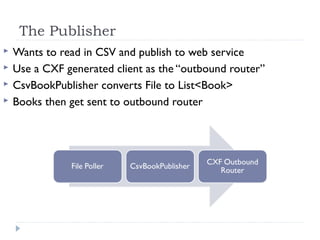
The Publisher
 Wants to read in CSV and publish to web service
 Use a CXF generated client as the “outbound router”
 CsvBookPublisher converts File to List<Book>
 Books then get sent to outbound router
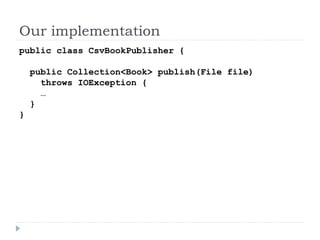
Our implementation
public class CsvBookPublisher {
public Collection<Book> publish(File file)
throws IOException {
…
}
}
Domain objects are the Messages
 File
 Book
 Title
 Author
 Access can be gained to raw UMOMessage as well
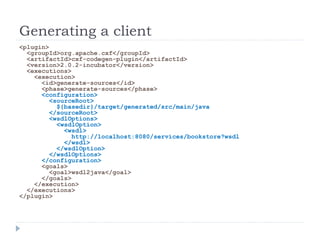
Generating a client
<plugin>
<groupId>org.apache.cxf</groupId>
<artifactId>cxf-codegen-plugin</artifactId>
<version>2.0.2-incubator</version>
<executions>
<execution>
<id>generate-sources</id>
<phase>generate-sources</phase>
<configuration>
<sourceRoot>
${basedir}/target/generated/src/main/java
</sourceRoot>
<wsdlOptions>
<wsdlOption>
<wsdl>
http://localhost:8080/services/bookstore?wsdl
</wsdl>
</wsdlOption>
</wsdlOptions>
</configuration>
<goals>
<goal>wsdl2java</goal>
</goals>
</execution>
</executions>
</plugin>
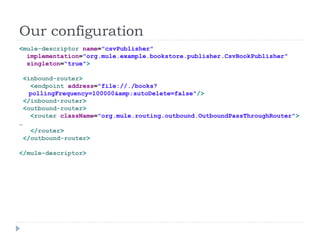
Our configuration
<mule-descriptor name="csvPublisher"
implementation="org.mule.example.bookstore.publisher.CsvBookPublisher"
singleton="true">
<inbound-router>
<endpoint address="file://./books?
pollingFrequency=100000&amp;autoDelete=false"/>
</inbound-router>
<outbound-router>
<router className="org.mule.routing.outbound.OutboundPassThroughRouter">
…
</router>
</outbound-router>
</mule-descriptor>
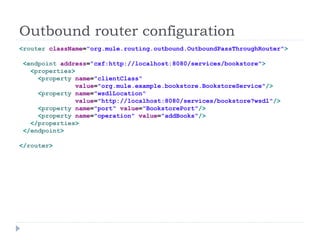
Outbound router configuration
<router className="org.mule.routing.outbound.OutboundPassThroughRouter">
<endpoint address="cxf:http://localhost:8080/services/bookstore">
<properties>
<property name="clientClass"
value="org.mule.example.bookstore.BookstoreService"/>
<property name="wsdlLocation"
value="http://localhost:8080/services/bookstore?wsdl"/>
<property name="port" value="BookstorePort"/>
<property name="operation" value="addBooks"/>
</properties>
</endpoint>
</router>
Start it up!
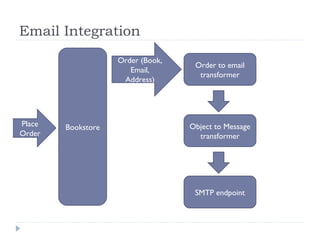
Email Integration
BookstorePlace
Order
Order (Book,
Email,
Address)
Order to email
transformer
Object to Message
transformer
SMTP endpoint
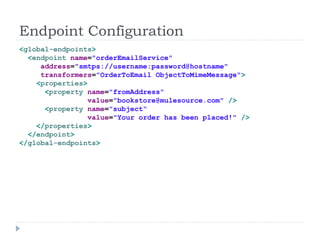
Endpoint Configuration
<global-endpoints>
<endpoint name="orderEmailService"
address="smtps://username:password@hostname"
transformers="OrderToEmail ObjectToMimeMessage">
<properties>
<property name="fromAddress"
value="bookstore@mulesource.com" />
<property name="subject“
value="Your order has been placed!" />
</properties>
</endpoint>
</global-endpoints>
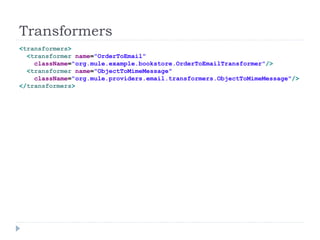
Transformers
<transformers>
<transformer name="OrderToEmail"
className="org.mule.example.bookstore.OrderToEmailTransformer"/>
<transformer name="ObjectToMimeMessage"
className="org.mule.providers.email.transformers.ObjectToMimeMessage"/>
</transformers>
Sending the Message
public void orderBook(long bookId, String address, String email) {
// In the real world we'd want this hidden behind
// an OrderService interface
try {
Book book = books.get(bookId);
MuleMessage msg = new MuleMessage(
new Object[] { book, address, email} );
RequestContext.getEventContext().dispatchEvent(
msg, "orderEmailService");
System.out.println("Dispatched message to orderService.");
} catch (UMOException e) {
// If this was real, we'd want better error handling
throw new RuntimeException(e);
}
}

Mule and web services

Editor's Notes

  • #9 Components, Endpoints, Lets look at the Xml for a component