Mule 3.8
2
Unified runtime for APIs and integration
When we first started our building our API solution, we created an
extension of our core runtime specifically for API gateways. As time moved
on, APIs became more and more central to everything we do, so in this
release, we’ve unified the API Gateway extensions with the core Mule
runtime, simplifying development and operations. Please see the migration
guide for information on how to migrate.
3
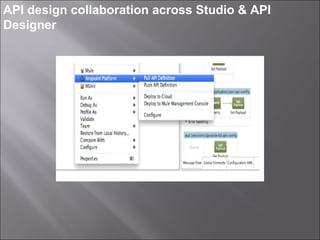
API design collaboration across Studio & API
Designer
4
Improved debugging and error messages
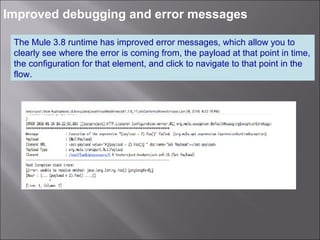
The Mule 3.8 runtime has improved error messages, which allow you to
clearly see where the error is coming from, the payload at that point in time,
the configuration for that element, and click to navigate to that point in the
flow.
5
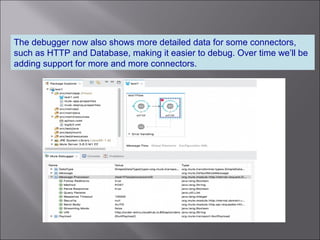
The debugger now also shows more detailed data for some connectors,
such as HTTP and Database, making it easier to debug. Over time we’ll be
adding support for more and more connectors.
6
Mule HA Improvements
Mule HA includes a number of new improvements. First and foremost, it
contains a new quorum feature, which allows you to specify the minimum
number of Mule instances to function. This allows you to more effectively
deal with network splits in a cloud environment, such as AWS and Azure. It
also now includes a persistence option, which allows you to store data in
the ObjectStore in a database. This improves resilience and allows you to
create backups for recovery situations.
7
And more
There are also many other enhancements in this release:
•DataWeave now supports flat files, allowing to parse files that have
hierarchical structures in a text delimited or fixed length form.
•Users can now browse for WSDLs in the Anypoint Exchange and when
configuring the WS Consumer.
•TLS improvements: TLS context can be shared in a domain, the cipher
suite and protocol configuration is allowed per connector, TLS 1.0 is now
disabled by default and there is a new “insecure” mode for local testing
which doesn’t perform certificate validation.
•Support for nesting tests inside folders in MUnit and running multiple
suites at a time.
Mule 3.8

Mule 3.8

  • 1.
  • 2.
    2 Unified runtime forAPIs and integration When we first started our building our API solution, we created an extension of our core runtime specifically for API gateways. As time moved on, APIs became more and more central to everything we do, so in this release, we’ve unified the API Gateway extensions with the core Mule runtime, simplifying development and operations. Please see the migration guide for information on how to migrate.
  • 3.
    3 API design collaborationacross Studio & API Designer
  • 4.
    4 Improved debugging anderror messages The Mule 3.8 runtime has improved error messages, which allow you to clearly see where the error is coming from, the payload at that point in time, the configuration for that element, and click to navigate to that point in the flow.
  • 5.
    5 The debugger nowalso shows more detailed data for some connectors, such as HTTP and Database, making it easier to debug. Over time we’ll be adding support for more and more connectors.
  • 6.
    6 Mule HA Improvements MuleHA includes a number of new improvements. First and foremost, it contains a new quorum feature, which allows you to specify the minimum number of Mule instances to function. This allows you to more effectively deal with network splits in a cloud environment, such as AWS and Azure. It also now includes a persistence option, which allows you to store data in the ObjectStore in a database. This improves resilience and allows you to create backups for recovery situations.
  • 7.
    7 And more There arealso many other enhancements in this release: •DataWeave now supports flat files, allowing to parse files that have hierarchical structures in a text delimited or fixed length form. •Users can now browse for WSDLs in the Anypoint Exchange and when configuring the WS Consumer. •TLS improvements: TLS context can be shared in a domain, the cipher suite and protocol configuration is allowed per connector, TLS 1.0 is now disabled by default and there is a new “insecure” mode for local testing which doesn’t perform certificate validation. •Support for nesting tests inside folders in MUnit and running multiple suites at a time.