
Hibernate Persistence Framework
and
Object Relational Mapping
Who is Kenan Sevindik?
● Over 15 years of
experience in enterprise
software development
● Involved in development
of architectures of several
enterprise projects
● Has extensive knowledge
and experience about
enterprise Java
technologies, such as
Spring, Spring Security,
Hibernate, Vaadin
Who is Kenan Sevindik?
● Co-author of Beginning
Spring Book
● Founded Harezmi IT
Solutions in 2011
● What Harezmi offers?
– Enterprise software
development services
– Mentoring and consultancy
services
– Organizing trainings about
enterprise Java technologies
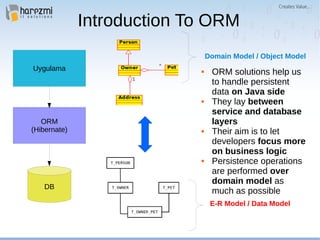
Introduction To ORM
Uygulama
ORM
(Hibernate)
DB
 ORM solutions help us
to handle persistent
data on Java side
 They lay between
service and database
layers
 Their aim is to let
developers focus more
on business logic
 Persistence operations
are performed over
domain model as
much as possible
Domain Model / Object Model
E-R Model / Data Model
Advantages of ORM
● You model entities (domain objects) based on
real business concepts rather than based on your
DB structure
● Reduces considerable amount of code to
perform repetitive persistence operations (CRUD)
over entities
● Provides rich query capabilities based on object
oriented concepts rather than relational algebra
● Encapsulates vendor specific SQL
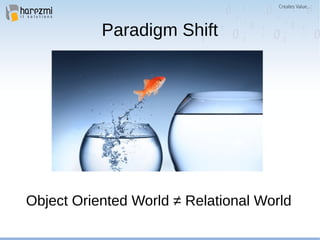
Paradigm Shift
Object Oriented World ≠ Relational World
Paradigm Shift
● Granularity problem
– It is not always the case that each table matches
with one and only one class or vice versa
● Problem with directional relationships
– Domain model contains direction information
between entity relations
– Relational model has no direction information on the
other hand
● Identity problem
– Database identity, object identity and object equality
are just three differenent concepts and you should
be aware of them
Paradigm Shift
● Subclass problem and polymorphic queries
– A class hierarchy can be mapped into several
different table combinations
– Any ORM solution should allow developers to query
objects over their super classes and interfaces
● Problem with object network traversal
– Domain model is suitable to be traversed one by
one as information is needed in application
– Relational model, on the other hand, is more
suitable to fetch necessary data once in the
beginning
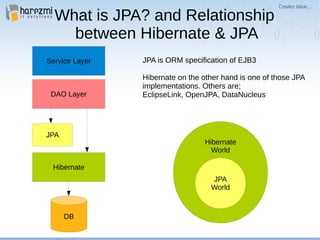
What is JPA? and Relationship
between Hibernate & JPA
Service Layer
DAO Layer
JPA
Hibernate
DB
Hibernate
World
JPA
World
JPA is ORM specification of EJB3
Hibernate on the other hand is one of those JPA
implementations. Others are;
EclipseLink, OpenJPA, DataNucleus
Benefits of JPA
● Standardization of discovery of metadata
eases configuration steps
● Configuration of ORM part becomes
standard in any enterprise Java
application
● Persistence operations are performed
over a standard data access API
Compartments of an
ORM Solution
● Any ORM solution consists of four fundamental
parts
– Metadata definition capability
– API for CRUD operations
– Persistence Context to track changes made
on domain objects, to manage lazy
associations
– Query/Criteria API for search requirements
O/R Mapping Metadata
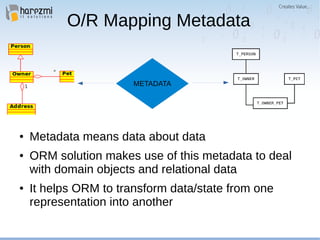
● Metadata means data about data
● ORM solution makes use of this metadata to deal
with domain objects and relational data
● It helps ORM to transform data/state from one
representation into another
METADATA
O/R Mapping Metadata
● ORM solution maps between following
structures
– Classes & tables
– Properties & columns
– Associations & foreign keys
– Java types & SQL types
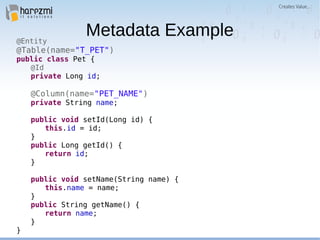
Metadata Example@Entity
@Table(name="T_PET")
public class Pet {
@Id
private Long id;
@Column(name="PET_NAME")
private String name;
public void setId(Long id) {
this.id = id;
}
public Long getId() {
return id;
}
public void setName(String name) {
this.name = name;
}
public String getName() {
return name;
}
}
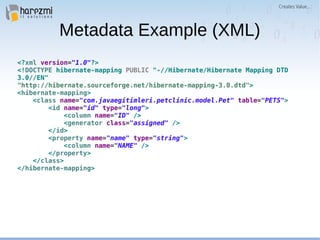
Metadata Example (XML)
<?xml version="1.0"?>
<!DOCTYPE hibernate-mapping PUBLIC "-//Hibernate/Hibernate Mapping DTD
3.0//EN"
"http://hibernate.sourceforge.net/hibernate-mapping-3.0.dtd">
<hibernate-mapping>
<class name="com.javaegitimleri.petclinic.model.Pet" table="PETS">
<id name="id" type="long">
<column name="ID" />
<generator class="assigned" />
</id>
<property name="name" type="string">
<column name="NAME" />
</property>
</class>
</hibernate-mapping>
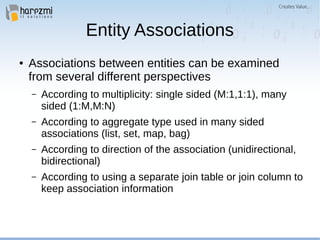
Entity Associations
● Associations between entities can be examined
from several different perspectives
– According to multiplicity: single sided (M:1,1:1), many
sided (1:M,M:N)
– According to aggregate type used in many sided
associations (list, set, map, bag)
– According to direction of the association (unidirectional,
bidirectional)
– According to using a separate join table or join column to
keep association information
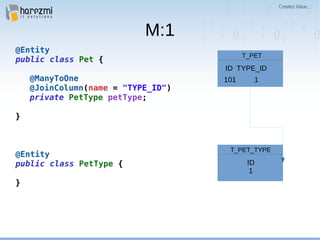
M:1
@Entity
public class Pet {
@ManyToOne
@JoinColumn(name = "TYPE_ID")
private PetType petType;
}
@Entity
public class PetType {
}
T_PET_TYPE
ID
1
T_PET
ID TYPE_ID
101 1
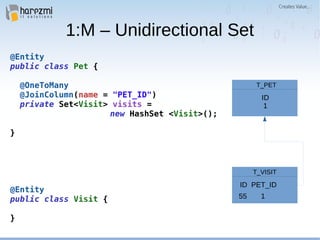
1:M – Unidirectional Set
@Entity
public class Pet {
@OneToMany
@JoinColumn(name = "PET_ID")
private Set<Visit> visits =
new HashSet <Visit>();
}
@Entity
public class Visit {
}
T_PET
ID
1
T_VISIT
ID PET_ID
55 1
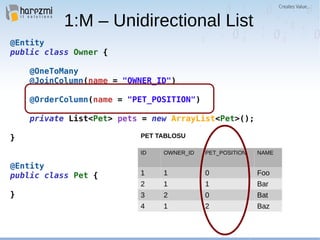
1:M – Unidirectional List
@Entity
public class Owner {
@OneToMany
@JoinColumn(name = "OWNER_ID")
@OrderColumn(name = "PET_POSITION")
private List<Pet> pets = new ArrayList<Pet>();
}
@Entity
public class Pet {
}
ID OWNER_ID PET_POSITION NAME
1 1 0 Foo
2 1 1 Bar
3 2 0 Bat
4 1 2 Baz
PET TABLOSU
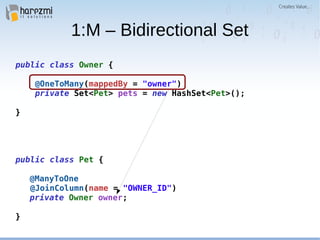
1:M – Bidirectional Set
public class Owner {
@OneToMany(mappedBy = "owner")
private Set<Pet> pets = new HashSet<Pet>();
}
public class Pet {
@ManyToOne
@JoinColumn(name = "OWNER_ID")
private Owner owner;
}
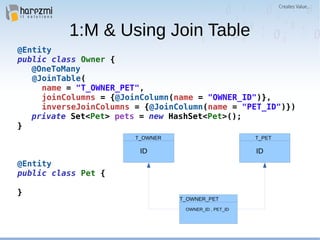
1:M & Using Join Table
@Entity
public class Owner {
@OneToMany
@JoinTable(
name = "T_OWNER_PET",
joinColumns = {@JoinColumn(name = "OWNER_ID")},
inverseJoinColumns = {@JoinColumn(name = "PET_ID")})
private Set<Pet> pets = new HashSet<Pet>();
}
@Entity
public class Pet {
}
T_OWNER
ID
T_PET
ID
T_OWNER_PET
OWNER_ID , PET_ID
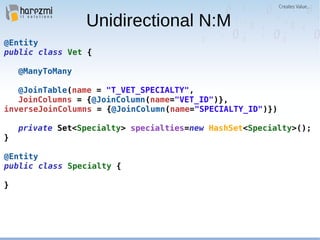
Unidirectional N:M
@Entity
public class Vet {
@ManyToMany
@JoinTable(name = "T_VET_SPECIALTY",
JoinColumns = {@JoinColumn(name="VET_ID")},
inverseJoinColumns = {@JoinColumn(name="SPECIALTY_ID")})
private Set<Specialty> specialties=new HashSet<Specialty>();
}
@Entity
public class Specialty {
}
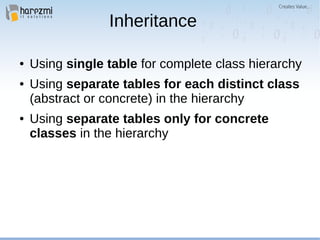
Inheritance
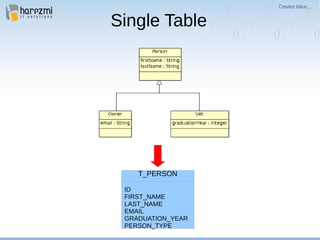
● Using single table for complete class hierarchy
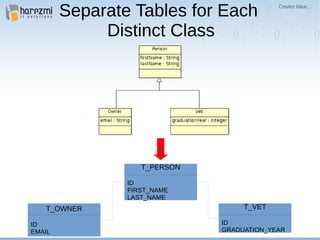
● Using separate tables for each distinct class
(abstract or concrete) in the hierarchy
● Using separate tables only for concrete
classes in the hierarchy
Single Table
T_PERSON
ID
FIRST_NAME
LAST_NAME
EMAIL
GRADUATION_YEAR
PERSON_TYPE
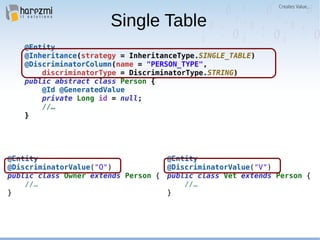
Single Table
@Entity
@Inheritance(strategy = InheritanceType.SINGLE_TABLE)
@DiscriminatorColumn(name = "PERSON_TYPE",
discriminatorType = DiscriminatorType.STRING)
public abstract class Person {
@Id @GeneratedValue
private Long id = null;
//…
}
@Entity
@DiscriminatorValue("O")
public class Owner extends Person {
//…
}
@Entity
@DiscriminatorValue("V")
public class Vet extends Person {
//…
}
Separate Tables for Each
Distinct Class
T_OWNER
ID
EMAIL
T_PERSON
ID
FIRST_NAME
LAST_NAME
T_VET
ID
GRADUATION_YEAR
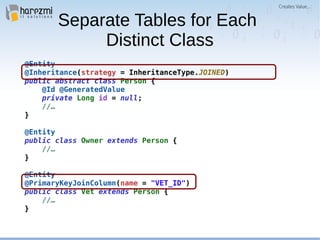
Separate Tables for Each
Distinct Class
@Entity
@Inheritance(strategy = InheritanceType.JOINED)
public abstract class Person {
@Id @GeneratedValue
private Long id = null;
//…
}
@Entity
public class Owner extends Person {
//…
}
@Entity
@PrimaryKeyJoinColumn(name = "VET_ID")
public class Vet extends Person {
//…
}
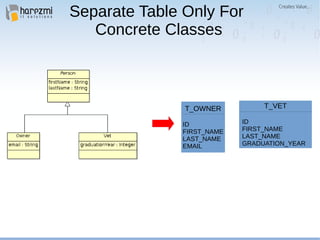
Separate Table Only For
Concrete Classes
T_OWNER
ID
FIRST_NAME
LAST_NAME
EMAIL
T_VET
ID
FIRST_NAME
LAST_NAME
GRADUATION_YEAR
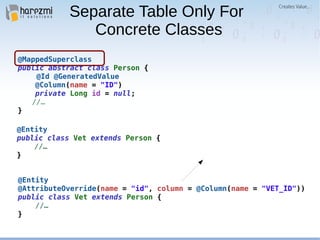
@MappedSuperclass
public abstract class Person {
@Id @GeneratedValue
@Column(name = "ID")
private Long id = null;
//…
}
@Entity
@AttributeOverride(name = "id", column = @Column(name = "VET_ID"))
public class Vet extends Person {
//…
}
Separate Table Only For
Concrete Classes
@Entity
public class Vet extends Person {
//…
}
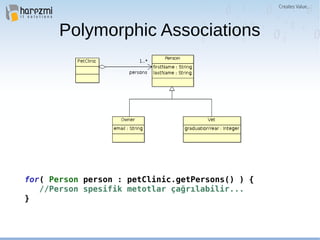
Polymorphic Associations
for( Person person : petClinic.getPersons() ) {
//Person spesifik metotlar çağrılabilir...
}
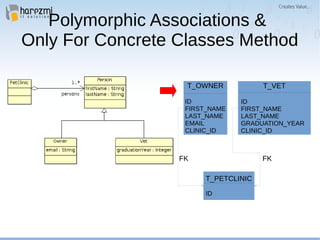
T_PETCLINIC
ID
T_OWNER
ID
FIRST_NAME
LAST_NAME
EMAIL
CLINIC_ID
T_VET
ID
FIRST_NAME
LAST_NAME
GRADUATION_YEAR
CLINIC_ID
FK FK
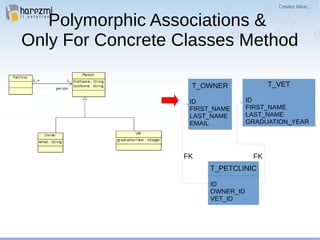
Polymorphic Associations &
Only For Concrete Classes Method
Polymorphic Associations &
Only For Concrete Classes Method
T_PETCLINIC
ID
OWNER_ID
VET_ID
T_OWNER
ID
FIRST_NAME
LAST_NAME
EMAIL
T_VET
ID
FIRST_NAME
LAST_NAME
GRADUATION_YEAR
FK FK
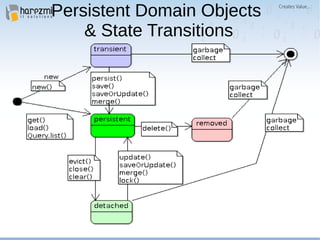
Persistent Domain Objects
& State Transitions
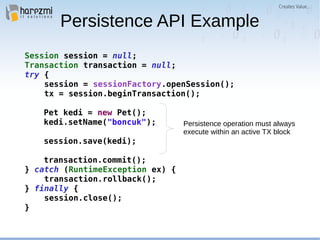
Session session = null;
Transaction transaction = null;
try {
session = sessionFactory.openSession();
tx = session.beginTransaction();
Pet kedi = new Pet();
kedi.setName("boncuk");
session.save(kedi);
transaction.commit();
} catch (RuntimeException ex) {
transaction.rollback();
} finally {
session.close();
}
Persistence API Example
Persistence operation must always
execute within an active TX block
Object Query Languages
● Any ORM tool provides a mechanism to
perform data fetching via a query mechanism
● That query mechanism is based on object
graph and navigation between object
relationships
● JPA and Hibernate provide their own object
query languages and programmatic query
generation mechanisms as well
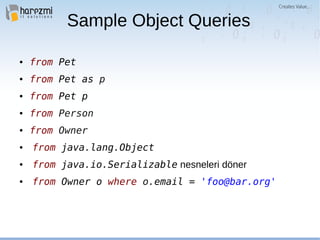
Sample Object Queries
● from Pet
● from Pet as p
● from Pet p
● from Person
● from Owner
● from java.lang.Object
● from java.io.Serializable nesneleri döner
● from Owner o where o.email = 'foo@bar.org'
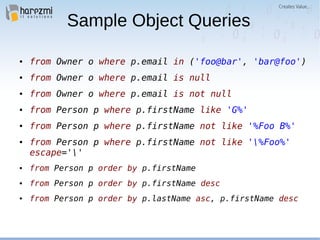
Sample Object Queries
● from Owner o where p.email in ('foo@bar', 'bar@foo')
● from Owner o where p.email is null
● from Owner o where p.email is not null
● from Person p where p.firstName like 'G%'
● from Person p where p.firstName not like '%Foo B%'
● from Person p where p.firstName not like '%Foo%'
escape=''
● from Person p order by p.firstName
● from Person p order by p.firstName desc
● from Person p order by p.lastName asc, p.firstName desc
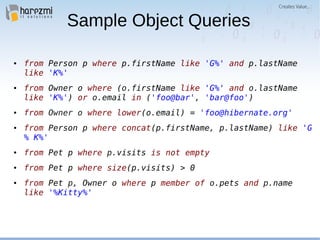
Sample Object Queries
● from Person p where p.firstName like 'G%' and p.lastName
like 'K%'
● from Owner o where (o.firstName like 'G%' and o.lastName
like 'K%') or o.email in ('foo@bar', 'bar@foo')
● from Owner o where lower(o.email) = 'foo@hibernate.org'
● from Person p where concat(p.firstName, p.lastName) like 'G
% K%'
● from Pet p where p.visits is not empty
● from Pet p where size(p.visits) > 0
● from Pet p, Owner o where p member of o.pets and p.name
like '%Kitty%'
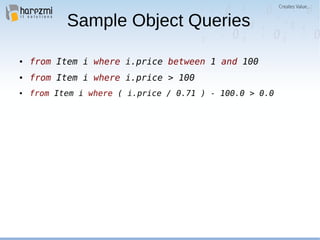
Sample Object Queries
● from Item i where i.price between 1 and 100
● from Item i where i.price > 100
● from Item i where ( i.price / 0.71 ) - 100.0 > 0.0
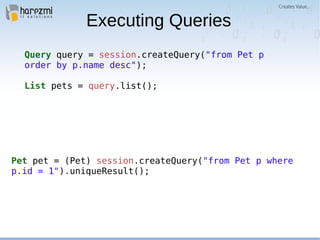
Executing Queries
Query query = session.createQuery("from Pet p
order by p.name desc");
List pets = query.list();
Pet pet = (Pet) session.createQuery("from Pet p where
p.id = 1").uniqueResult();
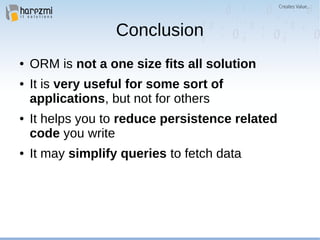
Conclusion
● ORM is not a one size fits all solution
● It is very useful for some sort of
applications, but not for others
● It helps you to reduce persistence related
code you write
● It may simplify queries to fetch data
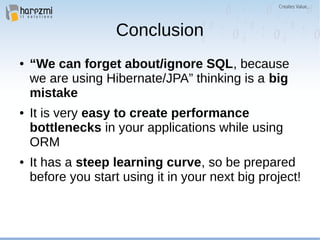
Conclusion
● “We can forget about/ignore SQL, because
we are using Hibernate/JPA” thinking is a big
mistake
● It is very easy to create performance
bottlenecks in your applications while using
ORM
● It has a steep learning curve, so be prepared
before you start using it in your next big project!
Choice is Yours!
Questions & Answers
Contact
● Harezmi Bilişim Çözümleri A.Ş.
● http://www.harezmi.com.tr
● info@harezmi.com.tr

20160523 hibernate persistence_framework_and_orm

  • 1.
  • 2.
    Who is KenanSevindik? ● Over 15 years of experience in enterprise software development ● Involved in development of architectures of several enterprise projects ● Has extensive knowledge and experience about enterprise Java technologies, such as Spring, Spring Security, Hibernate, Vaadin
  • 3.
    Who is KenanSevindik? ● Co-author of Beginning Spring Book ● Founded Harezmi IT Solutions in 2011 ● What Harezmi offers? – Enterprise software development services – Mentoring and consultancy services – Organizing trainings about enterprise Java technologies
  • 4.
    Introduction To ORM Uygulama ORM (Hibernate) DB ORM solutions help us to handle persistent data on Java side  They lay between service and database layers  Their aim is to let developers focus more on business logic  Persistence operations are performed over domain model as much as possible Domain Model / Object Model E-R Model / Data Model
  • 5.
    Advantages of ORM ●You model entities (domain objects) based on real business concepts rather than based on your DB structure ● Reduces considerable amount of code to perform repetitive persistence operations (CRUD) over entities ● Provides rich query capabilities based on object oriented concepts rather than relational algebra ● Encapsulates vendor specific SQL
  • 6.
    Paradigm Shift Object OrientedWorld ≠ Relational World
  • 7.
    Paradigm Shift ● Granularityproblem – It is not always the case that each table matches with one and only one class or vice versa ● Problem with directional relationships – Domain model contains direction information between entity relations – Relational model has no direction information on the other hand ● Identity problem – Database identity, object identity and object equality are just three differenent concepts and you should be aware of them
  • 8.
    Paradigm Shift ● Subclassproblem and polymorphic queries – A class hierarchy can be mapped into several different table combinations – Any ORM solution should allow developers to query objects over their super classes and interfaces ● Problem with object network traversal – Domain model is suitable to be traversed one by one as information is needed in application – Relational model, on the other hand, is more suitable to fetch necessary data once in the beginning
  • 9.
    What is JPA?and Relationship between Hibernate & JPA Service Layer DAO Layer JPA Hibernate DB Hibernate World JPA World JPA is ORM specification of EJB3 Hibernate on the other hand is one of those JPA implementations. Others are; EclipseLink, OpenJPA, DataNucleus
  • 10.
    Benefits of JPA ●Standardization of discovery of metadata eases configuration steps ● Configuration of ORM part becomes standard in any enterprise Java application ● Persistence operations are performed over a standard data access API
  • 11.
    Compartments of an ORMSolution ● Any ORM solution consists of four fundamental parts – Metadata definition capability – API for CRUD operations – Persistence Context to track changes made on domain objects, to manage lazy associations – Query/Criteria API for search requirements
  • 12.
    O/R Mapping Metadata ●Metadata means data about data ● ORM solution makes use of this metadata to deal with domain objects and relational data ● It helps ORM to transform data/state from one representation into another METADATA
  • 13.
    O/R Mapping Metadata ●ORM solution maps between following structures – Classes & tables – Properties & columns – Associations & foreign keys – Java types & SQL types
  • 14.
    Metadata Example@Entity @Table(name="T_PET") public classPet { @Id private Long id; @Column(name="PET_NAME") private String name; public void setId(Long id) { this.id = id; } public Long getId() { return id; } public void setName(String name) { this.name = name; } public String getName() { return name; } }
  • 15.
    Metadata Example (XML) <?xmlversion="1.0"?> <!DOCTYPE hibernate-mapping PUBLIC "-//Hibernate/Hibernate Mapping DTD 3.0//EN" "http://hibernate.sourceforge.net/hibernate-mapping-3.0.dtd"> <hibernate-mapping> <class name="com.javaegitimleri.petclinic.model.Pet" table="PETS"> <id name="id" type="long"> <column name="ID" /> <generator class="assigned" /> </id> <property name="name" type="string"> <column name="NAME" /> </property> </class> </hibernate-mapping>
  • 16.
    Entity Associations ● Associationsbetween entities can be examined from several different perspectives – According to multiplicity: single sided (M:1,1:1), many sided (1:M,M:N) – According to aggregate type used in many sided associations (list, set, map, bag) – According to direction of the association (unidirectional, bidirectional) – According to using a separate join table or join column to keep association information
  • 17.
    M:1 @Entity public class Pet{ @ManyToOne @JoinColumn(name = "TYPE_ID") private PetType petType; } @Entity public class PetType { } T_PET_TYPE ID 1 T_PET ID TYPE_ID 101 1
  • 18.
    1:M – UnidirectionalSet @Entity public class Pet { @OneToMany @JoinColumn(name = "PET_ID") private Set<Visit> visits = new HashSet <Visit>(); } @Entity public class Visit { } T_PET ID 1 T_VISIT ID PET_ID 55 1
  • 19.
    1:M – UnidirectionalList @Entity public class Owner { @OneToMany @JoinColumn(name = "OWNER_ID") @OrderColumn(name = "PET_POSITION") private List<Pet> pets = new ArrayList<Pet>(); } @Entity public class Pet { } ID OWNER_ID PET_POSITION NAME 1 1 0 Foo 2 1 1 Bar 3 2 0 Bat 4 1 2 Baz PET TABLOSU
  • 20.
    1:M – BidirectionalSet public class Owner { @OneToMany(mappedBy = "owner") private Set<Pet> pets = new HashSet<Pet>(); } public class Pet { @ManyToOne @JoinColumn(name = "OWNER_ID") private Owner owner; }
  • 21.
    1:M & UsingJoin Table @Entity public class Owner { @OneToMany @JoinTable( name = "T_OWNER_PET", joinColumns = {@JoinColumn(name = "OWNER_ID")}, inverseJoinColumns = {@JoinColumn(name = "PET_ID")}) private Set<Pet> pets = new HashSet<Pet>(); } @Entity public class Pet { } T_OWNER ID T_PET ID T_OWNER_PET OWNER_ID , PET_ID
  • 22.
    Unidirectional N:M @Entity public classVet { @ManyToMany @JoinTable(name = "T_VET_SPECIALTY", JoinColumns = {@JoinColumn(name="VET_ID")}, inverseJoinColumns = {@JoinColumn(name="SPECIALTY_ID")}) private Set<Specialty> specialties=new HashSet<Specialty>(); } @Entity public class Specialty { }
  • 23.
    Inheritance ● Using singletable for complete class hierarchy ● Using separate tables for each distinct class (abstract or concrete) in the hierarchy ● Using separate tables only for concrete classes in the hierarchy
  • 24.
  • 25.
    Single Table @Entity @Inheritance(strategy =InheritanceType.SINGLE_TABLE) @DiscriminatorColumn(name = "PERSON_TYPE", discriminatorType = DiscriminatorType.STRING) public abstract class Person { @Id @GeneratedValue private Long id = null; //… } @Entity @DiscriminatorValue("O") public class Owner extends Person { //… } @Entity @DiscriminatorValue("V") public class Vet extends Person { //… }
  • 26.
    Separate Tables forEach Distinct Class T_OWNER ID EMAIL T_PERSON ID FIRST_NAME LAST_NAME T_VET ID GRADUATION_YEAR
  • 27.
    Separate Tables forEach Distinct Class @Entity @Inheritance(strategy = InheritanceType.JOINED) public abstract class Person { @Id @GeneratedValue private Long id = null; //… } @Entity public class Owner extends Person { //… } @Entity @PrimaryKeyJoinColumn(name = "VET_ID") public class Vet extends Person { //… }
  • 28.
    Separate Table OnlyFor Concrete Classes T_OWNER ID FIRST_NAME LAST_NAME EMAIL T_VET ID FIRST_NAME LAST_NAME GRADUATION_YEAR
  • 29.
    @MappedSuperclass public abstract classPerson { @Id @GeneratedValue @Column(name = "ID") private Long id = null; //… } @Entity @AttributeOverride(name = "id", column = @Column(name = "VET_ID")) public class Vet extends Person { //… } Separate Table Only For Concrete Classes @Entity public class Vet extends Person { //… }
  • 30.
    Polymorphic Associations for( Personperson : petClinic.getPersons() ) { //Person spesifik metotlar çağrılabilir... }
  • 31.
  • 32.
    Polymorphic Associations & OnlyFor Concrete Classes Method T_PETCLINIC ID OWNER_ID VET_ID T_OWNER ID FIRST_NAME LAST_NAME EMAIL T_VET ID FIRST_NAME LAST_NAME GRADUATION_YEAR FK FK
  • 33.
    Persistent Domain Objects &State Transitions
  • 34.
    Session session =null; Transaction transaction = null; try { session = sessionFactory.openSession(); tx = session.beginTransaction(); Pet kedi = new Pet(); kedi.setName("boncuk"); session.save(kedi); transaction.commit(); } catch (RuntimeException ex) { transaction.rollback(); } finally { session.close(); } Persistence API Example Persistence operation must always execute within an active TX block
  • 35.
    Object Query Languages ●Any ORM tool provides a mechanism to perform data fetching via a query mechanism ● That query mechanism is based on object graph and navigation between object relationships ● JPA and Hibernate provide their own object query languages and programmatic query generation mechanisms as well
  • 36.
    Sample Object Queries ●from Pet ● from Pet as p ● from Pet p ● from Person ● from Owner ● from java.lang.Object ● from java.io.Serializable nesneleri döner ● from Owner o where o.email = 'foo@bar.org'
  • 37.
    Sample Object Queries ●from Owner o where p.email in ('foo@bar', 'bar@foo') ● from Owner o where p.email is null ● from Owner o where p.email is not null ● from Person p where p.firstName like 'G%' ● from Person p where p.firstName not like '%Foo B%' ● from Person p where p.firstName not like '%Foo%' escape='' ● from Person p order by p.firstName ● from Person p order by p.firstName desc ● from Person p order by p.lastName asc, p.firstName desc
  • 38.
    Sample Object Queries ●from Person p where p.firstName like 'G%' and p.lastName like 'K%' ● from Owner o where (o.firstName like 'G%' and o.lastName like 'K%') or o.email in ('foo@bar', 'bar@foo') ● from Owner o where lower(o.email) = 'foo@hibernate.org' ● from Person p where concat(p.firstName, p.lastName) like 'G % K%' ● from Pet p where p.visits is not empty ● from Pet p where size(p.visits) > 0 ● from Pet p, Owner o where p member of o.pets and p.name like '%Kitty%'
  • 39.
    Sample Object Queries ●from Item i where i.price between 1 and 100 ● from Item i where i.price > 100 ● from Item i where ( i.price / 0.71 ) - 100.0 > 0.0
  • 40.
    Executing Queries Query query= session.createQuery("from Pet p order by p.name desc"); List pets = query.list(); Pet pet = (Pet) session.createQuery("from Pet p where p.id = 1").uniqueResult();
  • 41.
    Conclusion ● ORM isnot a one size fits all solution ● It is very useful for some sort of applications, but not for others ● It helps you to reduce persistence related code you write ● It may simplify queries to fetch data
  • 42.
    Conclusion ● “We canforget about/ignore SQL, because we are using Hibernate/JPA” thinking is a big mistake ● It is very easy to create performance bottlenecks in your applications while using ORM ● It has a steep learning curve, so be prepared before you start using it in your next big project!
  • 43.
  • 44.
  • 45.
    Contact ● Harezmi BilişimÇözümleri A.Ş. ● http://www.harezmi.com.tr ● info@harezmi.com.tr