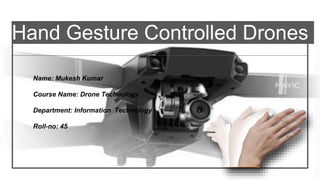
Hand Gesture Controlled Drones
Name: Mukesh Kumar
Course Name: Drone Technology
Department: Information Technology
Roll-no: 45
Table of Contents
1. Introduction
2. Background
3. Proposed Framework
4. Experiments
5. Discussion of Experimental Results
INTRODUCTION
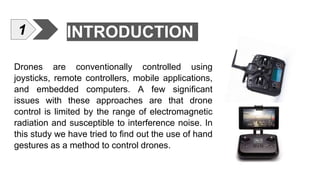
Drones are conventionally controlled using
joysticks, remote controllers, mobile applications,
and embedded computers. A few significant
issues with these approaches are that drone
control is limited by the range of electromagnetic
radiation and susceptible to interference noise. In
this study we have tried to find out the use of hand
gestures as a method to control drones.
1
Background
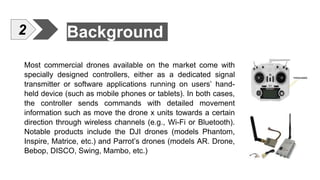
Most commercial drones available on the market come with
specially designed controllers, either as a dedicated signal
transmitter or software applications running on users’ hand-
held device (such as mobile phones or tablets). In both cases,
the controller sends commands with detailed movement
information such as move the drone x units towards a certain
direction through wireless channels (e.g., Wi-Fi or Bluetooth).
Notable products include the DJI drones (models Phantom,
Inspire, Matrice, etc.) and Parrot’s drones (models AR. Drone,
Bebop, DISCO, Swing, Mambo, etc.)
2
Proposed Framework
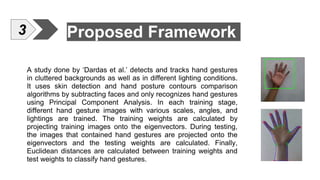
A study done by ‘Dardas et al.’ detects and tracks hand gestures
in cluttered backgrounds as well as in different lighting conditions.
It uses skin detection and hand posture contours comparison
algorithms by subtracting faces and only recognizes hand gestures
using Principal Component Analysis. In each training stage,
different hand gesture images with various scales, angles, and
lightings are trained. The training weights are calculated by
projecting training images onto the eigenvectors. During testing,
the images that contained hand gestures are projected onto the
eigenvectors and the testing weights are calculated. Finally,
Euclidean distances are calculated between training weights and
test weights to classify hand gestures.
3
Manual Experiment
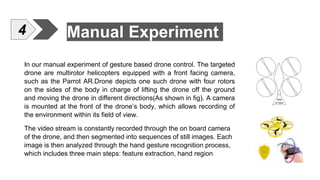
In our manual experiment of gesture based drone control. The targeted
drone are multirotor helicopters equipped with a front facing camera,
such as the Parrot AR.Drone depicts one such drone with four rotors
on the sides of the body in charge of lifting the drone off the ground
and moving the drone in different directions(As shown in fig). A camera
is mounted at the front of the drone’s body, which allows recording of
the environment within its field of view.
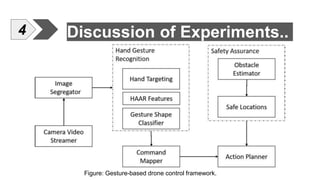
The video stream is constantly recorded through the on board camera
of the drone, and then segmented into sequences of still images. Each
image is then analyzed through the hand gesture recognition process,
which includes three main steps: feature extraction, hand region
4
Manual Experiment...
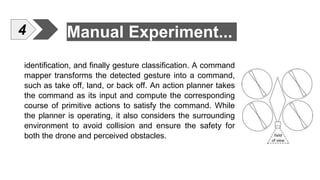
identification, and finally gesture classification. A command
mapper transforms the detected gesture into a command,
such as take off, land, or back off. An action planner takes
the command as its input and compute the corresponding
course of primitive actions to satisfy the command. While
the planner is operating, it also considers the surrounding
environment to avoid collision and ensure the safety for
both the drone and perceived obstacles.
4
Discussion of Experiments
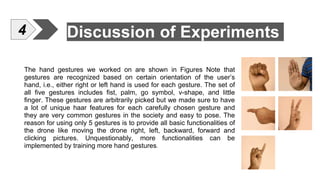
The hand gestures we worked on are shown in Figures Note that
gestures are recognized based on certain orientation of the user’s
hand, i.e., either right or left hand is used for each gesture. The set of
all five gestures includes fist, palm, go symbol, v-shape, and little
finger. These gestures are arbitrarily picked but we made sure to have
a lot of unique haar features for each carefully chosen gesture and
they are very common gestures in the society and easy to pose. The
reason for using only 5 gestures is to provide all basic functionalities of
the drone like moving the drone right, left, backward, forward and
clicking pictures. Unquestionably, more functionalities can be
implemented by training more hand gestures.
4
Discussion of Experiments..
4
Figure: Gesture-based drone control framework.
Conclusion
goal of this study is to enable the hand gesture based control mechanism with
maximum possible accuracy even in mediocre drones which can be easily
outperformed by the state-of-art drones due to their inbuilt high camera resolutions like
4K, 8K, 16K and 64K etc. In this empirical study, we investigated more on software
development for the AR Drones. We presented an image recognition based
communication framework to control drones with hand gestures. The framework is
successfully tested using a mediocre drone, Parrot AR.Drone 2.0. A set of five gestures
were carefully selected to build a dataset of 8302 images. Each image is represented
by a set of Haar features in cascaded Adaboost algorithm. Classification results showed
that the distance between drone and its operator is the most important indicator of
success. This applies all of five gestures.
5
TECHNOLOGY
DRONE
~/Mukesh

Drone tech hand gesture controlled drones

  • 1.
    Hand Gesture ControlledDrones Name: Mukesh Kumar Course Name: Drone Technology Department: Information Technology Roll-no: 45
  • 2.
    Table of Contents 1.Introduction 2. Background 3. Proposed Framework 4. Experiments 5. Discussion of Experimental Results
  • 3.
    INTRODUCTION Drones are conventionallycontrolled using joysticks, remote controllers, mobile applications, and embedded computers. A few significant issues with these approaches are that drone control is limited by the range of electromagnetic radiation and susceptible to interference noise. In this study we have tried to find out the use of hand gestures as a method to control drones. 1
  • 4.
    Background Most commercial dronesavailable on the market come with specially designed controllers, either as a dedicated signal transmitter or software applications running on users’ hand- held device (such as mobile phones or tablets). In both cases, the controller sends commands with detailed movement information such as move the drone x units towards a certain direction through wireless channels (e.g., Wi-Fi or Bluetooth). Notable products include the DJI drones (models Phantom, Inspire, Matrice, etc.) and Parrot’s drones (models AR. Drone, Bebop, DISCO, Swing, Mambo, etc.) 2
  • 5.
    Proposed Framework A studydone by ‘Dardas et al.’ detects and tracks hand gestures in cluttered backgrounds as well as in different lighting conditions. It uses skin detection and hand posture contours comparison algorithms by subtracting faces and only recognizes hand gestures using Principal Component Analysis. In each training stage, different hand gesture images with various scales, angles, and lightings are trained. The training weights are calculated by projecting training images onto the eigenvectors. During testing, the images that contained hand gestures are projected onto the eigenvectors and the testing weights are calculated. Finally, Euclidean distances are calculated between training weights and test weights to classify hand gestures. 3
  • 6.
    Manual Experiment In ourmanual experiment of gesture based drone control. The targeted drone are multirotor helicopters equipped with a front facing camera, such as the Parrot AR.Drone depicts one such drone with four rotors on the sides of the body in charge of lifting the drone off the ground and moving the drone in different directions(As shown in fig). A camera is mounted at the front of the drone’s body, which allows recording of the environment within its field of view. The video stream is constantly recorded through the on board camera of the drone, and then segmented into sequences of still images. Each image is then analyzed through the hand gesture recognition process, which includes three main steps: feature extraction, hand region 4
  • 7.
    Manual Experiment... identification, andfinally gesture classification. A command mapper transforms the detected gesture into a command, such as take off, land, or back off. An action planner takes the command as its input and compute the corresponding course of primitive actions to satisfy the command. While the planner is operating, it also considers the surrounding environment to avoid collision and ensure the safety for both the drone and perceived obstacles. 4
  • 8.
    Discussion of Experiments Thehand gestures we worked on are shown in Figures Note that gestures are recognized based on certain orientation of the user’s hand, i.e., either right or left hand is used for each gesture. The set of all five gestures includes fist, palm, go symbol, v-shape, and little finger. These gestures are arbitrarily picked but we made sure to have a lot of unique haar features for each carefully chosen gesture and they are very common gestures in the society and easy to pose. The reason for using only 5 gestures is to provide all basic functionalities of the drone like moving the drone right, left, backward, forward and clicking pictures. Unquestionably, more functionalities can be implemented by training more hand gestures. 4
  • 9.
    Discussion of Experiments.. 4 Figure:Gesture-based drone control framework.
  • 10.
    Conclusion goal of thisstudy is to enable the hand gesture based control mechanism with maximum possible accuracy even in mediocre drones which can be easily outperformed by the state-of-art drones due to their inbuilt high camera resolutions like 4K, 8K, 16K and 64K etc. In this empirical study, we investigated more on software development for the AR Drones. We presented an image recognition based communication framework to control drones with hand gestures. The framework is successfully tested using a mediocre drone, Parrot AR.Drone 2.0. A set of five gestures were carefully selected to build a dataset of 8302 images. Each image is represented by a set of Haar features in cascaded Adaboost algorithm. Classification results showed that the distance between drone and its operator is the most important indicator of success. This applies all of five gestures. 5
  • 11.