Project Seminar
on
Micro Air Vehicle
Under the guidance of
Prof. Syed Basith Muzammil ME, (PhD)
(Asst. Professor, Dept. of Mechanical
Engineering)
BY
Shazaan Sayeed ( 1HK11ME082 )
Suman Mandal ( 1HK11ME085 )
Sushil Kumar ( 1HK11ME087 )
Md Idris ( 1HK11ME054 )
HKBK College
of
Engineering
CONTENTS
 Introduction-MAV
 Our Project
 Advantages and Disadvantages
 Applications
 Basic Materials Required
 Block Diagram
 Circuit Diagram
 Working Principle
Design and fabrication of MAV
Introduction
 A quad-copter, also called a quad rotor helicopter is a
multi-rotor helicopter that is lifted and propelled by four
rotors.
 It is a type of small representation of Unmanned Air
Vehicle.
 The quad-copter is one of the most complex flying
machines due to its versatility to perform many types of
tasks.
 Classical quad-copters are usually equipped with a four
rotors.
 Quad-copters are symmetrical vehicles with four equally
sized rotors at the end of four equal length rods.
Design and fabrication of MAV
Our Project
 Ability to hover in a stationary position.
 Embedded with a camera for capturing live images
or videos of its propagation(fitted with GPS
system).
 Equipped with:
 LPG sensor for detecting leaked out LPG gas to
prevent future explosion.
 Explosive Detector Mo-8 – Tvin to detect the
explosives such as TNT, NG, PETN, C4 and their
mixtures.
Design and fabrication of MAV
Advantages
 Small sized quad-copters have frames that enclose the
rotors, permitting flights through more challenging
environments, with lower risk of damaging the vehicle or
surroundings.
 Small sized MAV's makes the vehicles safer for closer
interaction.
 Our MAV does not require mechanical linkages that vary
the rotor blade pitch angle as they spin. This simplifies the
design and maintenance of each vehicle.
 The use of four rotors allows each individual rotor to have a
smaller diameter than the equivalent helicopter rotor,
allowing them to possess less kinetic energy.
Design and fabrication of MAV
Disadvantages
 Fabrication material not so trendy.
 Can be controlled only up to a range of 100m.
 Has a maximum flight time of about 25 minutes.
 Skilled operator is needed.
 Complex design and calculations.
Design and fabrication of MAV
Applications
 Surveillance in military and
security sectors to disclose any
enemy troops in a war field.
 Security and law enforcement
surveillance.
 Research and rescue mission in
urban environments.
 Detect leaked gas chambers or
pipelines in industries.
 Inspection of power lines.
 Detect explosives such as TNT,
C4, NG, PETN, etc. in public
sectors without any need of
human intervention.
Design and fabrication of MAV
Basic Materials Required
 Frame
 Transmitter and receiver
 Electronic Speed Controller-4
 Propellers-4 ( 2CW and 2 CCW )
 Microcontroller- ATMega8
 Camera
 Sensors
 Battery (11.1v 5000mAh Li-Po ) and Charger
Design and fabrication of MAV
Working Principle
 Quad copter is a device with an intense mixture of
Electronics, Mechanical and mainly on the principle of
Aviation
 The quad copter has 4 motors whose speed of rotation
and direction of rotation changes according to the user's
desire to move the device in a particular direction.
 The rotation of Motors changes as per the transmitted
signal sent form the 6-Channel Transmitter.
 The program for which is written in the AT-MEGA8 chip.
 The signal from Microcontroller goes to the ESC's which in
turn controls the speed of motor and hence drives the
copter.
Design and fabrication of MAV
Block Diagram
Micro
Controller
AT Mega8
Arduino
Development
Board
Radio Frequency
Transmitter
Gyroscope
Sensor data
Battery
Camera data
ESC
Change in
direction and
altitude
Send signals to
receiver
Change the
motor speed
R/F Receiver Image receptor
Sensor detector
Design and fabrication of MAV
Electronic Circuit Block Diagram
Micro- Controller
ATMega8
Live video streaming
Driver- LED/ Buzzer
ESC- Motor speed
PWM to R/C Transmitter
DAC & ADC
convertor
Power Supply
4 bit data encoder
Oscillator
Data from Remote
Controller
Design and fabrication of MAV
Micro Controller- ATMega8 Features
 The micro controller used in ATMega8 as it gives high performance even in
low voltages.
 Nonvolatile Program and Data Memories ( 10,000 write cycles ).
 Operating voltages= 0-5.5 volts
 Power Consumption at 4 MHz, 3V at 35 °C
 1K Byte Internal SRAM
 The Micro controller receives power from batteries and data from the
remote controller.
 The analog-digital and digital-analog conversion takes place.
 The micro controller regulates the electronic speed controllers (ESC)
which in turn regulates the rotor speed and in turn controlling the
direction and movement of the vehicle.
 It then creates wireless signals through oscillators and sends signals
to the receiver via transmitters .
Design and fabrication of MAV
Hardware Components
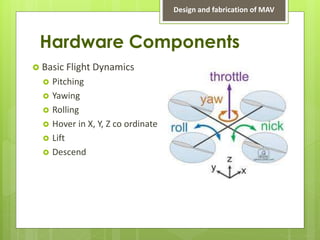
 Basic Flight Dynamics
 Pitching
 Yawing
 Rolling
 Hover in X, Y, Z co ordinate
 Lift
 Descend
Design and fabrication of MAV
Controlling directions and height
 Yawing: The movement of vehicle about Z axis. It causes change in
direction of the movement (right or left).
 It happens when one set of opposite motors are driven at a relatively
higher speed than the other two.
 Rolling: The movement of vehicle about Y axis. It causes to move the
vehicle side ways.
 It happens when one of the side motor is driven at a relatively higher
speed than the opposite motor.
 Pitching: Movement of vehicle
about X axis. It causes the
vehicle to move front or back.
 It happens when the front
or rear motors move at
different speeds.
Design and fabrication of MAV
 Hovering: For hovering, a balance of
forces is needed.
 If we want the quad-copter to hover,
SUM(Fi) must be equal m•g.
 To move the quad-copter
climb/decline the speed of every
motor is increased/decreased .
 SUM(Fi) > m•g <=> climb
 SUM(Fi) = m•g <=> hover
 SUM(Fi) < m•g <=> decline
Design and fabrication of MAV
Component Parameters
 Propellers: 4 * 10×4.7″ 2CW + 2CCW
 Propeller Adapter: 4 * Propeller Shaft Adapters dia 3mm
 Motor to motor dimension: 550mm
 Maximum Flight time: 25 minutes
 Motors: 4 * Emax CF2822 1200KV
 ESC: 4 *30A Brushless Motor Speed Controller
 Stability Control: 1 * MPU-6050 3 Axis Accelerometer + 3 Axis
Gyro
Design and fabrication of MAV
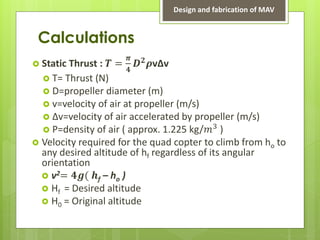
Calculations
 Static Thrust : 𝑻 =
𝝅
𝟒
𝑫 𝟐
𝝆vΔv
 T= Thrust (N)
 D=propeller diameter (m)
 v=velocity of air at propeller (m/s)
 Δv=velocity of air accelerated by propeller (m/s)
 Ρ=density of air ( approx. 1.225 kg/𝑚3 )
 Velocity required for the quad copter to climb from ho to
any desired altitude of hf regardless of its angular
orientation
 v2= 𝟒𝒈( 𝒉f – ho )
 Hf = Desired altitude
 H0 = Original altitude
Design and fabrication of MAV
 Flight time = Battery capacity/amps
 The drag equation from fluid dynamics gives us the
frictional force: 𝑭𝑫 =
𝟏
𝟐
𝝆𝑪 𝒅 𝑨 𝒗 𝟐
 Ρ is the surrounding fluid density
 A= propeller cross section
 𝐶 𝑑 is dimensionless constant
 Torque due to drag: T =
𝟏
𝟐
𝑹𝝆𝑪 𝒅 𝑨 𝒗 𝟐 =
𝟏
𝟐
𝑹𝝆𝑪 𝒅 𝑨 (𝝎𝑹) 𝟐
 R= radius of the propeller
 𝜔= angular velocity of the propeller
Design and fabrication of MAV
ANY QUERIES???
THANK YOU

Project seminar quadcopter

  • 1.
    Project Seminar on Micro AirVehicle Under the guidance of Prof. Syed Basith Muzammil ME, (PhD) (Asst. Professor, Dept. of Mechanical Engineering) BY Shazaan Sayeed ( 1HK11ME082 ) Suman Mandal ( 1HK11ME085 ) Sushil Kumar ( 1HK11ME087 ) Md Idris ( 1HK11ME054 ) HKBK College of Engineering
  • 2.
    CONTENTS  Introduction-MAV  OurProject  Advantages and Disadvantages  Applications  Basic Materials Required  Block Diagram  Circuit Diagram  Working Principle Design and fabrication of MAV
  • 3.
    Introduction  A quad-copter,also called a quad rotor helicopter is a multi-rotor helicopter that is lifted and propelled by four rotors.  It is a type of small representation of Unmanned Air Vehicle.  The quad-copter is one of the most complex flying machines due to its versatility to perform many types of tasks.  Classical quad-copters are usually equipped with a four rotors.  Quad-copters are symmetrical vehicles with four equally sized rotors at the end of four equal length rods. Design and fabrication of MAV
  • 4.
    Our Project  Abilityto hover in a stationary position.  Embedded with a camera for capturing live images or videos of its propagation(fitted with GPS system).  Equipped with:  LPG sensor for detecting leaked out LPG gas to prevent future explosion.  Explosive Detector Mo-8 – Tvin to detect the explosives such as TNT, NG, PETN, C4 and their mixtures. Design and fabrication of MAV
  • 5.
    Advantages  Small sizedquad-copters have frames that enclose the rotors, permitting flights through more challenging environments, with lower risk of damaging the vehicle or surroundings.  Small sized MAV's makes the vehicles safer for closer interaction.  Our MAV does not require mechanical linkages that vary the rotor blade pitch angle as they spin. This simplifies the design and maintenance of each vehicle.  The use of four rotors allows each individual rotor to have a smaller diameter than the equivalent helicopter rotor, allowing them to possess less kinetic energy. Design and fabrication of MAV
  • 6.
    Disadvantages  Fabrication materialnot so trendy.  Can be controlled only up to a range of 100m.  Has a maximum flight time of about 25 minutes.  Skilled operator is needed.  Complex design and calculations. Design and fabrication of MAV
  • 7.
    Applications  Surveillance inmilitary and security sectors to disclose any enemy troops in a war field.  Security and law enforcement surveillance.  Research and rescue mission in urban environments.  Detect leaked gas chambers or pipelines in industries.  Inspection of power lines.  Detect explosives such as TNT, C4, NG, PETN, etc. in public sectors without any need of human intervention. Design and fabrication of MAV
  • 8.
    Basic Materials Required Frame  Transmitter and receiver  Electronic Speed Controller-4  Propellers-4 ( 2CW and 2 CCW )  Microcontroller- ATMega8  Camera  Sensors  Battery (11.1v 5000mAh Li-Po ) and Charger Design and fabrication of MAV
  • 9.
    Working Principle  Quadcopter is a device with an intense mixture of Electronics, Mechanical and mainly on the principle of Aviation  The quad copter has 4 motors whose speed of rotation and direction of rotation changes according to the user's desire to move the device in a particular direction.  The rotation of Motors changes as per the transmitted signal sent form the 6-Channel Transmitter.  The program for which is written in the AT-MEGA8 chip.  The signal from Microcontroller goes to the ESC's which in turn controls the speed of motor and hence drives the copter. Design and fabrication of MAV
  • 10.
    Block Diagram Micro Controller AT Mega8 Arduino Development Board RadioFrequency Transmitter Gyroscope Sensor data Battery Camera data ESC Change in direction and altitude Send signals to receiver Change the motor speed R/F Receiver Image receptor Sensor detector Design and fabrication of MAV
  • 11.
    Electronic Circuit BlockDiagram Micro- Controller ATMega8 Live video streaming Driver- LED/ Buzzer ESC- Motor speed PWM to R/C Transmitter DAC & ADC convertor Power Supply 4 bit data encoder Oscillator Data from Remote Controller Design and fabrication of MAV
  • 12.
    Micro Controller- ATMega8Features  The micro controller used in ATMega8 as it gives high performance even in low voltages.  Nonvolatile Program and Data Memories ( 10,000 write cycles ).  Operating voltages= 0-5.5 volts  Power Consumption at 4 MHz, 3V at 35 °C  1K Byte Internal SRAM  The Micro controller receives power from batteries and data from the remote controller.  The analog-digital and digital-analog conversion takes place.  The micro controller regulates the electronic speed controllers (ESC) which in turn regulates the rotor speed and in turn controlling the direction and movement of the vehicle.  It then creates wireless signals through oscillators and sends signals to the receiver via transmitters . Design and fabrication of MAV
  • 13.
    Hardware Components  BasicFlight Dynamics  Pitching  Yawing  Rolling  Hover in X, Y, Z co ordinate  Lift  Descend Design and fabrication of MAV
  • 14.
    Controlling directions andheight  Yawing: The movement of vehicle about Z axis. It causes change in direction of the movement (right or left).  It happens when one set of opposite motors are driven at a relatively higher speed than the other two.  Rolling: The movement of vehicle about Y axis. It causes to move the vehicle side ways.  It happens when one of the side motor is driven at a relatively higher speed than the opposite motor.  Pitching: Movement of vehicle about X axis. It causes the vehicle to move front or back.  It happens when the front or rear motors move at different speeds. Design and fabrication of MAV
  • 15.
     Hovering: Forhovering, a balance of forces is needed.  If we want the quad-copter to hover, SUM(Fi) must be equal m•g.  To move the quad-copter climb/decline the speed of every motor is increased/decreased .  SUM(Fi) > m•g <=> climb  SUM(Fi) = m•g <=> hover  SUM(Fi) < m•g <=> decline Design and fabrication of MAV
  • 16.
    Component Parameters  Propellers:4 * 10×4.7″ 2CW + 2CCW  Propeller Adapter: 4 * Propeller Shaft Adapters dia 3mm  Motor to motor dimension: 550mm  Maximum Flight time: 25 minutes  Motors: 4 * Emax CF2822 1200KV  ESC: 4 *30A Brushless Motor Speed Controller  Stability Control: 1 * MPU-6050 3 Axis Accelerometer + 3 Axis Gyro Design and fabrication of MAV
  • 17.
    Calculations  Static Thrust: 𝑻 = 𝝅 𝟒 𝑫 𝟐 𝝆vΔv  T= Thrust (N)  D=propeller diameter (m)  v=velocity of air at propeller (m/s)  Δv=velocity of air accelerated by propeller (m/s)  Ρ=density of air ( approx. 1.225 kg/𝑚3 )  Velocity required for the quad copter to climb from ho to any desired altitude of hf regardless of its angular orientation  v2= 𝟒𝒈( 𝒉f – ho )  Hf = Desired altitude  H0 = Original altitude Design and fabrication of MAV
  • 18.
     Flight time= Battery capacity/amps  The drag equation from fluid dynamics gives us the frictional force: 𝑭𝑫 = 𝟏 𝟐 𝝆𝑪 𝒅 𝑨 𝒗 𝟐  Ρ is the surrounding fluid density  A= propeller cross section  𝐶 𝑑 is dimensionless constant  Torque due to drag: T = 𝟏 𝟐 𝑹𝝆𝑪 𝒅 𝑨 𝒗 𝟐 = 𝟏 𝟐 𝑹𝝆𝑪 𝒅 𝑨 (𝝎𝑹) 𝟐  R= radius of the propeller  𝜔= angular velocity of the propeller Design and fabrication of MAV
  • 19.
  • 20.