Abstract
 A drone, in technological terms, is an unmanned aircraft drones are more
formally knows as unmanned aerial vehicles (UAVs).
 In the recent past , UAVs were most often associated with the military,
where hey were used initially for anti-aircraft target practice, Intelligence
gathering and then, more controversially, as weapon platform.
 Drone are now used in a wide range of civilian roles ranging from search
and rescue, surveillance , traffic monitoring , weather monitoring
Objectives
Develop, improve and explore & transmission and substation maintenance
and operations by developing or improving one or more area of interest with
an using Unmanned Aerial vehicle (UAVs)
Drones:
 Investigating the use of drones for
transmission line inspection or maintaince
 eliminate the need for helicopter survey
 Mapping of wild and untouched areas.
 Lifesaver for critical situation.
Aim
Top Aim
 explore the untouched market of drones in India.
 drones much safer and reliable for for the user of UAVs
 make them easy to track and monitor their activities through multiple sensors
 develop a system through government track every single one and make
changes in the favor of drone user through every one can own their own drone
without legal issues.
Introduction
A drone, in technological terms, is an unmanned aircraft. Drones are more
formally known as unmanned aerial vehicles (UAVs) or unmanned aircraft
systems (UAVs). Essentially, a drone is a flying robot that can be remotely
controlled or fly autonomously through software-controlled flight plans in
their embedded systems, working in conjunction with onboard sensors
and GPS.
Ref:1
Types
A “Drone” is basically an Unmanned Aerial Vehicle(UAV) – an aircraft without a
human pilot aboard. In this article, we explore the different types of drones out
there in the market – some of which are just concepts, while most others are
already in action.
 Drones” can be classified on a different basis – say based on ‘usage‘ like Drones
for Photography, Drones for aerial Mapping, Drones for Surveillance etc.
However, the best classification of ‘Drones’ can be made on the basis of aerial
platforms.
Based on the type of aerial platform used, there are 4 major types of drones.
 Multi Rotor Drones
 Fixed Wing Drones
 Single Rotor Helicopter
 Fixed Wing Hybrid VTOL
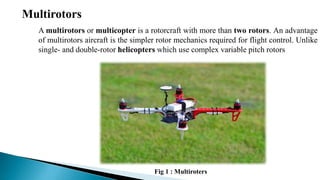
Multirotors
A multirotors or multicopter is a rotorcraft with more than two rotors. An advantage
of multirotors aircraft is the simpler rotor mechanics required for flight control. Unlike
single- and double-rotor helicopters which use complex variable pitch rotors
Fig 1 : Multiroters
Fixed Wing Drones
Fixed wing drones can fly at a higher altitude than other drones. Projects for
surveys and agriculture are easier due to the large plot of ground and geography
that can be covered. Fixed wings are more efficient than the use of a multi-
rotor drone that can not cover most of the land on a single flight.
Fig:2 Fixed wing Drones
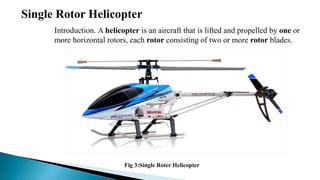
Single Rotor Helicopter
Introduction. A helicopter is an aircraft that is lifted and propelled by one or
more horizontal rotors, each rotor consisting of two or more rotor blades.
Fig 3:Single Roter Helicopter
Fixed Wing Hybrid VTOL
Hybrid VTOL Fixed-Wing UAVs combine the benefits of multi-rotor platforms
with fixed-wing drones and transition between the two modes during flight.
VTOL fixed-wing drones are a versatile choice for a wide range of commercial
and military aerial applications.
Fig 4: Fixed Wing Hybrid VTOL
Application
Fig 5: Application (Ref 2)
5 Benefits
 They can save lives. In natural and manmade disasters, UAS can be positioned
to survey damage, locate stranded and injured victims.
 They can support law enforcement. UAS can be used to search for lost
children, provide tactical surveillance and suspect tracking.
 They can contribute to safe infrastructure maintenance and management.
 They can streamline agriculture management. Using a crop management
system to observe, measure, and respond to variability in individual plants,
farmers can target areas requiring attention.
 They can give media access to hard-to-reach places. Aerial photography for
a news broadcast or a blockbuster film can be efficiently.
Advantages
 Doesn’t requires a qualified pilot.
 Can enter in any environment.
 Reduce the exposure risk of the aircraft operator.
 Can stay in the air up to 30 hours.
 Can be easily programed to complete a mission autonomously.
 Low cost operations
 Easy to operate and lightweight.
Disadvantages
Multi-rotors have a limited flying time (usually 15-30 minutes)
They only have small payload capabilities
And most of the drone’s energy is spent on fighting gravity and stabilizing
in the air
Threat to the nation security according to the Indian government.
Some time use for investigating and surveillance of people by drone
illegally.
Terror group use for arms supply in recent time in the boarder areas.
Basic Intro
 To distinguish UAVs from missiles, a UAV is defined as a "powered, aerial
vehicle that does not carry a human operator, uses aerodynamic forces to
provide vehicle lift, can fly autonomously or be piloted remotely
 can be expendable or recoverable, and can carry a lethal or non- lethal
payload‖
 Therefore, cruise missiles are not considered UAVs because, like many other
guided missiles, the vehicle itself is a weapon that is not reused, though it is
also unmanned and in some cases remotely guided The term UAV is
representative of a class of air vehicles known by different names:
uninhabited aerial vehicles
How It Works
 In the drone many component comes together With all will configure to achieve
the requires thrust to lift the drone in the air.
 Drones use rotors for propulsion and control. You can think of a rotor as a fan,
because they work pretty much the same. Spinning blades push air down. Of
course, all forces come in pairs, which means that as the rotor pushes down on
the air, the air pushes up on the rotor. This is the basic idea behind lift, which
comes down to controlling the upward and downward force. The faster the rotors
spin, the greater the lift, and vice-versa.
 Now, a drone can do three things in the vertical plane: hover, climb, or
descend. To hover, the net thrust of the four rotors pushing the drone up must be
equal to the gravitational force pulling it down. Easy. So what about moving up,
which pilots call climbing.
Components Of Drones
Fig 6: Components of Drones [3]
Different components of drone
Flight controller
Power distribution board
Electronic speed controller
Control receiver
FVP transmitter or antenna
FVP camera
Motors
Propellers
Battery
Extra sensors
GPS
Ultra sonic sensor ETC
Flight Controllers: The Processor Behind Every Multi-Rotor Flight
 The distinction with multi-rotors, whether or not advantageous, is that no
human is capable of controlling the rotational speeds of three or more motors
simultaneously with enough precision to balance a craft in the air. This is where
flight controllers come into play.
 A flight controller (FC) is a small circuit board of varying complexity. Its
function is to direct the RPM of each motor in response to input. A command
from the pilot for the multi-rotor to move forward is fed into the flight
controller, which determines how to manipulate the motors accordingly.
 The majority of flight controllers also employ sensors to supplement their
calculations. These range from simple gyroscopes for orientation to barometers
for automatically holding altitudes. GPS can also be used for auto-pilot or fail-
safe purposes. More on that shortly.
Power Distribution Board And ESC
 Power Distribution Board: A distribution board (also known as panel board,
breaker panel, or electric panel) is a component of an electricity supply system
that divides an electrical power feed into subsidiary circuits, while providing a
protective fuse or circuit breaker for each circuit in a common enclosure.
 Electronic speed controller(ESC): The FPV Drone Electronic Speed
Controller (ESC) on a drone is a hard-working, powerful component. The
ESC connects the flight controller and the motor. Given that each brushless
motor requires an ESC, a quad copter will require 4 ESCs.
Control Receiver And FVP Transmitter
 Control Receiver: The device which decodes the transmitted information from
the received signal is known as receiver. The receiver also uses antenna to receive
the signal from the air similar to the transmitter.
 FVP TRANSMITTER: First-person view (FPV), also known as remote-person
view (RPV), or simply video piloting, is a method used to control a radio-
controlled vehicle from the driver or pilot's view point.
 FVP Camera: FPV cameras are small, light and reasonably priced. The FPV
camera is mounted onto a drone to send real time video down to the ground using
a video transmitter.
Motors And Propellers
Fig 7: Motors And Propellers [4]
Implementation In Real World
Fig 8: Implementation In Real World [4]
Block Diagram For My Drone
Fig 9: Block Diagram For My Drone [5]
Possible Outcomes Of My Projects
 Can develop the drone technology with in the less budget and with more accuracy
 We can explore untouched or hidden market in India. Which market has a lot of
potential to boost Indian economy from consumer market to developer market
 Until government cannot taking any steps we fly drones without entry in *no
flying zone* like airports, military bases and other places.
 We can also share the every flight data with local authorities
Ex: flight time, location of actual drone,
 Note: Most important Purpose of flight.
Conclusion
 It is obvious that drone technology is an important part of the future
of warfare and is set to become a big commercial industry. The fact
that drones capabilities pose a threat to the liberties of people
around the globe is also apparent. Legislating on drones now is of
paramount importance because it sets the necessary limitations to
protect rights as drones are used in the future.
 Future is full of potential different industry using drone for different
purposes and if government support then its possible that we can
receive our parcel by drone in near future.
Ref: [6]
Reference
[1] www.youtube.com/brainright/1
[2] www.quora.com/drone
[3] https://www.sltc.ac.lk/workshop-uav/
[4] www.getfvp.com/learn/new-to-fvp
[5]https://www.slideshare.net/ABINVARGHESE2/autonomous- drone-
project-part-1
[6] https://dronedebate.weebly.com/in-conclusion.html
bca final year project drone presentation

bca final year project drone presentation

  • 2.
    Abstract  A drone,in technological terms, is an unmanned aircraft drones are more formally knows as unmanned aerial vehicles (UAVs).  In the recent past , UAVs were most often associated with the military, where hey were used initially for anti-aircraft target practice, Intelligence gathering and then, more controversially, as weapon platform.  Drone are now used in a wide range of civilian roles ranging from search and rescue, surveillance , traffic monitoring , weather monitoring
  • 3.
    Objectives Develop, improve andexplore & transmission and substation maintenance and operations by developing or improving one or more area of interest with an using Unmanned Aerial vehicle (UAVs) Drones:  Investigating the use of drones for transmission line inspection or maintaince  eliminate the need for helicopter survey  Mapping of wild and untouched areas.  Lifesaver for critical situation.
  • 4.
    Aim Top Aim  explorethe untouched market of drones in India.  drones much safer and reliable for for the user of UAVs  make them easy to track and monitor their activities through multiple sensors  develop a system through government track every single one and make changes in the favor of drone user through every one can own their own drone without legal issues.
  • 5.
    Introduction A drone, intechnological terms, is an unmanned aircraft. Drones are more formally known as unmanned aerial vehicles (UAVs) or unmanned aircraft systems (UAVs). Essentially, a drone is a flying robot that can be remotely controlled or fly autonomously through software-controlled flight plans in their embedded systems, working in conjunction with onboard sensors and GPS. Ref:1
  • 6.
    Types A “Drone” isbasically an Unmanned Aerial Vehicle(UAV) – an aircraft without a human pilot aboard. In this article, we explore the different types of drones out there in the market – some of which are just concepts, while most others are already in action.  Drones” can be classified on a different basis – say based on ‘usage‘ like Drones for Photography, Drones for aerial Mapping, Drones for Surveillance etc. However, the best classification of ‘Drones’ can be made on the basis of aerial platforms. Based on the type of aerial platform used, there are 4 major types of drones.  Multi Rotor Drones  Fixed Wing Drones  Single Rotor Helicopter  Fixed Wing Hybrid VTOL
  • 7.
    Multirotors A multirotors ormulticopter is a rotorcraft with more than two rotors. An advantage of multirotors aircraft is the simpler rotor mechanics required for flight control. Unlike single- and double-rotor helicopters which use complex variable pitch rotors Fig 1 : Multiroters
  • 8.
    Fixed Wing Drones Fixedwing drones can fly at a higher altitude than other drones. Projects for surveys and agriculture are easier due to the large plot of ground and geography that can be covered. Fixed wings are more efficient than the use of a multi- rotor drone that can not cover most of the land on a single flight. Fig:2 Fixed wing Drones
  • 9.
    Single Rotor Helicopter Introduction.A helicopter is an aircraft that is lifted and propelled by one or more horizontal rotors, each rotor consisting of two or more rotor blades. Fig 3:Single Roter Helicopter
  • 10.
    Fixed Wing HybridVTOL Hybrid VTOL Fixed-Wing UAVs combine the benefits of multi-rotor platforms with fixed-wing drones and transition between the two modes during flight. VTOL fixed-wing drones are a versatile choice for a wide range of commercial and military aerial applications. Fig 4: Fixed Wing Hybrid VTOL
  • 11.
  • 12.
    5 Benefits  Theycan save lives. In natural and manmade disasters, UAS can be positioned to survey damage, locate stranded and injured victims.  They can support law enforcement. UAS can be used to search for lost children, provide tactical surveillance and suspect tracking.  They can contribute to safe infrastructure maintenance and management.  They can streamline agriculture management. Using a crop management system to observe, measure, and respond to variability in individual plants, farmers can target areas requiring attention.  They can give media access to hard-to-reach places. Aerial photography for a news broadcast or a blockbuster film can be efficiently.
  • 13.
    Advantages  Doesn’t requiresa qualified pilot.  Can enter in any environment.  Reduce the exposure risk of the aircraft operator.  Can stay in the air up to 30 hours.  Can be easily programed to complete a mission autonomously.  Low cost operations  Easy to operate and lightweight.
  • 14.
    Disadvantages Multi-rotors have alimited flying time (usually 15-30 minutes) They only have small payload capabilities And most of the drone’s energy is spent on fighting gravity and stabilizing in the air Threat to the nation security according to the Indian government. Some time use for investigating and surveillance of people by drone illegally. Terror group use for arms supply in recent time in the boarder areas.
  • 15.
    Basic Intro  Todistinguish UAVs from missiles, a UAV is defined as a "powered, aerial vehicle that does not carry a human operator, uses aerodynamic forces to provide vehicle lift, can fly autonomously or be piloted remotely  can be expendable or recoverable, and can carry a lethal or non- lethal payload‖  Therefore, cruise missiles are not considered UAVs because, like many other guided missiles, the vehicle itself is a weapon that is not reused, though it is also unmanned and in some cases remotely guided The term UAV is representative of a class of air vehicles known by different names: uninhabited aerial vehicles
  • 16.
    How It Works In the drone many component comes together With all will configure to achieve the requires thrust to lift the drone in the air.  Drones use rotors for propulsion and control. You can think of a rotor as a fan, because they work pretty much the same. Spinning blades push air down. Of course, all forces come in pairs, which means that as the rotor pushes down on the air, the air pushes up on the rotor. This is the basic idea behind lift, which comes down to controlling the upward and downward force. The faster the rotors spin, the greater the lift, and vice-versa.  Now, a drone can do three things in the vertical plane: hover, climb, or descend. To hover, the net thrust of the four rotors pushing the drone up must be equal to the gravitational force pulling it down. Easy. So what about moving up, which pilots call climbing.
  • 17.
    Components Of Drones Fig6: Components of Drones [3]
  • 18.
    Different components ofdrone Flight controller Power distribution board Electronic speed controller Control receiver FVP transmitter or antenna FVP camera Motors Propellers Battery Extra sensors GPS Ultra sonic sensor ETC
  • 19.
    Flight Controllers: TheProcessor Behind Every Multi-Rotor Flight  The distinction with multi-rotors, whether or not advantageous, is that no human is capable of controlling the rotational speeds of three or more motors simultaneously with enough precision to balance a craft in the air. This is where flight controllers come into play.  A flight controller (FC) is a small circuit board of varying complexity. Its function is to direct the RPM of each motor in response to input. A command from the pilot for the multi-rotor to move forward is fed into the flight controller, which determines how to manipulate the motors accordingly.  The majority of flight controllers also employ sensors to supplement their calculations. These range from simple gyroscopes for orientation to barometers for automatically holding altitudes. GPS can also be used for auto-pilot or fail- safe purposes. More on that shortly.
  • 20.
    Power Distribution BoardAnd ESC  Power Distribution Board: A distribution board (also known as panel board, breaker panel, or electric panel) is a component of an electricity supply system that divides an electrical power feed into subsidiary circuits, while providing a protective fuse or circuit breaker for each circuit in a common enclosure.  Electronic speed controller(ESC): The FPV Drone Electronic Speed Controller (ESC) on a drone is a hard-working, powerful component. The ESC connects the flight controller and the motor. Given that each brushless motor requires an ESC, a quad copter will require 4 ESCs.
  • 21.
    Control Receiver AndFVP Transmitter  Control Receiver: The device which decodes the transmitted information from the received signal is known as receiver. The receiver also uses antenna to receive the signal from the air similar to the transmitter.  FVP TRANSMITTER: First-person view (FPV), also known as remote-person view (RPV), or simply video piloting, is a method used to control a radio- controlled vehicle from the driver or pilot's view point.  FVP Camera: FPV cameras are small, light and reasonably priced. The FPV camera is mounted onto a drone to send real time video down to the ground using a video transmitter.
  • 22.
    Motors And Propellers Fig7: Motors And Propellers [4]
  • 23.
    Implementation In RealWorld Fig 8: Implementation In Real World [4]
  • 24.
    Block Diagram ForMy Drone Fig 9: Block Diagram For My Drone [5]
  • 25.
    Possible Outcomes OfMy Projects  Can develop the drone technology with in the less budget and with more accuracy  We can explore untouched or hidden market in India. Which market has a lot of potential to boost Indian economy from consumer market to developer market  Until government cannot taking any steps we fly drones without entry in *no flying zone* like airports, military bases and other places.  We can also share the every flight data with local authorities Ex: flight time, location of actual drone,  Note: Most important Purpose of flight.
  • 26.
    Conclusion  It isobvious that drone technology is an important part of the future of warfare and is set to become a big commercial industry. The fact that drones capabilities pose a threat to the liberties of people around the globe is also apparent. Legislating on drones now is of paramount importance because it sets the necessary limitations to protect rights as drones are used in the future.  Future is full of potential different industry using drone for different purposes and if government support then its possible that we can receive our parcel by drone in near future. Ref: [6]
  • 27.
    Reference [1] www.youtube.com/brainright/1 [2] www.quora.com/drone [3]https://www.sltc.ac.lk/workshop-uav/ [4] www.getfvp.com/learn/new-to-fvp [5]https://www.slideshare.net/ABINVARGHESE2/autonomous- drone- project-part-1 [6] https://dronedebate.weebly.com/in-conclusion.html