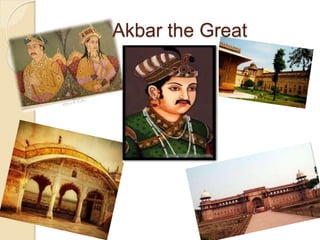
Akbar the Great
Akbar the great
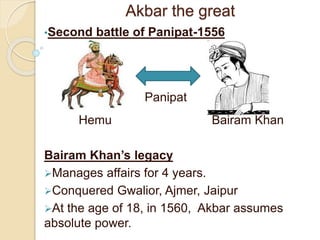
•Second battle of Panipat-1556
Hemu Bairam Khan
Bairam Khan’s legacy
Manages affairs for 4 years.
Conquered Gwalior, Ajmer, Jaipur
At the age of 18, in 1560, Akbar assumes
absolute power.
Panipat
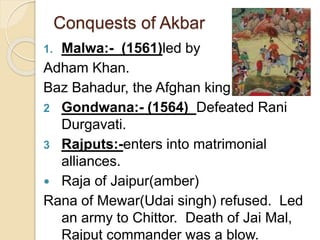
Conquests of Akbar
1. Malwa:- (1561)led by
Adham Khan.
Baz Bahadur, the Afghan king fled.
2 Gondwana:- (1564) Defeated Rani
Durgavati.
3 Rajputs:-enters into matrimonial
alliances.
 Raja of Jaipur(amber)
Rana of Mewar(Udai singh) refused. Led
an army to Chittor. Death of Jai Mal,
Rajput commander was a blow.
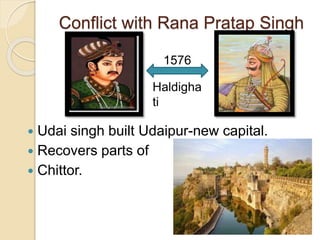
Conflict with Rana Pratap Singh
 Udai singh built Udaipur-new capital.
 Recovers parts of
 Chittor.
Haldigha
ti
1576
Akbar the great
Conquest of Gujarat- 1572
Cotton fields, flourishing seaports, trade with
European merchants.
Conquest of Bengal-1574-76
Trade links with south east Asia and China.
Rich revenues to Mughal treasury
Conquests of North west-1585-95
Kashmir, Kandahar, lower Sind(1591)
Baluchistan (1595)
Deccan Campaigns-1601
Berar, Khandesh, part of Ahmadnagar.
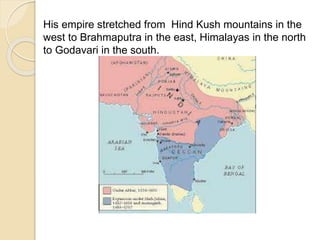
His empire stretched from Hind Kush mountains in the
west to Brahmaputra in the east, Himalayas in the north
to Godavari in the south.
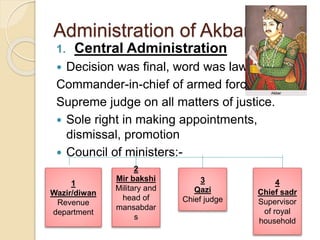
Administration of Akbar
1. Central Administration
 Decision was final, word was law.
Commander-in-chief of armed forces
Supreme judge on all matters of justice.
 Sole right in making appointments,
dismissal, promotion
 Council of ministers:-
1
Wazir/diwan
Revenue
department
2
Mir bakshi
Military and
head of
mansabdar
s
3
Qazi
Chief judge
4
Chief sadr
Supervisor
of royal
household
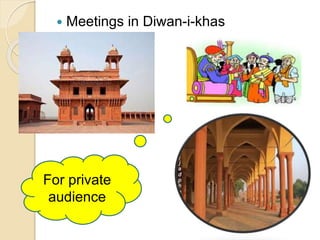
 Meetings in Diwan-i-khas
For private
audience
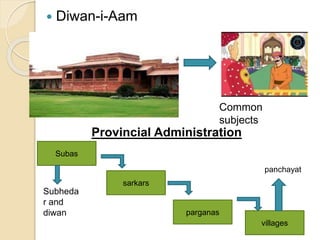
 Diwan-i-Aam
Provincial Administration
Subas
sarkars
parganas
villages
Subheda
r and
diwan
panchayat
Common
subjects
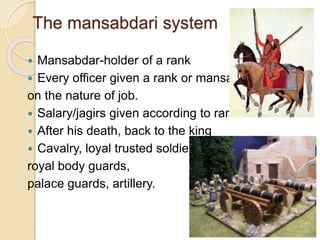
The mansabdari system
 Mansabdar-holder of a rank
 Every officer given a rank or mansab
on the nature of job.
 Salary/jagirs given according to rank
 After his death, back to the king
 Cavalry, loyal trusted soldiers,
royal body guards,
palace guards, artillery.
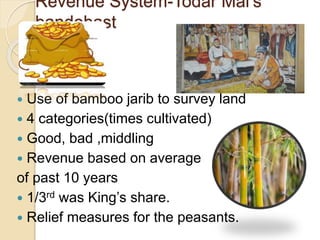
Revenue System-Todar Mal’s
bandobast
 Use of bamboo jarib to survey land
 4 categories(times cultivated)
 Good, bad ,middling
 Revenue based on average
of past 10 years
 1/3rd was King’s share.
 Relief measures for the peasants.
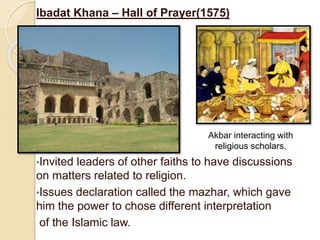
Ibadat Khana – Hall of Prayer(1575)
•Invited leaders of other faiths to have discussions
on matters related to religion.
•Issues declaration called the mazhar, which gave
him the power to chose different interpretation
of the Islamic law.
Akbar interacting with
religious scholars.
 Akbar’s religion
• Sulh-i-Kul or universal peace.
• Formation of Din-i-llahi
 belief in one God
Emperor as God’s representative on earth
Rajput policy
 Treated them with respect
 Did not annex their kingdoms, if they
recognized him as their overlord and paid him
regular tribute.
Social reforms.
 Prohibited sati, legalized widow remarriage.
 Discouraged child marriage. 14 yrs for girls
and 16 for boys.
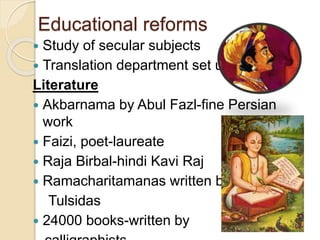
Educational reforms
 Study of secular subjects
 Translation department set up.
Literature
 Akbarnama by Abul Fazl-fine Persian
work
 Faizi, poet-laureate
 Raja Birbal-hindi Kavi Raj
 Ramacharitamanas written by
Tulsidas
 24000 books-written by
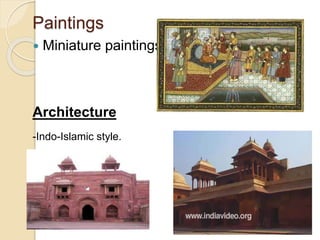
Paintings
 Miniature paintings
Architecture
-Indo-Islamic style.
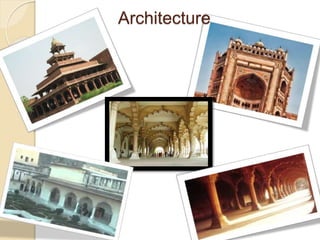
Architecture
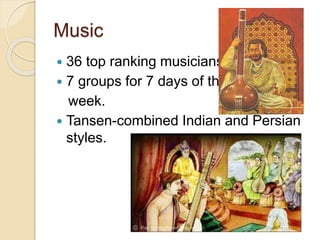
Music
 36 top ranking musicians.
 7 groups for 7 days of the
week.
 Tansen-combined Indian and Persian
styles.
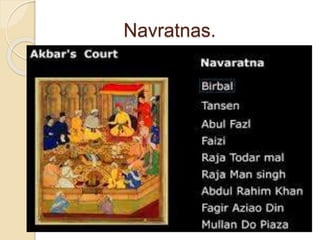
Navratnas.
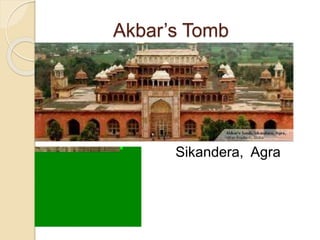
Akbar’s Tomb
Sikandera, Agra

Akbar the great .ppt

  • 1.
  • 2.
    Akbar the great •Secondbattle of Panipat-1556 Hemu Bairam Khan Bairam Khan’s legacy Manages affairs for 4 years. Conquered Gwalior, Ajmer, Jaipur At the age of 18, in 1560, Akbar assumes absolute power. Panipat
  • 3.
    Conquests of Akbar 1.Malwa:- (1561)led by Adham Khan. Baz Bahadur, the Afghan king fled. 2 Gondwana:- (1564) Defeated Rani Durgavati. 3 Rajputs:-enters into matrimonial alliances.  Raja of Jaipur(amber) Rana of Mewar(Udai singh) refused. Led an army to Chittor. Death of Jai Mal, Rajput commander was a blow.
  • 4.
    Conflict with RanaPratap Singh  Udai singh built Udaipur-new capital.  Recovers parts of  Chittor. Haldigha ti 1576
  • 5.
    Akbar the great Conquestof Gujarat- 1572 Cotton fields, flourishing seaports, trade with European merchants. Conquest of Bengal-1574-76 Trade links with south east Asia and China. Rich revenues to Mughal treasury Conquests of North west-1585-95 Kashmir, Kandahar, lower Sind(1591) Baluchistan (1595) Deccan Campaigns-1601 Berar, Khandesh, part of Ahmadnagar.
  • 6.
    His empire stretchedfrom Hind Kush mountains in the west to Brahmaputra in the east, Himalayas in the north to Godavari in the south.
  • 7.
    Administration of Akbar 1.Central Administration  Decision was final, word was law. Commander-in-chief of armed forces Supreme judge on all matters of justice.  Sole right in making appointments, dismissal, promotion  Council of ministers:- 1 Wazir/diwan Revenue department 2 Mir bakshi Military and head of mansabdar s 3 Qazi Chief judge 4 Chief sadr Supervisor of royal household
  • 8.
     Meetings inDiwan-i-khas For private audience
  • 9.
  • 10.
    The mansabdari system Mansabdar-holder of a rank  Every officer given a rank or mansab on the nature of job.  Salary/jagirs given according to rank  After his death, back to the king  Cavalry, loyal trusted soldiers, royal body guards, palace guards, artillery.
  • 11.
    Revenue System-Todar Mal’s bandobast Use of bamboo jarib to survey land  4 categories(times cultivated)  Good, bad ,middling  Revenue based on average of past 10 years  1/3rd was King’s share.  Relief measures for the peasants.
  • 12.
    Ibadat Khana –Hall of Prayer(1575) •Invited leaders of other faiths to have discussions on matters related to religion. •Issues declaration called the mazhar, which gave him the power to chose different interpretation of the Islamic law. Akbar interacting with religious scholars.
  • 13.
     Akbar’s religion •Sulh-i-Kul or universal peace. • Formation of Din-i-llahi  belief in one God Emperor as God’s representative on earth Rajput policy  Treated them with respect  Did not annex their kingdoms, if they recognized him as their overlord and paid him regular tribute. Social reforms.  Prohibited sati, legalized widow remarriage.  Discouraged child marriage. 14 yrs for girls and 16 for boys.
  • 14.
    Educational reforms  Studyof secular subjects  Translation department set up. Literature  Akbarnama by Abul Fazl-fine Persian work  Faizi, poet-laureate  Raja Birbal-hindi Kavi Raj  Ramacharitamanas written by Tulsidas  24000 books-written by
  • 15.
  • 16.
  • 17.
    Music  36 topranking musicians.  7 groups for 7 days of the week.  Tansen-combined Indian and Persian styles.
  • 18.
  • 19.