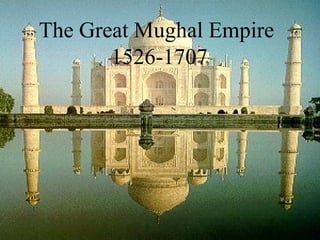
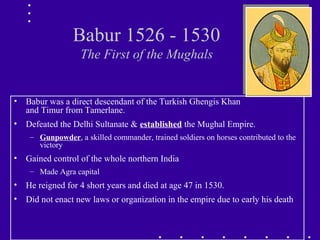
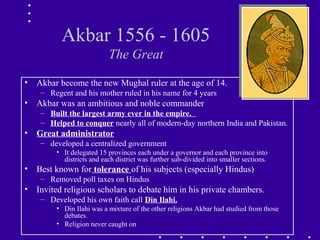
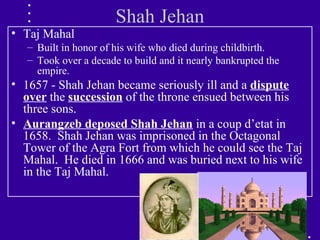
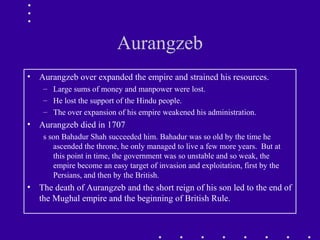
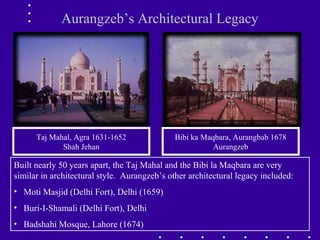
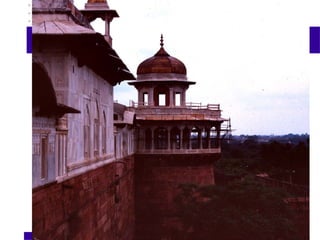
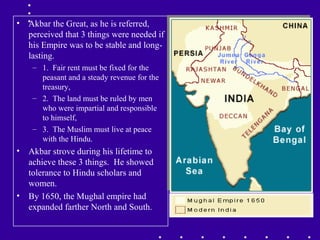
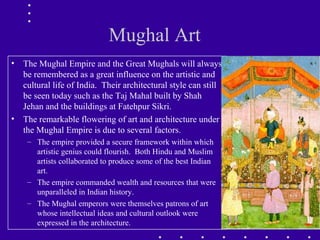
The Mughal Empire ruled northern India from 1526 to 1707, establishing the greatest, richest Muslim dynasty in India. Key emperors included Babur, who founded the empire; Akbar, who expanded it and promoted religious tolerance; Shah Jahan, a patron of the arts who built the Taj Mahal; and Aurangzeb, whose intolerance strained the empire. Under the Mughals, India saw a golden age of architecture, art, and culture. However, religious conflict and overexpansion eventually weakened the empire, leading to its decline in the early 18th century.




![Mughal Architecture [fort, mosque[masjid], tomb](https://cdn.slidesharecdn.com/ss_thumbnails/mughalarchitecture200-150723111603-lva1-app6892-thumbnail.jpg?width=640&height=640&fit=bounds)


