MUGHAL ARCHITECTURE
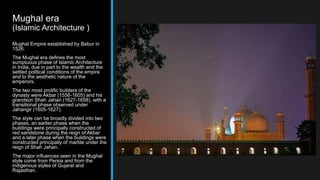
Mughal era
(Islamic Architecture )
Mughal Empire established by Babur in
1526.
The Mughal era defines the most
sumptuous phase of Islamic Architecture
in India, due in part to the wealth and the
settled political conditions of the empire
and to the aesthetic nature of the
emperors.
The two most prolific builders of the
dynasty were Akbar (1556-1605) and his
grandson Shah Jahan (1627-1658), with a
transitional phase observed under
Jahangir (1605-1627).
The style can be broadly divided into two
phases, an earlier phase when the
buildings were principally constructed of
red sandstone during the reign of Akbar
and a later phase when the buildings were
constructed principally of marble under the
reign of Shah Jahan.
The major influences seen in the Mughal
style come from Persia and from the
indigenous styles of Gujarat and
Rajasthan.
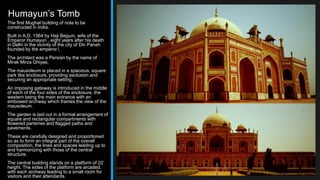
Humayun’s Tomb
The first Mughal building of note to be
constructed in India.
Built in A.D. 1564 by Haji Begum, wife of the
Emperor Humayun , eight years after his death
in Delhi in the vicinity of the city of Din Panah
founded by the emperor.
The architect was a Persian by the name of
Mirak Mirza Ghiyas.
The mausoleum is placed in a spacious, square
park like enclosure, providing seclusion and
securing an appropriate setting.
An imposing gateway is introduced in the middle
of each of the four sides of the enclosure, the
western being the main entrance with an
embowed archway which frames the view of the
mausoleum.
The garden is laid out in a formal arrangement of
square and rectangular compartments with
flowered parterres and flagged paths and
pavements.
These are carefully designed and proportioned
so as to form an integral part of the overall
composition, the lines and spaces leading up to
and harmonizing with those of the central
structure.
The central building stands on a platform of 22’
height. The sides of the platform are arcaded,
with each archway leading to a small room for
visitors and their attendants.
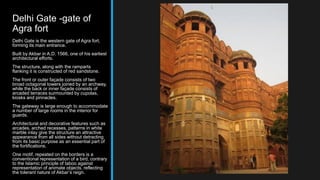
Delhi Gate -gate of
Agra fort
Delhi Gate is the western gate of Agra fort,
forming its main entrance.
Built by Akbar in A.D. 1566, one of his earliest
architectural efforts.
The structure, along with the ramparts
flanking it is constructed of red sandstone.
The front or outer façade consists of two
broad octagonal towers joined by an archway,
while the back or inner façade consists of
arcaded terraces surmounted by cupolas,
kiosks and pinnacles.
The gateway is large enough to accommodate
a number of large rooms in the interior for
guards.
Architectural and decorative features such as
arcades, arched recesses, patterns in white
marble inlay give the structure an attractive
appearance from all sides without detracting
from its basic purpose as an essential part of
the fortifications.
One motif, repeated on the borders is a
conventional representation of a bird, contrary
to the Islamic principle of taboo against
representation of animate objects, reflecting
the tolerant nature of Akbar’s reign.
Jami Masjid at
Fatehpur Sikri
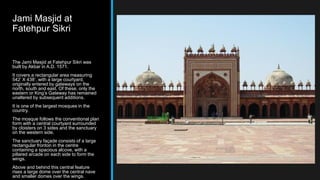
The Jami Masjid at Fatehpur Sikri was
built by Akbar in A.D. 1571.
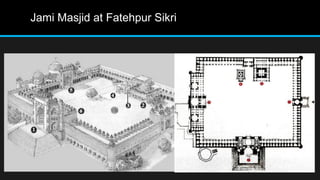
It covers a rectangular area measuring
542’ X 438’, with a large courtyard,
originally entered by gateways on the
north, south and east. Of these, only the
eastern or King’s Gateway has remained
unaltered by subsequent additions.
It is one of the largest mosques in the
country.
The mosque follows the conventional plan
form with a central courtyard surrounded
by cloisters on 3 sides and the sanctuary
on the western side.
The sanctuary façade consists of a large
rectangular fronton in the centre
containing a spacious alcove, with a
pillared arcade on each side to form the
wings.
Above and behind this central feature
rises a large dome over the central nave
and smaller domes over the wings.
Jami Masjid at Fatehpur Sikri
Akbar’s mausoleum
Akbar’s mausoleum was built by his son, the Emperor
Jahangir, 8 years after Akbar’s death, completed in
1613.
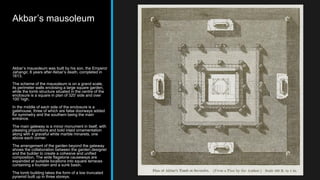
The scheme of the mausoleum is on a grand scale,
its perimeter walls enclosing a large square garden,
while the tomb structure situated in the centre of the
enclosure is a square in plan of 320’ side and over
100’ high.
In the middle of each side of the enclosure is a
gatehouse, three of which are false doorways added
for symmetry and the southern being the main
entrance.
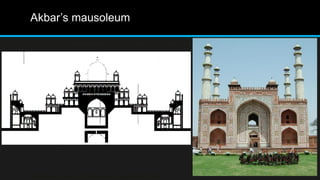
The main gateway is a minor monument in itself, with
pleasing proportions and bold inlaid ornamentation
along with 4 graceful white marble minarets, one
above each corner.
The arrangement of the garden beyond the gateway
shows the collaboration between the garden designer
and the builder to create a cohesive and unified
composition. The wide flagstone causeways are
expanded at suitable locations into square terraces
containing a fountain and a sunk basin.
The tomb building takes the form of a low truncated
pyramid built up in three storeys.
Akbar’s mausoleum
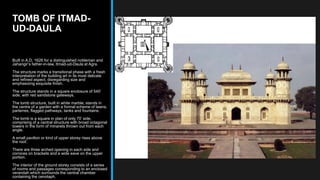
TOMB OF ITMAD-
UD-DAULA
Built in A.D. 1626 for a distinguished nobleman and
Jahangir’s father-in-law, Itmad-ud-Daula at Agra.
The structure marks a transitional phase with a fresh
interpretation of the building art in its most delicate
and refined aspect, disregarding size and
emphasizing exquisite finish.
The structure stands in a square enclosure of 540’
side, with red sandstone gateways.
The tomb structure, built in white marble, stands in
the centre of a garden with a formal scheme of lawns,
parterres, flagged pathways, tanks and fountains.
The tomb is a square in plan of only 70’ side,
comprising of a central structure with broad octagonal
towers in the form of minarets thrown out from each
angle.
A small pavilion or kind of upper storey rises above
the roof.
There are three arched opening in each side and
cornices on brackets and a wide eave on the upper
portion.
The interior of the ground storey consists of a series
of rooms and passages corresponding to an enclosed
verandah which surrounds the central chamber
containing the cenotaph.
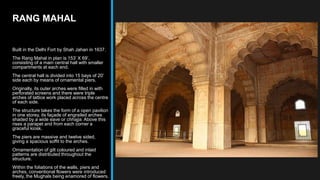
RANG MAHAL
Built in the Delhi Fort by Shah Jahan in 1637.
The Rang Mahal in plan is 153’ X 69’,
consisting of a main central hall with smaller
compartments at each end.
The central hall is divided into 15 bays of 20’
side each by means of ornamental piers.
Originally, its outer arches were filled in with
perforated screens and there were triple
arches of lattice work placed across the centre
of each side.
The structure takes the form of a open pavilion
in one storey, its façade of engrailed arches
shaded by a wide eave or chhajja. Above this
rises a parapet and from each corner a
graceful kiosk.
The piers are massive and twelve sided,
giving a spacious soffit to the arches.
Ornamentation of gilt coloured and inlaid
patterns are distributed throughout the
structure.
Within the foliations of the walls, piers and
arches, conventional flowers were introduced
freely, the Mughals being enamored of flowers.
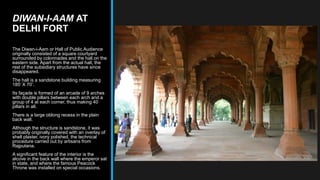
DIWAN-I-AAM AT
DELHI FORT
The Diwan-i-Aam or Hall of Public Audience
originally consisted of a square courtyard
surrounded by colonnades and the hall on the
eastern side. Apart from the actual hall, the
rest of the subsidiary structures have since
disappeared.
The hall is a sandstone building measuring
185’ X 70’.
Its façade is formed of an arcade of 9 arches
with double pillars between each arch and a
group of 4 at each corner, thus making 40
pillars in all.
There is a large oblong recess in the plain
back wall.
Although the structure is sandstone, it was
probably originally covered with an overlay of
shell plaster, ivory polished, the technical
procedure carried out by artisans from
Rajputana.
A significant feature of the interior is the
alcove in the back wall where the emperor sat
in state, and where the famous Peacock
Throne was installed on special occasions.
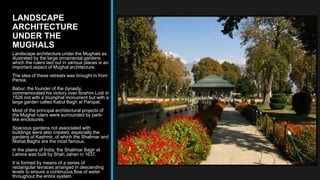
LANDSCAPE
ARCHITECTURE
UNDER THE
MUGHALS
Landscape architecture under the Mughals as
illustrated by the large ornamental gardens
which the rulers laid out in various places is an
important aspect of Mughal architecture.
The idea of these retreats was brought in from
Persia.
Babur, the founder of the dynasty,
commemorated his victory over Ibrahim Lodi in
1526 not with a triumphal monument but with a
large garden called Kabul Bagh at Panipat.
Most of the principal architectural projects of
the Mughal rulers were surrounded by park-
like enclosures.
Spacious gardens not associated with
buildings were also created, especially the
gardens of Kashmir, of which the Shalimar and
Nishat Baghs are the most famous.
In the plains of India, the Shalimar Bagh at
Lahore was built by Shah Jahan in 1637.
It is formed by means of a series of
rectangular terraces arranged in descending
levels to ensure a continuous flow of water
throughout the entire system.
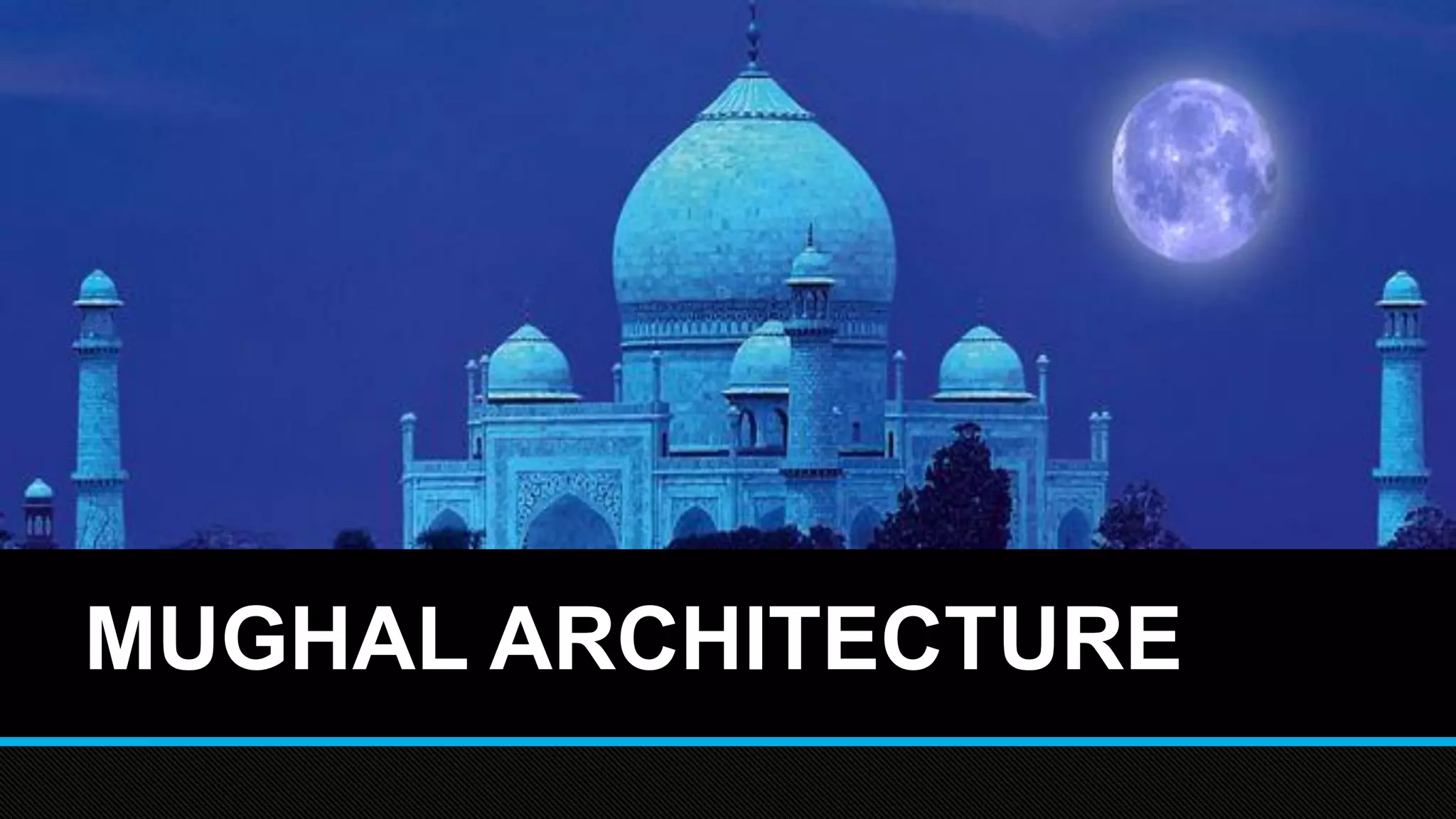
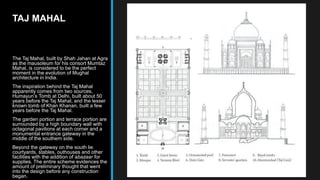
TAJ MAHAL
The Taj Mahal, built by Shah Jahan at Agra
as the mausoleum for his consort Mumtaz
Mahal, is considered to be the perfect
moment in the evolution of Mughal
architecture in India.
The inspiration behind the Taj Mahal
apparently comes from two sources,
Humayun’s Tomb at Delhi, built about 50
years before the Taj Mahal, and the lesser
known tomb of Khan Khanan, built a few
years before the Taj Mahal.
The garden portion and terrace portion are
surrounded by a high boundary wall with
octagonal pavilions at each corner and a
monumental entrance gateway in the
middle of the southern side.
Beyond the gateway on the south lie
courtyards, stables, outhouses and other
facilities with the addition of abazaar for
supplies. The entire scheme evidences the
amount of preliminary thought that went
into the design before any construction
began.
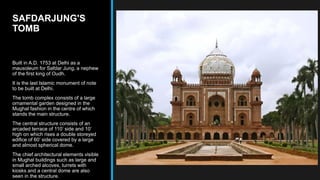
SAFDARJUNG'S
TOMB
Built in A.D. 1753 at Delhi as a
mausoleum for Safdar Jung, a nephew
of the first king of Oudh.
It is the last Islamic monument of note
to be built at Delhi.
The tomb complex consists of a large
ornamental garden designed in the
Mughal fashion in the centre of which
stands the main structure.
The central structure consists of an
arcaded terrace of 110’ side and 10’
high on which rises a double storeyed
edifice of 60’ side covered by a large
and almost spherical dome.
The chief architectural elements visible
in Mughal buildings such as large and
small arched alcoves, turrets with
kiosks and a central dome are also
seen in the structure.
architectnazim@gmail.com
Ar. Nazim Bin Shamshiraz Saifi

Mughal Architecture

  • 1.
  • 2.
    Mughal era (Islamic Architecture) Mughal Empire established by Babur in 1526. The Mughal era defines the most sumptuous phase of Islamic Architecture in India, due in part to the wealth and the settled political conditions of the empire and to the aesthetic nature of the emperors. The two most prolific builders of the dynasty were Akbar (1556-1605) and his grandson Shah Jahan (1627-1658), with a transitional phase observed under Jahangir (1605-1627). The style can be broadly divided into two phases, an earlier phase when the buildings were principally constructed of red sandstone during the reign of Akbar and a later phase when the buildings were constructed principally of marble under the reign of Shah Jahan. The major influences seen in the Mughal style come from Persia and from the indigenous styles of Gujarat and Rajasthan.
  • 3.
    Humayun’s Tomb The firstMughal building of note to be constructed in India. Built in A.D. 1564 by Haji Begum, wife of the Emperor Humayun , eight years after his death in Delhi in the vicinity of the city of Din Panah founded by the emperor. The architect was a Persian by the name of Mirak Mirza Ghiyas. The mausoleum is placed in a spacious, square park like enclosure, providing seclusion and securing an appropriate setting. An imposing gateway is introduced in the middle of each of the four sides of the enclosure, the western being the main entrance with an embowed archway which frames the view of the mausoleum. The garden is laid out in a formal arrangement of square and rectangular compartments with flowered parterres and flagged paths and pavements. These are carefully designed and proportioned so as to form an integral part of the overall composition, the lines and spaces leading up to and harmonizing with those of the central structure. The central building stands on a platform of 22’ height. The sides of the platform are arcaded, with each archway leading to a small room for visitors and their attendants.
  • 4.
    Delhi Gate -gateof Agra fort Delhi Gate is the western gate of Agra fort, forming its main entrance. Built by Akbar in A.D. 1566, one of his earliest architectural efforts. The structure, along with the ramparts flanking it is constructed of red sandstone. The front or outer façade consists of two broad octagonal towers joined by an archway, while the back or inner façade consists of arcaded terraces surmounted by cupolas, kiosks and pinnacles. The gateway is large enough to accommodate a number of large rooms in the interior for guards. Architectural and decorative features such as arcades, arched recesses, patterns in white marble inlay give the structure an attractive appearance from all sides without detracting from its basic purpose as an essential part of the fortifications. One motif, repeated on the borders is a conventional representation of a bird, contrary to the Islamic principle of taboo against representation of animate objects, reflecting the tolerant nature of Akbar’s reign.
  • 5.
    Jami Masjid at FatehpurSikri The Jami Masjid at Fatehpur Sikri was built by Akbar in A.D. 1571. It covers a rectangular area measuring 542’ X 438’, with a large courtyard, originally entered by gateways on the north, south and east. Of these, only the eastern or King’s Gateway has remained unaltered by subsequent additions. It is one of the largest mosques in the country. The mosque follows the conventional plan form with a central courtyard surrounded by cloisters on 3 sides and the sanctuary on the western side. The sanctuary façade consists of a large rectangular fronton in the centre containing a spacious alcove, with a pillared arcade on each side to form the wings. Above and behind this central feature rises a large dome over the central nave and smaller domes over the wings.
  • 6.
    Jami Masjid atFatehpur Sikri
  • 7.
    Akbar’s mausoleum Akbar’s mausoleumwas built by his son, the Emperor Jahangir, 8 years after Akbar’s death, completed in 1613. The scheme of the mausoleum is on a grand scale, its perimeter walls enclosing a large square garden, while the tomb structure situated in the centre of the enclosure is a square in plan of 320’ side and over 100’ high. In the middle of each side of the enclosure is a gatehouse, three of which are false doorways added for symmetry and the southern being the main entrance. The main gateway is a minor monument in itself, with pleasing proportions and bold inlaid ornamentation along with 4 graceful white marble minarets, one above each corner. The arrangement of the garden beyond the gateway shows the collaboration between the garden designer and the builder to create a cohesive and unified composition. The wide flagstone causeways are expanded at suitable locations into square terraces containing a fountain and a sunk basin. The tomb building takes the form of a low truncated pyramid built up in three storeys.
  • 8.
  • 9.
    TOMB OF ITMAD- UD-DAULA Builtin A.D. 1626 for a distinguished nobleman and Jahangir’s father-in-law, Itmad-ud-Daula at Agra. The structure marks a transitional phase with a fresh interpretation of the building art in its most delicate and refined aspect, disregarding size and emphasizing exquisite finish. The structure stands in a square enclosure of 540’ side, with red sandstone gateways. The tomb structure, built in white marble, stands in the centre of a garden with a formal scheme of lawns, parterres, flagged pathways, tanks and fountains. The tomb is a square in plan of only 70’ side, comprising of a central structure with broad octagonal towers in the form of minarets thrown out from each angle. A small pavilion or kind of upper storey rises above the roof. There are three arched opening in each side and cornices on brackets and a wide eave on the upper portion. The interior of the ground storey consists of a series of rooms and passages corresponding to an enclosed verandah which surrounds the central chamber containing the cenotaph.
  • 10.
    RANG MAHAL Built inthe Delhi Fort by Shah Jahan in 1637. The Rang Mahal in plan is 153’ X 69’, consisting of a main central hall with smaller compartments at each end. The central hall is divided into 15 bays of 20’ side each by means of ornamental piers. Originally, its outer arches were filled in with perforated screens and there were triple arches of lattice work placed across the centre of each side. The structure takes the form of a open pavilion in one storey, its façade of engrailed arches shaded by a wide eave or chhajja. Above this rises a parapet and from each corner a graceful kiosk. The piers are massive and twelve sided, giving a spacious soffit to the arches. Ornamentation of gilt coloured and inlaid patterns are distributed throughout the structure. Within the foliations of the walls, piers and arches, conventional flowers were introduced freely, the Mughals being enamored of flowers.
  • 11.
    DIWAN-I-AAM AT DELHI FORT TheDiwan-i-Aam or Hall of Public Audience originally consisted of a square courtyard surrounded by colonnades and the hall on the eastern side. Apart from the actual hall, the rest of the subsidiary structures have since disappeared. The hall is a sandstone building measuring 185’ X 70’. Its façade is formed of an arcade of 9 arches with double pillars between each arch and a group of 4 at each corner, thus making 40 pillars in all. There is a large oblong recess in the plain back wall. Although the structure is sandstone, it was probably originally covered with an overlay of shell plaster, ivory polished, the technical procedure carried out by artisans from Rajputana. A significant feature of the interior is the alcove in the back wall where the emperor sat in state, and where the famous Peacock Throne was installed on special occasions.
  • 12.
    LANDSCAPE ARCHITECTURE UNDER THE MUGHALS Landscape architectureunder the Mughals as illustrated by the large ornamental gardens which the rulers laid out in various places is an important aspect of Mughal architecture. The idea of these retreats was brought in from Persia. Babur, the founder of the dynasty, commemorated his victory over Ibrahim Lodi in 1526 not with a triumphal monument but with a large garden called Kabul Bagh at Panipat. Most of the principal architectural projects of the Mughal rulers were surrounded by park- like enclosures. Spacious gardens not associated with buildings were also created, especially the gardens of Kashmir, of which the Shalimar and Nishat Baghs are the most famous. In the plains of India, the Shalimar Bagh at Lahore was built by Shah Jahan in 1637. It is formed by means of a series of rectangular terraces arranged in descending levels to ensure a continuous flow of water throughout the entire system.
  • 13.
    TAJ MAHAL The TajMahal, built by Shah Jahan at Agra as the mausoleum for his consort Mumtaz Mahal, is considered to be the perfect moment in the evolution of Mughal architecture in India. The inspiration behind the Taj Mahal apparently comes from two sources, Humayun’s Tomb at Delhi, built about 50 years before the Taj Mahal, and the lesser known tomb of Khan Khanan, built a few years before the Taj Mahal. The garden portion and terrace portion are surrounded by a high boundary wall with octagonal pavilions at each corner and a monumental entrance gateway in the middle of the southern side. Beyond the gateway on the south lie courtyards, stables, outhouses and other facilities with the addition of abazaar for supplies. The entire scheme evidences the amount of preliminary thought that went into the design before any construction began.
  • 14.
    SAFDARJUNG'S TOMB Built in A.D.1753 at Delhi as a mausoleum for Safdar Jung, a nephew of the first king of Oudh. It is the last Islamic monument of note to be built at Delhi. The tomb complex consists of a large ornamental garden designed in the Mughal fashion in the centre of which stands the main structure. The central structure consists of an arcaded terrace of 110’ side and 10’ high on which rises a double storeyed edifice of 60’ side covered by a large and almost spherical dome. The chief architectural elements visible in Mughal buildings such as large and small arched alcoves, turrets with kiosks and a central dome are also seen in the structure.
  • 15.