Associate Professor, Department of Architecture
G. L. Bajaj Group of Institutions, Mathura, U.P.
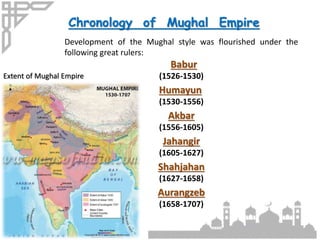
Chronology of Mughal Empire
Development of the Mughal style was flourished under the
following great rulers:
Babur
(1526-1530)
Humayun
(1530-1556)
Akbar
(1556-1605)
Jahangir
(1605-1627)
Shahjahan
(1627-1658)
Aurangzeb
(1658-1707)
Extent of Mughal Empire
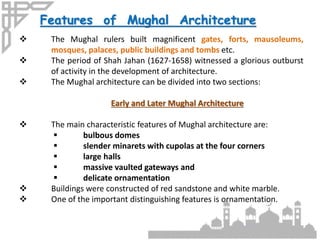
Features of Mughal Architceture
 The Mughal rulers built magnificent gates, forts, mausoleums,
mosques, palaces, public buildings and tombs etc.
 The period of Shah Jahan (1627-1658) witnessed a glorious outburst
of activity in the development of architecture.
 The Mughal architecture can be divided into two sections:
Early and Later Mughal Architecture
 The main characteristic features of Mughal architecture are:
 bulbous domes
 slender minarets with cupolas at the four corners
 large halls
 massive vaulted gateways and
 delicate ornamentation
 Buildings were constructed of red sandstone and white marble.
 One of the important distinguishing features is ornamentation.
Monuments:
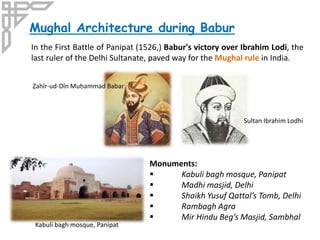
 Kabuli bagh mosque, Panipat
 Madhi masjid, Delhi
 Shaikh Yusuf Qattal’s Tomb, Delhi
 Rambagh Agra
 Mir Hindu Beg’s Masjid, Sambhal
Mughal Architecture during Babur
In the First Battle of Panipat (1526,) Babur's victory over Ibrahim Lodi, the
last ruler of the Delhi Sultanate, paved way for the Mughal rule in India.
Ẓahīr-ud-Dīn Muḥammad Babar
Sultan Ibrahim Lodhi
Kabuli bagh mosque, Panipat
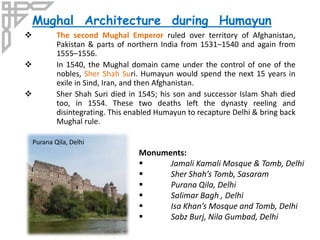
 The second Mughal Emperor ruled over territory of Afghanistan,
Pakistan & parts of northern India from 1531–1540 and again from
1555–1556.
 In 1540, the Mughal domain came under the control of one of the
nobles, Sher Shah Suri. Humayun would spend the next 15 years in
exile in Sind, Iran, and then Afghanistan.
 Sher Shah Suri died in 1545; his son and successor Islam Shah died
too, in 1554. These two deaths left the dynasty reeling and
disintegrating. This enabled Humayun to recapture Delhi & bring back
Mughal rule.
Mughal Architecture during Humayun
Monuments:
 Jamali Kamali Mosque & Tomb, Delhi
 Sher Shah’s Tomb, Sasaram
 Purana Qila, Delhi
 Salimar Bagh , Delhi
 Isa Khan’s Mosque and Tomb, Delhi
 Sabz Burj, Nila Gumbad, Delhi
Purana Qila, Delhi
Mughal Architecture during Akbar
 Mughal architecture gained prominence during the rule of Akbar.
 He built massively and the style was Unique .
 Most of Akbar`s buildings are in red sandstone, exempted at
times through marble inlay.
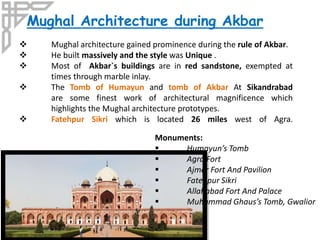
 The Tomb of Humayun and tomb of Akbar At Sikandrabad
are some finest work of architectural magnificence which
highlights the Mughal architecture prototypes.
 Fatehpur Sikri which is located 26 miles west of Agra.
Monuments:
 Humayun’s Tomb
 Agra Fort
 Ajmer Fort And Pavilion
 Fatehpur Sikri
 Allahabad Fort And Palace
 Muhammad Ghaus’s Tomb, Gwalior
 He revolted in 1599 while Akbar was engaged in the Deccan. Jahangir
was defeated, but ultimately succeeded his father as Emperor in 1605 .
 The first year of Jahangir's reign saw a rebellion organized by his eldest
son Khusrau. The rebellion was soon put down.
 Jahangir built on his father's foundations of excellent administration
and his reign was characterized by political stability, a strong economy
and impressive cultural achievements.
 From 1615 to 1618, a British diplomat Sir Thomas Roe served as an
ambassador of the East India Company to Mughal Court.
 A very undisciplined personal life and lack of interest in administration
resulted in the fall of Jahangir.
Mughal Architecture during Jahangir
Monuments:
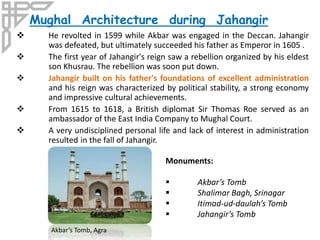
 Akbar’s Tomb
 Shalimar Bagh, Srinagar
 Itimad-ud-daulah’s Tomb
 Jahangir’s Tomb
Akbar’s Tomb, Agra
Mughal Architecture during Shah Jahan
Monuments:
 Palaces In Delhi Fort
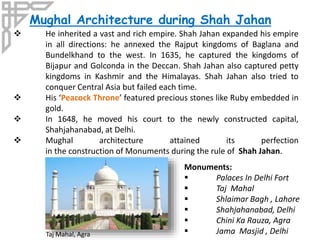
 Taj Mahal
 Shlaimar Bagh , Lahore
 Shahjahanabad, Delhi
 Chini Ka Rauza, Agra
 Jama Masjid , Delhi
 He inherited a vast and rich empire. Shah Jahan expanded his empire
in all directions: he annexed the Rajput kingdoms of Baglana and
Bundelkhand to the west. In 1635, he captured the kingdoms of
Bijapur and Golconda in the Deccan. Shah Jahan also captured petty
kingdoms in Kashmir and the Himalayas. Shah Jahan also tried to
conquer Central Asia but failed each time.
 His ‘Peacock Throne’ featured precious stones like Ruby embedded in
gold.
 In 1648, he moved his court to the newly constructed capital,
Shahjahanabad, at Delhi.
 Mughal architecture attained its perfection
in the construction of Monuments during the rule of Shah Jahan.
Taj Mahal, Agra
 Aurangazeb imprisoned Shah Jahan fort of Agra & seized power.
 Aurangazeb strictly put the principles of Quran into practice. He
banned the practice of Sati, music, gambling, alocohols & cultivation of
Cannabis.
 Aurangazeb imprisoned & killed Guru Tegh Bahadur & successfully
suppressed the revolts of the Jats, Bundelas & the Sikhs.
 He reimposed Jizya on non-Muslims. Further, Aurangzeb levied
discriminatory taxes on Hindu merchants. He became very unpopular
because of forced conversions.
 Aurangazeb fought with the Maratahas for more than three decades
which ultimately resulted in the decline of the Mughal empires.
Mughal Architecture during Aurangazeb
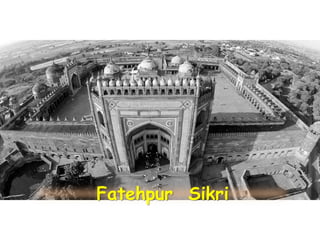
Fatehpur Sikri
Fatehpur Sikri
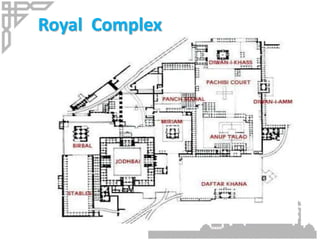
Components in Fatehpur Sikri
 Naubat Khana
 Buland Darwaja
 Jama Masjid
 Tomb Of Salim Chisti
 Diwan-i-am
 Diwan-i-khas
 Anup Talao
 Mariam’s Palace
 Jodha Bai’s Palace
 Panch Mahal
 Birbal’s Residence
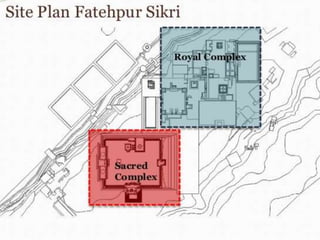
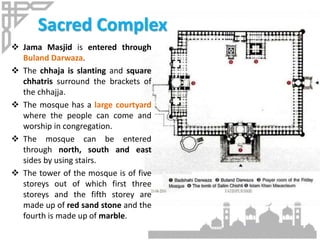
Sacred Complex
 Jama Masjid is entered through
Buland Darwaza.
 The chhaja is slanting and square
chhatris surround the brackets of
the chhajja.
 The mosque has a large courtyard
where the people can come and
worship in congregation.
 The mosque can be entered
through north, south and east
sides by using stairs.
 The tower of the mosque is of five
storeys out of which first three
storeys and the fifth storey are
made up of red sand stone and the
fourth is made up of marble.
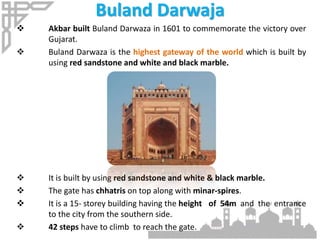
Buland Darwaja
 Akbar built Buland Darwaza in 1601 to commemorate the victory over
Gujarat.
 Buland Darwaza is the highest gateway of the world which is built by
using red sandstone and white and black marble.
 It is built by using red sandstone and white & black marble.
 The gate has chhatris on top along with minar-spires.
 It is a 15- storey building having the height of 54m and the entrance
to the city from the southern side.
 42 steps have to climb to reach the gate.
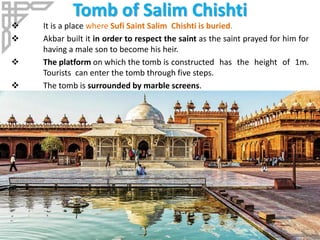
Tomb of Salim Chishti
 It is a place where Sufi Saint Salim Chishti is buried.
 Akbar built it in order to respect the saint as the saint prayed for him for
having a male son to become his heir.
 The platform on which the tomb is constructed has the height of 1m.
Tourists can enter the tomb through five steps.
 The tomb is surrounded by marble screens.
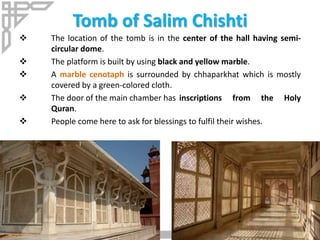
Tomb of Salim Chishti
 The location of the tomb is in the center of the hall having semi-
circular dome.
 The platform is built by using black and yellow marble.
 A marble cenotaph is surrounded by chhaparkhat which is mostly
covered by a green-colored cloth.
 The door of the main chamber has inscriptions from the Holy
Quran.
 People come here to ask for blessings to fulfil their wishes.
Royal Complex
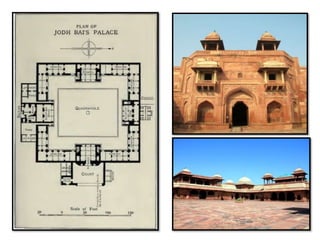
Jodha Bai’s Palace
• The palace is massive and is double-storeyed.
• There is a rectangular block in the palace whose dimension is 231.8 x 215
feet.
• The gateway of the palace is situated on the east side and is very
magnificent.
• The Hindu motifs used in the construction of the palace shows that the
palace was built for a Hindu lady.
• Many motifs can be found in the interior like swans, elephants, parrots
etc.
• There is a suite in the palace which served as a temple. It contains vedikas
and other Hindu motifs.
• The suite has pillars with brackets.
• The palace is built with red sandstone which also makes it very beautiful.
Diwan-i-Aam
• It is said that Akbar worshipped sun so it was made in such a way that it
faces east.
• This chamber has three parts. In the center, emperor used to sit and
address the people.
• On one side of the center there is a wide space while on the other side
there is a portion from where royal ladies can see the dealings. A beautiful
screen has been.
• There is no dome in the building but still it looks beautiful due to its
pillars, brackets, chhajjas, and kiosks which are placed at regular
intervals.
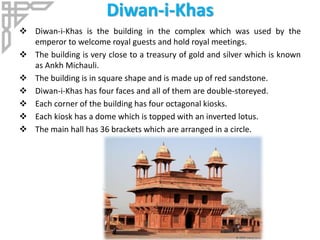
Diwan-i-Khas
 Diwan-i-Khas is the building in the complex which was used by the
emperor to welcome royal guests and hold royal meetings.
 The building is very close to a treasury of gold and silver which is known
as Ankh Michauli.
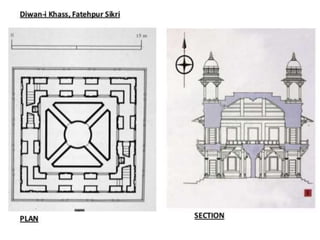
 The building is in square shape and is made up of red sandstone.
 Diwan-i-Khas has four faces and all of them are double-storeyed.
 Each corner of the building has four octagonal kiosks.
 Each kiosk has a dome which is topped with an inverted lotus.
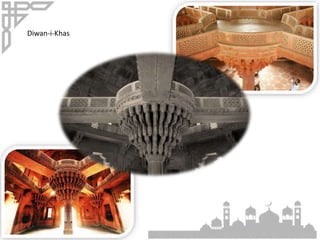
 The main hall has 36 brackets which are arranged in a circle.
Diwan-i-Khas
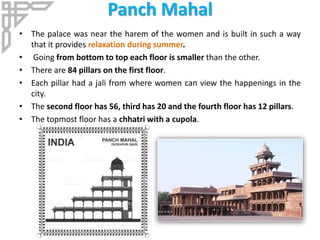
Panch Mahal
• The palace was near the harem of the women and is built in such a way
that it provides relaxation during summer.
• Going from bottom to top each floor is smaller than the other.
• There are 84 pillars on the first floor.
• Each pillar had a jali from where women can view the happenings in the
city.
• The second floor has 56, third has 20 and the fourth floor has 12 pillars.
• The topmost floor has a chhatri with a cupola.
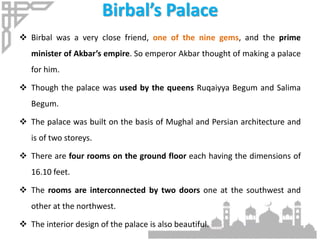
Birbal’s Palace
 Birbal was a very close friend, one of the nine gems, and the prime
minister of Akbar’s empire. So emperor Akbar thought of making a palace
for him.
 Though the palace was used by the queens Ruqaiyya Begum and Salima
Begum.
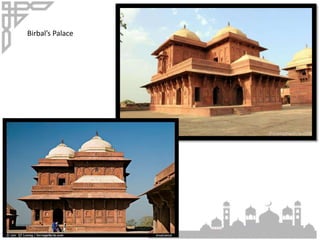
 The palace was built on the basis of Mughal and Persian architecture and
is of two storeys.
 There are four rooms on the ground floor each having the dimensions of
16.10 feet.
 The rooms are interconnected by two doors one at the southwest and
other at the northwest.
 The interior design of the palace is also beautiful.
Birbal’s Palace
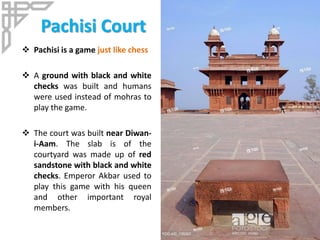
Pachisi Court
 Pachisi is a game just like chess
 A ground with black and white
checks was built and humans
were used instead of mohras to
play the game.
 The court was built near Diwan-
i-Aam. The slab is of the
courtyard was made up of red
sandstone with black and white
checks. Emperor Akbar used to
play this game with his queen
and other important royal
members.
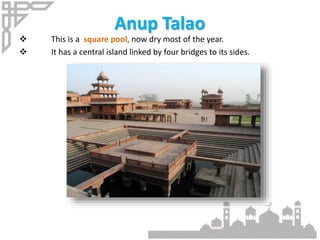
Anup Talao
 This is a square pool, now dry most of the year.
 It has a central island linked by four bridges to its sides.
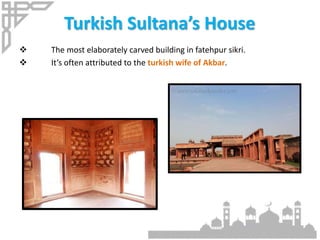
Turkish Sultana’s House
 The most elaborately carved building in fatehpur sikri.
 It’s often attributed to the turkish wife of Akbar.
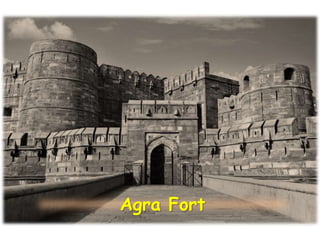
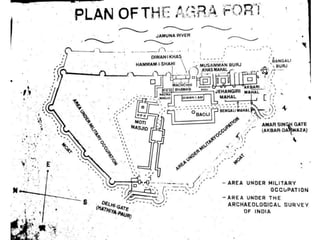
Agra Fort
Agra Fort
 Agra Fort was built by Raja Badal Singh and the fort was previously
called Badalgarh Fort.
 Later on, Lodi dynasty captured the fort and after that the fort came
under Mughal dynasty who renovated the fort.
 Agra Fort is now listed under UNESCO World Heritage sites.
 Inside the Fort Currently, there are more than two dozen monuments.
 Though Akbar built around 5,000 monuments according to Abul Fazl
out of which most of them are ruined.
 The monuments built by Akbar have the architecture of Gujarat and
Bengal.
Agra Fort
 Shah Jahan has also built white marble palaces and to do this he
destroyed some of the monuments.
 The remaining monuments in the fort are Delhi Gate, Akbari Gate,
Some Mahals and others.
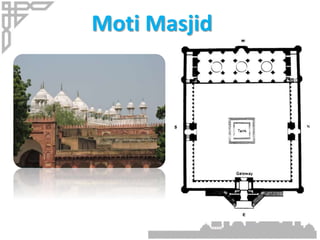
 Shah Jahan built three mosques inside the fort named Moti Masjid,
Mina Masjid, and Nagina Masjid.
 In order to give more security to the fort, Aurangzeb built barbicans
around two gates.
 The fort is built in a semi-circular form covering an area of 94 acre.
 The walls of the fort are 70 feet high.
Gates
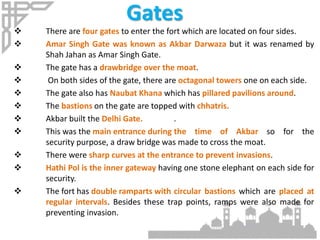
 There are four gates to enter the fort which are located on four sides.
 Amar Singh Gate was known as Akbar Darwaza but it was renamed by
Shah Jahan as Amar Singh Gate.
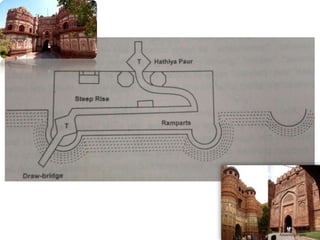
 The gate has a drawbridge over the moat.
 On both sides of the gate, there are octagonal towers one on each side.
 The gate also has Naubat Khana which has pillared pavilions around.
 The bastions on the gate are topped with chhatris.
 Akbar built the Delhi Gate. .
 This was the main entrance during the time of Akbar so for the
security purpose, a draw bridge was made to cross the moat.
 There were sharp curves at the entrance to prevent invasions.
 Hathi Pol is the inner gateway having one stone elephant on each side for
security.
 The fort has double ramparts with circular bastions which are placed at
regular intervals. Besides these trap points, ramps were also made for
preventing invasion.
Akbari Mahal
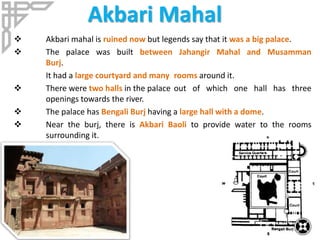
 Akbari mahal is ruined now but legends say that it was a big palace.
 The palace was built between Jahangir Mahal and Musamman
Burj.
It had a large courtyard and many rooms around it.
 There were two halls in the palace out of which one hall has three
openings towards the river.
 The palace has Bengali Burj having a large hall with a dome.
 Near the burj, there is Akbari Baoli to provide water to the rooms
surrounding it.
Jahangir Mahal
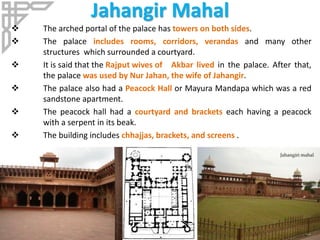
 The arched portal of the palace has towers on both sides.
 The palace includes rooms, corridors, verandas and many other
structures which surrounded a courtyard.
 It is said that the Rajput wives of Akbar lived in the palace. After that,
the palace was used by Nur Jahan, the wife of Jahangir.
 The palace also had a Peacock Hall or Mayura Mandapa which was a red
sandstone apartment.
 The peacock hall had a courtyard and brackets each having a peacock
with a serpent in its beak.
 The building includes chhajjas, brackets, and screens .
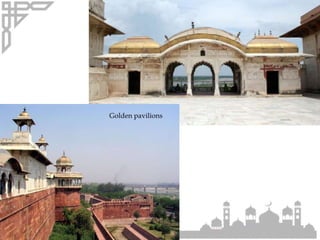
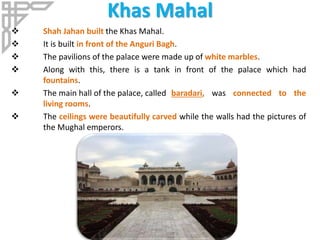
Khas Mahal
 Shah Jahan built the Khas Mahal.
 It is built in front of the Anguri Bagh.
 The pavilions of the palace were made up of white marbles.
 Along with this, there is a tank in front of the palace which had
fountains.
 The main hall of the palace, called baradari, was connected to the
living rooms.
 The ceilings were beautifully carved while the walls had the pictures of
the Mughal emperors.
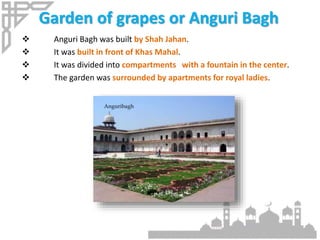
Garden of grapes or Anguri Bagh
 Anguri Bagh was built by Shah Jahan.
 It was built in front of Khas Mahal.
 It was divided into compartments with a fountain in the center.
 The garden was surrounded by apartments for royal ladies.
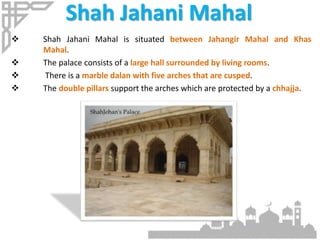
Shah Jahani Mahal
 Shah Jahani Mahal is situated between Jahangir Mahal and Khas
Mahal.
 The palace consists of a large hall surrounded by living rooms.
 There is a marble dalan with five arches that are cusped.
 The double pillars support the arches which are protected by a chhajja.
Musamman Burj
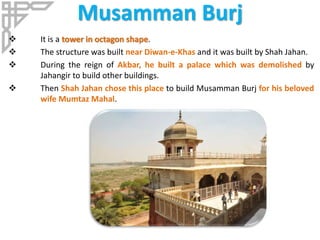
 It is a tower in octagon shape.
 The structure was built near Diwan-e-Khas and it was built by Shah Jahan.
 During the reign of Akbar, he built a palace which was demolished by
Jahangir to build other buildings.
 Then Shah Jahan chose this place to build Musamman Burj for his beloved
wife Mumtaz Mahal.
Musamman Burj
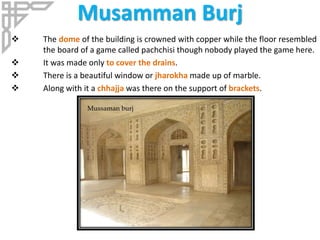
 The dome of the building is crowned with copper while the floor resembled
the board of a game called pachchisi though nobody played the game here.
 It was made only to cover the drains.
 There is a beautiful window or jharokha made up of marble.
 Along with it a chhajja was there on the support of brackets.
Diwan-e-Khas
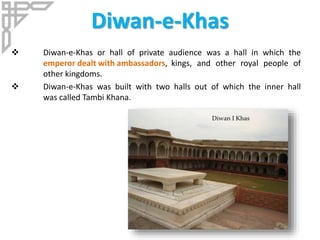
 Diwan-e-Khas or hall of private audience was a hall in which the
emperor dealt with ambassadors, kings, and other royal people of
other kingdoms.
 Diwan-e-Khas was built with two halls out of which the inner hall
was called Tambi Khana.
Nagina Masjid
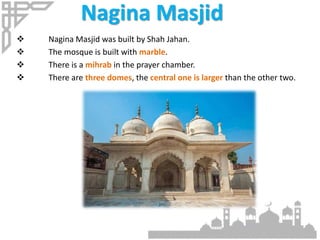
 Nagina Masjid was built by Shah Jahan.
 The mosque is built with marble.
 There is a mihrab in the prayer chamber.
 There are three domes, the central one is larger than the other two.
Moti Masjid
Diwan-e-Aam
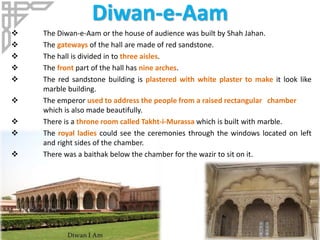
 The Diwan-e-Aam or the house of audience was built by Shah Jahan.
 The gateways of the hall are made of red sandstone.
 The hall is divided in to three aisles.
 The front part of the hall has nine arches.
 The red sandstone building is plastered with white plaster to make it look like
marble building.
 The emperor used to address the people from a raised rectangular chamber
which is also made beautifully.
 There is a throne room called Takht-i-Murassa which is built with marble.
 The royal ladies could see the ceremonies through the windows located on left
and right sides of the chamber.
 There was a baithak below the chamber for the wazir to sit on it.
Humayun’s Tomb
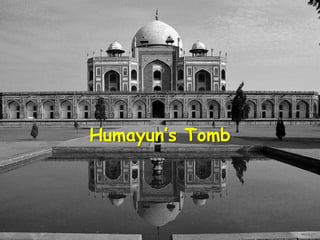
 The first Mughal building of note to be constructed in India.
 Built in A.D. 1564 by Haji Begum, wife of the Emperor Humayun.
 The architect was a Persian by the name of Mirak Mirza Ghiyas.

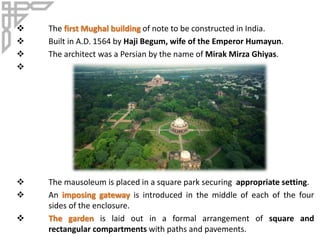
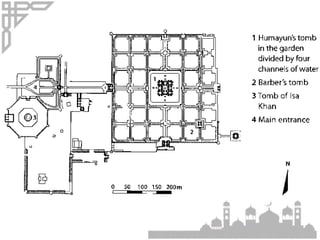
 The mausoleum is placed in a square park securing appropriate setting.
 An imposing gateway is introduced in the middle of each of the four
sides of the enclosure.
 The garden is laid out in a formal arrangement of square and
rectangular compartments with paths and pavements.
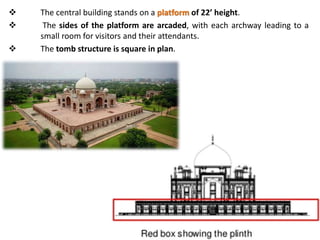
 The central building stands on a platform of 22’ height.
 The sides of the platform are arcaded, with each archway leading to a
small room for visitors and their attendants.
 The tomb structure is square in plan.
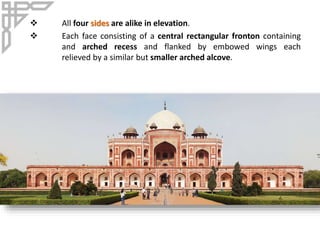
 All four sides are alike in elevation.
 Each face consisting of a central rectangular fronton containing
and arched recess and flanked by embowed wings each
relieved by a similar but smaller arched alcove.
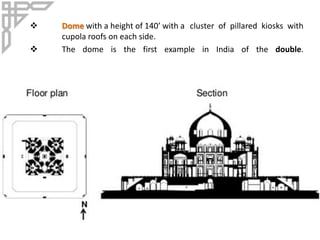
 Dome with a height of 140’ with a cluster of pillared kiosks with
cupola roofs on each side.
 The dome is the first example in India of the double.
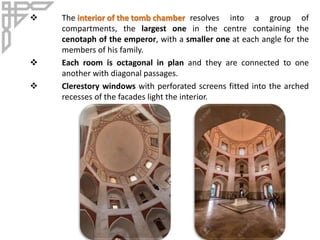
 The interior of the tomb chamber resolves into a group of
compartments, the largest one in the centre containing the
cenotaph of the emperor, with a smaller one at each angle for the
members of his family.
 Each room is octagonal in plan and they are connected to one
another with diagonal passages.
 Clerestory windows with perforated screens fitted into the arched
recesses of the facades light the interior.
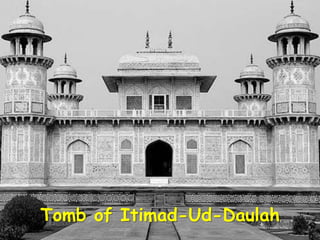
Tomb of Itimad-Ud-Daulah
TOMB OF ITIMAD-UD-DAULA
 Built in A.D. 1626 for a distinguished nobleman and Jahangir’s father-in-
law, Itimad-ud-Daula at Agra.
 The structure marks an interpretation of the building art in its most
delicate and refined finish.
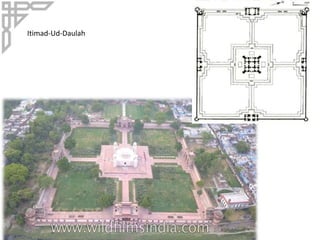
 The structure stands in a square enclosure of 540’ side, with red
sandstone gateways.

The tomb structure, built in white marble, stands in the centre of a
garden with a formal scheme of lawns, parterres, flagged pathways,
tanks and fountains.
 The walls being coloured delicately by inlaid stones. The inlay work was
done with a new system called pietra dura in which hard and rare stones
were embedded in the marble in graceful foliations.
Itimad-Ud-Daulah
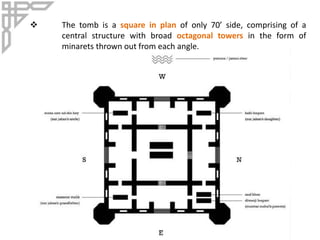
 The tomb is a square in plan of only 70’ side, comprising of a
central structure with broad octagonal towers in the form of
minarets thrown out from each angle.
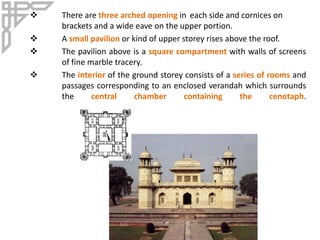
 There are three arched opening in each side and cornices on
brackets and a wide eave on the upper portion.
 A small pavilion or kind of upper storey rises above the roof.
 The pavilion above is a square compartment with walls of screens
of fine marble tracery.
 The interior of the ground storey consists of a series of rooms and
passages corresponding to an enclosed verandah which surrounds
the central chamber containing the cenotaph.
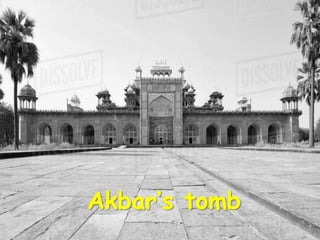
Akbar’s tomb
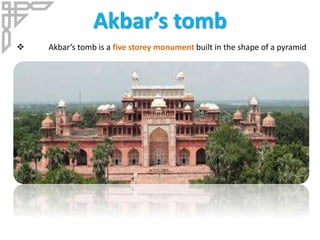
Akbar’s tomb
 Akbar’s tomb is a five storey monument built in the shape of a pyramid
Garden
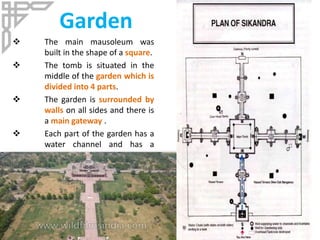
 The main mausoleum was
built in the shape of a square.
 The tomb is situated in the
middle of the garden which is
divided into 4 parts.
 The garden is surrounded by
walls on all sides and there is
a main gateway .
 Each part of the garden has a
water channel and has a
terrace.
Gateways
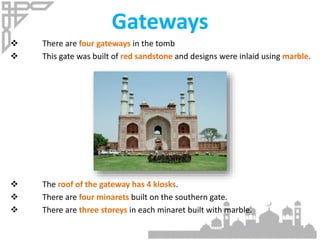
 There are four gateways in the tomb
 This gate was built of red sandstone and designs were inlaid using marble.
 The roof of the gateway has 4 kiosks.
 There are four minarets built on the southern gate.
 There are three storeys in each minaret built with marble.
First Floor or Ground Floor
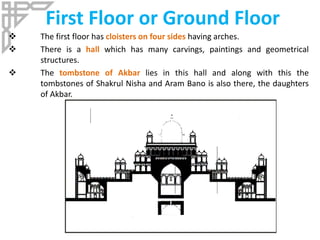
 The first floor has cloisters on four sides having arches.
 There is a hall which has many carvings, paintings and geometrical
structures.
 The tombstone of Akbar lies in this hall and along with this the
tombstones of Shakrul Nisha and Aram Bano is also there, the daughters
of Akbar.
Second Floor
The second floor is in the form of a square and is smaller than the first floor. It has a
chhatri of eight pillars supported by eight octagonal pillars on each corner. There are 23
bays on each arched verandah situated on each side.
Third Floor
The third floor is smaller than the second floor and is in a form of square and each side
measures 31.62m. There are four chhatris, one on each side having the same
dimensions as that of the second floor.
Fourth Floor
The fourth floor is square in shape whose
one side measures 27.16m. This floor is
smaller than the third floor and has
arches with pillar support and chhatris
on each side.
Fifth Floor
Fifth floor is the smallest and is built by using marble. The side of the square-shaped
central court has the dimensions of 21.34m. There are cloisters on all the four sides of
the measuring 27.16 x 2.74m.
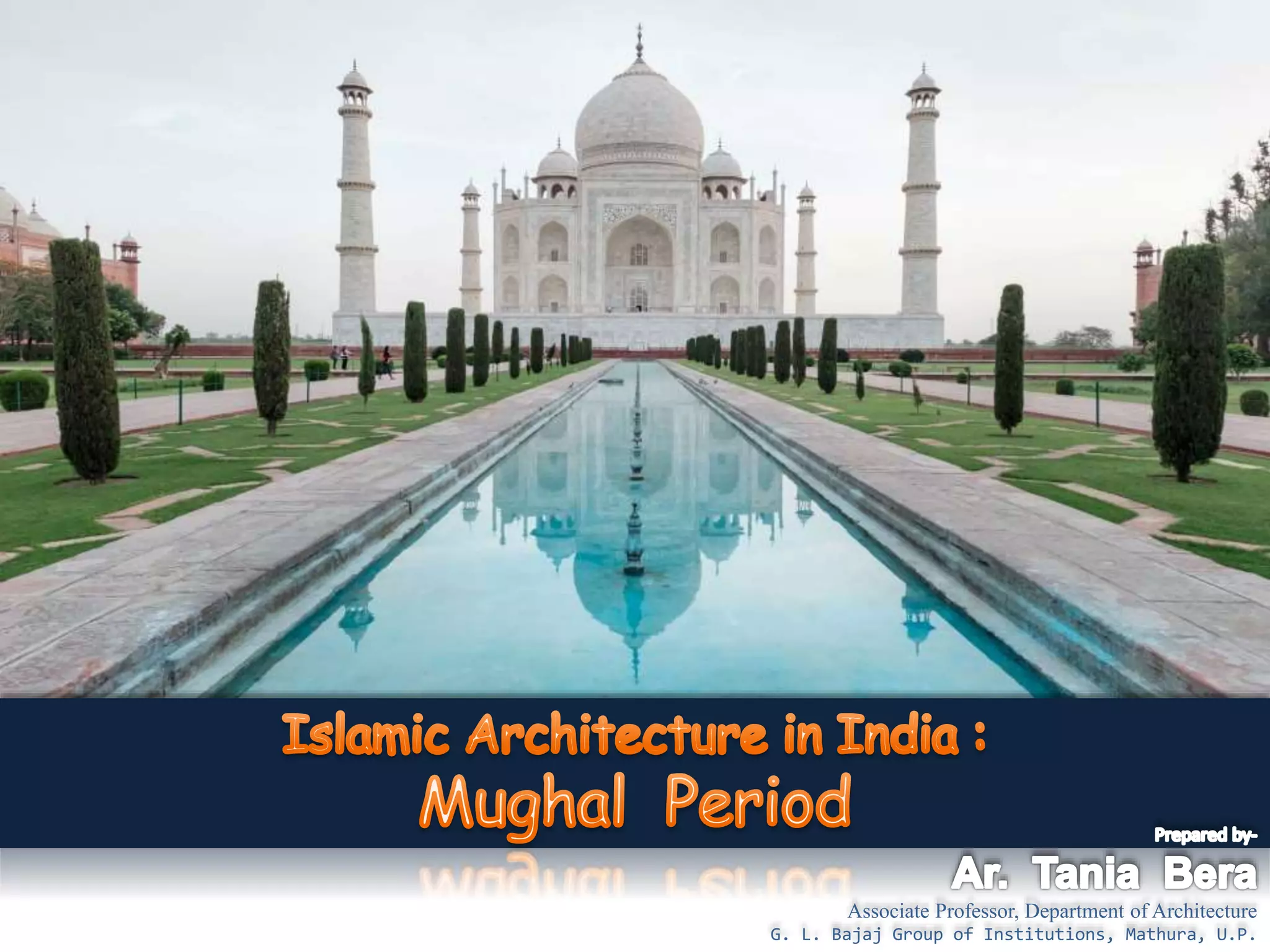
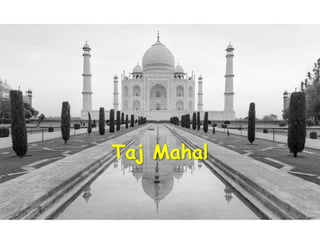
Taj Mahal
Taj Mahal
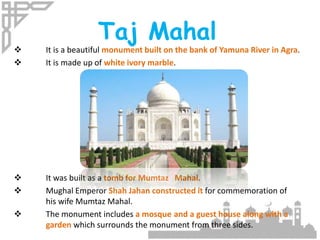
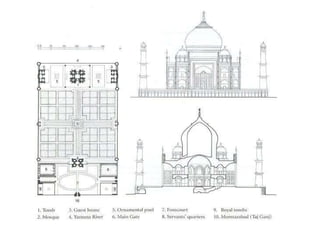
 It is a beautiful monument built on the bank of Yamuna River in Agra.
 It is made up of white ivory marble.
 It was built as a tomb for Mumtaz Mahal.
 Mughal Emperor Shah Jahan constructed it for commemoration of
his wife Mumtaz Mahal.
 The monument includes a mosque and a guest house along with a
garden which surrounds the monument from three sides.
Features
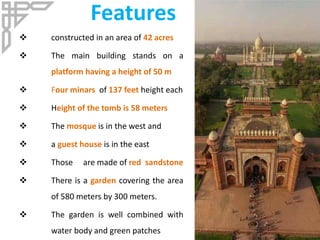
 constructed in an area of 42 acres
 The main building stands on a
platform having a height of 50 m
 Four minars of 137 feet height each
 Height of the tomb is 58 meters
 The mosque is in the west and
 a guest house is in the east
 Those are made of red sandstone
 There is a garden covering the area
of 580 meters by 300 meters.
 The garden is well combined with
water body and green patches
Gateway of Taj
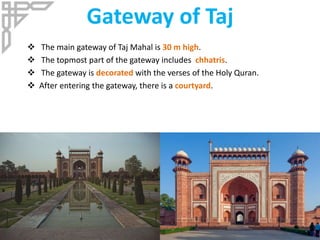
 The main gateway of Taj Mahal is 30 m high.
 The topmost part of the gateway includes chhatris.
 The gateway is decorated with the verses of the Holy Quran.
 After entering the gateway, there is a courtyard.
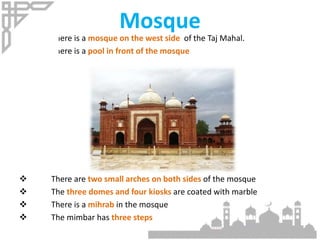
 There is a mosque on the west side of the Taj Mahal.
 There is a pool in front of the mosque
 There are two small arches on both sides of the mosque
 The three domes and four kiosks are coated with marble
 There is a mihrab in the mosque
 The mimbar has three steps
Mosque
Mausoleum
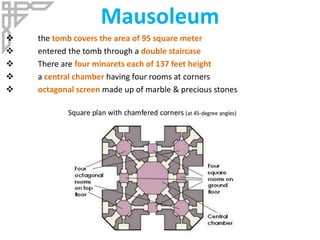
 the tomb covers the area of 95 square meter
 entered the tomb through a double staircase
 There are four minarets each of 137 feet height
 a central chamber having four rooms at corners
 octagonal screen made up of marble & precious stones
Garden
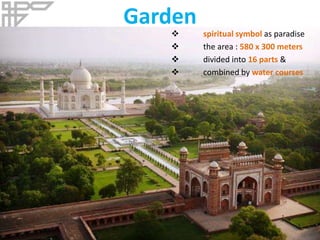
 spiritual symbol as paradise
 the area : 580 x 300 meters
 divided into 16 parts &
 combined by water courses

Mughal Architecture_Tania Bera.pptx

  • 1.
    Associate Professor, Departmentof Architecture G. L. Bajaj Group of Institutions, Mathura, U.P.
  • 2.
    Chronology of MughalEmpire Development of the Mughal style was flourished under the following great rulers: Babur (1526-1530) Humayun (1530-1556) Akbar (1556-1605) Jahangir (1605-1627) Shahjahan (1627-1658) Aurangzeb (1658-1707) Extent of Mughal Empire
  • 3.
    Features of MughalArchitceture  The Mughal rulers built magnificent gates, forts, mausoleums, mosques, palaces, public buildings and tombs etc.  The period of Shah Jahan (1627-1658) witnessed a glorious outburst of activity in the development of architecture.  The Mughal architecture can be divided into two sections: Early and Later Mughal Architecture  The main characteristic features of Mughal architecture are:  bulbous domes  slender minarets with cupolas at the four corners  large halls  massive vaulted gateways and  delicate ornamentation  Buildings were constructed of red sandstone and white marble.  One of the important distinguishing features is ornamentation.
  • 4.
    Monuments:  Kabuli baghmosque, Panipat  Madhi masjid, Delhi  Shaikh Yusuf Qattal’s Tomb, Delhi  Rambagh Agra  Mir Hindu Beg’s Masjid, Sambhal Mughal Architecture during Babur In the First Battle of Panipat (1526,) Babur's victory over Ibrahim Lodi, the last ruler of the Delhi Sultanate, paved way for the Mughal rule in India. Ẓahīr-ud-Dīn Muḥammad Babar Sultan Ibrahim Lodhi Kabuli bagh mosque, Panipat
  • 5.
     The secondMughal Emperor ruled over territory of Afghanistan, Pakistan & parts of northern India from 1531–1540 and again from 1555–1556.  In 1540, the Mughal domain came under the control of one of the nobles, Sher Shah Suri. Humayun would spend the next 15 years in exile in Sind, Iran, and then Afghanistan.  Sher Shah Suri died in 1545; his son and successor Islam Shah died too, in 1554. These two deaths left the dynasty reeling and disintegrating. This enabled Humayun to recapture Delhi & bring back Mughal rule. Mughal Architecture during Humayun Monuments:  Jamali Kamali Mosque & Tomb, Delhi  Sher Shah’s Tomb, Sasaram  Purana Qila, Delhi  Salimar Bagh , Delhi  Isa Khan’s Mosque and Tomb, Delhi  Sabz Burj, Nila Gumbad, Delhi Purana Qila, Delhi
  • 6.
    Mughal Architecture duringAkbar  Mughal architecture gained prominence during the rule of Akbar.  He built massively and the style was Unique .  Most of Akbar`s buildings are in red sandstone, exempted at times through marble inlay.  The Tomb of Humayun and tomb of Akbar At Sikandrabad are some finest work of architectural magnificence which highlights the Mughal architecture prototypes.  Fatehpur Sikri which is located 26 miles west of Agra. Monuments:  Humayun’s Tomb  Agra Fort  Ajmer Fort And Pavilion  Fatehpur Sikri  Allahabad Fort And Palace  Muhammad Ghaus’s Tomb, Gwalior
  • 7.
     He revoltedin 1599 while Akbar was engaged in the Deccan. Jahangir was defeated, but ultimately succeeded his father as Emperor in 1605 .  The first year of Jahangir's reign saw a rebellion organized by his eldest son Khusrau. The rebellion was soon put down.  Jahangir built on his father's foundations of excellent administration and his reign was characterized by political stability, a strong economy and impressive cultural achievements.  From 1615 to 1618, a British diplomat Sir Thomas Roe served as an ambassador of the East India Company to Mughal Court.  A very undisciplined personal life and lack of interest in administration resulted in the fall of Jahangir. Mughal Architecture during Jahangir Monuments:  Akbar’s Tomb  Shalimar Bagh, Srinagar  Itimad-ud-daulah’s Tomb  Jahangir’s Tomb Akbar’s Tomb, Agra
  • 8.
    Mughal Architecture duringShah Jahan Monuments:  Palaces In Delhi Fort  Taj Mahal  Shlaimar Bagh , Lahore  Shahjahanabad, Delhi  Chini Ka Rauza, Agra  Jama Masjid , Delhi  He inherited a vast and rich empire. Shah Jahan expanded his empire in all directions: he annexed the Rajput kingdoms of Baglana and Bundelkhand to the west. In 1635, he captured the kingdoms of Bijapur and Golconda in the Deccan. Shah Jahan also captured petty kingdoms in Kashmir and the Himalayas. Shah Jahan also tried to conquer Central Asia but failed each time.  His ‘Peacock Throne’ featured precious stones like Ruby embedded in gold.  In 1648, he moved his court to the newly constructed capital, Shahjahanabad, at Delhi.  Mughal architecture attained its perfection in the construction of Monuments during the rule of Shah Jahan. Taj Mahal, Agra
  • 9.
     Aurangazeb imprisonedShah Jahan fort of Agra & seized power.  Aurangazeb strictly put the principles of Quran into practice. He banned the practice of Sati, music, gambling, alocohols & cultivation of Cannabis.  Aurangazeb imprisoned & killed Guru Tegh Bahadur & successfully suppressed the revolts of the Jats, Bundelas & the Sikhs.  He reimposed Jizya on non-Muslims. Further, Aurangzeb levied discriminatory taxes on Hindu merchants. He became very unpopular because of forced conversions.  Aurangazeb fought with the Maratahas for more than three decades which ultimately resulted in the decline of the Mughal empires. Mughal Architecture during Aurangazeb
  • 10.
  • 11.
    Components in FatehpurSikri  Naubat Khana  Buland Darwaja  Jama Masjid  Tomb Of Salim Chisti  Diwan-i-am  Diwan-i-khas  Anup Talao  Mariam’s Palace  Jodha Bai’s Palace  Panch Mahal  Birbal’s Residence
  • 13.
    Sacred Complex  JamaMasjid is entered through Buland Darwaza.  The chhaja is slanting and square chhatris surround the brackets of the chhajja.  The mosque has a large courtyard where the people can come and worship in congregation.  The mosque can be entered through north, south and east sides by using stairs.  The tower of the mosque is of five storeys out of which first three storeys and the fifth storey are made up of red sand stone and the fourth is made up of marble.
  • 14.
    Buland Darwaja  Akbarbuilt Buland Darwaza in 1601 to commemorate the victory over Gujarat.  Buland Darwaza is the highest gateway of the world which is built by using red sandstone and white and black marble.  It is built by using red sandstone and white & black marble.  The gate has chhatris on top along with minar-spires.  It is a 15- storey building having the height of 54m and the entrance to the city from the southern side.  42 steps have to climb to reach the gate.
  • 15.
    Tomb of SalimChishti  It is a place where Sufi Saint Salim Chishti is buried.  Akbar built it in order to respect the saint as the saint prayed for him for having a male son to become his heir.  The platform on which the tomb is constructed has the height of 1m. Tourists can enter the tomb through five steps.  The tomb is surrounded by marble screens.
  • 16.
    Tomb of SalimChishti  The location of the tomb is in the center of the hall having semi- circular dome.  The platform is built by using black and yellow marble.  A marble cenotaph is surrounded by chhaparkhat which is mostly covered by a green-colored cloth.  The door of the main chamber has inscriptions from the Holy Quran.  People come here to ask for blessings to fulfil their wishes.
  • 17.
  • 18.
    Jodha Bai’s Palace •The palace is massive and is double-storeyed. • There is a rectangular block in the palace whose dimension is 231.8 x 215 feet. • The gateway of the palace is situated on the east side and is very magnificent. • The Hindu motifs used in the construction of the palace shows that the palace was built for a Hindu lady. • Many motifs can be found in the interior like swans, elephants, parrots etc. • There is a suite in the palace which served as a temple. It contains vedikas and other Hindu motifs. • The suite has pillars with brackets. • The palace is built with red sandstone which also makes it very beautiful.
  • 20.
    Diwan-i-Aam • It issaid that Akbar worshipped sun so it was made in such a way that it faces east. • This chamber has three parts. In the center, emperor used to sit and address the people. • On one side of the center there is a wide space while on the other side there is a portion from where royal ladies can see the dealings. A beautiful screen has been. • There is no dome in the building but still it looks beautiful due to its pillars, brackets, chhajjas, and kiosks which are placed at regular intervals.
  • 21.
    Diwan-i-Khas  Diwan-i-Khas isthe building in the complex which was used by the emperor to welcome royal guests and hold royal meetings.  The building is very close to a treasury of gold and silver which is known as Ankh Michauli.  The building is in square shape and is made up of red sandstone.  Diwan-i-Khas has four faces and all of them are double-storeyed.  Each corner of the building has four octagonal kiosks.  Each kiosk has a dome which is topped with an inverted lotus.  The main hall has 36 brackets which are arranged in a circle.
  • 23.
  • 24.
    Panch Mahal • Thepalace was near the harem of the women and is built in such a way that it provides relaxation during summer. • Going from bottom to top each floor is smaller than the other. • There are 84 pillars on the first floor. • Each pillar had a jali from where women can view the happenings in the city. • The second floor has 56, third has 20 and the fourth floor has 12 pillars. • The topmost floor has a chhatri with a cupola.
  • 25.
    Birbal’s Palace  Birbalwas a very close friend, one of the nine gems, and the prime minister of Akbar’s empire. So emperor Akbar thought of making a palace for him.  Though the palace was used by the queens Ruqaiyya Begum and Salima Begum.  The palace was built on the basis of Mughal and Persian architecture and is of two storeys.  There are four rooms on the ground floor each having the dimensions of 16.10 feet.  The rooms are interconnected by two doors one at the southwest and other at the northwest.  The interior design of the palace is also beautiful.
  • 26.
  • 27.
    Pachisi Court  Pachisiis a game just like chess  A ground with black and white checks was built and humans were used instead of mohras to play the game.  The court was built near Diwan- i-Aam. The slab is of the courtyard was made up of red sandstone with black and white checks. Emperor Akbar used to play this game with his queen and other important royal members.
  • 28.
    Anup Talao  Thisis a square pool, now dry most of the year.  It has a central island linked by four bridges to its sides.
  • 29.
    Turkish Sultana’s House The most elaborately carved building in fatehpur sikri.  It’s often attributed to the turkish wife of Akbar.
  • 30.
  • 31.
    Agra Fort  AgraFort was built by Raja Badal Singh and the fort was previously called Badalgarh Fort.  Later on, Lodi dynasty captured the fort and after that the fort came under Mughal dynasty who renovated the fort.  Agra Fort is now listed under UNESCO World Heritage sites.  Inside the Fort Currently, there are more than two dozen monuments.  Though Akbar built around 5,000 monuments according to Abul Fazl out of which most of them are ruined.  The monuments built by Akbar have the architecture of Gujarat and Bengal.
  • 32.
    Agra Fort  ShahJahan has also built white marble palaces and to do this he destroyed some of the monuments.  The remaining monuments in the fort are Delhi Gate, Akbari Gate, Some Mahals and others.  Shah Jahan built three mosques inside the fort named Moti Masjid, Mina Masjid, and Nagina Masjid.  In order to give more security to the fort, Aurangzeb built barbicans around two gates.  The fort is built in a semi-circular form covering an area of 94 acre.  The walls of the fort are 70 feet high.
  • 34.
    Gates  There arefour gates to enter the fort which are located on four sides.  Amar Singh Gate was known as Akbar Darwaza but it was renamed by Shah Jahan as Amar Singh Gate.  The gate has a drawbridge over the moat.  On both sides of the gate, there are octagonal towers one on each side.  The gate also has Naubat Khana which has pillared pavilions around.  The bastions on the gate are topped with chhatris.  Akbar built the Delhi Gate. .  This was the main entrance during the time of Akbar so for the security purpose, a draw bridge was made to cross the moat.  There were sharp curves at the entrance to prevent invasions.  Hathi Pol is the inner gateway having one stone elephant on each side for security.  The fort has double ramparts with circular bastions which are placed at regular intervals. Besides these trap points, ramps were also made for preventing invasion.
  • 36.
    Akbari Mahal  Akbarimahal is ruined now but legends say that it was a big palace.  The palace was built between Jahangir Mahal and Musamman Burj. It had a large courtyard and many rooms around it.  There were two halls in the palace out of which one hall has three openings towards the river.  The palace has Bengali Burj having a large hall with a dome.  Near the burj, there is Akbari Baoli to provide water to the rooms surrounding it.
  • 37.
    Jahangir Mahal  Thearched portal of the palace has towers on both sides.  The palace includes rooms, corridors, verandas and many other structures which surrounded a courtyard.  It is said that the Rajput wives of Akbar lived in the palace. After that, the palace was used by Nur Jahan, the wife of Jahangir.  The palace also had a Peacock Hall or Mayura Mandapa which was a red sandstone apartment.  The peacock hall had a courtyard and brackets each having a peacock with a serpent in its beak.  The building includes chhajjas, brackets, and screens .
  • 38.
    Khas Mahal  ShahJahan built the Khas Mahal.  It is built in front of the Anguri Bagh.  The pavilions of the palace were made up of white marbles.  Along with this, there is a tank in front of the palace which had fountains.  The main hall of the palace, called baradari, was connected to the living rooms.  The ceilings were beautifully carved while the walls had the pictures of the Mughal emperors.
  • 40.
    Garden of grapesor Anguri Bagh  Anguri Bagh was built by Shah Jahan.  It was built in front of Khas Mahal.  It was divided into compartments with a fountain in the center.  The garden was surrounded by apartments for royal ladies.
  • 41.
    Shah Jahani Mahal Shah Jahani Mahal is situated between Jahangir Mahal and Khas Mahal.  The palace consists of a large hall surrounded by living rooms.  There is a marble dalan with five arches that are cusped.  The double pillars support the arches which are protected by a chhajja.
  • 42.
    Musamman Burj  Itis a tower in octagon shape.  The structure was built near Diwan-e-Khas and it was built by Shah Jahan.  During the reign of Akbar, he built a palace which was demolished by Jahangir to build other buildings.  Then Shah Jahan chose this place to build Musamman Burj for his beloved wife Mumtaz Mahal.
  • 43.
    Musamman Burj  Thedome of the building is crowned with copper while the floor resembled the board of a game called pachchisi though nobody played the game here.  It was made only to cover the drains.  There is a beautiful window or jharokha made up of marble.  Along with it a chhajja was there on the support of brackets.
  • 44.
    Diwan-e-Khas  Diwan-e-Khas orhall of private audience was a hall in which the emperor dealt with ambassadors, kings, and other royal people of other kingdoms.  Diwan-e-Khas was built with two halls out of which the inner hall was called Tambi Khana.
  • 45.
    Nagina Masjid  NaginaMasjid was built by Shah Jahan.  The mosque is built with marble.  There is a mihrab in the prayer chamber.  There are three domes, the central one is larger than the other two.
  • 46.
  • 47.
    Diwan-e-Aam  The Diwan-e-Aamor the house of audience was built by Shah Jahan.  The gateways of the hall are made of red sandstone.  The hall is divided in to three aisles.  The front part of the hall has nine arches.  The red sandstone building is plastered with white plaster to make it look like marble building.  The emperor used to address the people from a raised rectangular chamber which is also made beautifully.  There is a throne room called Takht-i-Murassa which is built with marble.  The royal ladies could see the ceremonies through the windows located on left and right sides of the chamber.  There was a baithak below the chamber for the wazir to sit on it.
  • 48.
  • 49.
     The firstMughal building of note to be constructed in India.  Built in A.D. 1564 by Haji Begum, wife of the Emperor Humayun.  The architect was a Persian by the name of Mirak Mirza Ghiyas.   The mausoleum is placed in a square park securing appropriate setting.  An imposing gateway is introduced in the middle of each of the four sides of the enclosure.  The garden is laid out in a formal arrangement of square and rectangular compartments with paths and pavements.
  • 51.
     The centralbuilding stands on a platform of 22’ height.  The sides of the platform are arcaded, with each archway leading to a small room for visitors and their attendants.  The tomb structure is square in plan.
  • 52.
     All foursides are alike in elevation.  Each face consisting of a central rectangular fronton containing and arched recess and flanked by embowed wings each relieved by a similar but smaller arched alcove.
  • 53.
     Dome witha height of 140’ with a cluster of pillared kiosks with cupola roofs on each side.  The dome is the first example in India of the double.
  • 54.
     The interiorof the tomb chamber resolves into a group of compartments, the largest one in the centre containing the cenotaph of the emperor, with a smaller one at each angle for the members of his family.  Each room is octagonal in plan and they are connected to one another with diagonal passages.  Clerestory windows with perforated screens fitted into the arched recesses of the facades light the interior.
  • 55.
  • 56.
    TOMB OF ITIMAD-UD-DAULA Built in A.D. 1626 for a distinguished nobleman and Jahangir’s father-in- law, Itimad-ud-Daula at Agra.  The structure marks an interpretation of the building art in its most delicate and refined finish.  The structure stands in a square enclosure of 540’ side, with red sandstone gateways.  The tomb structure, built in white marble, stands in the centre of a garden with a formal scheme of lawns, parterres, flagged pathways, tanks and fountains.  The walls being coloured delicately by inlaid stones. The inlay work was done with a new system called pietra dura in which hard and rare stones were embedded in the marble in graceful foliations.
  • 57.
  • 58.
     The tombis a square in plan of only 70’ side, comprising of a central structure with broad octagonal towers in the form of minarets thrown out from each angle.
  • 59.
     There arethree arched opening in each side and cornices on brackets and a wide eave on the upper portion.  A small pavilion or kind of upper storey rises above the roof.  The pavilion above is a square compartment with walls of screens of fine marble tracery.  The interior of the ground storey consists of a series of rooms and passages corresponding to an enclosed verandah which surrounds the central chamber containing the cenotaph.
  • 60.
  • 61.
    Akbar’s tomb  Akbar’stomb is a five storey monument built in the shape of a pyramid
  • 62.
    Garden  The mainmausoleum was built in the shape of a square.  The tomb is situated in the middle of the garden which is divided into 4 parts.  The garden is surrounded by walls on all sides and there is a main gateway .  Each part of the garden has a water channel and has a terrace.
  • 63.
    Gateways  There arefour gateways in the tomb  This gate was built of red sandstone and designs were inlaid using marble.  The roof of the gateway has 4 kiosks.  There are four minarets built on the southern gate.  There are three storeys in each minaret built with marble.
  • 64.
    First Floor orGround Floor  The first floor has cloisters on four sides having arches.  There is a hall which has many carvings, paintings and geometrical structures.  The tombstone of Akbar lies in this hall and along with this the tombstones of Shakrul Nisha and Aram Bano is also there, the daughters of Akbar.
  • 65.
    Second Floor The secondfloor is in the form of a square and is smaller than the first floor. It has a chhatri of eight pillars supported by eight octagonal pillars on each corner. There are 23 bays on each arched verandah situated on each side. Third Floor The third floor is smaller than the second floor and is in a form of square and each side measures 31.62m. There are four chhatris, one on each side having the same dimensions as that of the second floor. Fourth Floor The fourth floor is square in shape whose one side measures 27.16m. This floor is smaller than the third floor and has arches with pillar support and chhatris on each side. Fifth Floor Fifth floor is the smallest and is built by using marble. The side of the square-shaped central court has the dimensions of 21.34m. There are cloisters on all the four sides of the measuring 27.16 x 2.74m.
  • 66.
  • 67.
    Taj Mahal  Itis a beautiful monument built on the bank of Yamuna River in Agra.  It is made up of white ivory marble.  It was built as a tomb for Mumtaz Mahal.  Mughal Emperor Shah Jahan constructed it for commemoration of his wife Mumtaz Mahal.  The monument includes a mosque and a guest house along with a garden which surrounds the monument from three sides.
  • 68.
    Features  constructed inan area of 42 acres  The main building stands on a platform having a height of 50 m  Four minars of 137 feet height each  Height of the tomb is 58 meters  The mosque is in the west and  a guest house is in the east  Those are made of red sandstone  There is a garden covering the area of 580 meters by 300 meters.  The garden is well combined with water body and green patches
  • 69.
    Gateway of Taj The main gateway of Taj Mahal is 30 m high.  The topmost part of the gateway includes chhatris.  The gateway is decorated with the verses of the Holy Quran.  After entering the gateway, there is a courtyard.
  • 70.
     There isa mosque on the west side of the Taj Mahal.  There is a pool in front of the mosque  There are two small arches on both sides of the mosque  The three domes and four kiosks are coated with marble  There is a mihrab in the mosque  The mimbar has three steps Mosque
  • 71.
    Mausoleum  the tombcovers the area of 95 square meter  entered the tomb through a double staircase  There are four minarets each of 137 feet height  a central chamber having four rooms at corners  octagonal screen made up of marble & precious stones
  • 73.
    Garden  spiritual symbolas paradise  the area : 580 x 300 meters  divided into 16 parts &  combined by water courses