Its Implementation
in the Basic Education
Curriculum
Mother Tongue-Based Multilingual
Education Framework :
BELLA LIZA F. TUMALE
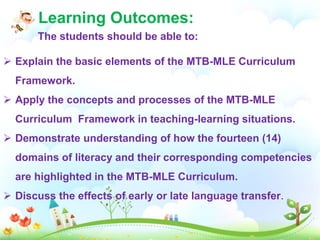
Learning Outcomes:
The students should be able to:
 Explain the basic elements of the MTB-MLE Curriculum
Framework.
 Apply the concepts and processes of the MTB-MLE
Curriculum Framework in teaching-learning situations.
 Demonstrate understanding of how the fourteen (14)
domains of literacy and their corresponding competencies
are highlighted in the MTB-MLE Curriculum.
 Discuss the effects of early or late language transfer.
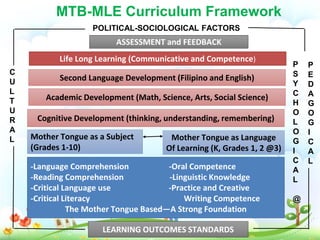
LEARNING OUTCOMES STANDARDS
-Language Comprehension -Oral Competence
-Reading Comprehension -Linguistic Knowledge
-Critical Language use -Practice and Creative
-Critical Literacy Writing Competence
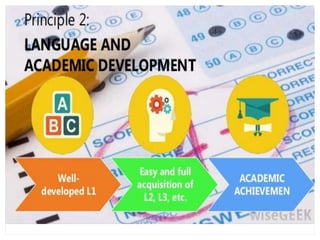
The Mother Tongue Based—A Strong Foundation
Mother Tongue as a Subject
(Grades 1-10)
Mother Tongue as Language
Of Learning (K, Grades 1, 2 @3)
Cognitive Development (thinking, understanding, remembering)
Academic Development (Math, Science, Arts, Social Science)
Second Language Development (Filipino and English)
Life Long Learning (Communicative and Competence)
ASSESSMENT and FEEDBACK
P
S
Y
C
H
O
L
O
G
I
C
A
L
@
P
E
D
A
G
O
G
I
C
A
L
POLITICAL-SOCIOLOGICAL FACTORS
C
U
L
T
U
R
A
L
MTB-MLE Curriculum Framework
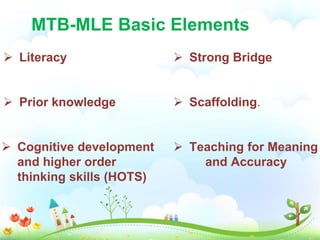
MTB-MLE Basic Elements
 Prior knowledge
 Cognitive development
and higher order
thinking skills (HOTS)
 Strong Bridge
 Scaffolding.
 Teaching for Meaning
and Accuracy
 Literacy
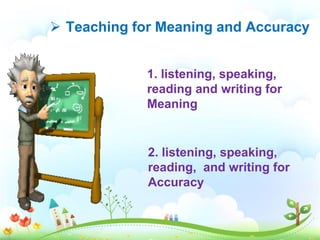
 Teaching for Meaning and Accuracy
1. listening, speaking,
reading and writing for
Meaning
2. listening, speaking,
reading, and writing for
Accuracy
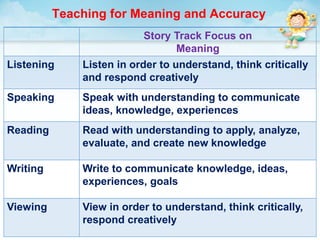
Story Track Focus on
Meaning
Listening Listen in order to understand, think critically
and respond creatively
Speaking Speak with understanding to communicate
ideas, knowledge, experiences
Reading Read with understanding to apply, analyze,
evaluate, and create new knowledge
Writing Write to communicate knowledge, ideas,
experiences, goals
Viewing View in order to understand, think critically,
respond creatively
Teaching for Meaning and Accuracy
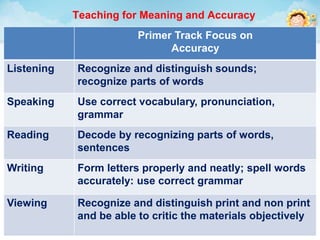
Primer Track Focus on
Accuracy
Listening Recognize and distinguish sounds;
recognize parts of words
Speaking Use correct vocabulary, pronunciation,
grammar
Reading Decode by recognizing parts of words,
sentences
Writing Form letters properly and neatly; spell words
accurately: use correct grammar
Viewing Recognize and distinguish print and non print
and be able to critic the materials objectively
Teaching for Meaning and Accuracy
The Fourteen Domains of
Literacy in the Philippine
MTB-MLE Curriculum
To ignore the impact of MTB-MLE on children's
learning and development is to reject the child-
friendly approach to language that ensures that
children enjoy and understand what they
learn.
MTB-MLE curriculum in the Philippine K-12 Basic
Education Program can help teachers in
promoting the delivery of the curriculum.
1. ORAL LANGUAGE
To communicate with children at the early years of
schooling in a caring, warm and welcoming
classroom environment
Refers to one’s knowledge and use of the
structure, meanings and uses of language in oral
communication.
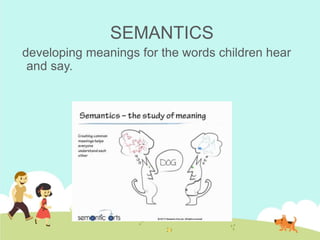
SEMANTICS
developing meanings for the words children hear
and say.
MORPHOLOGY
Figuring out how to manifest the smallest units of
meaning in the language called morphemes.
Example: boy
boys
SYNTAX
Learning the rules of how words are linked
together
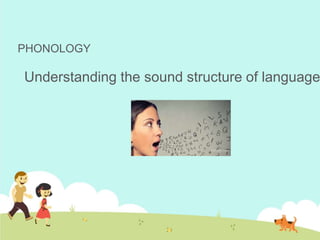
PHONOLOGY
Understanding the sound structure of language
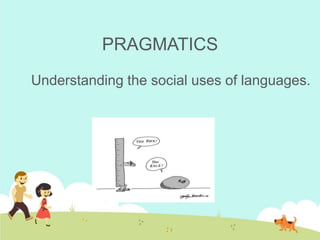
PRAGMATICS
Understanding the social uses of languages.
Sample competencies
KINDERGARTEN
Use polite greetings and courteous expressing
in appropriate situations:
* Good morning/afternoon
* Thank you/You’re welcome
* Please/May I
2. PHONOLOGICAL AWARENESS
The ability to know the phonological or sound
structure of language
Includes word awareness, syllable awareness,
rhyme awareness, and phoneme awareness.
“Phonemic awareness is the main predictor of
whether or not a child will learn to read at the
expected age.”
NOTE!
In Grade 2 phonological awareness in
Mother Tongue is no longer taught. It is
expected that by the end of grade 1,
competencies in this domain have already
been mastered.
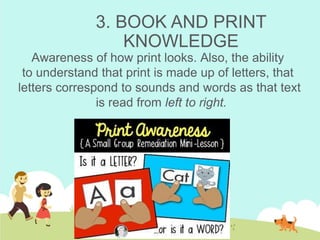
3. BOOK AND PRINT
KNOWLEDGE
Awareness of how print looks. Also, the ability
to understand that print is made up of letters, that
letters correspond to sounds and words as that text
is read from left to right.
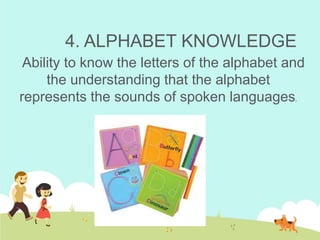
4. ALPHABET KNOWLEDGE
Ability to know the letters of the alphabet and
the understanding that the alphabet
represents the sounds of spoken languages.
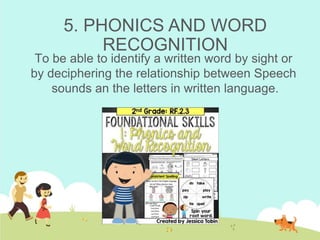
5. PHONICS AND WORD
RECOGNITION
To be able to identify a written word by sight or
by deciphering the relationship between Speech
sounds an the letters in written language.
6. VOCABULARY
DEVELOPMENT
Knowledge of words and their meanings in
both oral and print representations.
Types
1. EXPRESSIVE VOCABULARY – Express
themselves in oral or written form.
2. RECEPTIVE VOCABULARY – understand when
heard in context or read.
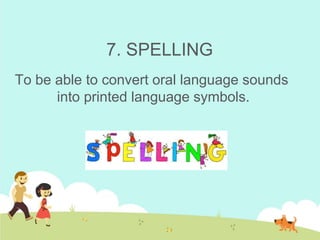
7. SPELLING
To be able to convert oral language sounds
into printed language symbols.
8. GRAMMAR AWARENESS
Both the language we used and the
description of language as a system
Is the ability to understand the rules
of how words are linked together to
convey meanings
9. FLUENCY
Refers to the fluidity of utterances
(oral fluency) or the oral reading of
texts smoothly (reading fluency). It is
also writing without thinking about
how to form a letter before writing
(writing fluency)
ELEMENTS:
A. Automaticity: to recognized quickly
and without much conscious attention
B. Accuracy: ability to recognized
words correctly.
C. Prosody or Proper Expression:
ability to read aloud with appropriate
intonations and pauses.
10. READING
COMPREHENSION
Constructive, interactive process
involving three factors – the readers,
the texts and the context
Goal is to understand the meaning of
written languages
A. Schema. Organized knowledge that an
individual has about people, places, things
and events
B. Activating prior knowledge. Is the unique
set of knowledge each individual learner
brings to the reading experiences.
C. Comprehension knowledge.
Comprehension strategies include
preparing, organizing, elaborating, releasing
and monitoring the reading process.
The complexity of words and sentences,
including comprehending informational or
actual texts.
Conceptual Complexity
Learners’ background knowledge about the
topic
Text types: Narrative Texts, stories, fantasy
novels, bedtime stories, historical fiction
informational texts.
11. WRITING AND
COMPOSING
The process of using he writing
system or orthography in the conduct
of peoples lives and in the
transmission of their culture to the
next generation
Process or result of recording
language graphically by hand or by
other means as by letters, logograms,
and other symbols.
12. HANDWRITING
The ability to form letters through
manuscript and cursive styles.
Performance by the end of the
third grade is writing legibly in
cursive style.
13. ATTITUDE TOWARDS
LANGUAGE, LITERACY, AND
LITERATURE
The process of reflecting ethical
consideration on the use of ideas
and information.
The use of language in
appreciating contexts and
situations considering the culture
of the audience.
14. STUDY STRATEGIES
Deliberate, planned procedures
designed to help a learner reach
a goal.
Refers to techniques and
strategies that help an individual
effectively learn for specific
purpose.
THANK YOU!!

Mother Tongue Based Multilingual education Framework

  • 1.
    Its Implementation in theBasic Education Curriculum Mother Tongue-Based Multilingual Education Framework : BELLA LIZA F. TUMALE
  • 2.
    Learning Outcomes: The studentsshould be able to:  Explain the basic elements of the MTB-MLE Curriculum Framework.  Apply the concepts and processes of the MTB-MLE Curriculum Framework in teaching-learning situations.  Demonstrate understanding of how the fourteen (14) domains of literacy and their corresponding competencies are highlighted in the MTB-MLE Curriculum.  Discuss the effects of early or late language transfer.
  • 3.
    LEARNING OUTCOMES STANDARDS -LanguageComprehension -Oral Competence -Reading Comprehension -Linguistic Knowledge -Critical Language use -Practice and Creative -Critical Literacy Writing Competence The Mother Tongue Based—A Strong Foundation Mother Tongue as a Subject (Grades 1-10) Mother Tongue as Language Of Learning (K, Grades 1, 2 @3) Cognitive Development (thinking, understanding, remembering) Academic Development (Math, Science, Arts, Social Science) Second Language Development (Filipino and English) Life Long Learning (Communicative and Competence) ASSESSMENT and FEEDBACK P S Y C H O L O G I C A L @ P E D A G O G I C A L POLITICAL-SOCIOLOGICAL FACTORS C U L T U R A L MTB-MLE Curriculum Framework
  • 4.
    MTB-MLE Basic Elements Prior knowledge  Cognitive development and higher order thinking skills (HOTS)  Strong Bridge  Scaffolding.  Teaching for Meaning and Accuracy  Literacy
  • 5.
     Teaching forMeaning and Accuracy 1. listening, speaking, reading and writing for Meaning 2. listening, speaking, reading, and writing for Accuracy
  • 6.
    Story Track Focuson Meaning Listening Listen in order to understand, think critically and respond creatively Speaking Speak with understanding to communicate ideas, knowledge, experiences Reading Read with understanding to apply, analyze, evaluate, and create new knowledge Writing Write to communicate knowledge, ideas, experiences, goals Viewing View in order to understand, think critically, respond creatively Teaching for Meaning and Accuracy
  • 7.
    Primer Track Focuson Accuracy Listening Recognize and distinguish sounds; recognize parts of words Speaking Use correct vocabulary, pronunciation, grammar Reading Decode by recognizing parts of words, sentences Writing Form letters properly and neatly; spell words accurately: use correct grammar Viewing Recognize and distinguish print and non print and be able to critic the materials objectively Teaching for Meaning and Accuracy
  • 9.
    The Fourteen Domainsof Literacy in the Philippine MTB-MLE Curriculum
  • 10.
    To ignore theimpact of MTB-MLE on children's learning and development is to reject the child- friendly approach to language that ensures that children enjoy and understand what they learn. MTB-MLE curriculum in the Philippine K-12 Basic Education Program can help teachers in promoting the delivery of the curriculum.
  • 11.
    1. ORAL LANGUAGE Tocommunicate with children at the early years of schooling in a caring, warm and welcoming classroom environment Refers to one’s knowledge and use of the structure, meanings and uses of language in oral communication.
  • 12.
    SEMANTICS developing meanings forthe words children hear and say.
  • 13.
    MORPHOLOGY Figuring out howto manifest the smallest units of meaning in the language called morphemes. Example: boy boys
  • 14.
    SYNTAX Learning the rulesof how words are linked together
  • 15.
    PHONOLOGY Understanding the soundstructure of language
  • 16.
  • 17.
    Sample competencies KINDERGARTEN Use politegreetings and courteous expressing in appropriate situations: * Good morning/afternoon * Thank you/You’re welcome * Please/May I
  • 18.
    2. PHONOLOGICAL AWARENESS Theability to know the phonological or sound structure of language Includes word awareness, syllable awareness, rhyme awareness, and phoneme awareness. “Phonemic awareness is the main predictor of whether or not a child will learn to read at the expected age.”
  • 19.
    NOTE! In Grade 2phonological awareness in Mother Tongue is no longer taught. It is expected that by the end of grade 1, competencies in this domain have already been mastered.
  • 20.
    3. BOOK ANDPRINT KNOWLEDGE Awareness of how print looks. Also, the ability to understand that print is made up of letters, that letters correspond to sounds and words as that text is read from left to right.
  • 21.
    4. ALPHABET KNOWLEDGE Abilityto know the letters of the alphabet and the understanding that the alphabet represents the sounds of spoken languages.
  • 22.
    5. PHONICS ANDWORD RECOGNITION To be able to identify a written word by sight or by deciphering the relationship between Speech sounds an the letters in written language.
  • 23.
    6. VOCABULARY DEVELOPMENT Knowledge ofwords and their meanings in both oral and print representations.
  • 24.
    Types 1. EXPRESSIVE VOCABULARY– Express themselves in oral or written form. 2. RECEPTIVE VOCABULARY – understand when heard in context or read.
  • 25.
    7. SPELLING To beable to convert oral language sounds into printed language symbols.
  • 26.
    8. GRAMMAR AWARENESS Boththe language we used and the description of language as a system Is the ability to understand the rules of how words are linked together to convey meanings
  • 27.
    9. FLUENCY Refers tothe fluidity of utterances (oral fluency) or the oral reading of texts smoothly (reading fluency). It is also writing without thinking about how to form a letter before writing (writing fluency)
  • 28.
    ELEMENTS: A. Automaticity: torecognized quickly and without much conscious attention B. Accuracy: ability to recognized words correctly. C. Prosody or Proper Expression: ability to read aloud with appropriate intonations and pauses.
  • 29.
    10. READING COMPREHENSION Constructive, interactiveprocess involving three factors – the readers, the texts and the context Goal is to understand the meaning of written languages
  • 30.
    A. Schema. Organizedknowledge that an individual has about people, places, things and events B. Activating prior knowledge. Is the unique set of knowledge each individual learner brings to the reading experiences. C. Comprehension knowledge. Comprehension strategies include preparing, organizing, elaborating, releasing and monitoring the reading process.
  • 31.
    The complexity ofwords and sentences, including comprehending informational or actual texts. Conceptual Complexity Learners’ background knowledge about the topic Text types: Narrative Texts, stories, fantasy novels, bedtime stories, historical fiction informational texts.
  • 32.
    11. WRITING AND COMPOSING Theprocess of using he writing system or orthography in the conduct of peoples lives and in the transmission of their culture to the next generation Process or result of recording language graphically by hand or by other means as by letters, logograms, and other symbols.
  • 33.
    12. HANDWRITING The abilityto form letters through manuscript and cursive styles. Performance by the end of the third grade is writing legibly in cursive style.
  • 34.
    13. ATTITUDE TOWARDS LANGUAGE,LITERACY, AND LITERATURE The process of reflecting ethical consideration on the use of ideas and information. The use of language in appreciating contexts and situations considering the culture of the audience.
  • 35.
    14. STUDY STRATEGIES Deliberate,planned procedures designed to help a learner reach a goal. Refers to techniques and strategies that help an individual effectively learn for specific purpose.
  • 36.