Content and
Pedagogy for the
Mother Tongue
Contents of this
Template
Language and its Importance
Definition/s of Mother
Tongue
Individual Activity and
Sharing Time
Mother Tongue-Based
Why is
language
important?
“Language is the
foundation of all
human relations.”
Language is the
foundation of all human
relations. All human
relationships are established on
the ability of people to
communicate effectively with
each other.
Thoughts, values, and
understandings are developed
Proficiency in the language
enables people to…
●access, process, and assess
information
● to engage with the wider and more
diverse communities
●and to learn about the role of
language in their own lives and others
Language is the basis of all
communication and the primary
instrument of thought.
Language thinking and learning are
interrelated.
Language is governed by rules and
system (language conventions) which
are used to explore and
Language is the central to
the people’s intellectual,
social, and emotional
development and has an
essential role in all key
learning areas
(English Curriculum Framework: Australia, 1998)
It defines culture…
 which is essential in
understanding oneself
(personal identity)
 forming interpersonal
relationships (socialization)
 extending experiences
 reflecting on thought and
We thrive in a bilingual, or even in a
multilingual, world.
The Philippines has multiple and
diverse languages, and according to
Ethnologue (2021), the country currently
has 186 individual languages. Prior to
the recent reform, the Philippine
educational system had followed English
and Filipino as the official languages,
which are affirmed under Article XIV, Sec.
7 of the 1987 Philippine Constitution.
The English-dominated educational
system (prior to the
implementation of K-12 program)
of the country is one of the main
factors of failure in the academic
performances of Filipino learners,
Nolasco (2009).
Bakit kaya?
e.g An usad…
Prof. Dina’s Reasearch
The English-dominated educational
system (prior to the implementation of K-
12 program) of the country is one of the
main factors of failure in the academic
performances of Filipino learners, Nolasco
(2009).This is the rationale why Mother
Tongue, Filipino, and English follow a
unified frame-work which allows easy
transition from acquiring and learning
one language to another.
- Republic Act 10533 “Enhance Basic
Education Act of 2013”- highlighted the
reality and relevance of Mother Tongue-
Based Multilingual Education (MTB-MLE).
- The implementation of the K to 12 Basic
Education program puts a high premium on
the learner’s mother tongue and other
languages used in the classroom.
- The Department of Education refers to
Mother Tongue-Based Instruction through
Bakit kaya MOTHER
TONGUE ang tawag,
hindi father tongue
o lola tongue o tita
tongue?
Give me a witty answer.
The
What
MTB-MLE
What is mother
tongue?
There are educators and
contemporary linguists generally
use the term L1 referring to a first
or native language (the mother
tongue) and the term L2 referring
to a second language or a foreign
language that's being learned.
- means one’s native
language, the language
learned by children and
passed from one
generation to the next.
The term is used to refer to
a person's native language.
It means that a child learns
this language from birth.
Children have more than
one mother tongue or native
language when they grow
up in bilingual homes.
What is mother
tongue?
There are some words or
terms that interchangeably
used for mother tongue like
the first language, dominant
language, home language,
and native tongue (even
though these terms are
not necessarily synonymous).
Moreover, mother
tongue is used to
refer to the language
that a person
learned, usually from
their parents, when
he/she was still a
child.
The linguist will tell you there is a
difference between the mother tongue
and the first language.
Mother tongue is the in-born language,
which a baby has already familiarized even
in the gestation of mother before it is born.
The first language is the language which a
child acquires either through schooling or
socialization, such as family.
At around 18 weeks, the fetus
can already hear sounds inside
the womb like heartbeats of the
mother.
He/she can already hear sounds
outside the body at 27-29
weeks.
What is your
mother tongue if
you’re from Nabua
Camarines Sur?
GUESS WHAT?
Individual Activity “Self and Language
Assessment”: What is your mother
tongue? What are the other languages
that you know? Think of how you
acquired and learned the languages that
you have right now. How will you rate the
level of proficiency for each of the
language (10 points if you consider
yourself highly proficient).
Group Activity:
Talk to each other and think
of two challenging words in
your mother tongue and let
them guess the meaning.
The group that has the most
number of points wins.
Mother Tongue-
Based
Education
-refers to any form of schooling which
uses the language or languages that
children are most familiar with, in
order to help them learn. This is
usually the language that children
speak at home with their family.
What is Mother Tongue-
Based Education?
As research shows, quality education occurs
most effectively when the mother tongue,
the learner’s home language, is used for
initial learning.
The first language is the language of
learning. It is by far the easiest way for
children to interact with the world.
And when the language of learning and the
language of instruction do not match,
learning difficulties are bound to follow
A strong mother tongue
foundation that comes from the
home can build and develop more
potent literacy in the school
language. The mother tongue and
the school language are
interdependent; they nurture each
other.
What is Mother Tongue-Based
Multilingual Education (MTB-
MLE)?
It is one of the distinctive features of the K to
12 program that was signed into law on May 15,
2013 by former President Benigno Aquino III. The
introduction of the MTB-MLE, specifically from
Kinder to Grade 3, is grounded on the belief that
children learn best if the language used in
instruction is understandable and accessible to
the young learners.
What is Multilingual Education?
Mother tongue-based multilingual education
(MTB-MLE) is education, formal or non - formal, in
which the learner’s mother tongue and additional
languages are used in the classroom.
Learners begin their education in the language
they understand best - their mother tongue - and
develop a strong foundation in their mother
language before learning additional languages.
o is a structured program of language learning and
cognitive development providing:
 a strong educational foundation in the first language
successful bridging to one or more additional languages
enabling the use of both/all languages for life-long
learning
o is based in the child’s own known environment and
bridges to the wider world. “Known to Unknown”
o maintains local language and culture
while providing national/international
language acquisition and instruction
o promotes learners’ integration into the
national society without forcing them
to sacrifice their linguistic and cultural
heritage.
o Meaning based education enables students to
learn well because they understand what the
teacher is saying.
o Using the culture the child knows enables
immediate comprehension from which new
concepts can be built – going from the known
to the unknown.
The purpose of a multilingual
education program is to develop
appropriate cognitive and
reasoning skills enabling children to
operate equally in different
languages - starting in the mother
tongue.
Multilingual Education
The MTB-MLE program aims to provide a
solution to the "high functional illiteracy of
the Filipinos" through language, in which the
said issue of illiteracy results in poor
performance, low retention, and low
learning outcomes (Nolasco, 2009). Through
the MTB-MLE education program, learners
can build a strong foundation for acquiring
new languages.
Multilingual Education
Mother Tongue-Based Multilingual Education
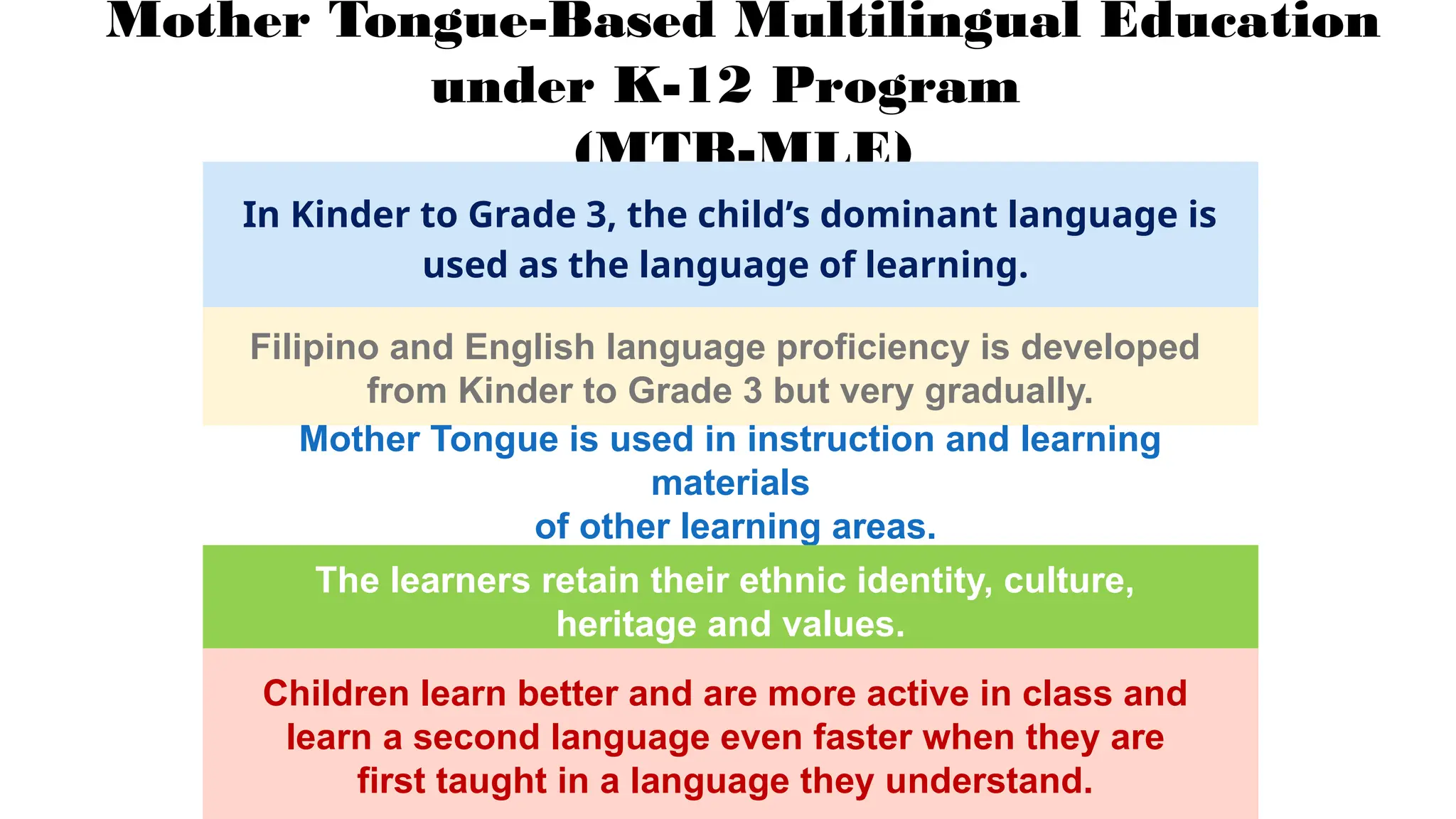
under K-12 Program
(MTB-MLE)
In Kinder to Grade 3, the child’s dominant language is
used as the language of learning.
Filipino and English language proficiency is developed
from Kinder to Grade 3 but very gradually.
Mother Tongue is used in instruction and learning
materials
of other learning areas.
The learners retain their ethnic identity, culture,
heritage and values.
Children learn better and are more active in class and
learn a second language even faster when they are
first taught in a language they understand.
MOTHER TONGUE IN
MATATAG
CURRICULUM
Is the Mother Tongue-Based
Multilingual Education (MTB-MLE)
program still being implemented in the
MATATAG Curriculum?
Yes. Pages 41 and 42 of DO
010, s. 2024 provides that
the first language is the
medium of teaching and
learning in K to 3.
References:
Analysis on the Importance of Mother Tongue in
Early Childhood Faizatul Faridy, Ernawulah
Syaodih Universitas Pendidikan Indonesia,
Bandung, Indonesia, 2016
PPT Regional Seminar on MTB-MLE by Rosalina
Jaducana Villaneza
https://www.thoughtco.com/mother-tongue-lan
guage-1691408
https://www.youtube.com/watch?v=sSZmZ0A3KD
Q

Lesson 1 Mother Tongue pppppppp (2).pptx

  • 1.
    Content and Pedagogy forthe Mother Tongue
  • 2.
    Contents of this Template Languageand its Importance Definition/s of Mother Tongue Individual Activity and Sharing Time Mother Tongue-Based
  • 3.
  • 4.
    “Language is the foundationof all human relations.”
  • 5.
    Language is the foundationof all human relations. All human relationships are established on the ability of people to communicate effectively with each other. Thoughts, values, and understandings are developed
  • 6.
    Proficiency in thelanguage enables people to… ●access, process, and assess information ● to engage with the wider and more diverse communities ●and to learn about the role of language in their own lives and others
  • 7.
    Language is thebasis of all communication and the primary instrument of thought. Language thinking and learning are interrelated. Language is governed by rules and system (language conventions) which are used to explore and
  • 8.
    Language is thecentral to the people’s intellectual, social, and emotional development and has an essential role in all key learning areas (English Curriculum Framework: Australia, 1998)
  • 9.
    It defines culture… which is essential in understanding oneself (personal identity)  forming interpersonal relationships (socialization)  extending experiences  reflecting on thought and
  • 10.
    We thrive ina bilingual, or even in a multilingual, world. The Philippines has multiple and diverse languages, and according to Ethnologue (2021), the country currently has 186 individual languages. Prior to the recent reform, the Philippine educational system had followed English and Filipino as the official languages, which are affirmed under Article XIV, Sec. 7 of the 1987 Philippine Constitution.
  • 11.
    The English-dominated educational system(prior to the implementation of K-12 program) of the country is one of the main factors of failure in the academic performances of Filipino learners, Nolasco (2009). Bakit kaya? e.g An usad… Prof. Dina’s Reasearch
  • 12.
    The English-dominated educational system(prior to the implementation of K- 12 program) of the country is one of the main factors of failure in the academic performances of Filipino learners, Nolasco (2009).This is the rationale why Mother Tongue, Filipino, and English follow a unified frame-work which allows easy transition from acquiring and learning one language to another.
  • 13.
    - Republic Act10533 “Enhance Basic Education Act of 2013”- highlighted the reality and relevance of Mother Tongue- Based Multilingual Education (MTB-MLE). - The implementation of the K to 12 Basic Education program puts a high premium on the learner’s mother tongue and other languages used in the classroom. - The Department of Education refers to Mother Tongue-Based Instruction through
  • 14.
    Bakit kaya MOTHER TONGUEang tawag, hindi father tongue o lola tongue o tita tongue? Give me a witty answer.
  • 15.
  • 16.
    What is mother tongue? Thereare educators and contemporary linguists generally use the term L1 referring to a first or native language (the mother tongue) and the term L2 referring to a second language or a foreign language that's being learned. - means one’s native language, the language learned by children and passed from one generation to the next. The term is used to refer to a person's native language. It means that a child learns this language from birth. Children have more than one mother tongue or native language when they grow up in bilingual homes.
  • 17.
    What is mother tongue? Thereare some words or terms that interchangeably used for mother tongue like the first language, dominant language, home language, and native tongue (even though these terms are not necessarily synonymous). Moreover, mother tongue is used to refer to the language that a person learned, usually from their parents, when he/she was still a child.
  • 18.
    The linguist willtell you there is a difference between the mother tongue and the first language. Mother tongue is the in-born language, which a baby has already familiarized even in the gestation of mother before it is born. The first language is the language which a child acquires either through schooling or socialization, such as family.
  • 19.
    At around 18weeks, the fetus can already hear sounds inside the womb like heartbeats of the mother. He/she can already hear sounds outside the body at 27-29 weeks.
  • 20.
    What is your mothertongue if you’re from Nabua Camarines Sur? GUESS WHAT?
  • 21.
    Individual Activity “Selfand Language Assessment”: What is your mother tongue? What are the other languages that you know? Think of how you acquired and learned the languages that you have right now. How will you rate the level of proficiency for each of the language (10 points if you consider yourself highly proficient).
  • 22.
    Group Activity: Talk toeach other and think of two challenging words in your mother tongue and let them guess the meaning. The group that has the most number of points wins.
  • 23.
  • 24.
    -refers to anyform of schooling which uses the language or languages that children are most familiar with, in order to help them learn. This is usually the language that children speak at home with their family. What is Mother Tongue- Based Education?
  • 25.
    As research shows,quality education occurs most effectively when the mother tongue, the learner’s home language, is used for initial learning. The first language is the language of learning. It is by far the easiest way for children to interact with the world. And when the language of learning and the language of instruction do not match, learning difficulties are bound to follow
  • 26.
    A strong mothertongue foundation that comes from the home can build and develop more potent literacy in the school language. The mother tongue and the school language are interdependent; they nurture each other.
  • 27.
    What is MotherTongue-Based Multilingual Education (MTB- MLE)? It is one of the distinctive features of the K to 12 program that was signed into law on May 15, 2013 by former President Benigno Aquino III. The introduction of the MTB-MLE, specifically from Kinder to Grade 3, is grounded on the belief that children learn best if the language used in instruction is understandable and accessible to the young learners.
  • 28.
    What is MultilingualEducation? Mother tongue-based multilingual education (MTB-MLE) is education, formal or non - formal, in which the learner’s mother tongue and additional languages are used in the classroom. Learners begin their education in the language they understand best - their mother tongue - and develop a strong foundation in their mother language before learning additional languages.
  • 29.
    o is astructured program of language learning and cognitive development providing:  a strong educational foundation in the first language successful bridging to one or more additional languages enabling the use of both/all languages for life-long learning o is based in the child’s own known environment and bridges to the wider world. “Known to Unknown”
  • 30.
    o maintains locallanguage and culture while providing national/international language acquisition and instruction o promotes learners’ integration into the national society without forcing them to sacrifice their linguistic and cultural heritage.
  • 31.
    o Meaning basededucation enables students to learn well because they understand what the teacher is saying. o Using the culture the child knows enables immediate comprehension from which new concepts can be built – going from the known to the unknown.
  • 32.
    The purpose ofa multilingual education program is to develop appropriate cognitive and reasoning skills enabling children to operate equally in different languages - starting in the mother tongue. Multilingual Education
  • 33.
    The MTB-MLE programaims to provide a solution to the "high functional illiteracy of the Filipinos" through language, in which the said issue of illiteracy results in poor performance, low retention, and low learning outcomes (Nolasco, 2009). Through the MTB-MLE education program, learners can build a strong foundation for acquiring new languages. Multilingual Education
  • 34.
    Mother Tongue-Based MultilingualEducation under K-12 Program (MTB-MLE) In Kinder to Grade 3, the child’s dominant language is used as the language of learning. Filipino and English language proficiency is developed from Kinder to Grade 3 but very gradually. Mother Tongue is used in instruction and learning materials of other learning areas. The learners retain their ethnic identity, culture, heritage and values. Children learn better and are more active in class and learn a second language even faster when they are first taught in a language they understand.
  • 35.
  • 36.
    Is the MotherTongue-Based Multilingual Education (MTB-MLE) program still being implemented in the MATATAG Curriculum? Yes. Pages 41 and 42 of DO 010, s. 2024 provides that the first language is the medium of teaching and learning in K to 3.
  • 37.
    References: Analysis on theImportance of Mother Tongue in Early Childhood Faizatul Faridy, Ernawulah Syaodih Universitas Pendidikan Indonesia, Bandung, Indonesia, 2016 PPT Regional Seminar on MTB-MLE by Rosalina Jaducana Villaneza https://www.thoughtco.com/mother-tongue-lan guage-1691408 https://www.youtube.com/watch?v=sSZmZ0A3KD Q