Internet Traffic Engineering Using Multi-Protocol Label Switching (MPLS)D.O. Awduche and B. JabbariGeneralized Multi-Protocol Label Switching: An Overview of Signaling Enhancements and Recovery TechniquesA. Banerjee et. al.Internet Traffic EngineeringJoachim Seilfaldet (joachse)Jonas Sæther Markussen (jonassm)
Multiprotocol Label SwitchingJonas Sæther Markussen
AgendaMulti-Protocol Label SwitchingOverviewLabelsLabel assignmentForward equivalence classes (FECs)Label switched forwarding (LSP)Control and data separationGeneralized Multi-Protocol Label SwitchingTraffic EngineeringTraffic Engineering using MPLS
Overview (1)Multiprotocol Label Switching Architecture (RFC3031)Overlay link network (OSI layer “2.5”)Eliminates the dependence on a specific link layer technology (e.g. ATM, SONET, etc.)Eliminates the need for multiple layer 2 networks to support multiple protocolsMPLS can carry many different kinds of traffic: IP, ATM, SONET, Ethernet frames, etc.Constraint-based forwarding(Optional) assignment of labels prefixing packet headersForwarding no longer constricted to packet destination only
Overview (2)Introduces connection-oriented routing to legacy IP routersDoes this by establishing “virtual links” using label switched paths (LSPs)Provides means for traffic engineering (TE)Can manipulate link-state advertisements (LSAs)An easy-to-maintain virtual topologyWith TE, MPLS can establish alternative paths to avoid congested areasEnables fault tolerance if a link goes down
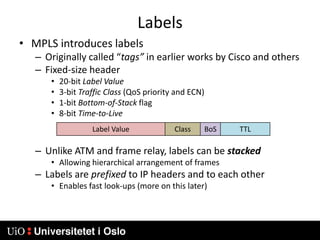
LabelsMPLS introduces labelsOriginally called “tags” in earlier works by Cisco and othersFixed-size header20-bit Label Value3-bit Traffic Class (QoS priority and ECN)1-bit Bottom-of-Stack flag8-bit Time-to-LiveUnlike ATM and frame relay, labels can be stackedAllowing hierarchical arrangement of framesLabels are prefixed to IP headers and to each otherEnables fast look-ups (more on this later)
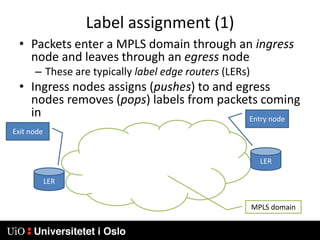
Label assignment (1)Packets enter a MPLS domain through an ingress node and leaves through an egress nodeThese are typically label edge routers (LERs)Ingress nodes assigns (pushes) to and egress nodes removes (pops) labels from packets coming inEntry nodeExit nodeLERLERMPLS domain
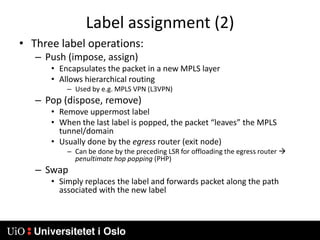
Label assignment (2)Three label operations:Push (impose, assign)Encapsulates the packet in a new MPLS layerAllows hierarchical routingUsed by e.g. MPLS VPN (L3VPN)Pop (dispose, remove)Remove uppermost labelWhen the last label is popped, the packet “leaves” the MPLS tunnel/domainUsually done by the egress router (exit node)Can be done by the preceding LSR for offloading the egress router  penultimate hop popping (PHP)SwapSimply replaces the label and forwards packet along the path associated with the new label
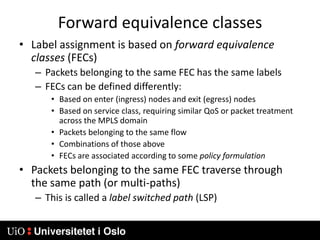
Forward equivalence classesLabel assignment is based on forward equivalence classes (FECs)Packets belonging to the same FEC has the same labelsFECs can be defined differently:Based on enter (ingress) nodes and exit (egress) nodesBased on service class, requiring similar QoS or packet treatment across the MPLS domainPackets belonging to the same flowCombinations of those aboveFECs are associated according to some policy formulationPackets belonging to the same FEC traverse through the same path (or multi-paths)This is called a label switched path (LSP)
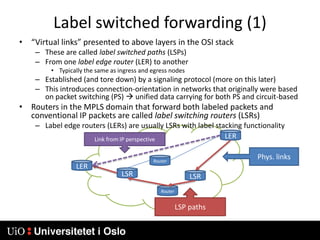
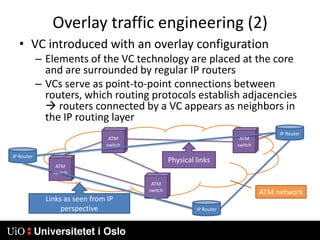
Label switched forwarding (1)“Virtual links” presented to above layers in the OSI stackThese are called label switched paths (LSPs)From one label edge router (LER) to anotherTypically the same as ingress and egress nodesEstablished (and tore down) by a signaling protocol (more on this later)This introduces connection-orientation in networks that originally were based on packet switching (PS)  unified data carrying for both PS and circuit-basedRouters in the MPLS domain that forward both labeled packets and conventional IP packets are called label switching routers (LSRs)Label edge routers (LERs) are usually LSRs with label stacking functionalityLERLink from IP perspectivePhys. linksRouterLERLSRLSRRouterLSP paths
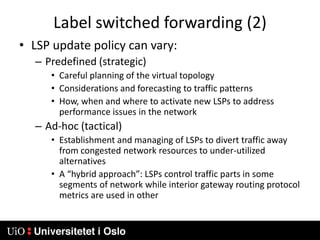
Label switched forwarding (2)LSP update policy can vary:Predefined (strategic)Careful planning of the virtual topologyConsiderations and forecasting to traffic patternsHow, when and where to activate new LSPs to address performance issues in the networkAd-hoc (tactical)Establishment and managing of LSPs to divert traffic away from congested network resources to under-utilized alternativesA “hybrid approach”: LSPs control traffic parts in some segments of network while interior gateway routing protocol metrics are used in other
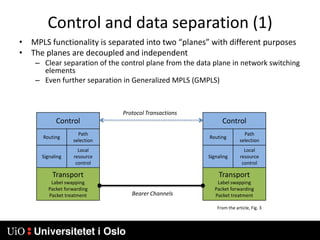
Control and data separation (1)MPLS functionality is separated into two “planes” with different purposesThe planes are decoupled and independentClear separation of the control plane from the data plane in network switching elementsEven further separation in Generalized MPLS (GMPLS)Protocol TransactionsBearer ChannelsFrom the article, Fig. 3
Control and data separation (2)Control planeControl protocols are software processes that communicate across node boundariesDistribute and manage:Network topologyResource availabilityEstablish and tear down LSPsSignaling protocolLabel distribution protocol (LDP) for best-effort hop-to-hop pathsRSVP-TE (or CR-LDP) for traffic engineering purposes and end-to-end virtual circuits
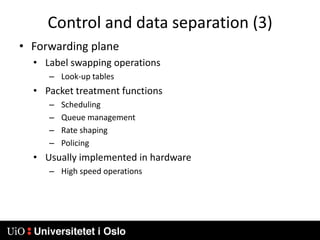
Control and data separation (3)Forwarding planeLabel swapping operationsLook-up tablesPacket treatment functionsSchedulingQueue managementRate shapingPolicingUsually implemented in hardwareHigh speed operations
Generalized Multi-Protocol Label SwitchingJoachim Seilfaldet
AgendaMulti-Protocol Label SwitchingGeneralized Multi-Protocol Label SwitchingWhat is GMPLS?Implemented interfaces to supportEnhancements to SignalingHierarchical LSP SetupGMPLS Protection and Restoration TechniquesPath SwitchingLine SwitchingProtection MechanismsRestoration MechanismsTraffic EngineeringTraffic Engineering using MPLS
What is GMPLS?Multi-Protocol Label Switching RecapWorks as an extension of IP
Control plane is logically separated from data plane.
Referred as a “Layer 2.5” protocol. Layer 2 (Data Link Layer) and Layer 3 (Network Layer).Generalized Multi-Protocol Label SwitchingNext generation implementation of Multi-Protocol Label Switching
Extends to support a wide range of LSP for  different network devices.
Extensions made to IP router protocols (OSPF and IS-IS)
New Link Management ProtocolWhat is GMPLS?Control plane concepts can be used in other switched transport technologiesPacket Switched Networks
A label represent a short tag attached to packet
Time-Division Multiplexing Networks
A label represent a time slot
Wavelength-Switched Networks
A label represent a wavelength
Fiber-switched Networks
A label represent a fiberImplemented interfaces to supportPacket Switch Capable Interfaces (PSC)
If a node recives data over this interface, it will be able to switch the recived data on a packet-by-packet basis based on the label attached.
Time-Division Multiplexing (TDM)
  Will be able to multiplex or de-multiplex channels within an payload.
Lambda Switch Capable Interface (LSC)
Will be able to recognize and switch individual lambdas within the interface.
Fiber Switch Capable Interface (FSC)Will be able to switch the entire contents to another interface (without distinguishing lambdas, channels or packets), such as optical cross-connects (OXCs) .
Enhancements to SignalingGMPLS require LSP start and end on similar device
For example, SONET TDM.
Necessitates a separate control plane transport network.
GMPLS is extended to allow control plane to be physically diverse from the associated data plan.Enhancements have been made to the label distribution protocol RSVP-TE to support GMPLS.
Hierarchical LSP SetupOccurs when a new LSP is tunneled inside an existing higher-order LSP
Serves as a link through other LSP
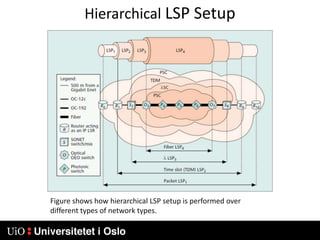
Nodes at border of regions are responsible for forming higher-order LSP and aggregating lower-order LSPs.Hierarchical LSP SetupFigure shows how hierarchical LSP setup is performed over different types of network types.
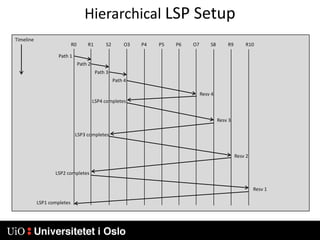
Hierarchical LSP SetupTimelineR0R1S2O3P4P5P6O7S8R9R10Path 1Path 2Path 3Path 4Resv 4LSP4 completesResv 3LSP3 completesResv 2LSP2 completesResv 1LSP1 completes
GMPLS Protection and Restoration TechniquesProtection and restoration is addressed using two techniquesPath Switching
Line SwitchingFault management consist ofDetection
Localization
Notification
Mitigation (Done with protection and restoration)Protection MechanismsEfficient use of protection requiresDistribution of relevant link properties
Protection bandwidth
Protection capabilities
Establish secondary paths through network
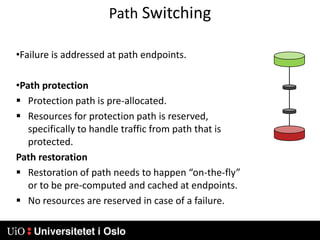
Signal switch from primary path to backup Path SwitchingFailure is addressed at path endpoints.Path protectionProtection path is pre-allocated.
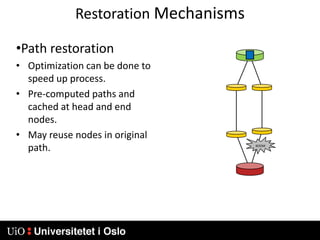
Resources for protection path is reserved, specifically to handle traffic from path that is protected.Path restorationRestoration of path needs to happen “on-the-fly” or to be pre-computed and cached at endpoints.
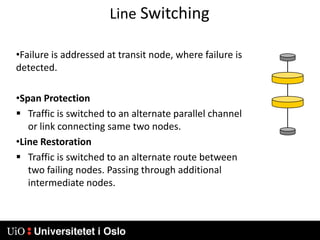
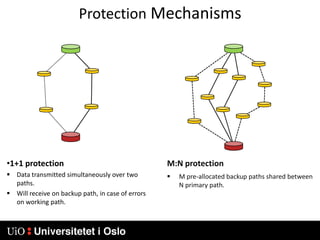
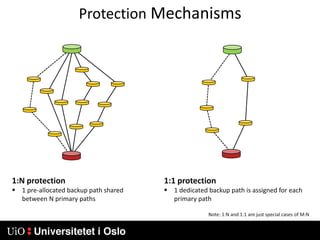
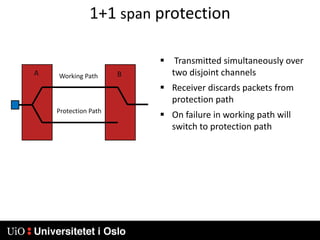
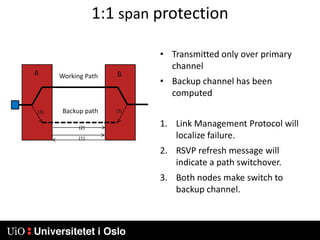
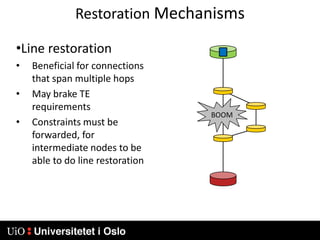
No resources are reserved in case of a failure.Line SwitchingFailure is addressed at transit node, where failure is detected.Span ProtectionTraffic is switched to an alternate parallel channel or link connecting same two nodes.Line RestorationTraffic is switched to an alternate route between two failing nodes. Passing through additional intermediate nodes.Protection Mechanisms1+1 protectionData transmitted simultaneously over two paths.

Internet Traffic Engineering

  • 1.
    Internet Traffic EngineeringUsing Multi-Protocol Label Switching (MPLS)D.O. Awduche and B. JabbariGeneralized Multi-Protocol Label Switching: An Overview of Signaling Enhancements and Recovery TechniquesA. Banerjee et. al.Internet Traffic EngineeringJoachim Seilfaldet (joachse)Jonas Sæther Markussen (jonassm)
  • 2.
  • 3.
    AgendaMulti-Protocol Label SwitchingOverviewLabelsLabelassignmentForward equivalence classes (FECs)Label switched forwarding (LSP)Control and data separationGeneralized Multi-Protocol Label SwitchingTraffic EngineeringTraffic Engineering using MPLS
  • 4.
    Overview (1)Multiprotocol LabelSwitching Architecture (RFC3031)Overlay link network (OSI layer “2.5”)Eliminates the dependence on a specific link layer technology (e.g. ATM, SONET, etc.)Eliminates the need for multiple layer 2 networks to support multiple protocolsMPLS can carry many different kinds of traffic: IP, ATM, SONET, Ethernet frames, etc.Constraint-based forwarding(Optional) assignment of labels prefixing packet headersForwarding no longer constricted to packet destination only
  • 5.
    Overview (2)Introduces connection-orientedrouting to legacy IP routersDoes this by establishing “virtual links” using label switched paths (LSPs)Provides means for traffic engineering (TE)Can manipulate link-state advertisements (LSAs)An easy-to-maintain virtual topologyWith TE, MPLS can establish alternative paths to avoid congested areasEnables fault tolerance if a link goes down
  • 6.
    LabelsMPLS introduces labelsOriginallycalled “tags” in earlier works by Cisco and othersFixed-size header20-bit Label Value3-bit Traffic Class (QoS priority and ECN)1-bit Bottom-of-Stack flag8-bit Time-to-LiveUnlike ATM and frame relay, labels can be stackedAllowing hierarchical arrangement of framesLabels are prefixed to IP headers and to each otherEnables fast look-ups (more on this later)
  • 7.
    Label assignment (1)Packetsenter a MPLS domain through an ingress node and leaves through an egress nodeThese are typically label edge routers (LERs)Ingress nodes assigns (pushes) to and egress nodes removes (pops) labels from packets coming inEntry nodeExit nodeLERLERMPLS domain
  • 8.
    Label assignment (2)Threelabel operations:Push (impose, assign)Encapsulates the packet in a new MPLS layerAllows hierarchical routingUsed by e.g. MPLS VPN (L3VPN)Pop (dispose, remove)Remove uppermost labelWhen the last label is popped, the packet “leaves” the MPLS tunnel/domainUsually done by the egress router (exit node)Can be done by the preceding LSR for offloading the egress router  penultimate hop popping (PHP)SwapSimply replaces the label and forwards packet along the path associated with the new label
  • 9.
    Forward equivalence classesLabelassignment is based on forward equivalence classes (FECs)Packets belonging to the same FEC has the same labelsFECs can be defined differently:Based on enter (ingress) nodes and exit (egress) nodesBased on service class, requiring similar QoS or packet treatment across the MPLS domainPackets belonging to the same flowCombinations of those aboveFECs are associated according to some policy formulationPackets belonging to the same FEC traverse through the same path (or multi-paths)This is called a label switched path (LSP)
  • 10.
    Label switched forwarding(1)“Virtual links” presented to above layers in the OSI stackThese are called label switched paths (LSPs)From one label edge router (LER) to anotherTypically the same as ingress and egress nodesEstablished (and tore down) by a signaling protocol (more on this later)This introduces connection-orientation in networks that originally were based on packet switching (PS)  unified data carrying for both PS and circuit-basedRouters in the MPLS domain that forward both labeled packets and conventional IP packets are called label switching routers (LSRs)Label edge routers (LERs) are usually LSRs with label stacking functionalityLERLink from IP perspectivePhys. linksRouterLERLSRLSRRouterLSP paths
  • 11.
    Label switched forwarding(2)LSP update policy can vary:Predefined (strategic)Careful planning of the virtual topologyConsiderations and forecasting to traffic patternsHow, when and where to activate new LSPs to address performance issues in the networkAd-hoc (tactical)Establishment and managing of LSPs to divert traffic away from congested network resources to under-utilized alternativesA “hybrid approach”: LSPs control traffic parts in some segments of network while interior gateway routing protocol metrics are used in other
  • 12.
    Control and dataseparation (1)MPLS functionality is separated into two “planes” with different purposesThe planes are decoupled and independentClear separation of the control plane from the data plane in network switching elementsEven further separation in Generalized MPLS (GMPLS)Protocol TransactionsBearer ChannelsFrom the article, Fig. 3
  • 13.
    Control and dataseparation (2)Control planeControl protocols are software processes that communicate across node boundariesDistribute and manage:Network topologyResource availabilityEstablish and tear down LSPsSignaling protocolLabel distribution protocol (LDP) for best-effort hop-to-hop pathsRSVP-TE (or CR-LDP) for traffic engineering purposes and end-to-end virtual circuits
  • 14.
    Control and dataseparation (3)Forwarding planeLabel swapping operationsLook-up tablesPacket treatment functionsSchedulingQueue managementRate shapingPolicingUsually implemented in hardwareHigh speed operations
  • 15.
    Generalized Multi-Protocol LabelSwitchingJoachim Seilfaldet
  • 16.
    AgendaMulti-Protocol Label SwitchingGeneralizedMulti-Protocol Label SwitchingWhat is GMPLS?Implemented interfaces to supportEnhancements to SignalingHierarchical LSP SetupGMPLS Protection and Restoration TechniquesPath SwitchingLine SwitchingProtection MechanismsRestoration MechanismsTraffic EngineeringTraffic Engineering using MPLS
  • 17.
    What is GMPLS?Multi-ProtocolLabel Switching RecapWorks as an extension of IP
  • 18.
    Control plane islogically separated from data plane.
  • 19.
    Referred as a“Layer 2.5” protocol. Layer 2 (Data Link Layer) and Layer 3 (Network Layer).Generalized Multi-Protocol Label SwitchingNext generation implementation of Multi-Protocol Label Switching
  • 20.
    Extends to supporta wide range of LSP for different network devices.
  • 21.
    Extensions made toIP router protocols (OSPF and IS-IS)
  • 22.
    New Link ManagementProtocolWhat is GMPLS?Control plane concepts can be used in other switched transport technologiesPacket Switched Networks
  • 23.
    A label representa short tag attached to packet
  • 24.
  • 25.
  • 26.
  • 27.
    A label representa wavelength
  • 28.
  • 29.
    A label representa fiberImplemented interfaces to supportPacket Switch Capable Interfaces (PSC)
  • 30.
    If a noderecives data over this interface, it will be able to switch the recived data on a packet-by-packet basis based on the label attached.
  • 31.
  • 32.
    Willbe able to multiplex or de-multiplex channels within an payload.
  • 33.
    Lambda Switch CapableInterface (LSC)
  • 34.
    Will be ableto recognize and switch individual lambdas within the interface.
  • 35.
    Fiber Switch CapableInterface (FSC)Will be able to switch the entire contents to another interface (without distinguishing lambdas, channels or packets), such as optical cross-connects (OXCs) .
  • 36.
    Enhancements to SignalingGMPLSrequire LSP start and end on similar device
  • 37.
  • 38.
    Necessitates a separatecontrol plane transport network.
  • 39.
    GMPLS is extendedto allow control plane to be physically diverse from the associated data plan.Enhancements have been made to the label distribution protocol RSVP-TE to support GMPLS.
  • 40.
    Hierarchical LSP SetupOccurswhen a new LSP is tunneled inside an existing higher-order LSP
  • 41.
    Serves as alink through other LSP
  • 42.
    Nodes at borderof regions are responsible for forming higher-order LSP and aggregating lower-order LSPs.Hierarchical LSP SetupFigure shows how hierarchical LSP setup is performed over different types of network types.
  • 43.
    Hierarchical LSP SetupTimelineR0R1S2O3P4P5P6O7S8R9R10Path1Path 2Path 3Path 4Resv 4LSP4 completesResv 3LSP3 completesResv 2LSP2 completesResv 1LSP1 completes
  • 44.
    GMPLS Protection andRestoration TechniquesProtection and restoration is addressed using two techniquesPath Switching
  • 45.
  • 46.
  • 47.
  • 48.
    Mitigation (Done withprotection and restoration)Protection MechanismsEfficient use of protection requiresDistribution of relevant link properties
  • 49.
  • 50.
  • 51.
  • 52.
    Signal switch fromprimary path to backup Path SwitchingFailure is addressed at path endpoints.Path protectionProtection path is pre-allocated.
  • 53.
    Resources for protectionpath is reserved, specifically to handle traffic from path that is protected.Path restorationRestoration of path needs to happen “on-the-fly” or to be pre-computed and cached at endpoints.
  • 54.
    No resources arereserved in case of a failure.Line SwitchingFailure is addressed at transit node, where failure is detected.Span ProtectionTraffic is switched to an alternate parallel channel or link connecting same two nodes.Line RestorationTraffic is switched to an alternate route between two failing nodes. Passing through additional intermediate nodes.Protection Mechanisms1+1 protectionData transmitted simultaneously over two paths.