Userspace 2015 | Dublin
DPDK Integration:
A Product’s Journey
Agenda
	
  
•  Introduc*on	
  &	
  Background	
  
•  Implementa*on:	
  
•  Experimen*ng	
  with	
  DPDK	
  
•  Observa*ons	
  and	
  Lessons	
  Learned	
  
•  Moving	
  Forward	
  
•  Q&A	
  
Introduction & Background
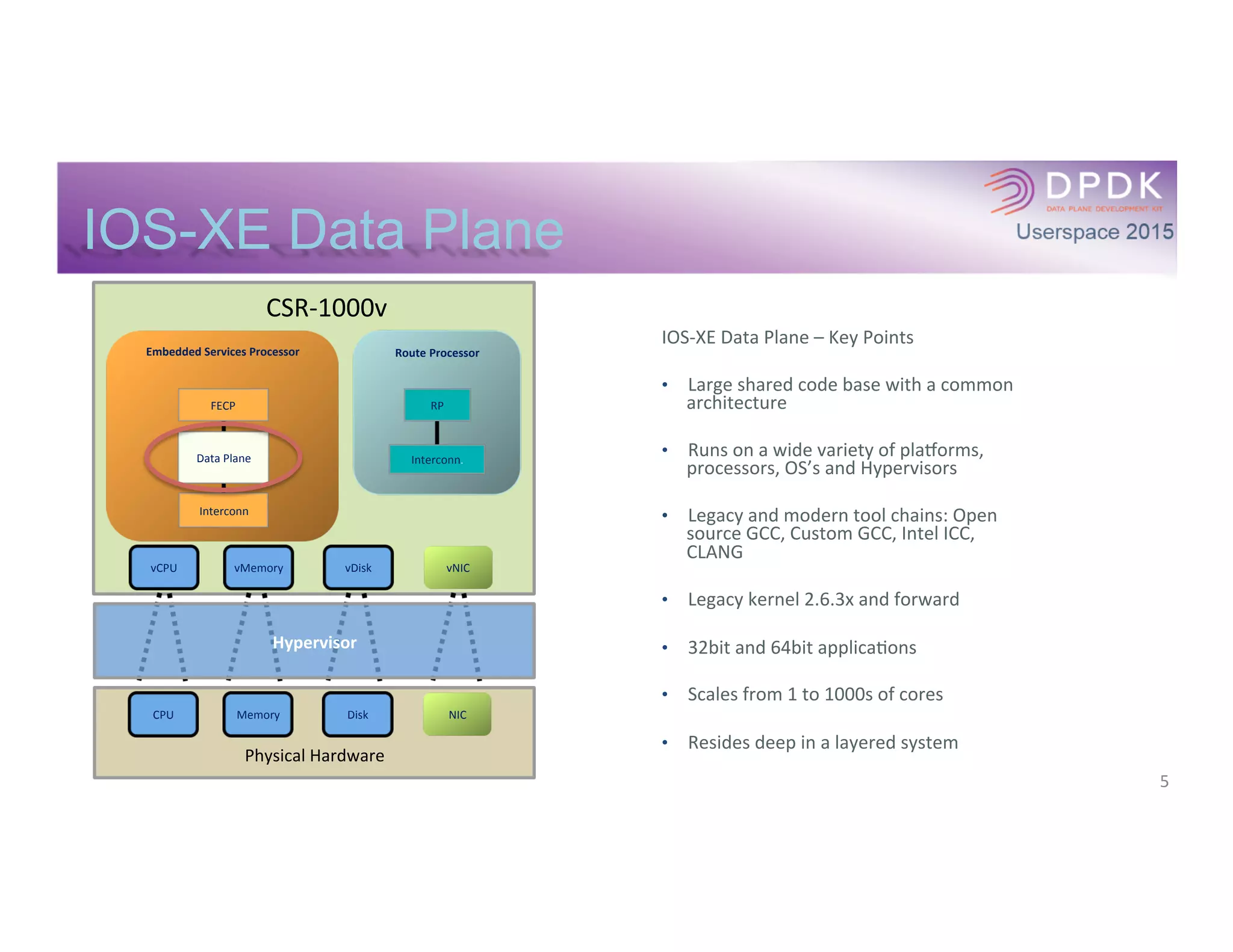
Cisco IOS-XE Data Plane
•  Legacy	
  and	
  modern	
  tool	
  chains:	
  
Open	
  source	
  GCC,	
  Custom	
  GCC,	
  
Intel	
  ICC,	
  CLANG	
  
•  Legacy	
  kernel	
  2.6.3x	
  and	
  forward	
  
•  32bit	
  and	
  64bit	
  applica*ons	
  
•  Scales	
  from	
  1	
  to	
  1000s	
  of	
  cores	
  
•  Resides	
  deep	
  in	
  a	
  layered	
  system	


•  Large	
  shared	
  code	
  base	
  with	
  a	
  
common	
  architecture	
  
•  Runs	
  on	
  a	
  wide	
  variety	
  of	
  
environments:	
  
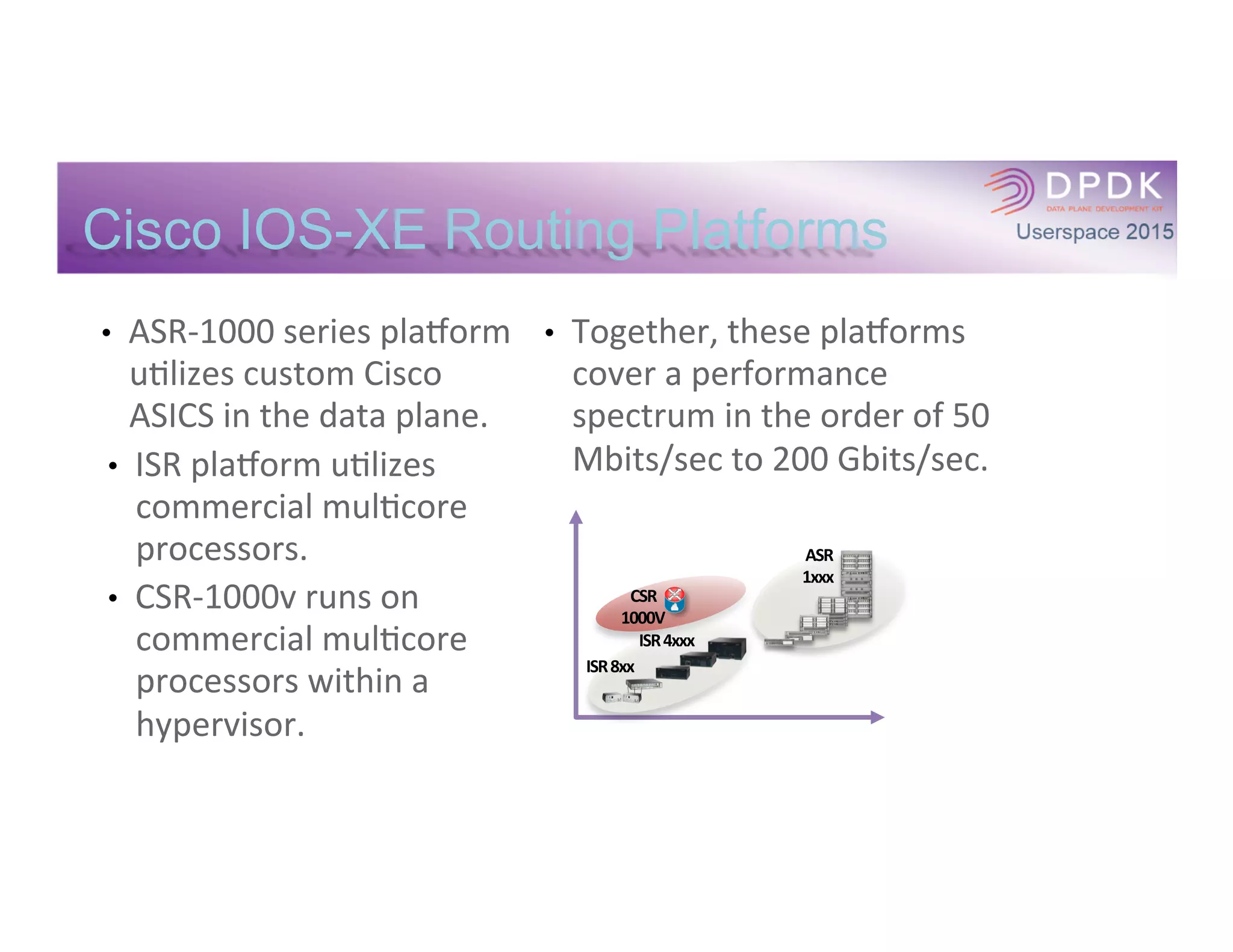
Cisco	
  custom	
  ASICS	
  
Commercial	
  mul*core	
  processors	
  
Commercial	
  mul*core	
  processors	
  
within	
  a	
  hypervisor	
  
•  Performance	
  spectrum	
  ranges	
  
from	
  50	
  Mbits/sec	
  to	
  200	
  Gbits/sec	


Experimenting with DPDK
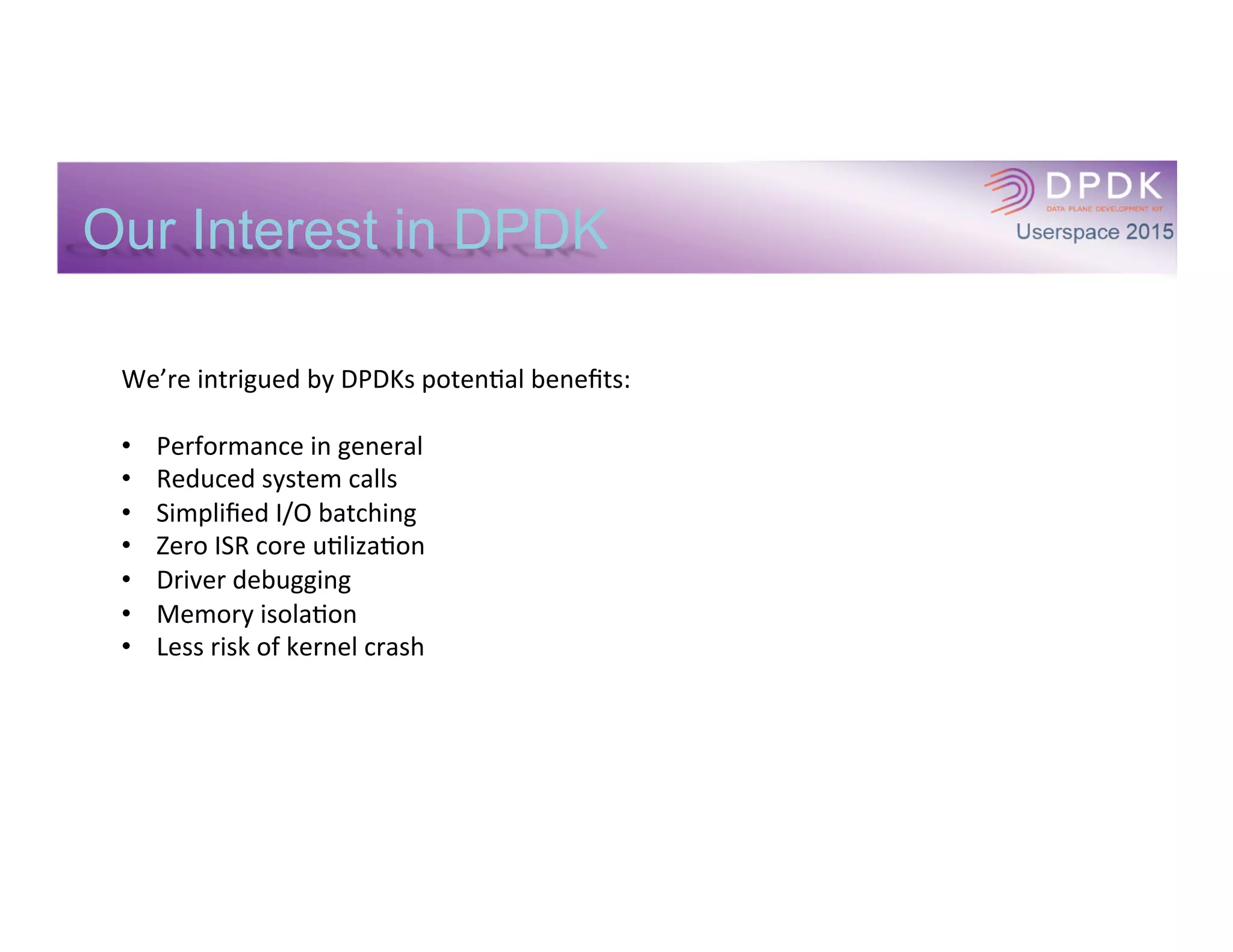
Our Interest in DPDK
We’re	
  intrigued	
  by	
  DPDKs	
  poten*al	
  benefits:	


•  Performance	
  in	
  general	
  
•  Reduced	
  system	
  calls	
  
•  Simplified	
  I/O	
  batching	
  
•  Zero	
  ISR	
  core	
  u*liza*on	
  
•  Driver	
  debugging	
  
•  Memory	
  isola*on	
  
•  Less	
  risk	
  of	
  kernel	
  crash	
  
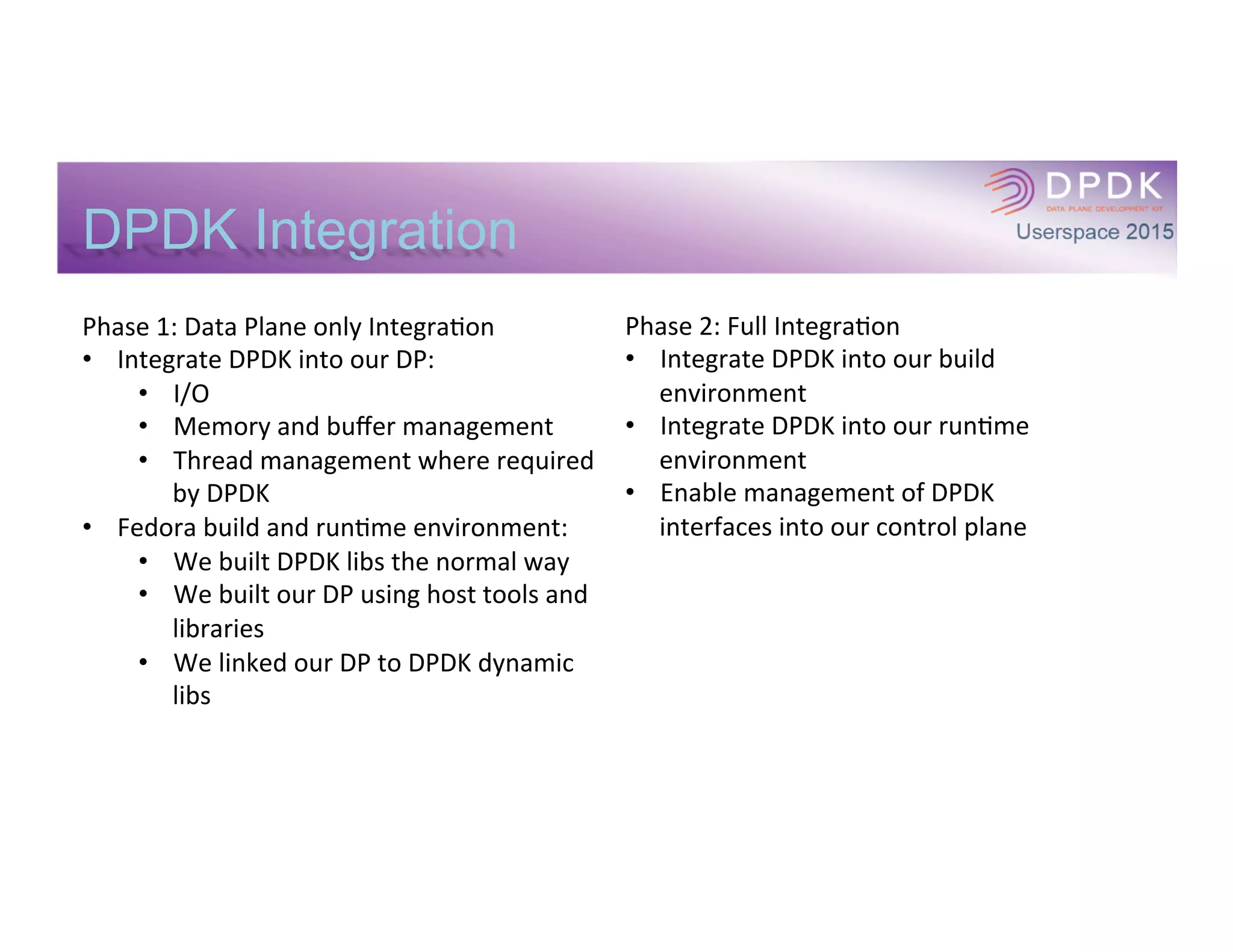
DPDK Integration
Phase	
  1:	
  Data	
  Plane	
  only	
  Integra*on	
  
•  Integrate	
  DPDK	
  into	
  our	
  DP:	
  
•  I/O	
  
•  Memory	
  and	
  buffer	
  management	
  
•  Thread	
  management	
  where	
  required	
  
by	
  DPDK	
  
•  Fedora	
  build	
  and	
  run*me	
  environment:	
  
•  We	
  built	
  DPDK	
  libs	
  the	
  normal	
  way	
  
•  We	
  built	
  our	
  DP	
  using	
  host	
  tools	
  and	
  
libraries	
  
•  We	
  linked	
  our	
  DP	
  to	
  DPDK	
  dynamic	
  
libs	


Phase	
  2:	
  Full	
  Integra*on	
  
•  Integrate	
  DPDK	
  into	
  our	
  build	
  
environment	
  
•  Integrate	
  DPDK	
  into	
  our	
  run*me	
  
environment	
  
•  Enable	
  management	
  of	
  DPDK	
  
interfaces	
  into	
  our	
  control	
  plane	


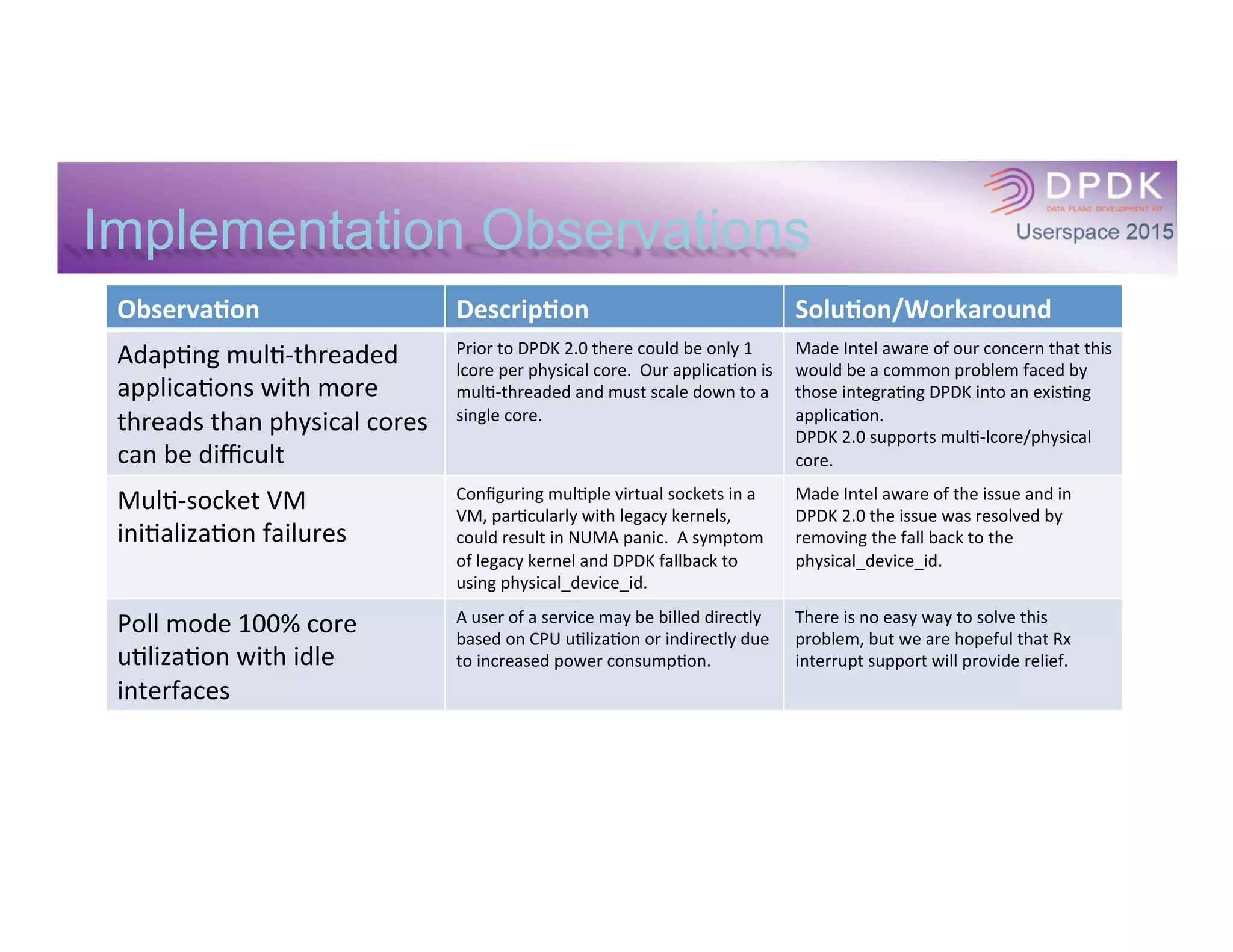
Implementation Observations
Observa(on	
   Descrip(on	
   Solu(on/Workaround	
  
Adap*ng	
  mul*-­‐threaded	
  
applica*ons	
  with	
  more	
  
threads	
  than	
  physical	
  cores	
  
can	
  be	
  difficult	
  
Our	
  applica*on	
  is	
  mul*-­‐threaded	
  and	
  
must	
  scale	
  down	
  to	
  a	
  single	
  core,	
  but	
  
early	
  versions	
  of	
  DPDK	
  enforced	
  a	
  1:1	
  
mapping	
  between	
  lcores	
  and	
  physical	
  
cores.	
  
From	
  DPDK	
  2.0	
  forward,	
  mul*-­‐lcore/
physical	
  core	
  is	
  supported.	
  
Mul*-­‐socket	
  VM	
  
ini*aliza*on	
  failures	
  on	
  
legacy	
  kernels	
  
Configuring	
  mul*ple	
  virtual	
  sockets	
  in	
  a	
  
VM,	
  par*cularly	
  with	
  legacy	
  kernels,	
  
could	
  result	
  in	
  NUMA	
  panic.	


Issue	
  addressed	
  in	
  DPDK	
  2.0	
  and	
  forward	
  
by	
  removing	
  the	
  fall	
  back	
  to	
  the	
  
physical_device_id.	
  
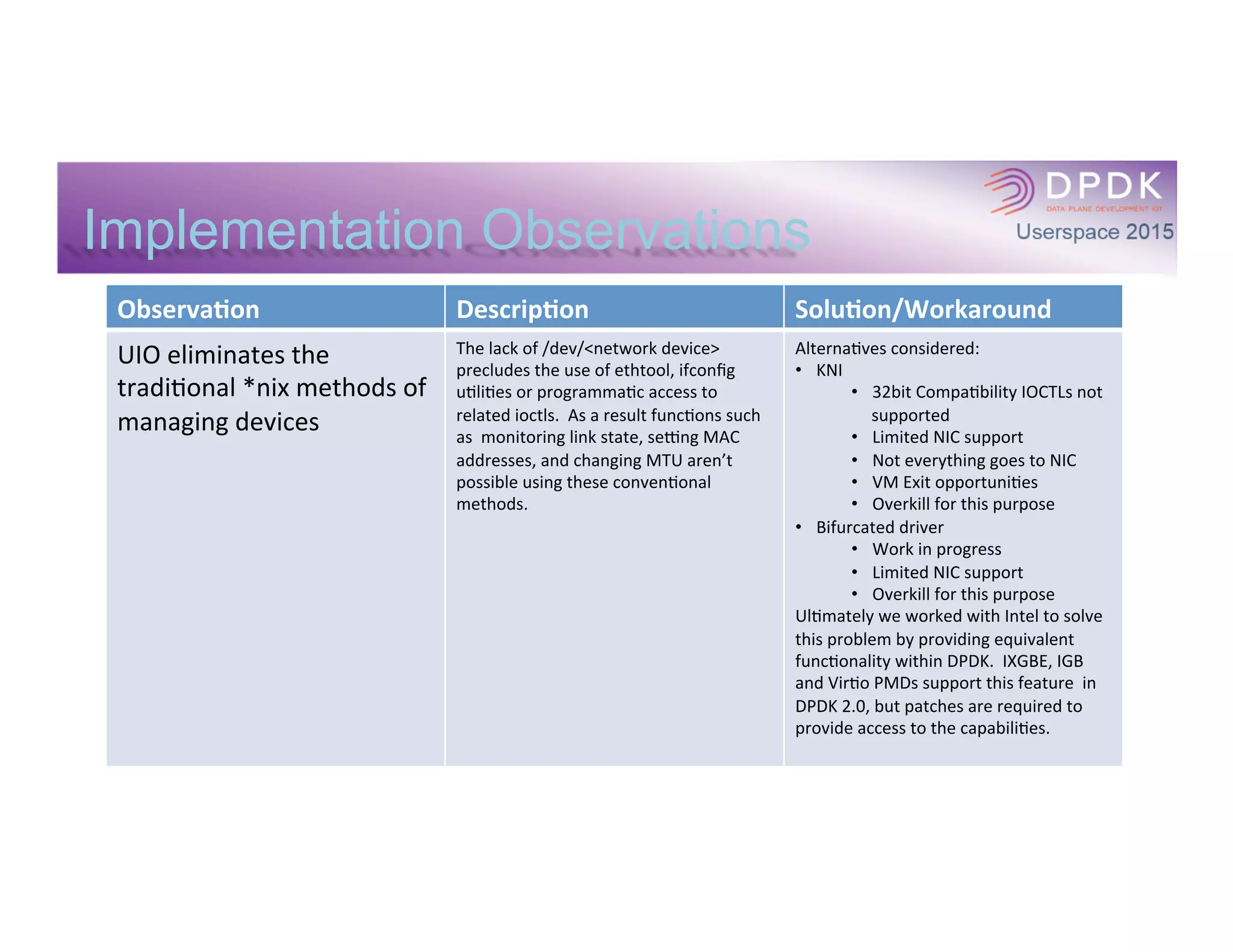
Implementation Observations
Observa(on	
   Descrip(on	
   Solu(on/Workaround	
  
UIO	
  eliminates	
  the	
  
tradi*onal	
  *nix	
  methods	
  of	
  
managing	
  devices	
  
The	
  ability	
  of	
  a	
  legacy	
  applica*on	
  to	
  
adopt	
  DPDK	
  may	
  be	
  hindered	
  by	
  the	
  lack	
  
of	
  /dev/<network	
  device>	
  which	
  
precludes	
  the	
  use	
  of	
  ethtool,	
  ifconfig	
  and	
  
similar	
  u*li*es	
  or	
  programma*c	
  access	
  to	
  
related	
  ioctls.	
  
Alterna*ves	
  considered:	
  
•  KNI	
  
•  Bifurcated	
  driver	
  
•  Ethtool/netdevice	
  APIs	


Ul*mately	
  we	
  chose	
  to	
  pursue	
  Ethtool/
Netdevice	
  APIs.	
  	
  
Poll	
  mode	
  100%	
  core	
  
u*liza*on	
  with	
  idle	
  
interfaces	
  
It	
  may	
  not	
  be	
  acceptable	
  to	
  consume	
  a	
  
core	
  when	
  there	
  is	
  no	
  work.	


There	
  is	
  no	
  easy	
  way	
  to	
  solve	
  this	
  
problem,	
  but	
  we	
  are	
  hopeful	
  that	
  Rx	
  
interrupt	
  support	
  will	
  provide	
  relief.	
  
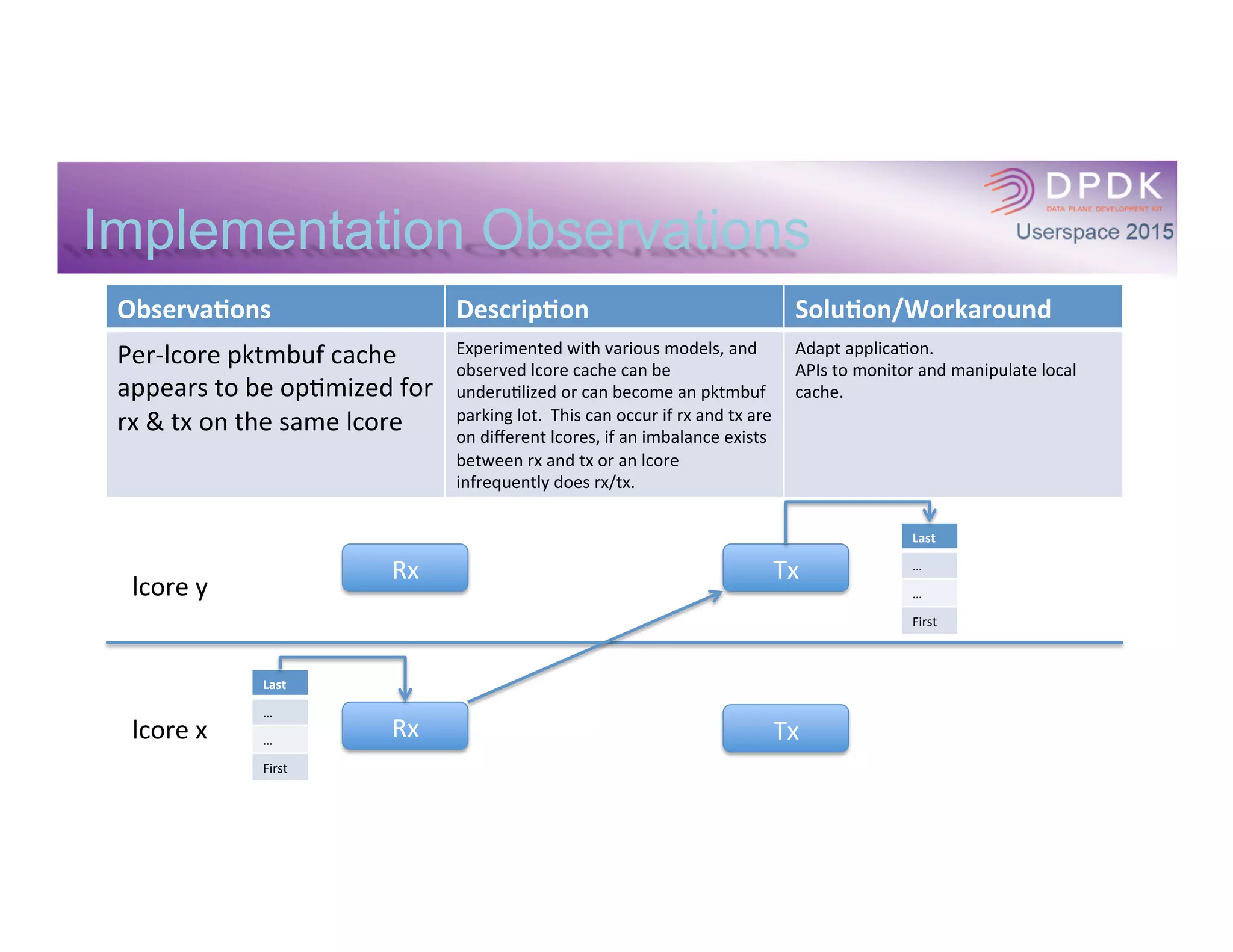
Implementation Observations
Observa(ons	
   Descrip(on	
   Solu(on/Workaround	
  
Per-­‐lcore	
  pktmbuf	
  cache	
  
appears	
  to	
  be	
  op*mized	
  for	
  
rx	
  &	
  tx	
  on	
  the	
  same	
  lcore	
  
Experimented	
  with	
  various	
  models,	
  and	
  
observed	
  lcore	
  cache	
  can	
  be	
  
underu*lized	
  or	
  can	
  become	
  an	
  pktmbuf	
  
parking	
  lot.	
  	
  This	
  can	
  occur	
  if	
  rx	
  and	
  tx	
  are	
  
on	
  different	
  lcores,	
  if	
  an	
  imbalance	
  exists	
  
between	
  rx	
  and	
  tx	
  or	
  an	
  lcore	
  
infrequently	
  does	
  rx/tx.	


Adapt	
  applica*on.	
  
APIs	
  to	
  monitor	
  and	
  manipulate	
  local	
  
cache.	


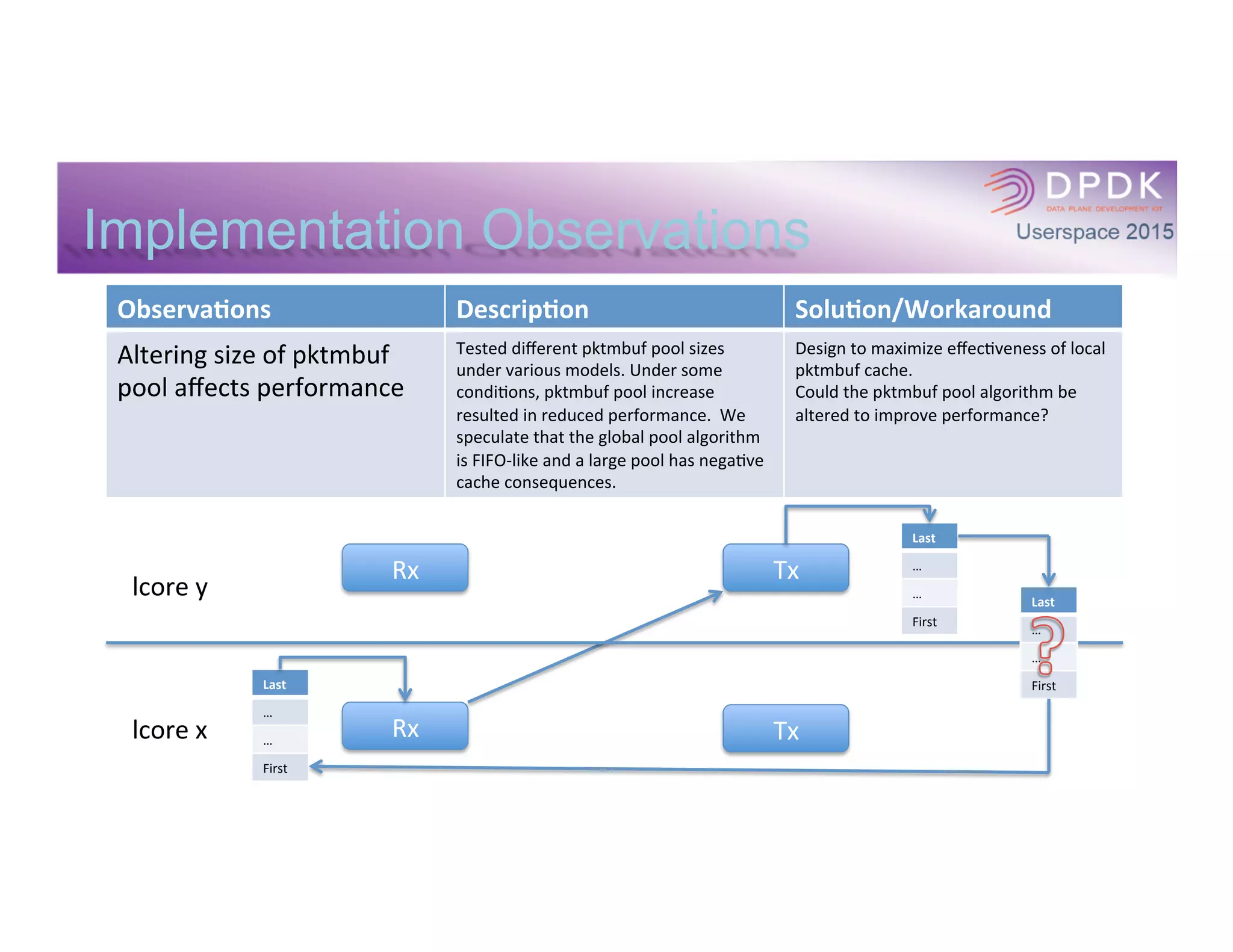
Implementation Observations
lcore	
  x	
  
lcore	
  y	
  
Rx	
  
Tx	
  
Tx	
  
Rx	
  
Last	
  
…	
  
…	
  
First	
  
Last	
  
…	
  
…	
  
First	
  
Observa(ons	
   Descrip(on	
   Solu(on/Workaround	
  
Altering	
  size	
  of	
  pktmbuf	
  
pool	
  affects	
  performance	
  
Tested	
  different	
  pktmbuf	
  pool	
  sizes	
  
under	
  various	
  models.	
  Under	
  some	
  
condi*ons,	
  pktmbuf	
  pool	
  increase	
  
resulted	
  in	
  reduced	
  performance.	
  	
  We	
  
speculate	
  that	
  the	
  global	
  pool	
  algorithm	
  
is	
  FIFO-­‐like	
  and	
  a	
  large	
  pool	
  has	
  nega*ve	
  
cache	
  consequences.	
  
Design	
  to	
  maximize	
  effec*veness	
  of	
  local	
  
pktmbuf	
  cache.	
  
Could	
  the	
  pktmbuf	
  pool	
  algorithm	
  be	
  
altered	
  to	
  improve	
  performance?	
  
Implementation Observations
lcore	
  x	
  
lcore	
  y	
  
Rx	
  
Tx	
  
Tx	
  
Rx	
  
Last	
  
…	
  
…	
  
First	
  
Last	
  
…	
  
…	
  
First	
  
Last	
  
…	
  
…	
  
First	
  
Observa(ons	
   Descrip(on	
   Solu(on/Workaround	
  
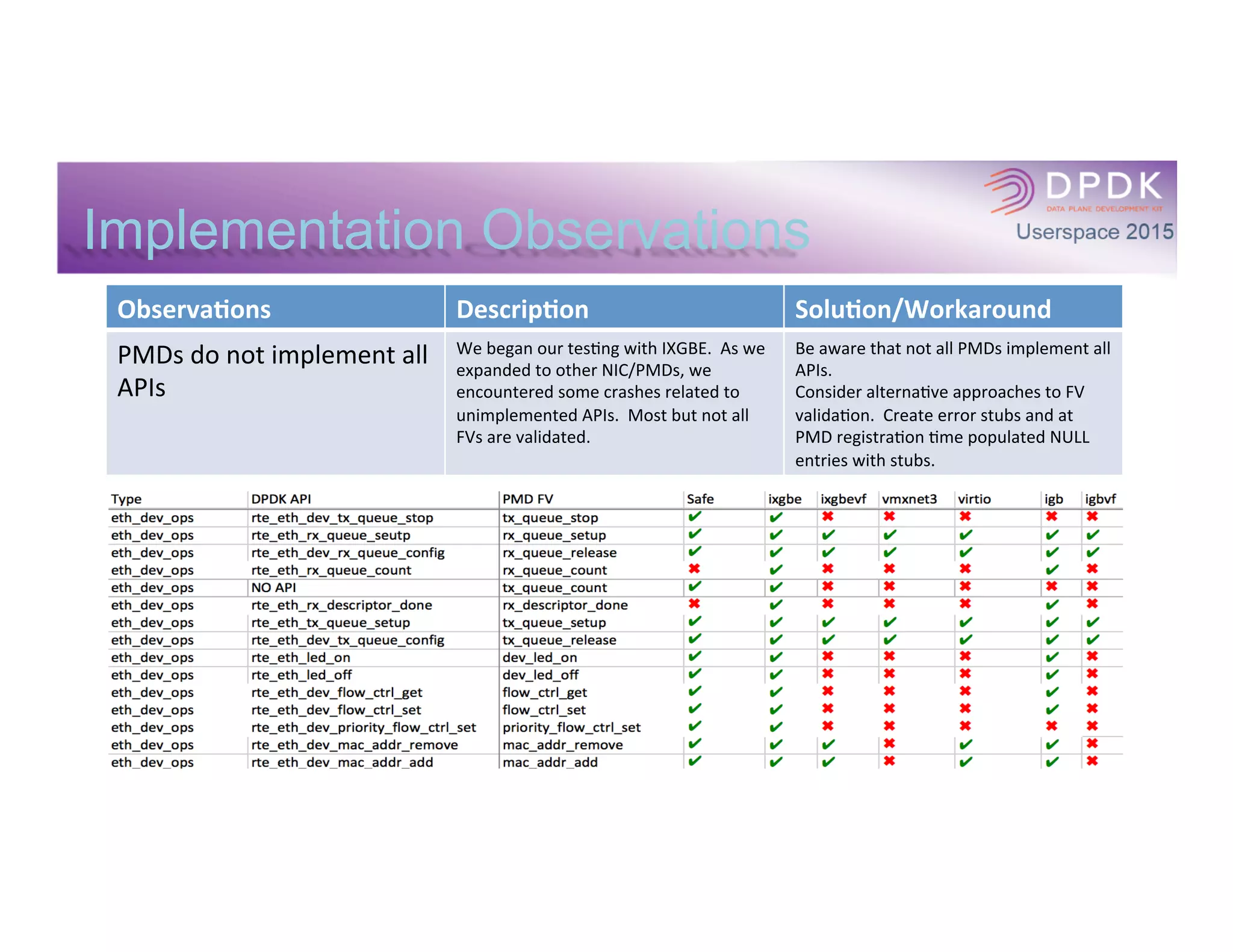
PMDs	
  do	
  not	
  implement	
  all	
  
APIs	
  
We	
  began	
  our	
  tes*ng	
  with	
  IXGBE.	
  	
  As	
  we	
  
expanded	
  to	
  other	
  NIC/PMDs,	
  we	
  
encountered	
  some	
  crashes	
  related	
  to	
  
unimplemented	
  APIs.	
  	
  Most	
  but	
  not	
  all	
  
FVs	
  are	
  validated.	
  
Be	
  aware	
  that	
  not	
  all	
  PMDs	
  implement	
  all	
  
APIs.	
  
Consider	
  alterna*ve	
  approaches	
  to	
  FV	
  
valida*on.	


Implementation Observations
Observa(ons	
   Descrip(on	
   Solu(on/Workaround	
  
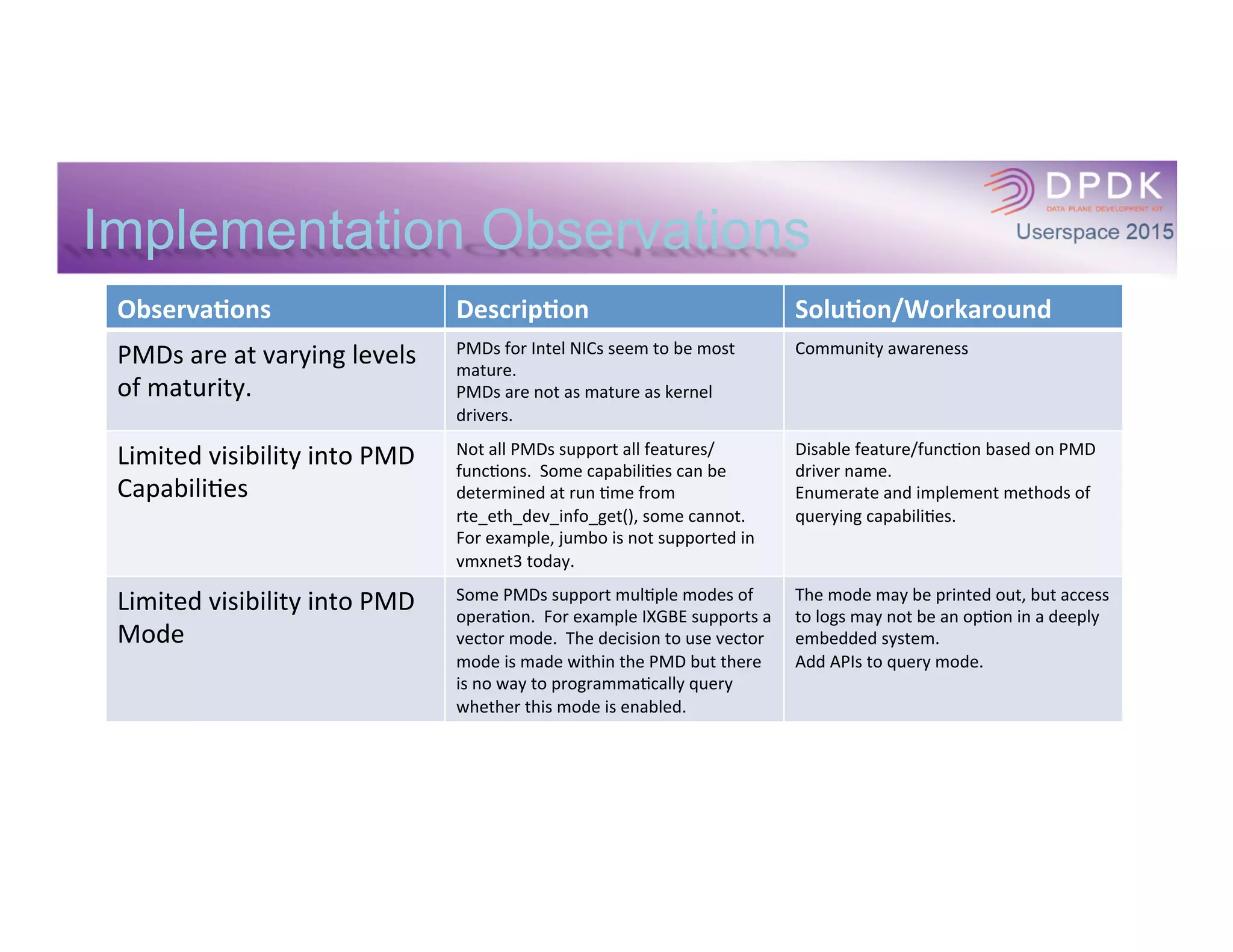
PMDs	
  are	
  at	
  varying	
  levels	
  
of	
  maturity.	
  
PMDs	
  for	
  Intel	
  NICs	
  seem	
  to	
  be	
  most	
  
mature.	
  
PMDs	
  are	
  not	
  as	
  mature	
  as	
  kernel	
  
drivers.	
  
Community	
  awareness	
  
Limited	
  visibility	
  into	
  PMD	
  
Capabili*es	
  
Not	
  all	
  PMDs	
  support	
  all	
  features/
func*ons.	
  	
  Some	
  capabili*es	
  can	
  be	
  
determined	
  at	
  run	
  *me	
  from	
  
rte_eth_dev_info_get(),	
  some	
  cannot.	
  	
  
For	
  example,	
  jumbo	
  is	
  not	
  supported	
  in	
  
vmxnet3	
  today.	
  
Disable	
  feature/func*on	
  based	
  on	
  PMD	
  
driver	
  name.	
  	
  
Enumerate	
  and	
  implement	
  methods	
  of	
  
querying	
  capabili*es.	


Limited	
  visibility	
  into	
  PMD	
  
Mode	
  
Some	
  PMDs	
  support	
  mul*ple	
  modes	
  of	
  
opera*on.	
  	
  For	
  example	
  IXGBE	
  supports	
  a	
  
vector	
  mode.	
  	
  The	
  decision	
  to	
  use	
  vector	
  
mode	
  is	
  made	
  within	
  the	
  PMD	
  but	
  there	
  
is	
  no	
  way	
  to	
  programma*cally	
  query	
  
whether	
  this	
  mode	
  is	
  enabled.	
  
The	
  mode	
  may	
  be	
  printed	
  out,	
  but	
  access	
  
to	
  logs	
  may	
  not	
  be	
  an	
  op*on	
  in	
  a	
  deeply	
  
embedded	
  system.	
  
Add	
  APIs	
  to	
  query	
  mode.	
  
Implementation Observations
Observa(ons	
   Descrip(on	
   Solu(on/Workaround	
  
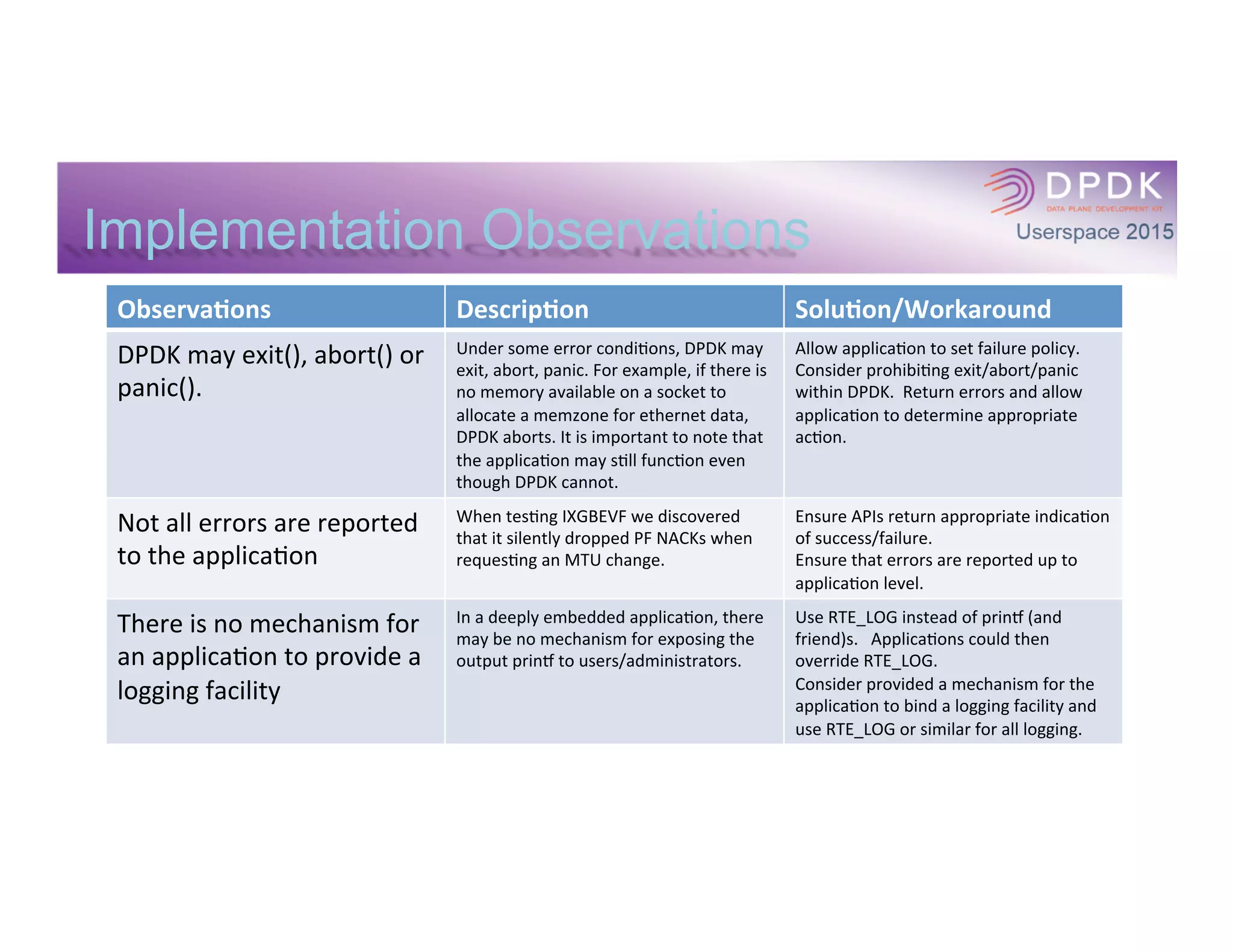
DPDK	
  may	
  exit(),	
  abort()	
  or	
  
panic().	
  
Under	
  some	
  error	
  condi*ons,	
  DPDK	
  may	
  
exit,	
  abort,	
  panic.	
  For	
  example,	
  if	
  there	
  is	
  
no	
  memory	
  available	
  on	
  a	
  socket	
  to	
  
allocate	
  a	
  memzone	
  for	
  ethernet	
  data,	
  
DPDK	
  aborts.	
  It	
  is	
  important	
  to	
  note	
  that	
  
the	
  applica*on	
  may	
  s*ll	
  func*on	
  even	
  
though	
  DPDK	
  cannot.	
  
Allow	
  applica*on	
  to	
  set	
  failure	
  policy.	
  	
  
Consider	
  prohibi*ng	
  exit/abort/panic	
  
within	
  DPDK.	
  	
  Return	
  errors	
  and	
  allow	
  
applica*on	
  to	
  determine	
  appropriate	
  
ac*on.	
  
Not	
  all	
  errors	
  are	
  reported	
  
to	
  the	
  applica*on	
  
When	
  tes*ng	
  IXGBEVF	
  we	
  discovered	
  
that	
  it	
  silently	
  dropped	
  PF	
  NACKs	
  when	
  
reques*ng	
  an	
  MTU	
  change.	
  	
  
Ensure	
  APIs	
  return	
  appropriate	
  indica*on	
  
of	
  success/failure.	
  
Ensure	
  that	
  errors	
  are	
  reported	
  up	
  to	
  
applica*on	
  level.	
  
There	
  is	
  no	
  mechanism	
  for	
  
an	
  applica*on	
  to	
  provide	
  a	
  
logging	
  facility	
  
In	
  a	
  deeply	
  embedded	
  applica*on,	
  there	
  
may	
  be	
  no	
  mechanism	
  for	
  exposing	
  the	
  
output	
  prinn	
  to	
  users/administrators.	
  
Use	
  RTE_LOG	
  instead	
  of	
  prinn	
  (and	
  
friend)s.	
  	
  	
  Applica*ons	
  could	
  then	
  
override	
  RTE_LOG.	
  
Consider	
  provided	
  a	
  mechanism	
  for	
  the	
  
applica*on	
  to	
  bind	
  a	
  logging	
  facility	
  and	
  
use	
  RTE_LOG	
  or	
  similar	
  for	
  all	
  logging.	
  
Implementation Observations
Observa(ons	
   Descrip(on	
   Solu(on/Workaround	
  
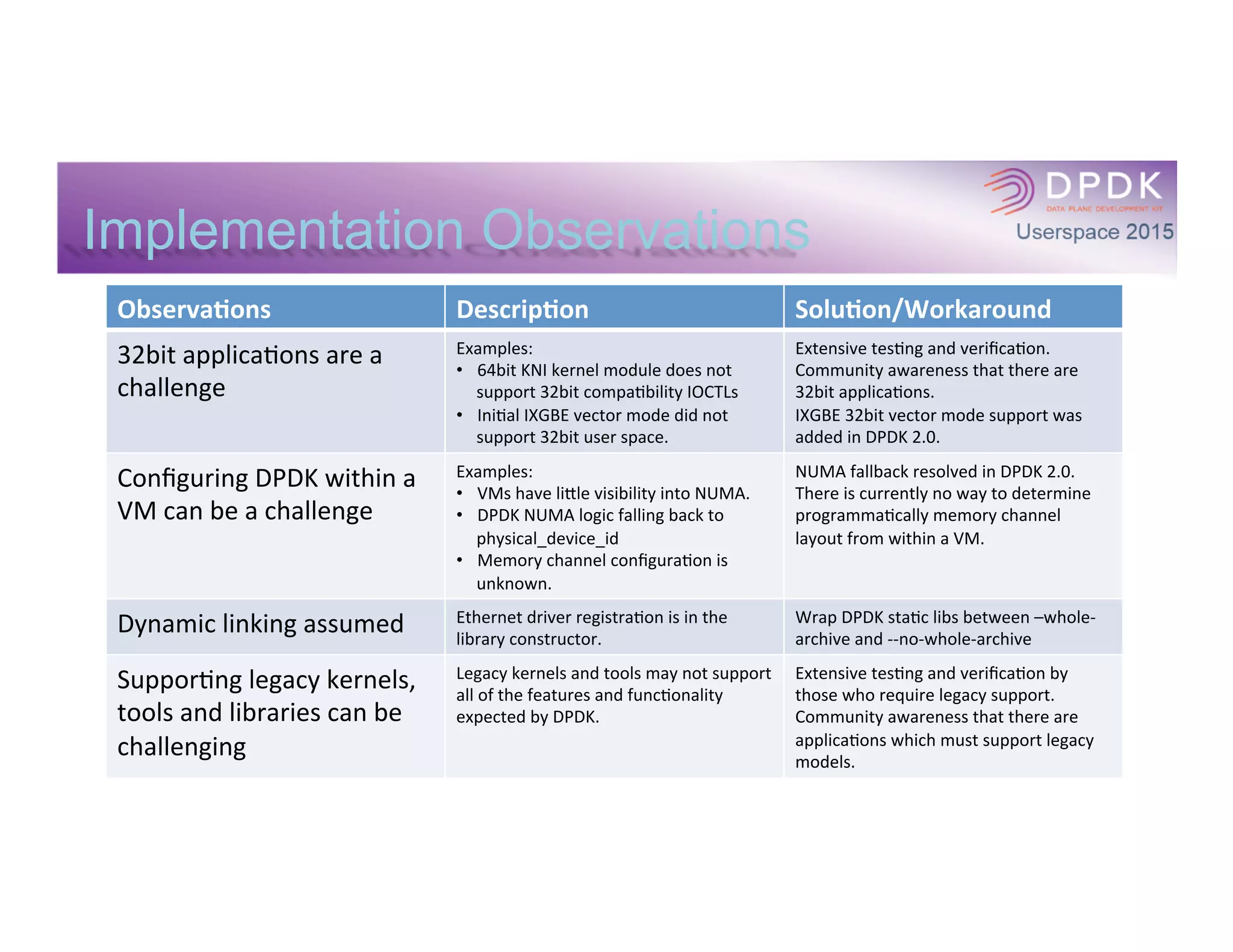
32bit	
  applica*ons	
  are	
  a	
  
challenge	
  
Examples:	
  
•  64bit	
  KNI	
  kernel	
  module	
  does	
  not	
  
support	
  32bit	
  compa*bility	
  IOCTLs	
  
•  Ini*al	
  IXGBE	
  vector	
  mode	
  did	
  not	
  
support	
  32bit	
  user	
  space.	
  
Extensive	
  tes*ng	
  and	
  verifica*on.	
  
Community	
  awareness	
  that	
  there	
  are	
  
32bit	
  applica*ons.	
  
IXGBE	
  32bit	
  vector	
  mode	
  support	
  was	
  
added	
  in	
  DPDK	
  2.0.	
  
Configuring	
  DPDK	
  within	
  a	
  
VM	
  can	
  be	
  a	
  challenge	
  
Examples:	
  
•  VMs	
  have	
  liole	
  visibility	
  into	
  NUMA.	
  
•  DPDK	
  NUMA	
  logic	
  falling	
  back	
  to	
  
physical_device_id	
  
•  Memory	
  channel	
  configura*on	
  is	
  
unknown.	
  
NUMA	
  fallback	
  resolved	
  in	
  DPDK	
  2.0.	
  
There	
  is	
  currently	
  no	
  way	
  to	
  determine	
  
programma*cally	
  memory	
  channel	
  
layout	
  from	
  within	
  a	
  VM.	
  
Dynamic	
  linking	
  assumed	
   Ethernet	
  driver	
  registra*on	
  is	
  in	
  the	
  
library	
  constructor.	
  
Wrap	
  DPDK	
  sta*c	
  libs	
  between	
  –whole-­‐
archive	
  and	
  -­‐-­‐no-­‐whole-­‐archive	
  
Suppor*ng	
  legacy	
  kernels,	
  
tools	
  and	
  libraries	
  can	
  be	
  
challenging	
  
Legacy	
  kernels	
  and	
  tools	
  may	
  not	
  support	
  
all	
  of	
  the	
  features	
  and	
  func*onality	
  
expected	
  by	
  DPDK.	
  
Extensive	
  tes*ng	
  and	
  verifica*on	
  by	
  
those	
  who	
  require	
  legacy	
  support.	
  
Community	
  awareness	
  that	
  there	
  are	
  
applica*ons	
  which	
  must	
  support	
  legacy	
  
models.	
  
Implementation Observations
Implementation Moving Forward
•  To	
  date	
  our	
  focus	
  has	
  been	
  integra*ng	
  DPDK	
  into	
  our	
  applica*on.	
  
•  We	
  have	
  worked	
  closely	
  with	
  Intel	
  to	
  resolve	
  the	
  issues	
  and	
  upstream	
  to	
  
dpdk.org.	
  
•  Going	
  forward	
  our	
  intent	
  is	
  to	
  contribute	
  directly	
  to	
  DPDK	
  through	
  bug	
  fixes	
  
and	
  enhancements.	
  
Q&A

DPDK Integration: A Product's Journey - Roger B. Melton

  • 1.
    Userspace 2015 |Dublin DPDK Integration: A Product’s Journey
  • 2.
    Agenda   •  Introduc*on  &  Background   •  Implementa*on:   •  Experimen*ng  with  DPDK   •  Observa*ons  and  Lessons  Learned   •  Moving  Forward   •  Q&A  
  • 3.
  • 4.
    Cisco IOS-XE DataPlane •  Legacy  and  modern  tool  chains:   Open  source  GCC,  Custom  GCC,   Intel  ICC,  CLANG   •  Legacy  kernel  2.6.3x  and  forward   •  32bit  and  64bit  applica*ons   •  Scales  from  1  to  1000s  of  cores   •  Resides  deep  in  a  layered  system         •  Large  shared  code  base  with  a   common  architecture   •  Runs  on  a  wide  variety  of   environments:   Cisco  custom  ASICS   Commercial  mul*core  processors   Commercial  mul*core  processors   within  a  hypervisor   •  Performance  spectrum  ranges   from  50  Mbits/sec  to  200  Gbits/sec      
  • 5.
  • 6.
    Our Interest inDPDK We’re  intrigued  by  DPDKs  poten*al  benefits:     •  Performance  in  general   •  Reduced  system  calls   •  Simplified  I/O  batching   •  Zero  ISR  core  u*liza*on   •  Driver  debugging   •  Memory  isola*on   •  Less  risk  of  kernel  crash  
  • 7.
    DPDK Integration Phase  1:  Data  Plane  only  Integra*on   •  Integrate  DPDK  into  our  DP:   •  I/O   •  Memory  and  buffer  management   •  Thread  management  where  required   by  DPDK   •  Fedora  build  and  run*me  environment:   •  We  built  DPDK  libs  the  normal  way   •  We  built  our  DP  using  host  tools  and   libraries   •  We  linked  our  DP  to  DPDK  dynamic   libs     Phase  2:  Full  Integra*on   •  Integrate  DPDK  into  our  build   environment   •  Integrate  DPDK  into  our  run*me   environment   •  Enable  management  of  DPDK   interfaces  into  our  control  plane    
  • 8.
  • 9.
    Observa(on   Descrip(on   Solu(on/Workaround   Adap*ng  mul*-­‐threaded   applica*ons  with  more   threads  than  physical  cores   can  be  difficult   Our  applica*on  is  mul*-­‐threaded  and   must  scale  down  to  a  single  core,  but   early  versions  of  DPDK  enforced  a  1:1   mapping  between  lcores  and  physical   cores.   From  DPDK  2.0  forward,  mul*-­‐lcore/ physical  core  is  supported.   Mul*-­‐socket  VM   ini*aliza*on  failures  on   legacy  kernels   Configuring  mul*ple  virtual  sockets  in  a   VM,  par*cularly  with  legacy  kernels,   could  result  in  NUMA  panic.       Issue  addressed  in  DPDK  2.0  and  forward   by  removing  the  fall  back  to  the   physical_device_id.   Implementation Observations
  • 10.
    Observa(on   Descrip(on   Solu(on/Workaround   UIO  eliminates  the   tradi*onal  *nix  methods  of   managing  devices   The  ability  of  a  legacy  applica*on  to   adopt  DPDK  may  be  hindered  by  the  lack   of  /dev/<network  device>  which   precludes  the  use  of  ethtool,  ifconfig  and   similar  u*li*es  or  programma*c  access  to   related  ioctls.   Alterna*ves  considered:   •  KNI   •  Bifurcated  driver   •  Ethtool/netdevice  APIs     Ul*mately  we  chose  to  pursue  Ethtool/ Netdevice  APIs.     Poll  mode  100%  core   u*liza*on  with  idle   interfaces   It  may  not  be  acceptable  to  consume  a   core  when  there  is  no  work.       There  is  no  easy  way  to  solve  this   problem,  but  we  are  hopeful  that  Rx   interrupt  support  will  provide  relief.   Implementation Observations
  • 11.
    Observa(ons   Descrip(on   Solu(on/Workaround   Per-­‐lcore  pktmbuf  cache   appears  to  be  op*mized  for   rx  &  tx  on  the  same  lcore   Experimented  with  various  models,  and   observed  lcore  cache  can  be   underu*lized  or  can  become  an  pktmbuf   parking  lot.    This  can  occur  if  rx  and  tx  are   on  different  lcores,  if  an  imbalance  exists   between  rx  and  tx  or  an  lcore   infrequently  does  rx/tx.       Adapt  applica*on.   APIs  to  monitor  and  manipulate  local   cache.     Implementation Observations lcore  x   lcore  y   Rx   Tx   Tx   Rx   Last   …   …   First   Last   …   …   First  
  • 12.
    Observa(ons   Descrip(on   Solu(on/Workaround   Altering  size  of  pktmbuf   pool  affects  performance   Tested  different  pktmbuf  pool  sizes   under  various  models.  Under  some   condi*ons,  pktmbuf  pool  increase   resulted  in  reduced  performance.    We   speculate  that  the  global  pool  algorithm   is  FIFO-­‐like  and  a  large  pool  has  nega*ve   cache  consequences.   Design  to  maximize  effec*veness  of  local   pktmbuf  cache.   Could  the  pktmbuf  pool  algorithm  be   altered  to  improve  performance?   Implementation Observations lcore  x   lcore  y   Rx   Tx   Tx   Rx   Last   …   …   First   Last   …   …   First   Last   …   …   First  
  • 13.
    Observa(ons   Descrip(on   Solu(on/Workaround   PMDs  do  not  implement  all   APIs   We  began  our  tes*ng  with  IXGBE.    As  we   expanded  to  other  NIC/PMDs,  we   encountered  some  crashes  related  to   unimplemented  APIs.    Most  but  not  all   FVs  are  validated.   Be  aware  that  not  all  PMDs  implement  all   APIs.   Consider  alterna*ve  approaches  to  FV   valida*on.       Implementation Observations
  • 14.
    Observa(ons   Descrip(on   Solu(on/Workaround   PMDs  are  at  varying  levels   of  maturity.   PMDs  for  Intel  NICs  seem  to  be  most   mature.   PMDs  are  not  as  mature  as  kernel   drivers.   Community  awareness   Limited  visibility  into  PMD   Capabili*es   Not  all  PMDs  support  all  features/ func*ons.    Some  capabili*es  can  be   determined  at  run  *me  from   rte_eth_dev_info_get(),  some  cannot.     For  example,  jumbo  is  not  supported  in   vmxnet3  today.   Disable  feature/func*on  based  on  PMD   driver  name.     Enumerate  and  implement  methods  of   querying  capabili*es.       Limited  visibility  into  PMD   Mode   Some  PMDs  support  mul*ple  modes  of   opera*on.    For  example  IXGBE  supports  a   vector  mode.    The  decision  to  use  vector   mode  is  made  within  the  PMD  but  there   is  no  way  to  programma*cally  query   whether  this  mode  is  enabled.   The  mode  may  be  printed  out,  but  access   to  logs  may  not  be  an  op*on  in  a  deeply   embedded  system.   Add  APIs  to  query  mode.   Implementation Observations
  • 15.
    Observa(ons   Descrip(on   Solu(on/Workaround   DPDK  may  exit(),  abort()  or   panic().   Under  some  error  condi*ons,  DPDK  may   exit,  abort,  panic.  For  example,  if  there  is   no  memory  available  on  a  socket  to   allocate  a  memzone  for  ethernet  data,   DPDK  aborts.  It  is  important  to  note  that   the  applica*on  may  s*ll  func*on  even   though  DPDK  cannot.   Allow  applica*on  to  set  failure  policy.     Consider  prohibi*ng  exit/abort/panic   within  DPDK.    Return  errors  and  allow   applica*on  to  determine  appropriate   ac*on.   Not  all  errors  are  reported   to  the  applica*on   When  tes*ng  IXGBEVF  we  discovered   that  it  silently  dropped  PF  NACKs  when   reques*ng  an  MTU  change.     Ensure  APIs  return  appropriate  indica*on   of  success/failure.   Ensure  that  errors  are  reported  up  to   applica*on  level.   There  is  no  mechanism  for   an  applica*on  to  provide  a   logging  facility   In  a  deeply  embedded  applica*on,  there   may  be  no  mechanism  for  exposing  the   output  prinn  to  users/administrators.   Use  RTE_LOG  instead  of  prinn  (and   friend)s.      Applica*ons  could  then   override  RTE_LOG.   Consider  provided  a  mechanism  for  the   applica*on  to  bind  a  logging  facility  and   use  RTE_LOG  or  similar  for  all  logging.   Implementation Observations
  • 16.
    Observa(ons   Descrip(on   Solu(on/Workaround   32bit  applica*ons  are  a   challenge   Examples:   •  64bit  KNI  kernel  module  does  not   support  32bit  compa*bility  IOCTLs   •  Ini*al  IXGBE  vector  mode  did  not   support  32bit  user  space.   Extensive  tes*ng  and  verifica*on.   Community  awareness  that  there  are   32bit  applica*ons.   IXGBE  32bit  vector  mode  support  was   added  in  DPDK  2.0.   Configuring  DPDK  within  a   VM  can  be  a  challenge   Examples:   •  VMs  have  liole  visibility  into  NUMA.   •  DPDK  NUMA  logic  falling  back  to   physical_device_id   •  Memory  channel  configura*on  is   unknown.   NUMA  fallback  resolved  in  DPDK  2.0.   There  is  currently  no  way  to  determine   programma*cally  memory  channel   layout  from  within  a  VM.   Dynamic  linking  assumed   Ethernet  driver  registra*on  is  in  the   library  constructor.   Wrap  DPDK  sta*c  libs  between  –whole-­‐ archive  and  -­‐-­‐no-­‐whole-­‐archive   Suppor*ng  legacy  kernels,   tools  and  libraries  can  be   challenging   Legacy  kernels  and  tools  may  not  support   all  of  the  features  and  func*onality   expected  by  DPDK.   Extensive  tes*ng  and  verifica*on  by   those  who  require  legacy  support.   Community  awareness  that  there  are   applica*ons  which  must  support  legacy   models.   Implementation Observations
  • 17.
  • 18.
    Implementation Moving Forward • To  date  our  focus  has  been  integra*ng  DPDK  into  our  applica*on.   •  We  have  worked  closely  with  Intel  to  resolve  the  issues  and  upstream  to   dpdk.org.   •  Going  forward  our  intent  is  to  contribute  directly  to  DPDK  through  bug  fixes   and  enhancements.  
  • 19.