MULTIPROTOCOL LABEL
SWITCHING (MLPS)
INTRODUCTION
 Routing technique in telecommunication network
 A protocol to establish an end-to-end path from source to the
destination
 A hop-by-hop forwarding mechanism
 Use labels to set up the path
 - Require a protocol to set up the labels along the path
 It builds a connection-oriented service on the IP network
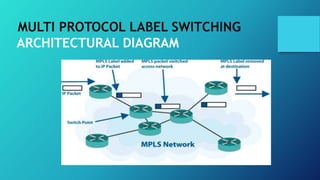
MULTI PROTOCOL LABEL SWITCHING
ARCHITECTURAL DIAGRAM
WHY MPLS?
• Makes IP routing fast
• Reduces number of routing lookups
• Eliminates to run a particular routing protocol
on all the devices
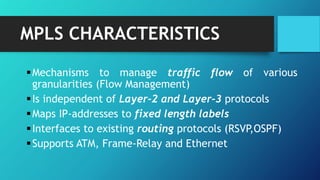
MPLS CHARACTERISTICS
Mechanisms to manage traffic flow of various
granularities (Flow Management)
Is independent of Layer-2 and Layer-3 protocols
Maps IP-addresses to fixed length labels
Interfaces to existing routing protocols (RSVP,OSPF)
Supports ATM, Frame-Relay and Ethernet
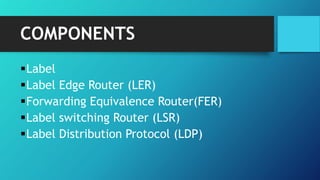
COMPONENTS
Label
Label Edge Router (LER)
Forwarding Equivalence Router(FER)
Label switching Router (LSR)
Label Distribution Protocol (LDP)
BENEFITS OF MPLS
1.Scalability
2.Performance
3.Better bandwidth utilization
4.Reduced network congestion
5.Better end-user experience
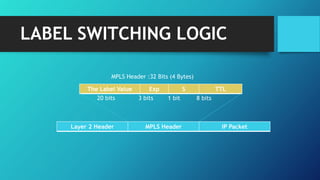
LABEL SWITCHING LOGIC
The Label Value Exp S TTL
Layer 2 Header MPLS Header IP Packet
MPLS Header :32 Bits (4 Bytes)
20 bits 3 bits 1 bit 8 bits
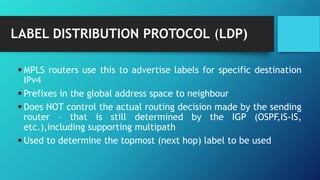
LABEL DISTRIBUTION PROTOCOL (LDP)
 MPLS routers use this to advertise labels for specific destination
IPv4
 Prefixes in the global address space to neighbour
 Does NOT control the actual routing decision made by the sending
router – that is still determined by the IGP (OSPF,IS-IS,
etc.),including supporting multipath
 Used to determine the topmost (next hop) label to be used
LDP CONFIGURATION
 By default it will advertise labels for all routes in the routing table
 Usually configured to only advertise the loopback addresses of
the routers
 These are the next hop addresses used in the iBGP routers to be
distributed (later)
 Once enabled all traffic to those addresses will be labelled: not
just MPLS VPN traffic.
DRAWBACKS OF MPLS
• Lack of Total Control – The service provider has to
configure the overall networks. And you will need to
work along with your provider in routing MPLS traffic
while using dynamic routing.
• Expensive – Since MPLS is an advanced way of
networking, it can cost you more than the Ethernet.

Presentation on MPLS (Multi Protocol Label Switching)

  • 1.
  • 2.
    INTRODUCTION  Routing techniquein telecommunication network  A protocol to establish an end-to-end path from source to the destination  A hop-by-hop forwarding mechanism  Use labels to set up the path  - Require a protocol to set up the labels along the path  It builds a connection-oriented service on the IP network
  • 3.
    MULTI PROTOCOL LABELSWITCHING ARCHITECTURAL DIAGRAM
  • 4.
    WHY MPLS? • MakesIP routing fast • Reduces number of routing lookups • Eliminates to run a particular routing protocol on all the devices
  • 5.
    MPLS CHARACTERISTICS Mechanisms tomanage traffic flow of various granularities (Flow Management) Is independent of Layer-2 and Layer-3 protocols Maps IP-addresses to fixed length labels Interfaces to existing routing protocols (RSVP,OSPF) Supports ATM, Frame-Relay and Ethernet
  • 6.
    COMPONENTS Label Label Edge Router(LER) Forwarding Equivalence Router(FER) Label switching Router (LSR) Label Distribution Protocol (LDP)
  • 7.
    BENEFITS OF MPLS 1.Scalability 2.Performance 3.Betterbandwidth utilization 4.Reduced network congestion 5.Better end-user experience
  • 8.
    LABEL SWITCHING LOGIC TheLabel Value Exp S TTL Layer 2 Header MPLS Header IP Packet MPLS Header :32 Bits (4 Bytes) 20 bits 3 bits 1 bit 8 bits
  • 9.
    LABEL DISTRIBUTION PROTOCOL(LDP)  MPLS routers use this to advertise labels for specific destination IPv4  Prefixes in the global address space to neighbour  Does NOT control the actual routing decision made by the sending router – that is still determined by the IGP (OSPF,IS-IS, etc.),including supporting multipath  Used to determine the topmost (next hop) label to be used
  • 10.
    LDP CONFIGURATION  Bydefault it will advertise labels for all routes in the routing table  Usually configured to only advertise the loopback addresses of the routers  These are the next hop addresses used in the iBGP routers to be distributed (later)  Once enabled all traffic to those addresses will be labelled: not just MPLS VPN traffic.
  • 11.
    DRAWBACKS OF MPLS •Lack of Total Control – The service provider has to configure the overall networks. And you will need to work along with your provider in routing MPLS traffic while using dynamic routing. • Expensive – Since MPLS is an advanced way of networking, it can cost you more than the Ethernet.

Editor's Notes