What is it and Why do we care?Mass Communication, Culture, and Media Literacy
Terms		Communication is simply the process of human beings sharing messagesSimple Model: Transmission of a message from a source to a receiverA source sends a message to a receiver – producing some effect. Problem with the simple model is that it assumes a passive receiver.
Terms	FeedbackCommunication becomes a reciprocal or ongoing process when the receiver returns a message. Noise – anything that interrupts the message – bias, for example or daydreaming, car horn….
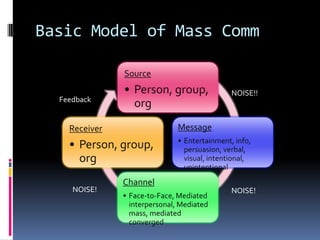
Basic Model of Mass CommNOISE!!FeedbackNOISE!NOISE!
Mass Media/MediumPerson-to-person is just communicationMEDIATED communication involves a device through which the message is delivered (book, newspaper, computer….)Can have INTERPERSONAL MEDIATED communication, which is just the sharing of PERSONAL messages through a device, not face-to-faceMEDIUM is the device, the plural of this is MEDIA
Mass Media Mass CommunicationMass communication then is MEDIATED messages transmitted large, widespread audiences
TermsGatekeepersThese are the people who get to determine what messages will be delivered to media consumers.Include editors, sponsors, reporters, producers and executives.IS THIS STILL TRUE? Or do we have more control?
CULTURE!The US EXPORTS way more media than it imports. Might be one of the only things in that situation. AND – the consumption of media is at an all time high and has continued to rise and the amount of time people spend with media they PAY for has also been on the rise since 2001…why do you think that is?
“Web 2.0”“The world of Web 2.o is more a cultural paradigm change than a technical one. These Internet communication technologies have existed for years. Now they’re being used differently. This includes chat, instant messaging, online video and online commentaries. More people are communicating in news and they’re doing it faster…”“Getting started: Social networking is a cultural paradigm shift, not a technical one”  - Ron Shulkin; Chicago Social Networking Examinerhttp://www.strategicgrowthconcepts.com/marketing/marketing-information-articles/Getting-Started:--Social-Networking-is-a-Cultural-Paradigm-Shift,-Not-a-Cultural-One_AE55.html
Culture	Learned behavior of members of a given social group.Socially constructed, learned behaviorEffectsLimitedLiberating
Lives in the water and swims?Must be a fish…defined by their “aquatic culture”We, too, are defined by our culture.Culture – AmericanCultural stereotypesSub-culture/co-culturesSuburbs, the South, fraternity row, Italian neighborhoodsSays something about our expectations
CULTURE – for the record“Culture is the world made meaningful; it is socially constructed and maintained through communication. It limits as well as liberates us; it shapes the ways we think, feel, and act.”
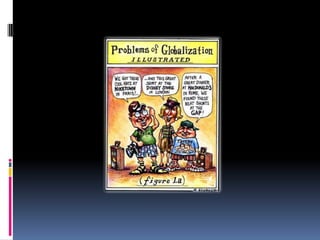
Cultural ImperialismIs the displacement of nation’s customs with those of another country.Basically – because the US exports so much media, we tend to be culturally imperialistic and displace the culture of other countries with our own. Not necessarily on purpose…Serious downsides to Cultural ImperialismOne study of teens in 12 countries showed that many of them considered Americans to be materialistic, sexually immoral, and often criminal people who seek to dominate other cultures. Media is a powerful propaganda tool, so you’d think we’d be sending out a better vibe! OR maybe we just don’t care?
Media Ownership - the “Biz”ConglomeratesLarge companies that own many different types of businessesVERTICAL INTEGRATION is ONE WAY that conglomerates can form	This is a business model in which a company owns different PARTS of the same industry. FOR EXAMPLE: NBC when it bought Universal Studios – gave it both production and distribution facilities through the Universal production facilities and then distribution through the existing NBC television network and cable channels.
LEGAL?It is legal, so long as it’s not a monopoly – has to encourage competition, not eliminate the competition.Anti-trust laws prohibit monopolistic practices.
Other integrationsHorizontal integration is corporate growth through  the acquisition of DIFFERENT TYPES of businessWhen a television company buys a book publishing companyNBC is owned by General ElectricCOMBINED INTEGRATION is the most common kind of conglomerate. Disney for example – owns not only a group of movie studies, but also theme parks and recording studios, publishing companies and even a hockey team.
The problem!Concentration of media ownership can result in one company having WAY too much power. http://www.cjr.org/resources/index.php
Media Literacy and CriticismSO – why do we need to be media literate?
Media Literacy and CriticismMedia literacy is simply the ability to be able to understand and make productive use of the mediaMedia CRITICISM is analytical and used to assess the effects of media on individuals, on societies as a whole and on cultures. Both are important for everyone.

MPC F2011 - WEEK ONE

  • 1.
    What is itand Why do we care?Mass Communication, Culture, and Media Literacy
  • 2.
    Terms Communication is simplythe process of human beings sharing messagesSimple Model: Transmission of a message from a source to a receiverA source sends a message to a receiver – producing some effect. Problem with the simple model is that it assumes a passive receiver.
  • 3.
    Terms FeedbackCommunication becomes areciprocal or ongoing process when the receiver returns a message. Noise – anything that interrupts the message – bias, for example or daydreaming, car horn….
  • 4.
    Basic Model ofMass CommNOISE!!FeedbackNOISE!NOISE!
  • 5.
    Mass Media/MediumPerson-to-person isjust communicationMEDIATED communication involves a device through which the message is delivered (book, newspaper, computer….)Can have INTERPERSONAL MEDIATED communication, which is just the sharing of PERSONAL messages through a device, not face-to-faceMEDIUM is the device, the plural of this is MEDIA
  • 6.
    Mass Media MassCommunicationMass communication then is MEDIATED messages transmitted large, widespread audiences
  • 7.
    TermsGatekeepersThese are thepeople who get to determine what messages will be delivered to media consumers.Include editors, sponsors, reporters, producers and executives.IS THIS STILL TRUE? Or do we have more control?
  • 8.
    CULTURE!The US EXPORTSway more media than it imports. Might be one of the only things in that situation. AND – the consumption of media is at an all time high and has continued to rise and the amount of time people spend with media they PAY for has also been on the rise since 2001…why do you think that is?
  • 9.
    “Web 2.0”“The worldof Web 2.o is more a cultural paradigm change than a technical one. These Internet communication technologies have existed for years. Now they’re being used differently. This includes chat, instant messaging, online video and online commentaries. More people are communicating in news and they’re doing it faster…”“Getting started: Social networking is a cultural paradigm shift, not a technical one” - Ron Shulkin; Chicago Social Networking Examinerhttp://www.strategicgrowthconcepts.com/marketing/marketing-information-articles/Getting-Started:--Social-Networking-is-a-Cultural-Paradigm-Shift,-Not-a-Cultural-One_AE55.html
  • 10.
    Culture Learned behavior ofmembers of a given social group.Socially constructed, learned behaviorEffectsLimitedLiberating
  • 11.
    Lives in thewater and swims?Must be a fish…defined by their “aquatic culture”We, too, are defined by our culture.Culture – AmericanCultural stereotypesSub-culture/co-culturesSuburbs, the South, fraternity row, Italian neighborhoodsSays something about our expectations
  • 12.
    CULTURE – forthe record“Culture is the world made meaningful; it is socially constructed and maintained through communication. It limits as well as liberates us; it shapes the ways we think, feel, and act.”
  • 13.
    Cultural ImperialismIs thedisplacement of nation’s customs with those of another country.Basically – because the US exports so much media, we tend to be culturally imperialistic and displace the culture of other countries with our own. Not necessarily on purpose…Serious downsides to Cultural ImperialismOne study of teens in 12 countries showed that many of them considered Americans to be materialistic, sexually immoral, and often criminal people who seek to dominate other cultures. Media is a powerful propaganda tool, so you’d think we’d be sending out a better vibe! OR maybe we just don’t care?
  • 15.
    Media Ownership -the “Biz”ConglomeratesLarge companies that own many different types of businessesVERTICAL INTEGRATION is ONE WAY that conglomerates can form This is a business model in which a company owns different PARTS of the same industry. FOR EXAMPLE: NBC when it bought Universal Studios – gave it both production and distribution facilities through the Universal production facilities and then distribution through the existing NBC television network and cable channels.
  • 16.
    LEGAL?It is legal,so long as it’s not a monopoly – has to encourage competition, not eliminate the competition.Anti-trust laws prohibit monopolistic practices.
  • 17.
    Other integrationsHorizontal integrationis corporate growth through the acquisition of DIFFERENT TYPES of businessWhen a television company buys a book publishing companyNBC is owned by General ElectricCOMBINED INTEGRATION is the most common kind of conglomerate. Disney for example – owns not only a group of movie studies, but also theme parks and recording studios, publishing companies and even a hockey team.
  • 18.
    The problem!Concentration ofmedia ownership can result in one company having WAY too much power. http://www.cjr.org/resources/index.php
  • 19.
    Media Literacy andCriticismSO – why do we need to be media literate?
  • 20.
    Media Literacy andCriticismMedia literacy is simply the ability to be able to understand and make productive use of the mediaMedia CRITICISM is analytical and used to assess the effects of media on individuals, on societies as a whole and on cultures. Both are important for everyone.