Where journalism began Newspapers School of Journalism and Mass Communication
You Be the Editor! What would YOU put in a newspaper? What would YOU leave out? How far would you go in covering the news? Would you show an execution at the moment of death? School of Journalism and Mass Communication
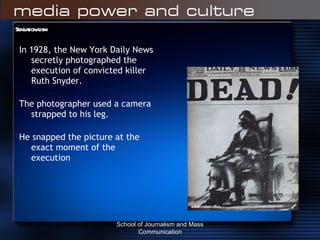
Sensationalism In 1928, the New York Daily News secretly photographed the execution of convicted killer Ruth Snyder. The photographer used a camera strapped to his leg. He snapped the picture at the exact moment of the execution School of Journalism and Mass Communication
What is NEWS? News satisfies our need to know things we cannot experience personally. News documents daily life and bears witness to ordinary and extraordinary events. Does it just report FACTS, or does it help us to interpret them? School of Journalism and Mass Communication
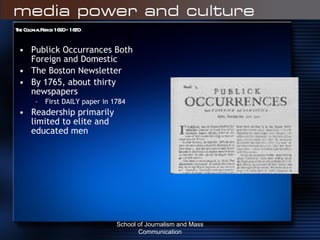
The Colonial Period 1690 – 1820 Publick Occurrances Both Foreign and Domestic The Boston Newsletter By 1765, about thirty newspapers First DAILY paper in 1784 Readership primarily limited to elite and educated men School of Journalism and Mass Communication
Political vs. Commercial Press Both shaped by response to British rule and the spread of commerce PARTISAN PRESS : political bias, argued for one perspective COMMERCIAL PRESS : served interests of business and economic leaders School of Journalism and Mass Communication
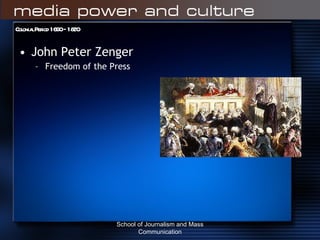
Colonial Period 1690 – 1820 John Peter Zenger Freedom of the Press School of Journalism and Mass Communication
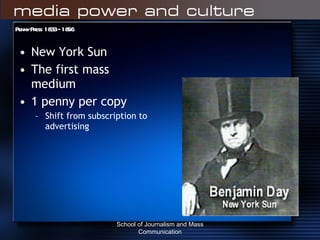
Penny Press  1833 – 1856 New York Sun The first mass medium 1 penny per copy Shift from subscription to advertising School of Journalism and Mass Communication
Penny Press Strategies Focus on local events, scandals and crime Ran serialized and human interest stories Celebrity news Fashion notes Jokes School of Journalism and Mass Communication
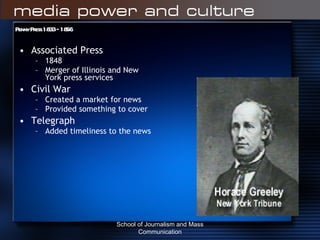
Penny Press 1833 – 1856 Associated Press 1848 Merger of Illinois and New York press services Civil War Created a market for news Provided something to cover Telegraph Added timeliness to the news School of Journalism and Mass Communication
Yellow Journalism 1865 – 1900 School of Journalism and Mass Communication
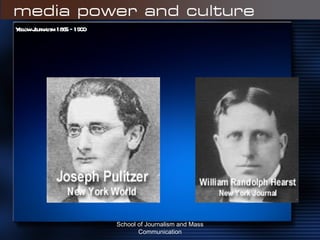
Joseph Pulitzer Eastern European immigrant, built empire from St. Louis Post-Dispatch to New York World  Appealed to working classes Promoted consumerism Crusaded against corruption School of Journalism and Mass Communication
William Randolph Hearst Son of U.S. senator, built empire from San Francisco Examiner to New York Journal: Appealed to immigrant and working class Sensational journalism (like tabloids today) Champion of the underdog Model for Citizen Kane (1941 film) School of Journalism and Mass Communication
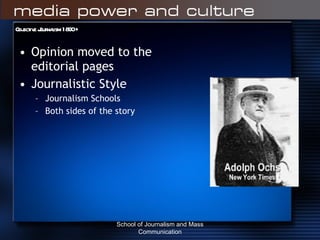
Objective Journalism 1890 + Opinion moved to the editorial pages Journalistic Style Journalism Schools Both sides of the story School of Journalism and Mass Communication
Objective Journalism 1890 + Became dominant model in 20th century American journalism Reporters strive to maintain a NEUTRAL, UNBIASED ATTITUDE about the issues Reporters seek to show BALANCED and COMPETING POINTS OF VIEW. School of Journalism and Mass Communication
New Journalism Era 1960 + 1960s to present Public has a right to know more than the facts Interpretation and analysis Blurring of fact and fiction School of Journalism and Mass Communication
New Journalism A style of reporting that tries to put issues and events in broader social and historical context. Explanatory, interpretive analysis of news Why? To help public to better understand complex events and issues School of Journalism and Mass Communication
Two Competing Models: STORY model: dramatized events, used individual characters and narrative structure  INFORMATION model: emphasized a purely factual, straightforward approach School of Journalism and Mass Communication
Inverted Pyramid Style Efficient model for news reporting Concentrated main details about news at top of story (WHO, WHAT, WHERE, WHEN) Initially, to ensure that primary elements got through telegraph transmissions School of Journalism and Mass Communication
Declining Credibility Loss of credibility by newspapers only 21 percent of Americans believe content in local newspapers  American Society of Newspaper Editors  project to improve credibility  School of Journalism and Mass Communication
Newspaper Credibility ASNE survey (1998) Too many factual errors Newspapers don’t demonstrate respect for readers and community Public suspects bias Too many sensationalized stories Readers have different priorities Bad personal experience with press School of Journalism and Mass Communication
The Newspaper Content Advertising display ads Opinion editorial writer political pundits reader opinions Graphics comics tables and graphs  News soft news features hard news breaking news in-depth news Photojournalism integrates words and photographs School of Journalism and Mass Communication
Who’s NOT Reading the Paper? Younger people The elderly Low income Apartment dwellers Heavy TV users School of Journalism and Mass Communication
Four Theories of the Press Authoritarian Libertarian Social Responsibility Communist School of Journalism and Mass Communication
Authoritarian Gutenberg Moveable type Church was the source of divine truth “ The divine right of kings” Press is left to “wise” men Press exists to support the leaders School of Journalism and Mass Communication
Authoritarian Who can use the media Anyone who is licensed or approved by the government What are the barriers for entry into the media marketplace? School of Journalism and Mass Communication
Libertarian Grew out of English philosophy John Locke, John Milton, John Stuart Mill The “marketplace of ideas” The media and the government are independent of each other The philosophy of rationalism and natural law School of Journalism and Mass Communication
Libertarian The U.S. First Amendment “ Congress shall make no law respecting the establishment of a religion, or prohibiting the free exchange thereof; of abridging the freedom of speech, or of the press or the right of the people to peacefully assemble, and to petition the government for a redress of grievances.” School of Journalism and Mass Communication
Libertarian Purpose of the media inform  entertain  Sell School of Journalism and Mass Communication
Libertarian Who can use the media? Anyone with the money to do so. What are the barriers for entry into the media marketplace? School of Journalism and Mass Communication
Social Responsibility Based on the Libertarian model The Press serves two masters Its own financial needs The public’s need for information Writings of W.E. Hocking and the Hutchins Commission School of Journalism and Mass Communication
Social Responsibility Who can use the media? Everyone who has something to say What are the barriers for entry into the media marketplace? School of Journalism and Mass Communication
Communist Developed in the Soviet Union Grew out of Marxist thought The press exist to contribute to the success of the state The media further the philosophy, ends and methods of the state “ planned” system, not a “controlled” system School of Journalism and Mass Communication
Communist Who can use the media? Loyal and orthodox members of the party What are the barriers for entry into the media marketplace? School of Journalism and Mass Communication
Socially Responsible Press Journalism Schools teach professional standards Journalists are free of obligation Opinion is clearly marked Local influence and control Need for reader/viewer feedback School of Journalism and Mass Communication

Newspapers

  • 1.
    Where journalism beganNewspapers School of Journalism and Mass Communication
  • 2.
    You Be theEditor! What would YOU put in a newspaper? What would YOU leave out? How far would you go in covering the news? Would you show an execution at the moment of death? School of Journalism and Mass Communication
  • 3.
    Sensationalism In 1928,the New York Daily News secretly photographed the execution of convicted killer Ruth Snyder. The photographer used a camera strapped to his leg. He snapped the picture at the exact moment of the execution School of Journalism and Mass Communication
  • 4.
    What is NEWS?News satisfies our need to know things we cannot experience personally. News documents daily life and bears witness to ordinary and extraordinary events. Does it just report FACTS, or does it help us to interpret them? School of Journalism and Mass Communication
  • 5.
    The Colonial Period1690 – 1820 Publick Occurrances Both Foreign and Domestic The Boston Newsletter By 1765, about thirty newspapers First DAILY paper in 1784 Readership primarily limited to elite and educated men School of Journalism and Mass Communication
  • 6.
    Political vs. CommercialPress Both shaped by response to British rule and the spread of commerce PARTISAN PRESS : political bias, argued for one perspective COMMERCIAL PRESS : served interests of business and economic leaders School of Journalism and Mass Communication
  • 7.
    Colonial Period 1690– 1820 John Peter Zenger Freedom of the Press School of Journalism and Mass Communication
  • 8.
    Penny Press 1833 – 1856 New York Sun The first mass medium 1 penny per copy Shift from subscription to advertising School of Journalism and Mass Communication
  • 9.
    Penny Press StrategiesFocus on local events, scandals and crime Ran serialized and human interest stories Celebrity news Fashion notes Jokes School of Journalism and Mass Communication
  • 10.
    Penny Press 1833– 1856 Associated Press 1848 Merger of Illinois and New York press services Civil War Created a market for news Provided something to cover Telegraph Added timeliness to the news School of Journalism and Mass Communication
  • 11.
    Yellow Journalism 1865– 1900 School of Journalism and Mass Communication
  • 12.
    Joseph Pulitzer EasternEuropean immigrant, built empire from St. Louis Post-Dispatch to New York World Appealed to working classes Promoted consumerism Crusaded against corruption School of Journalism and Mass Communication
  • 13.
    William Randolph HearstSon of U.S. senator, built empire from San Francisco Examiner to New York Journal: Appealed to immigrant and working class Sensational journalism (like tabloids today) Champion of the underdog Model for Citizen Kane (1941 film) School of Journalism and Mass Communication
  • 14.
    Objective Journalism 1890+ Opinion moved to the editorial pages Journalistic Style Journalism Schools Both sides of the story School of Journalism and Mass Communication
  • 15.
    Objective Journalism 1890+ Became dominant model in 20th century American journalism Reporters strive to maintain a NEUTRAL, UNBIASED ATTITUDE about the issues Reporters seek to show BALANCED and COMPETING POINTS OF VIEW. School of Journalism and Mass Communication
  • 16.
    New Journalism Era1960 + 1960s to present Public has a right to know more than the facts Interpretation and analysis Blurring of fact and fiction School of Journalism and Mass Communication
  • 17.
    New Journalism Astyle of reporting that tries to put issues and events in broader social and historical context. Explanatory, interpretive analysis of news Why? To help public to better understand complex events and issues School of Journalism and Mass Communication
  • 18.
    Two Competing Models:STORY model: dramatized events, used individual characters and narrative structure INFORMATION model: emphasized a purely factual, straightforward approach School of Journalism and Mass Communication
  • 19.
    Inverted Pyramid StyleEfficient model for news reporting Concentrated main details about news at top of story (WHO, WHAT, WHERE, WHEN) Initially, to ensure that primary elements got through telegraph transmissions School of Journalism and Mass Communication
  • 20.
    Declining Credibility Lossof credibility by newspapers only 21 percent of Americans believe content in local newspapers American Society of Newspaper Editors project to improve credibility School of Journalism and Mass Communication
  • 21.
    Newspaper Credibility ASNEsurvey (1998) Too many factual errors Newspapers don’t demonstrate respect for readers and community Public suspects bias Too many sensationalized stories Readers have different priorities Bad personal experience with press School of Journalism and Mass Communication
  • 22.
    The Newspaper ContentAdvertising display ads Opinion editorial writer political pundits reader opinions Graphics comics tables and graphs News soft news features hard news breaking news in-depth news Photojournalism integrates words and photographs School of Journalism and Mass Communication
  • 23.
    Who’s NOT Readingthe Paper? Younger people The elderly Low income Apartment dwellers Heavy TV users School of Journalism and Mass Communication
  • 24.
    Four Theories ofthe Press Authoritarian Libertarian Social Responsibility Communist School of Journalism and Mass Communication
  • 25.
    Authoritarian Gutenberg Moveabletype Church was the source of divine truth “ The divine right of kings” Press is left to “wise” men Press exists to support the leaders School of Journalism and Mass Communication
  • 26.
    Authoritarian Who canuse the media Anyone who is licensed or approved by the government What are the barriers for entry into the media marketplace? School of Journalism and Mass Communication
  • 27.
    Libertarian Grew outof English philosophy John Locke, John Milton, John Stuart Mill The “marketplace of ideas” The media and the government are independent of each other The philosophy of rationalism and natural law School of Journalism and Mass Communication
  • 28.
    Libertarian The U.S.First Amendment “ Congress shall make no law respecting the establishment of a religion, or prohibiting the free exchange thereof; of abridging the freedom of speech, or of the press or the right of the people to peacefully assemble, and to petition the government for a redress of grievances.” School of Journalism and Mass Communication
  • 29.
    Libertarian Purpose ofthe media inform entertain Sell School of Journalism and Mass Communication
  • 30.
    Libertarian Who canuse the media? Anyone with the money to do so. What are the barriers for entry into the media marketplace? School of Journalism and Mass Communication
  • 31.
    Social Responsibility Basedon the Libertarian model The Press serves two masters Its own financial needs The public’s need for information Writings of W.E. Hocking and the Hutchins Commission School of Journalism and Mass Communication
  • 32.
    Social Responsibility Whocan use the media? Everyone who has something to say What are the barriers for entry into the media marketplace? School of Journalism and Mass Communication
  • 33.
    Communist Developed inthe Soviet Union Grew out of Marxist thought The press exist to contribute to the success of the state The media further the philosophy, ends and methods of the state “ planned” system, not a “controlled” system School of Journalism and Mass Communication
  • 34.
    Communist Who canuse the media? Loyal and orthodox members of the party What are the barriers for entry into the media marketplace? School of Journalism and Mass Communication
  • 35.
    Socially Responsible PressJournalism Schools teach professional standards Journalists are free of obligation Opinion is clearly marked Local influence and control Need for reader/viewer feedback School of Journalism and Mass Communication

Editor's Notes

  • #8 One of the most important events in American journalism history occurred in New York in 1735. This, of course, was the libel trail of John Peter Zenger, printer of the New York Weekly Journal. John Peter Zenger arrived in New York from Germany in 1710 and served an apprenticeship to William Bradford, printer of the New York Gazette. In 1733 New York Colonial Governor William Cosby stirred up a great controversy by prosecuting the interim Governor, Rip Van Dam, and removing Chief Justice Lewis Morris from the courts. After Governor Cosby adopted arbitrary measures against these men, and opposition group arose to fight him politically. These wealthy and powerful men established an opposition newspaper, the New York Weekly Journal, and hired John Peter Zenger as the printer and editor. The Weekly Journal printed numerous articles critical of Governor Cosby until Cosby could take it no longer. In November, 1734, Cosby had Zenger arrested and put in jail incommunicado for ten months. On August 4, 1735, Zenger was brought to trial and charged with seditious libel. He was defended by Philadelphia lawyer, Andrew Hamilton. The prosecution argued that the sole fact of publication was sufficient to convict and excluded the truth from the evidence. Hamilton admitted that Zenger published the offending stories, but denied that it was libel unless it was false. Hamilton made an eloquent appeal to the jury to judge both the law and the facts; as a result was acquitted. This finding of not guilty established truth as a defense against libel and was a landmark victory for freedom of the press. It also set a precedent against judicial tyranny in libel suits. It has long been held that the first report of Zenger's victory in court came in his own newspaper, the New York Weekly Journal of August 18, 1735. The front page of that date contains the abbreviated story of his trial and in column two states "The jury returned in Ten Minutes, and found me Not Guilty" However, a review of the Journal file from 1735 reveals that the issue of August 18 was not the earliest report of Zenger's being freed. Although the New York Weekly Journal of August 11, 1735 had nothing on the trial itself, there is a printer's note at the end of the last column on page 4. It read, "The Printer, now having got his liberty again, designs God willing to Finish and Publish the Charter of the City of New York next week." So read your newspapers carefully as they sometimes whisper things to you if you take the time to read and listen.  
  • #21 Survey by Time Magazine. Only 21 percent of all Americans believe newspapers. Decline from 28 percent just 13 years before.