AGENDA:
*Real World Media Example
*Review Chapter One and
discuss its main concepts
*Chapter One Study Focus
Questions
Introduction to Mass
Communication:
Media Literacy and Culture
9th edition Stanley J. Baran
Chapter 1:
Mass Communication,
Culture, and Media Literacy
FUNDAMENTAL COURSE THEME:
Media inform us, entertain us, delight us,
annoy us – the move our emotions, challenge
our intellects, insult our intelligence – media
often reduce us to mere commodities for sale
to the highest bidder – media help define us
and shape or realities…BUT media does
nothing alone. It does it with us as well as to
us through mass communication, and it does it
as a central – many would say THE central –
cultural force in our society.
What Is Communication?
COMMUNICATION =
The process of creating
shared meaning
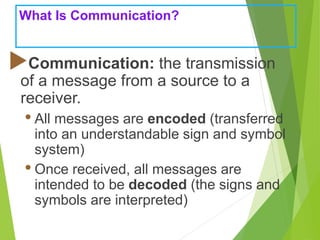
What Is Communication?
Communication: the transmission
of a message from a source to a
receiver.
• All messages are encoded (transferred
into an understandable sign and symbol
system)
• Once received, all messages are
intended to be decoded (the signs and
symbols are interpreted)
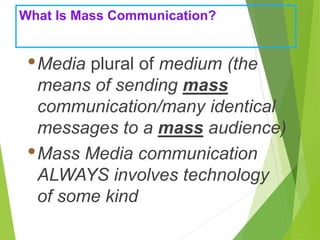
What Is Mass Communication?
•Media plural of medium (the
means of sending mass
communication/many identical
messages to a mass audience)
•Mass Media communication
ALWAYS involves technology
of some kind
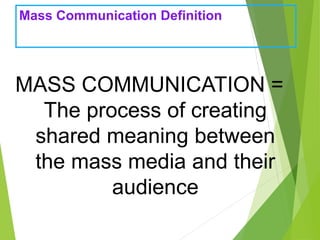
Mass Communication Definition
MASS COMMUNICATION =
The process of creating
shared meaning between
the mass media and their
audience
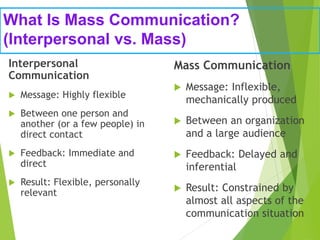
What Is Mass Communication?
(Interpersonal vs. Mass)
Interpersonal
Communication
 Message: Highly flexible
 Between one person and
another (or a few people) in
direct contact
 Feedback: Immediate and
direct
 Result: Flexible, personally
relevant
Mass Communication
 Message: Inflexible,
mechanically produced
 Between an organization
and a large audience
 Feedback: Delayed and
inferential
 Result: Constrained by
almost all aspects of the
communication situation
Communication Definition
“Communication is a
symbolic process whereby
reality is produced,
maintained, repaired and
transformed.”
– James W. Carey,
Media Theorist (1975)
Communication Definition
Communication and “reality” are
linked – communication informs
pragmatic “reality” by
impacting/forming the way we
perceive, understand and
construct our view of reality and
the world. Communication is the
foundation of our culture.
Communication Definition
“Communication is a symbolic
process whereby reality is
produced, maintained,
repaired and transformed.”
TED TALK EXAMPLE
STUDY FOCUS QUESTION #1
Describe a situation in which
you find that reality is
“produced, maintained,
repaired and/or transformed”
by mass media
communication
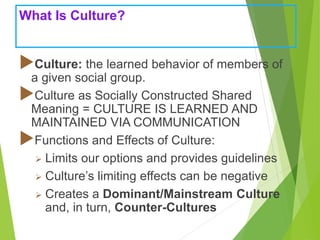
What Is Culture?
Culture: the learned behavior of members of
a given social group.
Culture as Socially Constructed Shared
Meaning = CULTURE IS LEARNED AND
MAINTAINED VIA COMMUNICATION
Functions and Effects of Culture:
 Limits our options and provides guidelines
 Culture’s limiting effects can be negative
 Creates a Dominant/Mainstream Culture
and, in turn, Counter-Cultures
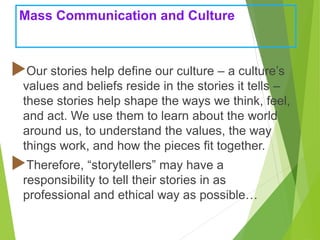
Mass Communication and Culture
Our stories help define our culture – a culture’s
values and beliefs reside in the stories it tells –
these stories help shape the ways we think, feel,
and act. We use them to learn about the world
around us, to understand the values, the way
things work, and how the pieces fit together.
Therefore, “storytellers” may have a
responsibility to tell their stories in as
professional and ethical way as possible…
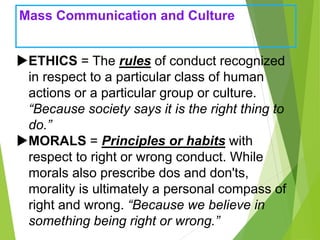
Mass Communication and Culture
ETHICS = The rules of conduct recognized
in respect to a particular class of human
actions or a particular group or culture.
“Because society says it is the right thing to
do.”
MORALS = Principles or habits with
respect to right or wrong conduct. While
morals also prescribe dos and don'ts,
morality is ultimately a personal compass of
right and wrong. “Because we believe in
something being right or wrong.”
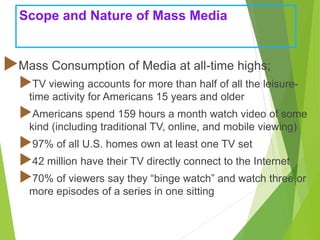
Scope and Nature of Mass Media
Mass Consumption of Media at all-time highs;
TV viewing accounts for more than half of all the leisure-
time activity for Americans 15 years and older
Americans spend 159 hours a month watch video of some
kind (including traditional TV, online, and mobile viewing)
97% of all U.S. homes own at least one TV set
42 million have their TV directly connect to the Internet
70% of viewers say they “binge watch” and watch three or
more episodes of a series in one sitting
Scope and Nature of Mass Media
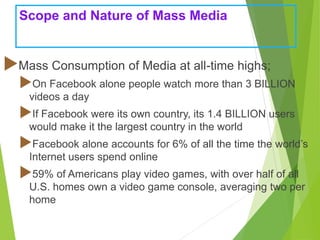
Mass Consumption of Media at all-time highs;
On Facebook alone people watch more than 3 BILLION
videos a day
If Facebook were its own country, its 1.4 BILLION users
would make it the largest country in the world
Facebook alone accounts for 6% of all the time the world’s
Internet users spend online
59% of Americans play video games, with over half of all
U.S. homes own a video game console, averaging two per
home
Scope and Nature of Mass Media
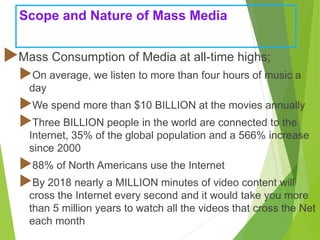
Mass Consumption of Media at all-time highs;
On average, we listen to more than four hours of music a
day
We spend more than $10 BILLION at the movies annually
Three BILLION people in the world are connected to the
Internet, 35% of the global population and a 566% increase
since 2000
88% of North Americans use the Internet
By 2018 nearly a MILLION minutes of video content will
cross the Internet every second and it would take you more
than 5 million years to watch all the videos that cross the Net
each month
Scope and Nature of Mass Media
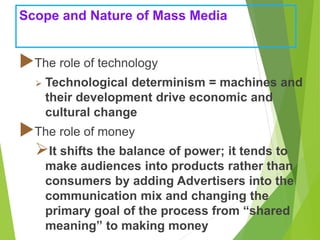
The role of technology
 Technological determinism = machines and
their development drive economic and
cultural change
The role of money
It shifts the balance of power; it tends to
make audiences into products rather than
consumers by adding Advertisers into the
communication mix and changing the
primary goal of the process from “shared
meaning” to making money
Mass Communication, Culture, and Media
Literacy
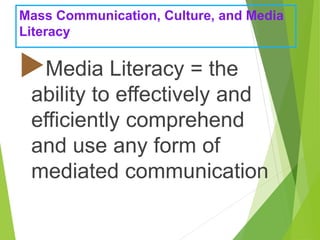
Media Literacy = the
ability to effectively and
efficiently comprehend
and use any form of
mediated communication
Being Media-Literate
Media-literate people develop an
understanding of media content as
a text that provides insight into our
culture and lives and they have an
awareness of the impact of media
on the individual and society.
STUDY FOCUS QUESTION #2
Who were your childhood heroes and
heroines and/or favorite characters
derived from MASS MEDIA? Why
did you choose them? What
cultural lessons did you learn from
them?

WCC COMM 101 CHAPTER ONE

  • 1.
    AGENDA: *Real World MediaExample *Review Chapter One and discuss its main concepts *Chapter One Study Focus Questions
  • 2.
    Introduction to Mass Communication: MediaLiteracy and Culture 9th edition Stanley J. Baran Chapter 1: Mass Communication, Culture, and Media Literacy
  • 3.
    FUNDAMENTAL COURSE THEME: Mediainform us, entertain us, delight us, annoy us – the move our emotions, challenge our intellects, insult our intelligence – media often reduce us to mere commodities for sale to the highest bidder – media help define us and shape or realities…BUT media does nothing alone. It does it with us as well as to us through mass communication, and it does it as a central – many would say THE central – cultural force in our society.
  • 4.
    What Is Communication? COMMUNICATION= The process of creating shared meaning
  • 5.
    What Is Communication? Communication:the transmission of a message from a source to a receiver. • All messages are encoded (transferred into an understandable sign and symbol system) • Once received, all messages are intended to be decoded (the signs and symbols are interpreted)
  • 6.
    What Is MassCommunication? •Media plural of medium (the means of sending mass communication/many identical messages to a mass audience) •Mass Media communication ALWAYS involves technology of some kind
  • 7.
    Mass Communication Definition MASSCOMMUNICATION = The process of creating shared meaning between the mass media and their audience
  • 8.
    What Is MassCommunication? (Interpersonal vs. Mass) Interpersonal Communication  Message: Highly flexible  Between one person and another (or a few people) in direct contact  Feedback: Immediate and direct  Result: Flexible, personally relevant Mass Communication  Message: Inflexible, mechanically produced  Between an organization and a large audience  Feedback: Delayed and inferential  Result: Constrained by almost all aspects of the communication situation
  • 9.
    Communication Definition “Communication isa symbolic process whereby reality is produced, maintained, repaired and transformed.” – James W. Carey, Media Theorist (1975)
  • 10.
    Communication Definition Communication and“reality” are linked – communication informs pragmatic “reality” by impacting/forming the way we perceive, understand and construct our view of reality and the world. Communication is the foundation of our culture.
  • 11.
    Communication Definition “Communication isa symbolic process whereby reality is produced, maintained, repaired and transformed.” TED TALK EXAMPLE
  • 12.
    STUDY FOCUS QUESTION#1 Describe a situation in which you find that reality is “produced, maintained, repaired and/or transformed” by mass media communication
  • 13.
    What Is Culture? Culture:the learned behavior of members of a given social group. Culture as Socially Constructed Shared Meaning = CULTURE IS LEARNED AND MAINTAINED VIA COMMUNICATION Functions and Effects of Culture:  Limits our options and provides guidelines  Culture’s limiting effects can be negative  Creates a Dominant/Mainstream Culture and, in turn, Counter-Cultures
  • 14.
    Mass Communication andCulture Our stories help define our culture – a culture’s values and beliefs reside in the stories it tells – these stories help shape the ways we think, feel, and act. We use them to learn about the world around us, to understand the values, the way things work, and how the pieces fit together. Therefore, “storytellers” may have a responsibility to tell their stories in as professional and ethical way as possible…
  • 15.
    Mass Communication andCulture ETHICS = The rules of conduct recognized in respect to a particular class of human actions or a particular group or culture. “Because society says it is the right thing to do.” MORALS = Principles or habits with respect to right or wrong conduct. While morals also prescribe dos and don'ts, morality is ultimately a personal compass of right and wrong. “Because we believe in something being right or wrong.”
  • 16.
    Scope and Natureof Mass Media Mass Consumption of Media at all-time highs; TV viewing accounts for more than half of all the leisure- time activity for Americans 15 years and older Americans spend 159 hours a month watch video of some kind (including traditional TV, online, and mobile viewing) 97% of all U.S. homes own at least one TV set 42 million have their TV directly connect to the Internet 70% of viewers say they “binge watch” and watch three or more episodes of a series in one sitting
  • 17.
    Scope and Natureof Mass Media Mass Consumption of Media at all-time highs; On Facebook alone people watch more than 3 BILLION videos a day If Facebook were its own country, its 1.4 BILLION users would make it the largest country in the world Facebook alone accounts for 6% of all the time the world’s Internet users spend online 59% of Americans play video games, with over half of all U.S. homes own a video game console, averaging two per home
  • 18.
    Scope and Natureof Mass Media Mass Consumption of Media at all-time highs; On average, we listen to more than four hours of music a day We spend more than $10 BILLION at the movies annually Three BILLION people in the world are connected to the Internet, 35% of the global population and a 566% increase since 2000 88% of North Americans use the Internet By 2018 nearly a MILLION minutes of video content will cross the Internet every second and it would take you more than 5 million years to watch all the videos that cross the Net each month
  • 19.
    Scope and Natureof Mass Media The role of technology  Technological determinism = machines and their development drive economic and cultural change The role of money It shifts the balance of power; it tends to make audiences into products rather than consumers by adding Advertisers into the communication mix and changing the primary goal of the process from “shared meaning” to making money
  • 20.
    Mass Communication, Culture,and Media Literacy Media Literacy = the ability to effectively and efficiently comprehend and use any form of mediated communication
  • 21.
    Being Media-Literate Media-literate peopledevelop an understanding of media content as a text that provides insight into our culture and lives and they have an awareness of the impact of media on the individual and society.
  • 22.
    STUDY FOCUS QUESTION#2 Who were your childhood heroes and heroines and/or favorite characters derived from MASS MEDIA? Why did you choose them? What cultural lessons did you learn from them?