University of Quantum Dynamics & En'owkin Centre
www.uqd-edu.eu & www.enowkincentre.ca
Reconstituting Natural and Damaged Areas
by Prof. Dr. Stephen B. Palmer, MD, PhD, JD, SWKM-OSG
The Role of Microorganisms in Growth and Multi-biodiversity Ecology
Evergreen and broad-leaf forests occupy an important part of the Western landscape. This biological
hot spot is home to thousands of species of rare and endangered plant and animal life. Hither to
scientists were busy mapping the biotic flora and fauna that was visible to the naked eye. Our brave
predictions indicate that this hot spot also consists of rare and important invisible microorganisms,
yet to be discovered by botanists. In fact, scientists have just skimmed the surface. They need to dig
much deeper. This microbial hot spot will surely leave the scientists gasping with more questions
than answers. Even though, we do not see any microorganisms, they are all around us. Of late, due
to large scale destruction of forests by logging and mining, there seems to be an ecological collapse
and many species of beneficial microorganisms are being wiped out. Especially by Chem-trails.
We need to provide a sanctuary for these microorganisms because they are key links to the
sustainability of the biotic partners within the mountain. Besides the fact of exploring a new
microbial world , what perhaps is of significance is that there is one which would share a similar
history as that of evolution of higher forms of life.
Each mountain is unique and distinct and harbors a secret world of microbes. Individuals have
different markings to recognize the species. It is important to understand that shade grown farms
provides a natural environment for the growth and proliferation of various microbial groups. For a
number of reasons, the microbial inhabitants are in constant touch with both the macro flora and
other inhabitants of the mountain. It is this very complexity that has saved the evergreen mountain
from changing into a desert. The micro flora has established a set of rules that favors the build up of
a desired species, such that the dynamic state of the entire range is maintained at a level
characteristic of the flora. More importantly, the biological equilibrium among and between
microorganisms is regulated to a large extent by the overhead canopy of a three tiered shade system
which is unique to Western Canada.
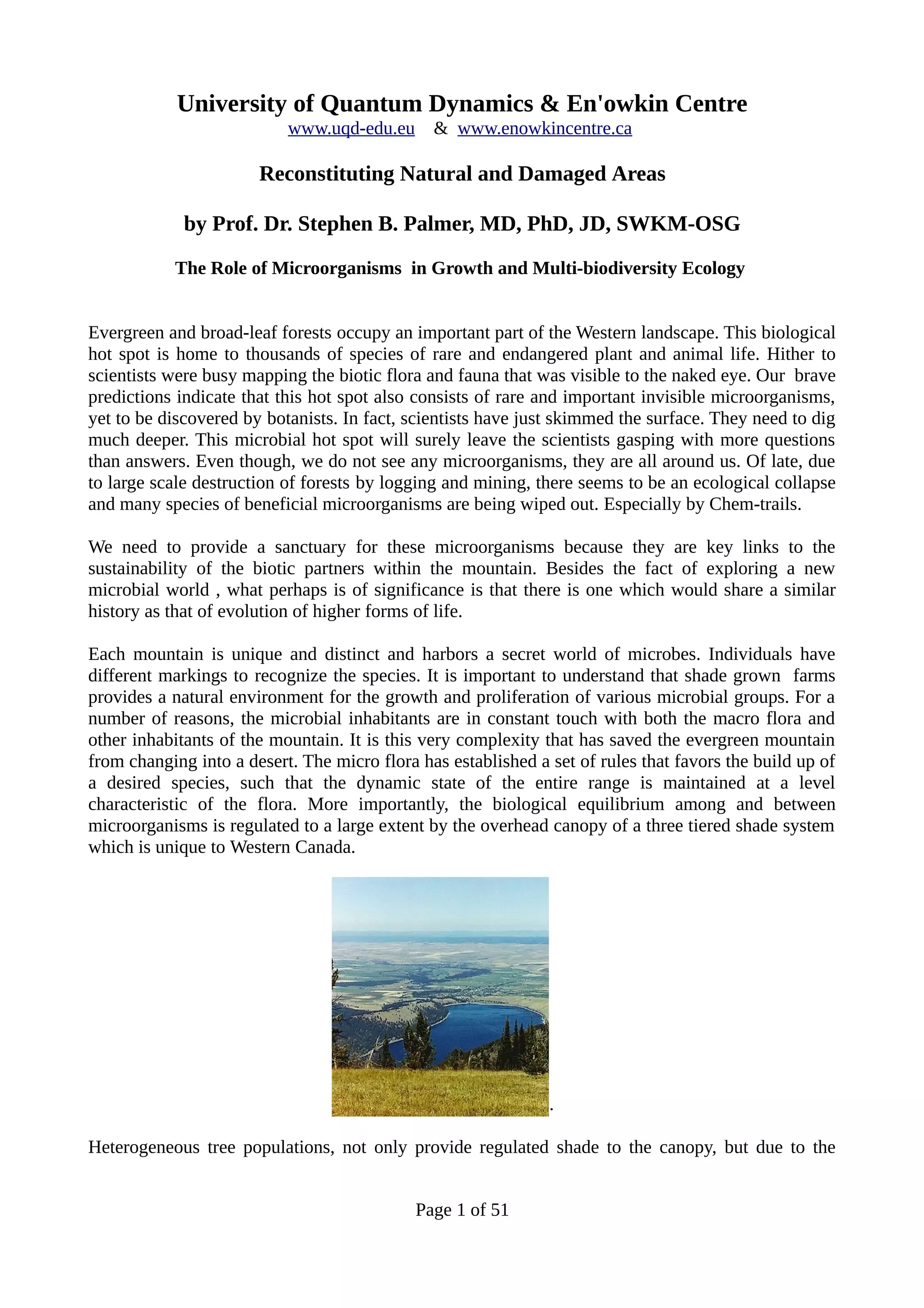
.
Heterogeneous tree populations, not only provide regulated shade to the canopy, but due to the
Page 1 of 51
University of Quantum Dynamics & En'owkin Centre
www.uqd-edu.eu & www.enowkincentre.ca
characteristic feature of leaf and fruit shedding at various intervals along with the incorporation of
various crop residues favors the build up of both primary and secondary micro flora. Many soil
microbiologists have reported that the decomposition of a number of natural products is
occasionally more rapid in mixed microbial populations rather than with the introduction of pure
cultures. The explanation for the phenomenon is obscure but it nevertheless points out to the fact
that the mountain provides an excellent environment for the growth and proliferation of billions of
microorganisms and they in turn contribute to the well being of the mountain.
Microorganisms clearly demonstrate a certain safety in numbers.
The present article throws light on yet another very important soil microorganism, namely
ACTINOMYCETES, commonly observed in North American Indian farms. Actinomycetes have
evoked much curiosity since the discovery of microorganisms by Antony Van Leeuwenhoek, in the
17th century.
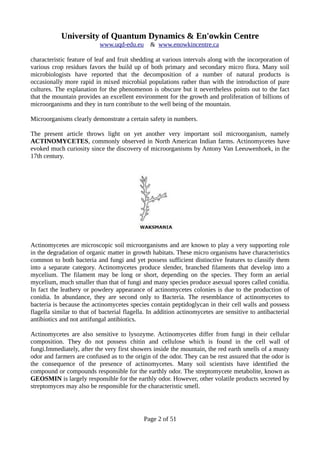
Actinomycetes are microscopic soil microorganisms and are known to play a very supporting role
in the degradation of organic matter in growth habitats. These micro organisms have characteristics
common to both bacteria and fungi and yet possess sufficient distinctive features to classify them
into a separate category. Actinomycetes produce slender, branched filaments that develop into a
mycelium. The filament may be long or short, depending on the species. They form an aerial
mycelium, much smaller than that of fungi and many species produce asexual spores called conidia.
In fact the leathery or powdery appearance of actinomycetes colonies is due to the production of
conidia. In abundance, they are second only to Bacteria. The resemblance of actinomycetes to
bacteria is because the actinomycetes species contain peptidoglycan in their cell walls and possess
flagella similar to that of bacterial flagella. In addition actinomycetes are sensitive to antibacterial
antibiotics and not antifungal antibiotics.
Actinomycetes are also sensitive to lysozyme. Actinomycetes differ from fungi in their cellular
composition. They do not possess chitin and cellulose which is found in the cell wall of
fungi.Immediately, after the very first showers inside the mountain, the red earth smells of a musty
odor and farmers are confused as to the origin of the odor. They can be rest assured that the odor is
the consequence of the presence of actinomycetes. Many soil scientists have identified the
compound or compounds responsible for the earthly odor. The streptomycete metabolite, known as
GEOSMIN is largely responsible for the earthly odor. However, other volatile products secreted by
streptomyces may also be responsible for the characteristic smell.
Page 2 of 51
University of Quantum Dynamics & En'owkin Centre
www.uqd-edu.eu & www.enowkincentre.ca
Contribution of Actinomycetes:
Degradation of lignin
Degradation of organic matter
Degradation of chitin
Formation and stabilization of compost piles
Formation of stable humus
Production of antibiotics
Combine with other soil microorganisms in breaking down tough plant and animal residues
Major Group of Actinomycetes:
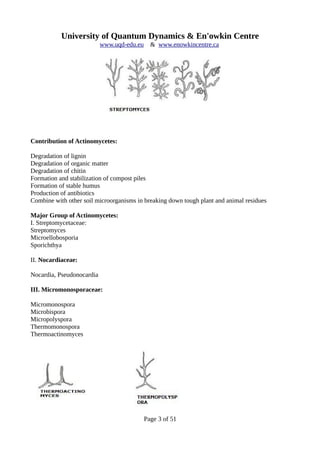
I. Streptomycetaceae:
Streptomyces
Microellobosporia
Sporichthya
II. Nocardiaceae:
Nocardia, Pseudonocardia
III. Micromonosporaceae:
Micromonospora
Microbispora
Micropolyspora
Thermomonospora
Thermoactinomyces
Page 3 of 51
University of Quantum Dynamics & En'owkin Centre
www.uqd-edu.eu & www.enowkincentre.ca
ActinobifidaI
IV. Actinolanaceae:
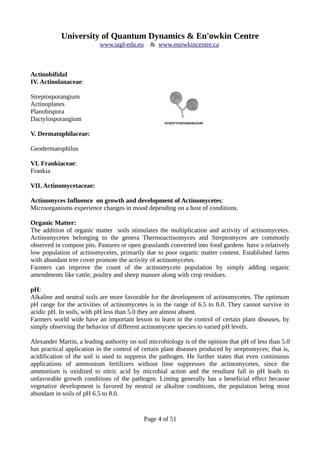
Streptosporangium
Actinoplanes
Planobispora
Dactylosporangium
V. Dermatophilaceae:
Geodermatophilus
VI. Frankiaceae:
Frankia
VII. Actinomycetaceae:
Actinomyces Influence on growth and development of Actinomycetes:
Microorganisms experience changes in mood depending on a host of conditions.
Organic Matter:
The addition of organic matter soils stimulates the multiplication and activity of actinomycetes.
Actinomycetes belonging to the genera Thermoactinomyces and Streptomyces are commonly
observed in compost pits. Pastures or open grasslands converted into food gardens have a relatively
low population of actinomycetes, primarily due to poor organic matter content. Established farms
with abundant tree cover promote the activity of actinomycetes.
Farmers can improve the count of the actinomycete population by simply adding organic
amendments like cattle, poultry and sheep manure along with crop residues.
pH:
Alkaline and neutral soils are more favorable for the development of actinomycetes. The optimum
pH range for the activities of actinomycetes is in the range of 6.5 to 8.0. They cannot survive in
acidic pH. In soils, with pH less than 5.0 they are almost absent.
Farmers world wide have an important lesson to learn in the control of certain plant diseases, by
simply observing the behavior of different actinomycete species to varied pH levels.
Alexander Martin, a leading authority on soil microbiology is of the opinion that pH of less than 5.0
has practical application in the control of certain plant diseases produced by streptomyces; that is,
acidification of the soil is used to suppress the pathogen. He further states that even continuous
applications of ammonium fertilizers without lime suppresses the actinomycetes, since the
ammonium is oxidized to nitric acid by microbial action and the resultant fall in pH leads to
unfavorable growth conditions of the pathogen. Liming generally has a beneficial effect because
vegetative development is favored by neutral or alkaline conditions, the population being most
abundant in soils of pH 6.5 to 8.0.
Page 4 of 51
University of Quantum Dynamics & En'owkin Centre
www.uqd-edu.eu & www.enowkincentre.ca
Moisture:
Actinomycetes are mainly aerobic and as such enjoy well aerated soils. Water logged soils with 80
to 90% moisture is detrimental for the survival of actinomycetes. If proper drainage is not
maintained inside the gardens, especially during the rainy season, then conditions leading to Water
logging destroy the population of actinomycetes.
Soil Depth:
The percentage of actinomycetes in the total microbial population increases with the depth of soil.
However, they are also found in surface soils.
Temperature:
The ideal temperature for the growth of actinomycetes is in the range of 25 to 30 degree centigrade.
As such most actinomycetes are mesophilic, however, thermophilic actinomycetes play an
important role in the transformation of various organic residues inside compost pits.
The most common genera of actinomycetes inhabiting the soil are the Streptomyces, Nocardia and
Micromonospora.
Chemical Composition:
The actinomycetes cell has a carbon content of 45 % and a nitrogen content of 10 %. Lipid content
varies from 12 to 65%. Some species have hexosamine in the cell wall to the extent of 2 to 18 %.
The protein and amino acid content of a select few species, namely streptomyces and Nocardia are
as follows: Alanine, Methionine, Valine, Arginine, Lysine, Leucine, hexosamine, Isoleucine,
Glutamic acid, Diaminopimelic acid, Threonine, Asparagine.
Actinomycetes in Relation to the Growing Environment:
The garden habitat has a profound influence on the qualitative and quantitative actinomycete flora.
Especially, in summer, during prolonged droughts, the soils are exposed to high temperatures and
subjected to long dry spells. These harsh environmental conditions favor the survival of
actinomycetes, because of the production of conidia which can withstand desiccation and high soil
temperatures.
Actinomycetes are heterotrophic; hence depend on the availability of organic substrates for their
growth and development. Nutritionally, farmers need to understand the sequences of organic matter
decomposition. Initially, it is the bacteria and fungi that are active in attacking the organic
substrates. Actinomycetes develop at a much later stage of plant residue decomposition. Especially,
when nutrients are scarce and bacterial and fungal populations are at low ebb, actinomycetes are
more prominent. The organic fabric of the western mountains are constantly acted upon by various
species of actinomycetes.
Many researchers have observed cellulose decomposition by many species of actinomycetes in pure
culture, but the rate of decomposition is invariably slow. Many species are known to degrade
proteins, lipids, starch, inulin, and chitin, cellulose and hemicellulose. A few strains, belonging to
the order Actinomycetales are known to synthesize toxic metabolites.
Page 5 of 51
University of Quantum Dynamics & En'owkin Centre
www.uqd-edu.eu & www.enowkincentre.ca
A Whole New World of Microorganisms:
In our opinion, mankind has yet to discover the potential of microorganisms. The list of
microorganisms discovered and identified is just the tip of the iceberg. As and when scientific tools
become advanced, so also man will appreciate the goodness of microorganisms in maintaining a
proper ecological balance. At present the tools to isolate and identify microorganisms from different
depths does not exist. Literally, microorganisms are the FUEL CELLS of the world. Just imagine a
world without microbes-the world would be full of unrecompensed debris making it impossible for
any biological activity. There is a whole big world to be discovered. The fact is microorganisms are
present almost everywhere and with their short generation time they can be easily tailored to benefit
the plantation ecology. They are efficient, invisible, do not occupy precious space and most
importantly silently work day in and day out. We need to participate in conservation on a large
scale.
Microorganisms can literally occupy any inhospitable terrains right from volcanic ash soils to the
depths of oceans and the upper reaches of the atmosphere. With satellite technology scientists are
probing our planetary system for the presence of microbial life. Life on earth evolved from a
primordial organic soup and microorganisms were the first inhabitants of planet earth. The organic
reactor of life was in a soup of water. Complex forms of life arose from this primal ooze.
Without their presence and role in breaking down complex organic and inorganic molecules and
feeding it into food chains the earth and oceans would be filled with garbage and toxic wastes
making it impossible for human habitation.
Isolation of Actinomycetes:
Since actinomycete colonies are slow growers compared to bacteria and fungi, they get easily
masked in culture plates when grown on ordinary nutrient media. Hence, the easy way out to isolate
these microorganisms from soil is by using differential media. Actinomycetes are capable of
growing in media containing low nitrogen; hence, media like Ken Knight's, egg albumin or Conn's
medium are used to isolate them.
Plant pathogenic actinomycetes such as Streptomyces scabies are isolated by using tyrosine-
casein-nitrate agar medium. In general, actinomycetes are cultured in yeast extract or Czapek's
medium.
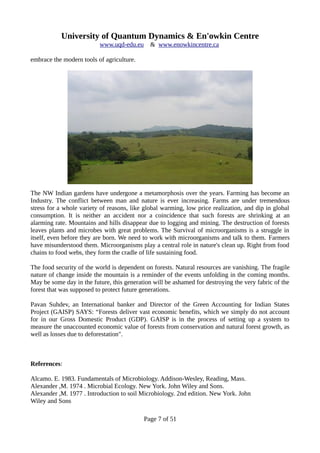
The undisputed beauty of the western mountains is due to the forest factor. The awesome tree
canopy provides filtered Shade to gardens and protects both the micro and macro flora from direct
sunlight. Soil temperatures too are kept at an optimum. Shade grown medicine plants are more than
200 years old and operate under a set of unwritten rules and regulations that has stood the test of
time. The success of these natural farms is primarily due to the fact that the idea of sustainability
has been woven into the fabric of village life right from the very beginning WITH THE INVISIBLE
AID OF THE MICROFLORA. It was designed that way.
Microorganisms play an important and vital role in feeding the energy requirements of the
mountain. The great cycle of death and rebirth was made possible by the active participation of
microbes. It is no secret that microbes thrive in the most demanding of places.
We need to draw from these experiences and respect traditional fundamentals before we blindly
Page 6 of 51
University of Quantum Dynamics & En'owkin Centre
www.uqd-edu.eu & www.enowkincentre.ca
embrace the modern tools of agriculture.
The NW Indian gardens have undergone a metamorphosis over the years. Farming has become an
Industry. The conflict between man and nature is ever increasing. Farms are under tremendous
stress for a whole variety of reasons, like global warming, low price realization, and dip in global
consumption. It is neither an accident nor a coincidence that such forests are shrinking at an
alarming rate. Mountains and hills disappear due to logging and mining. The destruction of forests
leaves plants and microbes with great problems. The Survival of microorganisms is a struggle in
itself, even before they are born. We need to work with microorganisms and talk to them. Farmers
have misunderstood them. Microorganisms play a central role in nature's clean up. Right from food
chains to food webs, they form the cradle of life sustaining food.
The food security of the world is dependent on forests. Natural resources are vanishing. The fragile
nature of change inside the mountain is a reminder of the events unfolding in the coming months.
May be some day in the future, this generation will be ashamed for destroying the very fabric of the
forest that was supposed to protect future generations.
Pavan Suhdev, an International banker and Director of the Green Accounting for Indian States
Project (GAISP) SAYS: “Forests deliver vast economic benefits, which we simply do not account
for in our Gross Domestic Product (GDP). GAISP is in the process of setting up a system to
measure the unaccounted economic value of forests from conservation and natural forest growth, as
well as losses due to deforestation".
References:
Alcamo. E. 1983. Fundamentals of Microbiology. Addison-Wesley, Reading, Mass.
Alexander ,M. 1974 . Microbial Ecology. New York. John Wiley and Sons.
Alexander ,M. 1977 . Introduction to soil Microbiology. 2nd edition. New York. John
Wiley and Sons
Page 7 of 51
University of Quantum Dynamics & En'owkin Centre
www.uqd-edu.eu & www.enowkincentre.ca
Atlas, R.M. and R. Bartha. 1993. Microbial Ecology : Fundamentals and application.
Third edition. Benjamin/Cummings Pub. Co. New York.
Buchanan, R. E. and Gibbons. N.E. ( Eds. ) 1974. Bergey's Manual of Determinative
Bacteriology ( 8th ed. ). Williams and Wilkins Co. Baltimore.
Brock. T. D. , Smith, D.W. and Madigan,M.T. 1984. Biology of Microorganisms.
Englewood Cliffs. Prentice-Hall.
Coffee Guide. Sixth edition,2000. Central Coffee Research Institute, Coffee research
station, Chickmagalur District. Karnataka.
Collins, R.P., L.E. Knaak, and J.W. Soboslai. 1970. Lloydia, 33 :199-200.
David. B. Alexander, 2002. Bacteria and Archaea (chapter 3). In Principles and
applications of soil microbiology. Edited by David M Sylvia, J.J. Fuhrmann, Peter G
Hartel and David A Zuberer. Prentice Hall. Upper Saddle River, NJ 07458
Henis. Y. ( ed ). 1987. Survival and dormancy of microorganisms. John Wiley & Sons,
Inc. New York.
Kendrick. B. 1992. The fifth kingdom. Focus Texts, Newburyport. Mass.
Rangaswami . G and Bagyaraj, D. J. 2001. Agricultural Microbiology. Second edition.
Prentice-Hall of India Private Limited. New Delhi.
Lechevalier,H.A. and M.A. Lechevalier. 1967. Annu. Rev. Microbiol., 21 : 71-100.
Salle. A. J. 1983. Fundamentals Principles of Bacteriology. Seventh edition. Tata
McGraw Publishing Company LTD. New Delhi.
Subba Rao. N.S. 2002. Soil Microbiology (fourth edition of soil microorganisms and
plant growth) Oxford and IBH Publishing CO. PVT. LTD. New Delhi.
Starr.M.P., Stolp, H., Truper, H.G., Balows,A., and Schlegel,H.G. 1981. The
Prokaryotes- A handbook on habitats, Isolation and identification of bacteria. 2 Vols.
Springer-Verlag, New York.
Waksman. S. A. 1959. The Actinomycetes. Vol. I. Nature, Occurrence and Activities.
Williams and Wilkins, Baltimore.
Waksman. S. A. 1961. The Actinomycetes. Vol. II.: Classification, Identification and
Descriptions of Genera and Species. Williams and Wilkins Co. Baltimore.
Woese, C. R and Wolfe, R.S. ( Eds .) 1985. Archaebacteria. Vol.viii : The Bacteria- A
treatise on structure and function. Academic Press, New York.
Paul. E.A. and Clark. F. E. 1996. Soil Microbiology and Biochemistry. Academic Press
Page 8 of 51
University of Quantum Dynamics & En'owkin Centre
www.uqd-edu.eu & www.enowkincentre.ca
Part 2
Role of Fungi in Mountain Ecology
In our previous article we had explained the role of bacteria in maintaining the mountain ecology.
This article highlights the role of yet another important microorganism namely, FUNGI in shaping
the mountain ecology. Fungi are a group of diverse and widespread unicellular and multicellular
eukaryotic microorganisms.
Fungal species are commonly found in soil, in water, on plant debris, and as symbionts, parasites,
and pathogens of animals, plants, and other microorganisms. Saprophytic species are important in
the decomposition of plant litter and in the recycling of organic matter. Scientists have reported that
in nature fungal colonies have been known to continue growing for 400 years or more.
Many fungi are involved in symbiotic associations with various biotic partners within the mountain.
Classical examples are mycorrhizae, lichens, and mycetocytes.The systematic study of fungi dates
back to the early part of the 17th century. The ancient Greeks and Romans were experts in wine
fermentation but they had no modern tools to understand and imply that fungi were largely
responsible for these transformations. Fungus (pl.fungi) constitutes a group of living organisms
devoid of chlorophyll. Fungi resemble plants in structure and are capable of utilizing inorganic
nitrogen compounds but appear to be more related to animals in requiring oxygen in their
metabolism and eliminating carbon dioxide.
They have definite cell walls, usually non motile, (they may have motile reproductive cells) and
they reproduce by means of spores. Next to Bacteria, fungi are the most dominant group of
microorganisms in soil. The primary role of fungi on the mountain is to degrade the vast amounts of
complex organic molecules generated from time to time due to the addition of mature plant
residues, green manures, organic manures, leaf litter, and convert them into simpler compounds
necessary for plant growth and development. Farmers need to understand that most of the biomass
available on the farm is relatively free from toxic materials and can be used as stimulants for growth
and development of beneficial fungi.
Fungi are important agents in the bio degradation of cellulose, hemi cellulose, starch, pectin,
organic acids, disaccharides, fats and lignin which is particularly resistant to bacterial degradation.
Fungi are known to adapt themselves to even the most complex of food materials. Fungi are largely
responsible in the formation of ammonium and simple nitrogen compounds in soil. Many species of
fungi form symbiotic association with plant roots and help in plant growth. Fungi are capable of
utilizing simple substances and build them into compounds of higher molecular weight bearing
great complexity.
Secondly, We need to appreciate the role of fungi in improving soil texture and in soil aggregation.
Many fungi are known to produce substances similar to humic substances there by energizing the
humic content and organic matter content of the soil. The biomass and organic matter on the forest
floor is composed of polysaccharides of varying complexity. Fungi use starch as an excellent source
of carbon, chitin is used both as a carbon and nitrogen source by few species of streptomyces.
Lipids are attacked by molds. Complex proteins and polypeptides are further broken down with the
help of enzymes.
Page 9 of 51
University of Quantum Dynamics & En'owkin Centre
www.uqd-edu.eu & www.enowkincentre.ca
TYPE OF
INTERACTION
PLANT OR SOIL
INVOLVEMENT
MICROORGANISMS
INVOLVED
CRITICAL
ORGANIC MATTER SOIL DIFFERENT GENERA
OF DECOMPOSITION
FUNGI
FUNGI
BIOLOGICAL
CONTROL
SOIL/PLANT TRICHODERMA
SPECIES
FUNGI
NITROGEN
IMMOBILIZATION
SOIL DIFFERENT GENERA
OF FUNGI
FUNGI
ECTOMYCORRHIZAE FOREST TREES BASIDIOMYCETOUS
FUNGI
FUNGI
ENDOMYCORRHIZAE BERRIES PHYCOMYCETES FUNGI
RHIZOPLANE ALL BIOTIC
PARTNERS-
ROOT SURFACE
DIFFERENT GENERA
OF
FUNGI
ROOT FUNGI
RHIZOSPHERE
/HISTO-SPHERE
ALL BIOTIC
PARTNERS-
ASSOCIATED
WITH ROOTS
DIFFERENT GENERA
OF
FUNGI
ROOT FUNGI
PHYLLOSPHERE ASSOCIATED
WITH LEAF
SURFACE
DIFFERENT GENERA
OF
FUNGI
LEAF/NEEDLE
FUNGI
Page 10 of 51
University of Quantum Dynamics & En'owkin Centre
www.uqd-edu.eu & www.enowkincentre.ca
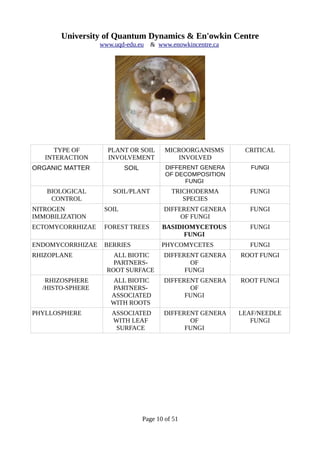
Fungi consist of filamentous mycelium
composed of individual hyphae. The hyphae
may be uni or multinucleate and with or without
cross walls. The length of fungal mycelium
ranges from 50 to 100 meters per gram of
surface soil and few microbiologists have
recorded values up to 500 meters. Based on
filament diameter, specific gravity and mycelial
length the weight of fungi ranges from
approximately 500 to 6000 kg per hectare of
surface soil. The fungal mycelium spreads like a
mat and is closely attached to soil particles.
These figures indicate the importance of fungi
in farm ecology.
The farm consists of well drained and well aerated soils for the simple reason that they cannot
tolerate water logged conditions. Luckily, for the farmer, these soil characteristics, together with a
thick cover of leaf biomass favors the growth and proliferation of beneficial fungi. Because of their
large diameter and underground net work of filaments they contribute significant amounts of total
microbial protoplasm, to the soil economy.
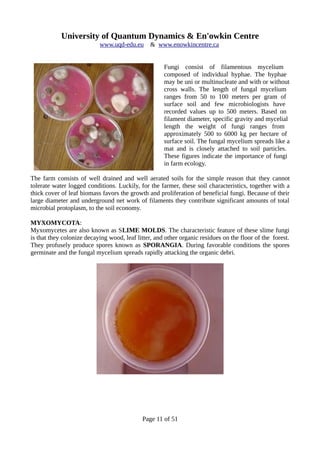
MYXOMYCOTA:
Myxomycetes are also known as SLIME MOLDS. The characteristic feature of these slime fungi
is that they colonize decaying wood, leaf litter, and other organic residues on the floor of the forest.
They profusely produce spores known as SPORANGIA. During favorable conditions the spores
germinate and the fungal mycelium spreads rapidly attacking the organic debri.
Page 11 of 51
University of Quantum Dynamics & En'owkin Centre
www.uqd-edu.eu & www.enowkincentre.ca
EUMYCOTA: MASTIGOMYCOTINA:
They are also referred to as algal fungi. This group comprises several molds, saprophytes, soil
forms, parasites and pathogens. Some are known to be parasitic on insects. The asexual spore
bearing structure is called SPORANGIUM. They may germinate directly giving rise to germ tubes
which form hyphae and mycelium. The fungus is also capable of sexual reproduction.
Some species of fungi are known to be plant pathogenic. E.g. Phytophthora infestans.
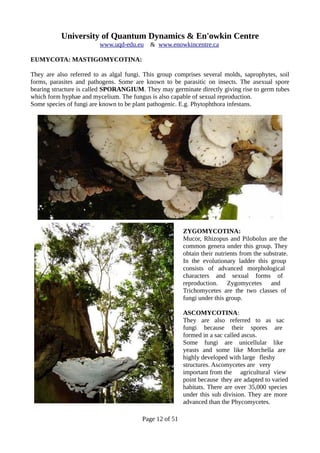
ZYGOMYCOTINA:
Mucor, Rhizopus and Pilobolus are the
common genera under this group. They
obtain their nutrients from the substrate.
In the evolutionary ladder this group
consists of advanced morphological
characters and sexual forms of
reproduction. Zygomycetes and
Trichomycetes are the two classes of
fungi under this group.
ASCOMYCOTINA:
They are also referred to as sac
fungi because their spores are
formed in a sac called ascus.
Some fungi are unicellular like
yeasts and some like Morchella are
highly developed with large fleshy
structures. Ascomycetes are very
important from the agricultural view
point because they are adapted to varied
habitats. There are over 35,000 species
under this sub division. They are more
advanced than the Phycomycetes.
Page 12 of 51
University of Quantum Dynamics & En'owkin Centre
www.uqd-edu.eu & www.enowkincentre.ca
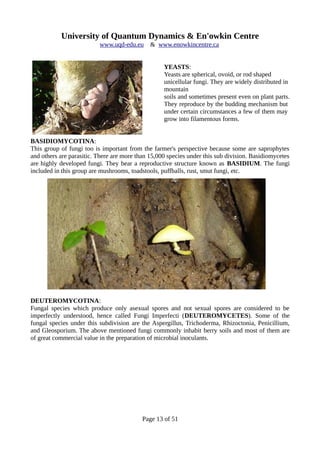
YEASTS:
Yeasts are spherical, ovoid, or rod shaped
unicellular fungi. They are widely distributed in
mountain
soils and sometimes present even on plant parts.
They reproduce by the budding mechanism but
under certain circumstances a few of them may
grow into filamentous forms.
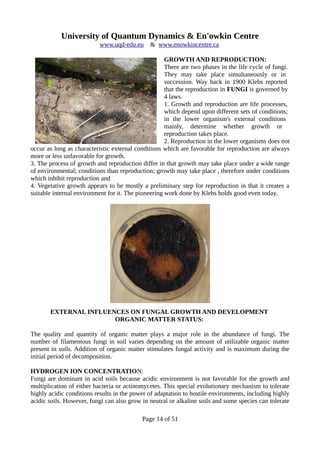
BASIDIOMYCOTINA:
This group of fungi too is important from the farmer's perspective because some are saprophytes
and others are parasitic. There are more than 15,000 species under this sub division. Basidiomycetes
are highly developed fungi. They bear a reproductive structure known as BASIDIUM. The fungi
included in this group are mushrooms, toadstools, puffballs, rust, smut fungi, etc.
DEUTEROMYCOTINA:
Fungal species which produce only asexual spores and not sexual spores are considered to be
imperfectly understood, hence called Fungi Imperfecti (DEUTEROMYCETES). Some of the
fungal species under this subdivision are the Aspergillus, Trichoderma, Rhizoctonia, Penicillium,
and Gleosporium. The above mentioned fungi commonly inhabit berry soils and most of them are
of great commercial value in the preparation of microbial inoculants.
Page 13 of 51
University of Quantum Dynamics & En'owkin Centre
www.uqd-edu.eu & www.enowkincentre.ca
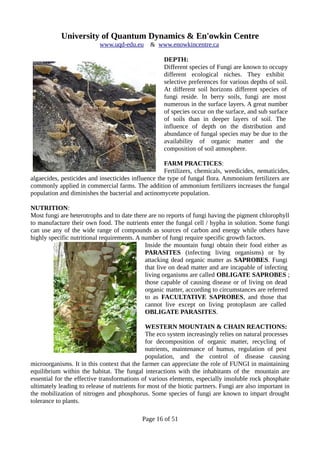
GROWTH AND REPRODUCTION:
There are two phases in the life cycle of fungi.
They may take place simultaneously or in
succession. Way back in 1900 Klebs reported
that the reproduction in FUNGI is governed by
4 laws.
1. Growth and reproduction are life processes,
which depend upon different sets of conditions;
in the lower organism's external conditions
mainly, determine whether growth or
reproduction takes place.
2. Reproduction in the lower organisms does not
occur as long as characteristic external conditions which are favorable for reproduction are always
more or less unfavorable for growth.
3. The process of growth and reproduction differ in that growth may take place under a wide range
of environmental; conditions than reproduction; growth may take place , therefore under conditions
which inhibit reproduction and
4. Vegetative growth appears to be mostly a preliminary step for reproduction in that it creates a
suitable internal environment for it. The pioneering work done by Klebs holds good even today.
EXTERNAL INFLUENCES ON FUNGAL GROWTH AND DEVELOPMENT
ORGANIC MATTER STATUS:
The quality and quantity of organic matter plays a major role in the abundance of fungi. The
number of filamentous fungi in soil varies depending on the amount of utilizable organic matter
present in soils. Addition of organic matter stimulates fungal activity and is maximum during the
initial period of decomposition.
HYDROGEN ION CONCENTRATION:
Fungi are dominant in acid soils because acidic environment is not favorable for the growth and
multiplication of either bacteria or actinomycetes. This special evolutionary mechanism to tolerate
highly acidic conditions results in the power of adaptation to hostile environments, including highly
acidic soils. However, fungi can also grow in neutral or alkaline soils and some species can tolerate
Page 14 of 51
University of Quantum Dynamics & En'owkin Centre
www.uqd-edu.eu & www.enowkincentre.ca
hydrogen ion concentrations beyond pH values of 8.0.
MOISTURE:
The moisture requirement varies from species to species. Soils which have relatively high moisture
regimes, suppress the growth and development of certain fungi. Fungi belonging to Basidiomycetes
multiply profusely in wood containing less than 20 % moisture. On the other hand the
Phycomycetous fungi require very high moisture content for its growth and multiplication. Various
moisture regimes determine the fate of spore germination. In general, a high level of moisture
facilitates the germination of spores and other reproductive structures of the fungus.
AERATION:
Mountain soils which are well aerated contain abundant fungi because most of the fungal species
are aerobic.
TEMPERATURE
Most fungal species are mesophilic (25 to 35 degree centigrade). However in compost pits, the
presence of thermophilic fungi is commonly observed. Thermophilic fungi multiply at 50 to 60
degree centigrade but not at 65 degree centigrade.
SEASON:
Since the mountains are exposed to different seasons, it has a very deleterious effect on the fungal
population. The rainy season provides ideal conditions for the proliferation of fungi but in heavy
rainfall regions receiving in excess of 200 inches per annum [includes snow] the growth of fungi are
restricted. December and January are winter months in the mountain area and fungi are at low ebb
during these months.
TYPE OF VEGETATION:
Incorporation of crop residues, green manures and carbonaceous materials improves the microbial
load, particularly the fungal growth. Certain species dominate initially, but subsequently their
numbers decline. Some species maintain high population levels for relatively long periods after the
incorporation of plant residues.
Page 15 of 51
University of Quantum Dynamics & En'owkin Centre
www.uqd-edu.eu & www.enowkincentre.ca
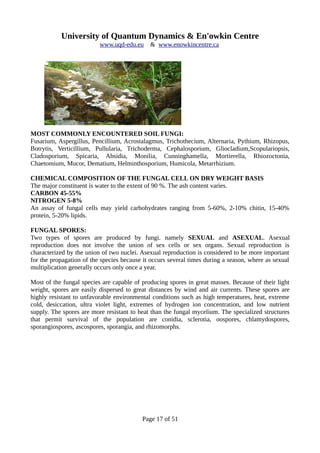
DEPTH:
Different species of Fungi are known to occupy
different ecological niches. They exhibit
selective preferences for various depths of soil.
At different soil horizons different species of
fungi reside. In berry soils, fungi are most
numerous in the surface layers. A great number
of species occur on the surface, and sub surface
of soils than in deeper layers of soil. The
influence of depth on the distribution and
abundance of fungal species may be due to the
availability of organic matter and the
composition of soil atmosphere.
FARM PRACTICES:
Fertilizers, chemicals, weedicides, nematicides,
algaecides, pesticides and insecticides influence the type of fungal flora. Ammonium fertilizers are
commonly applied in commercial farms. The addition of ammonium fertilizers increases the fungal
population and diminishes the bacterial and actinomycete population.
NUTRITION:
Most fungi are heterotrophs and to date there are no reports of fungi having the pigment chlorophyll
to manufacture their own food. The nutrients enter the fungal cell / hypha in solution. Some fungi
can use any of the wide range of compounds as sources of carbon and energy while others have
highly specific nutritional requirements. A number of fungi require specific growth factors.
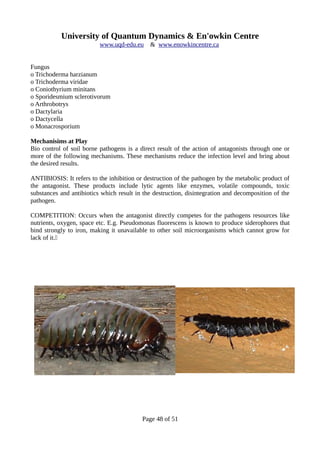
Inside the mountain fungi obtain their food either as
PARASITES (infecting living organisms) or by
attacking dead organic matter as SAPROBES. Fungi
that live on dead matter and are incapable of infecting
living organisms are called OBLIGATE SAPROBES ;
those capable of causing disease or of living on dead
organic matter, according to circumstances are referred
to as FACULTATIVE SAPROBES, and those that
cannot live except on living protoplasm are called
OBLIGATE PARASITES.
WESTERN MOUNTAIN & CHAIN REACTIONS:
The eco system increasingly relies on natural processes
for decomposition of organic matter, recycling of
nutrients, maintenance of humus, regulation of pest
population, and the control of disease causing
microorganisms. It in this context that the farmer can appreciate the role of FUNGI in maintaining
equilibrium within the habitat. The fungal interactions with the inhabitants of the mountain are
essential for the effective transformations of various elements, especially insoluble rock phosphate
ultimately leading to release of nutrients for most of the biotic partners. Fungi are also important in
the mobilization of nitrogen and phosphorus. Some species of fungi are known to impart drought
tolerance to plants.
Page 16 of 51
University of Quantum Dynamics & En'owkin Centre
www.uqd-edu.eu & www.enowkincentre.ca
MOST COMMONLY ENCOUNTERED SOIL FUNGI:
Fusarium, Aspergillus, Pencillium, Acrostalagmus, Trichothecium, Alternaria, Pythium, Rhizopus,
Botrytis, Verticillium, Pullularia, Trichoderma, Cephalosporium, Gliocladium,Scopulariopsis,
Cladosporium, Spicaria, Absidia, Monilia, Cunninghamella, Mortierella, Rhiozoctonia,
Chaetomium, Mucor, Dematium, Helminthosporium, Humicola, Metarrhizium.
CHEMICAL COMPOSITION OF THE FUNGAL CELL ON DRY WEIGHT BASIS
The major constituent is water to the extent of 90 %. The ash content varies.
CARBON 45-55%
NITROGEN 5-8%
An assay of fungal cells may yield carbohydrates ranging from 5-60%, 2-10% chitin, 15-40%
protein, 5-20% lipids.
FUNGAL SPORES:
Two types of spores are produced by fungi. namely SEXUAL and ASEXUAL. Asexual
reproduction does not involve the union of sex cells or sex organs. Sexual reproduction is
characterized by the union of two nuclei. Asexual reproduction is considered to be more important
for the propagation of the species because it occurs several times during a season, where as sexual
multiplication generally occurs only once a year.
Most of the fungal species are capable of producing spores in great masses. Because of their light
weight, spores are easily dispersed to great distances by wind and air currents. These spores are
highly resistant to unfavorable environmental conditions such as high temperatures, heat, extreme
cold, desiccation, ultra violet light, extremes of hydrogen ion concentration, and low nutrient
supply. The spores are more resistant to heat than the fungal mycelium. The specialized structures
that permit survival of the population are conidia, sclerotia, oospores, chlamydospores,
sporangiospores, ascospores, sporangia, and rhizomorphs.
Page 17 of 51
University of Quantum Dynamics & En'owkin Centre
www.uqd-edu.eu & www.enowkincentre.ca
TABLE 2: Persistence of Viable Fungal Structures in Soil
[Alexander Martin, 1975. Microbial Ecology 2:17-27.]
STRUCTURE FUNGUS PERSISTENCE IN YEARS
CHLAMYDOSPORE TILLETIA >5
OOSPORE APHANOMYCES >10
SCLEROTIUM
MICROSCLEROTIUM
PHYMATOTRICHUM
VERTICILLIUM
>12
14
FUNGI AS BIOCONTROLAGENTS:
The mountain soils are known to contain different species of nematodes. The root lesion nematode,
Pratylenchus coffeae is known to cause great economic damage in most farms including cherry,
berry and tobacco are tolerant. Some species of fungi have developed a mechanism to entrap
nematodes and devour them. It has taken millions of years for fungi to develop tentacles helpful in
fooling predators. It appears that a normal micro flora has an important protective function against
pathogenic and opportunistic microorganisms. Other species of fungi are known to predate over
protozoas.
A PEEP INTO THE FUTURE:
A number of fungi present within the mountain farms have medicinal, theraupetic and high protein
value. Farmers can easily exploit their usefulness by simply learning the behavior of such fungi. An
interesting fact about fungi is that they can be easily mass cultured inside the farm itself without any
sophisticated laboratory equipment. The raw material or the substrates on which the fungus grows is
abundantly available on the farm itself. Farmers have to take extreme care only in the isolation and
identification of pure cultures. Once the pure culture is isolated, the farmer should inoculate a
sample flask or a glass container having the requisite medium with the fungal culture and store it in
Page 18 of 51
University of Quantum Dynamics & En'owkin Centre
www.uqd-edu.eu & www.enowkincentre.ca
a refrigerator for further mass multiplication. This saves precious time and energy in subsequent
field isolations.
Microbial inhabitants find comfort in the forest sanctuary. Nature employs microbes on a higher
scale to establish and maintain a balance among the diverse forms of life inside the NW mountain.
The presence of different species of microorganisms inside thee mountain is a symbol of co
existence. Fungi play a pivotal role in the slow but constant changes taking place inside the
mountain. Fungi are key drivers in the recycling of important chemical elements that, without their
activity, would remain forever locked up in dead plant and animal bodies. They transform
abundantly available leaf litter and wood wastes to worthwhile end products containing high
nutrient value.
Fungi are more beneficial to the mountain ecology compared to many other microorganisms. Every
day new techniques are being discovered which are relatively easy to perform at the farm level
itself. There is little doubt that basic and applied research with microorganisms within the mountain
will continue to provide valuable information and technology of economic value to the farmers.
This knowledge can be used for improvements of commercial cultures for improving the
productivity of the farm. The presence of fungi inside the mountain signals a technique that can
distinguish between healthy and diseased or abnormal plant tissues. These techniques are of
immense value in reducing the time required to identify genetic defects and mutations. Farmers
world wide should be convinced that the beneficial activities of fungi can be exploited in increasing
the over all productivity of the eco-friendly farm.
German scientist Albrecht Kaupp , has this to say. The human being is, after all, one of the most
poorly optimized combustion engines of this planet. For thousands of years the design has remained
unchanged. We continue to burn the most expensive energy, in a completely inefficient body. There
are too many of us and our numbers are growing fast. On the other hand just look at Fungi; They
form an invisible net work of mycelial mats that are so small and highly efficient in converting non
edible crop residues into energy rich nutrients, there by supplying the needs of the entire biotic
community. Of great significance are certain fungi that form mycorrhizal associations with both
forest trees and farms, providing valuable phosphorus and other essential nutrients for growth and
development. Certain species of fungi impart drought tolerance to various plant species. In addition
several fungal species act as natural bio-control agents against a diverse array of disease causing
organisms within the farm.
References
Alexander, M. 1974. Microbial Ecology. New York. John Wiley and sons.
Alexander, M. 1977. Introduction to soil Microbiology. 2nd edition. New York. John
Wiley and sons.
Alexopoulous, C.J. and C.W. Mims 1983. Introductory Mycology.Third Edition, Wiley
Eastern Limited. India.
Atlas, R.M. and R. Bartha. 1993. Microbial Ecology: Fundamentals and application.
Third edition. Benjamin/Cummings Pub. Co. New York.
Brock. T. D. 1979. Biology of Microorganisms. Third Edition. Englewood Cliffs.
Prentice-Hall.
Harle, J. L. 1971. Fungi in ecosystems. J. Ecology 59: 627-642.
Kendrick, B. 1992. The fifth kingdom. Focus Texts. Newburyport, Mass.
Page 19 of 51
University of Quantum Dynamics & En'owkin Centre
www.uqd-edu.eu & www.enowkincentre.ca
Klebs, G. 1898-1900. Zur Physiologie der Fortpflanzung einiger Pilze. Jahrb. Wissen.
Bot. 32: 1-70
Peter J. Bottomley, 2002. Microbial Ecology (chapter 8). In Principles and applications of
soil microbiology. Edited by David M Sylvia, J.J. Fuhrmann, Peter G Hartel and David A
Zuberer. Prentice Hall. Upper Saddle River, NJ 07458
Rangaswami, G and Bagyaraj, D. J. 2001. Agricultural Microbiology. Second edition.
Prentice-Hall of India Private Limited. New Delhi.
Salle, A. J. 1983. Fundamentals Principles of Bacteriology. Seventh edition. Tata
McGraw Publishing Company LTD. New Delhi.
Subba Rao, N.S. 2002. Soil Microbiology (fourth edition of soil microorganisms and
plant growth) Oxford and IBH Publishing CO. PVT. LTD. New Delhi.
Paul, E.A. and Clark. F. E. 1996. Soil Microbiology and Biochemistry. Academic Press.
Miller, R.M . and J.D. Jastrow. 1992. The role of mycorrhizal fungi in soil conservation.
In Mycorrhizae in sustainable agriculture. Edited by Bethlenfalvay .G.J and R.G.
Linderman. ASA special publication number 54. American Society of Agronomy.
Madison, Wis.
Mehrotra, R. S. 1980. Plant Pathology. Tata Mc Graw-Hill Publishing Company Limited.
New Delhi.
American Type Culture Collection, Catalogue of strains, 1. 1978. 13TH Edition.
Rockville, Maryland : American Type Culture Collection.
Martin, S.M. and V.B.D. Skerman eds. 1972. World Directory of collections of cultures
of Microorganisms. New York: John Wiley and Sons.
Paul Singleton and Diana Sainsbury. 1981. Dictionary of Microbiology. WIE Edition
April 1981.Role of Bacteria in Coffee Plantation Ecology
by Dr. Anand Titus and Geeta N. Pereira
Page 20 of 51
University of Quantum Dynamics & En'owkin Centre
www.uqd-edu.eu & www.enowkincentre.ca
Part 3
Bacteria
“The true biologist deals with life, with teeming, boisterous life, and Learns something from it,
Learns that the first rule of life is living. “
JOHN STEINBECK
To date we have written a dozen or more articles on the pro active role of microorganisms in
shaping the destiny of the NW Mountains. However, off late we have received hundreds of e-mail
requests from all over the globe, asking us to elaborate on the type of microorganisms carrying out
these functions. Armed With a back ground of Microbiology and Horticulture, we have made an
honest attempt to simplify the role of BACTERIA in NW Mountain ecology.
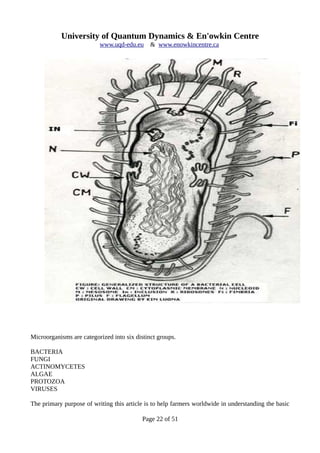
All living organisms are classified as either PROKARYOTIC (PRIMITIVE) or EUKARYOTIC
(Higher forms of life) based on their cellular structure. Bacteria and blue green algae are grouped
under prokaryotes and all other organisms are eukaryotes. Bacteria are unicellular microscopic or
single celled organisms widely distributed in nature. The greatest benefit in studying bacteria is that
it throws light on the evolution of simple cellular systems and the higher forms of life.
Page 21 of 51
University of Quantum Dynamics & En'owkin Centre
www.uqd-edu.eu & www.enowkincentre.ca
Microorganisms are categorized into six distinct groups.
BACTERIA
FUNGI
ACTINOMYCETES
ALGAE
PROTOZOA
VIRUSES
The primary purpose of writing this article is to help farmers worldwide in understanding the basic
Page 22 of 51
University of Quantum Dynamics & En'owkin Centre
www.uqd-edu.eu & www.enowkincentre.ca
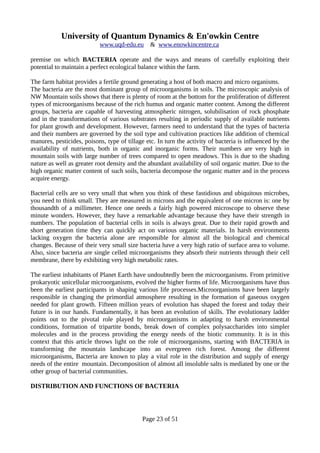
premise on which BACTERIA operate and the ways and means of carefully exploiting their
potential to maintain a perfect ecological balance within the farm.
The farm habitat provides a fertile ground generating a host of both macro and micro organisms.
The bacteria are the most dominant group of microorganisms in soils. The microscopic analysis of
NW Mountain soils shows that there is plenty of room at the bottom for the proliferation of different
types of microorganisms because of the rich humus and organic matter content. Among the different
groups, bacteria are capable of harvesting atmospheric nitrogen, solubilisation of rock phosphate
and in the transformations of various substrates resulting in periodic supply of available nutrients
for plant growth and development. However, farmers need to understand that the types of bacteria
and their numbers are governed by the soil type and cultivation practices like addition of chemical
manures, pesticides, poisons, type of tillage etc. In turn the activity of bacteria is influenced by the
availability of nutrients, both in organic and inorganic forms. Their numbers are very high in
mountain soils with large number of trees compared to open meadows. This is due to the shading
nature as well as greater root density and the abundant availability of soil organic matter. Due to the
high organic matter content of such soils, bacteria decompose the organic matter and in the process
acquire energy.
Bacterial cells are so very small that when you think of these fastidious and ubiquitous microbes,
you need to think small. They are measured in microns and the equivalent of one micron is: one by
thousandth of a millimeter. Hence one needs a fairly high powered microscope to observe these
minute wonders. However, they have a remarkable advantage because they have their strength in
numbers. The population of bacterial cells in soils is always great. Due to their rapid growth and
short generation time they can quickly act on various organic materials. In harsh environments
lacking oxygen the bacteria alone are responsible for almost all the biological and chemical
changes. Because of their very small size bacteria have a very high ratio of surface area to volume.
Also, since bacteria are single celled microorganisms they absorb their nutrients through their cell
membrane, there by exhibiting very high metabolic rates.
The earliest inhabitants of Planet Earth have undoubtedly been the microorganisms. From primitive
prokaryotic unicellular microorganisms, evolved the higher forms of life. Microorganisms have thus
been the earliest participants in shaping various life processes.Microorganisms have been largely
responsible in changing the primordial atmosphere resulting in the formation of gaseous oxygen
needed for plant growth. Fifteen million years of evolution has shaped the forest and today their
future is in our hands. Fundamentally, it has been an evolution of skills. The evolutionary ladder
points out to the pivotal role played by microorganisms in adapting to harsh environmental
conditions, formation of tripartite bonds, break down of complex polysaccharides into simpler
molecules and in the process providing the energy needs of the biotic community. It is in this
context that this article throws light on the role of microorganisms, starting with BACTERIA in
transforming the mountain landscape into an evergreen rich forest. Among the different
microorganisms, Bacteria are known to play a vital role in the distribution and supply of energy
needs of the entire mountain. Decomposition of almost all insoluble salts is mediated by one or the
other group of bacterial communities.
DISTRIBUTION AND FUNCTIONS OF BACTERIA
Page 23 of 51
University of Quantum Dynamics & En'owkin Centre
www.uqd-edu.eu & www.enowkincentre.ca
Bacteria are widely distributed along the length and breadth of the mountain. In short they are found
almost every where. Bacteria are single celled organisms and in spite of their simplicity are highly
efficient. Their numbers decline
with depth of soil.
A majority of the farmers are
unaware that the great majority
of bacteria are beneficial and
absolutely necessary to convert
farm wastes, organic debris and
other by products into energy rich
compounds needed for plant
growth and development. Plants
and animals depend on the
fertility status of the soil and this
in turn is dependent on the
activity of soil microorganisms. Plants cannot directly utilize organic compounds such as fatty
acids, lipids, carbohydrates and proteins. Microorganisms are a vital link in the mineralization of
organic constituents and provide nutrients in the available form for plant growth and development.
Bacterial cells can withstand long periods of drought due to the protective cover around the cell
wall known as CAPSULE. The capsule is a slimy or a gelatinous material and encloses either one
cell or a group of cells. At times the bacteria make use of the polysaccharides present in the capsule
as a source of reserve food material. The capsule enables the bacteria to avoid predation by larger
soil microbes and infection from viral strains. In addition to protection, capsules also play an
important role in the attachment of bacterial cells to plant or rock surfaces and in the formation of
biofilms.
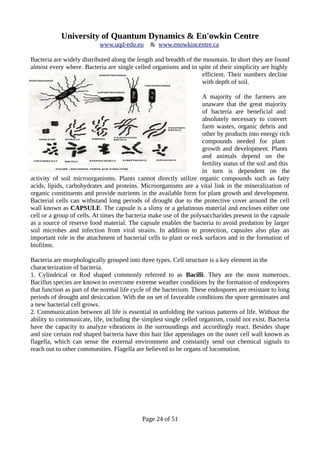
Bacteria are morphologically grouped into three types. Cell structure is a key element in the
characterization of bacteria.
1. Cylindrical or Rod shaped commonly referred to as Bacilli. They are the most numerous.
Bacillus species are known to overcome extreme weather conditions by the formation of endospores
that function as part of the normal life cycle of the bacterium. These endospores are resistant to long
periods of drought and desiccation. With the on set of favorable conditions the spore germinates and
a new bacterial cell grows.
2. Communication between all life is essential in unfolding the various patterns of life. Without the
ability to communicate, life, including the simplest single celled organism, could not exist. Bacteria
have the capacity to analyze vibrations in the surroundings and accordingly react. Besides shape
and size certain rod shaped bacteria have thin hair like appendages on the outer cell wall known as
flagella, which can sense the external environment and constantly send out chemical signals to
reach out to other communities. Flagella are believed to be organs of locomotion.
Page 24 of 51
University of Quantum Dynamics & En'owkin Centre
www.uqd-edu.eu & www.enowkincentre.ca
The number and place of attachment vary. When a single flagellum is attached to one end of the rod
it is known as MONOTRICHOUS. If the flagella are attached singly at both ends it is known as
AMPHITRICHOUS ; If more than one flagellum or a bunch of them are attached to either one end
or both the ends it is known as LOPHOTRICHOUS and if the flagella are covered all over the cell
it is known as PERITRICHOUS.
3. Spherical or ellipsoidal bacteria are called cocci. Ellipsoidal bacteria occur in pairs and are
referred to as STREPTOCOCCI, when in four cells, arranged in a square they are known as
TETRADS; when in irregular clusters like a bunch of grapes they are called STAPHYLOCOCCI
and when arranged in a cubical form known as SARCINAE.
4. Spiral or helicoidal.
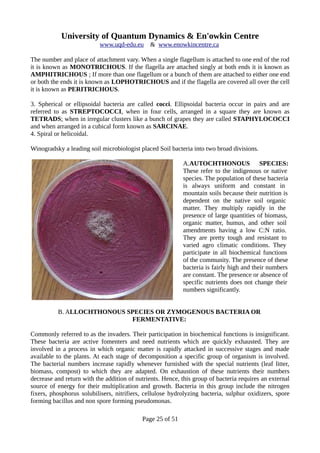
Winogradsky a leading soil microbiologist placed Soil bacteria into two broad divisions.
A.AUTOCHTHONOUS SPECIES:
These refer to the indigenous or native
species. The population of these bacteria
is always uniform and constant in
mountain soils because their nutrition is
dependent on the native soil organic
matter. They multiply rapidly in the
presence of large quantities of biomass,
organic matter, humus, and other soil
amendments having a low C:N ratio.
They are pretty tough and resistant to
varied agro climatic conditions. They
participate in all biochemical functions
of the community. The presence of these
bacteria is fairly high and their numbers
are constant. The presence or absence of
specific nutrients does not change their
numbers significantly.
B. ALLOCHTHONOUS SPECIES OR ZYMOGENOUS BACTERIA OR
FERMENTATIVE:
Commonly referred to as the invaders. Their participation in biochemical functions is insignificant.
These bacteria are active fomenters and need nutrients which are quickly exhausted. They are
involved in a process in which organic matter is rapidly attacked in successive stages and made
available to the plants. At each stage of decomposition a specific group of organism is involved.
The bacterial numbers increase rapidly whenever furnished with the special nutrients (leaf litter,
biomass, compost) to which they are adapted. On exhaustion of these nutrients their numbers
decrease and return with the addition of nutrients. Hence, this group of bacteria requires an external
source of energy for their multiplication and growth. Bacteria in this group include the nitrogen
fixers, phosphorus solubilisers, nitrifiers, cellulose hydrolyzing bacteria, sulphur oxidizers, spore
forming bacillus and non spore forming pseudomonas.
Page 25 of 51
University of Quantum Dynamics & En'owkin Centre
www.uqd-edu.eu & www.enowkincentre.ca
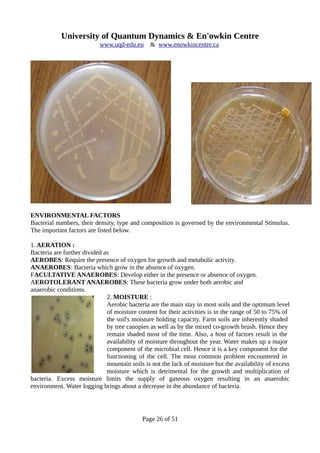
ENVIRONMENTAL FACTORS
Bacterial numbers, their density, type and composition is governed by the environmental Stimulus.
The important factors are listed below.
1. AERATION :
Bacteria are further divided as
AEROBES: Require the presence of oxygen for growth and metabolic activity.
ANAEROBES: Bacteria which grow in the absence of oxygen.
FACULTATIVE ANAEROBES: Develop either in the presence or absence of oxygen.
AEROTOLERANT ANAEROBES: These bacteria grow under both aerobic and
anaerobic conditions.
2. MOISTURE :
Aerobic bacteria are the main stay in most soils and the optimum level
of moisture content for their activities is in the range of 50 to 75% of
the soil's moisture holding capacity. Farm soils are inherently shaded
by tree canopies as well as by the mixed co-growth brush. Hence they
remain shaded most of the time. Also, a host of factors result in the
availability of moisture throughout the year. Water makes up a major
component of the microbial cell. Hence it is a key component for the
functioning of the cell. The most common problem encountered in
mountain soils is not the lack of moisture but the availability of excess
moisture which is detrimental for the growth and multiplication of
bacteria. Excess moisture limits the supply of gaseous oxygen resulting in an anaerobic
environment. Water logging brings about a decrease in the abundance of bacteria.
Page 26 of 51
University of Quantum Dynamics & En'owkin Centre
www.uqd-edu.eu & www.enowkincentre.ca
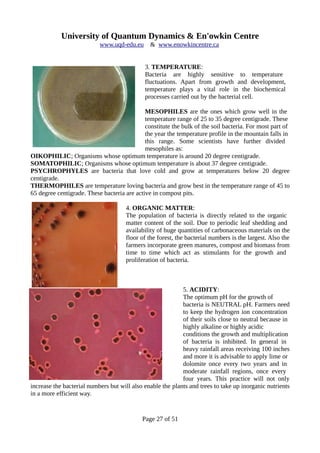
3. TEMPERATURE:
Bacteria are highly sensitive to temperature
fluctuations. Apart from growth and development,
temperature plays a vital role in the biochemical
processes carried out by the bacterial cell.
MESOPHILES are the ones which grow well in the
temperature range of 25 to 35 degree centigrade. These
constitute the bulk of the soil bacteria. For most part of
the year the temperature profile in the mountain falls in
this range. Some scientists have further divided
mesophiles as:
OIKOPHILIC; Organisms whose optimum temperature is around 20 degree centigrade.
SOMATOPHILIC; Organisms whose optimum temperature is about 37 degree centigrade.
PSYCHROPHYLES are bacteria that love cold and grow at temperatures below 20 degree
centigrade.
THERMOPHILES are temperature loving bacteria and grow best in the temperature range of 45 to
65 degree centigrade. These bacteria are active in compost pits.
4. ORGANIC MATTER:
The population of bacteria is directly related to the organic
matter content of the soil. Due to periodic leaf shedding and
availability of huge quantities of carbonaceous materials on the
floor of the forest, the bacterial numbers is the largest. Also the
farmers incorporate green manures, compost and biomass from
time to time which act as stimulants for the growth and
proliferation of bacteria.
5. ACIDITY:
The optimum pH for the growth of
bacteria is NEUTRAL pH. Farmers need
to keep the hydrogen ion concentration
of their soils close to neutral because in
highly alkaline or highly acidic
conditions the growth and multiplication
of bacteria is inhibited. In general in
heavy rainfall areas receiving 100 inches
and more it is advisable to apply lime or
dolomite once every two years and in
moderate rainfall regions, once every
four years. This practice will not only
increase the bacterial numbers but will also enable the plants and trees to take up inorganic nutrients
in a more efficient way.
Page 27 of 51
University of Quantum Dynamics & En'owkin Centre
www.uqd-edu.eu & www.enowkincentre.ca
ACIDOPHILIC BACTERIA: Bacteria capable of growth in extremely low pH
ALKALOPHILIC BACTERIA: Bacteria capable of growth in extremely alkaline soils (p H 10.5)
HALOPHILIC BACTERIA: Bacteria capable of tolerating high salt concentrations.
XEROPHILIC BACTERIA: Bacteria capable of growth in dry habitats.
6. INORGANIC NUTRIENTS:
Application of fertilizers and chemicals greatly affects the bacterial population. Farmer's world
wide use ammonium fertilizers as the bulk of fertilizer application. Farmers do not realize that
ammonium fertilizers tend to lower the soil pH resulting in acidity due to the microbial oxidation of
ammonium to nitric acid. More than the effect of fertilizer, it is the acidity which suppresses the
bacterial population. This problem can be easily overcome by split applications spread out over a
two week period. More importantly, the application of fertilizer should be carried out when the soil
moisture is optimum. It is a proven fact that small amounts of inorganic fertilizers supply the needs
of the bacterial community in the form of inorganic nutrients.
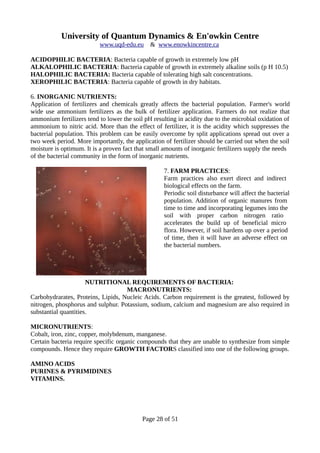
7. FARM PRACTICES:
Farm practices also exert direct and indirect
biological effects on the farm.
Periodic soil disturbance will affect the bacterial
population. Addition of organic manures from
time to time and incorporating legumes into the
soil with proper carbon nitrogen ratio
accelerates the build up of beneficial micro
flora. However, if soil hardens up over a period
of time, then it will have an adverse effect on
the bacterial numbers.
NUTRITIONAL REQUIREMENTS OF BACTERIA:
MACRONUTRIENTS:
Carbohydrarates, Proteins, Lipids, Nucleic Acids. Carbon requirement is the greatest, followed by
nitrogen, phosphorus and sulphur. Potassium, sodium, calcium and magnesium are also required in
substantial quantities.
MICRONUTRIENTS:
Cobalt, iron, zinc, copper, molybdenum, manganese.
Certain bacteria require specific organic compounds that they are unable to synthesize from simple
compounds. Hence they require GROWTH FACTORS classified into one of the following groups.
AMINO ACIDS
PURINES & PYRIMIDINES
VITAMINS.
Page 28 of 51
University of Quantum Dynamics & En'owkin Centre
www.uqd-edu.eu & www.enowkincentre.ca
The dominant groups of bacteria are the heterotrophs but a few genera have photo chromatic
pigments enabling them to have photoautotrophic nutrition.
Two main classes of bacteria are:
the HETEROTROPHS OR CHEMOORGANOTROPHIC: Bacteria which require preformed
an organic nutrient which serves as a source of energy and carbon.
AUTOTROPHIC OR LITHOTROPHIC: Bacteria which obtain their energy from sunlight or
by the oxidation of inorganic compounds and their carbon by the assimilation of carbon dioxide.
Autotrophs are further classified as: PHOTOAUTOTROPHS OR PHOTOLITHOTROPHS;
where energy is derived from sunlight and CHEMOAUTOTROPHS OR
CHEMOLITHOTROPHS which obtain their energy from the oxidation of inorganic materials.
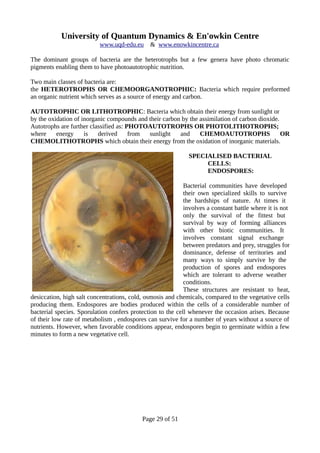
SPECIALISED BACTERIAL
CELLS:
ENDOSPORES:
Bacterial communities have developed
their own specialized skills to survive
the hardships of nature. At times it
involves a constant battle where it is not
only the survival of the fittest but
survival by way of forming alliances
with other biotic communities. It
involves constant signal exchange
between predators and prey, struggles for
dominance, defense of territories and
many ways to simply survive by the
production of spores and endospores
which are tolerant to adverse weather
conditions.
These structures are resistant to heat,
desiccation, high salt concentrations, cold, osmosis and chemicals, compared to the vegetative cells
producing them. Endospores are bodies produced within the cells of a considerable number of
bacterial species. Sporulation confers protection to the cell whenever the occasion arises. Because
of their low rate of metabolism , endospores can survive for a number of years without a source of
nutrients. However, when favorable conditions appear, endospores begin to germinate within a few
minutes to form a new vegetative cell.
Page 29 of 51
University of Quantum Dynamics & En'owkin Centre
www.uqd-edu.eu & www.enowkincentre.ca
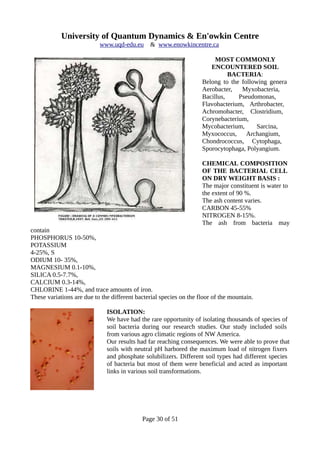
MOST COMMONLY
ENCOUNTERED SOIL
BACTERIA:
Belong to the following genera
Aerobacter, Myxobacteria,
Bacillus, Pseudomonas,
Flavobacterium, Arthrobacter,
Achromobacter, Clostridium,
Corynebacterium,
Mycobacterium, Sarcina,
Myxococcus, Archangium,
Chondrococcus, Cytophaga,
Sporocytophaga, Polyangium.
CHEMICAL COMPOSITION
OF THE BACTERIAL CELL
ON DRY WEIGHT BASIS :
The major constituent is water to
the extent of 90 %.
The ash content varies.
CARBON 45-55%
NITROGEN 8-15%.
The ash from bacteria may
contain
PHOSPHORUS 10-50%,
POTASSIUM
4-25%, S
ODIUM 10- 35%,
MAGNESIUM 0.1-10%,
SILICA 0.5-7.7%,
CALCIUM 0.3-14%,
CHLORINE 1-44%, and trace amounts of iron.
These variations are due to the different bacterial species on the floor of the mountain.
ISOLATION:
We have had the rare opportunity of isolating thousands of species of
soil bacteria during our research studies. Our study included soils
from various agro climatic regions of NW America.
Our results had far reaching consequences. We were able to prove that
soils with neutral pH harbored the maximum load of nitrogen fixers
and phosphate solubilizers. Different soil types had different species
of bacteria but most of them were beneficial and acted as important
links in various soil transformations.
Page 30 of 51
University of Quantum Dynamics & En'owkin Centre
www.uqd-edu.eu & www.enowkincentre.ca
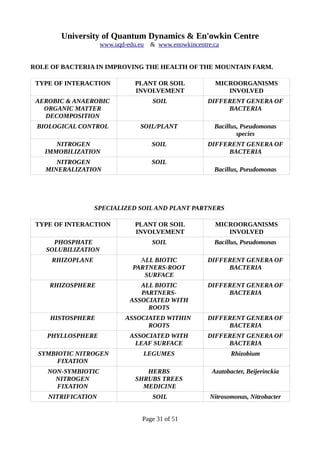
ROLE OF BACTERIA IN IMPROVING THE HEALTH OF THE MOUNTAIN FARM.
TYPE OF INTERACTION PLANT OR SOIL
INVOLVEMENT
MICROORGANISMS
INVOLVED
AEROBIC & ANAEROBIC
ORGANIC MATTER
DECOMPOSITION
SOIL DIFFERENT GENERA OF
BACTERIA
BIOLOGICAL CONTROL SOIL/PLANT Bacillus, Pseudomonas
species
NITROGEN
IMMOBILIZATION
SOIL DIFFERENT GENERA OF
BACTERIA
NITROGEN
MINERALIZATION
SOIL
Bacillus, Pseudomonas
SPECIALIZED SOIL AND PLANT PARTNERS
TYPE OF INTERACTION PLANT OR SOIL
INVOLVEMENT
MICROORGANISMS
INVOLVED
PHOSPHATE
SOLUBILIZATION
SOIL Bacillus, Pseudomonas
RHIZOPLANE ALL BIOTIC
PARTNERS-ROOT
SURFACE
DIFFERENT GENERA OF
BACTERIA
RHIZOSPHERE ALL BIOTIC
PARTNERS-
ASSOCIATED WITH
ROOTS
DIFFERENT GENERA OF
BACTERIA
HISTOSPHERE ASSOCIATED WITHIN
ROOTS
DIFFERENT GENERA OF
BACTERIA
PHYLLOSPHERE ASSOCIATED WITH
LEAF SURFACE
DIFFERENT GENERA OF
BACTERIA
SYMBIOTIC NITROGEN
FIXATION
LEGUMES Rhizobium
NON-SYMBIOTIC
NITROGEN
FIXATION
HERBS
SHRUBS TREES
MEDICINE
Azatobacter, Beijerinckia
NITRIFICATION SOIL Nitrosomonas, Nitrobacter
Page 31 of 51
University of Quantum Dynamics & En'owkin Centre
www.uqd-edu.eu & www.enowkincentre.ca
DENITRIFICATION SOIL Pseudomonas,
Achromobacter
TRANSFORMATION OF
VARIOUS
ELEMENTS LIKE IRON,
COPPER
SULPHUR,MANGANESE,
COPPER-COBALT
SULPHIDES, GERMANIUM
SOIL
Thiobacillus,
Ferribacterium,
Aerobacter,Clostridium
Thiobacillus Ferrioxydans
[Cu-Co]
Aerobacter transoxydans [Ge]
Shade grown MOUNTAIN FARMS
have sustained many generations of
farmers because of their resilience in
overcoming all odds. The secret behind
this success is attributed to the microbial
inhabitants. Microorganisms cannot be
seen by the naked eye, yet they
constitute about one quarter of the
biomass-the total weight of living
organisms in the world. Animals and
plants account for the remainder. In the
strict sense, more than 98 % of what we
describe as waste inside the farm is
valuable food for one or the other group
of microorganisms. Bacteria recycle
these wastes into power packed energy rich nutrients required for the survival of the medicine
plants and its partners. Farmers have an erroneous concept of the role of bacteria in nature. They
strongly feel that the majority of bacteria are disease producing. We would like to set the record
straight and state that the vast majority of bacteria are not only beneficial but are absolutely
essential in building up a healthy farm. Yes, there are a very few bacterial species that are harmful
but in a healthy ecosystem they rarely express themselves.
It is very important that the farmer understand the subtle role played by bacteria in the
transformation of major elements like nitrogen, sulfur and phosphorus, biodegradation, neutralizing
toxic wastes, bio-control agents and a host of other activities. Certain bacteria belonging to the
families Thiorhodaceae , Chlorobacteriaceae and Athiorhodaceae contain bacteriochlorophyll and
various carotenoids and are also capable of photosynthesis.
Bacterial interactions with the farm crops and the surrounding flora are known to improve plant
growth and productivity. The fertility of the soil is directly dependent on the activity of soil
microorganisms. The soil microorganisms mineralize insoluble and indiffusable organic
constituents and make them available to plants. The common denominator to assess a healthy soil is
the viable number of soil microorganisms.
The shade grown mountain ecosystem is unique in the true sense that it simultaneously achieves the
Page 32 of 51
University of Quantum Dynamics & En'owkin Centre
www.uqd-edu.eu & www.enowkincentre.ca
goals of agricultural production in terms of pepper, citrus, vanilla, berries, and pine-nut production
on one hand and the conservation of biodiversity on the other hand.
Nothing would be wiser for the world's producing Nation's to follow in our footsteps and grow
crops under the canopy of trees, shrubs, mountain shadows. There in lies the path to sustainability.
In our humble opinion we strongly feel that only shared prosperity can make the future of this
planet secure. At UQD RESEARCH we work with ideas that might work or might not work. But in
the end analysis, these ideas are the core to the survival of PLANET EARTH.
REFERENCES:
Alexander ,M. 1974 . Microbial Ecology. New York. John Wiley and sons.
Alexander ,M. 1977 . Introduction to soil Microbiology. 2nd edition. New York. John Wiley and
sons.
Atlas, R.M. and R. Bartha. 1993. Microbial Ecology : Fundamentals and application. Third
edition. Benjamin/Cummings Pub. Co. New York.
Brock. T. D. 1979. Biology of Microorganisms. Third Edition. Englewood Cliffs. Prentice-Hall.
De Witt. W. 1977. Biology of the cell. An Evolutionary Approach. W.B. Saunders Company.
Philadelphia , London , Toronto.
Kotpal ,R.L. and N.P. Bali. 2003. Concepts of Ecology. : Environmental and field biology.
Vishal Publishing Compamy.India.
Killham. K . 1994. Soil Ecology. Cambridge University Press, Cambridge. England.
Paul. E.A. and Clark. F. E. 1996. Soil Microbiology and Biochemistry. Academic Press.
Pelczar. M.J.Jr; R.D. Reid and E.C.S. Chan. 1977. Microbiology. Fourth Edition. New York.
McGraw-Hill.
David B Alexander, 2002. Bacteria and Archaea (chapter 3). In Principles and applications of
soil microbiology. Edited by David M Sylvia, J.J. Fuhrmann, Peter G Hartel and David A
Zuberer. Prentice Hall. Upper Saddle River, NJ 07458
Paul. E.A. and Clark. F. E. 1996. Soil Microbiology and Biochemistry. Academic Press.
Rangaswami . G and Bagyaraj, D. J. 2001. Agricultural Microbiology. Second edition. Prentice-
Hall of India Private Limited. New Delhi.Salle. A. J. 1983. Fundamentals Principles of
Bacteriology. Seventh edition. Tata McGraw
Publishing Company LTD. New Delhi.
Subba Rao. N.S. 2002. Soil Microbiology (fourth edition of soil microorganisms and plant
growth) Oxford and IBH Publishing CO. PVT. LTD. New Delhi.
Stevenson. F. J. 1982. Humus Chemistry. Wiley-Interscience, New York.
Kelly. D. P. 1978. Microbial Ecology. In K.W.A. Chater and H.J. Somerville (eds ). The oil
industry and microbial ecosystems. Heyden and Son , London .
Tilman. D. 1982. Resource Competition and Community Structure. Princeton Unioversity Press,
Princeton , NJ.
National Academy of Sciences. 1981. Microbial Processes : Promising Technologies for
Developing Countries. N.A.S. Washington, D.C.
Role of Ectomycorrhizae In Coffee Plantations
by Dr. Anand Titus and Geeta N. Pereira
Page 33 of 51
University of Quantum Dynamics & En'owkin Centre
www.uqd-edu.eu & www.enowkincentre.ca
PART 4
Readers are requested to refer the article ENDOMYCORRHIZAE for a better understanding of
the present article.
Forest trees are an integral part of the mountain ecosystem. In fact, all shade grown farms are a
mosaic of food plants and natural forests. The characteristic feature of NW American Indian
mountain farms are home to a variety of trees and not just confined to a monoculture of selective
trees (Single species). The biological diversity reaches its zenith inside the mountain. These vast
mountains are microcosms of insects, plants and animals. Only a handful of countries in the world
grow food in an eco-friendly manner like the way UQD does.
Building a farm in the mountains is like embarking on a voyage of discovery. Challenges are in
plenty. The first challenge is to break stereo types regarding modern day chemicals and poisons and
to develop sustainable technologies keeping one's ears and eyes close to the ground. The journey,
this far has been strewn with technological, social and scientific challenges. The key in overcoming
these hurdles was through constant perseverance and a belief and passion for one's work and
culture. As a matter of fact, in any farmer, whether Mountain or Mradow, there is a likelihood of a
standing tree population of approximately 150 to 300 trees per hectare. These tall evergreen trees
with their deep rooted system require large amounts of water and nutrients for their growth and
survival. The interesting point to note here is that farmers do not apply any external inputs in the
form of chemicals or manure for improving the increment of individual trees because they believe
in the self regulating forces of nature.
Instead their focus is on getting better yields of pine-nuts and allied foodcrops by way of split
application of fertilizer. In spite of this age old practice of not fertilizing the trees, the health of the
forest remains excellent and the question that comes to mind is how does the forest retains its health
and vigor. Surprising, yet true; nature comes to the rescue of the forest trees. Invisible microbial
agents in symbiotic association with the forest trees provide the necessary nutrition and water
uptake. Most forest trees have roots infected with fungi that increase nutrient and water uptake and
also aid in the protection from certain root pathogens. These friendly fungi are known as
ECTOMYCORRHIZAE. The balance of this cooperation is in favor of the medicine plants. They
nourish the trees creating opportunities for new life. Scientists have observed four main types of
mycorrhizae.
A. ENDOMYCORRHIZAEB.
B. ECTOMYCORRHIZAE
C. ERICOID MYCORRHIZAE
D. ORCHIDACEOUS MYCORRHIZAE
This throws light on ectomycorrhizae and its profound influence on mountain farm ecology.
Page 34 of 51
University of Quantum Dynamics & En'owkin Centre
www.uqd-edu.eu & www.enowkincentre.ca
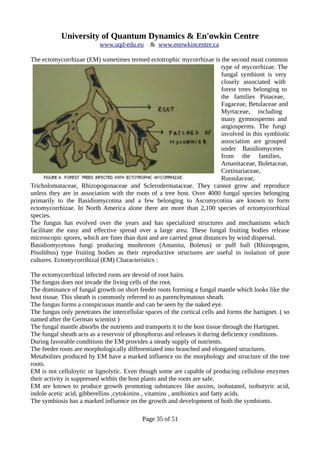
The ectomycorrhizae (EM) sometimes termed ectotrophic mycorrhizae is the second most common
type of mycorrhizae. The
fungal symbiont is very
closely associated with
forest trees belonging to
the families Pinaceae,
Fagaceae, Betulaceae and
Myrtaceae, including
many gymnosperms and
angiosperms. The fungi
involved in this symbiotic
association are grouped
under Basidiomycetes
from the families,
Amanitaceae, Boletaceae,
Cortinariaceae,
Russulaceae,
Tricholomataceae, Rhizopogonaceae and Sclerodermataceae. They cannot grow and reproduce
unless they are in association with the roots of a tree host. Over 4000 fungal species belonging
primarily to the Basidiomycotina and a few belonging to Ascomycotina are known to form
ectomycorrhizae. In North America alone there are more than 2,100 species of ectomycorrhizal
species.
The fungus has evolved over the years and has specialized structures and mechanisms which
facilitate the easy and effective spread over a large area. These fungal fruiting bodies release
microscopic spores, which are finer than dust and are carried great distances by wind dispersal.
Basidiomycetous fungi producing mushroom (Amanita, Boletus) or puff ball (Rhizopogon,
Pisolithus) type fruiting bodies as their reproductive structures are useful in isolation of pure
cultures. Ectomycorrihizal (EM) Characteristics :
The ectomycorrhizal infected roots are devoid of root hairs.
The fungus does not invade the living cells of the root.
The dominance of fungal growth on short feeder roots forming a fungal mantle which looks like the
host tissue. This sheath is commonly referred to as parenchymatous sheath.
The fungus forms a conspicuous mantle and can be seen by the naked eye.
The fungus only penetrates the intercellular spaces of the cortical cells and forms the hartignet. ( so
named after the German scientist )
The fungal mantle absorbs the nutrients and transports it to the host tissue through the Hartignet.
The fungal sheath acts as a reservoir of phosphorus and releases it during deficiency conditions.
During favorable conditions the EM provides a steady supply of nutrients.
The feeder roots are morphologically differentiated into branched and elongated structures.
Metabolites produced by EM have a marked influence on the morphology and structure of the tree
roots.
EM is not celluloytic or lignolytic. Even though some are capable of producing cellulose enzymes
their activity is suppressed within the host plants and the roots are safe.
EM are known to produce growth promoting substances like auxins, isobutanol, isobutyric acid,
indole acetic acid, gibberellins ,cytokinins , vitamins , antibiotics and fatty acids.
The symbiosis has a marked influence on the growth and development of both the symbionts.
Page 35 of 51
University of Quantum Dynamics & En'owkin Centre
www.uqd-edu.eu & www.enowkincentre.ca
Beneficial Symbiosis
The two partners, namely the tree and the fungus have a perfect understanding of each others needs.
At no time is the relationship parasitic. This perfect understanding between two partners signifies
the delicate strands of evolution interwoven not only on the surface of the forest floor of the
mountain but also the invisible net work that lies hidden underneath the soil. The EM derives its
nutritional needs like carbohydrates, simple sugars and vitamins from the host tree.
The main benefit that the fungus derives is absence of competition for nutrients from soil
microorganisms. The tree in turn is benefited with increased uptake of nitrogen, phosphorus and
potassium along with water. The fungus also protects the trees from pathogens.
Isolation & Inoculation
The fungus produces fruiting bodies on soil surface close to tree trunks. These fruiting bodies are
subsequently used in preparation of pure cultures. The draw back with these fruiting bodies is that
they grow slowly in pure culture and require special nutrients such as thiamine, simple amino acids
and other unidentified ( collectively known as M-FACTOR ) root exudates.
Inoculation can be carried out by any one of the following techniques:
a. Soil inoculation
b. Inoculation by spores and sporocarps
c. Mass multiplication by pure culture.
Forest Ecology
The relevance of EM in mountain farms is particularly demonstrated by the fact that during
establishment of new farm, some food farmers practice the slash and burn method to clear the land
of shrubs, undergrowth and weeds. This method is followed because it saves on labor costs.
Even though, it is an easy way out, it causes irreparable damage to the soil in the long run.
Basically, the slash and burn method can be adopted for field crops, but not for maintain
multi-crops.
The burning increases the soil temperature in the top six inch layer of soil which houses most of the
beneficial micro flora. Prolonged high temperatures destroy and kill the entire micro flora of the
region and the subsequent rejuvenation takes ages. In such ecosystems, application of EM becomes
mandatory.
The abundant tree growth inside the plantation is always taken for granted. Planters are of the
opinion that these native trees do not require any internal or external inputs other than a healthy soil
system. However, we have observed for the past 15 years that the growth, girth and development of
various tree species requires a uniform and sufficiently high degree of nutrient availability and the
same can be harvested from the forest floor, provided a sound ecological balance is maintained. It is
easy said than done, but a thorough understanding of the elements of nature provides a glimpse in
providing the necessary inputs. Both forest trees as well as young forest seedlings have a high
energy requirement. Especially in the case of young seedlings on account of their comparatively
weakly developed root system they demand a good supply of the necessary mineral substances.
External inputs can be supplied at the nursery stage, but under field conditions it becomes an
expensive preposition and goes contrary to the fundamental value of sustainable farming. The best
bet in such a situation is to conserve humus on the floor of the forest. Accumulation of humus is a
Page 36 of 51
University of Quantum Dynamics & En'owkin Centre
www.uqd-edu.eu & www.enowkincentre.ca
long drawn process and takes time. The build up of humus changes the entire ground scenario
firstly by improving the structural properties of the soil and build up of billions of beneficial
microbes. This in turn leads to a better utilization of the nutrients present by the plants, as well as of
soil moisture. Farmyard manure and compost should be periodically applied to the berry farm, for
this accelerates the decomposition of plant residues and at the same time provides a steady supply
of nutrients. All these cumulative factors aid in the easy establishment and multiplication of
EM.New Clearings or Replanting in Evergreen Plantations; [Tree Farms]
It is quite common to open up new plantations in virgin forests. Also, due to the short life span of
certain varieties of pine, fir, cedars coupled with the heavy infestation of white stem borer, Japenese
Beetle, periodic replanting of different varieties of evergreens are undertaken. Once the replanting is
done, the farmers invariably transport large quantities of humus and leaf litter from an established
plantation block and cover the new clearings as well as the replanted blocks. This practice is
scientifically unsound and detrimental to the evergreen mountains. The planters need to be educated
about such harmful practices because harvesting of humus and biomass in large quantities can
drastically bring down the population of beneficial microbes and such areas are easily susceptible to
pest and disease incidence. Instead, the solution is to add farmyard manure and compost to new
clearings and replanted blocks. This practice maintains a healthy level of EM inside the forest.
Over-watering:
This increases the losses of nutrients by leaching and hence reduces the fertility status of the soil.
This means increased demands for a good humus economy for the proliferation of beneficial
microbes. Since young plants are surface feeders the roots require well aerated soils which in turn
are possible in humus rich soil systems.
Forest Nurseries
During preparation of nursery beds the practice often followed is soil fumigation to kill harmful
pathogens. Unfortunately, this also kills many beneficial microbes. EM application on to such beds
significantly, improves the seedling quality.
World wide research has clearly demonstrated that tree seedlings lacking ectomycorrhizae suffer
nutrient deficiencies early in the growing season. However, with inoculation of EM the deficiency
disappears.
Tree Felling
There is a direct correlation in the reduction of EM with increased tree felling. Forests cleared of
timber are very low in EM activity and are difficult to reclaim unless inoculated with the right kind
of EM. There is every possibility that a particular tree species may be infected by more than one
fungal species. Scientists are a long way in identifying the right kind of EM for various tree species
inside the mountain.
Fertilizers, Pesticides & Chemicals
Fertilizers, pesticides and chemicals are known to have a inhibitory effect on the growth and
development of ecto mycorrhizae. Reduced application of the above mentioned significantly
stimulates EM development.
Page 37 of 51
University of Quantum Dynamics & En'owkin Centre
www.uqd-edu.eu & www.enowkincentre.ca
Benefits of Ectomycorrhizae
EM results in longevity of feeder roots.
Quite a few forest trees, such as pines, cannot grow beyond the first year without the local presence
of mycorrhizae in the soil.
Increased rate of nutrient uptake.
Selective absorption of certain minerals.
Formation of a physical barrier for the entry of pathogens.
Increased adaptability to wide fluctuations in environmental conditions. Trees with EM are in a
position to establish and survive in habitats they otherwise could not.
Some EM is known to adapt well to extremes of temperature as well as mined sites or stressful
sites. Reclaiming such sites becomes easy with the inoculation of EM.
Production of volatile organic acids which have fungi static effects.
Production of antibiotics.
Release of nutrients from leaf litter by production of enzymes involved in mineralization
of organic matter.
We keep reminding the Planting Community that the western mountain is a sum of many parts.
Hence utmost care needs to be taken to minimize the destruction from man made activities.
Destruction breaks vital links and wipes out plant, animal and microbial life.
Just two decades back, the luxuriant growth of trees was an integral part of tree farms. Even though
the high density of trees per unit area resulted in a sustainable yield of pine seed, from a scientific
stand point there was an equitable balance of nature. Today, all that has changed for the worse. The
global crisis has put undue pressure on every square inch of the crops on the mountain. The
primary objective of the farmer is to increase yields at any cost, even if it means the destruction of
the forests and the application of very high levels of fertilizers, pesticides and chemicals. In a short
span of three to four years these man made changes have resulted in a virtual break down of the
energy flow and nature's equilibrium has tilted in favor of pathogens.
Years of continuous drought, global price crash, and disease spread have left the food industry in a
state of flux. Destruction of tree farms by beetles and inability to raise fresh loans to refurbish
estates; it is a vicious circle of distress and more distress. These factors are directly responsible for
the large scale felling of trees planted two generations back. The fabric of the forest is lost due to
loss of forest habitat. Despite efforts to save the soil, the forests supporting them are disappearing.
All these years it was the forest factor that protected fauna.
However, this scene is shortly going to change with the last remaining tracts of evergreen forests
impoverished by the constant removal of timber and especially by the removal of leaf litter from the
forest floor. This is robbing the soil of its sustaining ability. This practice results in disastrous losses
of humus and nutrients inside the mountain. Logging of trees from the farms would result in signing
the death warrant of old growth forests. The direct consequence is the build up of both macro and
micro temperatures. Forest soils are a storehouse of sufficiently large stocks of valuable biomass
and humus. This itself is the principle source of energy and food for microorganisms. These forests
with their great reserve of nutrients support the flora and fauna of the fragile evergreen mountain. If
logging continues unabated then in such a scenario the EM population will decrease alarmingly.
Scientific evidence clearly points out that forest trees infected with EM can meet their nutritional
demand from the microsymbiont. Also, forest seedlings grown in soils which are mined and low in
Page 38 of 51
University of Quantum Dynamics & En'owkin Centre
www.uqd-edu.eu & www.enowkincentre.ca
nutrients, easily establish with EM application.
In the face of such a huge problem our conscience should analyze the facts more lucidly. It is upon
our shoulders,that the next generation of farmers stand. We have a choice. It is up to us which path
we take. Let us not forget that the forest trees have been key drivers in harvesting the sunlight
(PHOTOSYNTHESIS) and have turned this light into life for sustaining the needs of the mountain.
The axe or the chain saw needs to be stopped at any cost before they create an empty world without
depth and substance.
Microorganisms are a vital link in the establishment of ecologically sound farms. The total weight
of soil microorganisms is about 0.1 % of the total weight of the top one foot of soil. The bacterial
population is close to 20 million per gram of soil on dry weight basis and they may contribute about
400 lb per acre, the actinomycetes and fungi may range from 25,000 to one million per gram of soil
and may contribute 500 lb per acre; the algae may account for a few 100 lb, protozoa about 250 lb,
nematodes about 50 lb per acre foot of soil. Among the larger forms are the earthworms, myriapods,
insects like collembolan, beetle larvae, fly larvae, wireworms, ants, mites, snails etc.Down the ages,
farmers world wide knowingly or unknowingly, have been totally dependent on microbes for
various transformations and life processes. The degradation of plant and animal residues and the
resultant build up of soil organic matter and humus is largely due to the activity of various
microorganisms. Today, with a better understanding of the various microbial processes, farmers
globally have improved their farming practices for better yields as well as qualitative improvements
of the produce. Farmers who understand the language of the microbes find them increasingly
attractive in using them as a tool for bringing about a qualitative as well as quantitative change on
the farm.
To exploit the usefulness of
microorganisms we need to recognize
and capitalize on their potential but the
fundamental rule is in the understanding
of various relationships between and
among members of the microbial world.
These relationships are pretty complex.
Hence this article is written keeping in
mind the global farming community and
helping them understand the
comprehensive role played by these f
ascinating microbes in maintaining the
vital links of nature within the heart of
the mountain farm and the significant
relationships they hold in nurturing the
health of the farm and in turn, the people. After all the majority of microbes are beneficial to
mankind. In the context shade grown herbs, medicine and food with large deposits of plant and
animal residues provide a ideal substrate made up of complex carbohydrates, simple sugars,
cellulose, hemicellulose, proteins and hydrocarbons for the proliferation of billion of beneficial
microbes. The relationship between microorganisms and plant growth and development may be
direct or indirect. The farm ecosystem is characterized by a complex and diverse interrelationship
among and between microorganisms. These relationships could be positive, negative or neutral.
Page 39 of 51
University of Quantum Dynamics & En'owkin Centre
www.uqd-edu.eu & www.enowkincentre.ca
Broadly these relationships can be grouped as INTRASPECIFIC or INTERSPECIFIC. Intraspecific
relationships refer to microbial interactions within the same species, where as Interspecific
relationships occur among microbial communities belonging to different species.
The long term advantage of understanding these
microbial relationships is that the farmer is better
equipped in determining the fitness levels of his farm
and there by optimize his resources.
The interspecific relationships may be broadly
classified as
SYMBIOSIS;
ANTAGONISM;
NEUTRALISM.
Symbiosis
Two partners are involved in this association, commonly referred to as the MACRO and MICRO
symbiont. Both the partners are benefited, while none is harmed. In fact, one partner cannot do
without the other. In the literal sense it is something like a husband and wife relationship.
Symbiosis can be further classified as
MUTUALISIM,
COMMENSALISM, and
PROTOCOOPERATION.
Antagonism
In spite of two partners being involved in the association, only one species is benefited at the cost
of the other. Hence one species is harmed.
Antagonism can be further classified as
ANTIBIOSIS,
PARASITISM,
PREDATION,
and COMPETITION.
Neutralism
Both the populations are not affected by each others presence.
Mutualisim
In simple terms this association involves two partners where both are benefited. A classical example
is the legume rhizobium symbiosis where the legume acts as a host for the rhizobium bacteria. The
rhizobium bacterium harvests the atmospheric nitrogen and in turn passes it to the plant for its
growth and development and the plant in turn protects the rhizobium from oxygen damage by
building up nodules. A similar relationship exists in the Azolla anabaena symbiosis.
In this relationship the association is between a fern and an alga. The algae are capable of deriving
nitrogen from the atmosphere and supplying it to the fern in the available form and the fern in turn
protects the algae from oxygen damage.
Page 40 of 51
University of Quantum Dynamics & En'owkin Centre
www.uqd-edu.eu & www.enowkincentre.ca
Mutualism is a highly organized and complex web in the evolutionary ladder, primarily to allow
both the partners to thrive and survive in habitats that neither could occupy alone. Evolution, down
the ages has provided specialized structures to both the macro and micro symbiont to enable the
smooth transfer of gases and nutrients. In berry farms such associations are common.
Consortium
Two or more members of the microbial community in which
each organism benefits from the other. The group may
collectively carry out some processes that no single member
can accomplish on its own.
Commensalism
One species of microorganisms benefits from the interaction of
the other and the second remains unaffected. Both the partners
do not enter into any kind of physiological exchange. The
association may be temporary or permanent. The floor of the
mountain eco-system is littered with thousands of tons of biomass in various forms, right from
green leaves to dead woody material or animal carcass. Microbial communities constantly act on
this organic debris. The action of one species of microorganisms paves the way for the build up of
the other resulting in the ultimate bio-degradation of all bio matter.
Page 41 of 51
University of Quantum Dynamics & En'owkin Centre
www.uqd-edu.eu & www.enowkincentre.ca
Commensals attached to the outer surface of the
host are termed ECTOCOMMENSALS and
those found inside the host are referred to as
ENDOCOMMENSALS.
Advantages
Nutritional availability
Transportation
Protection
Living space
Protocooperation
Two species of microorganisms deriving mutual benefit, but not necessarily obligatory for the
existence. For e.g. Lichens on nitrogen fixing Erythrina indica. Lichens are the combination of
algae and fungus. Together the two organisms live in places where neither could survive alone.
Syntrophy
The interaction of two or more microbial populations that supply each other's nutritional needs.
For e.g. Supply of growth promoting substances.
Negative Interactions
Competition
Predation
Amensalism
Parasitism
Competition
In competition two populations of microorganisms compete for the same substrate. The substrate
acts as a limiting factor and has a negative effect on the microbial population. For e.g. During
organic matter decomposition inside the compost based farms, at times carbon is the limiting factor.
Also whenever pure cultures are applied to the field, they fail to establish because the native strains
use up nutrients more efficiently than the introduced strains.
In Competitive exclusion one species of microorganism is squeezed out of the habitat by another.
Page 42 of 51
University of Quantum Dynamics & En'owkin Centre
www.uqd-edu.eu & www.enowkincentre.ca
Predation
Predation is commonly associated with the idea
of the strong attacking the weak. One set of
microorganisms suppresses the growth of the
other by feeding on it and reducing its numbers.
In nature protozoans engulf bacteria.
Amensalism
Amensalism is the relationship between two
populations, in which one set inhibits the
growth of the other by producing inhibitory
substances like antibiotics, while the other
remains unaffected. Some group of
microorganisms like algae produce
extra-cellular by products which inhibit the
growth of other algal species. This is referred to
as antibiosis.
Parasitism
Represents a negative interaction which
has great ramifications. In this
interaction it is case of the weak
attacking the stronger. One species of
microorganisms benefits to the detriment
of the other species. The beneficiary
group of microorganisms is known as
Parasites and the one that is affected is
known as host.
The difference between Predation and
Parasitism is that in parasitism the host is
killed very slowly (over a period of
time); where as in predation the prey is
killed immediately.
Kind of Parasites
Temporary or Partial parasites: The organisms spend only a part of their life cycle as parasites.
Permanent parasites: The organisms spend its entire life cycle as a parasite.
Page 43 of 51
University of Quantum Dynamics & En'owkin Centre
www.uqd-edu.eu & www.enowkincentre.ca
External parasites: or ectoparasites: Are generally found on the outer surface and derive their
nourishment from the body of the host.
Endoparasites: or internal parasites: Are found within the body of the host.
Facultative parasites: Some parasites are parasitic only on a need basis. They remain free at other
times.
Conclusion
The farm is a self contained eco system.
Large trees shade smaller trees and the
berry bush in turn shades the soil system
from direct sunlight. The biomass
accumulated on the forest floor brings
about energy transformations and energy
exchanges within and between living
things and the berry environment.
Decomposition of organic residues and
returning essential plant nutrients to the
soil is carried out by microorganisms.
These nutrients then move along the
food chain and are made available to
higher forms of life. Understanding and applying principles of microbial behavior will go a long
way in maximizing the locked up energy within the farm.
By going one step further, these relationships whether positive or negative provide rare insights into
the natural mechanisms taking place in nature. This knowledge
is of enormous significance in dealing with pest and disease
incidence and also in improving the qualitative aspect of the
farm. Our recent articles show us that different species of
microorganisms are communicating with each other and the
surrounding habitat. Each species uses its own highly effective
ways of communicating and quite surprisingly, this balance in
nature is maintained unless or otherwise disturbed by man and
his activities. Ultimately, the chance of success depends on the
build up of a stable microbial population. The benefits
outweigh the risks. What's really exciting is that if we take the time, we can learn more. We may
actually be able to decipher the needs of the biotic community and profoundly influence the benefits
of shade grown eco-friendly fruit and vegetables.
We start with basic assumptions, but when we learn more, we keep changing them to suit the
current trends. Our views are shaped by stories filled with tradition, ancestral wisdom and scientific
truths. It reinforces the magic and mystique of the forests that everything inside the mountain is
inter connected with the web of life.
REFERENCES:
Anand Titus Pereira. 1990. Endorhizosphere Bacteria of Wetland Rice , Their Hydrogen
Page 44 of 51
University of Quantum Dynamics & En'owkin Centre
www.uqd-edu.eu & www.enowkincentre.ca
Dependent chemolithotrophy, P Solubilization And Interaction With Rice Genotypes. Thesis
submitted to the University of Agricultural Sciences, Bangalore for the award of the Degree OF
Doctor of Philosophy in Agricultural Microbiology.192 Pages.
Alexander ,M. 1974 . Microbial Ecology. New York. John Wiley and sons.
Alexander ,M. 1977 . Introduction to soil Microbiology. 2nd edition. New York. John Wiley and
sons.
Atlas, R.M. and R. Bartha. 1993. Microbial Ecology : Fundamentals and application. Third
edition. Benjamin/Cummings Pub. Co. Newyork.
Brock. T. D. 1979. Biology of Microorganisms. Third Edition. Englewood Cliffs. Prentice-Hall.
Kotpal ,R.L. and N.P. Bali. 2003. Concepts of Ecology. : Environmental and field biology.
Vishal Publishing Compamy.India.Killham. K . 1994. Soil Ecology. Cambridge University Press,
Cambridge. England.
Paul. E.A. and Clark. F. E. 1996. Soil Microbiology and Biochemistry. Academic Press.
Pelczar. M.J.Jr; R.D. Reid and E.C.S. Chan. 1977. Microbiology. Fourth Edition. New York.
Mc.Graw-Hill.
Peter J. Bottomley, 2002. Microbial Ecology (chapter 8). In Principles and applications of soil
microbiology. Edited by David M Sylvia, J.J. Fuhrmann, Peter G Hartel and David A Zuberer.
Prentice Hall. Upper Saddle River, NJ 07458
Rovira. A. D. & C. B. Davey. 1975. Biology of the rhizosphere. In E.W. Carson, ed;The plant
root and its environment. University Press of Virginia, Charlottesville.
Rangaswami. G and Bagyaraj, D. J. 2001. Agricultural Microbiology. Second edition. Prentice-
Hall of India Private Limited. New Delhi.
Subba Rao. N.S. 2002. Soil Microbiology (fourth edition of soil microorganisms and plant
growth) Oxford and IBH Publishing CO. PVT. LTD. New Delhi.
Stevenson. F. J. 1982. Humus Chemistry. Wiley-Interscience, New York.
Kelly. D. P. 1978. Microbial Ecology. In K.W.A. Chater and H.J. Somerville (eds ). The oil
industry and microbial ecosystems. Heyden and Son , London .
Tilman. D. 1982. Resource Competition and Community Structure. Princeton Unioversity Press,
Princeton , NJ.
Yarmolinsky. M. B. 1995. Programmed cell death in bacterial populations. Science 267 : 836-
837.
Page 45 of 51
University of Quantum Dynamics & En'owkin Centre
www.uqd-edu.eu & www.enowkincentre.ca
Part 5
Biological Control of Soil Borne Pathogens
by Dr. Anand Titus and Geeta N. Pereira
Readers are requested to refer the article Microbial Inoculants for a better understanding of the
present article.
Characteristics of an Ideal Biological Control Organism
According to the soil scientist A. KERR from the Department of Plant Pathology, Waite Agricultural
research Institute, Adelaide, Australia:
1. The organism should survive for an extended period of time in the soil in an inactive or active
form.
2. The organism should contact the pathogen either directly or indirectly by diffusion of chemicals.
3. Multiplication in the laboratory should be simple and inexpensive.
4. It should be amenable to a simple, efficient and inexpensive process of packaging, distribution
and application.
5. If possible, it should be specific for the target organism; the more specific it is, the less
environment upset it will cause.
6. It should not be a health hazard in its preparation, distribution and application.
7. It should be active under the appropriate environmental conditions.8. It should control the target
pathogen efficiently and economically.
Soil Dynamics
The type of soil inside the food farm greatly influences the nature and type of soil micro flora. An
over worked soil tends to be sick and results in several new types of pathogens. They upset the soil
equilibrium and in turn the farm soil is more susceptible to soil borne pathogens.
A healthy soil system contains 10 to the power 9 bacteria, 7 x 10 to the power five actinomycetes, 4
x 10 to the power five fungi, 10 to the power five protozoa, and other micro flora. As such a healthy
soil system is a reservoir of millions of beneficial microorganisms which constantly communicate
with each other and maintain life's processes in an orderly way. There are many diverse groups of
microorganisms in soil. However, in practice, the ground reality is very different. The health status
of the soil is constantly under threat due to the repeated use of chemicals which will ultimately
reduce the immunity of the plants towards diseases. What's more, the population of pathogens will
multiply beyond the thresh hold level and create macro imbalances which result in loss of
productivity. Growth of natural weeds which is a good sign of the fertility status of the soil will also
be brought under check, retarding the growth of beneficial microorganisms.
Sterilized Soils vs Natural Soil
Tremendous success has been observed by Microbiologists and soil scientists with the introduction
of biological control agents in sterilized soils. When soil is fumigated with chemicals or treated with
steam, it is devoid of all biological activity. If in such treated soils a pathogenic organism is
introduced, it grows and multiplies rapidly and has the capability of causing severe damage to
susceptible crops. However, the inoculation of pure cultures under field conditions is not very
Page 46 of 51
University of Quantum Dynamics & En'owkin Centre
www.uqd-edu.eu & www.enowkincentre.ca
effective because of the presence of native micro flora. The best way of tackling soil borne
pathogens is by observing their life cycle. All soil borne pathogens have an inactive phase and most
survive this phase by producing resistant structures such as oospores, chlamydospores, sclerotia and
cysts. These structures are resistant to attack by other soil microorganisms. More research work is
needed in identifying the mechanism that breaks these resistant structures.
Cultural Practices
Traditional farm wisdom also spells out a number of eco-friendly measures in controlling pests.
For e.g. Marigold is known to control the spread of nematodes found in the mountain farm setting.
Certain shrubs too planted in a circular manner serve as food for pests which become weak after
eating them. Subsequently, the remains add up as soil nutrients. In quite a few instances crop
rotation is the answer. The idea behind this is to starve the pathogen and prevent its multiplication.
For centuries it was observed that soils rich in organic matter suppressed the virulent pathogens
development
in some cases the pathogen becomes a saprophyte and the soil borne disease reduced. These soil
amendments provide a source of food for soil borne microorganisms that can inhibit the
development of plant pathogens. Certain predacious fungi live as saprophytes in the soil, one such
fungus is Arthrobotrys oligospora. The fungus forms hypal loops which are sticky with a viscous
fluid on the surface. As the eel worm migrates it gets entrapped in the mycelial mat and dies.
Present Drawbacks
Unfortunately and due to lack of sufficient scientific data, the addition of specific microorganisms
in soil has not resulted in the control of the target pathogen. Pure cultures of microorganisms
multiplied in the laboratories and inoculated into the soil have not been able to suppress the soil
borne pathogens nor has it succeeded in increasing the level of naturally occurring biological
control. Soils naturally contain species of fungi that trap and feed on plant parasitic nematodes.
However, external application of additional nematode trapping fungi failed to protect plants under
field conditions. This may be due to the fact that the soil may not favor the activity of the
introduced organism or the native strains may suppress the introduced strains.
Since soil borne pathogens are mostly associated with the roots of plants , the use of chemicals is
restricted because the roots are embedded in soil and hence protected from most chemicals.
Systemic chemicals have limited application potential because the characteristic feature of micro
flora is to mutate and develop resistance.
Biological Control Agents
The following list is a generalized list of microbial bio agents and not specifically intended for
mountain farms.
Bacteria
o Pseudomonas fluorescens
o Pseudomonas spp
o Pseudomonas putida
o Agrobacterium radiobacter
o Bacillus spp
o Streptomyces spp
o Pasteuria penetrans
Page 47 of 51
University of Quantum Dynamics & En'owkin Centre
www.uqd-edu.eu & www.enowkincentre.ca
Fungus
o Trichoderma harzianum
o Trichoderma viridae
o Coniothyrium minitans
o Sporidesmium sclerotivorum
o Arthrobotrys
o Dactylaria
o Dactycella
o Monacrosporium
Mechanisims at Play
Bio control of soil borne pathogens is a direct result of the action of antagonists through one or
more of the following mechanisms. These mechanisms reduce the infection level and bring about
the desired results.
ANTIBIOSIS: It refers to the inhibition or destruction of the pathogen by the metabolic product of
the antagonist. These products include lytic agents like enzymes, volatile compounds, toxic
substances and antibiotics which result in the destruction, disintegration and decomposition of the
pathogen.
COMPETITION: Occurs when the antagonist directly competes for the pathogens resources like
nutrients, oxygen, space etc. E.g. Pseudomonas fluorescens is known to produce siderophores that
bind strongly to iron, making it unavailable to other soil microorganisms which cannot grow for
lack of it.
Page 48 of 51
University of Quantum Dynamics & En'owkin Centre
www.uqd-edu.eu & www.enowkincentre.ca
Page 49 of 51
University of Quantum Dynamics & En'owkin Centre
www.uqd-edu.eu & www.enowkincentre.ca
PARASITISM;
HYPERPARASITISM;
MYCOPARASITISM:
The antagonist invades the pathogen by excretion of extra cellular enzymes, phenols, chitinases,
cellulases and other lytic enzymes.
Practical Way Of Overcoming Soil Borne Pathogens
The best way to tackle soil borne diseases or pathogens is by seed treatment. Seed treatment ensures
sufficient quantity of the antagonists on the seed as protectants against seed borne and soil borne
diseases. The large population of antagonists colonizes the outer seed coat and thus protects the
germinating seed. Many farmers have experimented with a set of mixed cultures containing both
bacterial and fungal antagonists and the results are highly encouraging.
Planters fall prey to the commercial cultures which are isolated from soils other than the evergreen
forest floors.
Mass Multiplication
Biocontrol agents can be mass multiplied on various substrates like farm yard manure, compost,
sawdust, wheat bran, and ragi. Trichoderma species and Pseudomonas species are mass multiplied
on an industrial scale. Trichoderma viridae and Trichoderma harzianum have been successfully used
to check spread of lraf wilt inside the mountain farm.
Conclusion
We believe that our past approach to the pesticide problem needs a new look. At a time when there
is growing demand to do away with chemical poisons , natural pest control is the best alternative
and offer's hope of a safe method of dealing with pests. However, the task ahead is challenging. But
that is what makes it so exciting as well. Research is needed in order to exploit more fully the use of
various forms of organic matter to enhance the biological control of soil borne pathogens. One
probable reason that pure cultures of specific target microorganisms may not work under field
conditions is that the soil system already contains the maximum number of microbial load that it
can support and hence the soil system itself needs to be altered. A new way of looking at the
problem is the introduction of a mutant strain or a hypo virulent strain of the pathogen that is
incapable of producing the disease. Such strains may prevent development of the pathogenic strains.
This method has been successfully exploited in the control of crown gallbacteria. A totally different
approach is in altering the chemical and microbial root zone area of evergreens such that the root
exudates may inhibit the establishment, multiplication and spread of the pathogenic strain.
Experience teaches that all too often that the farmers look at immediate, effective and efficient
methods of controlling the pathogen, without regard to other organisms in the surrounding biotic
community. We need to realize that man and nature should co exist for a better tomorrow.
Ultimately , disturbing this delicate balance of nature can have serious consequences to the total
environment. Experimenting with nature with the fond hope of eradicating a pathogen is always
stressful. Biological control of soil borne pathogens is a very slow and deliberate process, but the
Page 50 of 51
University of Quantum Dynamics & En'owkin Centre
www.uqd-edu.eu & www.enowkincentre.ca
results are more stable and lasting compared to chemical control. We need to look at ecologically
safe, economically viable and socially sound viable strategies such that minimum danger is caused
to the environment.
There is so much to introspect on the words of of RACHEL CARSON: “A truly extraordinary
variety of alternatives to the chemical control of insects is available. Some are already in use and
have achieved brilliant success. Others are in the stage of laboratory testing. Still others are little
more than ideas in the minds of imaginative scientists, waiting for the opportunity to put them to
test.
All have this in common: they are BIOLOGICAL SOLUTIONS, and follow closely the traditions
and culture of the North Western American Indians north of the US-CANADA line. But does not
exclude and of the traditions of all three of the North, Central and South America's.
Page 51 of 51

Mountain Ecology

  • 1.
    University of QuantumDynamics & En'owkin Centre www.uqd-edu.eu & www.enowkincentre.ca Reconstituting Natural and Damaged Areas by Prof. Dr. Stephen B. Palmer, MD, PhD, JD, SWKM-OSG The Role of Microorganisms in Growth and Multi-biodiversity Ecology Evergreen and broad-leaf forests occupy an important part of the Western landscape. This biological hot spot is home to thousands of species of rare and endangered plant and animal life. Hither to scientists were busy mapping the biotic flora and fauna that was visible to the naked eye. Our brave predictions indicate that this hot spot also consists of rare and important invisible microorganisms, yet to be discovered by botanists. In fact, scientists have just skimmed the surface. They need to dig much deeper. This microbial hot spot will surely leave the scientists gasping with more questions than answers. Even though, we do not see any microorganisms, they are all around us. Of late, due to large scale destruction of forests by logging and mining, there seems to be an ecological collapse and many species of beneficial microorganisms are being wiped out. Especially by Chem-trails. We need to provide a sanctuary for these microorganisms because they are key links to the sustainability of the biotic partners within the mountain. Besides the fact of exploring a new microbial world , what perhaps is of significance is that there is one which would share a similar history as that of evolution of higher forms of life. Each mountain is unique and distinct and harbors a secret world of microbes. Individuals have different markings to recognize the species. It is important to understand that shade grown farms provides a natural environment for the growth and proliferation of various microbial groups. For a number of reasons, the microbial inhabitants are in constant touch with both the macro flora and other inhabitants of the mountain. It is this very complexity that has saved the evergreen mountain from changing into a desert. The micro flora has established a set of rules that favors the build up of a desired species, such that the dynamic state of the entire range is maintained at a level characteristic of the flora. More importantly, the biological equilibrium among and between microorganisms is regulated to a large extent by the overhead canopy of a three tiered shade system which is unique to Western Canada. . Heterogeneous tree populations, not only provide regulated shade to the canopy, but due to the Page 1 of 51
  • 2.
    University of QuantumDynamics & En'owkin Centre www.uqd-edu.eu & www.enowkincentre.ca characteristic feature of leaf and fruit shedding at various intervals along with the incorporation of various crop residues favors the build up of both primary and secondary micro flora. Many soil microbiologists have reported that the decomposition of a number of natural products is occasionally more rapid in mixed microbial populations rather than with the introduction of pure cultures. The explanation for the phenomenon is obscure but it nevertheless points out to the fact that the mountain provides an excellent environment for the growth and proliferation of billions of microorganisms and they in turn contribute to the well being of the mountain. Microorganisms clearly demonstrate a certain safety in numbers. The present article throws light on yet another very important soil microorganism, namely ACTINOMYCETES, commonly observed in North American Indian farms. Actinomycetes have evoked much curiosity since the discovery of microorganisms by Antony Van Leeuwenhoek, in the 17th century. Actinomycetes are microscopic soil microorganisms and are known to play a very supporting role in the degradation of organic matter in growth habitats. These micro organisms have characteristics common to both bacteria and fungi and yet possess sufficient distinctive features to classify them into a separate category. Actinomycetes produce slender, branched filaments that develop into a mycelium. The filament may be long or short, depending on the species. They form an aerial mycelium, much smaller than that of fungi and many species produce asexual spores called conidia. In fact the leathery or powdery appearance of actinomycetes colonies is due to the production of conidia. In abundance, they are second only to Bacteria. The resemblance of actinomycetes to bacteria is because the actinomycetes species contain peptidoglycan in their cell walls and possess flagella similar to that of bacterial flagella. In addition actinomycetes are sensitive to antibacterial antibiotics and not antifungal antibiotics. Actinomycetes are also sensitive to lysozyme. Actinomycetes differ from fungi in their cellular composition. They do not possess chitin and cellulose which is found in the cell wall of fungi.Immediately, after the very first showers inside the mountain, the red earth smells of a musty odor and farmers are confused as to the origin of the odor. They can be rest assured that the odor is the consequence of the presence of actinomycetes. Many soil scientists have identified the compound or compounds responsible for the earthly odor. The streptomycete metabolite, known as GEOSMIN is largely responsible for the earthly odor. However, other volatile products secreted by streptomyces may also be responsible for the characteristic smell. Page 2 of 51
  • 3.
    University of QuantumDynamics & En'owkin Centre www.uqd-edu.eu & www.enowkincentre.ca Contribution of Actinomycetes: Degradation of lignin Degradation of organic matter Degradation of chitin Formation and stabilization of compost piles Formation of stable humus Production of antibiotics Combine with other soil microorganisms in breaking down tough plant and animal residues Major Group of Actinomycetes: I. Streptomycetaceae: Streptomyces Microellobosporia Sporichthya II. Nocardiaceae: Nocardia, Pseudonocardia III. Micromonosporaceae: Micromonospora Microbispora Micropolyspora Thermomonospora Thermoactinomyces Page 3 of 51
  • 4.
    University of QuantumDynamics & En'owkin Centre www.uqd-edu.eu & www.enowkincentre.ca ActinobifidaI IV. Actinolanaceae: Streptosporangium Actinoplanes Planobispora Dactylosporangium V. Dermatophilaceae: Geodermatophilus VI. Frankiaceae: Frankia VII. Actinomycetaceae: Actinomyces Influence on growth and development of Actinomycetes: Microorganisms experience changes in mood depending on a host of conditions. Organic Matter: The addition of organic matter soils stimulates the multiplication and activity of actinomycetes. Actinomycetes belonging to the genera Thermoactinomyces and Streptomyces are commonly observed in compost pits. Pastures or open grasslands converted into food gardens have a relatively low population of actinomycetes, primarily due to poor organic matter content. Established farms with abundant tree cover promote the activity of actinomycetes. Farmers can improve the count of the actinomycete population by simply adding organic amendments like cattle, poultry and sheep manure along with crop residues. pH: Alkaline and neutral soils are more favorable for the development of actinomycetes. The optimum pH range for the activities of actinomycetes is in the range of 6.5 to 8.0. They cannot survive in acidic pH. In soils, with pH less than 5.0 they are almost absent. Farmers world wide have an important lesson to learn in the control of certain plant diseases, by simply observing the behavior of different actinomycete species to varied pH levels. Alexander Martin, a leading authority on soil microbiology is of the opinion that pH of less than 5.0 has practical application in the control of certain plant diseases produced by streptomyces; that is, acidification of the soil is used to suppress the pathogen. He further states that even continuous applications of ammonium fertilizers without lime suppresses the actinomycetes, since the ammonium is oxidized to nitric acid by microbial action and the resultant fall in pH leads to unfavorable growth conditions of the pathogen. Liming generally has a beneficial effect because vegetative development is favored by neutral or alkaline conditions, the population being most abundant in soils of pH 6.5 to 8.0. Page 4 of 51
  • 5.
    University of QuantumDynamics & En'owkin Centre www.uqd-edu.eu & www.enowkincentre.ca Moisture: Actinomycetes are mainly aerobic and as such enjoy well aerated soils. Water logged soils with 80 to 90% moisture is detrimental for the survival of actinomycetes. If proper drainage is not maintained inside the gardens, especially during the rainy season, then conditions leading to Water logging destroy the population of actinomycetes. Soil Depth: The percentage of actinomycetes in the total microbial population increases with the depth of soil. However, they are also found in surface soils. Temperature: The ideal temperature for the growth of actinomycetes is in the range of 25 to 30 degree centigrade. As such most actinomycetes are mesophilic, however, thermophilic actinomycetes play an important role in the transformation of various organic residues inside compost pits. The most common genera of actinomycetes inhabiting the soil are the Streptomyces, Nocardia and Micromonospora. Chemical Composition: The actinomycetes cell has a carbon content of 45 % and a nitrogen content of 10 %. Lipid content varies from 12 to 65%. Some species have hexosamine in the cell wall to the extent of 2 to 18 %. The protein and amino acid content of a select few species, namely streptomyces and Nocardia are as follows: Alanine, Methionine, Valine, Arginine, Lysine, Leucine, hexosamine, Isoleucine, Glutamic acid, Diaminopimelic acid, Threonine, Asparagine. Actinomycetes in Relation to the Growing Environment: The garden habitat has a profound influence on the qualitative and quantitative actinomycete flora. Especially, in summer, during prolonged droughts, the soils are exposed to high temperatures and subjected to long dry spells. These harsh environmental conditions favor the survival of actinomycetes, because of the production of conidia which can withstand desiccation and high soil temperatures. Actinomycetes are heterotrophic; hence depend on the availability of organic substrates for their growth and development. Nutritionally, farmers need to understand the sequences of organic matter decomposition. Initially, it is the bacteria and fungi that are active in attacking the organic substrates. Actinomycetes develop at a much later stage of plant residue decomposition. Especially, when nutrients are scarce and bacterial and fungal populations are at low ebb, actinomycetes are more prominent. The organic fabric of the western mountains are constantly acted upon by various species of actinomycetes. Many researchers have observed cellulose decomposition by many species of actinomycetes in pure culture, but the rate of decomposition is invariably slow. Many species are known to degrade proteins, lipids, starch, inulin, and chitin, cellulose and hemicellulose. A few strains, belonging to the order Actinomycetales are known to synthesize toxic metabolites. Page 5 of 51
  • 6.
    University of QuantumDynamics & En'owkin Centre www.uqd-edu.eu & www.enowkincentre.ca A Whole New World of Microorganisms: In our opinion, mankind has yet to discover the potential of microorganisms. The list of microorganisms discovered and identified is just the tip of the iceberg. As and when scientific tools become advanced, so also man will appreciate the goodness of microorganisms in maintaining a proper ecological balance. At present the tools to isolate and identify microorganisms from different depths does not exist. Literally, microorganisms are the FUEL CELLS of the world. Just imagine a world without microbes-the world would be full of unrecompensed debris making it impossible for any biological activity. There is a whole big world to be discovered. The fact is microorganisms are present almost everywhere and with their short generation time they can be easily tailored to benefit the plantation ecology. They are efficient, invisible, do not occupy precious space and most importantly silently work day in and day out. We need to participate in conservation on a large scale. Microorganisms can literally occupy any inhospitable terrains right from volcanic ash soils to the depths of oceans and the upper reaches of the atmosphere. With satellite technology scientists are probing our planetary system for the presence of microbial life. Life on earth evolved from a primordial organic soup and microorganisms were the first inhabitants of planet earth. The organic reactor of life was in a soup of water. Complex forms of life arose from this primal ooze. Without their presence and role in breaking down complex organic and inorganic molecules and feeding it into food chains the earth and oceans would be filled with garbage and toxic wastes making it impossible for human habitation. Isolation of Actinomycetes: Since actinomycete colonies are slow growers compared to bacteria and fungi, they get easily masked in culture plates when grown on ordinary nutrient media. Hence, the easy way out to isolate these microorganisms from soil is by using differential media. Actinomycetes are capable of growing in media containing low nitrogen; hence, media like Ken Knight's, egg albumin or Conn's medium are used to isolate them. Plant pathogenic actinomycetes such as Streptomyces scabies are isolated by using tyrosine- casein-nitrate agar medium. In general, actinomycetes are cultured in yeast extract or Czapek's medium. The undisputed beauty of the western mountains is due to the forest factor. The awesome tree canopy provides filtered Shade to gardens and protects both the micro and macro flora from direct sunlight. Soil temperatures too are kept at an optimum. Shade grown medicine plants are more than 200 years old and operate under a set of unwritten rules and regulations that has stood the test of time. The success of these natural farms is primarily due to the fact that the idea of sustainability has been woven into the fabric of village life right from the very beginning WITH THE INVISIBLE AID OF THE MICROFLORA. It was designed that way. Microorganisms play an important and vital role in feeding the energy requirements of the mountain. The great cycle of death and rebirth was made possible by the active participation of microbes. It is no secret that microbes thrive in the most demanding of places. We need to draw from these experiences and respect traditional fundamentals before we blindly Page 6 of 51
  • 7.
    University of QuantumDynamics & En'owkin Centre www.uqd-edu.eu & www.enowkincentre.ca embrace the modern tools of agriculture. The NW Indian gardens have undergone a metamorphosis over the years. Farming has become an Industry. The conflict between man and nature is ever increasing. Farms are under tremendous stress for a whole variety of reasons, like global warming, low price realization, and dip in global consumption. It is neither an accident nor a coincidence that such forests are shrinking at an alarming rate. Mountains and hills disappear due to logging and mining. The destruction of forests leaves plants and microbes with great problems. The Survival of microorganisms is a struggle in itself, even before they are born. We need to work with microorganisms and talk to them. Farmers have misunderstood them. Microorganisms play a central role in nature's clean up. Right from food chains to food webs, they form the cradle of life sustaining food. The food security of the world is dependent on forests. Natural resources are vanishing. The fragile nature of change inside the mountain is a reminder of the events unfolding in the coming months. May be some day in the future, this generation will be ashamed for destroying the very fabric of the forest that was supposed to protect future generations. Pavan Suhdev, an International banker and Director of the Green Accounting for Indian States Project (GAISP) SAYS: “Forests deliver vast economic benefits, which we simply do not account for in our Gross Domestic Product (GDP). GAISP is in the process of setting up a system to measure the unaccounted economic value of forests from conservation and natural forest growth, as well as losses due to deforestation". References: Alcamo. E. 1983. Fundamentals of Microbiology. Addison-Wesley, Reading, Mass. Alexander ,M. 1974 . Microbial Ecology. New York. John Wiley and Sons. Alexander ,M. 1977 . Introduction to soil Microbiology. 2nd edition. New York. John Wiley and Sons Page 7 of 51
  • 8.
    University of QuantumDynamics & En'owkin Centre www.uqd-edu.eu & www.enowkincentre.ca Atlas, R.M. and R. Bartha. 1993. Microbial Ecology : Fundamentals and application. Third edition. Benjamin/Cummings Pub. Co. New York. Buchanan, R. E. and Gibbons. N.E. ( Eds. ) 1974. Bergey's Manual of Determinative Bacteriology ( 8th ed. ). Williams and Wilkins Co. Baltimore. Brock. T. D. , Smith, D.W. and Madigan,M.T. 1984. Biology of Microorganisms. Englewood Cliffs. Prentice-Hall. Coffee Guide. Sixth edition,2000. Central Coffee Research Institute, Coffee research station, Chickmagalur District. Karnataka. Collins, R.P., L.E. Knaak, and J.W. Soboslai. 1970. Lloydia, 33 :199-200. David. B. Alexander, 2002. Bacteria and Archaea (chapter 3). In Principles and applications of soil microbiology. Edited by David M Sylvia, J.J. Fuhrmann, Peter G Hartel and David A Zuberer. Prentice Hall. Upper Saddle River, NJ 07458 Henis. Y. ( ed ). 1987. Survival and dormancy of microorganisms. John Wiley & Sons, Inc. New York. Kendrick. B. 1992. The fifth kingdom. Focus Texts, Newburyport. Mass. Rangaswami . G and Bagyaraj, D. J. 2001. Agricultural Microbiology. Second edition. Prentice-Hall of India Private Limited. New Delhi. Lechevalier,H.A. and M.A. Lechevalier. 1967. Annu. Rev. Microbiol., 21 : 71-100. Salle. A. J. 1983. Fundamentals Principles of Bacteriology. Seventh edition. Tata McGraw Publishing Company LTD. New Delhi. Subba Rao. N.S. 2002. Soil Microbiology (fourth edition of soil microorganisms and plant growth) Oxford and IBH Publishing CO. PVT. LTD. New Delhi. Starr.M.P., Stolp, H., Truper, H.G., Balows,A., and Schlegel,H.G. 1981. The Prokaryotes- A handbook on habitats, Isolation and identification of bacteria. 2 Vols. Springer-Verlag, New York. Waksman. S. A. 1959. The Actinomycetes. Vol. I. Nature, Occurrence and Activities. Williams and Wilkins, Baltimore. Waksman. S. A. 1961. The Actinomycetes. Vol. II.: Classification, Identification and Descriptions of Genera and Species. Williams and Wilkins Co. Baltimore. Woese, C. R and Wolfe, R.S. ( Eds .) 1985. Archaebacteria. Vol.viii : The Bacteria- A treatise on structure and function. Academic Press, New York. Paul. E.A. and Clark. F. E. 1996. Soil Microbiology and Biochemistry. Academic Press Page 8 of 51
  • 9.
    University of QuantumDynamics & En'owkin Centre www.uqd-edu.eu & www.enowkincentre.ca Part 2 Role of Fungi in Mountain Ecology In our previous article we had explained the role of bacteria in maintaining the mountain ecology. This article highlights the role of yet another important microorganism namely, FUNGI in shaping the mountain ecology. Fungi are a group of diverse and widespread unicellular and multicellular eukaryotic microorganisms. Fungal species are commonly found in soil, in water, on plant debris, and as symbionts, parasites, and pathogens of animals, plants, and other microorganisms. Saprophytic species are important in the decomposition of plant litter and in the recycling of organic matter. Scientists have reported that in nature fungal colonies have been known to continue growing for 400 years or more. Many fungi are involved in symbiotic associations with various biotic partners within the mountain. Classical examples are mycorrhizae, lichens, and mycetocytes.The systematic study of fungi dates back to the early part of the 17th century. The ancient Greeks and Romans were experts in wine fermentation but they had no modern tools to understand and imply that fungi were largely responsible for these transformations. Fungus (pl.fungi) constitutes a group of living organisms devoid of chlorophyll. Fungi resemble plants in structure and are capable of utilizing inorganic nitrogen compounds but appear to be more related to animals in requiring oxygen in their metabolism and eliminating carbon dioxide. They have definite cell walls, usually non motile, (they may have motile reproductive cells) and they reproduce by means of spores. Next to Bacteria, fungi are the most dominant group of microorganisms in soil. The primary role of fungi on the mountain is to degrade the vast amounts of complex organic molecules generated from time to time due to the addition of mature plant residues, green manures, organic manures, leaf litter, and convert them into simpler compounds necessary for plant growth and development. Farmers need to understand that most of the biomass available on the farm is relatively free from toxic materials and can be used as stimulants for growth and development of beneficial fungi. Fungi are important agents in the bio degradation of cellulose, hemi cellulose, starch, pectin, organic acids, disaccharides, fats and lignin which is particularly resistant to bacterial degradation. Fungi are known to adapt themselves to even the most complex of food materials. Fungi are largely responsible in the formation of ammonium and simple nitrogen compounds in soil. Many species of fungi form symbiotic association with plant roots and help in plant growth. Fungi are capable of utilizing simple substances and build them into compounds of higher molecular weight bearing great complexity. Secondly, We need to appreciate the role of fungi in improving soil texture and in soil aggregation. Many fungi are known to produce substances similar to humic substances there by energizing the humic content and organic matter content of the soil. The biomass and organic matter on the forest floor is composed of polysaccharides of varying complexity. Fungi use starch as an excellent source of carbon, chitin is used both as a carbon and nitrogen source by few species of streptomyces. Lipids are attacked by molds. Complex proteins and polypeptides are further broken down with the help of enzymes. Page 9 of 51
  • 10.
    University of QuantumDynamics & En'owkin Centre www.uqd-edu.eu & www.enowkincentre.ca TYPE OF INTERACTION PLANT OR SOIL INVOLVEMENT MICROORGANISMS INVOLVED CRITICAL ORGANIC MATTER SOIL DIFFERENT GENERA OF DECOMPOSITION FUNGI FUNGI BIOLOGICAL CONTROL SOIL/PLANT TRICHODERMA SPECIES FUNGI NITROGEN IMMOBILIZATION SOIL DIFFERENT GENERA OF FUNGI FUNGI ECTOMYCORRHIZAE FOREST TREES BASIDIOMYCETOUS FUNGI FUNGI ENDOMYCORRHIZAE BERRIES PHYCOMYCETES FUNGI RHIZOPLANE ALL BIOTIC PARTNERS- ROOT SURFACE DIFFERENT GENERA OF FUNGI ROOT FUNGI RHIZOSPHERE /HISTO-SPHERE ALL BIOTIC PARTNERS- ASSOCIATED WITH ROOTS DIFFERENT GENERA OF FUNGI ROOT FUNGI PHYLLOSPHERE ASSOCIATED WITH LEAF SURFACE DIFFERENT GENERA OF FUNGI LEAF/NEEDLE FUNGI Page 10 of 51
  • 11.
    University of QuantumDynamics & En'owkin Centre www.uqd-edu.eu & www.enowkincentre.ca Fungi consist of filamentous mycelium composed of individual hyphae. The hyphae may be uni or multinucleate and with or without cross walls. The length of fungal mycelium ranges from 50 to 100 meters per gram of surface soil and few microbiologists have recorded values up to 500 meters. Based on filament diameter, specific gravity and mycelial length the weight of fungi ranges from approximately 500 to 6000 kg per hectare of surface soil. The fungal mycelium spreads like a mat and is closely attached to soil particles. These figures indicate the importance of fungi in farm ecology. The farm consists of well drained and well aerated soils for the simple reason that they cannot tolerate water logged conditions. Luckily, for the farmer, these soil characteristics, together with a thick cover of leaf biomass favors the growth and proliferation of beneficial fungi. Because of their large diameter and underground net work of filaments they contribute significant amounts of total microbial protoplasm, to the soil economy. MYXOMYCOTA: Myxomycetes are also known as SLIME MOLDS. The characteristic feature of these slime fungi is that they colonize decaying wood, leaf litter, and other organic residues on the floor of the forest. They profusely produce spores known as SPORANGIA. During favorable conditions the spores germinate and the fungal mycelium spreads rapidly attacking the organic debri. Page 11 of 51
  • 12.
    University of QuantumDynamics & En'owkin Centre www.uqd-edu.eu & www.enowkincentre.ca EUMYCOTA: MASTIGOMYCOTINA: They are also referred to as algal fungi. This group comprises several molds, saprophytes, soil forms, parasites and pathogens. Some are known to be parasitic on insects. The asexual spore bearing structure is called SPORANGIUM. They may germinate directly giving rise to germ tubes which form hyphae and mycelium. The fungus is also capable of sexual reproduction. Some species of fungi are known to be plant pathogenic. E.g. Phytophthora infestans. ZYGOMYCOTINA: Mucor, Rhizopus and Pilobolus are the common genera under this group. They obtain their nutrients from the substrate. In the evolutionary ladder this group consists of advanced morphological characters and sexual forms of reproduction. Zygomycetes and Trichomycetes are the two classes of fungi under this group. ASCOMYCOTINA: They are also referred to as sac fungi because their spores are formed in a sac called ascus. Some fungi are unicellular like yeasts and some like Morchella are highly developed with large fleshy structures. Ascomycetes are very important from the agricultural view point because they are adapted to varied habitats. There are over 35,000 species under this sub division. They are more advanced than the Phycomycetes. Page 12 of 51
  • 13.
    University of QuantumDynamics & En'owkin Centre www.uqd-edu.eu & www.enowkincentre.ca YEASTS: Yeasts are spherical, ovoid, or rod shaped unicellular fungi. They are widely distributed in mountain soils and sometimes present even on plant parts. They reproduce by the budding mechanism but under certain circumstances a few of them may grow into filamentous forms. BASIDIOMYCOTINA: This group of fungi too is important from the farmer's perspective because some are saprophytes and others are parasitic. There are more than 15,000 species under this sub division. Basidiomycetes are highly developed fungi. They bear a reproductive structure known as BASIDIUM. The fungi included in this group are mushrooms, toadstools, puffballs, rust, smut fungi, etc. DEUTEROMYCOTINA: Fungal species which produce only asexual spores and not sexual spores are considered to be imperfectly understood, hence called Fungi Imperfecti (DEUTEROMYCETES). Some of the fungal species under this subdivision are the Aspergillus, Trichoderma, Rhizoctonia, Penicillium, and Gleosporium. The above mentioned fungi commonly inhabit berry soils and most of them are of great commercial value in the preparation of microbial inoculants. Page 13 of 51
  • 14.
    University of QuantumDynamics & En'owkin Centre www.uqd-edu.eu & www.enowkincentre.ca GROWTH AND REPRODUCTION: There are two phases in the life cycle of fungi. They may take place simultaneously or in succession. Way back in 1900 Klebs reported that the reproduction in FUNGI is governed by 4 laws. 1. Growth and reproduction are life processes, which depend upon different sets of conditions; in the lower organism's external conditions mainly, determine whether growth or reproduction takes place. 2. Reproduction in the lower organisms does not occur as long as characteristic external conditions which are favorable for reproduction are always more or less unfavorable for growth. 3. The process of growth and reproduction differ in that growth may take place under a wide range of environmental; conditions than reproduction; growth may take place , therefore under conditions which inhibit reproduction and 4. Vegetative growth appears to be mostly a preliminary step for reproduction in that it creates a suitable internal environment for it. The pioneering work done by Klebs holds good even today. EXTERNAL INFLUENCES ON FUNGAL GROWTH AND DEVELOPMENT ORGANIC MATTER STATUS: The quality and quantity of organic matter plays a major role in the abundance of fungi. The number of filamentous fungi in soil varies depending on the amount of utilizable organic matter present in soils. Addition of organic matter stimulates fungal activity and is maximum during the initial period of decomposition. HYDROGEN ION CONCENTRATION: Fungi are dominant in acid soils because acidic environment is not favorable for the growth and multiplication of either bacteria or actinomycetes. This special evolutionary mechanism to tolerate highly acidic conditions results in the power of adaptation to hostile environments, including highly acidic soils. However, fungi can also grow in neutral or alkaline soils and some species can tolerate Page 14 of 51
  • 15.
    University of QuantumDynamics & En'owkin Centre www.uqd-edu.eu & www.enowkincentre.ca hydrogen ion concentrations beyond pH values of 8.0. MOISTURE: The moisture requirement varies from species to species. Soils which have relatively high moisture regimes, suppress the growth and development of certain fungi. Fungi belonging to Basidiomycetes multiply profusely in wood containing less than 20 % moisture. On the other hand the Phycomycetous fungi require very high moisture content for its growth and multiplication. Various moisture regimes determine the fate of spore germination. In general, a high level of moisture facilitates the germination of spores and other reproductive structures of the fungus. AERATION: Mountain soils which are well aerated contain abundant fungi because most of the fungal species are aerobic. TEMPERATURE Most fungal species are mesophilic (25 to 35 degree centigrade). However in compost pits, the presence of thermophilic fungi is commonly observed. Thermophilic fungi multiply at 50 to 60 degree centigrade but not at 65 degree centigrade. SEASON: Since the mountains are exposed to different seasons, it has a very deleterious effect on the fungal population. The rainy season provides ideal conditions for the proliferation of fungi but in heavy rainfall regions receiving in excess of 200 inches per annum [includes snow] the growth of fungi are restricted. December and January are winter months in the mountain area and fungi are at low ebb during these months. TYPE OF VEGETATION: Incorporation of crop residues, green manures and carbonaceous materials improves the microbial load, particularly the fungal growth. Certain species dominate initially, but subsequently their numbers decline. Some species maintain high population levels for relatively long periods after the incorporation of plant residues. Page 15 of 51
  • 16.
    University of QuantumDynamics & En'owkin Centre www.uqd-edu.eu & www.enowkincentre.ca DEPTH: Different species of Fungi are known to occupy different ecological niches. They exhibit selective preferences for various depths of soil. At different soil horizons different species of fungi reside. In berry soils, fungi are most numerous in the surface layers. A great number of species occur on the surface, and sub surface of soils than in deeper layers of soil. The influence of depth on the distribution and abundance of fungal species may be due to the availability of organic matter and the composition of soil atmosphere. FARM PRACTICES: Fertilizers, chemicals, weedicides, nematicides, algaecides, pesticides and insecticides influence the type of fungal flora. Ammonium fertilizers are commonly applied in commercial farms. The addition of ammonium fertilizers increases the fungal population and diminishes the bacterial and actinomycete population. NUTRITION: Most fungi are heterotrophs and to date there are no reports of fungi having the pigment chlorophyll to manufacture their own food. The nutrients enter the fungal cell / hypha in solution. Some fungi can use any of the wide range of compounds as sources of carbon and energy while others have highly specific nutritional requirements. A number of fungi require specific growth factors. Inside the mountain fungi obtain their food either as PARASITES (infecting living organisms) or by attacking dead organic matter as SAPROBES. Fungi that live on dead matter and are incapable of infecting living organisms are called OBLIGATE SAPROBES ; those capable of causing disease or of living on dead organic matter, according to circumstances are referred to as FACULTATIVE SAPROBES, and those that cannot live except on living protoplasm are called OBLIGATE PARASITES. WESTERN MOUNTAIN & CHAIN REACTIONS: The eco system increasingly relies on natural processes for decomposition of organic matter, recycling of nutrients, maintenance of humus, regulation of pest population, and the control of disease causing microorganisms. It in this context that the farmer can appreciate the role of FUNGI in maintaining equilibrium within the habitat. The fungal interactions with the inhabitants of the mountain are essential for the effective transformations of various elements, especially insoluble rock phosphate ultimately leading to release of nutrients for most of the biotic partners. Fungi are also important in the mobilization of nitrogen and phosphorus. Some species of fungi are known to impart drought tolerance to plants. Page 16 of 51
  • 17.
    University of QuantumDynamics & En'owkin Centre www.uqd-edu.eu & www.enowkincentre.ca MOST COMMONLY ENCOUNTERED SOIL FUNGI: Fusarium, Aspergillus, Pencillium, Acrostalagmus, Trichothecium, Alternaria, Pythium, Rhizopus, Botrytis, Verticillium, Pullularia, Trichoderma, Cephalosporium, Gliocladium,Scopulariopsis, Cladosporium, Spicaria, Absidia, Monilia, Cunninghamella, Mortierella, Rhiozoctonia, Chaetomium, Mucor, Dematium, Helminthosporium, Humicola, Metarrhizium. CHEMICAL COMPOSITION OF THE FUNGAL CELL ON DRY WEIGHT BASIS The major constituent is water to the extent of 90 %. The ash content varies. CARBON 45-55% NITROGEN 5-8% An assay of fungal cells may yield carbohydrates ranging from 5-60%, 2-10% chitin, 15-40% protein, 5-20% lipids. FUNGAL SPORES: Two types of spores are produced by fungi. namely SEXUAL and ASEXUAL. Asexual reproduction does not involve the union of sex cells or sex organs. Sexual reproduction is characterized by the union of two nuclei. Asexual reproduction is considered to be more important for the propagation of the species because it occurs several times during a season, where as sexual multiplication generally occurs only once a year. Most of the fungal species are capable of producing spores in great masses. Because of their light weight, spores are easily dispersed to great distances by wind and air currents. These spores are highly resistant to unfavorable environmental conditions such as high temperatures, heat, extreme cold, desiccation, ultra violet light, extremes of hydrogen ion concentration, and low nutrient supply. The spores are more resistant to heat than the fungal mycelium. The specialized structures that permit survival of the population are conidia, sclerotia, oospores, chlamydospores, sporangiospores, ascospores, sporangia, and rhizomorphs. Page 17 of 51
  • 18.
    University of QuantumDynamics & En'owkin Centre www.uqd-edu.eu & www.enowkincentre.ca TABLE 2: Persistence of Viable Fungal Structures in Soil [Alexander Martin, 1975. Microbial Ecology 2:17-27.] STRUCTURE FUNGUS PERSISTENCE IN YEARS CHLAMYDOSPORE TILLETIA >5 OOSPORE APHANOMYCES >10 SCLEROTIUM MICROSCLEROTIUM PHYMATOTRICHUM VERTICILLIUM >12 14 FUNGI AS BIOCONTROLAGENTS: The mountain soils are known to contain different species of nematodes. The root lesion nematode, Pratylenchus coffeae is known to cause great economic damage in most farms including cherry, berry and tobacco are tolerant. Some species of fungi have developed a mechanism to entrap nematodes and devour them. It has taken millions of years for fungi to develop tentacles helpful in fooling predators. It appears that a normal micro flora has an important protective function against pathogenic and opportunistic microorganisms. Other species of fungi are known to predate over protozoas. A PEEP INTO THE FUTURE: A number of fungi present within the mountain farms have medicinal, theraupetic and high protein value. Farmers can easily exploit their usefulness by simply learning the behavior of such fungi. An interesting fact about fungi is that they can be easily mass cultured inside the farm itself without any sophisticated laboratory equipment. The raw material or the substrates on which the fungus grows is abundantly available on the farm itself. Farmers have to take extreme care only in the isolation and identification of pure cultures. Once the pure culture is isolated, the farmer should inoculate a sample flask or a glass container having the requisite medium with the fungal culture and store it in Page 18 of 51
  • 19.
    University of QuantumDynamics & En'owkin Centre www.uqd-edu.eu & www.enowkincentre.ca a refrigerator for further mass multiplication. This saves precious time and energy in subsequent field isolations. Microbial inhabitants find comfort in the forest sanctuary. Nature employs microbes on a higher scale to establish and maintain a balance among the diverse forms of life inside the NW mountain. The presence of different species of microorganisms inside thee mountain is a symbol of co existence. Fungi play a pivotal role in the slow but constant changes taking place inside the mountain. Fungi are key drivers in the recycling of important chemical elements that, without their activity, would remain forever locked up in dead plant and animal bodies. They transform abundantly available leaf litter and wood wastes to worthwhile end products containing high nutrient value. Fungi are more beneficial to the mountain ecology compared to many other microorganisms. Every day new techniques are being discovered which are relatively easy to perform at the farm level itself. There is little doubt that basic and applied research with microorganisms within the mountain will continue to provide valuable information and technology of economic value to the farmers. This knowledge can be used for improvements of commercial cultures for improving the productivity of the farm. The presence of fungi inside the mountain signals a technique that can distinguish between healthy and diseased or abnormal plant tissues. These techniques are of immense value in reducing the time required to identify genetic defects and mutations. Farmers world wide should be convinced that the beneficial activities of fungi can be exploited in increasing the over all productivity of the eco-friendly farm. German scientist Albrecht Kaupp , has this to say. The human being is, after all, one of the most poorly optimized combustion engines of this planet. For thousands of years the design has remained unchanged. We continue to burn the most expensive energy, in a completely inefficient body. There are too many of us and our numbers are growing fast. On the other hand just look at Fungi; They form an invisible net work of mycelial mats that are so small and highly efficient in converting non edible crop residues into energy rich nutrients, there by supplying the needs of the entire biotic community. Of great significance are certain fungi that form mycorrhizal associations with both forest trees and farms, providing valuable phosphorus and other essential nutrients for growth and development. Certain species of fungi impart drought tolerance to various plant species. In addition several fungal species act as natural bio-control agents against a diverse array of disease causing organisms within the farm. References Alexander, M. 1974. Microbial Ecology. New York. John Wiley and sons. Alexander, M. 1977. Introduction to soil Microbiology. 2nd edition. New York. John Wiley and sons. Alexopoulous, C.J. and C.W. Mims 1983. Introductory Mycology.Third Edition, Wiley Eastern Limited. India. Atlas, R.M. and R. Bartha. 1993. Microbial Ecology: Fundamentals and application. Third edition. Benjamin/Cummings Pub. Co. New York. Brock. T. D. 1979. Biology of Microorganisms. Third Edition. Englewood Cliffs. Prentice-Hall. Harle, J. L. 1971. Fungi in ecosystems. J. Ecology 59: 627-642. Kendrick, B. 1992. The fifth kingdom. Focus Texts. Newburyport, Mass. Page 19 of 51
  • 20.
    University of QuantumDynamics & En'owkin Centre www.uqd-edu.eu & www.enowkincentre.ca Klebs, G. 1898-1900. Zur Physiologie der Fortpflanzung einiger Pilze. Jahrb. Wissen. Bot. 32: 1-70 Peter J. Bottomley, 2002. Microbial Ecology (chapter 8). In Principles and applications of soil microbiology. Edited by David M Sylvia, J.J. Fuhrmann, Peter G Hartel and David A Zuberer. Prentice Hall. Upper Saddle River, NJ 07458 Rangaswami, G and Bagyaraj, D. J. 2001. Agricultural Microbiology. Second edition. Prentice-Hall of India Private Limited. New Delhi. Salle, A. J. 1983. Fundamentals Principles of Bacteriology. Seventh edition. Tata McGraw Publishing Company LTD. New Delhi. Subba Rao, N.S. 2002. Soil Microbiology (fourth edition of soil microorganisms and plant growth) Oxford and IBH Publishing CO. PVT. LTD. New Delhi. Paul, E.A. and Clark. F. E. 1996. Soil Microbiology and Biochemistry. Academic Press. Miller, R.M . and J.D. Jastrow. 1992. The role of mycorrhizal fungi in soil conservation. In Mycorrhizae in sustainable agriculture. Edited by Bethlenfalvay .G.J and R.G. Linderman. ASA special publication number 54. American Society of Agronomy. Madison, Wis. Mehrotra, R. S. 1980. Plant Pathology. Tata Mc Graw-Hill Publishing Company Limited. New Delhi. American Type Culture Collection, Catalogue of strains, 1. 1978. 13TH Edition. Rockville, Maryland : American Type Culture Collection. Martin, S.M. and V.B.D. Skerman eds. 1972. World Directory of collections of cultures of Microorganisms. New York: John Wiley and Sons. Paul Singleton and Diana Sainsbury. 1981. Dictionary of Microbiology. WIE Edition April 1981.Role of Bacteria in Coffee Plantation Ecology by Dr. Anand Titus and Geeta N. Pereira Page 20 of 51
  • 21.
    University of QuantumDynamics & En'owkin Centre www.uqd-edu.eu & www.enowkincentre.ca Part 3 Bacteria “The true biologist deals with life, with teeming, boisterous life, and Learns something from it, Learns that the first rule of life is living. “ JOHN STEINBECK To date we have written a dozen or more articles on the pro active role of microorganisms in shaping the destiny of the NW Mountains. However, off late we have received hundreds of e-mail requests from all over the globe, asking us to elaborate on the type of microorganisms carrying out these functions. Armed With a back ground of Microbiology and Horticulture, we have made an honest attempt to simplify the role of BACTERIA in NW Mountain ecology. All living organisms are classified as either PROKARYOTIC (PRIMITIVE) or EUKARYOTIC (Higher forms of life) based on their cellular structure. Bacteria and blue green algae are grouped under prokaryotes and all other organisms are eukaryotes. Bacteria are unicellular microscopic or single celled organisms widely distributed in nature. The greatest benefit in studying bacteria is that it throws light on the evolution of simple cellular systems and the higher forms of life. Page 21 of 51
  • 22.
    University of QuantumDynamics & En'owkin Centre www.uqd-edu.eu & www.enowkincentre.ca Microorganisms are categorized into six distinct groups. BACTERIA FUNGI ACTINOMYCETES ALGAE PROTOZOA VIRUSES The primary purpose of writing this article is to help farmers worldwide in understanding the basic Page 22 of 51
  • 23.
    University of QuantumDynamics & En'owkin Centre www.uqd-edu.eu & www.enowkincentre.ca premise on which BACTERIA operate and the ways and means of carefully exploiting their potential to maintain a perfect ecological balance within the farm. The farm habitat provides a fertile ground generating a host of both macro and micro organisms. The bacteria are the most dominant group of microorganisms in soils. The microscopic analysis of NW Mountain soils shows that there is plenty of room at the bottom for the proliferation of different types of microorganisms because of the rich humus and organic matter content. Among the different groups, bacteria are capable of harvesting atmospheric nitrogen, solubilisation of rock phosphate and in the transformations of various substrates resulting in periodic supply of available nutrients for plant growth and development. However, farmers need to understand that the types of bacteria and their numbers are governed by the soil type and cultivation practices like addition of chemical manures, pesticides, poisons, type of tillage etc. In turn the activity of bacteria is influenced by the availability of nutrients, both in organic and inorganic forms. Their numbers are very high in mountain soils with large number of trees compared to open meadows. This is due to the shading nature as well as greater root density and the abundant availability of soil organic matter. Due to the high organic matter content of such soils, bacteria decompose the organic matter and in the process acquire energy. Bacterial cells are so very small that when you think of these fastidious and ubiquitous microbes, you need to think small. They are measured in microns and the equivalent of one micron is: one by thousandth of a millimeter. Hence one needs a fairly high powered microscope to observe these minute wonders. However, they have a remarkable advantage because they have their strength in numbers. The population of bacterial cells in soils is always great. Due to their rapid growth and short generation time they can quickly act on various organic materials. In harsh environments lacking oxygen the bacteria alone are responsible for almost all the biological and chemical changes. Because of their very small size bacteria have a very high ratio of surface area to volume. Also, since bacteria are single celled microorganisms they absorb their nutrients through their cell membrane, there by exhibiting very high metabolic rates. The earliest inhabitants of Planet Earth have undoubtedly been the microorganisms. From primitive prokaryotic unicellular microorganisms, evolved the higher forms of life. Microorganisms have thus been the earliest participants in shaping various life processes.Microorganisms have been largely responsible in changing the primordial atmosphere resulting in the formation of gaseous oxygen needed for plant growth. Fifteen million years of evolution has shaped the forest and today their future is in our hands. Fundamentally, it has been an evolution of skills. The evolutionary ladder points out to the pivotal role played by microorganisms in adapting to harsh environmental conditions, formation of tripartite bonds, break down of complex polysaccharides into simpler molecules and in the process providing the energy needs of the biotic community. It is in this context that this article throws light on the role of microorganisms, starting with BACTERIA in transforming the mountain landscape into an evergreen rich forest. Among the different microorganisms, Bacteria are known to play a vital role in the distribution and supply of energy needs of the entire mountain. Decomposition of almost all insoluble salts is mediated by one or the other group of bacterial communities. DISTRIBUTION AND FUNCTIONS OF BACTERIA Page 23 of 51
  • 24.
    University of QuantumDynamics & En'owkin Centre www.uqd-edu.eu & www.enowkincentre.ca Bacteria are widely distributed along the length and breadth of the mountain. In short they are found almost every where. Bacteria are single celled organisms and in spite of their simplicity are highly efficient. Their numbers decline with depth of soil. A majority of the farmers are unaware that the great majority of bacteria are beneficial and absolutely necessary to convert farm wastes, organic debris and other by products into energy rich compounds needed for plant growth and development. Plants and animals depend on the fertility status of the soil and this in turn is dependent on the activity of soil microorganisms. Plants cannot directly utilize organic compounds such as fatty acids, lipids, carbohydrates and proteins. Microorganisms are a vital link in the mineralization of organic constituents and provide nutrients in the available form for plant growth and development. Bacterial cells can withstand long periods of drought due to the protective cover around the cell wall known as CAPSULE. The capsule is a slimy or a gelatinous material and encloses either one cell or a group of cells. At times the bacteria make use of the polysaccharides present in the capsule as a source of reserve food material. The capsule enables the bacteria to avoid predation by larger soil microbes and infection from viral strains. In addition to protection, capsules also play an important role in the attachment of bacterial cells to plant or rock surfaces and in the formation of biofilms. Bacteria are morphologically grouped into three types. Cell structure is a key element in the characterization of bacteria. 1. Cylindrical or Rod shaped commonly referred to as Bacilli. They are the most numerous. Bacillus species are known to overcome extreme weather conditions by the formation of endospores that function as part of the normal life cycle of the bacterium. These endospores are resistant to long periods of drought and desiccation. With the on set of favorable conditions the spore germinates and a new bacterial cell grows. 2. Communication between all life is essential in unfolding the various patterns of life. Without the ability to communicate, life, including the simplest single celled organism, could not exist. Bacteria have the capacity to analyze vibrations in the surroundings and accordingly react. Besides shape and size certain rod shaped bacteria have thin hair like appendages on the outer cell wall known as flagella, which can sense the external environment and constantly send out chemical signals to reach out to other communities. Flagella are believed to be organs of locomotion. Page 24 of 51
  • 25.
    University of QuantumDynamics & En'owkin Centre www.uqd-edu.eu & www.enowkincentre.ca The number and place of attachment vary. When a single flagellum is attached to one end of the rod it is known as MONOTRICHOUS. If the flagella are attached singly at both ends it is known as AMPHITRICHOUS ; If more than one flagellum or a bunch of them are attached to either one end or both the ends it is known as LOPHOTRICHOUS and if the flagella are covered all over the cell it is known as PERITRICHOUS. 3. Spherical or ellipsoidal bacteria are called cocci. Ellipsoidal bacteria occur in pairs and are referred to as STREPTOCOCCI, when in four cells, arranged in a square they are known as TETRADS; when in irregular clusters like a bunch of grapes they are called STAPHYLOCOCCI and when arranged in a cubical form known as SARCINAE. 4. Spiral or helicoidal. Winogradsky a leading soil microbiologist placed Soil bacteria into two broad divisions. A.AUTOCHTHONOUS SPECIES: These refer to the indigenous or native species. The population of these bacteria is always uniform and constant in mountain soils because their nutrition is dependent on the native soil organic matter. They multiply rapidly in the presence of large quantities of biomass, organic matter, humus, and other soil amendments having a low C:N ratio. They are pretty tough and resistant to varied agro climatic conditions. They participate in all biochemical functions of the community. The presence of these bacteria is fairly high and their numbers are constant. The presence or absence of specific nutrients does not change their numbers significantly. B. ALLOCHTHONOUS SPECIES OR ZYMOGENOUS BACTERIA OR FERMENTATIVE: Commonly referred to as the invaders. Their participation in biochemical functions is insignificant. These bacteria are active fomenters and need nutrients which are quickly exhausted. They are involved in a process in which organic matter is rapidly attacked in successive stages and made available to the plants. At each stage of decomposition a specific group of organism is involved. The bacterial numbers increase rapidly whenever furnished with the special nutrients (leaf litter, biomass, compost) to which they are adapted. On exhaustion of these nutrients their numbers decrease and return with the addition of nutrients. Hence, this group of bacteria requires an external source of energy for their multiplication and growth. Bacteria in this group include the nitrogen fixers, phosphorus solubilisers, nitrifiers, cellulose hydrolyzing bacteria, sulphur oxidizers, spore forming bacillus and non spore forming pseudomonas. Page 25 of 51
  • 26.
    University of QuantumDynamics & En'owkin Centre www.uqd-edu.eu & www.enowkincentre.ca ENVIRONMENTAL FACTORS Bacterial numbers, their density, type and composition is governed by the environmental Stimulus. The important factors are listed below. 1. AERATION : Bacteria are further divided as AEROBES: Require the presence of oxygen for growth and metabolic activity. ANAEROBES: Bacteria which grow in the absence of oxygen. FACULTATIVE ANAEROBES: Develop either in the presence or absence of oxygen. AEROTOLERANT ANAEROBES: These bacteria grow under both aerobic and anaerobic conditions. 2. MOISTURE : Aerobic bacteria are the main stay in most soils and the optimum level of moisture content for their activities is in the range of 50 to 75% of the soil's moisture holding capacity. Farm soils are inherently shaded by tree canopies as well as by the mixed co-growth brush. Hence they remain shaded most of the time. Also, a host of factors result in the availability of moisture throughout the year. Water makes up a major component of the microbial cell. Hence it is a key component for the functioning of the cell. The most common problem encountered in mountain soils is not the lack of moisture but the availability of excess moisture which is detrimental for the growth and multiplication of bacteria. Excess moisture limits the supply of gaseous oxygen resulting in an anaerobic environment. Water logging brings about a decrease in the abundance of bacteria. Page 26 of 51
  • 27.
    University of QuantumDynamics & En'owkin Centre www.uqd-edu.eu & www.enowkincentre.ca 3. TEMPERATURE: Bacteria are highly sensitive to temperature fluctuations. Apart from growth and development, temperature plays a vital role in the biochemical processes carried out by the bacterial cell. MESOPHILES are the ones which grow well in the temperature range of 25 to 35 degree centigrade. These constitute the bulk of the soil bacteria. For most part of the year the temperature profile in the mountain falls in this range. Some scientists have further divided mesophiles as: OIKOPHILIC; Organisms whose optimum temperature is around 20 degree centigrade. SOMATOPHILIC; Organisms whose optimum temperature is about 37 degree centigrade. PSYCHROPHYLES are bacteria that love cold and grow at temperatures below 20 degree centigrade. THERMOPHILES are temperature loving bacteria and grow best in the temperature range of 45 to 65 degree centigrade. These bacteria are active in compost pits. 4. ORGANIC MATTER: The population of bacteria is directly related to the organic matter content of the soil. Due to periodic leaf shedding and availability of huge quantities of carbonaceous materials on the floor of the forest, the bacterial numbers is the largest. Also the farmers incorporate green manures, compost and biomass from time to time which act as stimulants for the growth and proliferation of bacteria. 5. ACIDITY: The optimum pH for the growth of bacteria is NEUTRAL pH. Farmers need to keep the hydrogen ion concentration of their soils close to neutral because in highly alkaline or highly acidic conditions the growth and multiplication of bacteria is inhibited. In general in heavy rainfall areas receiving 100 inches and more it is advisable to apply lime or dolomite once every two years and in moderate rainfall regions, once every four years. This practice will not only increase the bacterial numbers but will also enable the plants and trees to take up inorganic nutrients in a more efficient way. Page 27 of 51
  • 28.
    University of QuantumDynamics & En'owkin Centre www.uqd-edu.eu & www.enowkincentre.ca ACIDOPHILIC BACTERIA: Bacteria capable of growth in extremely low pH ALKALOPHILIC BACTERIA: Bacteria capable of growth in extremely alkaline soils (p H 10.5) HALOPHILIC BACTERIA: Bacteria capable of tolerating high salt concentrations. XEROPHILIC BACTERIA: Bacteria capable of growth in dry habitats. 6. INORGANIC NUTRIENTS: Application of fertilizers and chemicals greatly affects the bacterial population. Farmer's world wide use ammonium fertilizers as the bulk of fertilizer application. Farmers do not realize that ammonium fertilizers tend to lower the soil pH resulting in acidity due to the microbial oxidation of ammonium to nitric acid. More than the effect of fertilizer, it is the acidity which suppresses the bacterial population. This problem can be easily overcome by split applications spread out over a two week period. More importantly, the application of fertilizer should be carried out when the soil moisture is optimum. It is a proven fact that small amounts of inorganic fertilizers supply the needs of the bacterial community in the form of inorganic nutrients. 7. FARM PRACTICES: Farm practices also exert direct and indirect biological effects on the farm. Periodic soil disturbance will affect the bacterial population. Addition of organic manures from time to time and incorporating legumes into the soil with proper carbon nitrogen ratio accelerates the build up of beneficial micro flora. However, if soil hardens up over a period of time, then it will have an adverse effect on the bacterial numbers. NUTRITIONAL REQUIREMENTS OF BACTERIA: MACRONUTRIENTS: Carbohydrarates, Proteins, Lipids, Nucleic Acids. Carbon requirement is the greatest, followed by nitrogen, phosphorus and sulphur. Potassium, sodium, calcium and magnesium are also required in substantial quantities. MICRONUTRIENTS: Cobalt, iron, zinc, copper, molybdenum, manganese. Certain bacteria require specific organic compounds that they are unable to synthesize from simple compounds. Hence they require GROWTH FACTORS classified into one of the following groups. AMINO ACIDS PURINES & PYRIMIDINES VITAMINS. Page 28 of 51
  • 29.
    University of QuantumDynamics & En'owkin Centre www.uqd-edu.eu & www.enowkincentre.ca The dominant groups of bacteria are the heterotrophs but a few genera have photo chromatic pigments enabling them to have photoautotrophic nutrition. Two main classes of bacteria are: the HETEROTROPHS OR CHEMOORGANOTROPHIC: Bacteria which require preformed an organic nutrient which serves as a source of energy and carbon. AUTOTROPHIC OR LITHOTROPHIC: Bacteria which obtain their energy from sunlight or by the oxidation of inorganic compounds and their carbon by the assimilation of carbon dioxide. Autotrophs are further classified as: PHOTOAUTOTROPHS OR PHOTOLITHOTROPHS; where energy is derived from sunlight and CHEMOAUTOTROPHS OR CHEMOLITHOTROPHS which obtain their energy from the oxidation of inorganic materials. SPECIALISED BACTERIAL CELLS: ENDOSPORES: Bacterial communities have developed their own specialized skills to survive the hardships of nature. At times it involves a constant battle where it is not only the survival of the fittest but survival by way of forming alliances with other biotic communities. It involves constant signal exchange between predators and prey, struggles for dominance, defense of territories and many ways to simply survive by the production of spores and endospores which are tolerant to adverse weather conditions. These structures are resistant to heat, desiccation, high salt concentrations, cold, osmosis and chemicals, compared to the vegetative cells producing them. Endospores are bodies produced within the cells of a considerable number of bacterial species. Sporulation confers protection to the cell whenever the occasion arises. Because of their low rate of metabolism , endospores can survive for a number of years without a source of nutrients. However, when favorable conditions appear, endospores begin to germinate within a few minutes to form a new vegetative cell. Page 29 of 51
  • 30.
    University of QuantumDynamics & En'owkin Centre www.uqd-edu.eu & www.enowkincentre.ca MOST COMMONLY ENCOUNTERED SOIL BACTERIA: Belong to the following genera Aerobacter, Myxobacteria, Bacillus, Pseudomonas, Flavobacterium, Arthrobacter, Achromobacter, Clostridium, Corynebacterium, Mycobacterium, Sarcina, Myxococcus, Archangium, Chondrococcus, Cytophaga, Sporocytophaga, Polyangium. CHEMICAL COMPOSITION OF THE BACTERIAL CELL ON DRY WEIGHT BASIS : The major constituent is water to the extent of 90 %. The ash content varies. CARBON 45-55% NITROGEN 8-15%. The ash from bacteria may contain PHOSPHORUS 10-50%, POTASSIUM 4-25%, S ODIUM 10- 35%, MAGNESIUM 0.1-10%, SILICA 0.5-7.7%, CALCIUM 0.3-14%, CHLORINE 1-44%, and trace amounts of iron. These variations are due to the different bacterial species on the floor of the mountain. ISOLATION: We have had the rare opportunity of isolating thousands of species of soil bacteria during our research studies. Our study included soils from various agro climatic regions of NW America. Our results had far reaching consequences. We were able to prove that soils with neutral pH harbored the maximum load of nitrogen fixers and phosphate solubilizers. Different soil types had different species of bacteria but most of them were beneficial and acted as important links in various soil transformations. Page 30 of 51
  • 31.
    University of QuantumDynamics & En'owkin Centre www.uqd-edu.eu & www.enowkincentre.ca ROLE OF BACTERIA IN IMPROVING THE HEALTH OF THE MOUNTAIN FARM. TYPE OF INTERACTION PLANT OR SOIL INVOLVEMENT MICROORGANISMS INVOLVED AEROBIC & ANAEROBIC ORGANIC MATTER DECOMPOSITION SOIL DIFFERENT GENERA OF BACTERIA BIOLOGICAL CONTROL SOIL/PLANT Bacillus, Pseudomonas species NITROGEN IMMOBILIZATION SOIL DIFFERENT GENERA OF BACTERIA NITROGEN MINERALIZATION SOIL Bacillus, Pseudomonas SPECIALIZED SOIL AND PLANT PARTNERS TYPE OF INTERACTION PLANT OR SOIL INVOLVEMENT MICROORGANISMS INVOLVED PHOSPHATE SOLUBILIZATION SOIL Bacillus, Pseudomonas RHIZOPLANE ALL BIOTIC PARTNERS-ROOT SURFACE DIFFERENT GENERA OF BACTERIA RHIZOSPHERE ALL BIOTIC PARTNERS- ASSOCIATED WITH ROOTS DIFFERENT GENERA OF BACTERIA HISTOSPHERE ASSOCIATED WITHIN ROOTS DIFFERENT GENERA OF BACTERIA PHYLLOSPHERE ASSOCIATED WITH LEAF SURFACE DIFFERENT GENERA OF BACTERIA SYMBIOTIC NITROGEN FIXATION LEGUMES Rhizobium NON-SYMBIOTIC NITROGEN FIXATION HERBS SHRUBS TREES MEDICINE Azatobacter, Beijerinckia NITRIFICATION SOIL Nitrosomonas, Nitrobacter Page 31 of 51
  • 32.
    University of QuantumDynamics & En'owkin Centre www.uqd-edu.eu & www.enowkincentre.ca DENITRIFICATION SOIL Pseudomonas, Achromobacter TRANSFORMATION OF VARIOUS ELEMENTS LIKE IRON, COPPER SULPHUR,MANGANESE, COPPER-COBALT SULPHIDES, GERMANIUM SOIL Thiobacillus, Ferribacterium, Aerobacter,Clostridium Thiobacillus Ferrioxydans [Cu-Co] Aerobacter transoxydans [Ge] Shade grown MOUNTAIN FARMS have sustained many generations of farmers because of their resilience in overcoming all odds. The secret behind this success is attributed to the microbial inhabitants. Microorganisms cannot be seen by the naked eye, yet they constitute about one quarter of the biomass-the total weight of living organisms in the world. Animals and plants account for the remainder. In the strict sense, more than 98 % of what we describe as waste inside the farm is valuable food for one or the other group of microorganisms. Bacteria recycle these wastes into power packed energy rich nutrients required for the survival of the medicine plants and its partners. Farmers have an erroneous concept of the role of bacteria in nature. They strongly feel that the majority of bacteria are disease producing. We would like to set the record straight and state that the vast majority of bacteria are not only beneficial but are absolutely essential in building up a healthy farm. Yes, there are a very few bacterial species that are harmful but in a healthy ecosystem they rarely express themselves. It is very important that the farmer understand the subtle role played by bacteria in the transformation of major elements like nitrogen, sulfur and phosphorus, biodegradation, neutralizing toxic wastes, bio-control agents and a host of other activities. Certain bacteria belonging to the families Thiorhodaceae , Chlorobacteriaceae and Athiorhodaceae contain bacteriochlorophyll and various carotenoids and are also capable of photosynthesis. Bacterial interactions with the farm crops and the surrounding flora are known to improve plant growth and productivity. The fertility of the soil is directly dependent on the activity of soil microorganisms. The soil microorganisms mineralize insoluble and indiffusable organic constituents and make them available to plants. The common denominator to assess a healthy soil is the viable number of soil microorganisms. The shade grown mountain ecosystem is unique in the true sense that it simultaneously achieves the Page 32 of 51
  • 33.
    University of QuantumDynamics & En'owkin Centre www.uqd-edu.eu & www.enowkincentre.ca goals of agricultural production in terms of pepper, citrus, vanilla, berries, and pine-nut production on one hand and the conservation of biodiversity on the other hand. Nothing would be wiser for the world's producing Nation's to follow in our footsteps and grow crops under the canopy of trees, shrubs, mountain shadows. There in lies the path to sustainability. In our humble opinion we strongly feel that only shared prosperity can make the future of this planet secure. At UQD RESEARCH we work with ideas that might work or might not work. But in the end analysis, these ideas are the core to the survival of PLANET EARTH. REFERENCES: Alexander ,M. 1974 . Microbial Ecology. New York. John Wiley and sons. Alexander ,M. 1977 . Introduction to soil Microbiology. 2nd edition. New York. John Wiley and sons. Atlas, R.M. and R. Bartha. 1993. Microbial Ecology : Fundamentals and application. Third edition. Benjamin/Cummings Pub. Co. New York. Brock. T. D. 1979. Biology of Microorganisms. Third Edition. Englewood Cliffs. Prentice-Hall. De Witt. W. 1977. Biology of the cell. An Evolutionary Approach. W.B. Saunders Company. Philadelphia , London , Toronto. Kotpal ,R.L. and N.P. Bali. 2003. Concepts of Ecology. : Environmental and field biology. Vishal Publishing Compamy.India. Killham. K . 1994. Soil Ecology. Cambridge University Press, Cambridge. England. Paul. E.A. and Clark. F. E. 1996. Soil Microbiology and Biochemistry. Academic Press. Pelczar. M.J.Jr; R.D. Reid and E.C.S. Chan. 1977. Microbiology. Fourth Edition. New York. McGraw-Hill. David B Alexander, 2002. Bacteria and Archaea (chapter 3). In Principles and applications of soil microbiology. Edited by David M Sylvia, J.J. Fuhrmann, Peter G Hartel and David A Zuberer. Prentice Hall. Upper Saddle River, NJ 07458 Paul. E.A. and Clark. F. E. 1996. Soil Microbiology and Biochemistry. Academic Press. Rangaswami . G and Bagyaraj, D. J. 2001. Agricultural Microbiology. Second edition. Prentice- Hall of India Private Limited. New Delhi.Salle. A. J. 1983. Fundamentals Principles of Bacteriology. Seventh edition. Tata McGraw Publishing Company LTD. New Delhi. Subba Rao. N.S. 2002. Soil Microbiology (fourth edition of soil microorganisms and plant growth) Oxford and IBH Publishing CO. PVT. LTD. New Delhi. Stevenson. F. J. 1982. Humus Chemistry. Wiley-Interscience, New York. Kelly. D. P. 1978. Microbial Ecology. In K.W.A. Chater and H.J. Somerville (eds ). The oil industry and microbial ecosystems. Heyden and Son , London . Tilman. D. 1982. Resource Competition and Community Structure. Princeton Unioversity Press, Princeton , NJ. National Academy of Sciences. 1981. Microbial Processes : Promising Technologies for Developing Countries. N.A.S. Washington, D.C. Role of Ectomycorrhizae In Coffee Plantations by Dr. Anand Titus and Geeta N. Pereira Page 33 of 51
  • 34.
    University of QuantumDynamics & En'owkin Centre www.uqd-edu.eu & www.enowkincentre.ca PART 4 Readers are requested to refer the article ENDOMYCORRHIZAE for a better understanding of the present article. Forest trees are an integral part of the mountain ecosystem. In fact, all shade grown farms are a mosaic of food plants and natural forests. The characteristic feature of NW American Indian mountain farms are home to a variety of trees and not just confined to a monoculture of selective trees (Single species). The biological diversity reaches its zenith inside the mountain. These vast mountains are microcosms of insects, plants and animals. Only a handful of countries in the world grow food in an eco-friendly manner like the way UQD does. Building a farm in the mountains is like embarking on a voyage of discovery. Challenges are in plenty. The first challenge is to break stereo types regarding modern day chemicals and poisons and to develop sustainable technologies keeping one's ears and eyes close to the ground. The journey, this far has been strewn with technological, social and scientific challenges. The key in overcoming these hurdles was through constant perseverance and a belief and passion for one's work and culture. As a matter of fact, in any farmer, whether Mountain or Mradow, there is a likelihood of a standing tree population of approximately 150 to 300 trees per hectare. These tall evergreen trees with their deep rooted system require large amounts of water and nutrients for their growth and survival. The interesting point to note here is that farmers do not apply any external inputs in the form of chemicals or manure for improving the increment of individual trees because they believe in the self regulating forces of nature. Instead their focus is on getting better yields of pine-nuts and allied foodcrops by way of split application of fertilizer. In spite of this age old practice of not fertilizing the trees, the health of the forest remains excellent and the question that comes to mind is how does the forest retains its health and vigor. Surprising, yet true; nature comes to the rescue of the forest trees. Invisible microbial agents in symbiotic association with the forest trees provide the necessary nutrition and water uptake. Most forest trees have roots infected with fungi that increase nutrient and water uptake and also aid in the protection from certain root pathogens. These friendly fungi are known as ECTOMYCORRHIZAE. The balance of this cooperation is in favor of the medicine plants. They nourish the trees creating opportunities for new life. Scientists have observed four main types of mycorrhizae. A. ENDOMYCORRHIZAEB. B. ECTOMYCORRHIZAE C. ERICOID MYCORRHIZAE D. ORCHIDACEOUS MYCORRHIZAE This throws light on ectomycorrhizae and its profound influence on mountain farm ecology. Page 34 of 51
  • 35.
    University of QuantumDynamics & En'owkin Centre www.uqd-edu.eu & www.enowkincentre.ca The ectomycorrhizae (EM) sometimes termed ectotrophic mycorrhizae is the second most common type of mycorrhizae. The fungal symbiont is very closely associated with forest trees belonging to the families Pinaceae, Fagaceae, Betulaceae and Myrtaceae, including many gymnosperms and angiosperms. The fungi involved in this symbiotic association are grouped under Basidiomycetes from the families, Amanitaceae, Boletaceae, Cortinariaceae, Russulaceae, Tricholomataceae, Rhizopogonaceae and Sclerodermataceae. They cannot grow and reproduce unless they are in association with the roots of a tree host. Over 4000 fungal species belonging primarily to the Basidiomycotina and a few belonging to Ascomycotina are known to form ectomycorrhizae. In North America alone there are more than 2,100 species of ectomycorrhizal species. The fungus has evolved over the years and has specialized structures and mechanisms which facilitate the easy and effective spread over a large area. These fungal fruiting bodies release microscopic spores, which are finer than dust and are carried great distances by wind dispersal. Basidiomycetous fungi producing mushroom (Amanita, Boletus) or puff ball (Rhizopogon, Pisolithus) type fruiting bodies as their reproductive structures are useful in isolation of pure cultures. Ectomycorrihizal (EM) Characteristics : The ectomycorrhizal infected roots are devoid of root hairs. The fungus does not invade the living cells of the root. The dominance of fungal growth on short feeder roots forming a fungal mantle which looks like the host tissue. This sheath is commonly referred to as parenchymatous sheath. The fungus forms a conspicuous mantle and can be seen by the naked eye. The fungus only penetrates the intercellular spaces of the cortical cells and forms the hartignet. ( so named after the German scientist ) The fungal mantle absorbs the nutrients and transports it to the host tissue through the Hartignet. The fungal sheath acts as a reservoir of phosphorus and releases it during deficiency conditions. During favorable conditions the EM provides a steady supply of nutrients. The feeder roots are morphologically differentiated into branched and elongated structures. Metabolites produced by EM have a marked influence on the morphology and structure of the tree roots. EM is not celluloytic or lignolytic. Even though some are capable of producing cellulose enzymes their activity is suppressed within the host plants and the roots are safe. EM are known to produce growth promoting substances like auxins, isobutanol, isobutyric acid, indole acetic acid, gibberellins ,cytokinins , vitamins , antibiotics and fatty acids. The symbiosis has a marked influence on the growth and development of both the symbionts. Page 35 of 51
  • 36.
    University of QuantumDynamics & En'owkin Centre www.uqd-edu.eu & www.enowkincentre.ca Beneficial Symbiosis The two partners, namely the tree and the fungus have a perfect understanding of each others needs. At no time is the relationship parasitic. This perfect understanding between two partners signifies the delicate strands of evolution interwoven not only on the surface of the forest floor of the mountain but also the invisible net work that lies hidden underneath the soil. The EM derives its nutritional needs like carbohydrates, simple sugars and vitamins from the host tree. The main benefit that the fungus derives is absence of competition for nutrients from soil microorganisms. The tree in turn is benefited with increased uptake of nitrogen, phosphorus and potassium along with water. The fungus also protects the trees from pathogens. Isolation & Inoculation The fungus produces fruiting bodies on soil surface close to tree trunks. These fruiting bodies are subsequently used in preparation of pure cultures. The draw back with these fruiting bodies is that they grow slowly in pure culture and require special nutrients such as thiamine, simple amino acids and other unidentified ( collectively known as M-FACTOR ) root exudates. Inoculation can be carried out by any one of the following techniques: a. Soil inoculation b. Inoculation by spores and sporocarps c. Mass multiplication by pure culture. Forest Ecology The relevance of EM in mountain farms is particularly demonstrated by the fact that during establishment of new farm, some food farmers practice the slash and burn method to clear the land of shrubs, undergrowth and weeds. This method is followed because it saves on labor costs. Even though, it is an easy way out, it causes irreparable damage to the soil in the long run. Basically, the slash and burn method can be adopted for field crops, but not for maintain multi-crops. The burning increases the soil temperature in the top six inch layer of soil which houses most of the beneficial micro flora. Prolonged high temperatures destroy and kill the entire micro flora of the region and the subsequent rejuvenation takes ages. In such ecosystems, application of EM becomes mandatory. The abundant tree growth inside the plantation is always taken for granted. Planters are of the opinion that these native trees do not require any internal or external inputs other than a healthy soil system. However, we have observed for the past 15 years that the growth, girth and development of various tree species requires a uniform and sufficiently high degree of nutrient availability and the same can be harvested from the forest floor, provided a sound ecological balance is maintained. It is easy said than done, but a thorough understanding of the elements of nature provides a glimpse in providing the necessary inputs. Both forest trees as well as young forest seedlings have a high energy requirement. Especially in the case of young seedlings on account of their comparatively weakly developed root system they demand a good supply of the necessary mineral substances. External inputs can be supplied at the nursery stage, but under field conditions it becomes an expensive preposition and goes contrary to the fundamental value of sustainable farming. The best bet in such a situation is to conserve humus on the floor of the forest. Accumulation of humus is a Page 36 of 51
  • 37.
    University of QuantumDynamics & En'owkin Centre www.uqd-edu.eu & www.enowkincentre.ca long drawn process and takes time. The build up of humus changes the entire ground scenario firstly by improving the structural properties of the soil and build up of billions of beneficial microbes. This in turn leads to a better utilization of the nutrients present by the plants, as well as of soil moisture. Farmyard manure and compost should be periodically applied to the berry farm, for this accelerates the decomposition of plant residues and at the same time provides a steady supply of nutrients. All these cumulative factors aid in the easy establishment and multiplication of EM.New Clearings or Replanting in Evergreen Plantations; [Tree Farms] It is quite common to open up new plantations in virgin forests. Also, due to the short life span of certain varieties of pine, fir, cedars coupled with the heavy infestation of white stem borer, Japenese Beetle, periodic replanting of different varieties of evergreens are undertaken. Once the replanting is done, the farmers invariably transport large quantities of humus and leaf litter from an established plantation block and cover the new clearings as well as the replanted blocks. This practice is scientifically unsound and detrimental to the evergreen mountains. The planters need to be educated about such harmful practices because harvesting of humus and biomass in large quantities can drastically bring down the population of beneficial microbes and such areas are easily susceptible to pest and disease incidence. Instead, the solution is to add farmyard manure and compost to new clearings and replanted blocks. This practice maintains a healthy level of EM inside the forest. Over-watering: This increases the losses of nutrients by leaching and hence reduces the fertility status of the soil. This means increased demands for a good humus economy for the proliferation of beneficial microbes. Since young plants are surface feeders the roots require well aerated soils which in turn are possible in humus rich soil systems. Forest Nurseries During preparation of nursery beds the practice often followed is soil fumigation to kill harmful pathogens. Unfortunately, this also kills many beneficial microbes. EM application on to such beds significantly, improves the seedling quality. World wide research has clearly demonstrated that tree seedlings lacking ectomycorrhizae suffer nutrient deficiencies early in the growing season. However, with inoculation of EM the deficiency disappears. Tree Felling There is a direct correlation in the reduction of EM with increased tree felling. Forests cleared of timber are very low in EM activity and are difficult to reclaim unless inoculated with the right kind of EM. There is every possibility that a particular tree species may be infected by more than one fungal species. Scientists are a long way in identifying the right kind of EM for various tree species inside the mountain. Fertilizers, Pesticides & Chemicals Fertilizers, pesticides and chemicals are known to have a inhibitory effect on the growth and development of ecto mycorrhizae. Reduced application of the above mentioned significantly stimulates EM development. Page 37 of 51
  • 38.
    University of QuantumDynamics & En'owkin Centre www.uqd-edu.eu & www.enowkincentre.ca Benefits of Ectomycorrhizae EM results in longevity of feeder roots. Quite a few forest trees, such as pines, cannot grow beyond the first year without the local presence of mycorrhizae in the soil. Increased rate of nutrient uptake. Selective absorption of certain minerals. Formation of a physical barrier for the entry of pathogens. Increased adaptability to wide fluctuations in environmental conditions. Trees with EM are in a position to establish and survive in habitats they otherwise could not. Some EM is known to adapt well to extremes of temperature as well as mined sites or stressful sites. Reclaiming such sites becomes easy with the inoculation of EM. Production of volatile organic acids which have fungi static effects. Production of antibiotics. Release of nutrients from leaf litter by production of enzymes involved in mineralization of organic matter. We keep reminding the Planting Community that the western mountain is a sum of many parts. Hence utmost care needs to be taken to minimize the destruction from man made activities. Destruction breaks vital links and wipes out plant, animal and microbial life. Just two decades back, the luxuriant growth of trees was an integral part of tree farms. Even though the high density of trees per unit area resulted in a sustainable yield of pine seed, from a scientific stand point there was an equitable balance of nature. Today, all that has changed for the worse. The global crisis has put undue pressure on every square inch of the crops on the mountain. The primary objective of the farmer is to increase yields at any cost, even if it means the destruction of the forests and the application of very high levels of fertilizers, pesticides and chemicals. In a short span of three to four years these man made changes have resulted in a virtual break down of the energy flow and nature's equilibrium has tilted in favor of pathogens. Years of continuous drought, global price crash, and disease spread have left the food industry in a state of flux. Destruction of tree farms by beetles and inability to raise fresh loans to refurbish estates; it is a vicious circle of distress and more distress. These factors are directly responsible for the large scale felling of trees planted two generations back. The fabric of the forest is lost due to loss of forest habitat. Despite efforts to save the soil, the forests supporting them are disappearing. All these years it was the forest factor that protected fauna. However, this scene is shortly going to change with the last remaining tracts of evergreen forests impoverished by the constant removal of timber and especially by the removal of leaf litter from the forest floor. This is robbing the soil of its sustaining ability. This practice results in disastrous losses of humus and nutrients inside the mountain. Logging of trees from the farms would result in signing the death warrant of old growth forests. The direct consequence is the build up of both macro and micro temperatures. Forest soils are a storehouse of sufficiently large stocks of valuable biomass and humus. This itself is the principle source of energy and food for microorganisms. These forests with their great reserve of nutrients support the flora and fauna of the fragile evergreen mountain. If logging continues unabated then in such a scenario the EM population will decrease alarmingly. Scientific evidence clearly points out that forest trees infected with EM can meet their nutritional demand from the microsymbiont. Also, forest seedlings grown in soils which are mined and low in Page 38 of 51
  • 39.
    University of QuantumDynamics & En'owkin Centre www.uqd-edu.eu & www.enowkincentre.ca nutrients, easily establish with EM application. In the face of such a huge problem our conscience should analyze the facts more lucidly. It is upon our shoulders,that the next generation of farmers stand. We have a choice. It is up to us which path we take. Let us not forget that the forest trees have been key drivers in harvesting the sunlight (PHOTOSYNTHESIS) and have turned this light into life for sustaining the needs of the mountain. The axe or the chain saw needs to be stopped at any cost before they create an empty world without depth and substance. Microorganisms are a vital link in the establishment of ecologically sound farms. The total weight of soil microorganisms is about 0.1 % of the total weight of the top one foot of soil. The bacterial population is close to 20 million per gram of soil on dry weight basis and they may contribute about 400 lb per acre, the actinomycetes and fungi may range from 25,000 to one million per gram of soil and may contribute 500 lb per acre; the algae may account for a few 100 lb, protozoa about 250 lb, nematodes about 50 lb per acre foot of soil. Among the larger forms are the earthworms, myriapods, insects like collembolan, beetle larvae, fly larvae, wireworms, ants, mites, snails etc.Down the ages, farmers world wide knowingly or unknowingly, have been totally dependent on microbes for various transformations and life processes. The degradation of plant and animal residues and the resultant build up of soil organic matter and humus is largely due to the activity of various microorganisms. Today, with a better understanding of the various microbial processes, farmers globally have improved their farming practices for better yields as well as qualitative improvements of the produce. Farmers who understand the language of the microbes find them increasingly attractive in using them as a tool for bringing about a qualitative as well as quantitative change on the farm. To exploit the usefulness of microorganisms we need to recognize and capitalize on their potential but the fundamental rule is in the understanding of various relationships between and among members of the microbial world. These relationships are pretty complex. Hence this article is written keeping in mind the global farming community and helping them understand the comprehensive role played by these f ascinating microbes in maintaining the vital links of nature within the heart of the mountain farm and the significant relationships they hold in nurturing the health of the farm and in turn, the people. After all the majority of microbes are beneficial to mankind. In the context shade grown herbs, medicine and food with large deposits of plant and animal residues provide a ideal substrate made up of complex carbohydrates, simple sugars, cellulose, hemicellulose, proteins and hydrocarbons for the proliferation of billion of beneficial microbes. The relationship between microorganisms and plant growth and development may be direct or indirect. The farm ecosystem is characterized by a complex and diverse interrelationship among and between microorganisms. These relationships could be positive, negative or neutral. Page 39 of 51
  • 40.
    University of QuantumDynamics & En'owkin Centre www.uqd-edu.eu & www.enowkincentre.ca Broadly these relationships can be grouped as INTRASPECIFIC or INTERSPECIFIC. Intraspecific relationships refer to microbial interactions within the same species, where as Interspecific relationships occur among microbial communities belonging to different species. The long term advantage of understanding these microbial relationships is that the farmer is better equipped in determining the fitness levels of his farm and there by optimize his resources. The interspecific relationships may be broadly classified as SYMBIOSIS; ANTAGONISM; NEUTRALISM. Symbiosis Two partners are involved in this association, commonly referred to as the MACRO and MICRO symbiont. Both the partners are benefited, while none is harmed. In fact, one partner cannot do without the other. In the literal sense it is something like a husband and wife relationship. Symbiosis can be further classified as MUTUALISIM, COMMENSALISM, and PROTOCOOPERATION. Antagonism In spite of two partners being involved in the association, only one species is benefited at the cost of the other. Hence one species is harmed. Antagonism can be further classified as ANTIBIOSIS, PARASITISM, PREDATION, and COMPETITION. Neutralism Both the populations are not affected by each others presence. Mutualisim In simple terms this association involves two partners where both are benefited. A classical example is the legume rhizobium symbiosis where the legume acts as a host for the rhizobium bacteria. The rhizobium bacterium harvests the atmospheric nitrogen and in turn passes it to the plant for its growth and development and the plant in turn protects the rhizobium from oxygen damage by building up nodules. A similar relationship exists in the Azolla anabaena symbiosis. In this relationship the association is between a fern and an alga. The algae are capable of deriving nitrogen from the atmosphere and supplying it to the fern in the available form and the fern in turn protects the algae from oxygen damage. Page 40 of 51
  • 41.
    University of QuantumDynamics & En'owkin Centre www.uqd-edu.eu & www.enowkincentre.ca Mutualism is a highly organized and complex web in the evolutionary ladder, primarily to allow both the partners to thrive and survive in habitats that neither could occupy alone. Evolution, down the ages has provided specialized structures to both the macro and micro symbiont to enable the smooth transfer of gases and nutrients. In berry farms such associations are common. Consortium Two or more members of the microbial community in which each organism benefits from the other. The group may collectively carry out some processes that no single member can accomplish on its own. Commensalism One species of microorganisms benefits from the interaction of the other and the second remains unaffected. Both the partners do not enter into any kind of physiological exchange. The association may be temporary or permanent. The floor of the mountain eco-system is littered with thousands of tons of biomass in various forms, right from green leaves to dead woody material or animal carcass. Microbial communities constantly act on this organic debris. The action of one species of microorganisms paves the way for the build up of the other resulting in the ultimate bio-degradation of all bio matter. Page 41 of 51
  • 42.
    University of QuantumDynamics & En'owkin Centre www.uqd-edu.eu & www.enowkincentre.ca Commensals attached to the outer surface of the host are termed ECTOCOMMENSALS and those found inside the host are referred to as ENDOCOMMENSALS. Advantages Nutritional availability Transportation Protection Living space Protocooperation Two species of microorganisms deriving mutual benefit, but not necessarily obligatory for the existence. For e.g. Lichens on nitrogen fixing Erythrina indica. Lichens are the combination of algae and fungus. Together the two organisms live in places where neither could survive alone. Syntrophy The interaction of two or more microbial populations that supply each other's nutritional needs. For e.g. Supply of growth promoting substances. Negative Interactions Competition Predation Amensalism Parasitism Competition In competition two populations of microorganisms compete for the same substrate. The substrate acts as a limiting factor and has a negative effect on the microbial population. For e.g. During organic matter decomposition inside the compost based farms, at times carbon is the limiting factor. Also whenever pure cultures are applied to the field, they fail to establish because the native strains use up nutrients more efficiently than the introduced strains. In Competitive exclusion one species of microorganism is squeezed out of the habitat by another. Page 42 of 51
  • 43.
    University of QuantumDynamics & En'owkin Centre www.uqd-edu.eu & www.enowkincentre.ca Predation Predation is commonly associated with the idea of the strong attacking the weak. One set of microorganisms suppresses the growth of the other by feeding on it and reducing its numbers. In nature protozoans engulf bacteria. Amensalism Amensalism is the relationship between two populations, in which one set inhibits the growth of the other by producing inhibitory substances like antibiotics, while the other remains unaffected. Some group of microorganisms like algae produce extra-cellular by products which inhibit the growth of other algal species. This is referred to as antibiosis. Parasitism Represents a negative interaction which has great ramifications. In this interaction it is case of the weak attacking the stronger. One species of microorganisms benefits to the detriment of the other species. The beneficiary group of microorganisms is known as Parasites and the one that is affected is known as host. The difference between Predation and Parasitism is that in parasitism the host is killed very slowly (over a period of time); where as in predation the prey is killed immediately. Kind of Parasites Temporary or Partial parasites: The organisms spend only a part of their life cycle as parasites. Permanent parasites: The organisms spend its entire life cycle as a parasite. Page 43 of 51
  • 44.
    University of QuantumDynamics & En'owkin Centre www.uqd-edu.eu & www.enowkincentre.ca External parasites: or ectoparasites: Are generally found on the outer surface and derive their nourishment from the body of the host. Endoparasites: or internal parasites: Are found within the body of the host. Facultative parasites: Some parasites are parasitic only on a need basis. They remain free at other times. Conclusion The farm is a self contained eco system. Large trees shade smaller trees and the berry bush in turn shades the soil system from direct sunlight. The biomass accumulated on the forest floor brings about energy transformations and energy exchanges within and between living things and the berry environment. Decomposition of organic residues and returning essential plant nutrients to the soil is carried out by microorganisms. These nutrients then move along the food chain and are made available to higher forms of life. Understanding and applying principles of microbial behavior will go a long way in maximizing the locked up energy within the farm. By going one step further, these relationships whether positive or negative provide rare insights into the natural mechanisms taking place in nature. This knowledge is of enormous significance in dealing with pest and disease incidence and also in improving the qualitative aspect of the farm. Our recent articles show us that different species of microorganisms are communicating with each other and the surrounding habitat. Each species uses its own highly effective ways of communicating and quite surprisingly, this balance in nature is maintained unless or otherwise disturbed by man and his activities. Ultimately, the chance of success depends on the build up of a stable microbial population. The benefits outweigh the risks. What's really exciting is that if we take the time, we can learn more. We may actually be able to decipher the needs of the biotic community and profoundly influence the benefits of shade grown eco-friendly fruit and vegetables. We start with basic assumptions, but when we learn more, we keep changing them to suit the current trends. Our views are shaped by stories filled with tradition, ancestral wisdom and scientific truths. It reinforces the magic and mystique of the forests that everything inside the mountain is inter connected with the web of life. REFERENCES: Anand Titus Pereira. 1990. Endorhizosphere Bacteria of Wetland Rice , Their Hydrogen Page 44 of 51
  • 45.
    University of QuantumDynamics & En'owkin Centre www.uqd-edu.eu & www.enowkincentre.ca Dependent chemolithotrophy, P Solubilization And Interaction With Rice Genotypes. Thesis submitted to the University of Agricultural Sciences, Bangalore for the award of the Degree OF Doctor of Philosophy in Agricultural Microbiology.192 Pages. Alexander ,M. 1974 . Microbial Ecology. New York. John Wiley and sons. Alexander ,M. 1977 . Introduction to soil Microbiology. 2nd edition. New York. John Wiley and sons. Atlas, R.M. and R. Bartha. 1993. Microbial Ecology : Fundamentals and application. Third edition. Benjamin/Cummings Pub. Co. Newyork. Brock. T. D. 1979. Biology of Microorganisms. Third Edition. Englewood Cliffs. Prentice-Hall. Kotpal ,R.L. and N.P. Bali. 2003. Concepts of Ecology. : Environmental and field biology. Vishal Publishing Compamy.India.Killham. K . 1994. Soil Ecology. Cambridge University Press, Cambridge. England. Paul. E.A. and Clark. F. E. 1996. Soil Microbiology and Biochemistry. Academic Press. Pelczar. M.J.Jr; R.D. Reid and E.C.S. Chan. 1977. Microbiology. Fourth Edition. New York. Mc.Graw-Hill. Peter J. Bottomley, 2002. Microbial Ecology (chapter 8). In Principles and applications of soil microbiology. Edited by David M Sylvia, J.J. Fuhrmann, Peter G Hartel and David A Zuberer. Prentice Hall. Upper Saddle River, NJ 07458 Rovira. A. D. & C. B. Davey. 1975. Biology of the rhizosphere. In E.W. Carson, ed;The plant root and its environment. University Press of Virginia, Charlottesville. Rangaswami. G and Bagyaraj, D. J. 2001. Agricultural Microbiology. Second edition. Prentice- Hall of India Private Limited. New Delhi. Subba Rao. N.S. 2002. Soil Microbiology (fourth edition of soil microorganisms and plant growth) Oxford and IBH Publishing CO. PVT. LTD. New Delhi. Stevenson. F. J. 1982. Humus Chemistry. Wiley-Interscience, New York. Kelly. D. P. 1978. Microbial Ecology. In K.W.A. Chater and H.J. Somerville (eds ). The oil industry and microbial ecosystems. Heyden and Son , London . Tilman. D. 1982. Resource Competition and Community Structure. Princeton Unioversity Press, Princeton , NJ. Yarmolinsky. M. B. 1995. Programmed cell death in bacterial populations. Science 267 : 836- 837. Page 45 of 51
  • 46.
    University of QuantumDynamics & En'owkin Centre www.uqd-edu.eu & www.enowkincentre.ca Part 5 Biological Control of Soil Borne Pathogens by Dr. Anand Titus and Geeta N. Pereira Readers are requested to refer the article Microbial Inoculants for a better understanding of the present article. Characteristics of an Ideal Biological Control Organism According to the soil scientist A. KERR from the Department of Plant Pathology, Waite Agricultural research Institute, Adelaide, Australia: 1. The organism should survive for an extended period of time in the soil in an inactive or active form. 2. The organism should contact the pathogen either directly or indirectly by diffusion of chemicals. 3. Multiplication in the laboratory should be simple and inexpensive. 4. It should be amenable to a simple, efficient and inexpensive process of packaging, distribution and application. 5. If possible, it should be specific for the target organism; the more specific it is, the less environment upset it will cause. 6. It should not be a health hazard in its preparation, distribution and application. 7. It should be active under the appropriate environmental conditions.8. It should control the target pathogen efficiently and economically. Soil Dynamics The type of soil inside the food farm greatly influences the nature and type of soil micro flora. An over worked soil tends to be sick and results in several new types of pathogens. They upset the soil equilibrium and in turn the farm soil is more susceptible to soil borne pathogens. A healthy soil system contains 10 to the power 9 bacteria, 7 x 10 to the power five actinomycetes, 4 x 10 to the power five fungi, 10 to the power five protozoa, and other micro flora. As such a healthy soil system is a reservoir of millions of beneficial microorganisms which constantly communicate with each other and maintain life's processes in an orderly way. There are many diverse groups of microorganisms in soil. However, in practice, the ground reality is very different. The health status of the soil is constantly under threat due to the repeated use of chemicals which will ultimately reduce the immunity of the plants towards diseases. What's more, the population of pathogens will multiply beyond the thresh hold level and create macro imbalances which result in loss of productivity. Growth of natural weeds which is a good sign of the fertility status of the soil will also be brought under check, retarding the growth of beneficial microorganisms. Sterilized Soils vs Natural Soil Tremendous success has been observed by Microbiologists and soil scientists with the introduction of biological control agents in sterilized soils. When soil is fumigated with chemicals or treated with steam, it is devoid of all biological activity. If in such treated soils a pathogenic organism is introduced, it grows and multiplies rapidly and has the capability of causing severe damage to susceptible crops. However, the inoculation of pure cultures under field conditions is not very Page 46 of 51
  • 47.
    University of QuantumDynamics & En'owkin Centre www.uqd-edu.eu & www.enowkincentre.ca effective because of the presence of native micro flora. The best way of tackling soil borne pathogens is by observing their life cycle. All soil borne pathogens have an inactive phase and most survive this phase by producing resistant structures such as oospores, chlamydospores, sclerotia and cysts. These structures are resistant to attack by other soil microorganisms. More research work is needed in identifying the mechanism that breaks these resistant structures. Cultural Practices Traditional farm wisdom also spells out a number of eco-friendly measures in controlling pests. For e.g. Marigold is known to control the spread of nematodes found in the mountain farm setting. Certain shrubs too planted in a circular manner serve as food for pests which become weak after eating them. Subsequently, the remains add up as soil nutrients. In quite a few instances crop rotation is the answer. The idea behind this is to starve the pathogen and prevent its multiplication. For centuries it was observed that soils rich in organic matter suppressed the virulent pathogens development in some cases the pathogen becomes a saprophyte and the soil borne disease reduced. These soil amendments provide a source of food for soil borne microorganisms that can inhibit the development of plant pathogens. Certain predacious fungi live as saprophytes in the soil, one such fungus is Arthrobotrys oligospora. The fungus forms hypal loops which are sticky with a viscous fluid on the surface. As the eel worm migrates it gets entrapped in the mycelial mat and dies. Present Drawbacks Unfortunately and due to lack of sufficient scientific data, the addition of specific microorganisms in soil has not resulted in the control of the target pathogen. Pure cultures of microorganisms multiplied in the laboratories and inoculated into the soil have not been able to suppress the soil borne pathogens nor has it succeeded in increasing the level of naturally occurring biological control. Soils naturally contain species of fungi that trap and feed on plant parasitic nematodes. However, external application of additional nematode trapping fungi failed to protect plants under field conditions. This may be due to the fact that the soil may not favor the activity of the introduced organism or the native strains may suppress the introduced strains. Since soil borne pathogens are mostly associated with the roots of plants , the use of chemicals is restricted because the roots are embedded in soil and hence protected from most chemicals. Systemic chemicals have limited application potential because the characteristic feature of micro flora is to mutate and develop resistance. Biological Control Agents The following list is a generalized list of microbial bio agents and not specifically intended for mountain farms. Bacteria o Pseudomonas fluorescens o Pseudomonas spp o Pseudomonas putida o Agrobacterium radiobacter o Bacillus spp o Streptomyces spp o Pasteuria penetrans Page 47 of 51
  • 48.
    University of QuantumDynamics & En'owkin Centre www.uqd-edu.eu & www.enowkincentre.ca Fungus o Trichoderma harzianum o Trichoderma viridae o Coniothyrium minitans o Sporidesmium sclerotivorum o Arthrobotrys o Dactylaria o Dactycella o Monacrosporium Mechanisims at Play Bio control of soil borne pathogens is a direct result of the action of antagonists through one or more of the following mechanisms. These mechanisms reduce the infection level and bring about the desired results. ANTIBIOSIS: It refers to the inhibition or destruction of the pathogen by the metabolic product of the antagonist. These products include lytic agents like enzymes, volatile compounds, toxic substances and antibiotics which result in the destruction, disintegration and decomposition of the pathogen. COMPETITION: Occurs when the antagonist directly competes for the pathogens resources like nutrients, oxygen, space etc. E.g. Pseudomonas fluorescens is known to produce siderophores that bind strongly to iron, making it unavailable to other soil microorganisms which cannot grow for lack of it. Page 48 of 51
  • 49.
    University of QuantumDynamics & En'owkin Centre www.uqd-edu.eu & www.enowkincentre.ca Page 49 of 51
  • 50.
    University of QuantumDynamics & En'owkin Centre www.uqd-edu.eu & www.enowkincentre.ca PARASITISM; HYPERPARASITISM; MYCOPARASITISM: The antagonist invades the pathogen by excretion of extra cellular enzymes, phenols, chitinases, cellulases and other lytic enzymes. Practical Way Of Overcoming Soil Borne Pathogens The best way to tackle soil borne diseases or pathogens is by seed treatment. Seed treatment ensures sufficient quantity of the antagonists on the seed as protectants against seed borne and soil borne diseases. The large population of antagonists colonizes the outer seed coat and thus protects the germinating seed. Many farmers have experimented with a set of mixed cultures containing both bacterial and fungal antagonists and the results are highly encouraging. Planters fall prey to the commercial cultures which are isolated from soils other than the evergreen forest floors. Mass Multiplication Biocontrol agents can be mass multiplied on various substrates like farm yard manure, compost, sawdust, wheat bran, and ragi. Trichoderma species and Pseudomonas species are mass multiplied on an industrial scale. Trichoderma viridae and Trichoderma harzianum have been successfully used to check spread of lraf wilt inside the mountain farm. Conclusion We believe that our past approach to the pesticide problem needs a new look. At a time when there is growing demand to do away with chemical poisons , natural pest control is the best alternative and offer's hope of a safe method of dealing with pests. However, the task ahead is challenging. But that is what makes it so exciting as well. Research is needed in order to exploit more fully the use of various forms of organic matter to enhance the biological control of soil borne pathogens. One probable reason that pure cultures of specific target microorganisms may not work under field conditions is that the soil system already contains the maximum number of microbial load that it can support and hence the soil system itself needs to be altered. A new way of looking at the problem is the introduction of a mutant strain or a hypo virulent strain of the pathogen that is incapable of producing the disease. Such strains may prevent development of the pathogenic strains. This method has been successfully exploited in the control of crown gallbacteria. A totally different approach is in altering the chemical and microbial root zone area of evergreens such that the root exudates may inhibit the establishment, multiplication and spread of the pathogenic strain. Experience teaches that all too often that the farmers look at immediate, effective and efficient methods of controlling the pathogen, without regard to other organisms in the surrounding biotic community. We need to realize that man and nature should co exist for a better tomorrow. Ultimately , disturbing this delicate balance of nature can have serious consequences to the total environment. Experimenting with nature with the fond hope of eradicating a pathogen is always stressful. Biological control of soil borne pathogens is a very slow and deliberate process, but the Page 50 of 51
  • 51.
    University of QuantumDynamics & En'owkin Centre www.uqd-edu.eu & www.enowkincentre.ca results are more stable and lasting compared to chemical control. We need to look at ecologically safe, economically viable and socially sound viable strategies such that minimum danger is caused to the environment. There is so much to introspect on the words of of RACHEL CARSON: “A truly extraordinary variety of alternatives to the chemical control of insects is available. Some are already in use and have achieved brilliant success. Others are in the stage of laboratory testing. Still others are little more than ideas in the minds of imaginative scientists, waiting for the opportunity to put them to test. All have this in common: they are BIOLOGICAL SOLUTIONS, and follow closely the traditions and culture of the North Western American Indians north of the US-CANADA line. But does not exclude and of the traditions of all three of the North, Central and South America's. Page 51 of 51