DEFINITION
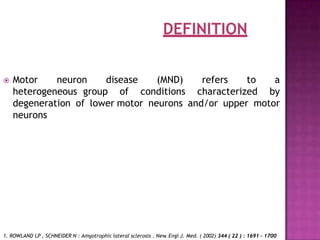
 Motor neuron disease (MND) refers to a
heterogeneous group of conditions characterized by
degeneration of lower motor neurons and/or upper motor
neurons
1. ROWLAND LP , SCHNEIDER N : Amyotrophic lateral sclerosis . New
. Engl J. Med. ( 2002) 344 ( 22 ) : 1691 - 1700
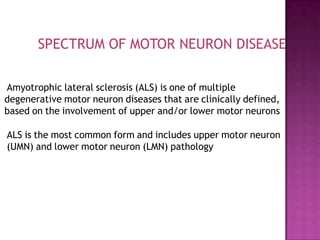
Amyotrophic lateral sclerosis (ALS) is one of multiple
degenerative motor neuron diseases that are clinically defined,
based on the involvement of upper and/or lower motor neurons
ALS is the most common form and includes upper motor neuron
(UMN) and lower motor neuron (LMN) pathology
SPECTRUM OF MOTOR NEURON DISEASE
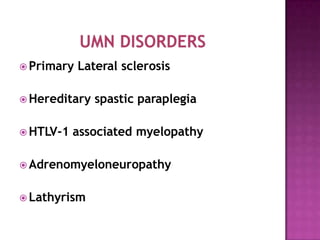
 Primary Lateral sclerosis
 Hereditary spastic paraplegia
 HTLV-1 associated myelopathy
 Adrenomyeloneuropathy
 Lathyrism
 Poliomyelitis
 Multifocal Motor Neuropathy
 Spinal Muscular Atrophy
 Bulbo-Spinal Muscular Atrophy (BSMA;
Kennedy's Syndrome; X-linked)
 Primary Muscular Atrophy (PMA)
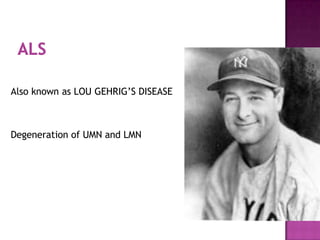
Also known as LOU GEHRIG’S DISEASE
Degeneration of UMN and LMN
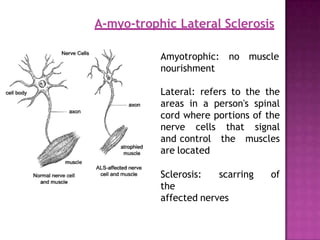
A-myo-trophic Lateral Sclerosis
Amyotrophic:
nourishment
no muscle
Lateral: refers to the the
areas in a person's spinal
cord where portions of the
nerve cells that signal
and control the muscles
are located
Sclerosis: scarring of
the
affected nerves
INCIDENCE AND PREV
ALENCE
•Incidence rates for ALS in Europe and North America range
between 1.5 and 2.7 per 100,000/year.[2]
•Prevalence rates range between 2.7 and 7.4 per 100,000 [2] .
•Incidence of ALS may be lower among African, Asian, and
Hispanic ethnic groups than among Caucasians [3].
•The male to female ratio is about 1.3 to 1.5 for sporadic ALS,
although the ratio becomes closer to unity in the age group
over 70 years.
•ALS is most commonly sporadic. Genetic or familial ALS
represents only 10 percent of all ALS
• In the United States, about 7000 new cases of ALS are
2. Worms, pm .the epidemiology of motor neuron disorder;a review of recent studies.j neuro sci 2001;191.
3. Cronin s, hardiman o,traynor BJ ethnic variation in the incidence of als ; a systemic review
.neurology 2007;68;1002.
diagnosed each year
RISK FACTORS
•The only established risk factors for ALS are age and
family history.
•Increased risk for developing ALS has been suggested for
cigarette smokers, labourers engaged in agricultural work,
factory work, heavy manual labour, exposure to welding,
and work in the plastics industry .
•Repetitive muscle use, athleticism, playing professional
soccer, trauma, and electrical shock have also been
proposed as risk factors.
•A large case-control study found no association between
physical activity and the risk of developing ALS, but did find
that increased leisure time physical activity was associated
with a younger age of onset in patients with ALS [4].
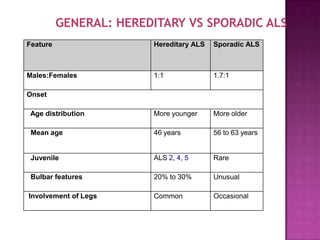
GENERAL: HEREDITARY VS SPORADIC ALS
Feature Hereditary ALS Sporadic ALS
Males:Females 1:1 1.7:1
Onset
Age distribution More younger More older
Mean age 46 years 56 to 63 years
Juvenile ALS 2, 4, 5 Rare
Bulbar features 20% to 30% Unusual
Involvement of Legs Common Occasional
•ALS is characterized by motor neuron degeneration and death
with gliosis replacing lost neurons.
•Cortical motor cells (pyramidal and Betz cells) disappear
leading to retrograde axonal loss and gliosis in the corticospinal
tract.
•This gliosis results in the bilateral white matter changes
sometimes seen in the brain magnetic resonance imaging (MRI)
of patients with ALS.
•The spinal cord becomes atrophic. The ventral roots become
thin, and there is a loss of large myelinated fibers in motor
nerves.
•The affected muscles show denervation atrophy.
PATHOLOGY
Excitotoxicity — The excitotoxicity hypothesis postulates
that excessive levels of the excitatory neurotransmitter
glutamate may initiate a cascade resulting in cellular death
of motor neurons in ALS.[9].
Excessive activation of glutamate receptors may lead to
increased entry of calcium into cells. In turn, intracellular
calcium may trigger a cascade of events that causes
neuronal cell death via
•Lipid peroxidation
•Nucleic acid damage
•and mitochondrial disruption.
9-VAN DEN BOSCH L , VAN DAMME P , BOGAERT E , ROBBERECHT W : The role of excitotoxicity in the pathogenesis
of amyotrophic lateral sclerosis. biochimica et Biophysica Acta ( 2006 ) 1762: 1068 - 1082
Apoptosis or programmed cell death cascades have been
implicated in several studies .
These reports have shown a number of the hallmarks of
apoptosis including
•DNA fragmentation
•altered expression of the antiapoptotic protein Bcl-2 [16]
Apoptosis
16-LI M , ONA VO , GUEGAN C et al. : Functional role of caspase 1 and 3 in ALS. Science ( 2000 ) 288 :335 - 339
 Loss of muscle strength
 Atrophy
 Fasciculations
 Muscle cramps
 Difficulty in chewing, swallowing & movement of
face and tongue
CLINICAL FEATURES:
LOWER MOTOR SYMPTOMS
 Slowed movements
 Loss of muscle strength
 Stiffness
 Emotional lability
CLINICAL FEATURES:
UPPER MOTOR SYMPTOMS
DIAGNOSIS OF ALS
•No biological marker has been identified yet.
•Series of clinical and neurological exams.
•MRI
•Myelogram of cervical spine (an x-ray analysis that allows
the detection of lesions in selected area of the spinal cord)
•Muscle and/or nerve biopsy
•Electromyography (EMG) and nerve conduction velocity
(NCV) to measure muscle response to nervous stimulation.
Riluzole — Three separate mechanisms of riluzole are thought
to reduce glutamate-induced excitotoxicity:
•inhibition of glutamic acid release
•noncompetitive block of NMDA receptor mediated responses
•direct action on the voltage-dependent sodium channel
Dose and side effects — The recommended dose of Riluzole is
100 mg per day.
Riluzole
SIDE EFFECTS
Very Common
Asthenia. Nausea.
Common
Alterations in liver function tests.
Headache.
Abdominal pain. Pain.
Vomiting. Dizziness. Tachycardia.
Somnolence.
Oral Paraesthesia.
Uncommon
Anaemia. Anaphylactoid reaction.
Neutropenia.
Angioedema. Pancreatitis
CONTRAINDICATIONS
•Hepatic disease or baseline transaminases greater than 3 times the upper
limit of normal or raised bilirubin.
•Pregnancy and breastfeeding
MONITORING
•Regular hepatic function blood tests (baseline then every month for 3
months, then every 3 months for a further 9 months and annually thereafter)
are recommended to monitor tolerability.
•ALT levels should be measured more frequently in patients who develop
elevated ALT levels >2x upper limit of normal.
•If patient presents with febrile illness then monitoring white blood cell count
for neutropenia is strongly recommended.
STOP TREATMENT IF
•Liver function tests – ALT greater than 5 times the upper limit of normal .
•Blood disorders - absolute neutrophil count less than 500/mm3 .
•A cephalosporin antibiotic.
•It increases expression of GL
T1
survival in MND patients.
and prolongs
•Has good brain penetration and has a good short-
term safety record.
•However
, intravenous administration is required.
13-ROTHSTEIN JD, PATEL S, REGAN MR et al. : β-lactam antibiotics offer neuroprotection by
increasing glutamate transporter expression. Nature ( 2005 ) 433: 73 - 77 .
Ceftriaxone
•IV ceftriaxone, 4 gm/day, four sequential days weekly in early 2004.
•Patient improvement was rapidly evident.
•Objective muscle strength was significantly improved and muscle
atrophy was visibly diminishing.
•After 12 weeks of assistance was no longer required for mobility,
and squats became possible for the first time since presentation.
•Ceftriaxone cessation after 12 weeks resulted in partial return of
signs and symptoms typical of als but with improvement on re-
infusion.
•Used to treat breast cancer.
•Acts as an anti-inflammatory
•Tamoxifen has been extensively used in humans and has a
good safety profile.
Tamoxifen
18-TRAYNOR BJ , BRUIJN L , CONWIT F et al. : Neuroprotective agents for clinical trials in ALS: a systematic
assessment. Neurology ( 2006 ) 67 :20 - 27 .
Stem cells
There are a number of ways in which stem cells could be beneficial
in ALS. These include
•Replacement of dying motor neurons.
•Replacement of defective glial cells.
•Sources of growth factor production.
 Spasticity
 Baclofen 5 to 10 mg twice daily to three
times daily.
 Tizanidine 2 to 4 mg by mouth twice
daily up to a total dose of 24 mg daily.
 Memantine starting at 5 mg daily,
increasing by 5 mg a week to a maximum
of 20 mg twice a day.
 Tetrazepam 50 mg at bedtime, increasing
by 25 mg a day to a maximum dose of 150
mg taken two to three times a day.
 Non-pharmacologic management
 Suction machine (not usually helpful for thick
mucus, but helpful with sialorrhea)
 Mechanical insufflation-exsufflation (In-
Exsufflator cough machine)
 Manually assisted coughing techniques
 Speech therapy often helpful early
 Computer technology offer many options to
assist with patient communication
 Urinary frequency/urgency
 In the absence of UTI, often due to spasticity that
responds well to Oxybutinin
Peripheral edema
 Often dependent: elevation, massage, compression
hose (r/o DVOT)
Laryngospasm
 Sudden reflex closure of vocal cords due to variety of
stimuli, usually resolves spontaneously
 H1 and H2 blocking agents may be helpful
THANK YOU!!!

Motor_neuron_disease.ppt

  • 2.
    DEFINITION  Motor neurondisease (MND) refers to a heterogeneous group of conditions characterized by degeneration of lower motor neurons and/or upper motor neurons 1. ROWLAND LP , SCHNEIDER N : Amyotrophic lateral sclerosis . New . Engl J. Med. ( 2002) 344 ( 22 ) : 1691 - 1700
  • 3.
    Amyotrophic lateral sclerosis(ALS) is one of multiple degenerative motor neuron diseases that are clinically defined, based on the involvement of upper and/or lower motor neurons ALS is the most common form and includes upper motor neuron (UMN) and lower motor neuron (LMN) pathology SPECTRUM OF MOTOR NEURON DISEASE
  • 4.
     Primary Lateralsclerosis  Hereditary spastic paraplegia  HTLV-1 associated myelopathy  Adrenomyeloneuropathy  Lathyrism
  • 5.
     Poliomyelitis  MultifocalMotor Neuropathy  Spinal Muscular Atrophy  Bulbo-Spinal Muscular Atrophy (BSMA; Kennedy's Syndrome; X-linked)  Primary Muscular Atrophy (PMA)
  • 6.
    Also known asLOU GEHRIG’S DISEASE Degeneration of UMN and LMN
  • 7.
    A-myo-trophic Lateral Sclerosis Amyotrophic: nourishment nomuscle Lateral: refers to the the areas in a person's spinal cord where portions of the nerve cells that signal and control the muscles are located Sclerosis: scarring of the affected nerves
  • 8.
    INCIDENCE AND PREV ALENCE •Incidencerates for ALS in Europe and North America range between 1.5 and 2.7 per 100,000/year.[2] •Prevalence rates range between 2.7 and 7.4 per 100,000 [2] . •Incidence of ALS may be lower among African, Asian, and Hispanic ethnic groups than among Caucasians [3]. •The male to female ratio is about 1.3 to 1.5 for sporadic ALS, although the ratio becomes closer to unity in the age group over 70 years. •ALS is most commonly sporadic. Genetic or familial ALS represents only 10 percent of all ALS • In the United States, about 7000 new cases of ALS are 2. Worms, pm .the epidemiology of motor neuron disorder;a review of recent studies.j neuro sci 2001;191. 3. Cronin s, hardiman o,traynor BJ ethnic variation in the incidence of als ; a systemic review .neurology 2007;68;1002. diagnosed each year
  • 9.
    RISK FACTORS •The onlyestablished risk factors for ALS are age and family history. •Increased risk for developing ALS has been suggested for cigarette smokers, labourers engaged in agricultural work, factory work, heavy manual labour, exposure to welding, and work in the plastics industry . •Repetitive muscle use, athleticism, playing professional soccer, trauma, and electrical shock have also been proposed as risk factors. •A large case-control study found no association between physical activity and the risk of developing ALS, but did find that increased leisure time physical activity was associated with a younger age of onset in patients with ALS [4].
  • 10.
    GENERAL: HEREDITARY VSSPORADIC ALS Feature Hereditary ALS Sporadic ALS Males:Females 1:1 1.7:1 Onset Age distribution More younger More older Mean age 46 years 56 to 63 years Juvenile ALS 2, 4, 5 Rare Bulbar features 20% to 30% Unusual Involvement of Legs Common Occasional
  • 11.
    •ALS is characterizedby motor neuron degeneration and death with gliosis replacing lost neurons. •Cortical motor cells (pyramidal and Betz cells) disappear leading to retrograde axonal loss and gliosis in the corticospinal tract. •This gliosis results in the bilateral white matter changes sometimes seen in the brain magnetic resonance imaging (MRI) of patients with ALS. •The spinal cord becomes atrophic. The ventral roots become thin, and there is a loss of large myelinated fibers in motor nerves. •The affected muscles show denervation atrophy. PATHOLOGY
  • 12.
    Excitotoxicity — Theexcitotoxicity hypothesis postulates that excessive levels of the excitatory neurotransmitter glutamate may initiate a cascade resulting in cellular death of motor neurons in ALS.[9]. Excessive activation of glutamate receptors may lead to increased entry of calcium into cells. In turn, intracellular calcium may trigger a cascade of events that causes neuronal cell death via •Lipid peroxidation •Nucleic acid damage •and mitochondrial disruption. 9-VAN DEN BOSCH L , VAN DAMME P , BOGAERT E , ROBBERECHT W : The role of excitotoxicity in the pathogenesis of amyotrophic lateral sclerosis. biochimica et Biophysica Acta ( 2006 ) 1762: 1068 - 1082
  • 13.
    Apoptosis or programmedcell death cascades have been implicated in several studies . These reports have shown a number of the hallmarks of apoptosis including •DNA fragmentation •altered expression of the antiapoptotic protein Bcl-2 [16] Apoptosis 16-LI M , ONA VO , GUEGAN C et al. : Functional role of caspase 1 and 3 in ALS. Science ( 2000 ) 288 :335 - 339
  • 14.
     Loss ofmuscle strength  Atrophy  Fasciculations  Muscle cramps  Difficulty in chewing, swallowing & movement of face and tongue CLINICAL FEATURES: LOWER MOTOR SYMPTOMS
  • 15.
     Slowed movements Loss of muscle strength  Stiffness  Emotional lability CLINICAL FEATURES: UPPER MOTOR SYMPTOMS
  • 17.
    DIAGNOSIS OF ALS •Nobiological marker has been identified yet. •Series of clinical and neurological exams. •MRI •Myelogram of cervical spine (an x-ray analysis that allows the detection of lesions in selected area of the spinal cord) •Muscle and/or nerve biopsy •Electromyography (EMG) and nerve conduction velocity (NCV) to measure muscle response to nervous stimulation.
  • 19.
    Riluzole — Threeseparate mechanisms of riluzole are thought to reduce glutamate-induced excitotoxicity: •inhibition of glutamic acid release •noncompetitive block of NMDA receptor mediated responses •direct action on the voltage-dependent sodium channel Dose and side effects — The recommended dose of Riluzole is 100 mg per day. Riluzole
  • 20.
    SIDE EFFECTS Very Common Asthenia.Nausea. Common Alterations in liver function tests. Headache. Abdominal pain. Pain. Vomiting. Dizziness. Tachycardia. Somnolence. Oral Paraesthesia. Uncommon Anaemia. Anaphylactoid reaction. Neutropenia. Angioedema. Pancreatitis
  • 21.
    CONTRAINDICATIONS •Hepatic disease orbaseline transaminases greater than 3 times the upper limit of normal or raised bilirubin. •Pregnancy and breastfeeding MONITORING •Regular hepatic function blood tests (baseline then every month for 3 months, then every 3 months for a further 9 months and annually thereafter) are recommended to monitor tolerability. •ALT levels should be measured more frequently in patients who develop elevated ALT levels >2x upper limit of normal. •If patient presents with febrile illness then monitoring white blood cell count for neutropenia is strongly recommended. STOP TREATMENT IF •Liver function tests – ALT greater than 5 times the upper limit of normal . •Blood disorders - absolute neutrophil count less than 500/mm3 .
  • 22.
    •A cephalosporin antibiotic. •Itincreases expression of GL T1 survival in MND patients. and prolongs •Has good brain penetration and has a good short- term safety record. •However , intravenous administration is required. 13-ROTHSTEIN JD, PATEL S, REGAN MR et al. : β-lactam antibiotics offer neuroprotection by increasing glutamate transporter expression. Nature ( 2005 ) 433: 73 - 77 . Ceftriaxone
  • 23.
    •IV ceftriaxone, 4gm/day, four sequential days weekly in early 2004. •Patient improvement was rapidly evident. •Objective muscle strength was significantly improved and muscle atrophy was visibly diminishing. •After 12 weeks of assistance was no longer required for mobility, and squats became possible for the first time since presentation. •Ceftriaxone cessation after 12 weeks resulted in partial return of signs and symptoms typical of als but with improvement on re- infusion.
  • 24.
    •Used to treatbreast cancer. •Acts as an anti-inflammatory •Tamoxifen has been extensively used in humans and has a good safety profile. Tamoxifen 18-TRAYNOR BJ , BRUIJN L , CONWIT F et al. : Neuroprotective agents for clinical trials in ALS: a systematic assessment. Neurology ( 2006 ) 67 :20 - 27 .
  • 25.
    Stem cells There area number of ways in which stem cells could be beneficial in ALS. These include •Replacement of dying motor neurons. •Replacement of defective glial cells. •Sources of growth factor production.
  • 27.
     Spasticity  Baclofen5 to 10 mg twice daily to three times daily.  Tizanidine 2 to 4 mg by mouth twice daily up to a total dose of 24 mg daily.  Memantine starting at 5 mg daily, increasing by 5 mg a week to a maximum of 20 mg twice a day.  Tetrazepam 50 mg at bedtime, increasing by 25 mg a day to a maximum dose of 150 mg taken two to three times a day.
  • 28.
     Non-pharmacologic management Suction machine (not usually helpful for thick mucus, but helpful with sialorrhea)  Mechanical insufflation-exsufflation (In- Exsufflator cough machine)  Manually assisted coughing techniques
  • 29.
     Speech therapyoften helpful early  Computer technology offer many options to assist with patient communication
  • 30.
     Urinary frequency/urgency In the absence of UTI, often due to spasticity that responds well to Oxybutinin Peripheral edema  Often dependent: elevation, massage, compression hose (r/o DVOT) Laryngospasm  Sudden reflex closure of vocal cords due to variety of stimuli, usually resolves spontaneously  H1 and H2 blocking agents may be helpful
  • 31.