Motivation
Content Theories and Process Theories
Content Theories


 Need Hierarchy Theory
 Existence Relatedness Growth Theory
 Motivation-Hygiene Theory
 Learned Needs Theory
Abraham Maslow’s Need
Hierarchy Theory


 Physiological Needs
 Safety Needs
 Social Needs
 Esteem Needs
 Self-Actualization Needs
Clayton Alderfer’s Existence
Relatedness Growth Theory


 Existence Needs (Physiological and Material Desires)
 Relatedness Needs (Interpersonal Relationships)
 Growth Needs (Intrinsic Desire to Grow, Develop, and
  Fulfill Potential)
Frederick Herzberg’s Motivation-
Hygiene Theory


 Focuses on identifying factors that arouse either positive
  or negative attitudes toward work
 Reported good feelings generally associated with the job
  itself
 Reported bad feelings generally associated with the
  environment surrounding the job
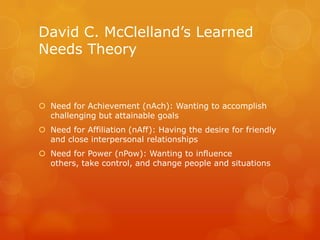
David C. McClelland’s Learned
Needs Theory


 Need for Achievement (nAch): Wanting to accomplish
  challenging but attainable goals
 Need for Affiliation (nAff): Having the desire for friendly
  and close interpersonal relationships
 Need for Power (nPow): Wanting to influence
  others, take control, and change people and situations
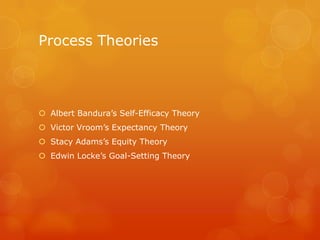
Process Theories


 Albert Bandura’s Self-Efficacy Theory
 Victor Vroom’s Expectancy Theory
 Stacy Adams’s Equity Theory
 Edwin Locke’s Goal-Setting Theory
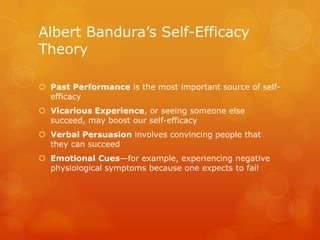
Albert Bandura’s Self-Efficacy
Theory

 Past Performance is the most important source of self-
  efficacy
 Vicarious Experience, or seeing someone else
  succeed, may boost our self-efficacy
 Verbal Persuasion involves convincing people that
  they can succeed
 Emotional Cues—for example, experiencing negative
  physiological symptoms because one expects to fail
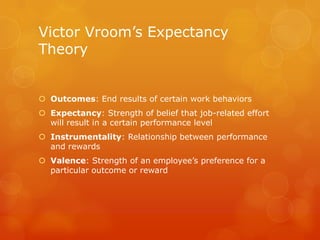
Victor Vroom’s Expectancy
Theory


 Outcomes: End results of certain work behaviors
 Expectancy: Strength of belief that job-related effort
  will result in a certain performance level
 Instrumentality: Relationship between performance
  and rewards
 Valence: Strength of an employee’s preference for a
  particular outcome or reward
Stacy Adams’s Equity Theory


 Argues that employees value the equity, or fairness, of
  their outcomes by a process of social comparison
 When these ratios are equal, the employee feels that a
  fair and equitable exchange exists
 Inequity can occur in either direction
Edwin Locke’s Goal-Setting
Theory

 Difficult goals lead to higher performance
 Specific goals lead to higher performance
 Goals direct attention, mobilize effort, increase
  persistence, and motivate searches for performance
  strategies
 Feedback is necessary
 Goal commitment is necessary
 Individual differences are not related to goal-setting
  performance

Motivation final

  • 1.
  • 2.
    Content Theories  NeedHierarchy Theory  Existence Relatedness Growth Theory  Motivation-Hygiene Theory  Learned Needs Theory
  • 3.
    Abraham Maslow’s Need HierarchyTheory  Physiological Needs  Safety Needs  Social Needs  Esteem Needs  Self-Actualization Needs
  • 4.
    Clayton Alderfer’s Existence RelatednessGrowth Theory  Existence Needs (Physiological and Material Desires)  Relatedness Needs (Interpersonal Relationships)  Growth Needs (Intrinsic Desire to Grow, Develop, and Fulfill Potential)
  • 5.
    Frederick Herzberg’s Motivation- HygieneTheory  Focuses on identifying factors that arouse either positive or negative attitudes toward work  Reported good feelings generally associated with the job itself  Reported bad feelings generally associated with the environment surrounding the job
  • 6.
    David C. McClelland’sLearned Needs Theory  Need for Achievement (nAch): Wanting to accomplish challenging but attainable goals  Need for Affiliation (nAff): Having the desire for friendly and close interpersonal relationships  Need for Power (nPow): Wanting to influence others, take control, and change people and situations
  • 7.
    Process Theories  AlbertBandura’s Self-Efficacy Theory  Victor Vroom’s Expectancy Theory  Stacy Adams’s Equity Theory  Edwin Locke’s Goal-Setting Theory
  • 8.
    Albert Bandura’s Self-Efficacy Theory Past Performance is the most important source of self- efficacy  Vicarious Experience, or seeing someone else succeed, may boost our self-efficacy  Verbal Persuasion involves convincing people that they can succeed  Emotional Cues—for example, experiencing negative physiological symptoms because one expects to fail
  • 9.
    Victor Vroom’s Expectancy Theory Outcomes: End results of certain work behaviors  Expectancy: Strength of belief that job-related effort will result in a certain performance level  Instrumentality: Relationship between performance and rewards  Valence: Strength of an employee’s preference for a particular outcome or reward
  • 10.
    Stacy Adams’s EquityTheory  Argues that employees value the equity, or fairness, of their outcomes by a process of social comparison  When these ratios are equal, the employee feels that a fair and equitable exchange exists  Inequity can occur in either direction
  • 11.
    Edwin Locke’s Goal-Setting Theory Difficult goals lead to higher performance  Specific goals lead to higher performance  Goals direct attention, mobilize effort, increase persistence, and motivate searches for performance strategies  Feedback is necessary  Goal commitment is necessary  Individual differences are not related to goal-setting performance