Trends in Assessment


 Suzanne Ehrlich, EdD
Types of
     Assessments
        Traditional -------- Authentic

   Selecting a Response ---------------------------- Performing a Task
              Contrived --------------------------- Real-life
Recall/Recognition ------------------------------ Construction/Application
  Teacher-structured -------------------------------Student-structured

  Indirect Evidence ------------------------- Direct Evidence


      Authentic also known as:
   Performance, Alternative, Direct
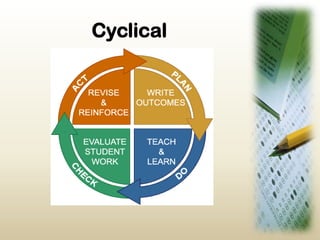
Cyclical
Real-time or post correction?
• What do you do when your assessment isn’t
  working for you? Change it in the moment or
  wait for to revise post delivery?
• In what ways do you know your assessment is
  effective? How do you measure this?
Process for developing
           assessments
• Identify standards (which do you use?)
• Write clear objectives
• Identify target performance
     (higher order cognitive skills)
• Choose performance criteria
• Create scoring rubric
• Develop instructional activities
Common activities to consider:


 •   Guided-discovery learning
 •   Interactive lecture
 •   Student teaching
 •   Problem solving
 •   Projects
 •   Self/Peer Assessment
 •   Student presentations
 •   Self-study
 •   Reading
 •   Technology
 •   Role playing
 •   Consulting
How do you design instructional
              activities?
• What resources do you use?
• Do you always consider the learning
  outcomes?
• What types of learning have you
  identified when developing activities?
• Do you include assessment of the
  activity? If so, how?
External challenges
  • Time-intensive to manage, monitor, and
    coordinate

  • Challenging to grade in a consistent manner

  • Susceptible to a more subjective (and
    potentially biased) approach to grading

  • Demanding additional instruction, orienting
    students to unfamiliar tasks such as
    emulating professional writing or
    presentations

  • Difficult to implement in large-enrollment
    courses
Corrective Feedback
•   In ESL/SLA research
•   Initial feedback should focus on effective behaviors demonstrated
    by the student.
•   Initial feedback should focus on a mastery criteria known to
    students.
•   Corrective feedback should focus on the effectiveness (or
    ineffectiveness) of the strategy employed by the student.
•   Corrective feedback should focus on error patterns, not specific
    errors.
•   Corrective feedback should use examples and nonexamples to
    help illustrate effective behavior.
•   Corrective feedback should be selective.
•   Effective feedback includes student elaboration.
•   Effective feedback focuses on increasing effort to use the strategy.
•   Effective feedback includes establishing goals for improving
    specific behaviors on subsequent attempts.
•   Effective feedback is provided immediately after the practice
    attempt and just before the next practice attempt.
Corrective feedback (cont’d)
• “Although many teachers are reluctant to provide
  what they perceive to be negative feedback
  because they are concerned about its impact on
  self-esteem and motivation, research clearly
  shows that the absence of explicit feedback can be
  considerably more detrimental to students in both
  areas.“
(Masterminds, 2001)
http://www.calhoun.k12.al.us/makes%20sense/Adobe%20Reader/DO%20NOT%20OPEN%20program%20files/Skill%20instruction/HOW%20to
%20teach%20skills/During%20Tactics/SKILL%20Feedback.pdf
Good feedback practice:

1. helps clarify what good performance is (goals, criteria, standards);
2. facilitates the development of reflection and self-assessment in learning;
3. delivers high quality feedback that helps learners self-correct;
4. encourage interaction and dialogue around learning (peer and teacher-
student);
5. encourages positive motivational beliefs and self-esteem;
6. provides opportunities to close the gap between current and desired
performance;
7. provides information to teachers that can be used to help shape their
teaching.
Examples of using other disciplines
• Free medical terminology course (http://www.dmu.edu/medterms/)

• Group feedback/evaluation for group projects
  (jfmueller.faculty.noctrl.edu/crow/altmangroupprocessrubric.pdf)

• Protocols for discussion
  (http://educon20.wikispaces.com/Protocols+Examples)
Questions for Discussion
• How might you use questioning and discussion in your classroom in a way
  that gives you formative assessment information on all students?


• How can you use assignments and tests as effective formative assessment?


• How could you design and implement a balanced assessment system that
  includes pre- and post assessments for learning?

Trendsinassessment

  • 1.
    Trends in Assessment Suzanne Ehrlich, EdD
  • 2.
    Types of Assessments Traditional -------- Authentic Selecting a Response ---------------------------- Performing a Task Contrived --------------------------- Real-life Recall/Recognition ------------------------------ Construction/Application Teacher-structured -------------------------------Student-structured Indirect Evidence ------------------------- Direct Evidence Authentic also known as: Performance, Alternative, Direct
  • 3.
  • 4.
    Real-time or postcorrection? • What do you do when your assessment isn’t working for you? Change it in the moment or wait for to revise post delivery? • In what ways do you know your assessment is effective? How do you measure this?
  • 5.
    Process for developing assessments • Identify standards (which do you use?) • Write clear objectives • Identify target performance (higher order cognitive skills) • Choose performance criteria • Create scoring rubric • Develop instructional activities
  • 6.
    Common activities toconsider: • Guided-discovery learning • Interactive lecture • Student teaching • Problem solving • Projects • Self/Peer Assessment • Student presentations • Self-study • Reading • Technology • Role playing • Consulting
  • 7.
    How do youdesign instructional activities? • What resources do you use? • Do you always consider the learning outcomes? • What types of learning have you identified when developing activities? • Do you include assessment of the activity? If so, how?
  • 8.
    External challenges • Time-intensive to manage, monitor, and coordinate • Challenging to grade in a consistent manner • Susceptible to a more subjective (and potentially biased) approach to grading • Demanding additional instruction, orienting students to unfamiliar tasks such as emulating professional writing or presentations • Difficult to implement in large-enrollment courses
  • 9.
    Corrective Feedback • In ESL/SLA research • Initial feedback should focus on effective behaviors demonstrated by the student. • Initial feedback should focus on a mastery criteria known to students. • Corrective feedback should focus on the effectiveness (or ineffectiveness) of the strategy employed by the student. • Corrective feedback should focus on error patterns, not specific errors. • Corrective feedback should use examples and nonexamples to help illustrate effective behavior. • Corrective feedback should be selective. • Effective feedback includes student elaboration. • Effective feedback focuses on increasing effort to use the strategy. • Effective feedback includes establishing goals for improving specific behaviors on subsequent attempts. • Effective feedback is provided immediately after the practice attempt and just before the next practice attempt.
  • 10.
    Corrective feedback (cont’d) •“Although many teachers are reluctant to provide what they perceive to be negative feedback because they are concerned about its impact on self-esteem and motivation, research clearly shows that the absence of explicit feedback can be considerably more detrimental to students in both areas.“ (Masterminds, 2001) http://www.calhoun.k12.al.us/makes%20sense/Adobe%20Reader/DO%20NOT%20OPEN%20program%20files/Skill%20instruction/HOW%20to %20teach%20skills/During%20Tactics/SKILL%20Feedback.pdf
  • 11.
    Good feedback practice: 1.helps clarify what good performance is (goals, criteria, standards); 2. facilitates the development of reflection and self-assessment in learning; 3. delivers high quality feedback that helps learners self-correct; 4. encourage interaction and dialogue around learning (peer and teacher- student); 5. encourages positive motivational beliefs and self-esteem; 6. provides opportunities to close the gap between current and desired performance; 7. provides information to teachers that can be used to help shape their teaching.
  • 12.
    Examples of usingother disciplines • Free medical terminology course (http://www.dmu.edu/medterms/) • Group feedback/evaluation for group projects (jfmueller.faculty.noctrl.edu/crow/altmangroupprocessrubric.pdf) • Protocols for discussion (http://educon20.wikispaces.com/Protocols+Examples)
  • 13.
    Questions for Discussion •How might you use questioning and discussion in your classroom in a way that gives you formative assessment information on all students? • How can you use assignments and tests as effective formative assessment? • How could you design and implement a balanced assessment system that includes pre- and post assessments for learning?