Motivation
By Wasaf Basit
What is motivation
• Motivation refers to all processes involved in initiating, directing, and
maintaining physical and psychological activities.
• It came from “mover” a Latin word, which means “to move”
• It refers to the factors that energizes a behavior.
• Motivation refers to the dynamics of behavior—the ways in
which our actions are initiated (begin, Start off), sustained
(continuing for an extended period or without interruption), directed,
and terminated (end)
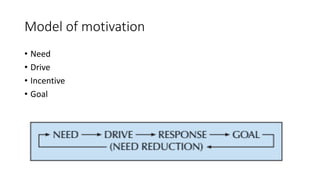
Model of motivation
• Need
• Drive
• Incentive
• Goal
• Need
An internal deficiency that may energize behavior.
It’s a state of physical deprivation that causes tension within an organism.
Drive (Motivation of action)
An uncomfortable internal state that motivates us to reduce this discomfort
through our behavior
Need leads to drive
Drive acts as a strong persistent stimulus to push an organism towards its
goal.
• Incentive
The object of the environment that activates, directs, and maintains behavior is
called incentive.
external stimuli that pull us
toward certain actions.
A reward that motivates
behavior
Goal
The target or objective of motivated behavior
The reduction of tension in the body can be considered as the goal of any
motivated behavior.
These four steps continue on and on throughout the life-course of an
organism. Because the needs are never ending, it leads to drive,
which then lead to incentive and the goal.
Types of Motivation
Intrinsic motivation
occurs when we act without any obvious external rewards. We simply
enjoy an activity or see it as an opportunity to explore, learn, and
actualize our potentials.
Intrinsic (internal) motivation refers to motivation that
comes from within.
extrinsic motivation
stems from external factors, such as pay, grades, rewards, obligations, and
approval. Most of the activities we think of as “work” are extrinsically rewarded.
Motivation that comes from outside the person, such as a reward or a threat
Motives
• Motives
A need or desire that prompts us to do something.
Types of motives
• Primary (Biogenic) motives
• Secondary (Sociogenic) motives
• Primary motives
Innate motives based on biological needs.
Motives that are essential for survival. Also known as physiological motives.
For example: Hunger, thirst, need for oxygen, regulation of body, temperature,
need for sleep, avoidance of pain, need for sex,
• Secondary motives
Motives based on learned needs, drives, and goals. Any motive acquired as a result
of interaction with others.
For example: Need for achievement, need for aggression, power motives, curiosity,
and habits.
Motivation

Motivation

  • 1.
  • 2.
    What is motivation •Motivation refers to all processes involved in initiating, directing, and maintaining physical and psychological activities. • It came from “mover” a Latin word, which means “to move” • It refers to the factors that energizes a behavior. • Motivation refers to the dynamics of behavior—the ways in which our actions are initiated (begin, Start off), sustained (continuing for an extended period or without interruption), directed, and terminated (end)
  • 3.
    Model of motivation •Need • Drive • Incentive • Goal
  • 4.
    • Need An internaldeficiency that may energize behavior. It’s a state of physical deprivation that causes tension within an organism. Drive (Motivation of action) An uncomfortable internal state that motivates us to reduce this discomfort through our behavior Need leads to drive Drive acts as a strong persistent stimulus to push an organism towards its goal.
  • 5.
    • Incentive The objectof the environment that activates, directs, and maintains behavior is called incentive. external stimuli that pull us toward certain actions. A reward that motivates behavior Goal The target or objective of motivated behavior The reduction of tension in the body can be considered as the goal of any motivated behavior.
  • 7.
    These four stepscontinue on and on throughout the life-course of an organism. Because the needs are never ending, it leads to drive, which then lead to incentive and the goal.
  • 8.
    Types of Motivation Intrinsicmotivation occurs when we act without any obvious external rewards. We simply enjoy an activity or see it as an opportunity to explore, learn, and actualize our potentials. Intrinsic (internal) motivation refers to motivation that comes from within. extrinsic motivation stems from external factors, such as pay, grades, rewards, obligations, and approval. Most of the activities we think of as “work” are extrinsically rewarded. Motivation that comes from outside the person, such as a reward or a threat
  • 9.
    Motives • Motives A needor desire that prompts us to do something. Types of motives • Primary (Biogenic) motives • Secondary (Sociogenic) motives
  • 10.
    • Primary motives Innatemotives based on biological needs. Motives that are essential for survival. Also known as physiological motives. For example: Hunger, thirst, need for oxygen, regulation of body, temperature, need for sleep, avoidance of pain, need for sex, • Secondary motives Motives based on learned needs, drives, and goals. Any motive acquired as a result of interaction with others. For example: Need for achievement, need for aggression, power motives, curiosity, and habits.