Motion is Lotion: Protecting your Long-term Health in the Workplace  Amy Flory PT 05/19/2010 NAU Employee Development Day
The workplace pain problem: 12.7% of the workforce lost productive time in a 2-week period due to a common pain condition. 1 Headache: 5.4% Back pain: 3.2% Arthritis: 2.0% Other musculoskeletal pain: 2.0%
The workplace pain problem: Average of 4.6hr/wk lost in productive time 1 . Lost productive time due to health-related reduced performance on days at work account for 4 times more lost time than absenteeism. 1 Of 23,287 annual estimated reduced effectiveness workday equivalents [related to headache], 64% were due to tension-type and other headache types, and 36% were due to migraine. 2
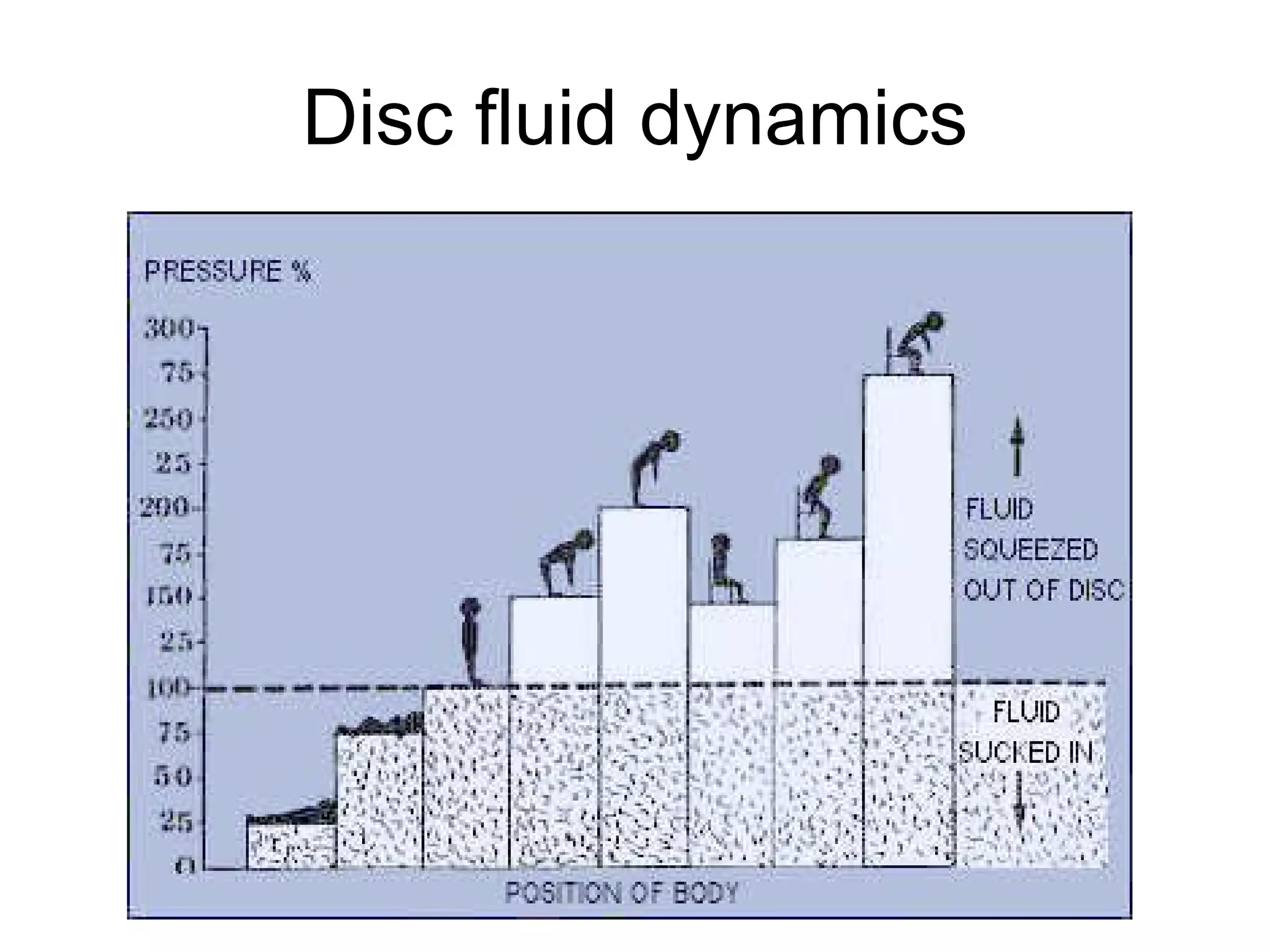
The role of sitting in pain conditions at the workplace Flattening of the lumbar curve increases stresses 3,4  on the intervertebral discs and is associated with accelerated disc degeneration 5 . Contemporary seating designs aim to decrease disc pressure, but more recent studies indicate that pressure is not the likely culprit in development of LBP 6 .
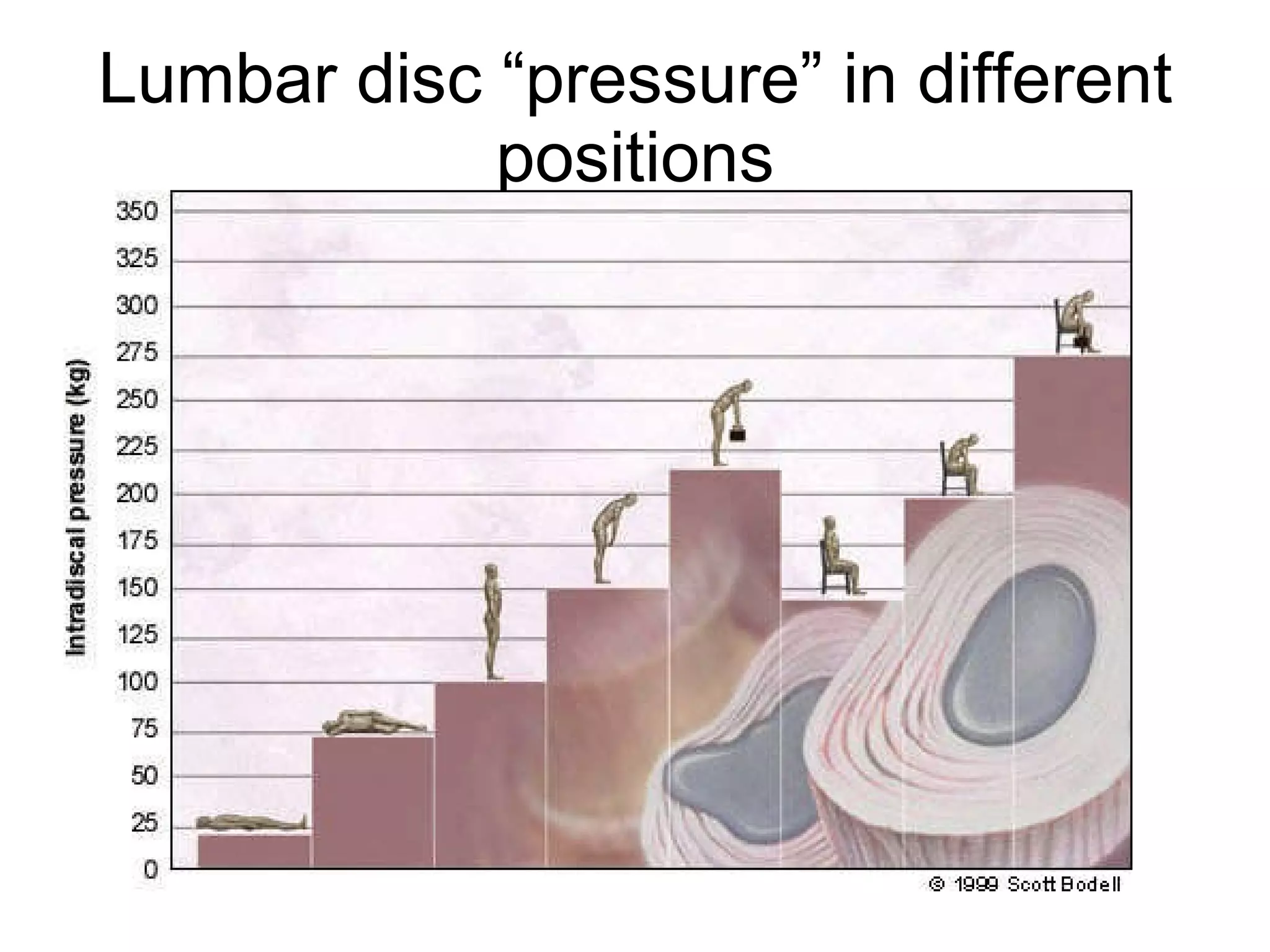
Lumbar disc “pressure” in different positions
The problem of recommendations based on disc pressure Disc “pressure” measurements actually measure pressure as well as other stresses (shear forces, for example). Activities in which disc “pressure” is also high are not associated with increased disc degeneration or low back pain. Perhaps the lack of activity is the reason sitting accelerates disc problems as well as back pain.
Disc fluid dynamics
Disc fluid dynamics There is no direct blood supply to the disc. The disc receives nutrition from the fluid flow within the disc material 10 . Motion may “pump” fluid through disc material.
The role of sitting in pain conditions at the workplace Neck pain is associated with prolonged sedentary postures at work 7 . Office workers with neck pain adopt even more of a “forward head” posture when distracted 8 . The “forward head” posture is strongly associated with chronic headaches 9 .
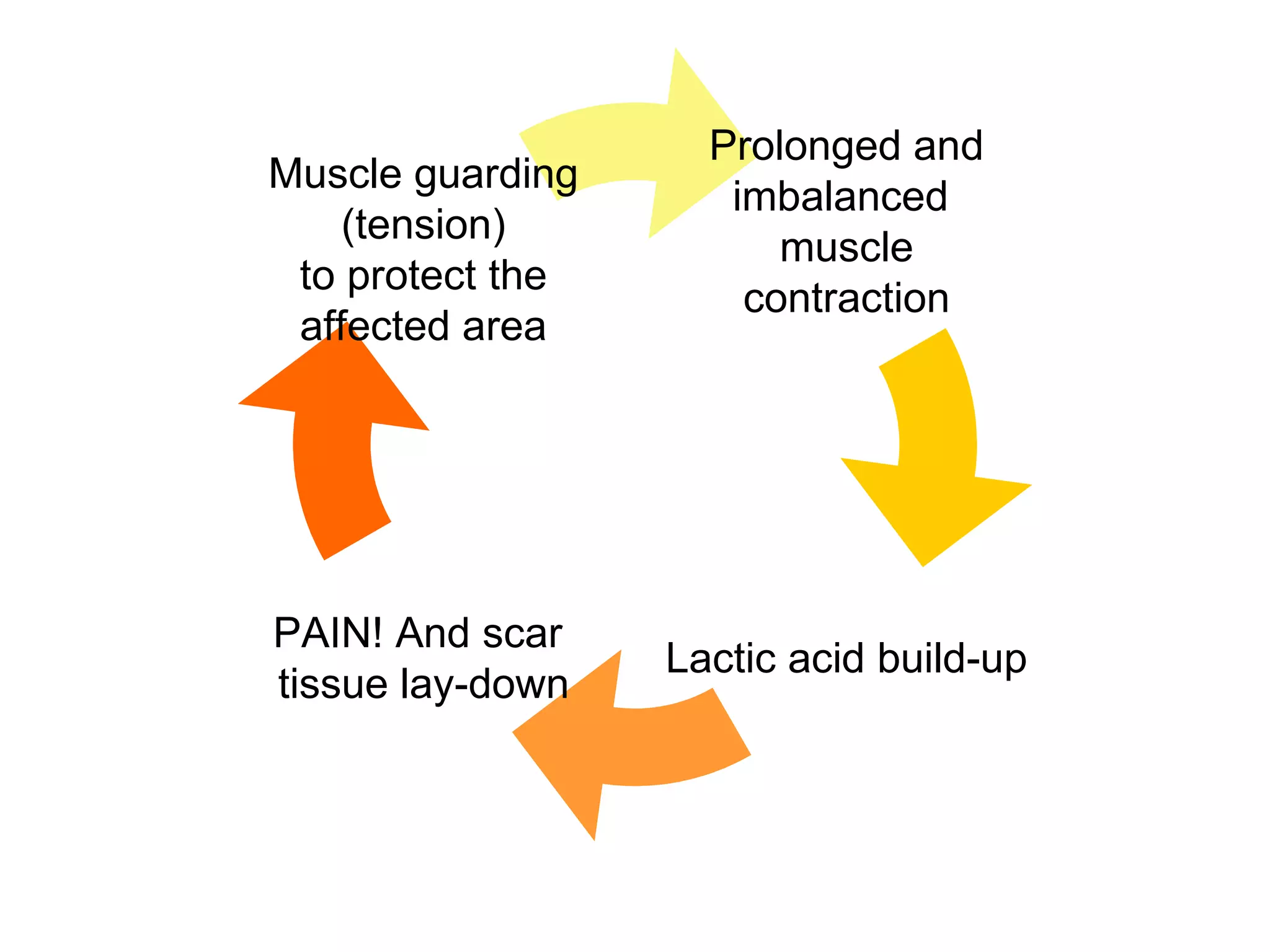
Prolonged and imbalanced  muscle contraction PAIN! And scar  tissue lay-down Muscle guarding (tension) to protect the affected area Lactic acid build-up
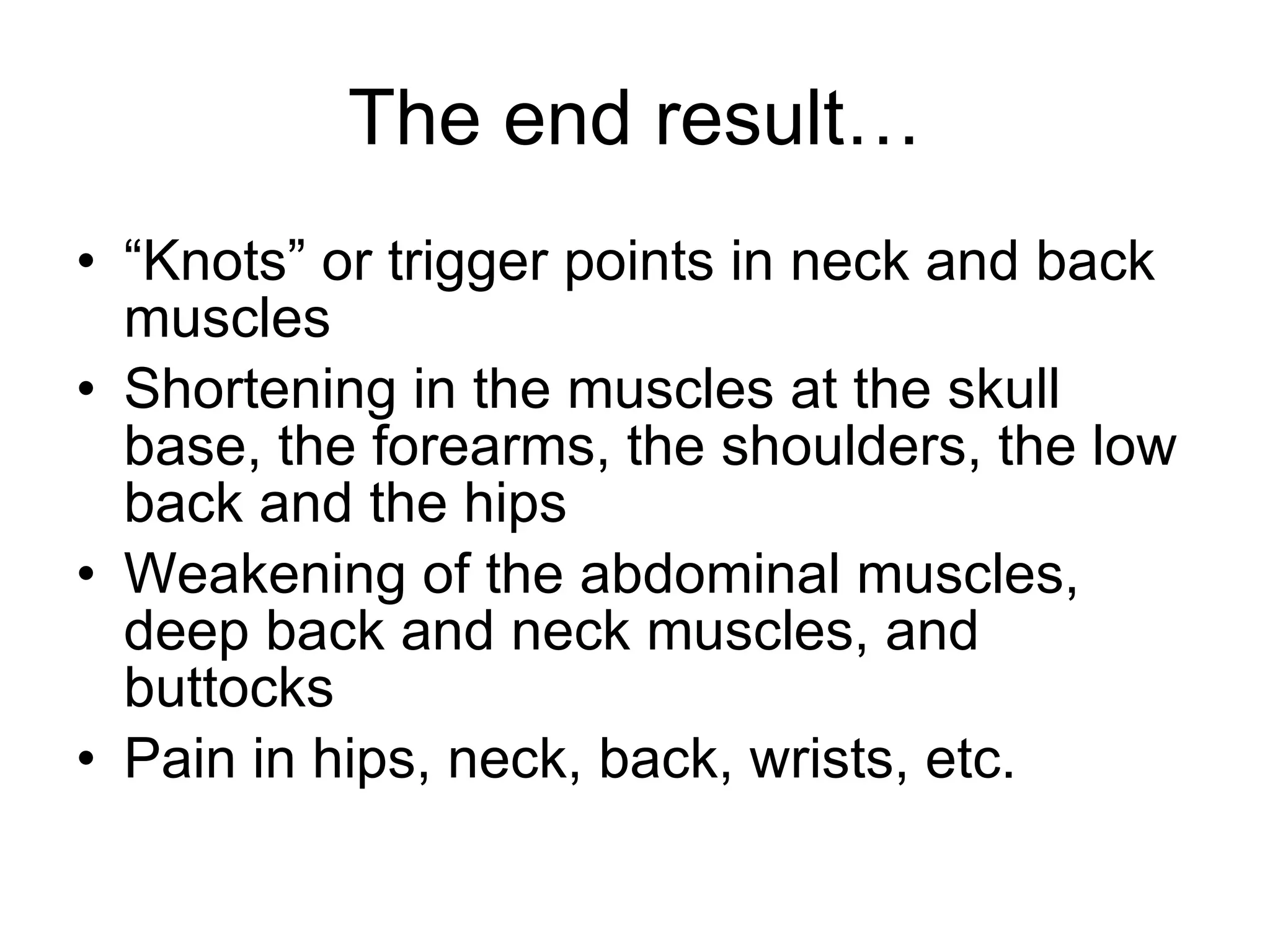
The end result… “Knots” or trigger points in neck and back muscles Shortening in the muscles at the skull base, the forearms, the shoulders, the low back and the hips Weakening of the abdominal muscles, deep back and neck muscles, and buttocks Pain in hips, neck, back, wrists, etc.
 
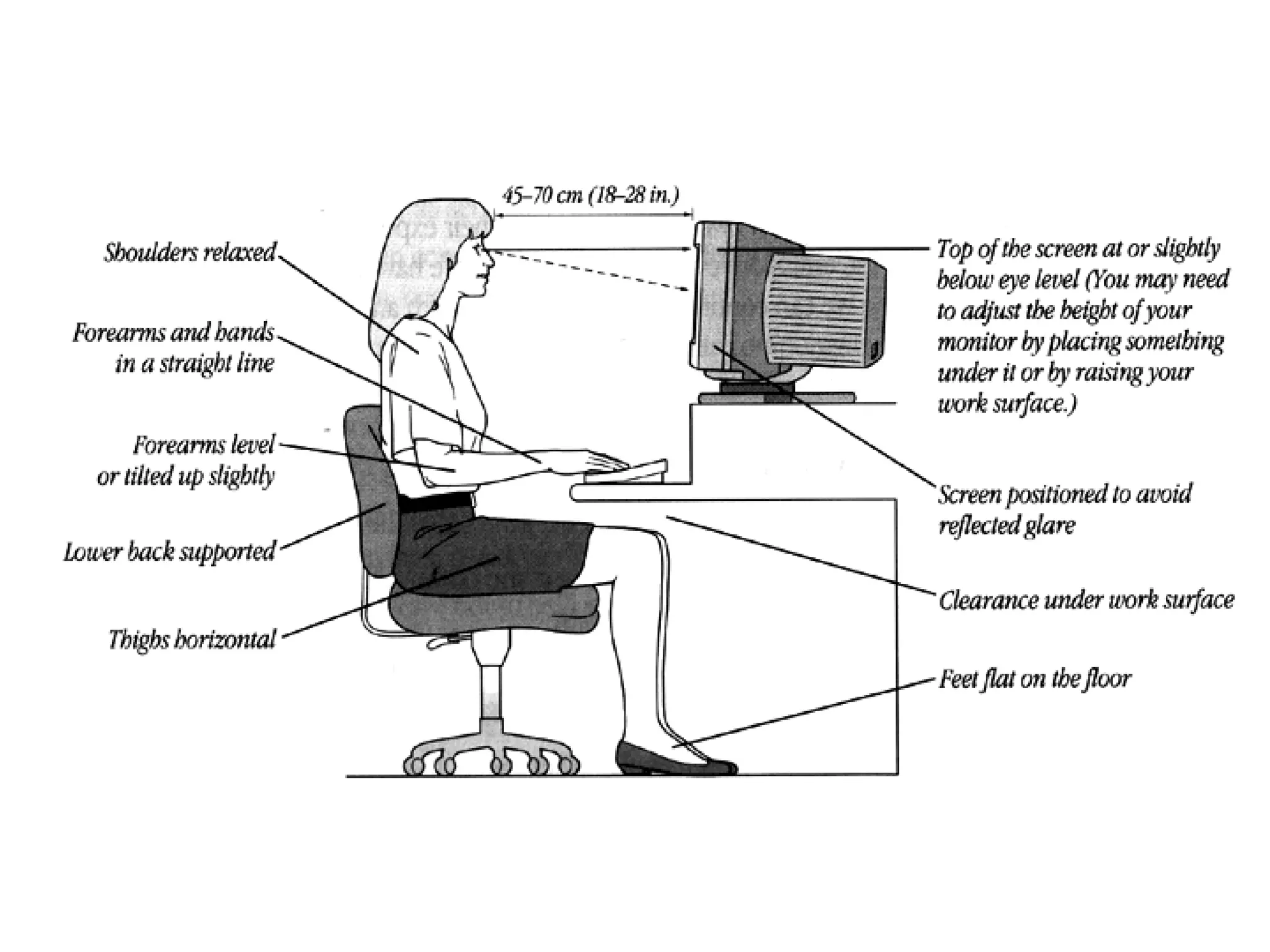
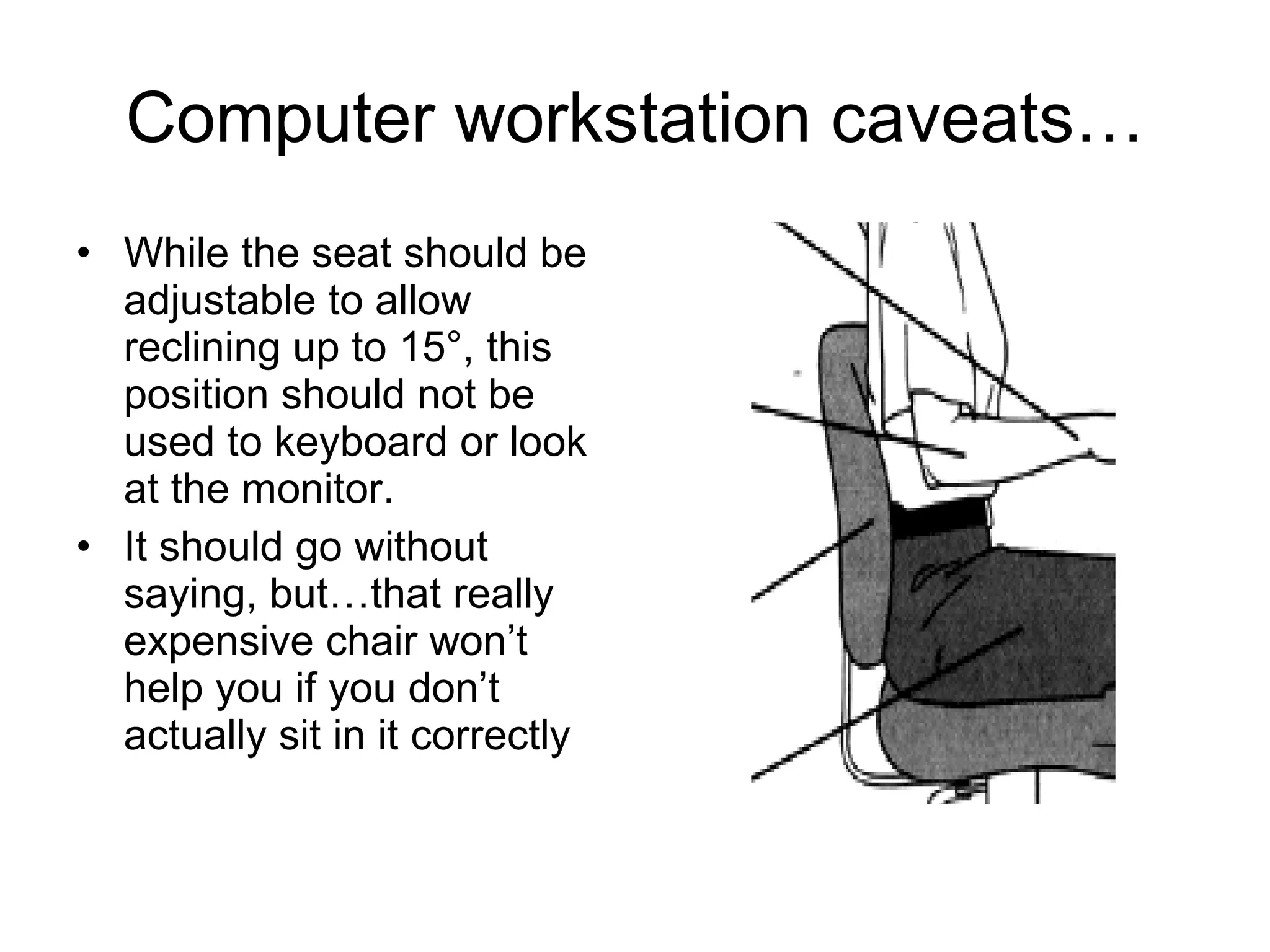
Computer workstation caveats… While the seat should be adjustable to allow reclining up to 15°, this position should not be used to keyboard or look at the monitor. It should go without saying, but…that really expensive chair won’t help you if you don’t actually sit in it correctly
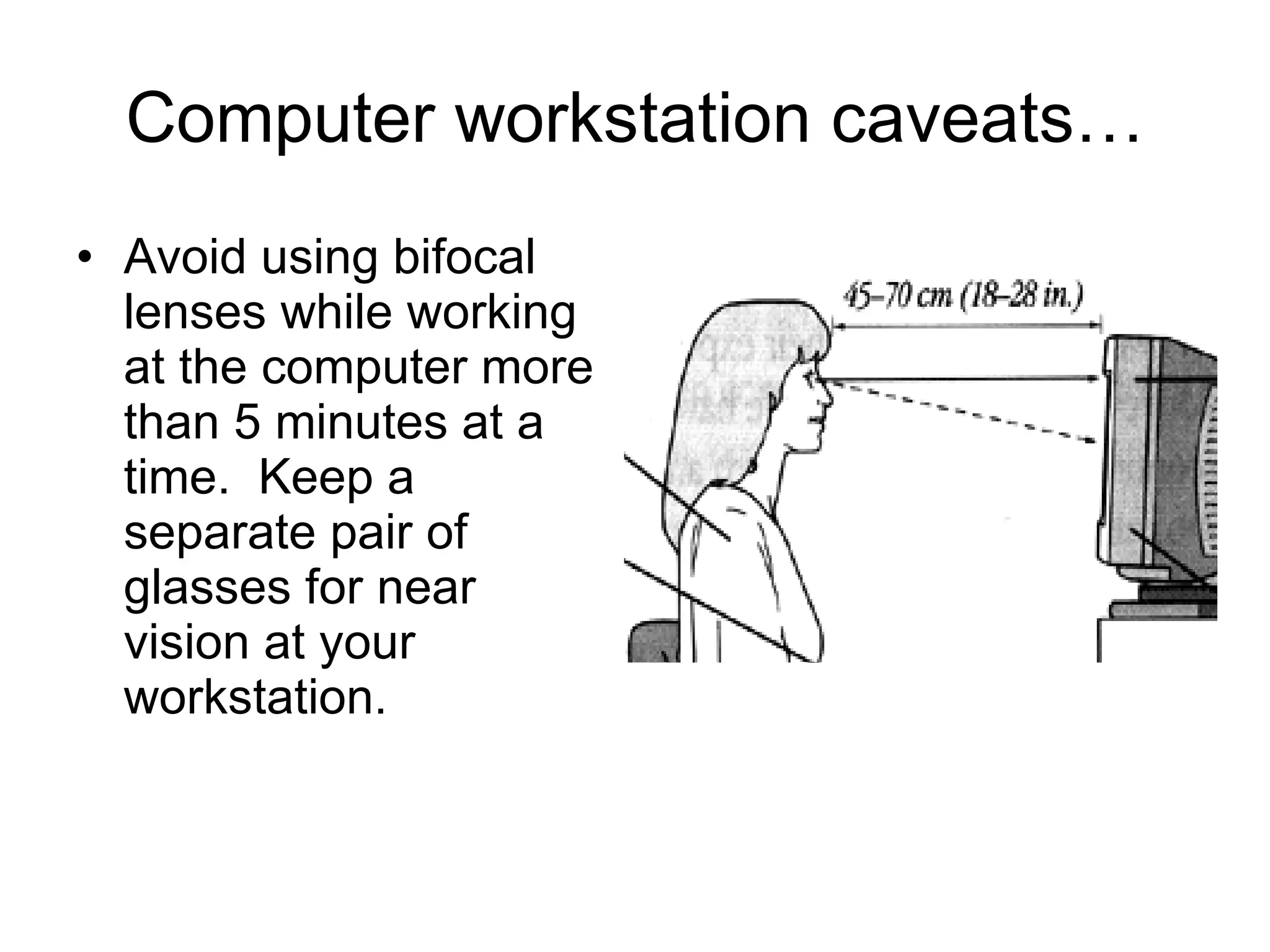
Computer workstation caveats… Avoid using bifocal lenses while working at the computer more than 5 minutes at a time.  Keep a separate pair of glasses for near vision at your workstation.
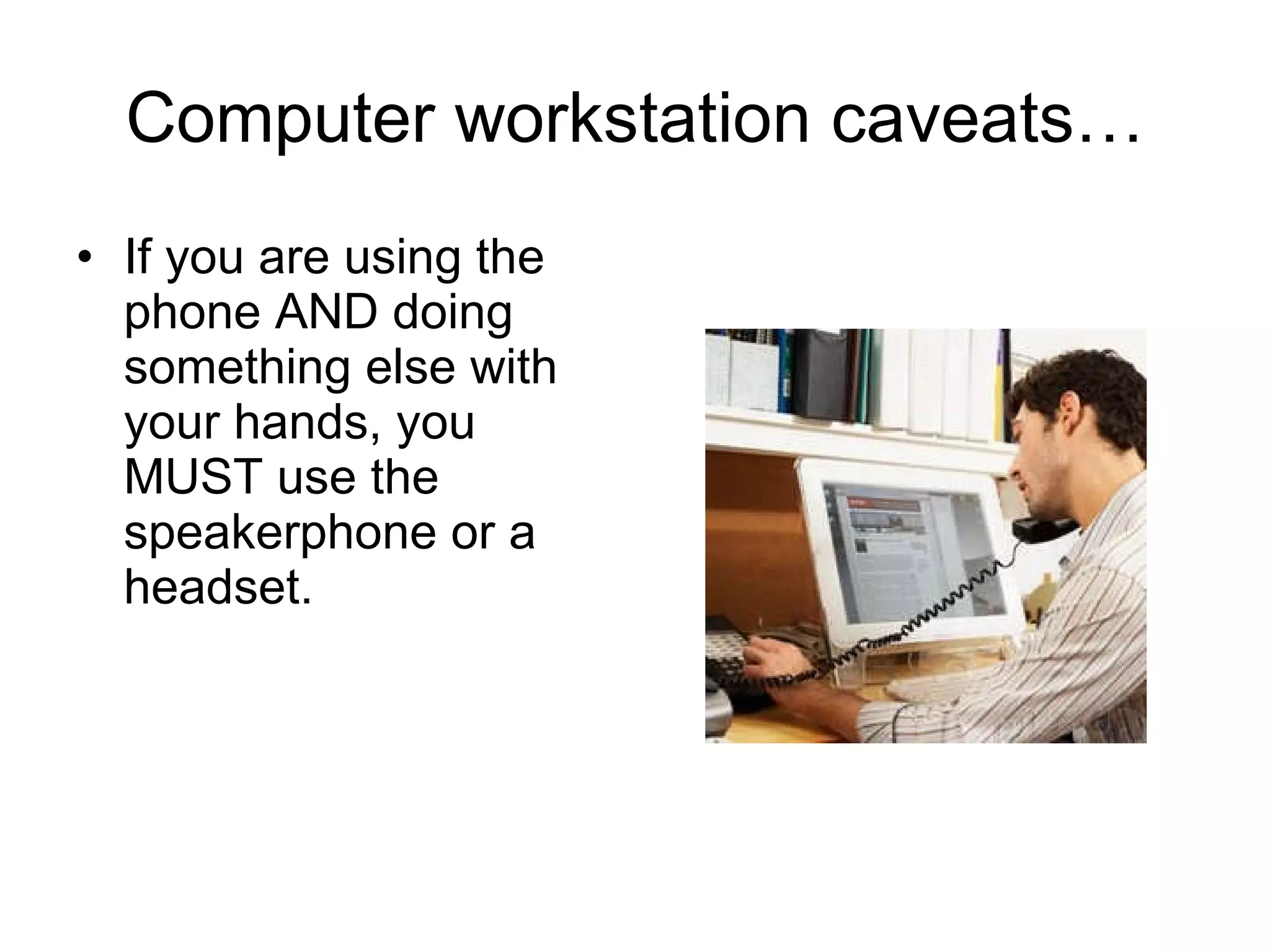
Computer workstation caveats… If you are using the phone AND doing something else with your hands, you MUST use the speakerphone or a headset.
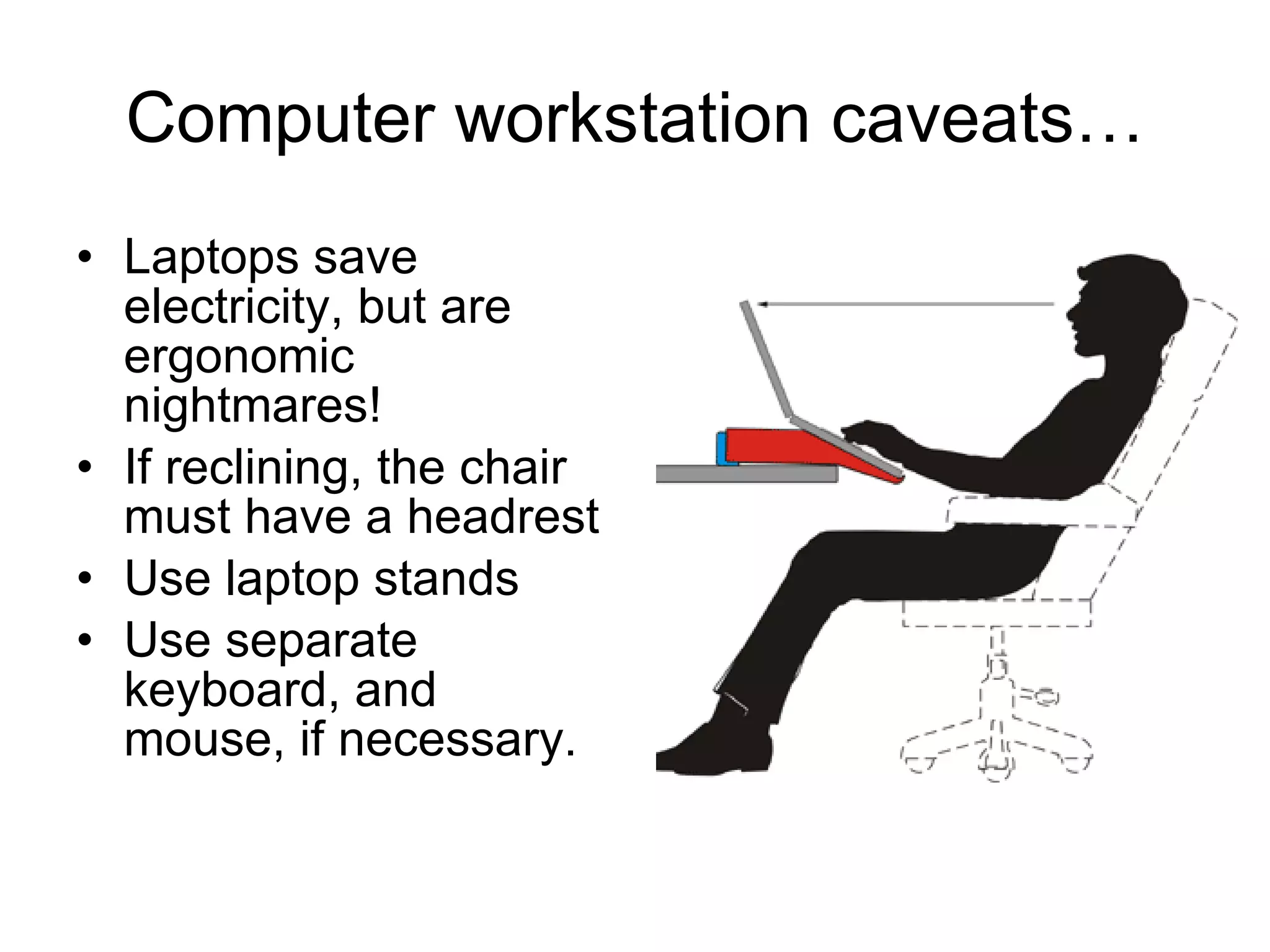
Computer workstation caveats… Laptops save electricity, but are ergonomic nightmares! If reclining, the chair must have a headrest Use laptop stands Use separate keyboard, and mouse, if necessary.
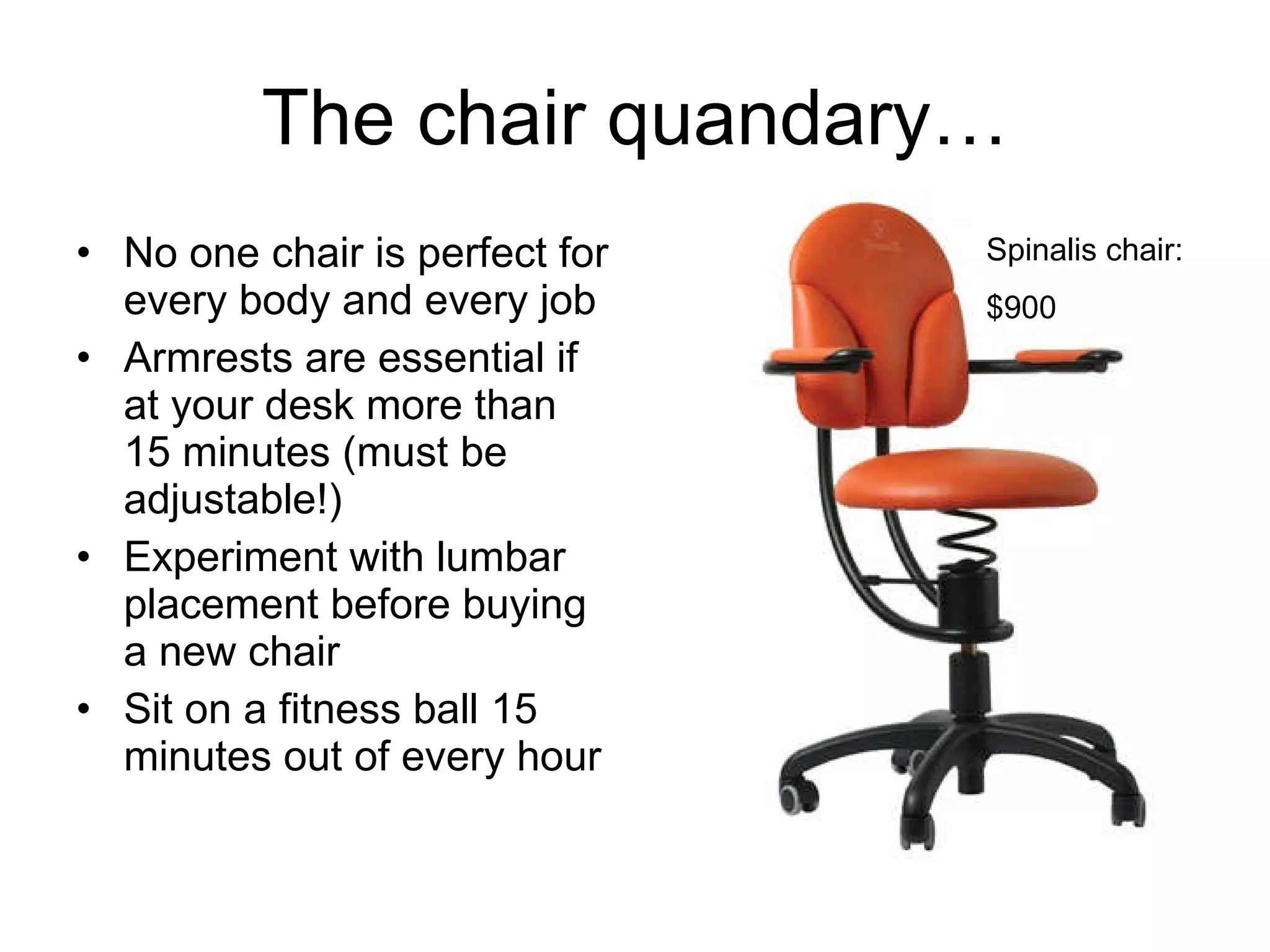
The chair quandary… No one chair is perfect for every body and every job Armrests are essential if at your desk more than 15 minutes (must be adjustable!) Experiment with lumbar placement before buying a new chair Sit on a fitness ball 15 minutes out of every hour Spinalis chair: $900
The antidote for the chair: DO NOT USE THE CHAIR!! Get out of the chair every 20 minutes Do some stretches http://ehs.concordia.ca/ih/ergonomics/exercises.html Stand up on your tiptoes or march in place while talking on the phone Stand instead of sit at the conference table
Stretch break
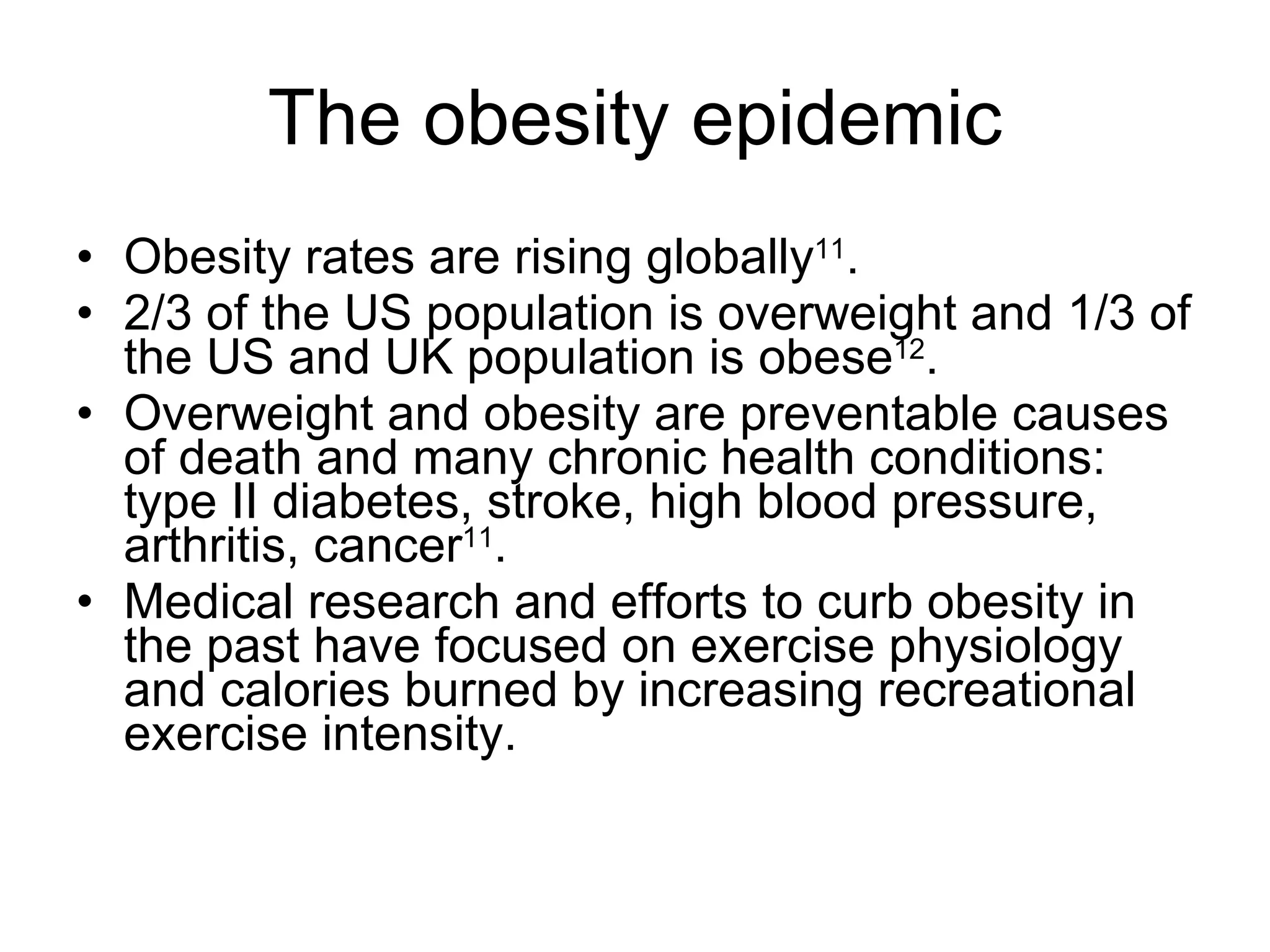
The obesity epidemic Obesity rates are rising globally 11 . 2/3 of the US population is overweight and 1/3 of the US and UK population is obese 12 . Overweight and obesity are preventable causes of death and many chronic health conditions: type II diabetes, stroke, high blood pressure, arthritis, cancer 11 . Medical research and efforts to curb obesity in the past have focused on exercise physiology and calories burned by increasing recreational exercise intensity.
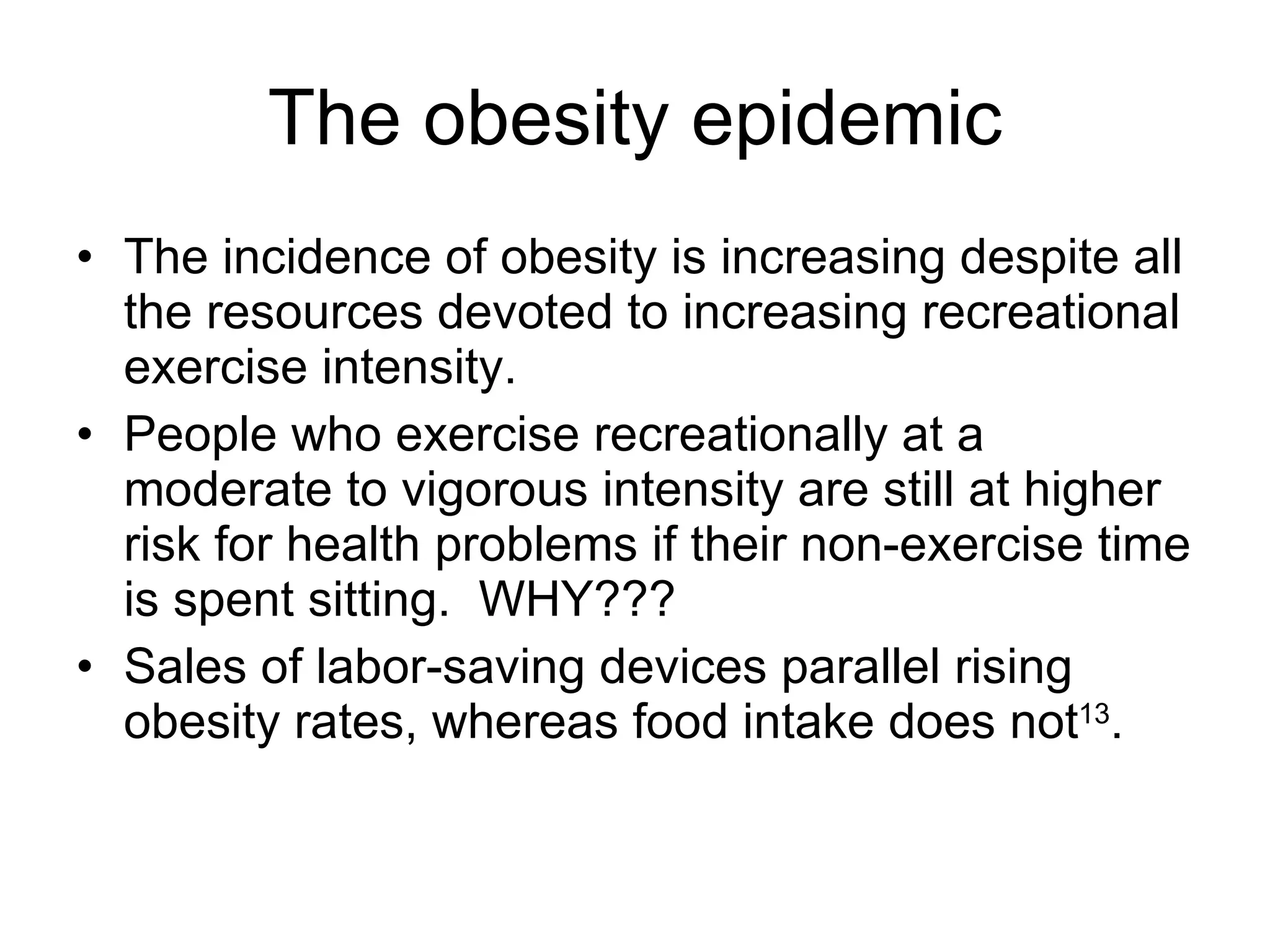
The obesity epidemic The incidence of obesity is increasing despite all the resources devoted to increasing recreational exercise intensity. People who exercise recreationally at a moderate to vigorous intensity are still at higher risk for health problems if their non-exercise time is spent sitting.  WHY??? Sales of labor-saving devices parallel rising obesity rates, whereas food intake does not 13 .
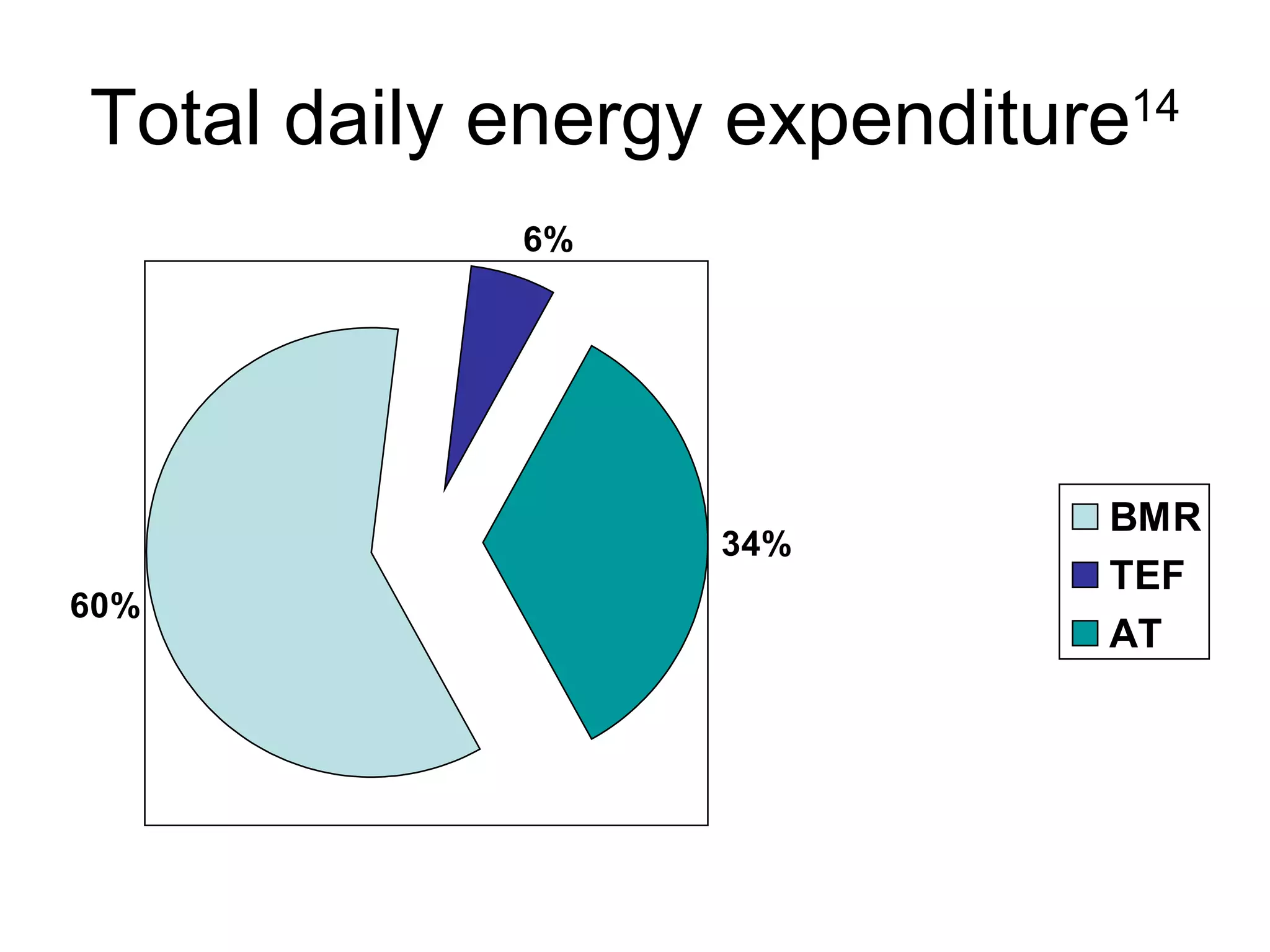
Total daily energy expenditure 14
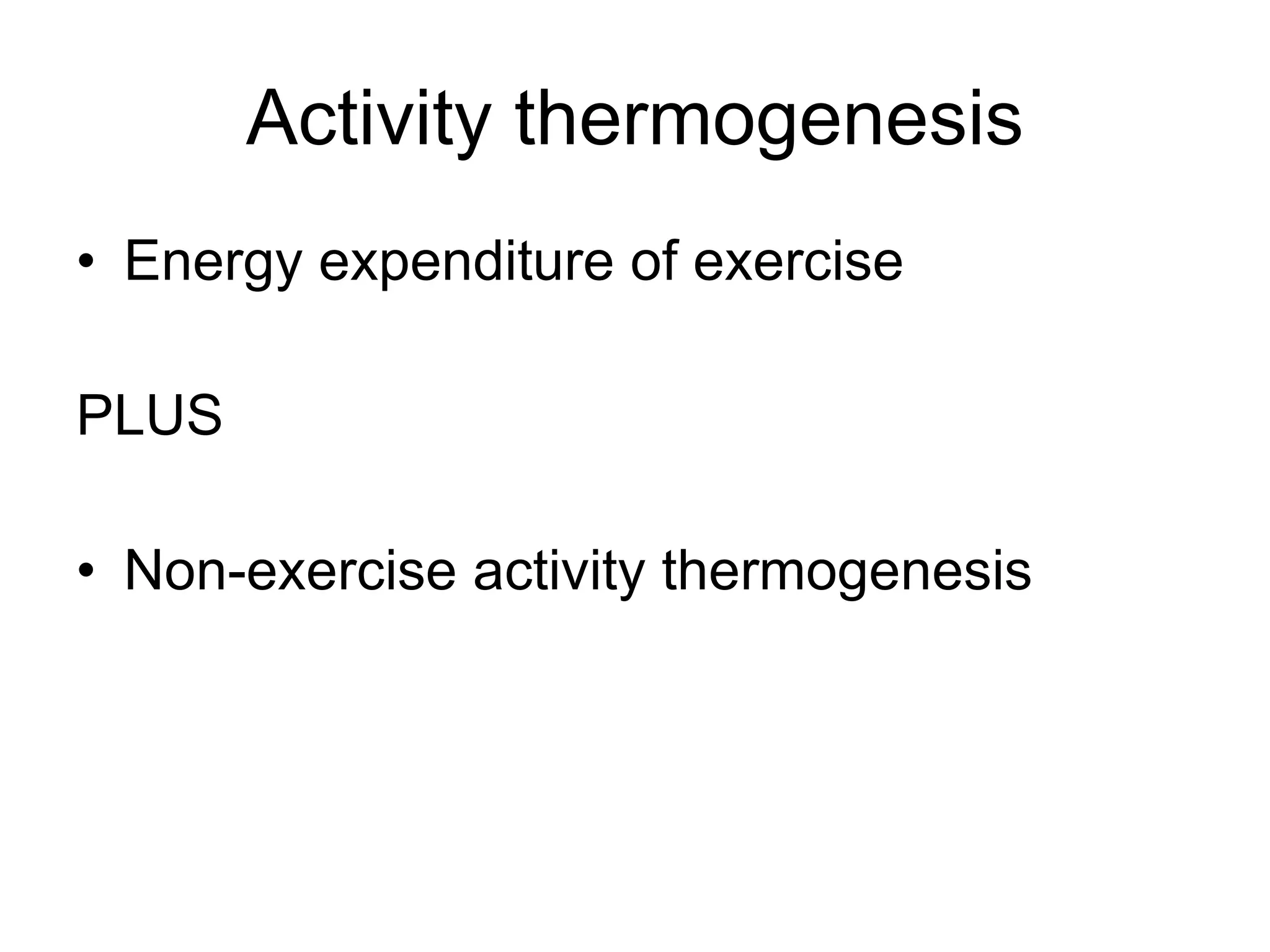
Activity thermogenesis Energy expenditure of exercise PLUS Non-exercise activity thermogenesis
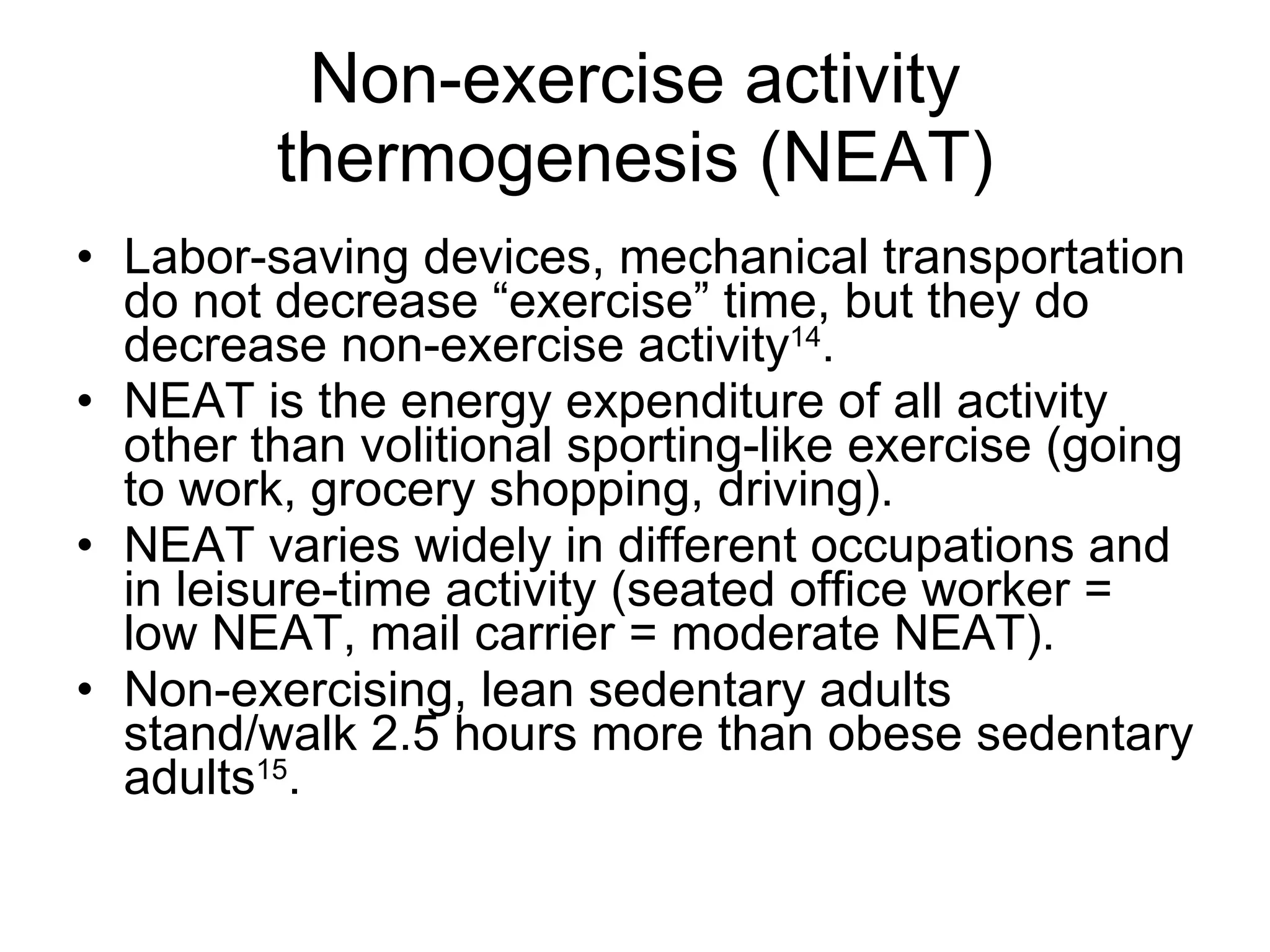
Non-exercise activity thermogenesis (NEAT) Labor-saving devices, mechanical transportation do not decrease “exercise” time, but they do decrease non-exercise activity 14 . NEAT is the energy expenditure of all activity other than volitional sporting-like exercise (going to work, grocery shopping, driving). NEAT varies widely in different occupations and in leisure-time activity (seated office worker = low NEAT, mail carrier = moderate NEAT). Non-exercising, lean sedentary adults stand/walk 2.5 hours more than obese sedentary adults 15 .
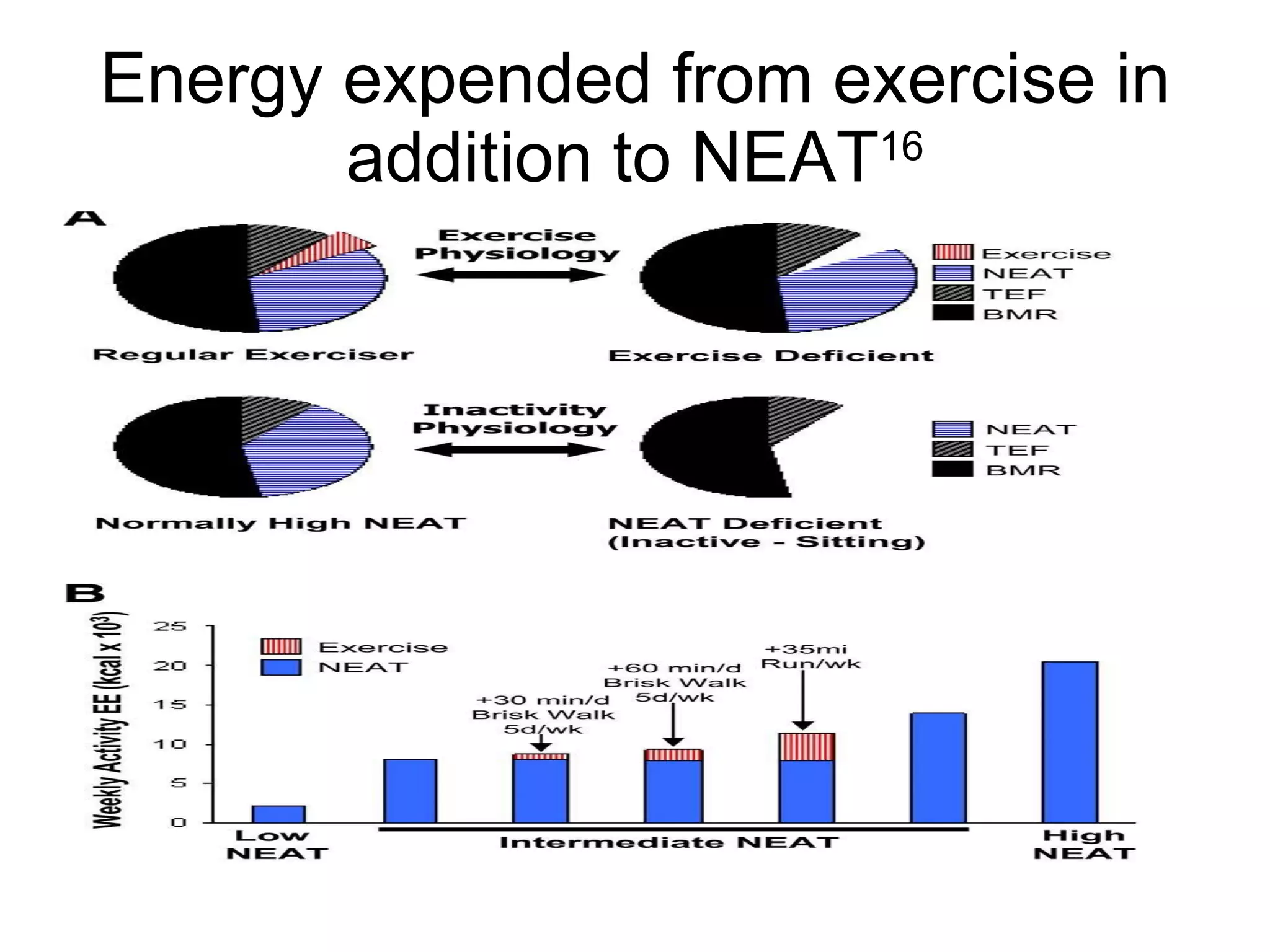
Energy expended from exercise in addition to NEAT 16
Walk and work desk 18 http://www.mayoclinic.com/health/treadmill-desk/MM00706
Inactivity physiology The “act” of sitting results in specific cellular signals, not simply the lack of the signals resulting from exercise 16 . Non-exercise activity (and sitting time) are associated with elevated rates of metabolic syndrome, type 2 diabetes, cardiovascular disease, and obesity 17 . There is much research to be done! There are no specific recommendations yet, however…
2 birds with 1 stone—what a deal! Many of the recommendations for decreasing musculoskeletal stresses will also stimulate large muscle contractions that appear to be important in thermogenesis and modulating scary cellular signals.
Talk is cheap Changing habits is never easy. Use of technology (walk over to your co-worker instead of using email?) Type of footwear! Changing workplace culture is certainly not easy. Standing meetings?  Walking meetings?  Will someone feel too short?  Too slow?  Left out? Change requires consistent cuing from outside ourselves.  We can cue others, but we also need cues from them.
Jump around!
References 1.  Stewart W; Ricci J; Chee E; et al. Lost Productive Time and Cost Due to Common Pain Conditions in the US Workforce.  JAMA  2003;290(18):2443-2454 2. Schwartz, B; et al. Lost workdays and decreased work effectiveness associated with headache in the workplace.  JOEM  1997;39(4):320  3. Adams MA, McNally DS, Chinn H, et al. Posture and the compressive strength of the lumbar spine.  Clin Biomech  1994;9:5–14.
References, cont’d 4. Keegan JJ. Alterations of the lumbar curve related to posture and seating.  J Bone Joint Surg Am  1953;35:589–603. 5. Farfan HF, Huberdeau RM, Dubow HI. Lumbar intervertebral disc degeneration.  J Bone Joint Surg Am  1972;54:492–510. 6. Claus A, Hides J, Moseley GL, Hodges P. Sitting versus standing: does the intradiscal pressure cause disc degeneration or low back pain? J Electromyogr Kinesiol 2008 Aug;18(4):550-8.
References, cont’d 7. Ariens G, Mechelen WV, Bongers PW, Bouter LM, van der Wal G .  Physical risk factors for neck pain.  Scand J Work Environ Health  2000;26(1):7- 19. 8. Szeto GP, Straker LM, O’Sullivan PB. A comparison of symptomatic and asymptomatic office workers performing monotonous keyboard work.  Man Ther  2005;10:281–291. 9. Watson DH, Trott   PH. Cervical Headache: an investigation of natural head posture and upper cervical flexor muscle performance.  Cephalalgia  1993;13(4), 272-284
References, cont’d 10.Adams MA, Hutton, WC. The effect of posture on the fluid content of lumbar intervertebral discs.  Spine  1983;8(6) 11.World Health Organization. Obesity: preventing and managing the global epidemic. Geneva, Switzerland; 1997. 12.Wyatt SB, Winters KP, Dubbert PM. Overweight and obesity: prevalence, consequences, and causes of a growing public health problem.  Am J Med Sci  2006;331:166-74
References, cont’d 13.Lanningham-Foster L, Nysse LJ, Levine JA. Labor saved, calories lost: the energetic impact of domestic labor-saving devices.  Obes Res  2003;11:1178-1181 14.Levine JA, Vander Weg MW, Hill JO, Klesges RC. Non-exercise activity thermogenesis: the crouching tiger hidden dragon of societal weight gain.  Arterioscler. Thromb. Vasc. Biol.  2006;26:729-736. 15.Levine JA, Lanningham-Foster LM, McCrady SK, et al. Interindividual variation in posture allocation: possible role in human obesity.  Science . 2006;307(5709):584-6
References, cont’d 16.Hamilton MT, Hamilton DB, Zderic TW. Role of low energy expenditure and sitting in obesity, metabolic syndrome, type 2 diabetes, and cardiovascular disease.  Diabetes  2007;56:2655-67. 17.Manini TM, Everhart JE, Patel KV; et al. Daily activity energy expenditure and mortality among older adults.  JAMA  2006;296:171-179. 18.Levine JA, Miller JM. The energy expenditure of using a “walk-and-work” desk for office workers with obesity.  Br J Sports Med  2007;41:558-61.

Motion is lotion

  • 1.
    Motion is Lotion:Protecting your Long-term Health in the Workplace Amy Flory PT 05/19/2010 NAU Employee Development Day
  • 2.
    The workplace painproblem: 12.7% of the workforce lost productive time in a 2-week period due to a common pain condition. 1 Headache: 5.4% Back pain: 3.2% Arthritis: 2.0% Other musculoskeletal pain: 2.0%
  • 3.
    The workplace painproblem: Average of 4.6hr/wk lost in productive time 1 . Lost productive time due to health-related reduced performance on days at work account for 4 times more lost time than absenteeism. 1 Of 23,287 annual estimated reduced effectiveness workday equivalents [related to headache], 64% were due to tension-type and other headache types, and 36% were due to migraine. 2
  • 4.
    The role ofsitting in pain conditions at the workplace Flattening of the lumbar curve increases stresses 3,4 on the intervertebral discs and is associated with accelerated disc degeneration 5 . Contemporary seating designs aim to decrease disc pressure, but more recent studies indicate that pressure is not the likely culprit in development of LBP 6 .
  • 5.
    Lumbar disc “pressure”in different positions
  • 6.
    The problem ofrecommendations based on disc pressure Disc “pressure” measurements actually measure pressure as well as other stresses (shear forces, for example). Activities in which disc “pressure” is also high are not associated with increased disc degeneration or low back pain. Perhaps the lack of activity is the reason sitting accelerates disc problems as well as back pain.
  • 7.
  • 8.
    Disc fluid dynamicsThere is no direct blood supply to the disc. The disc receives nutrition from the fluid flow within the disc material 10 . Motion may “pump” fluid through disc material.
  • 9.
    The role ofsitting in pain conditions at the workplace Neck pain is associated with prolonged sedentary postures at work 7 . Office workers with neck pain adopt even more of a “forward head” posture when distracted 8 . The “forward head” posture is strongly associated with chronic headaches 9 .
  • 10.
    Prolonged and imbalanced muscle contraction PAIN! And scar tissue lay-down Muscle guarding (tension) to protect the affected area Lactic acid build-up
  • 11.
    The end result…“Knots” or trigger points in neck and back muscles Shortening in the muscles at the skull base, the forearms, the shoulders, the low back and the hips Weakening of the abdominal muscles, deep back and neck muscles, and buttocks Pain in hips, neck, back, wrists, etc.
  • 12.
  • 13.
    Computer workstation caveats…While the seat should be adjustable to allow reclining up to 15°, this position should not be used to keyboard or look at the monitor. It should go without saying, but…that really expensive chair won’t help you if you don’t actually sit in it correctly
  • 14.
    Computer workstation caveats…Avoid using bifocal lenses while working at the computer more than 5 minutes at a time. Keep a separate pair of glasses for near vision at your workstation.
  • 15.
    Computer workstation caveats…If you are using the phone AND doing something else with your hands, you MUST use the speakerphone or a headset.
  • 16.
    Computer workstation caveats…Laptops save electricity, but are ergonomic nightmares! If reclining, the chair must have a headrest Use laptop stands Use separate keyboard, and mouse, if necessary.
  • 17.
    The chair quandary…No one chair is perfect for every body and every job Armrests are essential if at your desk more than 15 minutes (must be adjustable!) Experiment with lumbar placement before buying a new chair Sit on a fitness ball 15 minutes out of every hour Spinalis chair: $900
  • 18.
    The antidote forthe chair: DO NOT USE THE CHAIR!! Get out of the chair every 20 minutes Do some stretches http://ehs.concordia.ca/ih/ergonomics/exercises.html Stand up on your tiptoes or march in place while talking on the phone Stand instead of sit at the conference table
  • 19.
  • 20.
    The obesity epidemicObesity rates are rising globally 11 . 2/3 of the US population is overweight and 1/3 of the US and UK population is obese 12 . Overweight and obesity are preventable causes of death and many chronic health conditions: type II diabetes, stroke, high blood pressure, arthritis, cancer 11 . Medical research and efforts to curb obesity in the past have focused on exercise physiology and calories burned by increasing recreational exercise intensity.
  • 21.
    The obesity epidemicThe incidence of obesity is increasing despite all the resources devoted to increasing recreational exercise intensity. People who exercise recreationally at a moderate to vigorous intensity are still at higher risk for health problems if their non-exercise time is spent sitting. WHY??? Sales of labor-saving devices parallel rising obesity rates, whereas food intake does not 13 .
  • 22.
    Total daily energyexpenditure 14
  • 23.
    Activity thermogenesis Energyexpenditure of exercise PLUS Non-exercise activity thermogenesis
  • 24.
    Non-exercise activity thermogenesis(NEAT) Labor-saving devices, mechanical transportation do not decrease “exercise” time, but they do decrease non-exercise activity 14 . NEAT is the energy expenditure of all activity other than volitional sporting-like exercise (going to work, grocery shopping, driving). NEAT varies widely in different occupations and in leisure-time activity (seated office worker = low NEAT, mail carrier = moderate NEAT). Non-exercising, lean sedentary adults stand/walk 2.5 hours more than obese sedentary adults 15 .
  • 25.
    Energy expended fromexercise in addition to NEAT 16
  • 26.
    Walk and workdesk 18 http://www.mayoclinic.com/health/treadmill-desk/MM00706
  • 27.
    Inactivity physiology The“act” of sitting results in specific cellular signals, not simply the lack of the signals resulting from exercise 16 . Non-exercise activity (and sitting time) are associated with elevated rates of metabolic syndrome, type 2 diabetes, cardiovascular disease, and obesity 17 . There is much research to be done! There are no specific recommendations yet, however…
  • 28.
    2 birds with1 stone—what a deal! Many of the recommendations for decreasing musculoskeletal stresses will also stimulate large muscle contractions that appear to be important in thermogenesis and modulating scary cellular signals.
  • 29.
    Talk is cheapChanging habits is never easy. Use of technology (walk over to your co-worker instead of using email?) Type of footwear! Changing workplace culture is certainly not easy. Standing meetings? Walking meetings? Will someone feel too short? Too slow? Left out? Change requires consistent cuing from outside ourselves. We can cue others, but we also need cues from them.
  • 30.
  • 31.
    References 1. Stewart W; Ricci J; Chee E; et al. Lost Productive Time and Cost Due to Common Pain Conditions in the US Workforce. JAMA 2003;290(18):2443-2454 2. Schwartz, B; et al. Lost workdays and decreased work effectiveness associated with headache in the workplace. JOEM 1997;39(4):320 3. Adams MA, McNally DS, Chinn H, et al. Posture and the compressive strength of the lumbar spine. Clin Biomech 1994;9:5–14.
  • 32.
    References, cont’d 4.Keegan JJ. Alterations of the lumbar curve related to posture and seating. J Bone Joint Surg Am 1953;35:589–603. 5. Farfan HF, Huberdeau RM, Dubow HI. Lumbar intervertebral disc degeneration. J Bone Joint Surg Am 1972;54:492–510. 6. Claus A, Hides J, Moseley GL, Hodges P. Sitting versus standing: does the intradiscal pressure cause disc degeneration or low back pain? J Electromyogr Kinesiol 2008 Aug;18(4):550-8.
  • 33.
    References, cont’d 7.Ariens G, Mechelen WV, Bongers PW, Bouter LM, van der Wal G . Physical risk factors for neck pain. Scand J Work Environ Health 2000;26(1):7- 19. 8. Szeto GP, Straker LM, O’Sullivan PB. A comparison of symptomatic and asymptomatic office workers performing monotonous keyboard work. Man Ther 2005;10:281–291. 9. Watson DH, Trott PH. Cervical Headache: an investigation of natural head posture and upper cervical flexor muscle performance. Cephalalgia 1993;13(4), 272-284
  • 34.
    References, cont’d 10.AdamsMA, Hutton, WC. The effect of posture on the fluid content of lumbar intervertebral discs. Spine 1983;8(6) 11.World Health Organization. Obesity: preventing and managing the global epidemic. Geneva, Switzerland; 1997. 12.Wyatt SB, Winters KP, Dubbert PM. Overweight and obesity: prevalence, consequences, and causes of a growing public health problem. Am J Med Sci 2006;331:166-74
  • 35.
    References, cont’d 13.Lanningham-FosterL, Nysse LJ, Levine JA. Labor saved, calories lost: the energetic impact of domestic labor-saving devices. Obes Res 2003;11:1178-1181 14.Levine JA, Vander Weg MW, Hill JO, Klesges RC. Non-exercise activity thermogenesis: the crouching tiger hidden dragon of societal weight gain. Arterioscler. Thromb. Vasc. Biol. 2006;26:729-736. 15.Levine JA, Lanningham-Foster LM, McCrady SK, et al. Interindividual variation in posture allocation: possible role in human obesity. Science . 2006;307(5709):584-6
  • 36.
    References, cont’d 16.HamiltonMT, Hamilton DB, Zderic TW. Role of low energy expenditure and sitting in obesity, metabolic syndrome, type 2 diabetes, and cardiovascular disease. Diabetes 2007;56:2655-67. 17.Manini TM, Everhart JE, Patel KV; et al. Daily activity energy expenditure and mortality among older adults. JAMA 2006;296:171-179. 18.Levine JA, Miller JM. The energy expenditure of using a “walk-and-work” desk for office workers with obesity. Br J Sports Med 2007;41:558-61.