Inventory ManagementPresented by :Ashutosh Kumar Jha(91011)Deepinder Singh(91016)DivanshuKapoor (91017)Harsh Agrawal (91022)Nishant Singh(91039)SwetaAgarwal (91059)
"In the physical world it's the old saw: location, location, location. The three most important things for us are technology, technology, technology."- Jeff Bezos, CEO, Amazon.com
Amazon.com  One of the first online shopping sites launched in 1995.
  Consistently ranked as one of the best retail sites on the Internet.
 According to an analyst, "When you think of web shopping, you think of Amazon first."
  It is an American electronic commerce company based in Seattle, Washingtonwith an additional office in Coffeyville, Kansas. It has six global websites to serve domestic customers in the US, the UK, Germany, France, Japan and Canada Features include: one-click shopping, customer review and e-mail order verification.
The company is in coalition with other retailers and offer various new, and used items in categories.
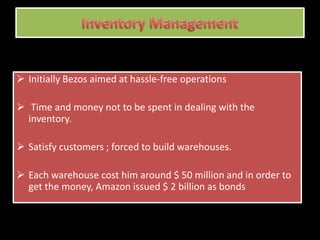
It has expanded from its existing business of selling books to selling a wide variety of products such as DVDs, music CDs, computer software, video games, electronics, apparel, furniture, food and more HISTORYJeff Bezos, in 1995, started AMAZON.com as a “virtual” retailer – no inventory, no warehouses, no overhead; just computersAmazon owed its popularity to its excellent customer service, which was due to its effective inventory management.
TYPES OF INVENTORIES Raw materials (items to be used for manufacturing)
 Work in process(semi finished items that are stored temporarily)
 Finished goods(waiting in stores for delivery)
Transit inventory (need to transport items)
Buffer inventory(uncertainties of supply and demand)
Anticipation Inventory(anticipation of a possible future event)Reasons for Huge inventories Customer’s orders in anticipation
 To protect against stock-outs
 To take advantage of quantity discounts
 To protect against inflation
To protect the uncertainties of supply and demand
Unpredictable events
Seasonal increase in demand

Inventory Management Amazon

  • 1.
    Inventory ManagementPresented by:Ashutosh Kumar Jha(91011)Deepinder Singh(91016)DivanshuKapoor (91017)Harsh Agrawal (91022)Nishant Singh(91039)SwetaAgarwal (91059)
  • 2.
    "In the physicalworld it's the old saw: location, location, location. The three most important things for us are technology, technology, technology."- Jeff Bezos, CEO, Amazon.com
  • 3.
    Amazon.com Oneof the first online shopping sites launched in 1995.
  • 4.
    Consistentlyranked as one of the best retail sites on the Internet.
  • 5.
    According toan analyst, "When you think of web shopping, you think of Amazon first."
  • 6.
    Itis an American electronic commerce company based in Seattle, Washingtonwith an additional office in Coffeyville, Kansas. It has six global websites to serve domestic customers in the US, the UK, Germany, France, Japan and Canada Features include: one-click shopping, customer review and e-mail order verification.
  • 7.
    The company isin coalition with other retailers and offer various new, and used items in categories.
  • 8.
    It has expandedfrom its existing business of selling books to selling a wide variety of products such as DVDs, music CDs, computer software, video games, electronics, apparel, furniture, food and more HISTORYJeff Bezos, in 1995, started AMAZON.com as a “virtual” retailer – no inventory, no warehouses, no overhead; just computersAmazon owed its popularity to its excellent customer service, which was due to its effective inventory management.
  • 9.
    TYPES OF INVENTORIESRaw materials (items to be used for manufacturing)
  • 10.
    Work inprocess(semi finished items that are stored temporarily)
  • 11.
    Finished goods(waitingin stores for delivery)
  • 12.
    Transit inventory (needto transport items)
  • 13.
  • 14.
    Anticipation Inventory(anticipation ofa possible future event)Reasons for Huge inventories Customer’s orders in anticipation
  • 15.
    To protectagainst stock-outs
  • 16.
    To takeadvantage of quantity discounts
  • 17.
    To protectagainst inflation
  • 18.
    To protect theuncertainties of supply and demand
  • 19.
  • 20.